
UDSL UniDSL One DSL for Universal Service 1
- Slides: 17
UDSL Uni-DSL - One DSL for Universal Service 1
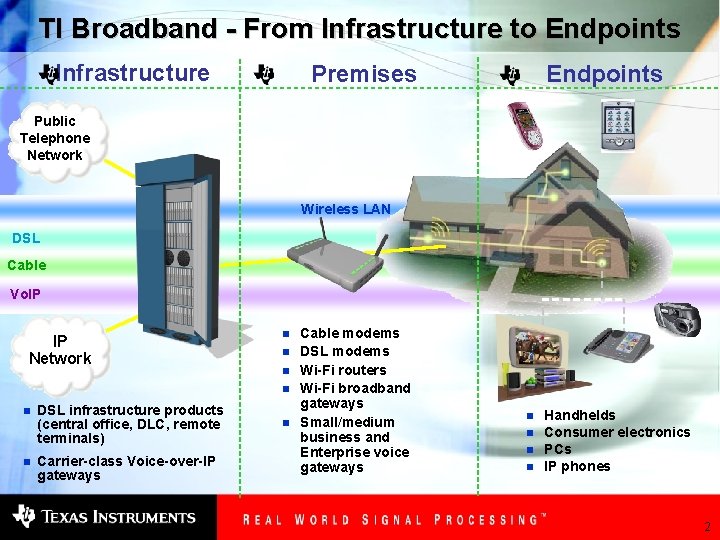
TI Broadband - From Infrastructure to Endpoints Infrastructure Premises Endpoints Public Telephone Network Wireless LAN DSL Cable Vo. IP IP Network n n n DSL infrastructure products (central office, DLC, remote terminals) Carrier-class Voice-over-IP gateways n Cable modems DSL modems Wi-Fi routers Wi-Fi broadband gateways Small/medium business and Enterprise voice gateways n n Handhelds Consumer electronics PCs IP phones 2
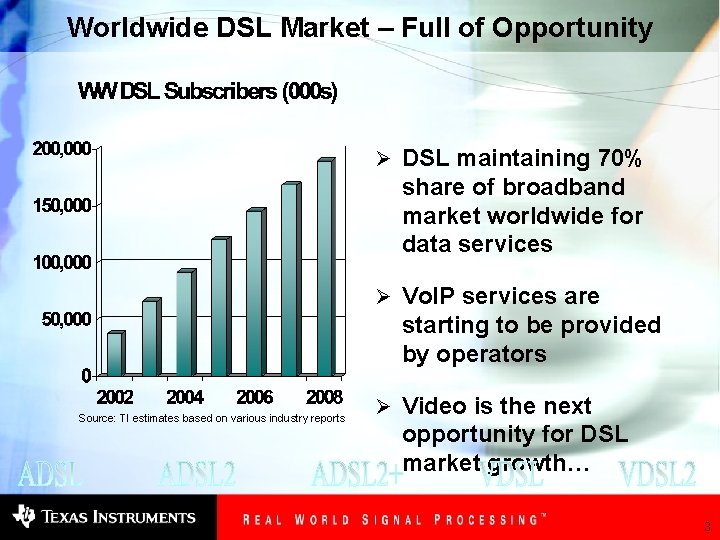
Worldwide DSL Market – Full of Opportunity Ø DSL maintaining 70% share of broadband market worldwide for data services Ø Vo. IP services are starting to be provided by operators Source: TI estimates based on various industry reports Ø Video is the next opportunity for DSL market growth… 3
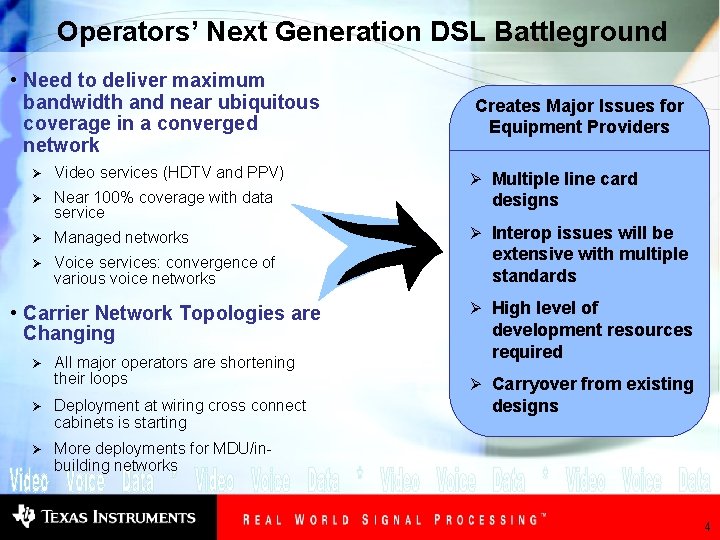
Operators’ Next Generation DSL Battleground • Need to deliver maximum bandwidth and near ubiquitous coverage in a converged network Ø Video services (HDTV and PPV) Ø Near 100% coverage with data service Ø Managed networks Ø Voice services: convergence of various voice networks • Carrier Network Topologies are Changing Ø All major operators are shortening their loops Ø Deployment at wiring cross connect cabinets is starting Ø More deployments for MDU/inbuilding networks Creates Major Issues for Equipment Providers Ø Multiple line card designs Ø Interop issues will be extensive with multiple standards Ø High level of development resources required Ø Carryover from existing designs 4
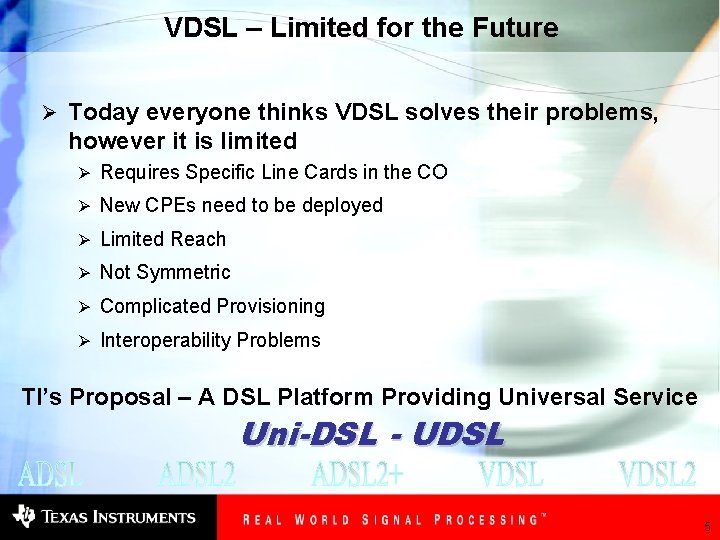
VDSL – Limited for the Future Ø Today everyone thinks VDSL solves their problems, however it is limited Ø Requires Specific Line Cards in the CO Ø New CPEs need to be deployed Ø Limited Reach Ø Not Symmetric Ø Complicated Provisioning Ø Interoperability Problems TI’s Proposal – A DSL Platform Providing Universal Service Uni-DSL - UDSL 5
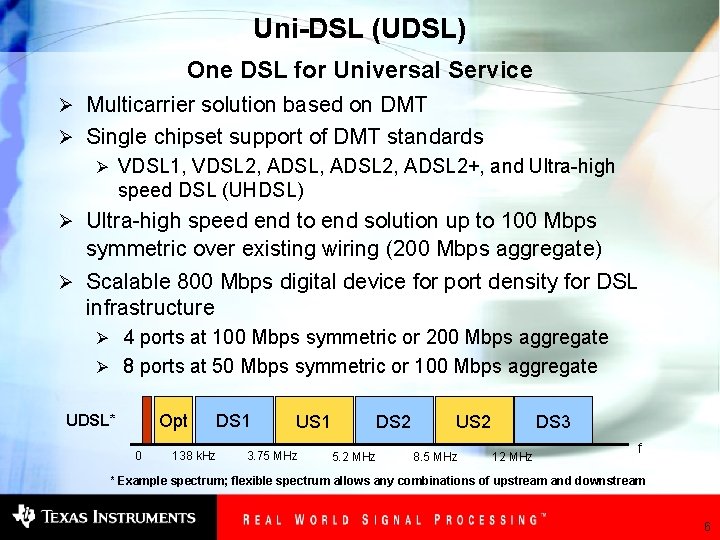
Uni-DSL (UDSL) One DSL for Universal Service Ø Multicarrier solution based on DMT Ø Single chipset support of DMT standards Ø VDSL 1, VDSL 2, ADSL 2+, and Ultra-high speed DSL (UHDSL) Ø Ultra-high speed end to end solution up to 100 Mbps symmetric over existing wiring (200 Mbps aggregate) Ø Scalable 800 Mbps digital device for port density for DSL infrastructure Ø 4 ports at 100 Mbps symmetric or 200 Mbps aggregate Ø 8 ports at 50 Mbps symmetric or 100 Mbps aggregate Opt UDSL* 0 138 k. Hz DS 1 US 1 3. 75 MHz DS 2 5. 2 MHz US 2 8. 5 MHz DS 3 12 MHz f * Example spectrum; flexible spectrum allows any combinations of upstream and downstream 6
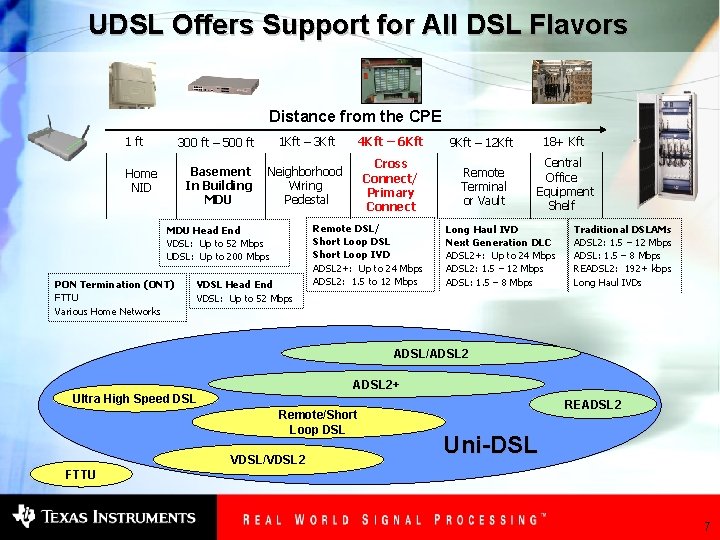
UDSL Offers Support for All DSL Flavors Distance from the CPE 1 ft Home NID 300 ft – 500 ft 1 Kft – 3 Kft 4 Kft – 6 Kft 9 Kft – 12 Kft 18+ Kft Basement In Building MDU Neighborhood Wiring Pedestal Cross Connect/ Primary Connect Remote Terminal or Vault Central Office Equipment Shelf MDU Head End VDSL: Up to 52 Mbps UDSL: Up to 200 Mbps PON Termination (ONT) FTTU Various Home Networks VDSL Head End VDSL: Up to 52 Mbps Remote DSL/ Short Loop DSL Short Loop IVD ADSL 2+: Up to 24 Mbps ADSL 2: 1. 5 to 12 Mbps Long Haul IVD Next Generation DLC ADSL 2+: Up to 24 Mbps ADSL 2: 1. 5 – 12 Mbps ADSL: 1. 5 – 8 Mbps Traditional DSLAMs ADSL 2: 1. 5 – 12 Mbps ADSL: 1. 5 – 8 Mbps READSL 2: 192+ kbps Long Haul IVDs ADSL/ADSL 2+ Ultra High Speed DSL Remote/Short Loop DSL VDSL/VDSL 2 READSL 2 Uni-DSL FTTU 7
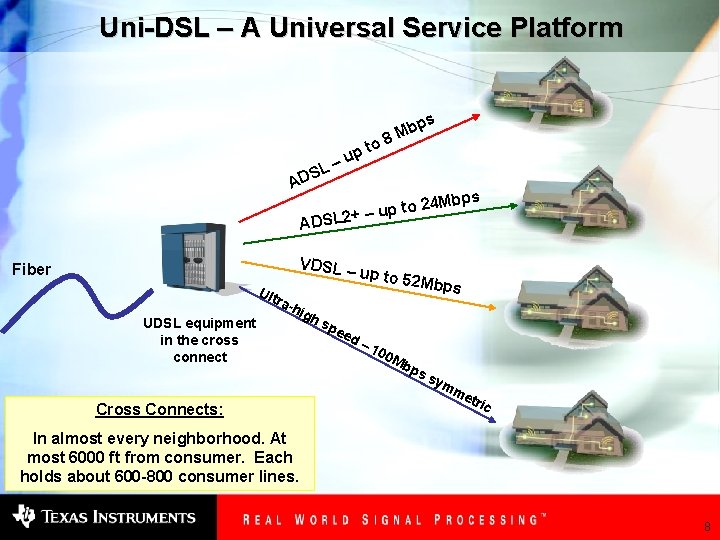
Uni-DSL – A Universal Service Platform ps SL D A p –u to b 8 M Mbps p to 24 u – + 2 ADSL VDSL – Fiber Ult rah UDSL equipment in the cross connect igh Cross Connects: up to 5 2 Mbps sp e ed – 10 0 M b ps sy m me tric In almost every neighborhood. At most 6000 ft from consumer. Each holds about 600 -800 consumer lines. 8
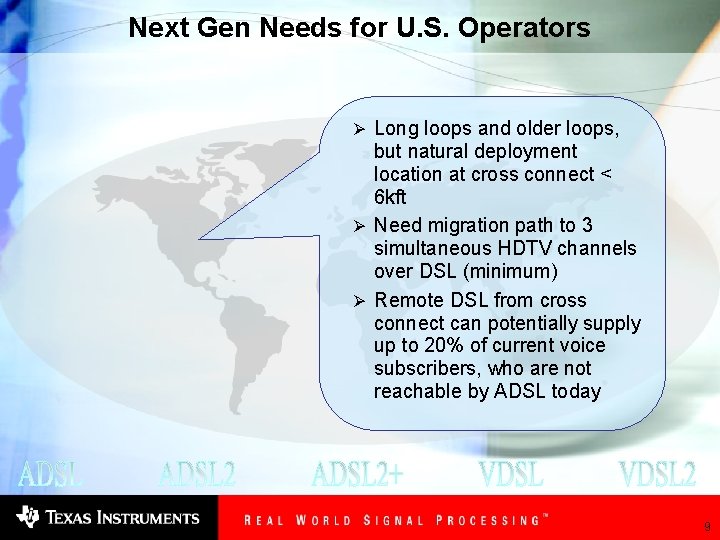
Next Gen Needs for U. S. Operators Ø Long loops and older loops, but natural deployment location at cross connect < 6 kft Ø Need migration path to 3 simultaneous HDTV channels over DSL (minimum) Ø Remote DSL from cross connect can potentially supply up to 20% of current voice subscribers, who are not reachable by ADSL today 9
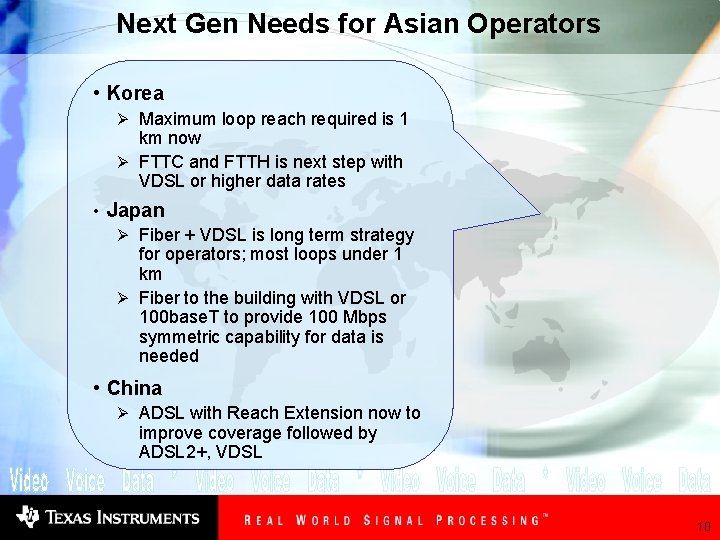
Next Gen Needs for Asian Operators • Korea Ø Maximum loop reach required is 1 km now Ø FTTC and FTTH is next step with VDSL or higher data rates • Japan Ø Fiber + VDSL is long term strategy for operators; most loops under 1 km Ø Fiber to the building with VDSL or 100 base. T to provide 100 Mbps symmetric capability for data is needed • China Ø ADSL with Reach Extension now to improve coverage followed by ADSL 2+, VDSL 10
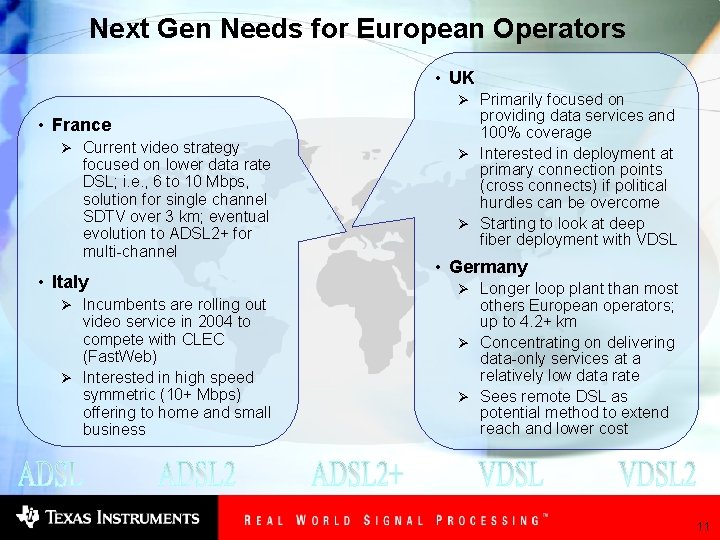
Next Gen Needs for European Operators • UK Ø Primarily focused on • France Ø Current video strategy focused on lower data rate DSL; i. e. , 6 to 10 Mbps, solution for single channel SDTV over 3 km; eventual evolution to ADSL 2+ for multi-channel • Italy Ø Incumbents are rolling out video service in 2004 to compete with CLEC (Fast. Web) Ø Interested in high speed symmetric (10+ Mbps) offering to home and small business providing data services and 100% coverage Ø Interested in deployment at primary connection points (cross connects) if political hurdles can be overcome Ø Starting to look at deep fiber deployment with VDSL • Germany Ø Longer loop plant than most others European operators; up to 4. 2+ km Ø Concentrating on delivering data-only services at a relatively low data rate Ø Sees remote DSL as potential method to extend reach and lower cost 11
TI’s Current UDSL Activities Ø Discussions with worldwide operators on concept Ø Strategic discussions with key customers Ø Potential to leverage incumbency and capture DSLAM/DLC market opportunities Ø Looking at standards activity Ø Have over 20 submissions into the standards bodies related to UDSL concepts Ø No one is at this level of leadership to drive universal services Ø Goal to make Uni-DSL an industry-wide effort to drive growth in the DSL market 12
UDSL Makes Video Over DSL Possible Ø Operators need an affordable option to support all of their network requirements and services Ø Uni-DSL (UDSL) provides support for ADSL, ADSL 2+, VDSL 2 and a 100 Mbps symmetric ultra-high speed mode Ø Operators will be able to provide all DMT-based services off of one line card or home gateway, making deployment more affordable Ø TI is taking a leadership position in making video over DSL services a reality 13
Back Up 14
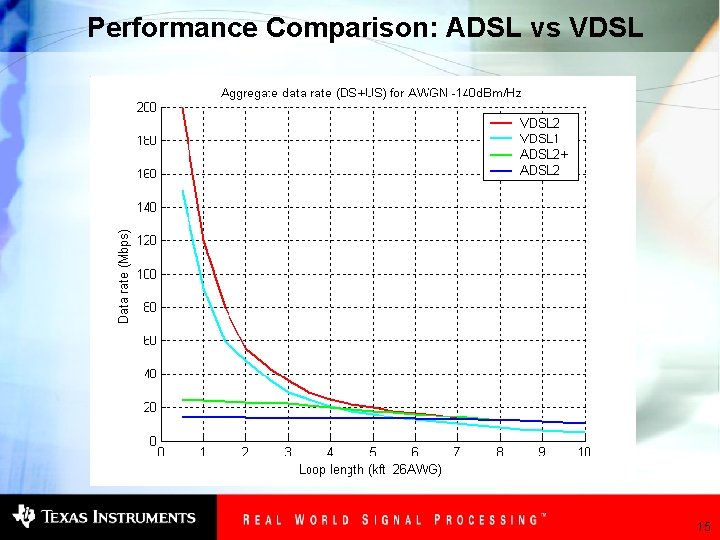
Performance Comparison: ADSL vs VDSL 15
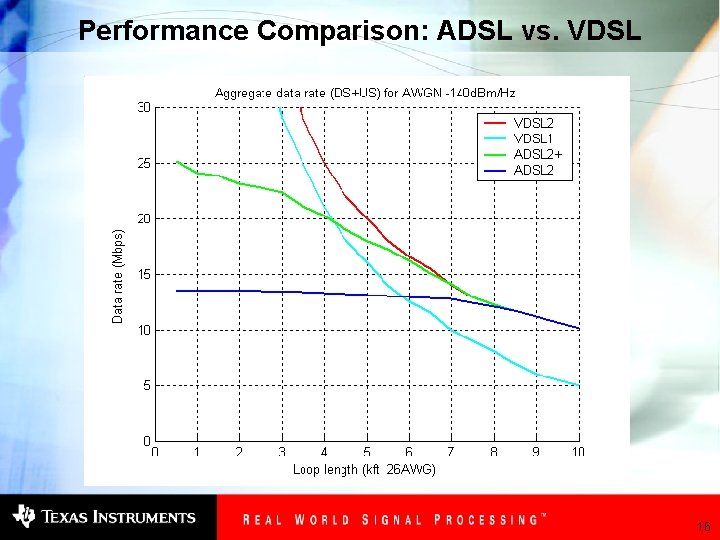
Performance Comparison: ADSL vs. VDSL 16
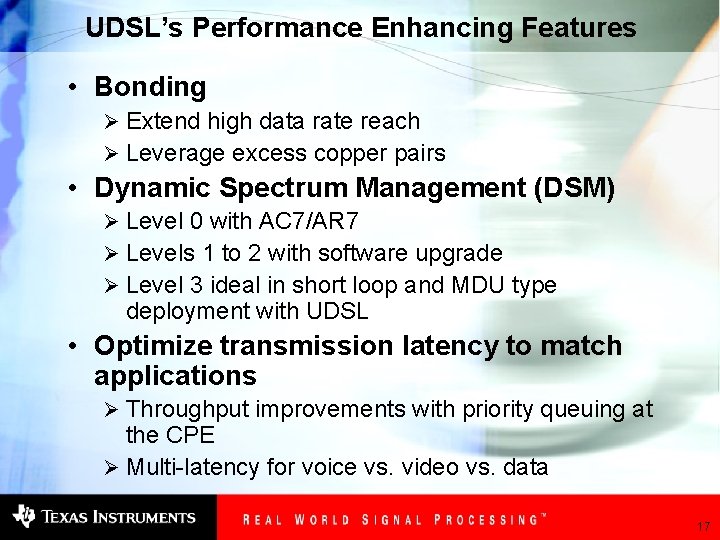
UDSL’s Performance Enhancing Features • Bonding Ø Extend high data rate reach Ø Leverage excess copper pairs • Dynamic Spectrum Management (DSM) Ø Level 0 with AC 7/AR 7 Ø Levels 1 to 2 with software upgrade Ø Level 3 ideal in short loop and MDU type deployment with UDSL • Optimize transmission latency to match applications Ø Throughput improvements with priority queuing at the CPE Ø Multi-latency for voice vs. video vs. data 17