
UDL Core Foundation Resource Learn about a UDL
UDL Core Foundation Resource Learn about a UDL Knowledge Statement: The goal promotes expert learning by encouraging challenging ways of thinking and doing. @Learning. Dsigned | learningdesigned. org © 2019 CAST | Until Learning Has No Limits
Universal Design for Learning (UDL) is a research-based framework that can be used to anticipate human variability and to reduce learning barriers in the design of any environment. The UDL Guidelines are a tool for applying UDL to practice. Knowledge Statements The UDL Knowledge Statements (KS) were developed as part of the UDL credential initiative by Learning Designed. Together with the UDL Guidelines, these KS can be used to reflect on how the design of any learning experience anticipates variability and reduces barriers. © © 2019 CAST || Until Learning Has No No Limits
First… a brief overview of the UDL Knowledge Statements. © 2019 CAST | Until Learning Has No Limits
Overview: UDL Knowledge Statements The UDL Knowledge Statements (KS) were developed as part of the UDL credential initiative by CAST and the UDLIRN. Together with the UDL Guidelines, these KS can be used to reflect on how the design of a learning experience anticipates variability and reduces barriers in any context. @Learning. Dsigned | learningdesigned. org © 2019 CAST | Until Learning Has No Limits
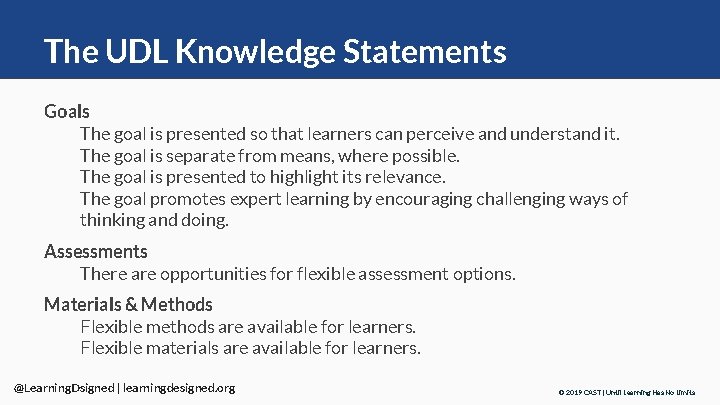
The UDL Knowledge Statements Goals The goal is presented so that learners can perceive and understand it. The goal is separate from means, where possible. The goal is presented to highlight its relevance. The goal promotes expert learning by encouraging challenging ways of thinking and doing. Assessments There are opportunities for flexible assessment options. Materials & Methods Flexible methods are available for learners. Flexible materials are available for learners. @Learning. Dsigned | learningdesigned. org © 2019 CAST | Until Learning Has No Limits
Now. . . a focus in on one of the UDL Knowledge Statements. © 2019 CAST | Until Learning Has No Limits

Goals: UDL Knowledge Statement Goals The goal is presented so that learners can perceive and understand it. The goal is separate from means, where possible. The goal is presented to highlight its relevance. The goal promotes expert learning by encouraging challenging ways of thinking and doing. Assessments There are opportunities for flexible assessment options. Materials & Methods Flexible methods are available for learners. Flexible materials are available for learners. @Learning. Dsigned | learningdesigned. org © 2019 CAST | Until Learning Has No Limits
What does “expert learning” really mean? What are “challenging ways of thinking and doing”? © 2019 CAST | Until Learning Has No Limits
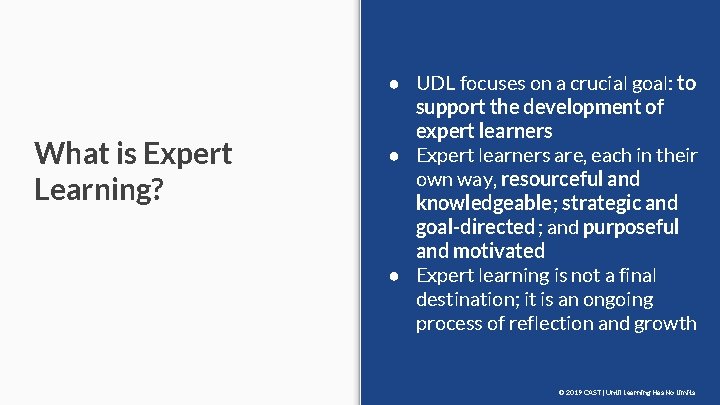
What is Expert Learning? ● UDL focuses on a crucial goal: to support the development of expert learners ● Expert learners are, each in their own way, resourceful and knowledgeable; strategic and goal-directed ; and purposeful and motivated ● Expert learning is not a final destination; it is an ongoing process of reflection and growth © 2019 CAST | Until Learning Has No Limits
When learners are engaged in challenging ways of thinking and doing. . . What are challenging ways of thinking and doing? ● They move beyond basic comprehension & rote memorization ● They develop expert learner practices, habits, & commitments of specific disciplines. They grow as expert mathematicians, expert writers, expert artists, etc. ● They examine, interrogate, and challenge existing norms and structures ● And more! What are your examples? © 2019 CAST | Until Learning Has No Limits
How can I design goals that promote expert learning by encouraging challenging ways of thinking and doing? © 2019 CAST | Until Learning Has No Limits
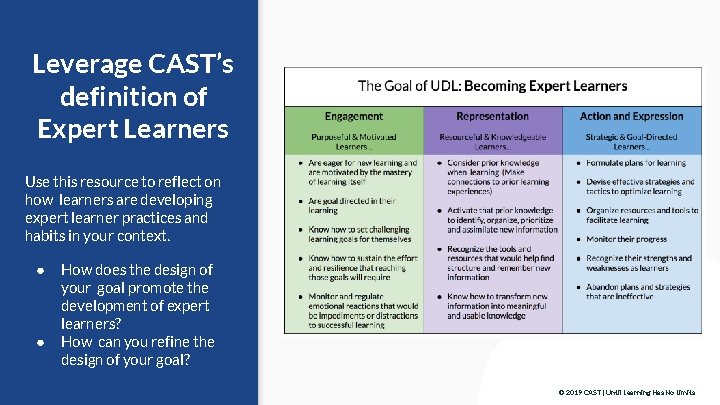
Leverage CAST’s definition of Expert Learners Use this resource to reflect on how learners are developing expert learner practices and habits in your context. ● ● How does the design of your goal promote the development of expert learners? How can you refine the design of your goal? © 2019 CAST | Until Learning Has No Limits
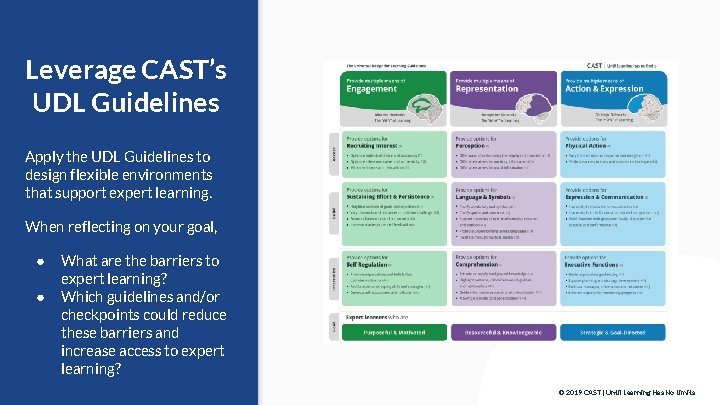
Leverage CAST’s UDL Guidelines Apply the UDL Guidelines to design flexible environments that support expert learning. When reflecting on your goal, ● ● What are the barriers to expert learning? Which guidelines and/or checkpoints could reduce these barriers and increase access to expert learning? © 2019 CAST | Until Learning Has No Limits
References CAST (2018). Universal Design for Learning Guidelines version 2. 2. Retrieved from http: //udlguidelines. cast. org Meyer, A. , Rose, D. H. , & Gordon, D. T. (2014). Universal design for learning: Theory and practice. CAST Professional Publishing. @Learning. Dsigned | learningdesigned. org © 2019 CAST | Until Learning Has No Limits
- Slides: 14