
UCSD to NIH Sara Kimmich Embodied Cognition in

UCSD to NIH Sara Kimmich
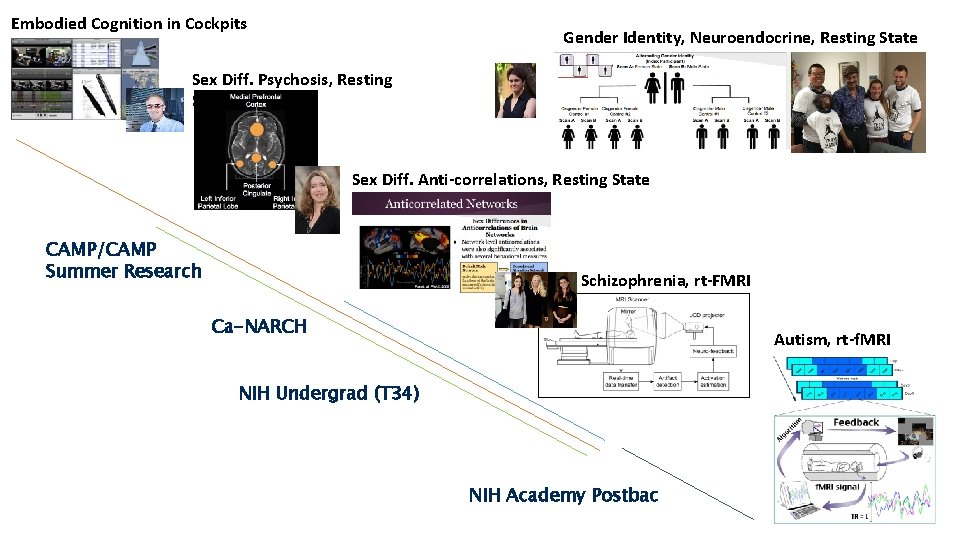
Embodied Cognition in Cockpits Gender Identity, Neuroendocrine, Resting State Sex Diff. Psychosis, Resting State Sex Diff. Anti-correlations, Resting State CAMP/CAMP Summer Research Schizophrenia, rt-FMRI Ca-NARCH Autism, rt-f. MRI NIH Undergrad (T 34) NIH Academy Postbac
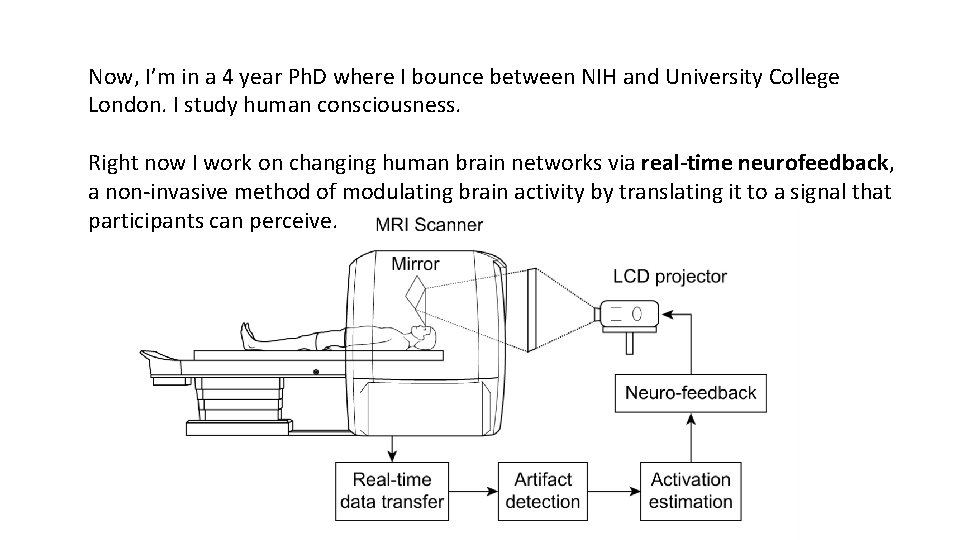
Now, I’m in a 4 year Ph. D where I bounce between NIH and University College London. I study human consciousness. Right now I work on changing human brain networks via real-time neurofeedback, a non-invasive method of modulating brain activity by translating it to a signal that participants can perceive.
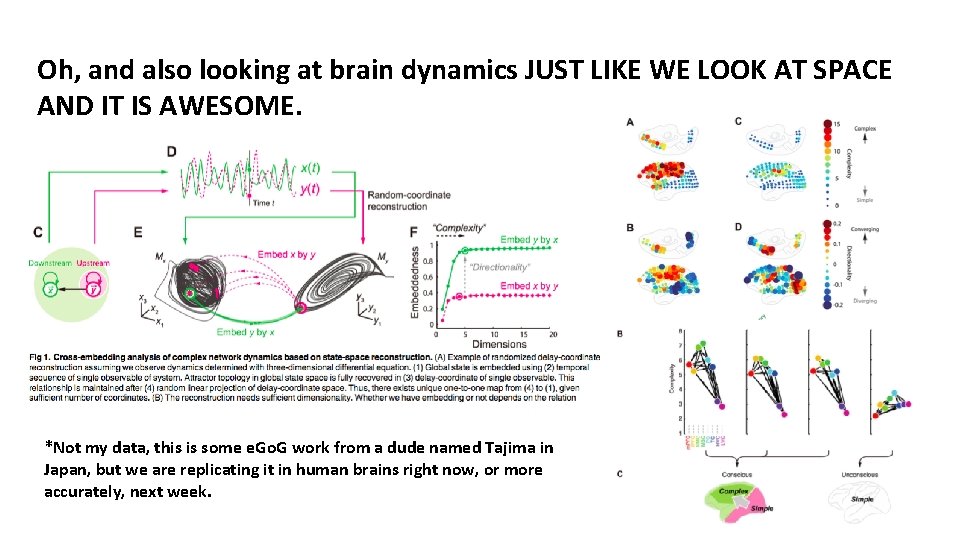
Oh, and also looking at brain dynamics JUST LIKE WE LOOK AT SPACE AND IT IS AWESOME. *Not my data, this is some e. Go. G work from a dude named Tajima in Japan, but we are replicating it in human brains right now, or more accurately, next week.
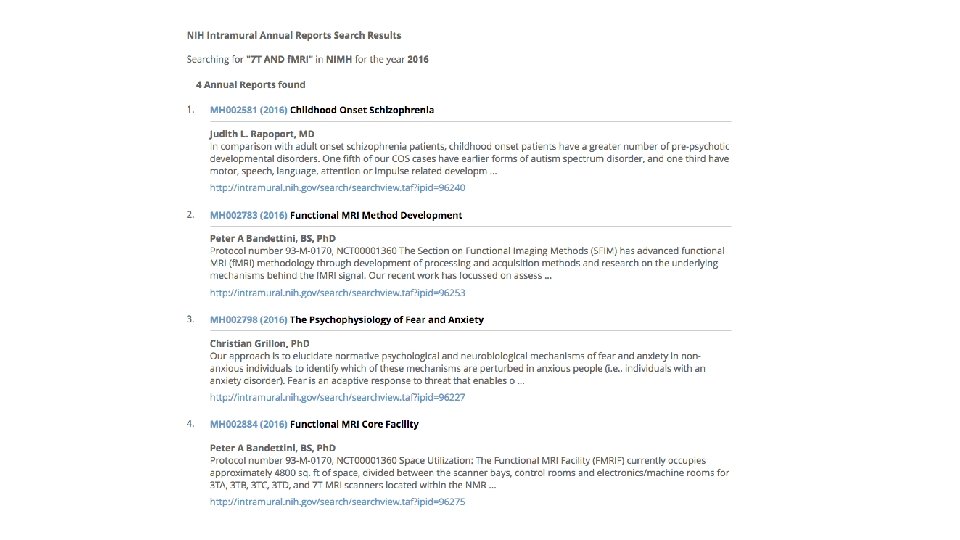
• When to apply to paid research programs and how to tailor your application to land your top choice • Why work at NIH? Research at institutes vs research in academia • What paid research opportunities are available at every level of education, from college freshmen to graduating seniors • How to search government grant data bases to find the right research fit for your interests
• What really matters: personality, interest and options • Where you go from here: NIH, academia, industry • The skills you need: Starting your career as an undergrad sarakimmich. weebly. com/apply-to-nih or http: //tinyurl. com/joraxgr
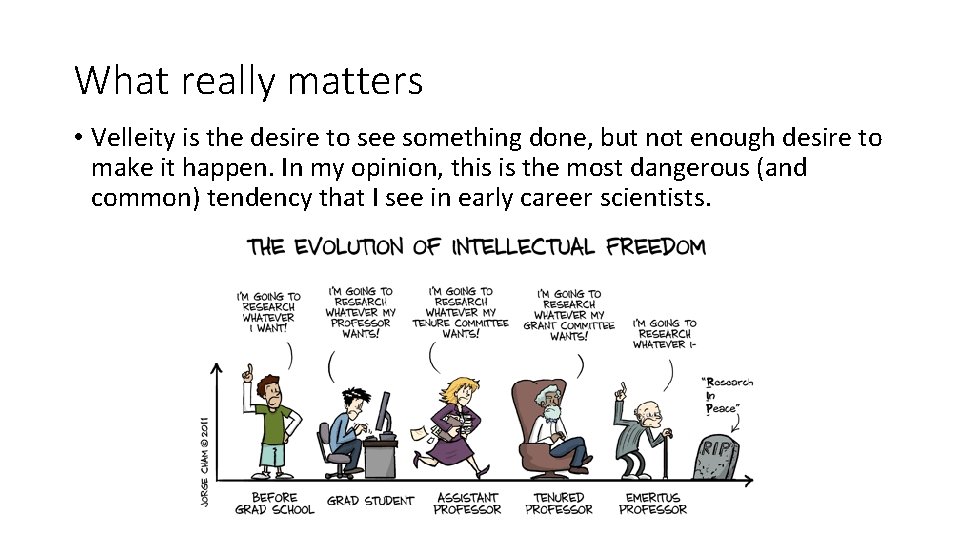
What really matters • Velleity is the desire to see something done, but not enough desire to make it happen. In my opinion, this is the most dangerous (and common) tendency that I see in early career scientists.
Let’s get this straight: • Medical facts have a half-life of 5 years (in my field it’s 2). It’s hard work to keep up. • STEM jobs are in international demand, so even for US positions you are competing with the best from Asia and UK and EU • Gender and race politics definitely, definitely exist. Learn to navigate those now. Medical research is also exciting, global, optimistic and fundamentally humanist.
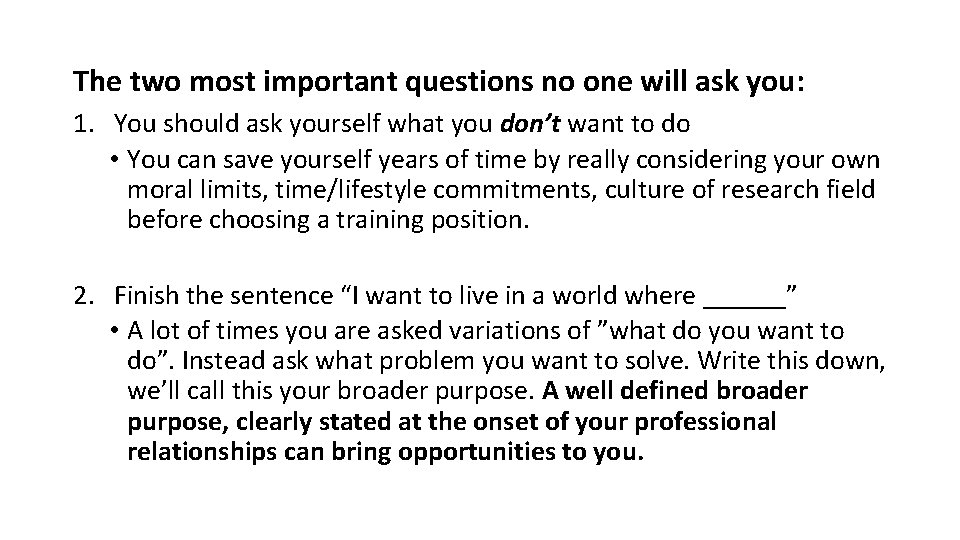
The two most important questions no one will ask you: 1. You should ask yourself what you don’t want to do • You can save yourself years of time by really considering your own moral limits, time/lifestyle commitments, culture of research field before choosing a training position. 2. Finish the sentence “I want to live in a world where ______” • A lot of times you are asked variations of ”what do you want to do”. Instead ask what problem you want to solve. Write this down, we’ll call this your broader purpose. A well defined broader purpose, clearly stated at the onset of your professional relationships can bring opportunities to you.
• When to apply to paid research programs and how to tailor your application to land your top choice • Why work at NIH? Research at institutes vs research in academia • What paid research opportunities are available at every level of education, from college freshmen to graduating seniors • How to search government grant data bases to find the right research fit for your interests
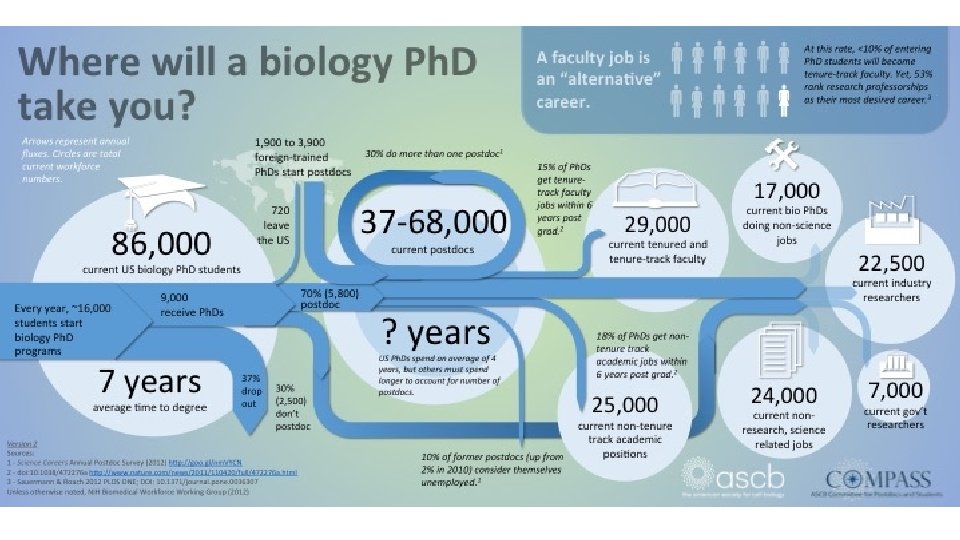
What really matters
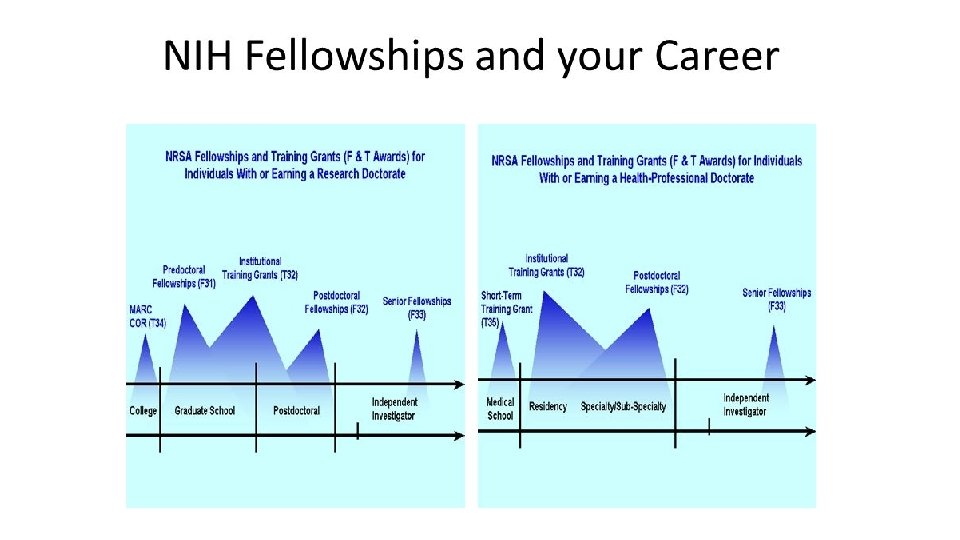
• When to apply to paid research programs and how to tailor your application to land your top choice • Why work at NIH? Research at institutes vs research in academia • What paid research opportunities are available at every level of education, from college freshmen to graduating seniors • How to search government grant data bases to find the right research fit for your interests
Paid Opportunities • Summer Research Programs • Post baccalaureate Training Awards • Graduate Programs
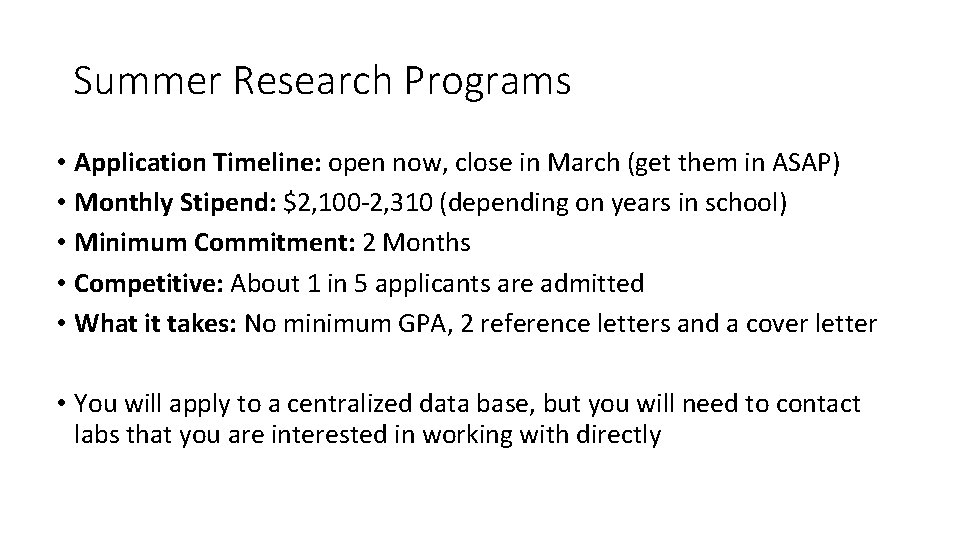
Summer Research Programs • Application Timeline: open now, close in March (get them in ASAP) • Monthly Stipend: $2, 100 -2, 310 (depending on years in school) • Minimum Commitment: 2 Months • Competitive: About 1 in 5 applicants are admitted • What it takes: No minimum GPA, 2 reference letters and a cover letter • You will apply to a centralized data base, but you will need to contact labs that you are interested in working with directly
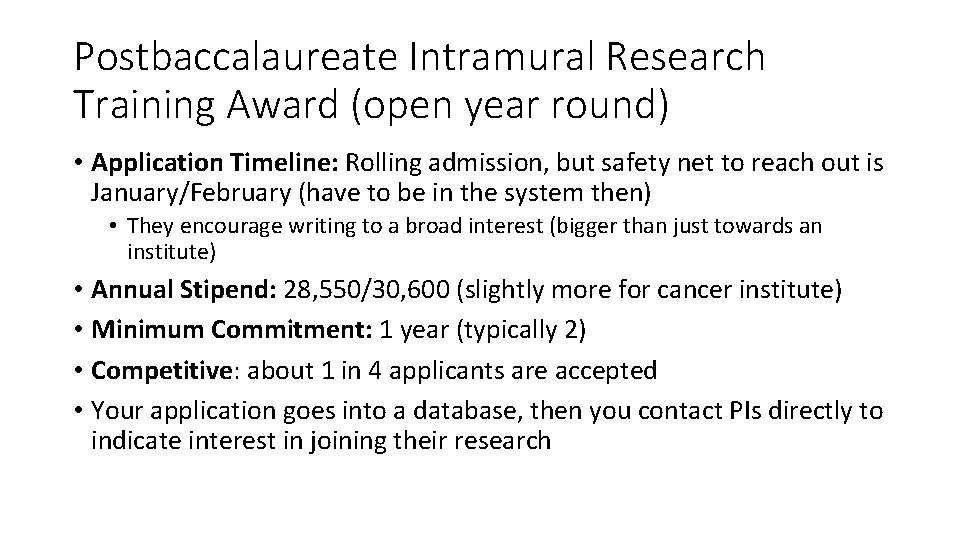
Postbaccalaureate Intramural Research Training Award (open year round) • Application Timeline: Rolling admission, but safety net to reach out is January/February (have to be in the system then) • They encourage writing to a broad interest (bigger than just towards an institute) • Annual Stipend: 28, 550/30, 600 (slightly more for cancer institute) • Minimum Commitment: 1 year (typically 2) • Competitive: about 1 in 4 applicants are accepted • Your application goes into a database, then you contact PIs directly to indicate interest in joining their research
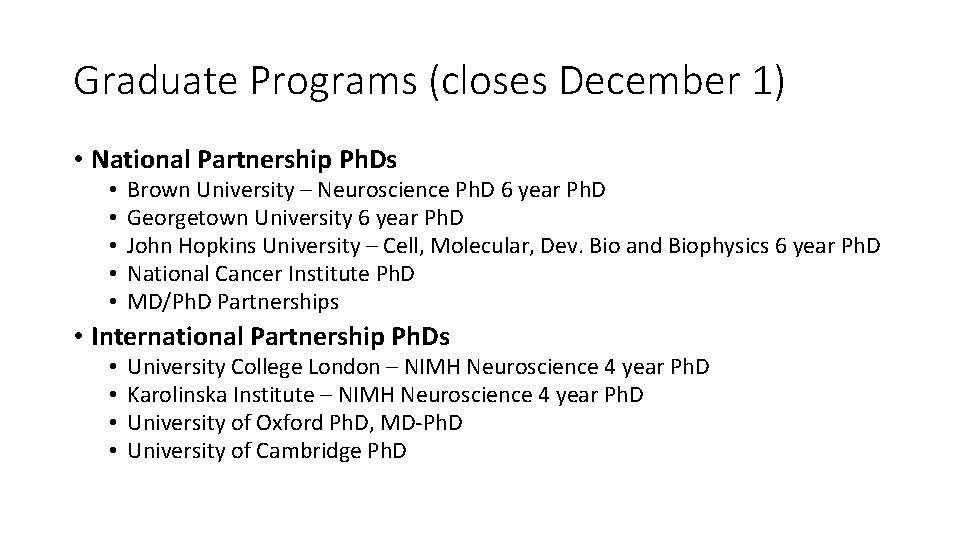
Graduate Programs (closes December 1) • National Partnership Ph. Ds • • • Brown University – Neuroscience Ph. D 6 year Ph. D Georgetown University 6 year Ph. D John Hopkins University – Cell, Molecular, Dev. Bio and Biophysics 6 year Ph. D National Cancer Institute Ph. D MD/Ph. D Partnerships • International Partnership Ph. Ds • • University College London – NIMH Neuroscience 4 year Ph. D Karolinska Institute – NIMH Neuroscience 4 year Ph. D University of Oxford Ph. D, MD-Ph. D University of Cambridge Ph. D
• When to apply to paid research programs and how to tailor your application to land your top choice • Why work at NIH? Research at institutes vs research in academia • What paid research opportunities are available at every level of education, from college freshmen to graduating seniors • How to search government grant data bases to find the right research fit for your interests
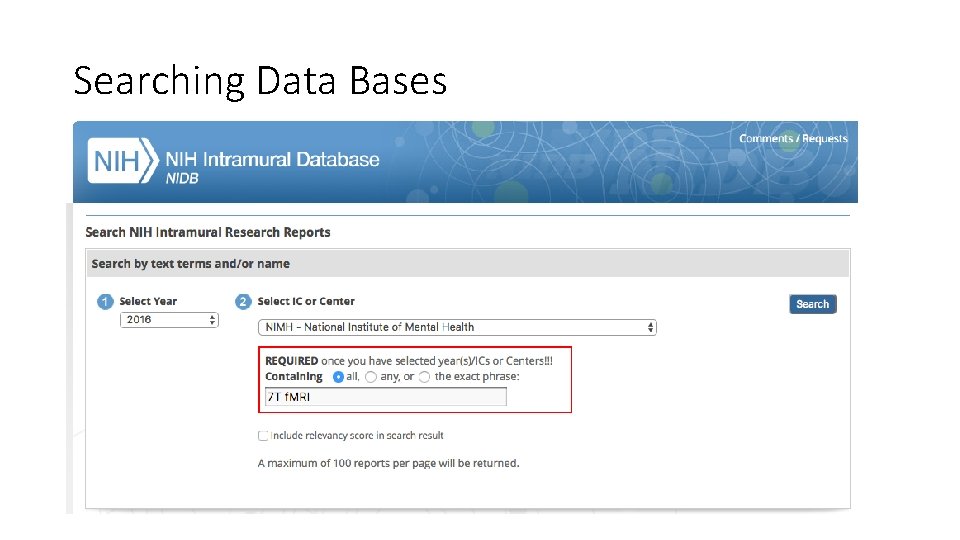
Searching Data Bases • http: //intramural. nih. gov/search/index. taf
Thing you’re not qualified? • It’s not that hard to be an expert in a field. With a good cup of coffee you can read everything published in the last 6 months on a topic in about 2 -3 hours. Make a map of how the people are connected • What’s important is how you read them: learn to see the narrative in the data • When you reach out to potential mentors, having this baseline puts you miles ahead. • GO TO CONFERENCES. Volunteer, make your own opportunities
Useful Tips • Make a Map of Potential Mentors • Get Good References from existing mentors • Doing Original Research (first author as an undergrad)
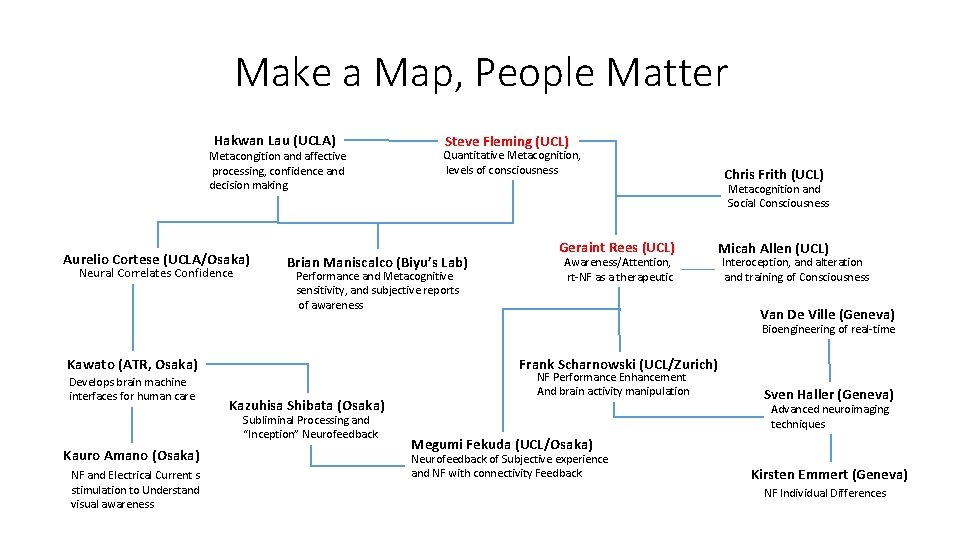
Make a Map, People Matter Hakwan Lau (UCLA) Metacongition and affective processing, confidence and decision making Aurelio Cortese (UCLA/Osaka) Neural Correlates Confidence Steve Fleming (UCL) Quantitative Metacognition, levels of consciousness Chris Frith (UCL) Metacognition and Social Consciousness Brian Maniscalco (Biyu’s Lab) Performance and Metacognitive sensitivity, and subjective reports of awareness Geraint Rees (UCL) Awareness/Attention, rt-NF as a therapeutic Micah Allen (UCL) Interoception, and alteration and training of Consciousness Van De Ville (Geneva) Bioengineering of real-time Kawato (ATR, Osaka) Develops brain machine interfaces for human care Frank Scharnowski (UCL/Zurich) Kazuhisa Shibata (Osaka) Subliminal Processing and “Inception” Neurofeedback Kauro Amano (Osaka) NF and Electrical Current s stimulation to Understand visual awareness NF Performance Enhancement And brain activity manipulation Sven Haller (Geneva) Advanced neuroimaging techniques Megumi Fekuda (UCL/Osaka) Neurofeedback of Subjective experience and NF with connectivity Feedback Kirsten Emmert (Geneva) NF Individual Differences
Getting Good References: • Tell them what the program is about, in a visual way. Give them a paragraph describing what it would look like for you to work there. • Tell them the explicit skills you would need for that job, and also what skills you hope to learn. This is the crucial step • There are grants and awards that are readily available at the UCSD campus (and beyond) to get you a living wage to learn these skills
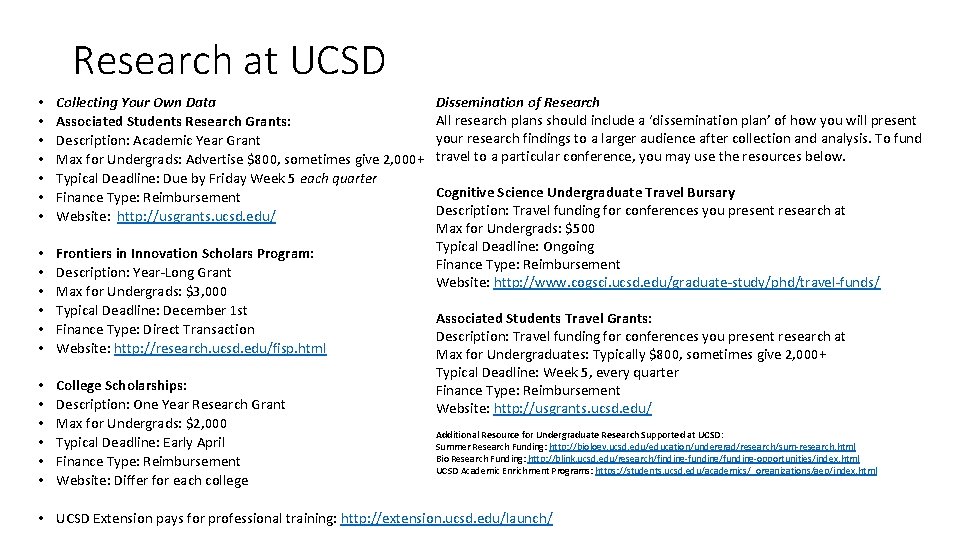
Research at UCSD • • Collecting Your Own Data Associated Students Research Grants: Description: Academic Year Grant Max for Undergrads: Advertise $800, sometimes give 2, 000+ Typical Deadline: Due by Friday Week 5 each quarter Finance Type: Reimbursement Website: http: //usgrants. ucsd. edu/ • • • Frontiers in Innovation Scholars Program: Description: Year-Long Grant Max for Undergrads: $3, 000 Typical Deadline: December 1 st Finance Type: Direct Transaction Website: http: //research. ucsd. edu/fisp. html • • • College Scholarships: Description: One Year Research Grant Max for Undergrads: $2, 000 Typical Deadline: Early April Finance Type: Reimbursement Website: Differ for each college Dissemination of Research All research plans should include a ‘dissemination plan’ of how you will present your research findings to a larger audience after collection and analysis. To fund travel to a particular conference, you may use the resources below. Cognitive Science Undergraduate Travel Bursary Description: Travel funding for conferences you present research at Max for Undergrads: $500 Typical Deadline: Ongoing Finance Type: Reimbursement Website: http: //www. cogsci. ucsd. edu/graduate-study/phd/travel-funds/ Associated Students Travel Grants: Description: Travel funding for conferences you present research at Max for Undergraduates: Typically $800, sometimes give 2, 000+ Typical Deadline: Week 5, every quarter Finance Type: Reimbursement Website: http: //usgrants. ucsd. edu/ Additional Resource for Undergraduate Research Supported at UCSD: Summer Research Funding: http: //biology. ucsd. edu/education/undergrad/research/sum-research. html Bio Research Funding: http: //blink. ucsd. edu/research/finding-funding/funding-opportunities/index. html UCSD Academic Enrichment Programs: https: //students. ucsd. edu/academics/_organizations/aep/index. html • UCSD Extension pays for professional training: http: //extension. ucsd. edu/launch/
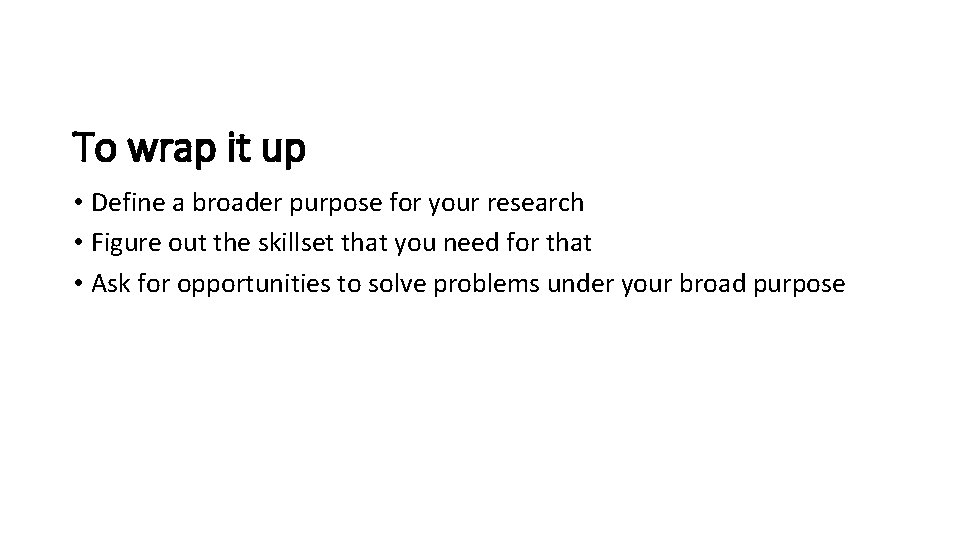
To wrap it up • Define a broader purpose for your research • Figure out the skillset that you need for that • Ask for opportunities to solve problems under your broad purpose
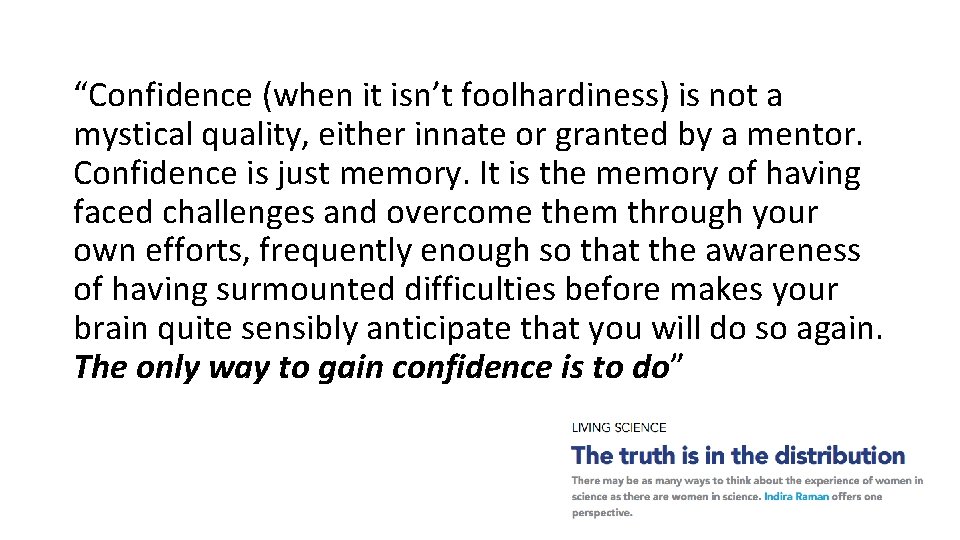
“Confidence (when it isn’t foolhardiness) is not a mystical quality, either innate or granted by a mentor. Confidence is just memory. It is the memory of having faced challenges and overcome them through your own efforts, frequently enough so that the awareness of having surmounted difficulties before makes your brain quite sensibly anticipate that you will do so again. The only way to gain confidence is to do”
- Slides: 28