
UCSD Physics 8 2006 Radio Waves Electromagnetic Radiation
- Slides: 20
UCSD: Physics 8; 2006 Radio Waves Electromagnetic Radiation Radio Transmission and Reception Modulation Techniques Spring 2006
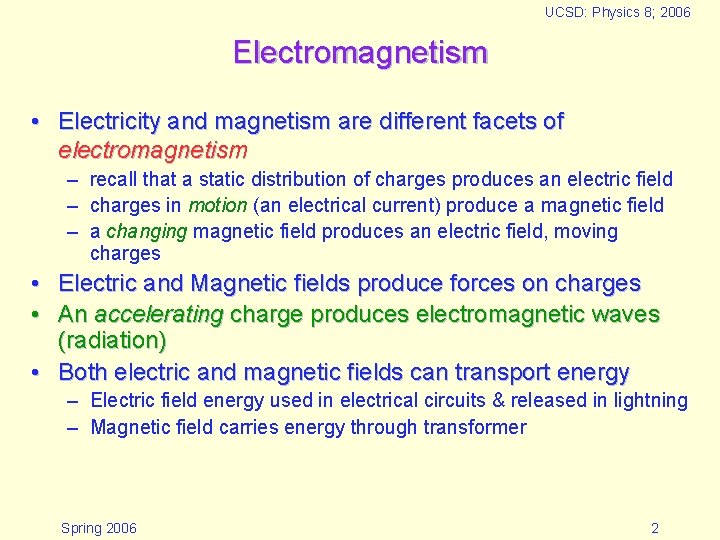
UCSD: Physics 8; 2006 Electromagnetism • Electricity and magnetism are different facets of electromagnetism – recall that a static distribution of charges produces an electric field – charges in motion (an electrical current) produce a magnetic field – a changing magnetic field produces an electric field, moving charges • Electric and Magnetic fields produce forces on charges • An accelerating charge produces electromagnetic waves (radiation) • Both electric and magnetic fields can transport energy – Electric field energy used in electrical circuits & released in lightning – Magnetic field carries energy through transformer Spring 2006 2
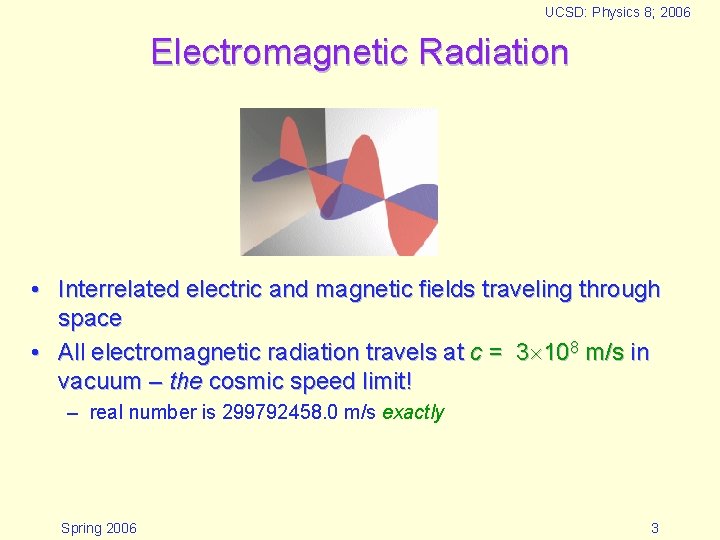
UCSD: Physics 8; 2006 Electromagnetic Radiation • Interrelated electric and magnetic fields traveling through space • All electromagnetic radiation travels at c = 3 108 m/s in vacuum – the cosmic speed limit! – real number is 299792458. 0 m/s exactly Spring 2006 3
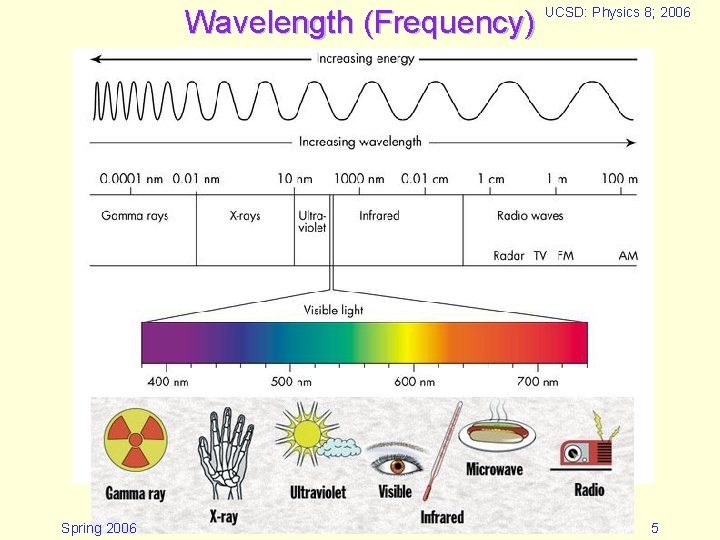
UCSD: Physics 8; 2006 Examples of Electromagnetic Radiation • • AM and FM radio waves (including TV signals) Cell phone communication links Microwaves Infrared radiation Light X-rays Gamma rays What distinguishes these from one another? Spring 2006 4
Wavelength (Frequency) Spring 2006 UCSD: Physics 8; 2006 5
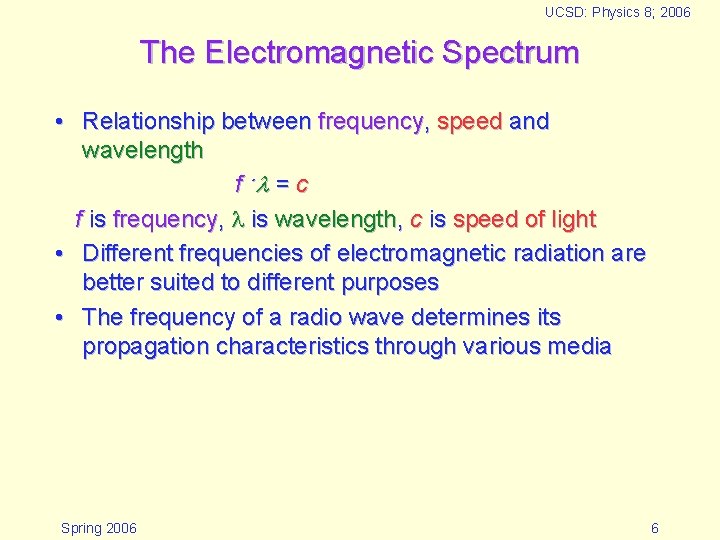
UCSD: Physics 8; 2006 The Electromagnetic Spectrum • Relationship between frequency, speed and wavelength f ·l = c f is frequency, is wavelength, c is speed of light • Different frequencies of electromagnetic radiation are better suited to different purposes • The frequency of a radio wave determines its propagation characteristics through various media Spring 2006 6
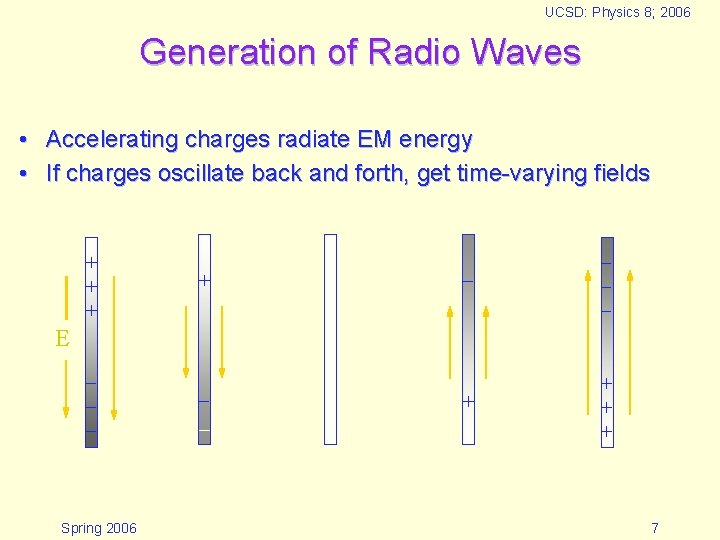
UCSD: Physics 8; 2006 Generation of Radio Waves • Accelerating charges radiate EM energy • If charges oscillate back and forth, get time-varying fields + + - - + + E - Spring 2006 - 7
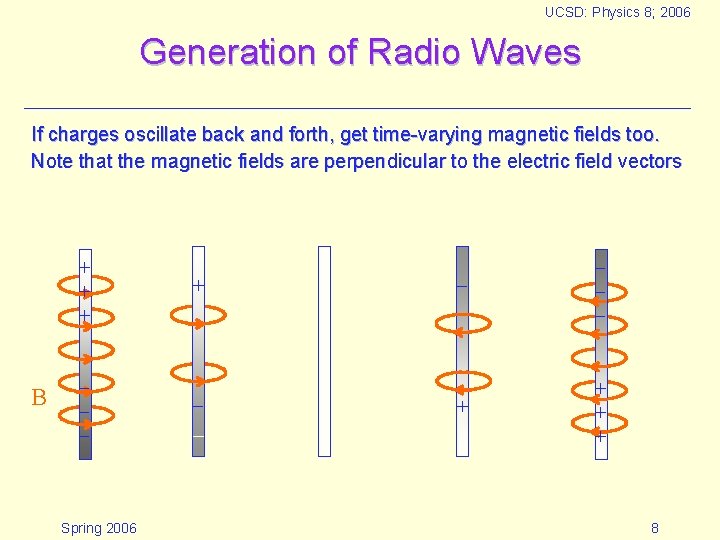
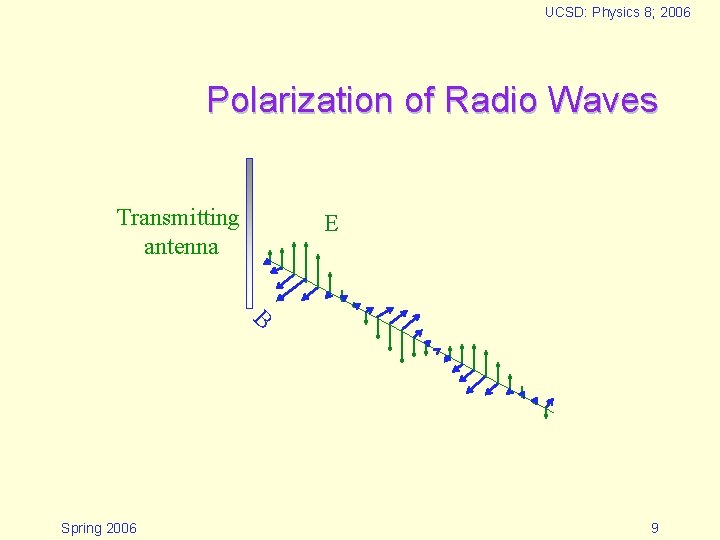
UCSD: Physics 8; 2006 Generation of Radio Waves If charges oscillate back and forth, get time-varying magnetic fields too. Note that the magnetic fields are perpendicular to the electric field vectors + + + B - Spring 2006 + - - - + + 8
UCSD: Physics 8; 2006 Polarization of Radio Waves Transmitting antenna E B Spring 2006 9
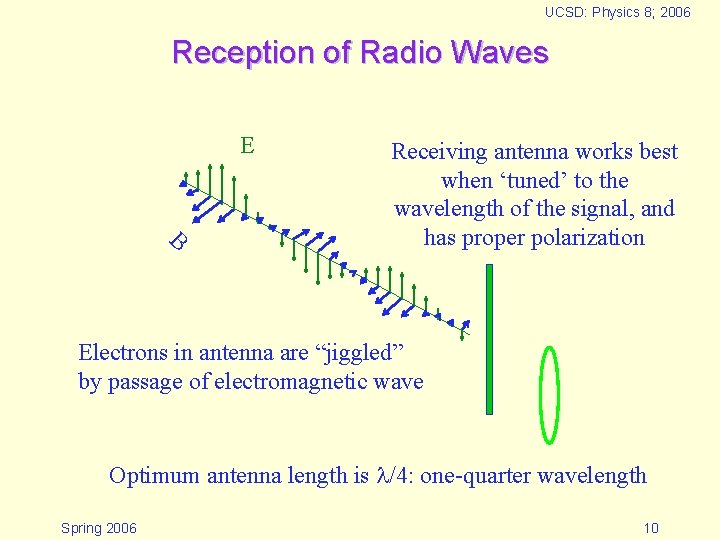
UCSD: Physics 8; 2006 Reception of Radio Waves E B Receiving antenna works best when ‘tuned’ to the wavelength of the signal, and has proper polarization Electrons in antenna are “jiggled” by passage of electromagnetic wave Optimum antenna length is /4: one-quarter wavelength Spring 2006 10
UCSD: Physics 8; 2006 Encoding Information on Radio Waves • What quantities characterize a radio wave? • Two common ways to carry analog information with radio waves – Amplitude Modulation (AM) – Frequency Modulation (FM): “static free” Spring 2006 11
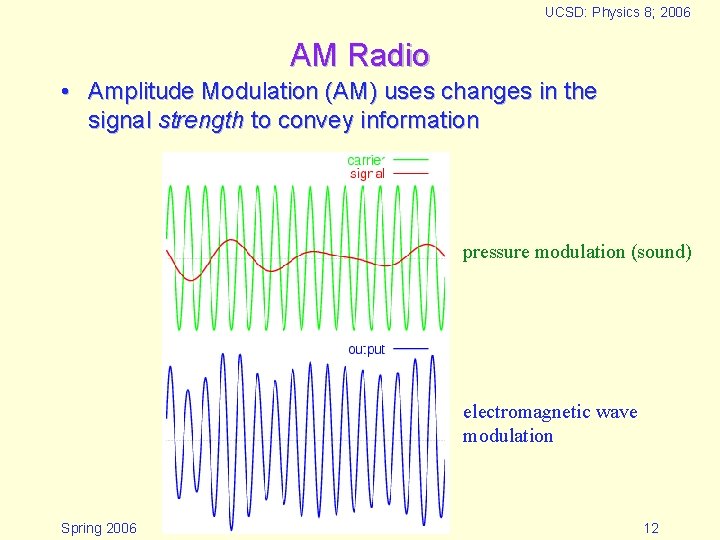
UCSD: Physics 8; 2006 AM Radio • Amplitude Modulation (AM) uses changes in the signal strength to convey information pressure modulation (sound) electromagnetic wave modulation Spring 2006 12
UCSD: Physics 8; 2006 AM Radio in Practice • Uses frequency range from 530 k. Hz to 1700 k. Hz – each station uses 9 k. Hz – spacing is 10 k. Hz (a little breathing room) 117 channels – 9 k. Hz of bandwidth means 4. 5 k. Hz is highest audio frequency that can be encoded • falls short of 20 k. Hz capability of human ear • Previous diagram is exaggerated: – audio signal changes slowly with respect to radio carrier • typical speech sound of 500 Hz varies 1000 times slower than carrier • thus will see 1000 cycles of carrier to every one cycle of audio Spring 2006 13
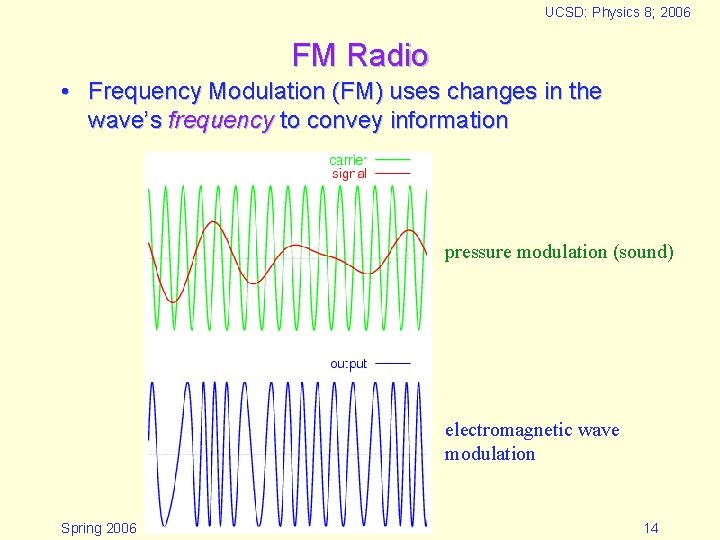
UCSD: Physics 8; 2006 FM Radio • Frequency Modulation (FM) uses changes in the wave’s frequency to convey information pressure modulation (sound) electromagnetic wave modulation Spring 2006 14
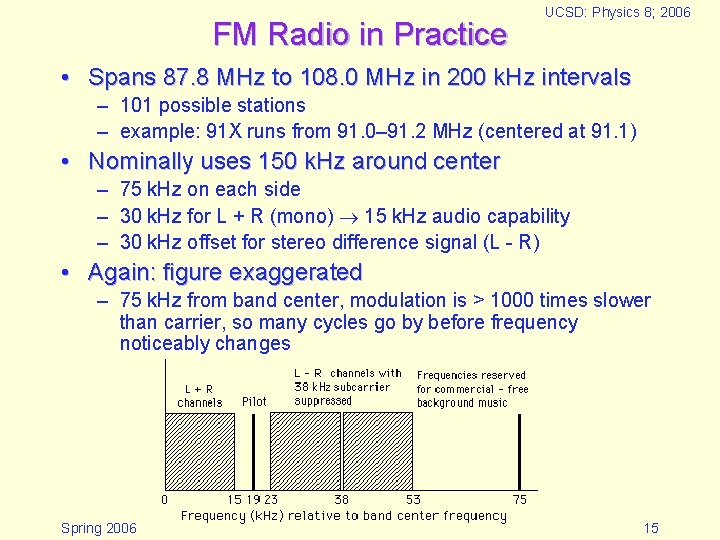
FM Radio in Practice UCSD: Physics 8; 2006 • Spans 87. 8 MHz to 108. 0 MHz in 200 k. Hz intervals – 101 possible stations – example: 91 X runs from 91. 0– 91. 2 MHz (centered at 91. 1) • Nominally uses 150 k. Hz around center – 75 k. Hz on each side – 30 k. Hz for L + R (mono) 15 k. Hz audio capability – 30 k. Hz offset for stereo difference signal (L - R) • Again: figure exaggerated – 75 k. Hz from band center, modulation is > 1000 times slower than carrier, so many cycles go by before frequency noticeably changes Spring 2006 15
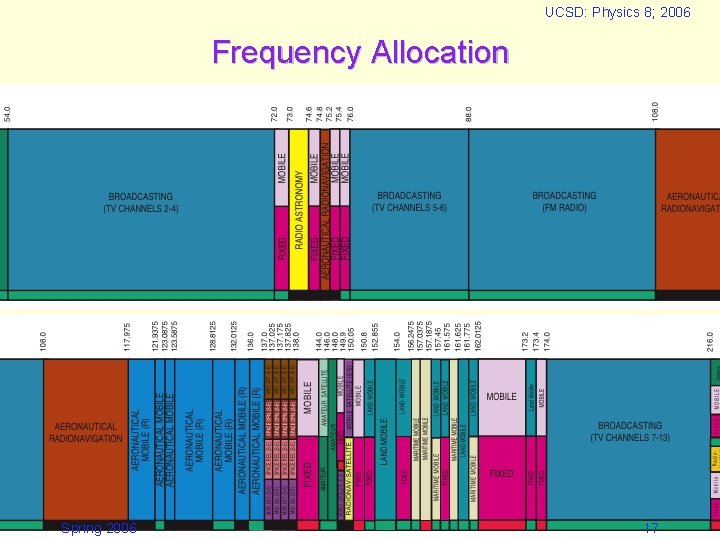
UCSD: Physics 8; 2006 AM vs. FM • FM is not inherently higher frequency than AM – these are just choices – aviation band is 108– 136 MHz uses AM technique • Besides the greater bandwidth (leading to stereo and higher audio frequencies), FM is superior in immunity to environmental influences – there are lots of ways to mess with an EM-wave’s amplitude • pass under a bridge • re-orient the antenna – no natural processes mess with the frequency • FM still works in the face of amplitude foolery Spring 2006 16
UCSD: Physics 8; 2006 Frequency Allocation Spring 2006 17
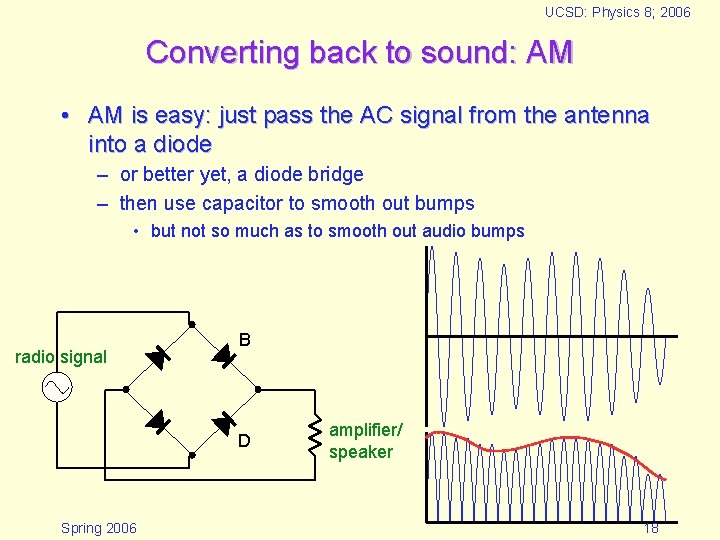
UCSD: Physics 8; 2006 Converting back to sound: AM • AM is easy: just pass the AC signal from the antenna into a diode – or better yet, a diode bridge – then use capacitor to smooth out bumps • but not so much as to smooth out audio bumps radio signal B D Spring 2006 amplifier/ speaker 18
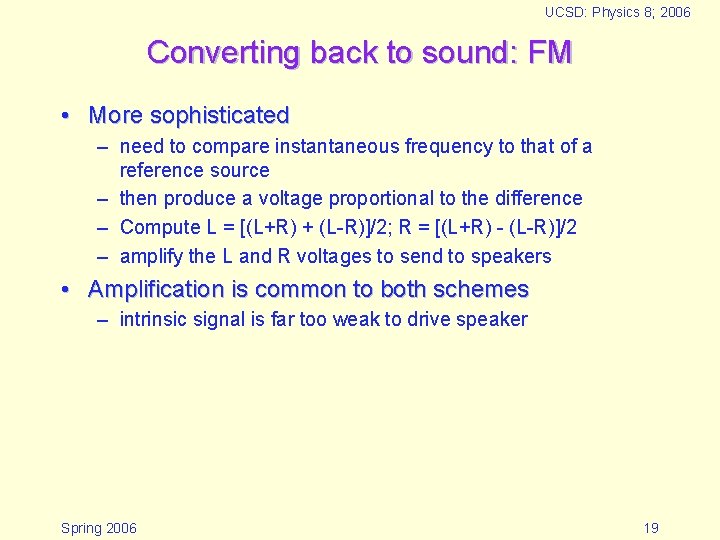
UCSD: Physics 8; 2006 Converting back to sound: FM • More sophisticated – need to compare instantaneous frequency to that of a reference source – then produce a voltage proportional to the difference – Compute L = [(L+R) + (L-R)]/2; R = [(L+R) - (L-R)]/2 – amplify the L and R voltages to send to speakers • Amplification is common to both schemes – intrinsic signal is far too weak to drive speaker Spring 2006 19
UCSD: Physics 8; 2006 Assignments • HW 5: 12. E. 24, 13. E. 13, 13. E. 15, 13. E. 16, 13. P. 7, 13. P. 9, 13. P. 11, plus additional required problems available on website Spring 2006 20