
UCLA DIS 280 Social Science Research Methodology Logical
- Slides: 33
UCLA DIS 280 Social Science Research Methodology: Logical Frameworks or Theoretical Structures Dr. John V. Richardson, Professor UCLA GSE&IS DIS
Topic 3 --Structures l Some Definitions and Situations – Articulated, Formalized Structures – Logical Frameworks vs. Theoretical Structures – Concepts vs. Operational Definitions – Dependent, Intervening, Independent Variables l Three Functions: – Selecting, Operationalizing, and Validating
Problems and Frameworks l Problems are articulated within a conceptual framework. l A framework or structure is a clarifying and exclusionary step in the research process. l Best understood if this framework or structure is made explicit; in that way, it provides a focus. . .
A Formalized Structure is. . . l. A set of descriptive categories; it’s a perspective; way of looking at a problem l “Point of view is worth 80 IQ points. ” --Alan Kay, Apple Fellow l It can be either: a) logical or b) theoretical l Theory interconnects the categories and objectives, questions, and hypotheses can be derived
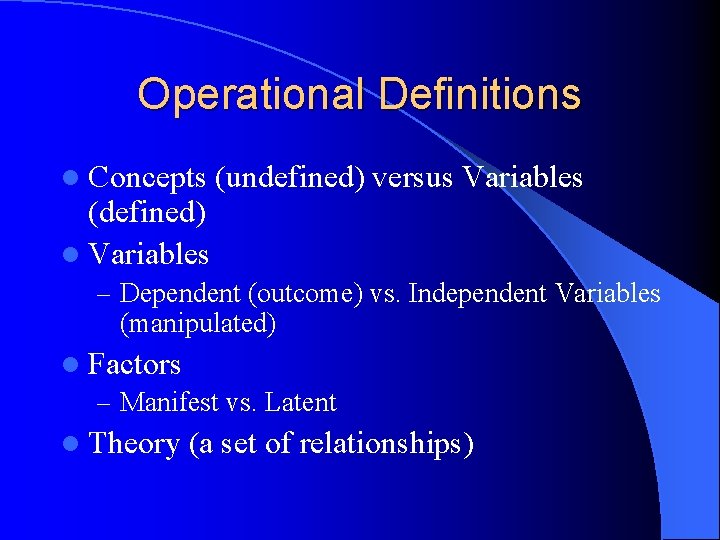
Operational Definitions l Concepts (defined) l Variables (undefined) versus Variables – Dependent (outcome) vs. Independent Variables (manipulated) l Factors – Manifest vs. Latent l Theory (a set of relationships)
Concepts and Defined Terms l Concepts are simply undefined terms which appear in the problem statement or elsewhere; they are a kind of shorthand l Defined terms provide operationalized definitions; they are concrete by contrast to concepts which can be said to be abstract or generalized terms
Variables l “any property of a person, thing, event, setting, and so on that is not fixed. ” SOURCE: Marshall (1989), p. 17 l “A variable is a property that takes on different values. In statistical uses, it is a symbol to which numerals or values are assigned. ” SOURCE: Kerlinger, p. 32
Dependent Variables l “Variables that are presumed to be affected by changes in independent variables are called dependent variables. ” l SOURCE: Sellitz, p. 44
Intervening Variables l “any variable that occurs in the causal chain between some independent variable and its dependent variable. ” – SOURCE: Powell (1997), p. 31 l See Powell, p. 32 for other types. . .
Causality l “The cause must precede the effect. l The variables must be empirically correlated with each other. l The influence of other variables must be accounted for—no other tenable explanation for the effect. ” l SOURCE: Clara Chu, DIS 280
Influence, Effect, and Impact l Think about the relationship(s) between variables l Does a research question come to mind? l Do you want to speculate about the influence, an effect, or the impact of one or more variables upon another variable?
Independent Variables l “Variables that come first in a temporal sense in hypotheses are called independent variables. ” l SOURCE: Sellitz, p. 44
Factors, Manifest and Latent l The term factor is synonymous with variable. . . and can be divided into two types: – Manifest l i. e. , Directly observable – Latent l i. e. , Underlying, less obvious
Underlying Discipline? l Biochemistry is to the practice of medicine l As l ____ is to the practice of librarianship.
Depends on the Problem l Blank is: History, sociology, and psychology, according to Pierce Butler’s Introduction to Library Science (1933) l Social epistemology, according to Margaret Egan and Jesse Shera (LQ, 1952) l Today, information science, linguistics, what else? l
Theory l Theory may be defined: – “as a complex set of relationships among several variables. ” SOURCE: Babbie (1979), p. 108 or as – “a deductively connected set of laws, in the logical form of an explanation and with all statements as generalizations. ” SOURCE: Goldhor (1972), p. 43
Theory l “A theory is a tentative logical explanation of the network of relationships in a large body of different individual situations—a technique for establishing relationships. ” l Herbert Goldhor
Models l. A formalized representation of reality l Think of a picture as a model (or a doll house or toy train) l Models can be classified into: – Simple (bivariate) or – Complex (multivariate)
Structures Select. . . l By choosing among a variety of possible definitions and theories (thereby connecting work with a tradition, a line of inquiry)
Structures Select… l By clarifying concepts and excluding alternative ways of seeing things
Structures Select… l “A way of seeing is also a way of not seeing --a focus upon Object A involves a neglect of Object B. ” – Kenneth Burke
Structures Operationalize. . . l By defining and expounding upon concepts
Structures Operationalize. . . l By identifying all of the nouns in the problem statement (underline them)
Structures Operationalize. . . l By answering, “how many of these can be understood in different ways? ” l You can and should define your jargon (ALA Glossary, 1983)
Definitions by. . . l Extension: “to define a term by extension is to list or state the class of objects to which a term applies. l Intension: “to define a term by intention is to describe the properties held in common by all of the objects in a term’s extension. ”
Structures Validate. . . l By discussing the advantages and disadvantages of the structure in comparison to the alternatives l “You don’t know the truth until you’ve heard all points of view. ”
How to Begin Framing l Note the key terms l Define your jargon l Look for logical classification schemes or taxonomies l Look for theories in the literature
A Conceptualization l Draw the three dimensions of the study: l Known (K) l Theory bridging (T) l Unknown (U)
A Common Criticism l The study is flat (i. e. , not three dimensional)
More than Three Dimensions? l At the University of Chicago GLS, the early faculty thought about the possibility of other dimensions. In fact, when Douglas Waples, a researcher par excellence, started talking about the fifth and sixth dimensions, Dean L. R. Wilson said: “I fall off the sled. ” l SOURCE: Investigating Library Problems
Questions about the Frame… l Are there at least three dimensions/ perspectives (i. e. , a known, a theory, and an unknown) to the study? l Are all the structural elements operationally defined and expounded? l Is the structure validated in terms of its advantages or disadvantages?
Readings l Dictionary of Theories (2002) l Chris Rohmann, A World of Ideas: A Dictionary of Important Theories (1999)
Just A Gentle Reminder. . . l Remove the disk from the drive now!