
UCLA Computer Science Department Highperformance Pattern Detection and

![Advances in the Automata World Nested Words [Alur’ 06] Linear sequence + well-nested edges](https://slidetodoc.com/presentation_image_h2/075f76b66f3dec040caa8b1fbe28f623/image-20.jpg "Advances in the Automata World Nested Words [Alur’ 06] Linear sequence + well-nested edges")
![References • [1] Data mining: Staking a claim on your privacy. Information and Privacy](https://slidetodoc.com/presentation_image_h2/075f76b66f3dec040caa8b1fbe28f623/image-50.jpg "References • [1] Data mining: Staking a claim on your privacy. Information and Privacy")
![References • [7] R. Agrawal and R. Srikant. Fast algorithms for mining association rules](https://slidetodoc.com/presentation_image_h2/075f76b66f3dec040caa8b1fbe28f623/image-51.jpg "References • [7] R. Agrawal and R. Srikant. Fast algorithms for mining association rules")
![References • [11] Rajeev Alur, Marcelo Arenas, Pablo Barcelo, Kousha Etessami, Neil Immerman, and](https://slidetodoc.com/presentation_image_h2/075f76b66f3dec040caa8b1fbe28f623/image-52.jpg "References • [11] Rajeev Alur, Marcelo Arenas, Pablo Barcelo, Kousha Etessami, Neil Immerman, and")
![References • • [17] RICARDO A. BAEZA-YATES and GASTON H. GONNET. Fast text searching](https://slidetodoc.com/presentation_image_h2/075f76b66f3dec040caa8b1fbe28f623/image-53.jpg "References • • [17] RICARDO A. BAEZA-YATES and GASTON H. GONNET. Fast text searching")
![References • • [24] Y. Chi, H. Wang, P. S. Yu, and R. R.](https://slidetodoc.com/presentation_image_h2/075f76b66f3dec040caa8b1fbe28f623/image-54.jpg "References • • [24] Y. Chi, H. Wang, P. S. Yu, and R. R.")
![References • • [32] E. Keogh and M. Pazzani. Learning augmented bayesian classi�ers: A](https://slidetodoc.com/presentation_image_h2/075f76b66f3dec040caa8b1fbe28f623/image-55.jpg "References • • [32] E. Keogh and M. Pazzani. Learning augmented bayesian classi�ers: A")
![References • • [40] Feifei Li, Jimeng Sun, Spiros Papadimitriou, George A. Mihaila, and](https://slidetodoc.com/presentation_image_h2/075f76b66f3dec040caa8b1fbe28f623/image-56.jpg "References • • [40] Feifei Li, Jimeng Sun, Spiros Papadimitriou, George A. Mihaila, and")
![References • [47] Vibhor Rastogi, Sungho Hong, and Dan Suciu. The boundary between privacy](https://slidetodoc.com/presentation_image_h2/075f76b66f3dec040caa8b1fbe28f623/image-57.jpg "References • [47] Vibhor Rastogi, Sungho Hong, and Dan Suciu. The boundary between privacy")
![References • • • [52] Hetal Thakkar, Barzan Mozafari, and Carlo Zaniolo. A data](https://slidetodoc.com/presentation_image_h2/075f76b66f3dec040caa8b1fbe28f623/image-58.jpg "References • • • [52] Hetal Thakkar, Barzan Mozafari, and Carlo Zaniolo. A data")
- Slides: 58
UCLA Computer Science Department High-performance Pattern Detection and Discovery for Databases and Data Streams Barzan Mozafari Adviser: Prof. Carlo Zaniolo Committee Members: Prof. Junghoo Cho, Prof. D. Stott Parker, and Prof. Mark Hansen Winter 2011
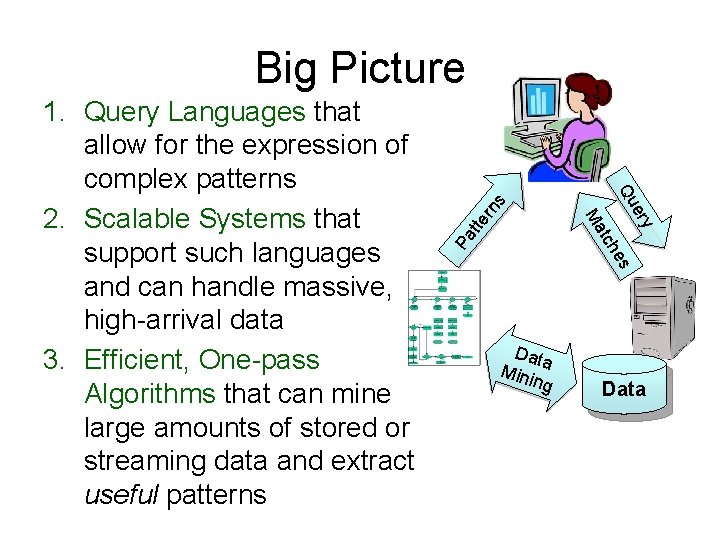
tte Pa ery Qu es tch Ma 1. Query Languages that allow for the expression of complex patterns 2. Scalable Systems that support such languages and can handle massive, high-arrival data 3. Efficient, One-pass Algorithms that can mine large amounts of stored or streaming data and extract useful patterns rn s Big Picture Dat Min a ing Data
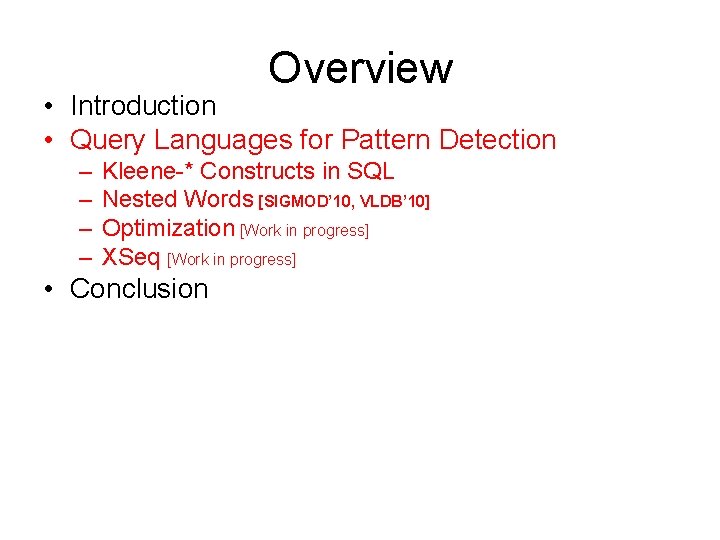
Overview • Introduction • Query Languages for Pattern Detection – – Kleene-* Constructs in SQL Nested Words [SIGMOD’ 10, VLDB’ 10] Optimization [Work in progress] XSeq [Work in progress] • Conclusion
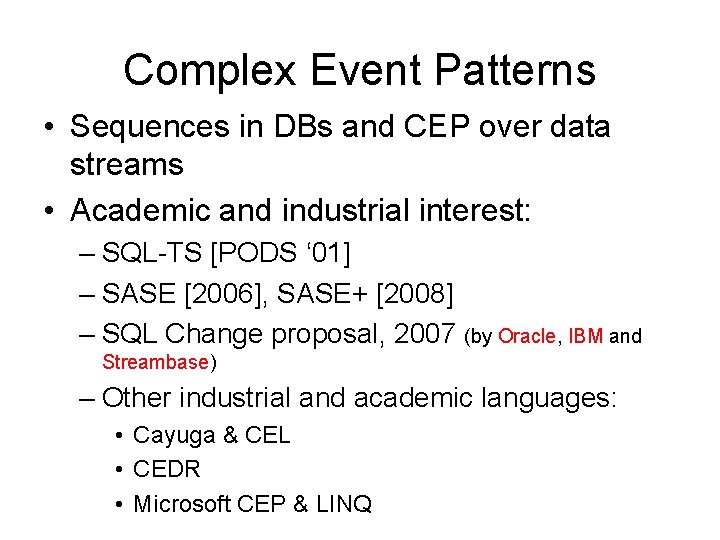
Complex Event Patterns • Sequences in DBs and CEP over data streams • Academic and industrial interest: – SQL-TS [PODS ‘ 01] – SASE [2006], SASE+ [2008] – SQL Change proposal, 2007 (by Oracle, IBM and Streambase) – Other industrial and academic languages: • Cayuga & CEL • CEDR • Microsoft CEP & LINQ
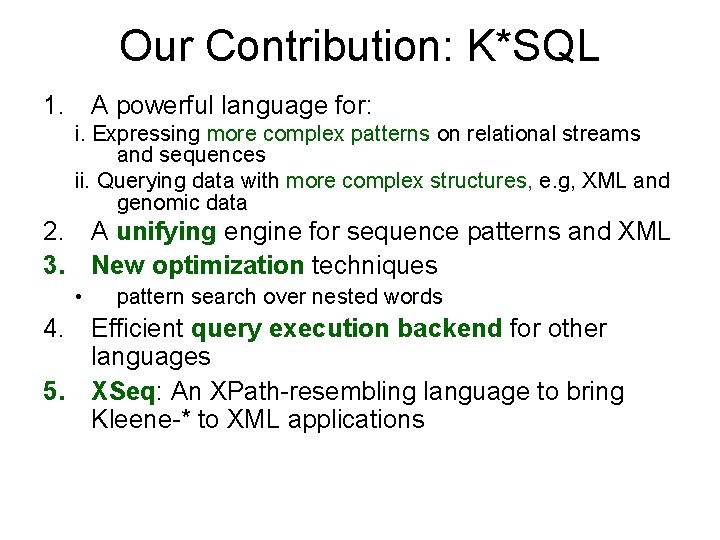
Our Contribution: K*SQL 1. A powerful language for: i. Expressing more complex patterns on relational streams and sequences ii. Querying data with more complex structures, e. g, XML and genomic data 2. A unifying engine for sequence patterns and XML 3. New optimization techniques • pattern search over nested words 4. Efficient query execution backend for other languages 5. XSeq: An XPath-resembling language to bring Kleene-* to XML applications
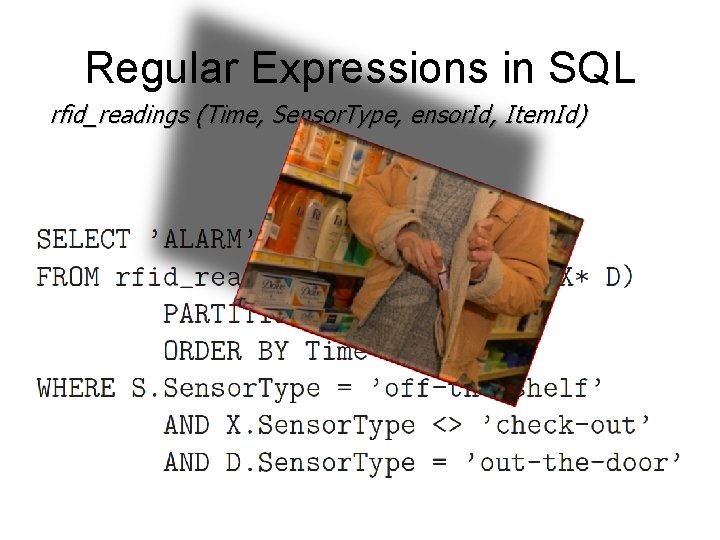
Regular Expressions in SQL rfid_readings (Time, Sensor. Type, ensor. Id, Item. Id)
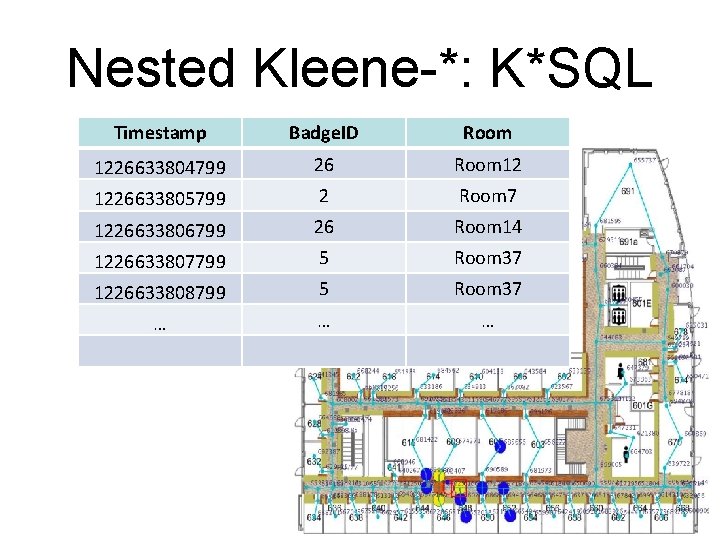
Nested Kleene-*: K*SQL Timestamp Badge. ID Room 1226633804799 26 Room 12 1226633805799 2 Room 7 1226633806799 26 Room 14 1226633807799 5 Room 37 1226633808799 5 Room 37 … … …
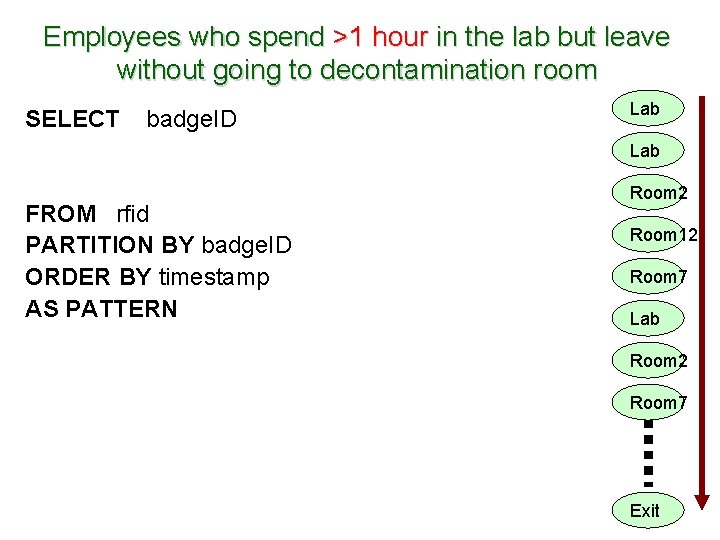
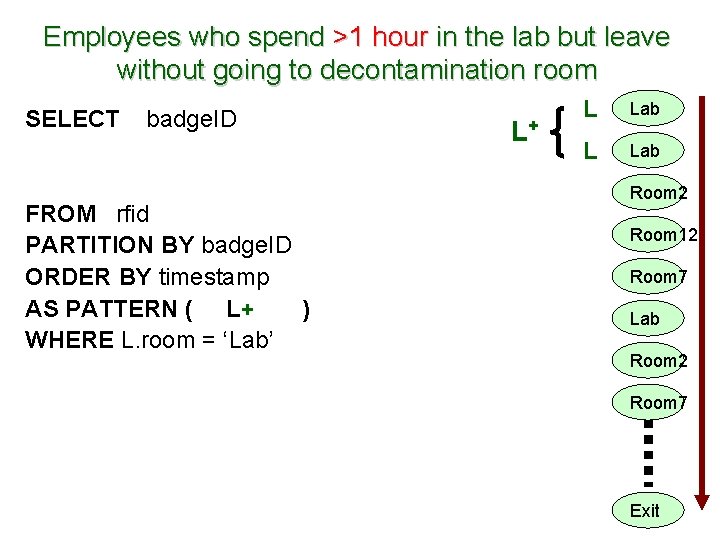
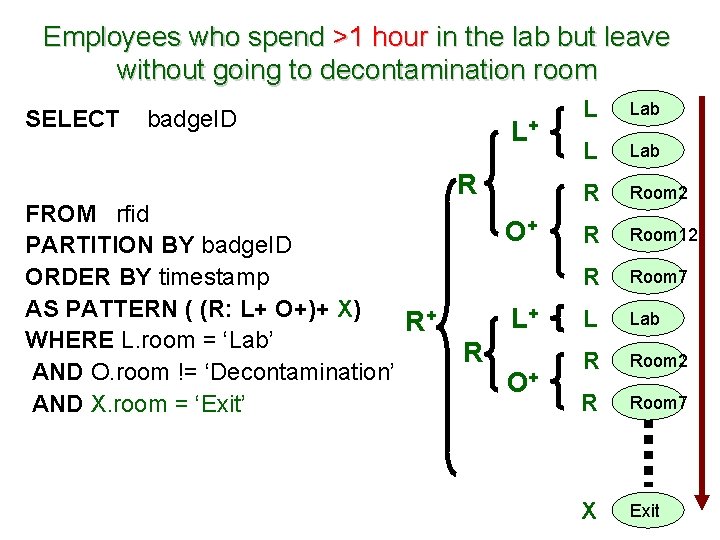
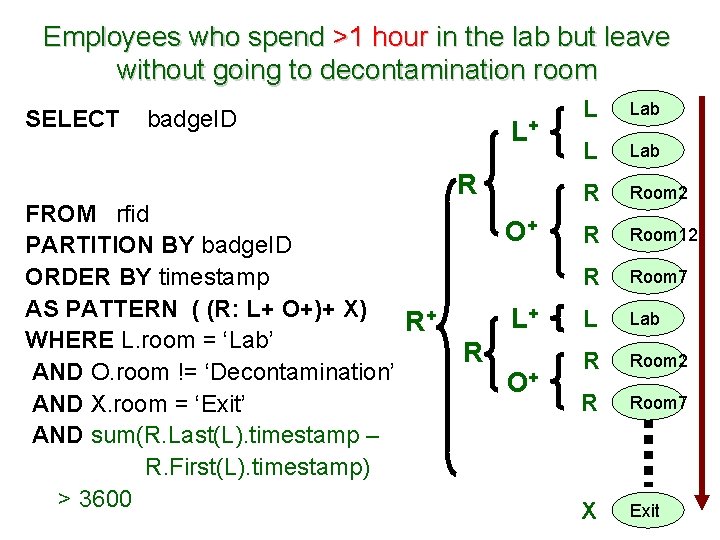
Employees who spend >1 hour in the lab but leave without going to decontamination room SELECT badge. ID Lab FROM rfid PARTITION BY badge. ID ORDER BY timestamp AS PATTERN Room 2 Room 12 Room 7 Lab Room 2 Room 7 Exit
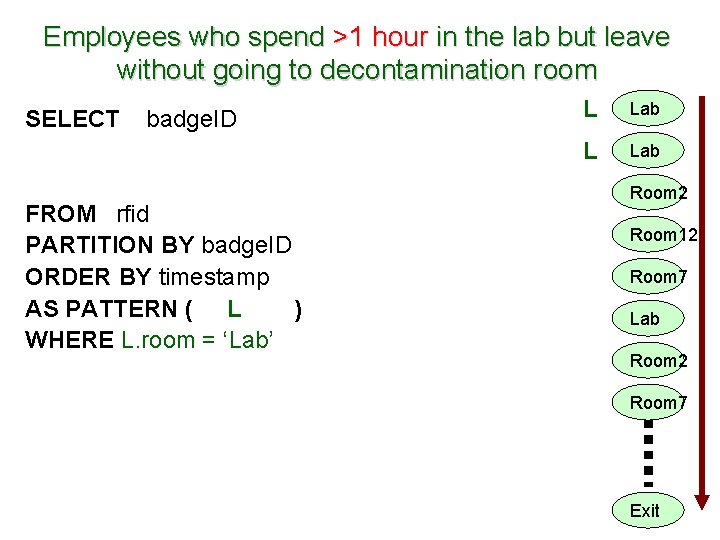
Employees who spend >1 hour in the lab but leave without going to decontamination room SELECT badge. ID FROM rfid PARTITION BY badge. ID ORDER BY timestamp AS PATTERN ( L ) WHERE L. room = ‘Lab’ L Lab Room 2 Room 12 Room 7 Lab Room 2 Room 7 Exit
Employees who spend >1 hour in the lab but leave without going to decontamination room SELECT badge. ID FROM rfid PARTITION BY badge. ID ORDER BY timestamp AS PATTERN ( L+ ) WHERE L. room = ‘Lab’ L+ L Lab Room 2 Room 12 Room 7 Lab Room 2 Room 7 Exit
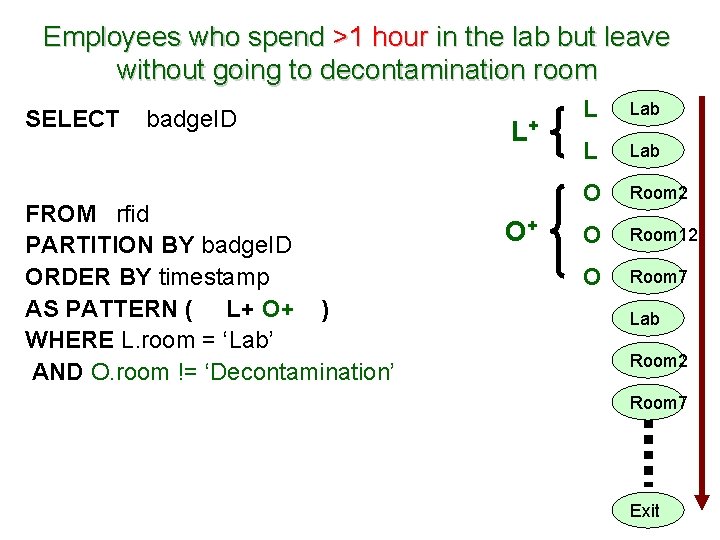
Employees who spend >1 hour in the lab but leave without going to decontamination room SELECT badge. ID FROM rfid PARTITION BY badge. ID ORDER BY timestamp AS PATTERN ( L+ O+ ) WHERE L. room = ‘Lab’ AND O. room != ‘Decontamination’ L+ O+ L Lab O Room 2 O Room 12 O Room 7 Lab Room 2 Room 7 Exit
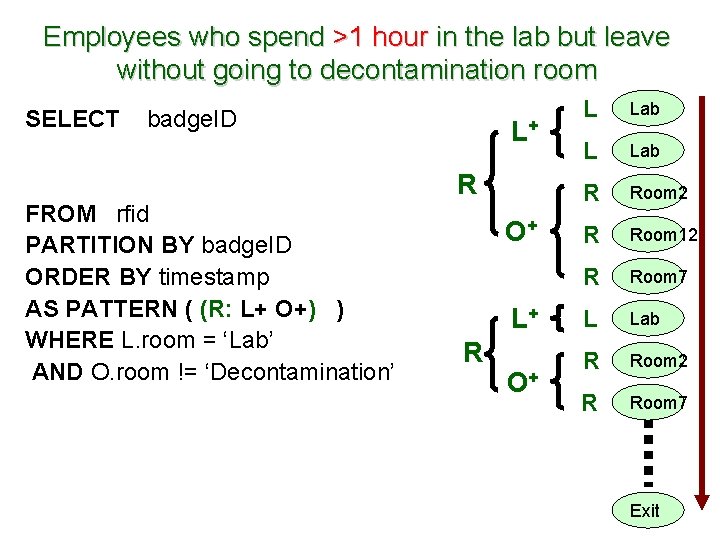
Employees who spend >1 hour in the lab but leave without going to decontamination room SELECT badge. ID L+ R FROM rfid PARTITION BY badge. ID ORDER BY timestamp AS PATTERN ( (R: L+ O+) ) WHERE L. room = ‘Lab’ AND O. room != ‘Decontamination’ O+ L+ R O+ L Lab R Room 2 R Room 12 R Room 7 L Lab R Room 2 R Room 7 Exit
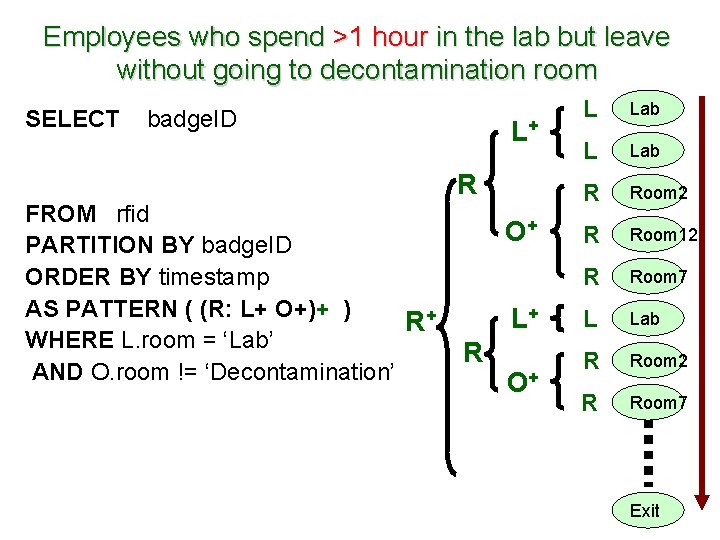
Employees who spend >1 hour in the lab but leave without going to decontamination room SELECT badge. ID L+ R FROM rfid PARTITION BY badge. ID ORDER BY timestamp AS PATTERN ( (R: L+ O+)+ ) R+ WHERE L. room = ‘Lab’ AND O. room != ‘Decontamination’ O+ L+ R O+ L Lab R Room 2 R Room 12 R Room 7 L Lab R Room 2 R Room 7 Exit
Employees who spend >1 hour in the lab but leave without going to decontamination room SELECT badge. ID L+ R FROM rfid PARTITION BY badge. ID ORDER BY timestamp AS PATTERN ( (R: L+ O+)+ X) R+ WHERE L. room = ‘Lab’ AND O. room != ‘Decontamination’ AND X. room = ‘Exit’ O+ L+ R O+ L Lab R Room 2 R Room 12 R Room 7 L Lab R Room 2 R Room 7 X Exit
Employees who spend >1 hour in the lab but leave without going to decontamination room SELECT badge. ID L+ R FROM rfid PARTITION BY badge. ID ORDER BY timestamp AS PATTERN ( (R: L+ O+)+ X) R+ WHERE L. room = ‘Lab’ AND O. room != ‘Decontamination’ AND X. room = ‘Exit’ AND sum(R. Last(L). timestamp – R. First(L). timestamp) > 3600 O+ L+ R O+ L Lab R Room 2 R Room 12 R Room 7 L Lab R Room 2 R Room 7 X Exit
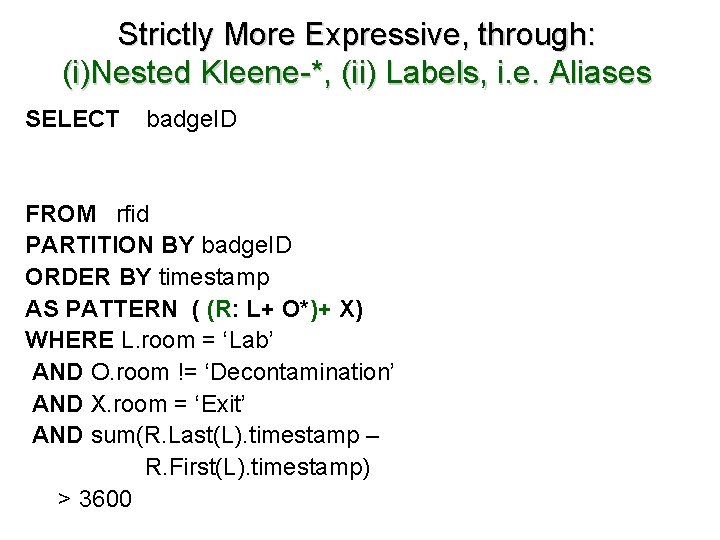
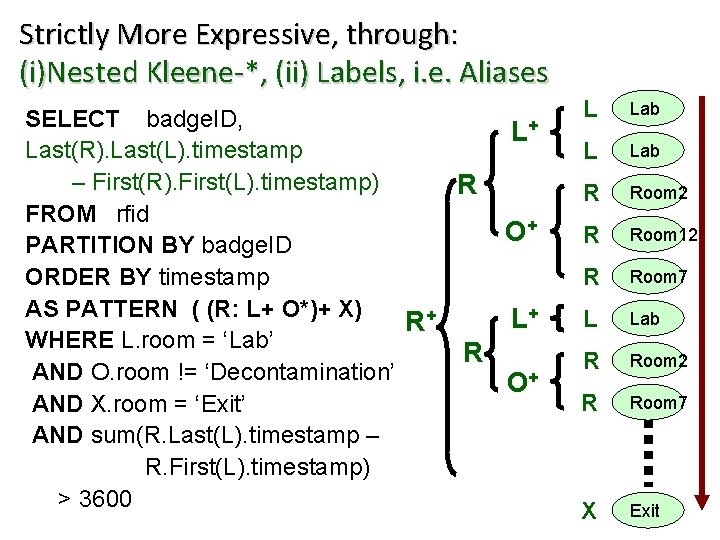
Strictly More Expressive, through: (i)Nested Kleene-*, (ii) Labels, i. e. Aliases SELECT badge. ID FROM rfid PARTITION BY badge. ID ORDER BY timestamp AS PATTERN ( (R: L+ O*)+ X) WHERE L. room = ‘Lab’ AND O. room != ‘Decontamination’ AND X. room = ‘Exit’ AND sum(R. Last(L). timestamp – R. First(L). timestamp) > 3600
Strictly More Expressive, through: (i)Nested Kleene-*, (ii) Labels, i. e. Aliases SELECT badge. ID, L+ Last(R). Last(L). timestamp – First(R). First(L). timestamp) R FROM rfid + O PARTITION BY badge. ID ORDER BY timestamp AS PATTERN ( (R: L+ O*)+ X) L+ R+ WHERE L. room = ‘Lab’ R AND O. room != ‘Decontamination’ O+ AND X. room = ‘Exit’ AND sum(R. Last(L). timestamp – R. First(L). timestamp) > 3600 L Lab R Room 2 R Room 12 R Room 7 L Lab R Room 2 R Room 7 X Exit
K*SQL Checkpoint 1. A powerful language with a very efficient implementation based on FSA 2. Subsumes SQL-MR, SASE+, Cayuga, SQL -TS 3. Many interesting applications – including queries on semistructured documents Very natural question: Can we handle full XML?
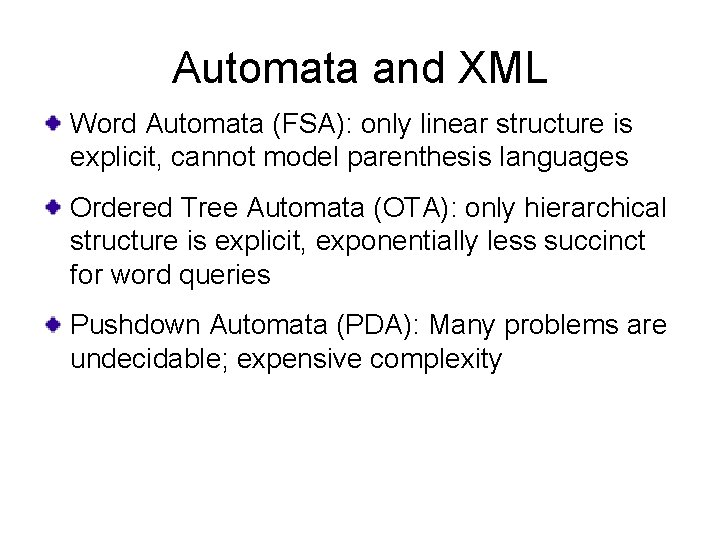
Automata and XML Word Automata (FSA): only linear structure is explicit, cannot model parenthesis languages Ordered Tree Automata (OTA): only hierarchical structure is explicit, exponentially less succinct for word queries Pushdown Automata (PDA): Many problems are undecidable; expensive complexity
Advances in the Automata World Nested Words [Alur’ 06] Linear sequence + well-nested edges Positions labeled with symbols in S a 1 a 2 a 3 a 4 a 5 a 6 a 7 a 8 a 9 a 10 a 11 a 12 Positions classified as: Call positions: both linear and hierarchical successors Return positions: both linear and hierarchical predecessors Internal positions: otherwise 20
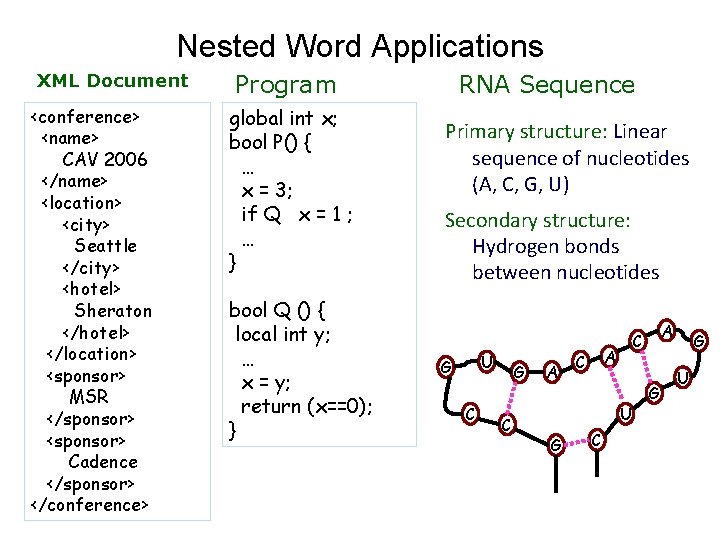
Nested Word Applications XML Document <conference> <name> CAV 2006 </name> <location> <city> Seattle </city> <hotel> Sheraton </hotel> </location> <sponsor> MSR </sponsor> <sponsor> Cadence </sponsor> </conference> Program global int x; bool P() { … x = 3; if Q x = 1 ; … } bool Q () { local int y; … x = y; return (x==0); } RNA Sequence Primary structure: Linear sequence of nucleotides (A, C, G, U) Secondary structure: Hydrogen bonds between nucleotides U G C A A C U G C A C G G U
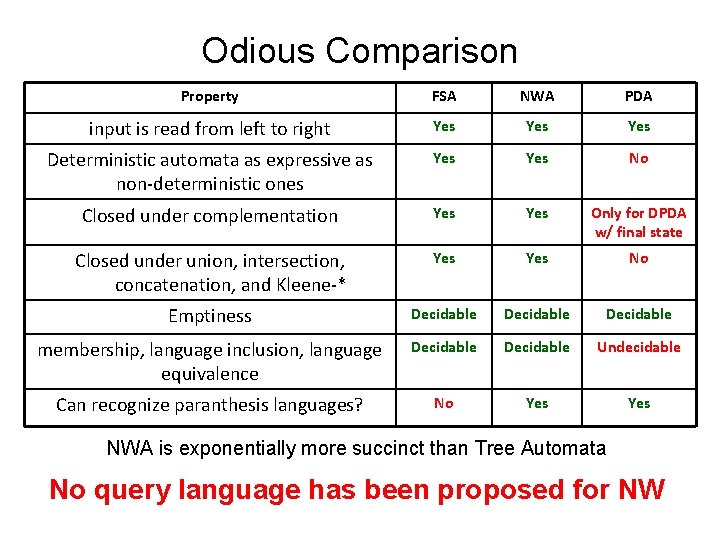
Odious Comparison Property FSA NWA PDA input is read from left to right Yes Yes Deterministic automata as expressive as non-deterministic ones Yes No Closed under complementation Yes Only for DPDA w/ final state Closed under union, intersection, concatenation, and Kleene-* Yes No Emptiness Decidable membership, language inclusion, language equivalence Decidable Undecidable Can recognize paranthesis languages? No Yes NWA is exponentially more succinct than Tree Automata No query language has been proposed for NW
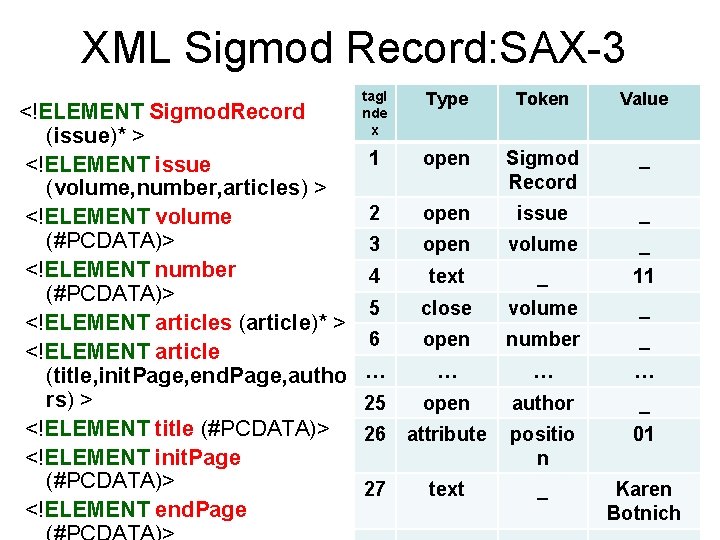
XML Sigmod Record: SAX-3 <!ELEMENT Sigmod. Record (issue)* > <!ELEMENT issue (volume, number, articles) > <!ELEMENT volume (#PCDATA)> <!ELEMENT number (#PCDATA)> <!ELEMENT articles (article)* > <!ELEMENT article (title, init. Page, end. Page, autho rs) > <!ELEMENT title (#PCDATA)> <!ELEMENT init. Page (#PCDATA)> <!ELEMENT end. Page tag. I nde x Type Token Value 1 open Sigmod Record _ 2 open issue _ 3 open volume _ 4 text _ 11 5 close volume _ 6 open number _ … … 25 open author _ 26 attribute positio n 01 27 text _ Karen Botnich
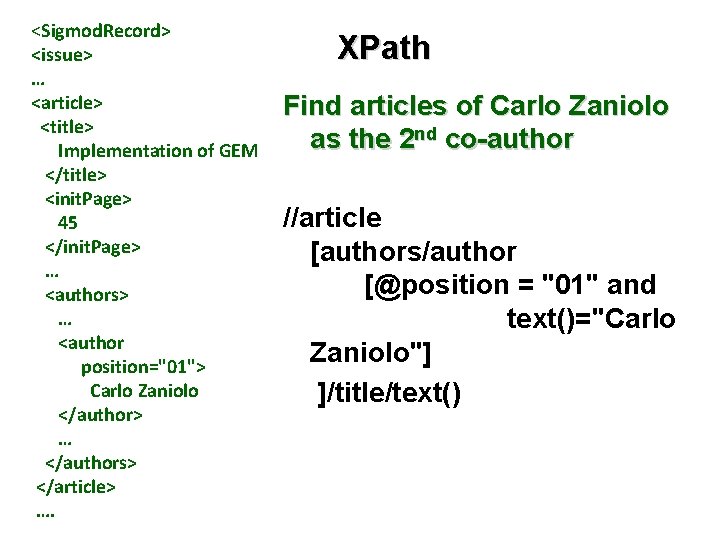
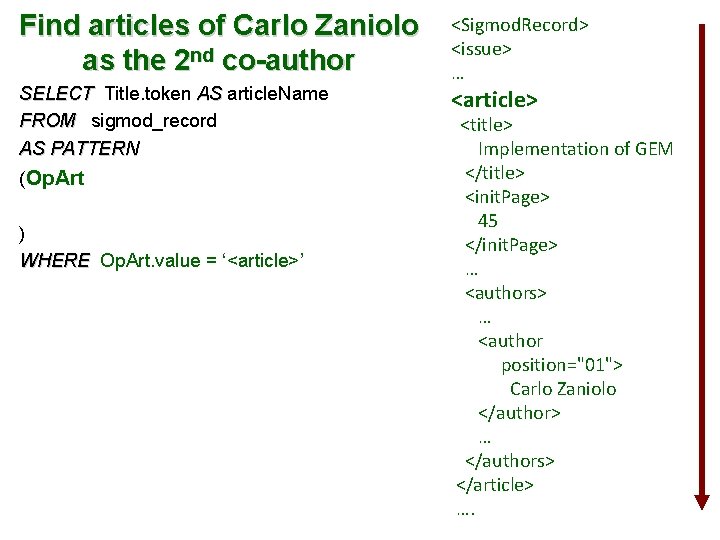
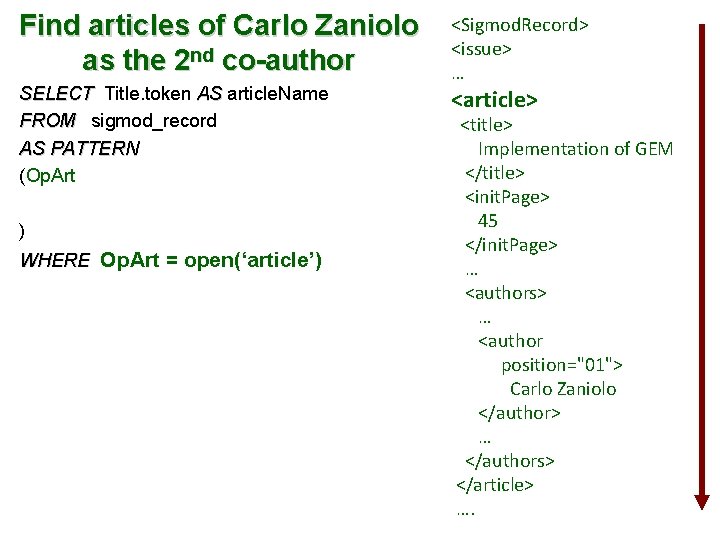
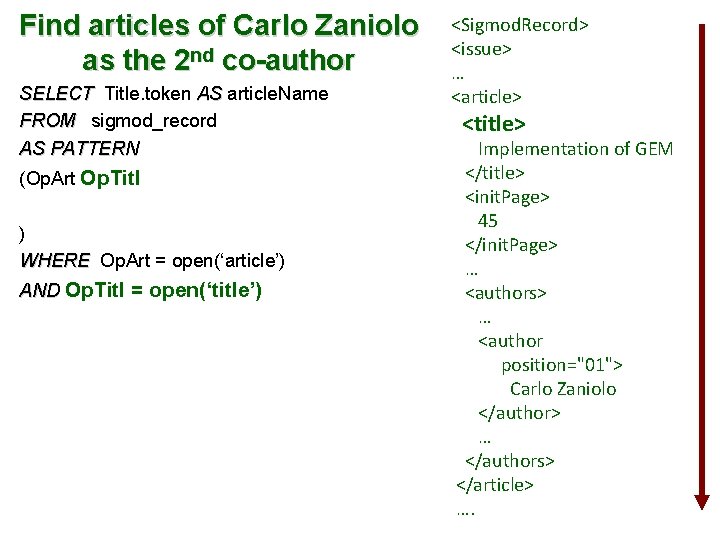
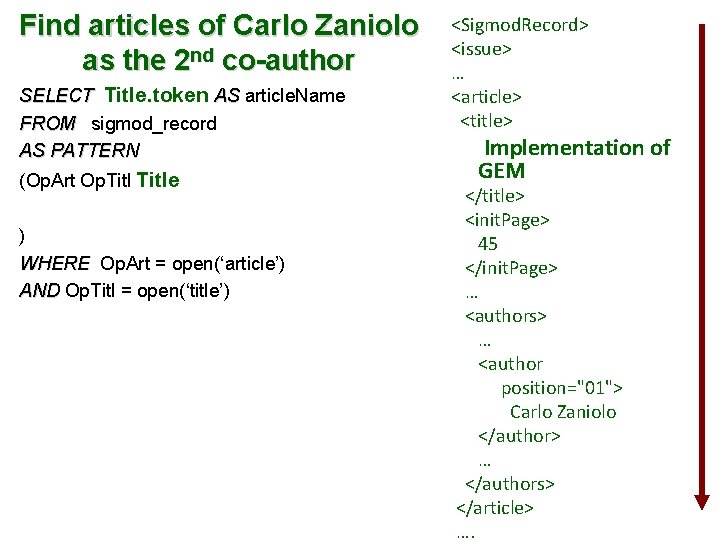
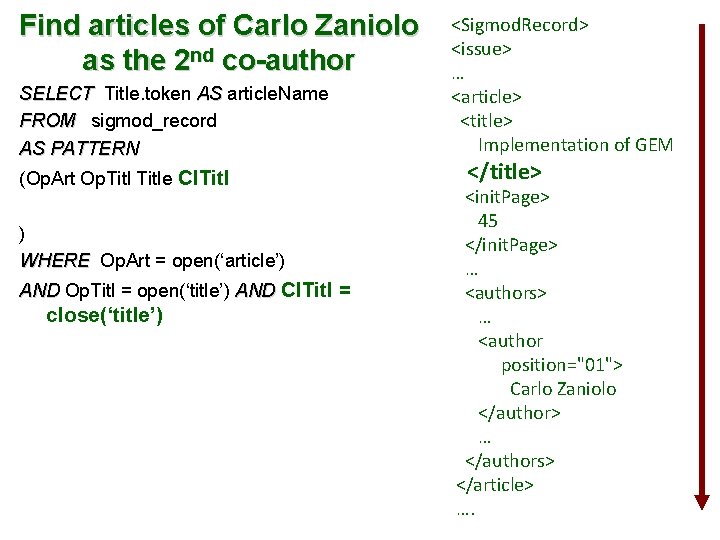
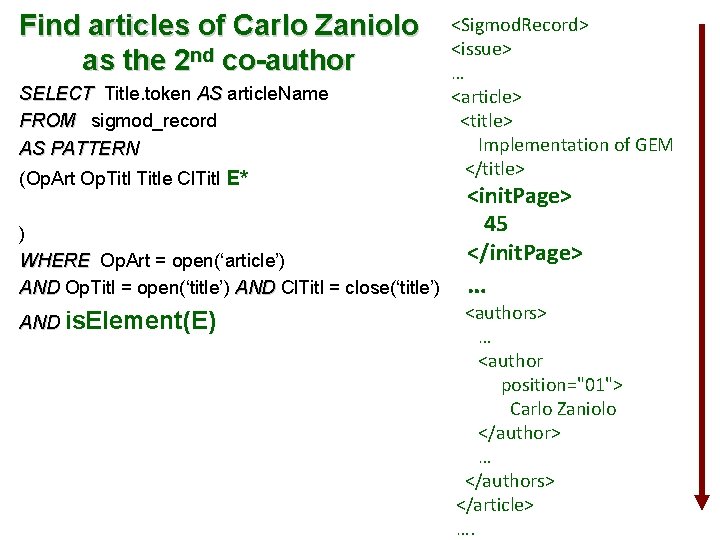
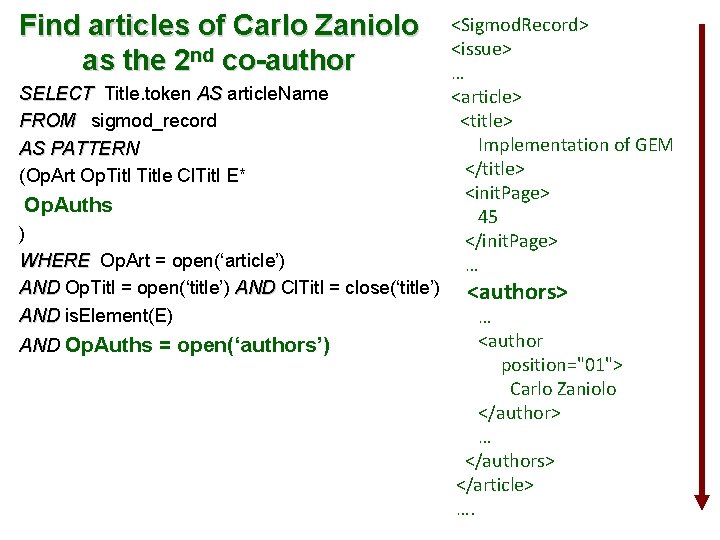
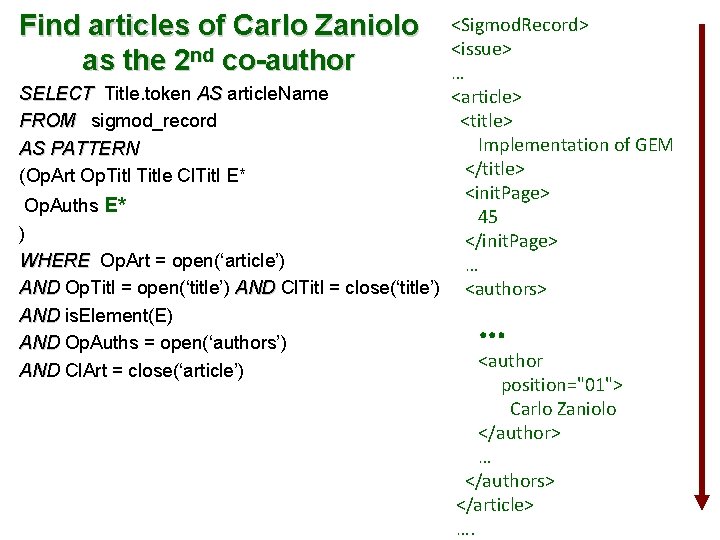
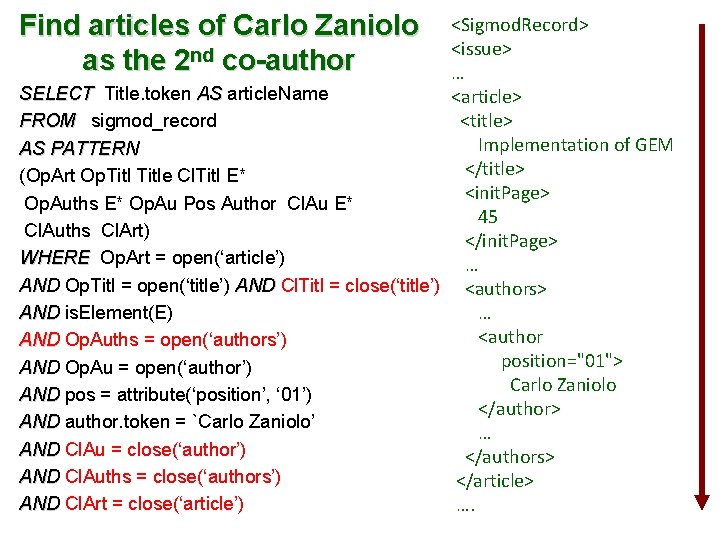
<Sigmod. Record> <issue> … <article> <title> Implementation of GEM </title> <init. Page> 45 </init. Page> … <authors> … <author position="01"> Carlo Zaniolo </author> … </authors> </article> …. XPath Find articles of Carlo Zaniolo as the 2 nd co-author //article [authors/author [@position = "01" and text()="Carlo Zaniolo"] ]/title/text()
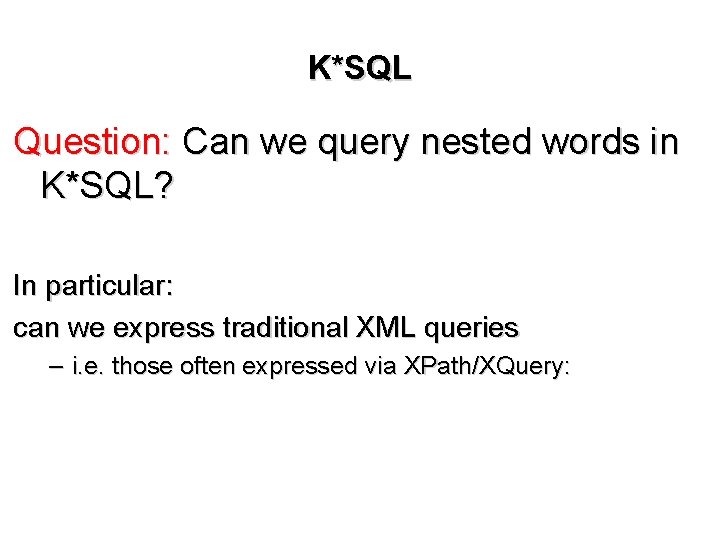
K*SQL Question: Can we query nested words in K*SQL? In particular: can we express traditional XML queries – i. e. those often expressed via XPath/XQuery:
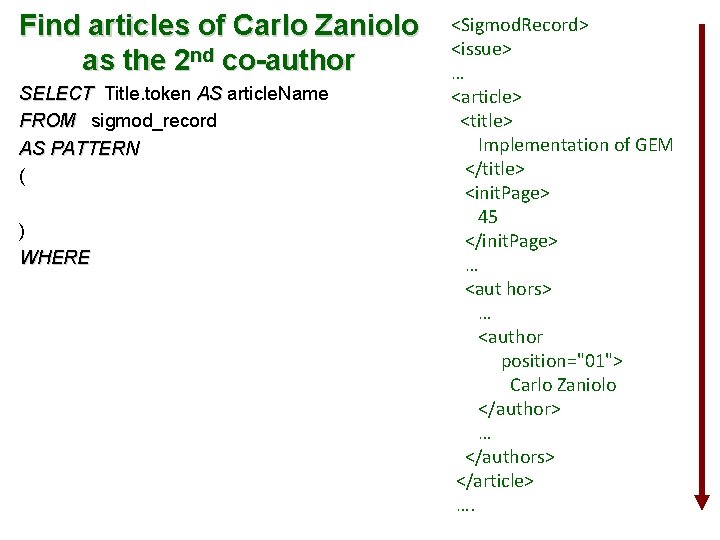
Find articles of Carlo Zaniolo as the 2 nd co-author SELECT Title. token AS article. Name FROM sigmod_record AS PATTERN ( ) WHERE <Sigmod. Record> <issue> … <article> <title> Implementation of GEM </title> <init. Page> 45 </init. Page> … <aut hors> … <author position="01"> Carlo Zaniolo </author> … </authors> </article> ….
Find articles of Carlo Zaniolo as the 2 nd co-author SELECT Title. token AS article. Name FROM sigmod_record AS PATTERN (Op. Art ) WHERE Op. Art. value = ‘<article>’ <Sigmod. Record> <issue> … <article> <title> Implementation of GEM </title> <init. Page> 45 </init. Page> … <authors> … <author position="01"> Carlo Zaniolo </author> … </authors> </article> ….
Find articles of Carlo Zaniolo as the 2 nd co-author SELECT Title. token AS article. Name FROM sigmod_record AS PATTERN (Op. Art ) WHERE Op. Art = open(‘article’) <Sigmod. Record> <issue> … <article> <title> Implementation of GEM </title> <init. Page> 45 </init. Page> … <authors> … <author position="01"> Carlo Zaniolo </author> … </authors> </article> ….
Find articles of Carlo Zaniolo as the 2 nd co-author SELECT Title. token AS article. Name FROM sigmod_record AS PATTERN (Op. Art Op. Titl ) WHERE Op. Art = open(‘article’) AND Op. Titl = open(‘title’) <Sigmod. Record> <issue> … <article> <title> Implementation of GEM </title> <init. Page> 45 </init. Page> … <authors> … <author position="01"> Carlo Zaniolo </author> … </authors> </article> ….
Find articles of Carlo Zaniolo as the 2 nd co-author SELECT Title. token AS article. Name FROM sigmod_record AS PATTERN (Op. Art Op. Title ) WHERE Op. Art = open(‘article’) AND Op. Titl = open(‘title’) <Sigmod. Record> <issue> … <article> <title> Implementation of GEM </title> <init. Page> 45 </init. Page> … <authors> … <author position="01"> Carlo Zaniolo </author> … </authors> </article> ….
Find articles of Carlo Zaniolo as the 2 nd co-author SELECT Title. token AS article. Name FROM sigmod_record AS PATTERN (Op. Art Op. Title Cl. Titl ) WHERE Op. Art = open(‘article’) AND Op. Titl = open(‘title’) AND Cl. Titl = close(‘title’) <Sigmod. Record> <issue> … <article> <title> Implementation of GEM </title> <init. Page> 45 </init. Page> … <authors> … <author position="01"> Carlo Zaniolo </author> … </authors> </article> ….
Find articles of Carlo Zaniolo as the 2 nd co-author SELECT Title. token AS article. Name FROM sigmod_record AS PATTERN (Op. Art Op. Title Cl. Titl E* ) WHERE Op. Art = open(‘article’) AND Op. Titl = open(‘title’) AND Cl. Titl = close(‘title’) AND is. Element(E) <Sigmod. Record> <issue> … <article> <title> Implementation of GEM </title> <init. Page> 45 </init. Page> … <authors> … <author position="01"> Carlo Zaniolo </author> … </authors> </article> ….
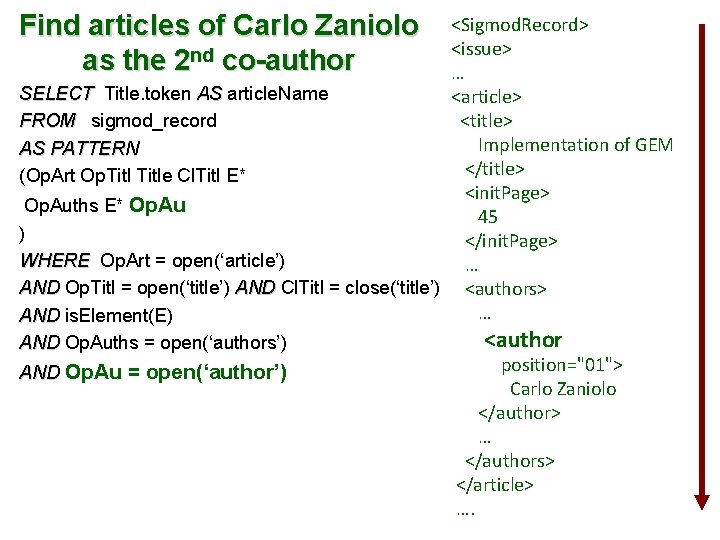
Find articles of Carlo Zaniolo as the 2 nd co-author SELECT Title. token AS article. Name FROM sigmod_record AS PATTERN (Op. Art Op. Title Cl. Titl E* Op. Auths ) WHERE Op. Art = open(‘article’) AND Op. Titl = open(‘title’) AND Cl. Titl = close(‘title’) AND is. Element(E) AND Op. Auths = open(‘authors’) <Sigmod. Record> <issue> … <article> <title> Implementation of GEM </title> <init. Page> 45 </init. Page> … <authors> … <author position="01"> Carlo Zaniolo </author> … </authors> </article> ….
Find articles of Carlo Zaniolo as the 2 nd co-author <Sigmod. Record> <issue> … SELECT Title. token AS article. Name <article> <title> FROM sigmod_record Implementation of GEM AS PATTERN </title> (Op. Art Op. Title Cl. Titl E* <init. Page> Op. Auths E* 45 ) </init. Page> WHERE Op. Art = open(‘article’) … AND Op. Titl = open(‘title’) AND Cl. Titl = close(‘title’) <authors> AND is. Element(E) AND Op. Auths = open(‘authors’) AND Cl. Art = close(‘article’) … <author position="01"> Carlo Zaniolo </author> … </authors> </article> ….
Find articles of Carlo Zaniolo as the 2 nd co-author <Sigmod. Record> <issue> … SELECT Title. token AS article. Name <article> <title> FROM sigmod_record Implementation of GEM AS PATTERN </title> (Op. Art Op. Title Cl. Titl E* <init. Page> Op. Auths E* Op. Au 45 ) </init. Page> WHERE Op. Art = open(‘article’) … AND Op. Titl = open(‘title’) AND Cl. Titl = close(‘title’) <authors> … AND is. Element(E) AND Op. Auths = open(‘authors’) AND Op. Au = open(‘author’) <author position="01"> Carlo Zaniolo </author> … </authors> </article> ….
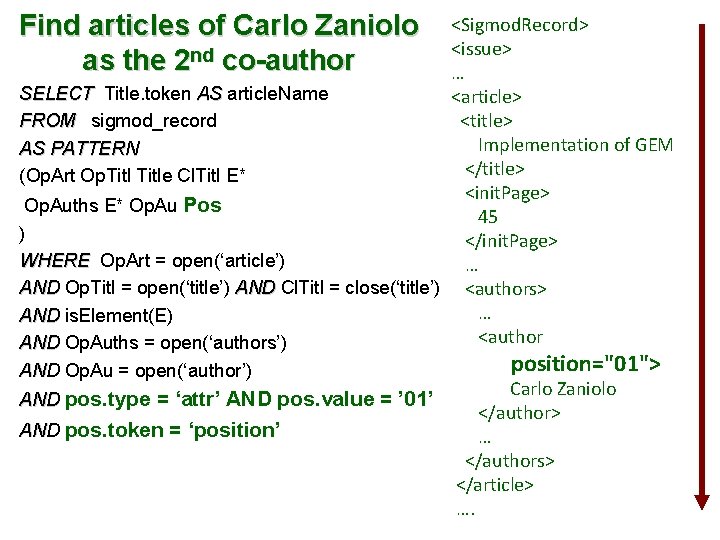
Find articles of Carlo Zaniolo as the 2 nd co-author <Sigmod. Record> <issue> … SELECT Title. token AS article. Name <article> <title> FROM sigmod_record Implementation of GEM AS PATTERN </title> (Op. Art Op. Title Cl. Titl E* <init. Page> Op. Auths E* Op. Au Pos 45 ) </init. Page> WHERE Op. Art = open(‘article’) … AND Op. Titl = open(‘title’) AND Cl. Titl = close(‘title’) <authors> … AND is. Element(E) <author AND Op. Auths = open(‘authors’) AND Op. Au = open(‘author’) AND pos. type = ‘attr’ AND pos. value = ’ 01’ AND pos. token = ‘position’ position="01"> Carlo Zaniolo </author> … </authors> </article> ….
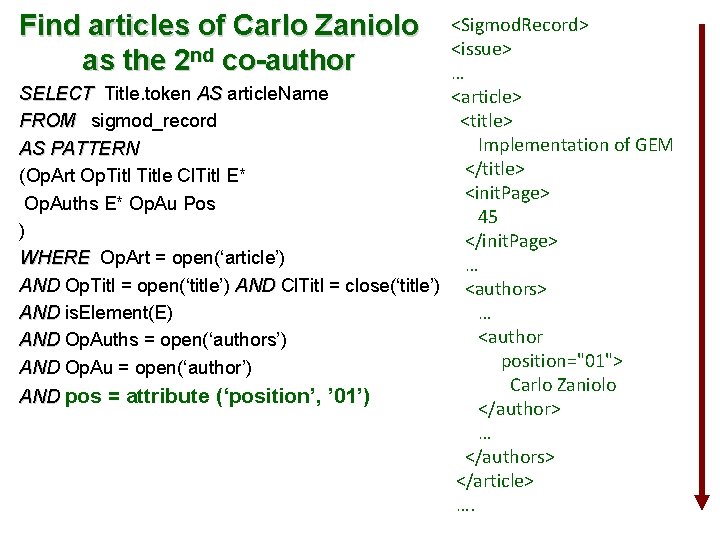
Find articles of Carlo Zaniolo as the 2 nd co-author <Sigmod. Record> <issue> … SELECT Title. token AS article. Name <article> <title> FROM sigmod_record Implementation of GEM AS PATTERN </title> (Op. Art Op. Title Cl. Titl E* <init. Page> Op. Auths E* Op. Au Pos 45 ) </init. Page> WHERE Op. Art = open(‘article’) … AND Op. Titl = open(‘title’) AND Cl. Titl = close(‘title’) <authors> … AND is. Element(E) <author AND Op. Auths = open(‘authors’) position="01"> AND Op. Au = open(‘author’) Carlo Zaniolo AND pos = attribute (‘position’, ’ 01’) </author> … </authors> </article> ….
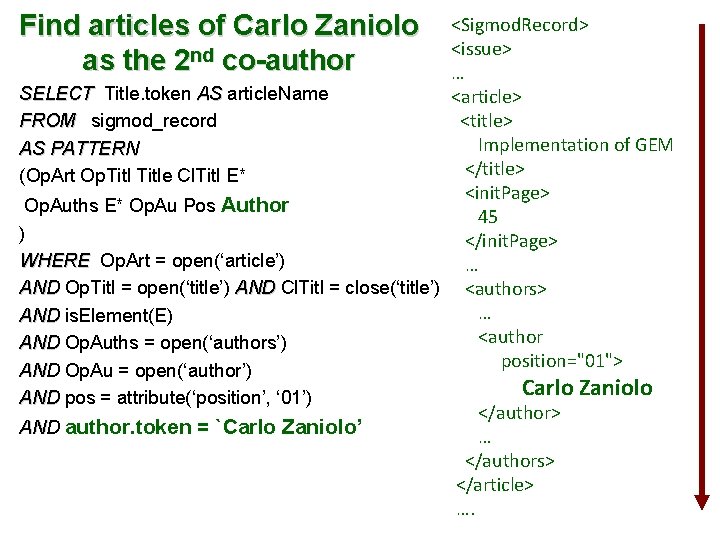
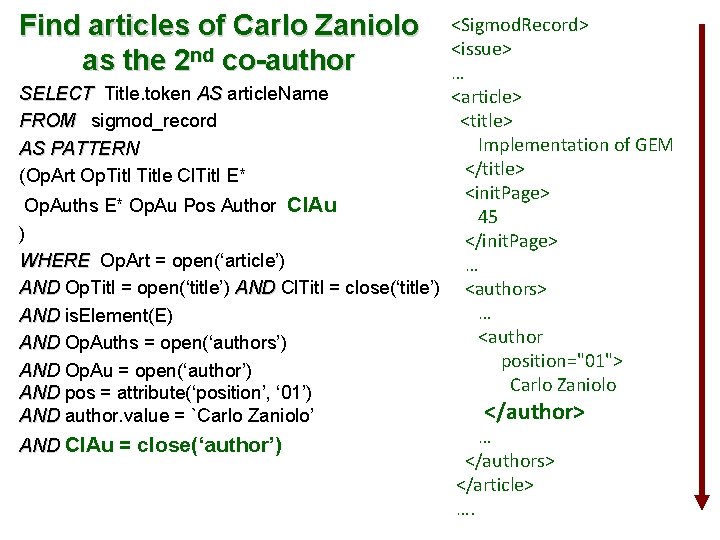
Find articles of Carlo Zaniolo as the 2 nd co-author <Sigmod. Record> <issue> … SELECT Title. token AS article. Name <article> <title> FROM sigmod_record Implementation of GEM AS PATTERN </title> (Op. Art Op. Title Cl. Titl E* <init. Page> Op. Auths E* Op. Au Pos Author 45 ) </init. Page> WHERE Op. Art = open(‘article’) … AND Op. Titl = open(‘title’) AND Cl. Titl = close(‘title’) <authors> … AND is. Element(E) <author AND Op. Auths = open(‘authors’) position="01"> AND Op. Au = open(‘author’) AND pos = attribute(‘position’, ‘ 01’) AND author. token = `Carlo Zaniolo’ Carlo Zaniolo </author> … </authors> </article> ….
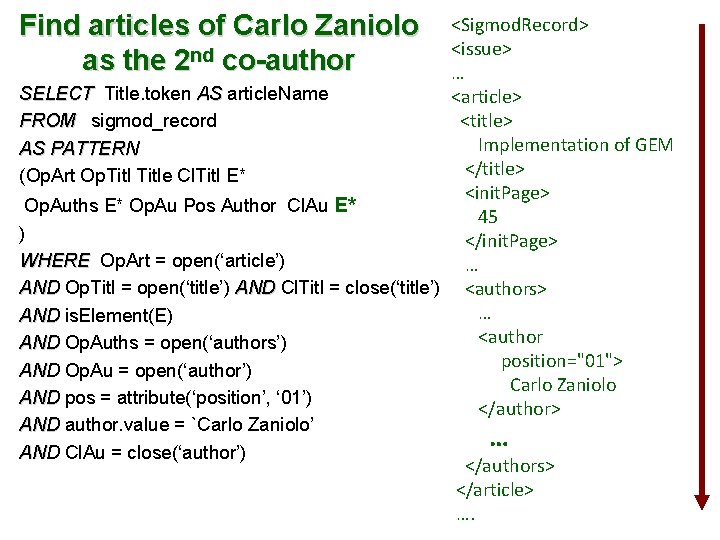
Find articles of Carlo Zaniolo as the 2 nd co-author <Sigmod. Record> <issue> … SELECT Title. token AS article. Name <article> <title> FROM sigmod_record Implementation of GEM AS PATTERN </title> (Op. Art Op. Title Cl. Titl E* <init. Page> Op. Auths E* Op. Au Pos Author Cl. Au 45 ) </init. Page> WHERE Op. Art = open(‘article’) … AND Op. Titl = open(‘title’) AND Cl. Titl = close(‘title’) <authors> … AND is. Element(E) <author AND Op. Auths = open(‘authors’) position="01"> AND Op. Au = open(‘author’) Carlo Zaniolo AND pos = attribute(‘position’, ‘ 01’) AND author. value = `Carlo Zaniolo’ AND Cl. Au = close(‘author’) </author> … </authors> </article> ….
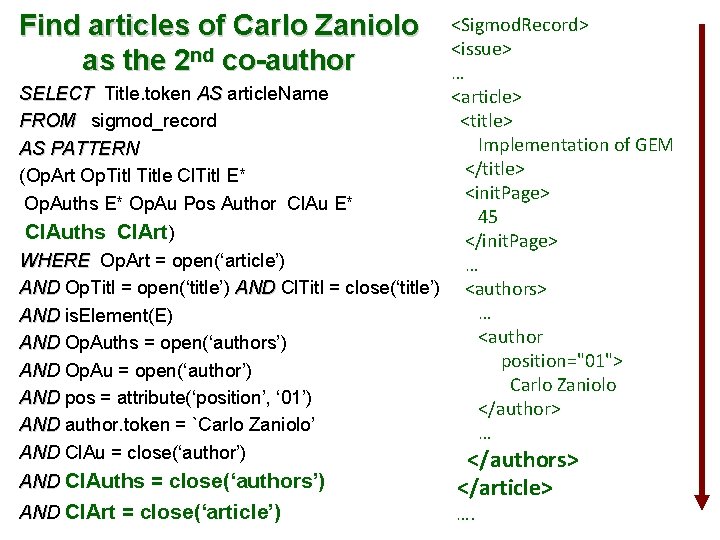
Find articles of Carlo Zaniolo as the 2 nd co-author <Sigmod. Record> <issue> … SELECT Title. token AS article. Name <article> <title> FROM sigmod_record Implementation of GEM AS PATTERN </title> (Op. Art Op. Title Cl. Titl E* <init. Page> Op. Auths E* Op. Au Pos Author Cl. Au E* 45 ) </init. Page> WHERE Op. Art = open(‘article’) … AND Op. Titl = open(‘title’) AND Cl. Titl = close(‘title’) <authors> … AND is. Element(E) <author AND Op. Auths = open(‘authors’) position="01"> AND Op. Au = open(‘author’) Carlo Zaniolo AND pos = attribute(‘position’, ‘ 01’) </author> AND author. value = `Carlo Zaniolo’ AND Cl. Au = close(‘author’) … </authors> </article> ….
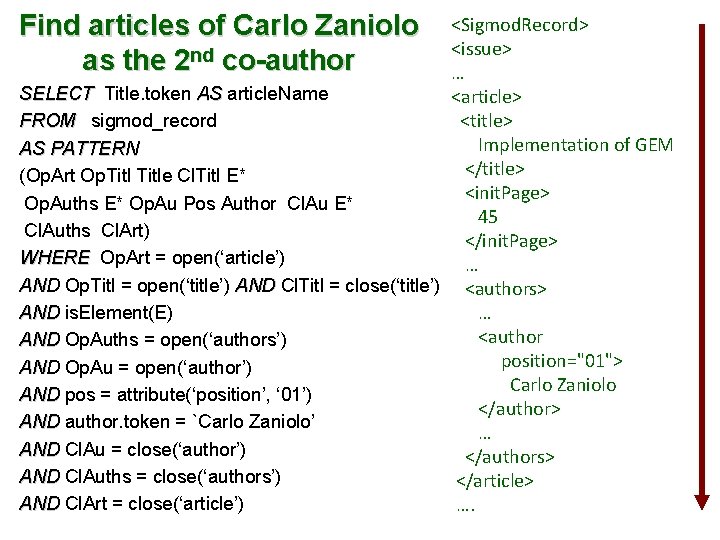
Find articles of Carlo Zaniolo as the 2 nd co-author <Sigmod. Record> <issue> … SELECT Title. token AS article. Name <article> <title> FROM sigmod_record Implementation of GEM AS PATTERN </title> (Op. Art Op. Title Cl. Titl E* <init. Page> Op. Auths E* Op. Au Pos Author Cl. Au E* 45 Cl. Auths Cl. Art) </init. Page> WHERE Op. Art = open(‘article’) … AND Op. Titl = open(‘title’) AND Cl. Titl = close(‘title’) <authors> … AND is. Element(E) <author AND Op. Auths = open(‘authors’) position="01"> AND Op. Au = open(‘author’) Carlo Zaniolo AND pos = attribute(‘position’, ‘ 01’) </author> AND author. token = `Carlo Zaniolo’ … AND Cl. Au = close(‘author’) AND Cl. Auths = close(‘authors’) AND Cl. Art = close(‘article’) </authors> </article> ….
Find articles of Carlo Zaniolo as the 2 nd co-author <Sigmod. Record> <issue> … SELECT Title. token AS article. Name <article> <title> FROM sigmod_record Implementation of GEM AS PATTERN </title> (Op. Art Op. Title Cl. Titl E* <init. Page> Op. Auths E* Op. Au Pos Author Cl. Au E* 45 Cl. Auths Cl. Art) </init. Page> WHERE Op. Art = open(‘article’) … AND Op. Titl = open(‘title’) AND Cl. Titl = close(‘title’) <authors> … AND is. Element(E) <author AND Op. Auths = open(‘authors’) position="01"> AND Op. Au = open(‘author’) Carlo Zaniolo AND pos = attribute(‘position’, ‘ 01’) </author> AND author. token = `Carlo Zaniolo’ … AND Cl. Au = close(‘author’) </authors> AND Cl. Auths = close(‘authors’) </article> AND Cl. Art = close(‘article’) ….
Find articles of Carlo Zaniolo as the 2 nd co-author <Sigmod. Record> <issue> … SELECT Title. token AS article. Name <article> <title> FROM sigmod_record Implementation of GEM AS PATTERN </title> (Op. Art Op. Title Cl. Titl E* <init. Page> Op. Auths E* Op. Au Pos Author Cl. Au E* 45 Cl. Auths Cl. Art) </init. Page> WHERE Op. Art = open(‘article’) … AND Op. Titl = open(‘title’) AND Cl. Titl = close(‘title’) <authors> … AND is. Element(E) <author AND Op. Auths = open(‘authors’) position="01"> AND Op. Au = open(‘author’) Carlo Zaniolo AND pos = attribute(‘position’, ‘ 01’) </author> AND author. token = `Carlo Zaniolo’ … AND Cl. Au = close(‘author’) </authors> AND Cl. Auths = close(‘authors’) </article> AND Cl. Art = close(‘article’) ….
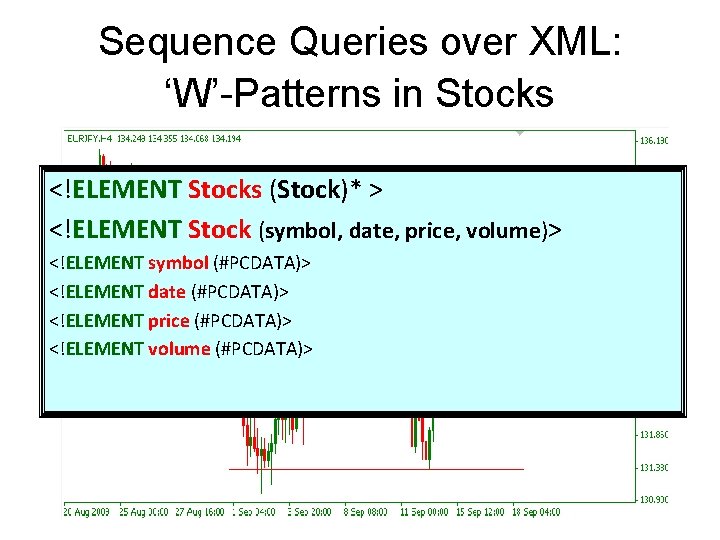
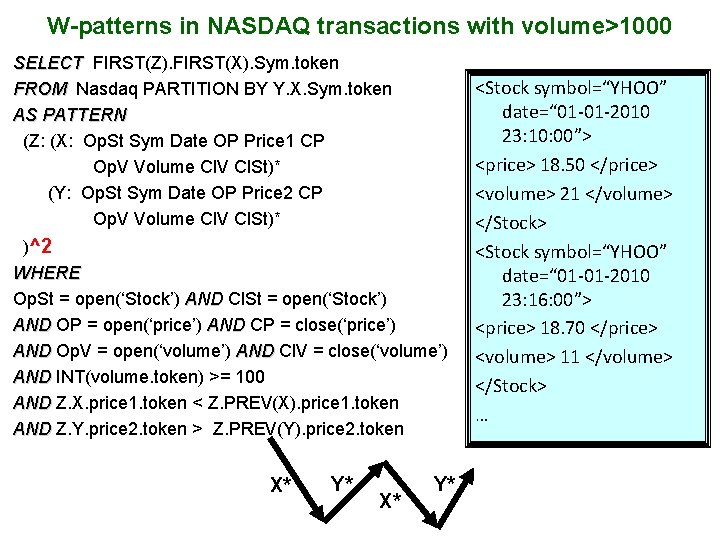
Sequence Queries over XML: ‘W’-Patterns in Stocks <!ELEMENT Stocks (Stock)* > <!ELEMENT Stock (symbol, date, price, volume)> <!ELEMENT symbol (#PCDATA)> <!ELEMENT date (#PCDATA)> <!ELEMENT price (#PCDATA)> <!ELEMENT volume (#PCDATA)>
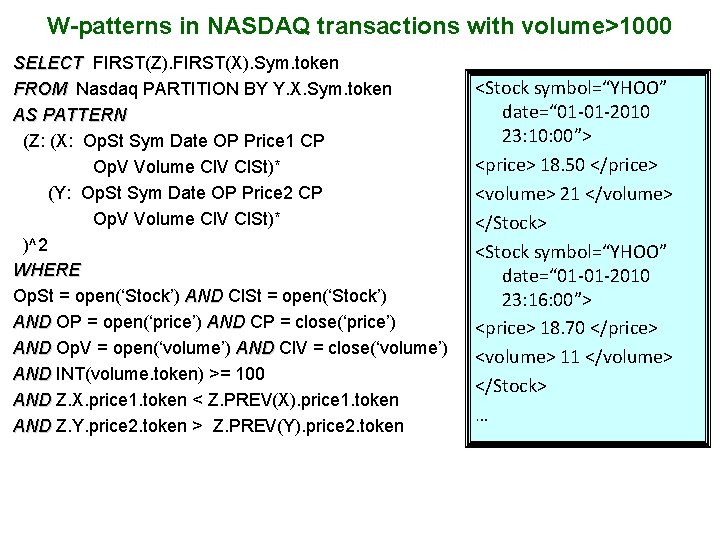
W-patterns in NASDAQ transactions with volume>1000 SELECT FIRST(Z). FIRST(X). Sym. token FROM Nasdaq PARTITION BY Y. X. Sym. token AS PATTERN (Z: (X: Op. St Sym Date OP Price 1 CP Op. V Volume Cl. V Cl. St)* (Y: Op. St Sym Date OP Price 2 CP Op. V Volume Cl. V Cl. St)* )^2 WHERE Op. St = open(‘Stock’) AND Cl. St = open(‘Stock’) AND OP = open(‘price’) AND CP = close(‘price’) AND Op. V = open(‘volume’) AND Cl. V = close(‘volume’) AND INT(volume. token) >= 100 AND Z. X. price 1. token < Z. PREV(X). price 1. token AND Z. Y. price 2. token > Z. PREV(Y). price 2. token <Stock symbol=“YHOO” date=“ 01 -01 -2010 23: 10: 00”> <price> 18. 50 </price> <volume> 21 </volume> </Stock> <Stock symbol=“YHOO” date=“ 01 -01 -2010 23: 16: 00”> <price> 18. 70 </price> <volume> 11 </volume> </Stock> …
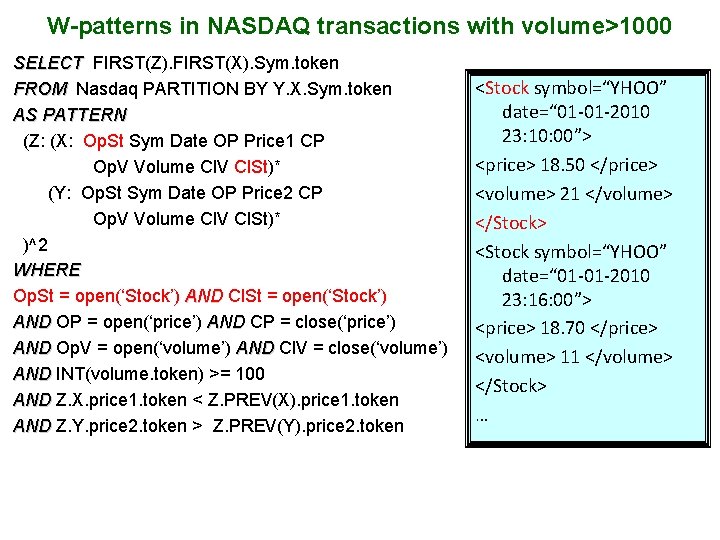
W-patterns in NASDAQ transactions with volume>1000 SELECT FIRST(Z). FIRST(X). Sym. token FROM Nasdaq PARTITION BY Y. X. Sym. token AS PATTERN (Z: (X: Op. St Sym Date OP Price 1 CP Op. V Volume Cl. V Cl. St)* (Y: Op. St Sym Date OP Price 2 CP Op. V Volume Cl. V Cl. St)* )^2 WHERE Op. St = open(‘Stock’) AND Cl. St = open(‘Stock’) AND OP = open(‘price’) AND CP = close(‘price’) AND Op. V = open(‘volume’) AND Cl. V = close(‘volume’) AND INT(volume. token) >= 100 AND Z. X. price 1. token < Z. PREV(X). price 1. token AND Z. Y. price 2. token > Z. PREV(Y). price 2. token <Stock symbol=“YHOO” date=“ 01 -01 -2010 23: 10: 00”> <price> 18. 50 </price> <volume> 21 </volume> </Stock> <Stock symbol=“YHOO” date=“ 01 -01 -2010 23: 16: 00”> <price> 18. 70 </price> <volume> 11 </volume> </Stock> …
W-patterns in NASDAQ transactions with volume>1000 SELECT FIRST(Z). FIRST(X). Sym. token FROM Nasdaq PARTITION BY Y. X. Sym. token AS PATTERN (Z: (X: Op. St Sym Date OP Price 1 CP Op. V Volume Cl. V Cl. St)* (Y: Op. St Sym Date OP Price 2 CP Op. V Volume Cl. V Cl. St)* )^2 WHERE Op. St = open(‘Stock’) AND Cl. St = open(‘Stock’) AND OP = open(‘price’) AND CP = close(‘price’) AND Op. V = open(‘volume’) AND Cl. V = close(‘volume’) AND INT(volume. token) >= 100 AND Z. X. price 1. token < Z. PREV(X). price 1. token AND Z. Y. price 2. token > Z. PREV(Y). price 2. token X* Y* <Stock symbol=“YHOO” date=“ 01 -01 -2010 23: 10: 00”> <price> 18. 50 </price> <volume> 21 </volume> </Stock> <Stock symbol=“YHOO” date=“ 01 -01 -2010 23: 16: 00”> <price> 18. 70 </price> <volume> 11 </volume> </Stock> …
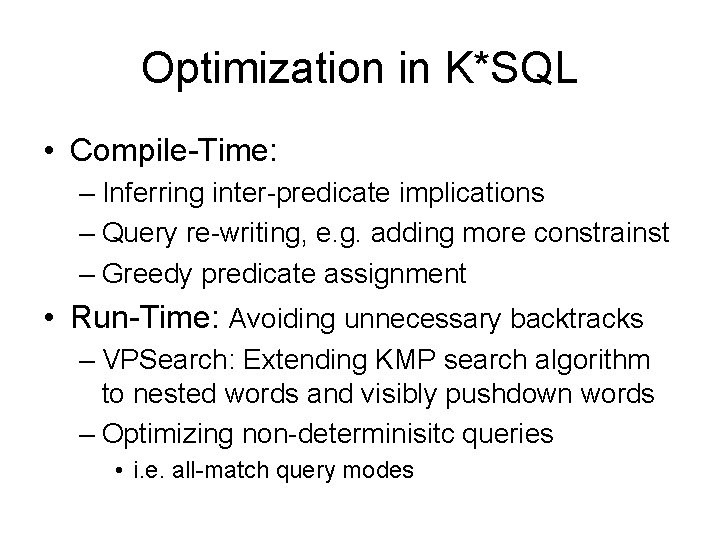
Optimization in K*SQL • Compile-Time: – Inferring inter-predicate implications – Query re-writing, e. g. adding more constrainst – Greedy predicate assignment • Run-Time: Avoiding unnecessary backtracks – VPSearch: Extending KMP search algorithm to nested words and visibly pushdown words – Optimizing non-determinisitc queries • i. e. all-match query modes
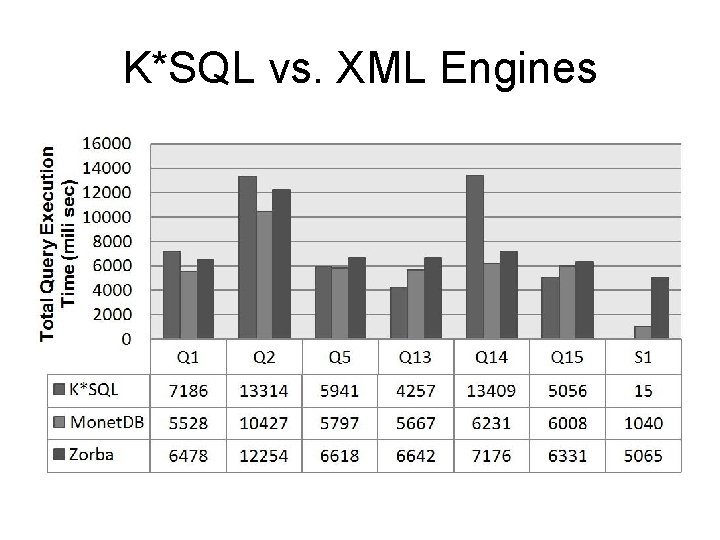
K*SQL vs. XML Engines
References • [1] Data mining: Staking a claim on your privacy. Information and Privacy Commissioner, Ontario, Jan. 1998. • [2] Directive on privacy protection. European Union, Oct. 1998. • [3] The end of privacy. The Economist, May 1999. • [4] Daniel J. Abadi, Donald Carney, Ugur C� etintemel, Mitch Cherniack, Christian Convey, C. Erwin, Eduardo F. Galvez, M. Hatoun, Anurag Maskey, Alex Rasin, A. Singer, Michael Stonebraker, Nesime Tatbul, Ying Xing, R. Yan, and Stanley B. Zdonik. Aurora: A data stream management system. In SIGMOD Conference, page 666, 2003. • [5] Mads Sig Ager, Olivier Danvy, and Henning Korsholm Rohde. Fast partial evaluation of pattern matching in strings. In PEPM, 2003. • [6] Jagrati Agrawal, Yanlei Diao, Daniel Gyllstrom, and Neil Immerman. E�cient pattern matching over event streams. In SIGMOD '08: Proceedings of the 2008 ACM SIGMOD international conference on Management of data, pages 147{160, New York, NY, USA, 2008. ACM.
References • [7] R. Agrawal and R. Srikant. Fast algorithms for mining association rules in large • databases. In VLDB, 1994. • [8] Rakesh Agrawal and Ramakrishnan Srikant. Privacypreserving data mining. In SIG • MOD, 2000. • [9] Shipra Agrawal, Vijay Krishnan, and Jayant R. Haritsa. On addressing e�ciency • concerns in privacy-preserving mining. In DASFAA, 2004. • [10] Rajeev Alur. Marrying words and trees. In PODS, 2007.
References • [11] Rajeev Alur, Marcelo Arenas, Pablo Barcelo, Kousha Etessami, Neil Immerman, and 1 Leonid Libkin. First-order and temporal logics for nestedwords. In LICS, 2007. • [12] Rajeev Alur, Swarat Chaudhuri, and P. Madhusudan. Languages of nested trees. In CAV, 2006. • [13] Rajeev Alur and P. Madhusudan. Visibly pushdown languages. In STOC, pages 202{ 211, 2004. • [14] Rajeev Alur and P. Madhusudan. Adding nesting structure to words. In Developments in Language Theory, pages 1{13, 2006. • [15] Arvind Arasu, Brian Babcock, Shivnath Babu, Mayur Datar, Keith Ito, Itaru Nishizawa, Justin Rosenstein, and Jennifer Widom. Stream: The stanford stream data manager. In SIGMOD, 2003. • [16] Brian Babcock, Mayur Datar, and Rajeev Motwani. Load shedding for aggregation queries over data streams. In ICDE '04: Proceedings of the 20 th International Conference on Data Engineering, page 350, Washington, DC, USA, 2004. IEEE Computer Society.
References • • [17] RICARDO A. BAEZA-YATES and GASTON H. GONNET. Fast text searching for regular expressions or automaton searching on tries. 1996. [18] Yijian Bai, Hetal Thakkar, Chang Luo, Haixun Wang, and Carlo Zaniolo. A data stream language and system designed for power and extensibility. In CIKM, pages 337{346, 2006. [19] Gerard Berry and Ravi Sethi. From regular expressions to deterministic automata. [20] Philip Bille and Martin Farach-Colton. Fast and compact regular expression matching. 2008. [21] Ronnie Chaiken, Bob Jenkins, Paul Larson, Bill Ramsey, Darren Shakib, Simon Weaver, and Jingren Zhou. Scope: Easy and e�cient parallel processing of massive data sets. VLDB, 29(2): 282{318, 2008. [22] Ronnie Chaiken, Bob Jenkins, Per-�Ake Larson, Bill Ramsey, Darren Shakib, Simon Weaver, and Jingren Zhou. Scope: easy and e�cient parallel processing of massive data sets. PVLDB, 1(2): 1265{1276, 2008. [23] Hei Chan and Adnan Darwiche. Sensitivity analysis in Bayesian networks: From single to multiple parameters. In 20'th Conference on Uncertainty in Arti�cial Intelligence (UAI), 2004.
References • • [24] Y. Chi, H. Wang, P. S. Yu, and R. R. Muntz. Moment: Maintaining closed frequent itemsets over a stream sliding window. In Proceedings of the 2004 IEEE International Conference on Data Mining (ICDM'04), November 2004. [25] Yun Chi, Philip S. Yu, Haixun Wang, and Richard R. Muntz. Loadstar: A load shedding scheme for classifying data streams. In SDM, 2005. [26] Alexandre Ev�mievski, Johannes Gehrke, and Ramakrishnan Srikant. Limiting privacy breaches in privacy preserving data mining. In PODS, 2003. [27] Sudipto Guha, Dimitrios Gunopulos, and Nick Koudas. Correlating synchronous and asynchronous data streams. In KDD, pages 529{534, 2003. [28] Daniel Gyllstrom, Eugene Wu 0002, Hee-Jin Chae, Yanlei Diao, Patrick Stahlberg, and Gordon Anderson. Sase: Complex event processing over streams. Co. RR, abs/cs/0612128, 2006. [29] J. Han, J. Pei, and Y. Yin. Mining frequent patterns without candidate generation. In SIGMOD, 2000. [30] HARUO HOSOYA, JERO ME VOUILLON, and BENJAMIN C. PIERCE. Regular expression types for xml. ACM Transactions on Programming Languages and Systems, 27(1): 46{90, January 2005. [31] Jeong-Hyon Hwang, Sanghoon Cha, Ugur C� etintemel, and Stanley B. Zdonik. Borealisr: a replication-transparent stream processing system for wide-area monitoring applications. In SIGMOD Conference, pages 1303{1306, 2008.
References • • [32] E. Keogh and M. Pazzani. Learning augmented bayesian classi�ers: A comparison of distribution-based and classi�cation-based approaches. In Int'l Workshop on AI and Statistics, 1999. [33] Donald E. Knuth, James H. Morris Jr. , and Vaughan R. Pratt. Fast pattern matching in strings. SIAM J. Comput. , 6(2): 323{350, 1977. [34] S. Rao Kosaraju. E�cient tree pattern matching. 1989. [35] Yan-Nei Law, Haixun Wang, and Carlo Zaniolo. Query languages and data models for database sequences and data streams. In VLDB, 2004. [36] Yan-Nei Law and Carlo Zaniolo. Improving the accuracy of continuous aggregates and mining queries on data streams under load shedding. [37] Yan- Nei Law and Carlo Zaniolo. Improving the accuracy of continuous aggregates and mining queries on data streams under load shedding. Int. J. Bus. Intell. Data Min. , 3(1): 99{117, 2008. [38] Jae. Gil Lee, Jiawei Han, Xiaolei Li, and Hector Gonzalez. Traclass: Trajectory classification using hierarchical regionbased and trajectorybased clustering. VLDB, 29(2): 282{ 318, 2008. [39] C. K. -S. Leung, Q. I. Khan, and T. Hoque. Cantree: A tree structure for efficient incremental mining of frequent patterns. In ICDM, 2005.
References • • [40] Feifei Li, Jimeng Sun, Spiros Papadimitriou, George A. Mihaila, and Ioana Stanoi. Hiding in the crowd: Privacy preservation on evolving streams through correlation tracking. In ICDE, pages 686{695, 2007. [41] Barzan Mozafari, Hetal Thakkar, and Carlo Zaniolo. Verifying and mining frequent patterns from large windows over data streams. In the 24 th International Conference on Data Engineering (ICDE), 2008. [42] Barzan Mozafari and Carlo Zaniolo. Publishing naive bayesian classi�ers: Pri without accuracy loss. In the 35 th International Conference on Very Large Data Bases (VLDB), 2009. [43] Barzan Mozafari and Carlo Zaniolo. A scalable algorithm for optimal load shedding with aggregates and mining queries. In Under review process, 2009. [44] Gonzalo Navarro and Mathieu Rafnot. Fast regular expression search. WAE, pages 198{212, 1999. [45] Christopher Olston, Benjamin Reed, Utkarsh Srivastava, Ravi Kumar, and Andrew Tomkins. Pig latin: a not-so-foreign language for data processing. In Jason Tsong-Li Wang, editor, SIGMOD Conference, pages 1099{1110. ACM, 2008. [46] Jian Pei, Jiawei Han, Behzad Mortazavi-Asl, Jianyong Wang, Helen Pinto, Qiming Chen, Umeshwar Dayal, and M. Hsu. Mining sequential patterns by patterngrowth: The Prefix. Span approach. IEEE TKDE, 16(11): 1424{1440, November 2004.
References • [47] Vibhor Rastogi, Sungho Hong, and Dan Suciu. The boundary between privacy and utility in data publishing. In VLDB, 2007. 34 • [48] Reza Sadri, Carlo Zaniolo, Amir M. Zarkesh, and Jafar Adibi. A sequential pattern query language for supporting instant data mining for e-services. In VLDB, pages 653{656, 2001. • [49] Reza Sadri, Carlo Zaniolo, Amir M. Zarkesh, and Jafar Adibi. Expressing and optimizing sequence queries in database systems. ACM Trans. Database Syst. , 29(2): 282{318, 2004. • [50] Nesime Tatbul, Ugur C� etintemel, Stanley B. Zdonik, Mitch Cherniack, and Michael Stonebraker. Load shedding in a data stream manager. In VLDB, pages 309{320, 2003. • [51] Nesime Tatbul and Stanley B. Zdonik. Window-aware load shedding for aggregation queries over data streams. In VLDB, pages 799{810, 2006.
References • • • [52] Hetal Thakkar, Barzan Mozafari, and Carlo Zaniolo. A data stream mining system. In ICDM, pages 79{88, 2008. [53] Hetal Thakkar, Barzan Mozafari, and Carlo Zaniolo. Designing an inductive data stream management system: the stream mill experience. In SSPS in conjunction with EDBT, pages 79{88, 2008. [54] Yi-Cheng Tu, Song Liu, Sunil Prabhakar, and Bin Yao. Load shedding in stream databases: A control-based approach. In VLDB, pages 787{798, 2006. [55] Haixun Wang, Carlo Zaniolo, and Chang Luo. Atlas: A small but complete sql extension for data mining and data streams. In VLDB, pages 1113{1116, 2003. [56] J. T. Yao and M. Zhang. A fast tree pattern matching algorithm for xml query. [57] Fred Zemke, Andrew Witkowski, Mitch Cherniak, and Latha Colby. Pattern matching in sequences of rows. In [sql change proposal, march 2007], http: //asktom. oracle. com/tkyte/row-patternrecogniton-11 -public. pdf