
UC BERKELEY Intro to AMPLab and Berkeley Data
UC BERKELEY Intro to AMPLab and Berkeley Data Analytics Stack Ion Stoica UC Berkeley
A Brief History… AMPCamp 1 (August, 2012) » 150 campers (3, 000+ online) AMPCamp 2 (February, 2013) » Full-Day Strata Tutorial » Sold-out hands-on tutorial AMPCamp 3 (Today and Tomorrow) » 250 capers (sold-out)
What is Big Data used For? Reports, e. g. , » Track business processes, transactions Diagnosis, e. g. , » Why is user engagement dropping? » Why is the system slow? » Detect spam, worms, viruses, DDo. S attacks Decisions, e. g. , » Personalized medical treatment » Decide what feature to add to a product » Decide what ads to show Data is only as useful as the decisions it enables
Data Processing Goals Low latency (interactive) queries on historical data: enable faster decisions » E. g. , identify why a site is slow and fix it Low latency queries on live data (streaming): enable decisions on real-time data » E. g. , detect & block worms in real-time (a worm may infect 1 mil hosts in 1. 3 sec) Sophisticated data processing: enable “better” decisions » E. g. , anomaly detection, trend analysis
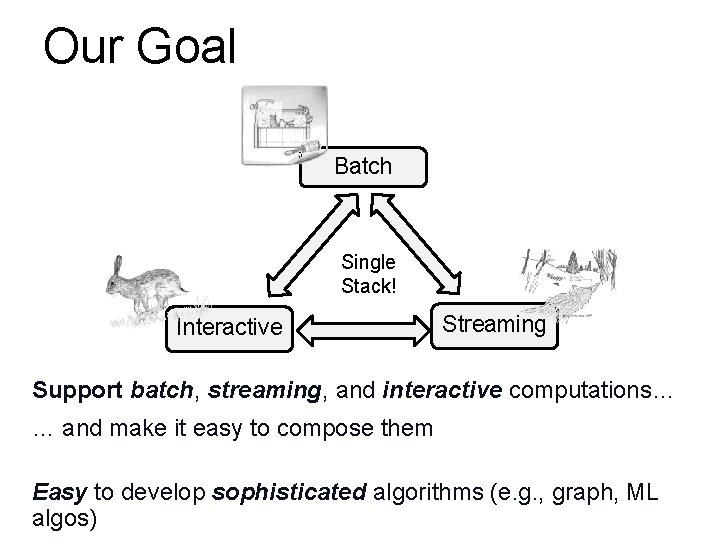
Our Goal Batch Single Stack! Interactive Streaming Support batch, streaming, and interactive computations… … and make it easy to compose them Easy to develop sophisticated algorithms (e. g. , graph, ML algos)
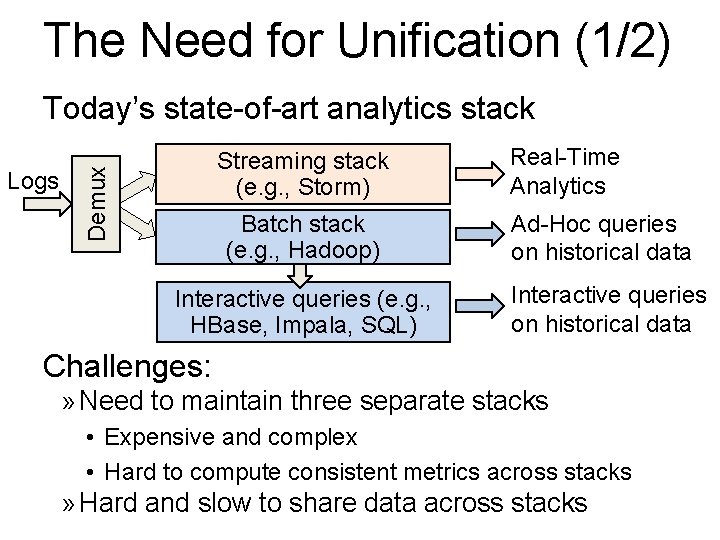
The Need for Unification (1/2) Today’s state-of-art analytics stack Demux Logs Streaming stack (e. g. , Storm) Batch stack (e. g. , Hadoop) Interactive queries (e. g. , HBase, Impala, SQL) Real-Time Analytics Ad-Hoc queries on historical data Interactive queries on historical data Challenges: » Need to maintain three separate stacks • Expensive and complex • Hard to compute consistent metrics across stacks » Hard and slow to share data across stacks
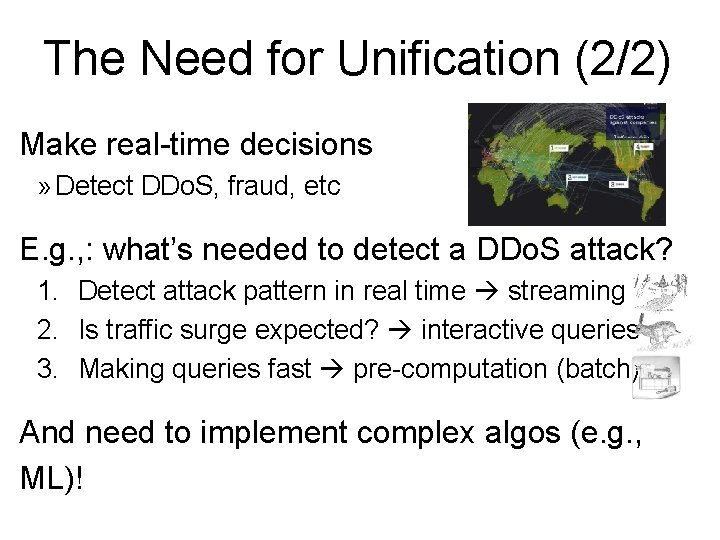
The Need for Unification (2/2) Make real-time decisions » Detect DDo. S, fraud, etc E. g. , : what’s needed to detect a DDo. S attack? 1. Detect attack pattern in real time streaming 2. Is traffic surge expected? interactive queries 3. Making queries fast pre-computation (batch) And need to implement complex algos (e. g. , ML)!
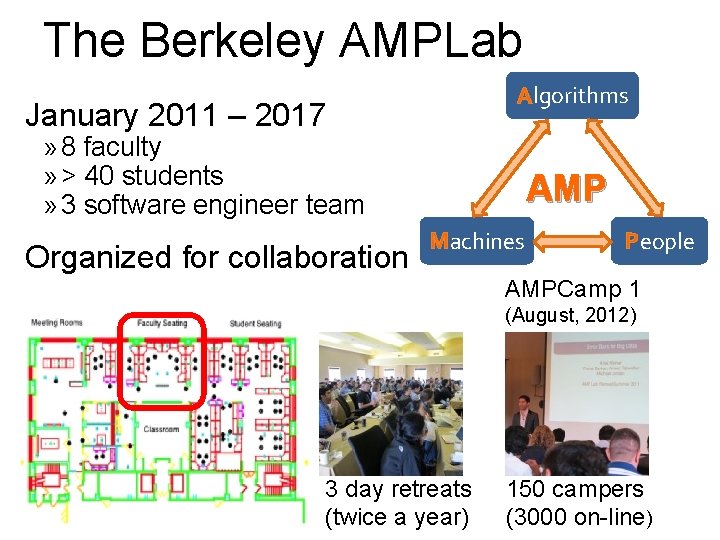
The Berkeley AMPLab Algorithms January 2011 – 2017 » 8 faculty » > 40 students » 3 software engineer team Organized for collaboration AMP Machines People AMPCamp 1 (August, 2012) 3 day retreats (twice a year) 150 campers (3000 on-line)
The Berkeley AMPLab Governmental and industrial funding: Goal: Next generation of open source data analytics stack for industry & academia: Berkeley Data Analytics Stack (BDAS)
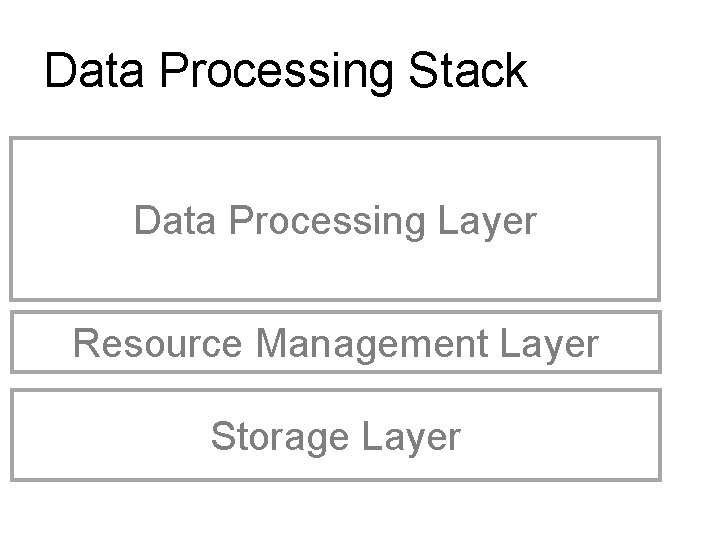
Data Processing Stack Data Processing Layer Resource Management Layer Storage Layer
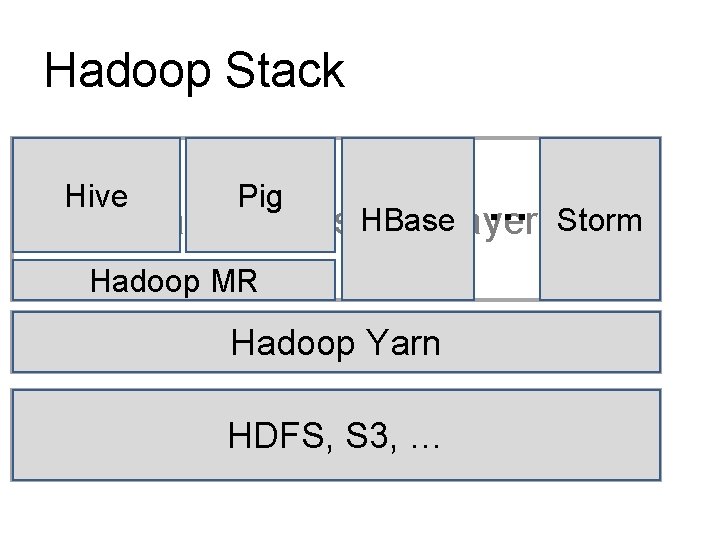
Hadoop Stack Hive Data Pig … HBase Processing Layer Storm Hadoop MR Yarn Resource. Hadoop Management Layer HDFS, S 3, … Storage Layer
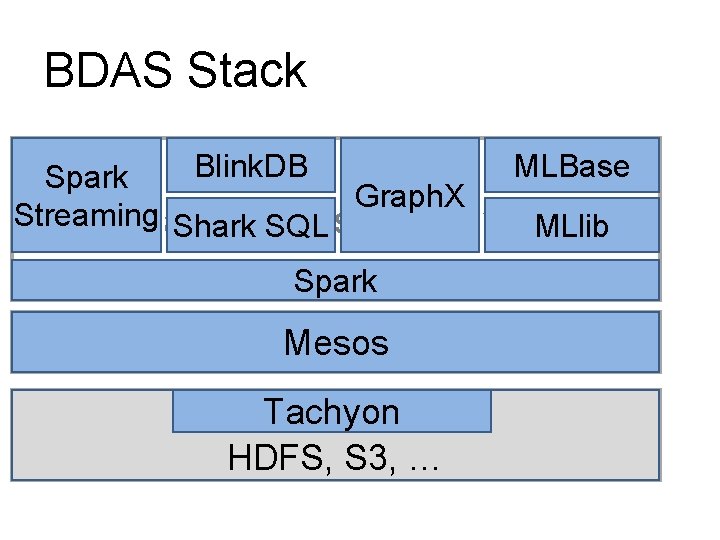
BDAS Stack MLBase Blink. DB Spark Graph. X Streaming Data Processing Layer. MLlib Shark SQL Spark Mesos Resource Management Layer Tachyon Storage Layer HDFS, S 3, …
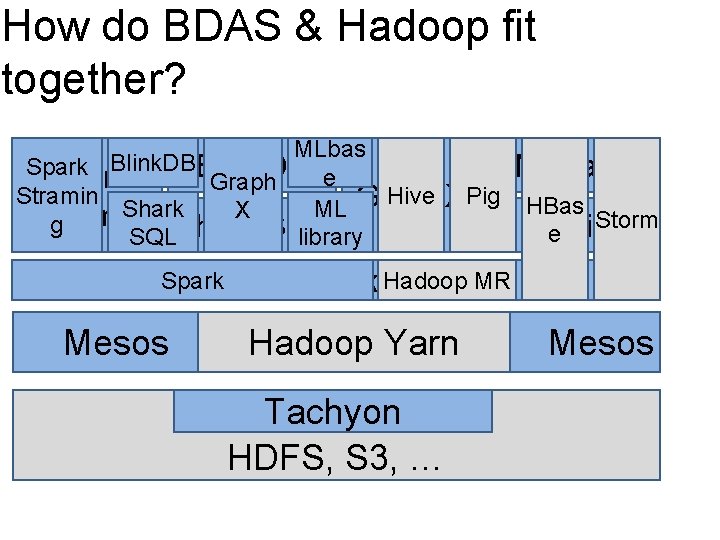
How do BDAS & Hadoop fit together? MLbas Blink. DB Spark Blink. DB e Spark Graph Hive Pig Stramin Graph. X Shark ML X Streaming g SQLShark SQL library Spark Mesos MLBase HBas Storm MLlib e Spark Hadoop MR Hadoop Yarn Tachyon HDFS, S 3, … Mesos
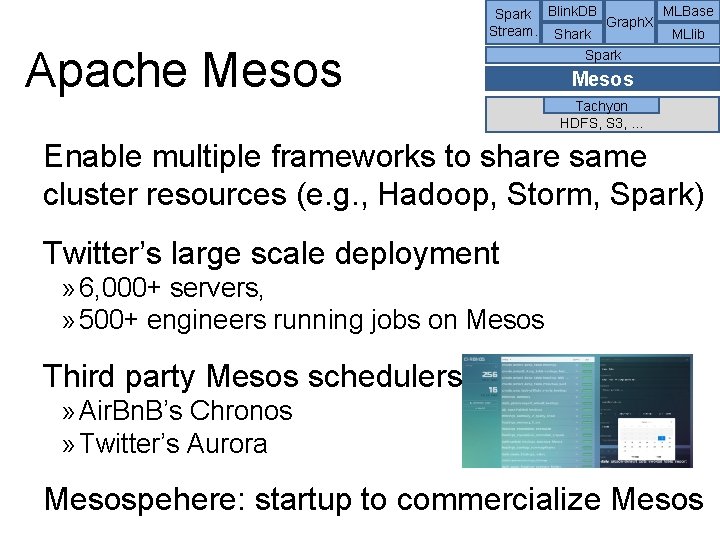
MLBase Spark Blink. DB Graph. X Stream. Shark MLlib Apache Mesos Spark Mesos Tachyon HDFS, S 3, … Enable multiple frameworks to share same cluster resources (e. g. , Hadoop, Storm, Spark) Twitter’s large scale deployment » 6, 000+ servers, » 500+ engineers running jobs on Mesos Third party Mesos schedulers » Air. Bn. B’s Chronos » Twitter’s Aurora Mesospehere: startup to commercialize Mesos
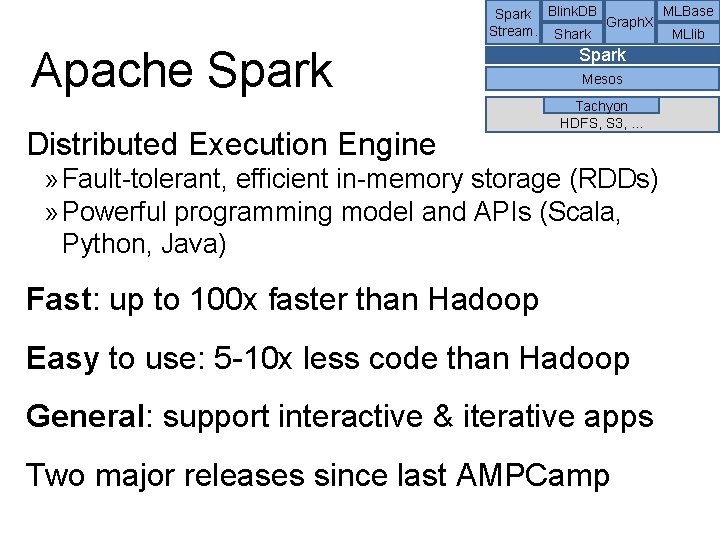
MLBase Spark Blink. DB Graph. X Stream. Shark MLlib Apache Spark Distributed Execution Engine Spark Mesos Tachyon HDFS, S 3, … » Fault-tolerant, efficient in-memory storage (RDDs) » Powerful programming model and APIs (Scala, Python, Java) Fast: up to 100 x faster than Hadoop Easy to use: 5 -10 x less code than Hadoop General: support interactive & iterative apps Two major releases since last AMPCamp
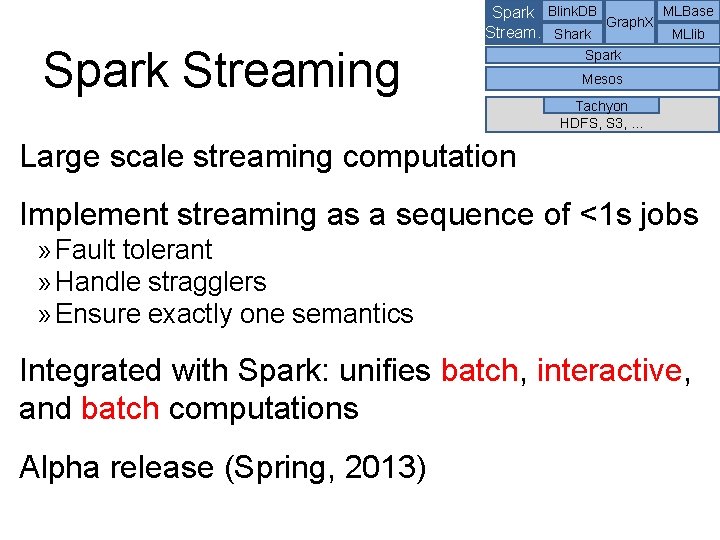
MLBase Spark Blink. DB Graph. X Stream. Shark MLlib Spark Streaming Spark Mesos Tachyon HDFS, S 3, … Large scale streaming computation Implement streaming as a sequence of <1 s jobs » Fault tolerant » Handle stragglers » Ensure exactly one semantics Integrated with Spark: unifies batch, interactive, and batch computations Alpha release (Spring, 2013)
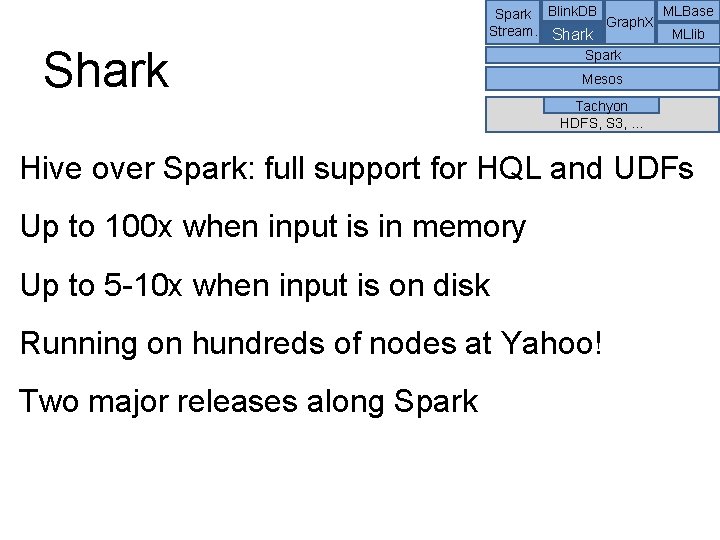
MLBase Spark Blink. DB Graph. X Stream. Shark MLlib Shark Spark Mesos Tachyon HDFS, S 3, … Hive over Spark: full support for HQL and UDFs Up to 100 x when input is in memory Up to 5 -10 x when input is on disk Running on hundreds of nodes at Yahoo! Two major releases along Spark
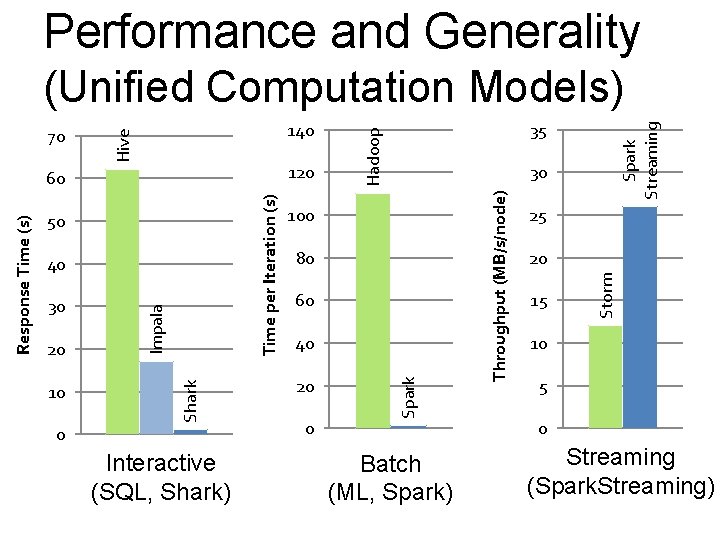
Performance and Generality (Unified Computation Models) 20 10 Shark 0 Interactive (SQL, Shark) 80 60 40 20 0 Batch (ML, Spark) Spark Streaming 25 20 15 Storm 30 100 Spark Time per Iteration (s) 40 Impala Response Time (s) 50 30 Throughput (MB/s/node) 120 60 35 Hadoop 140 Hive 70 10 5 0 Streaming (Spark. Streaming)
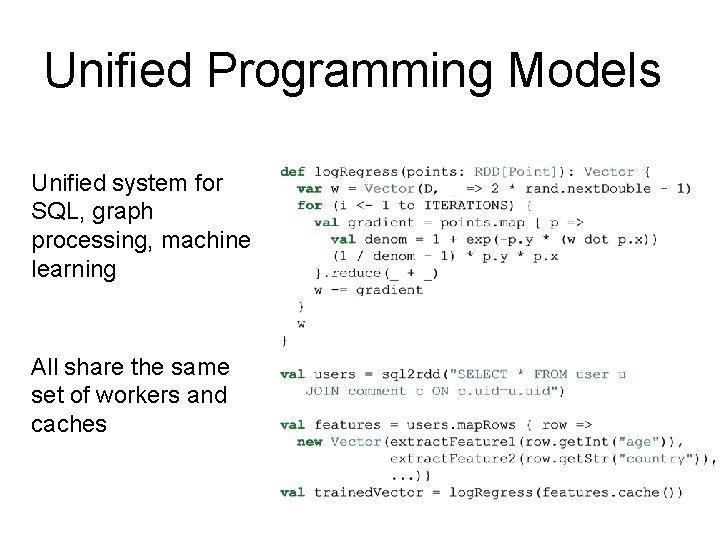
Unified Programming Models Unified system for SQL, graph processing, machine learning All share the same set of workers and caches
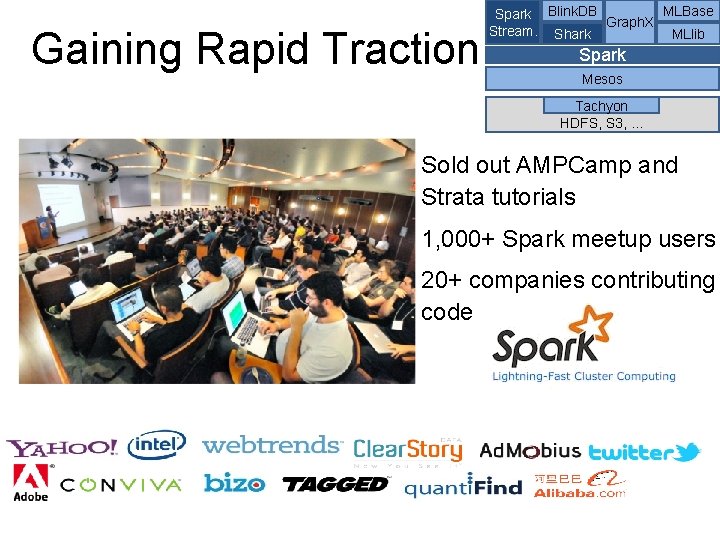
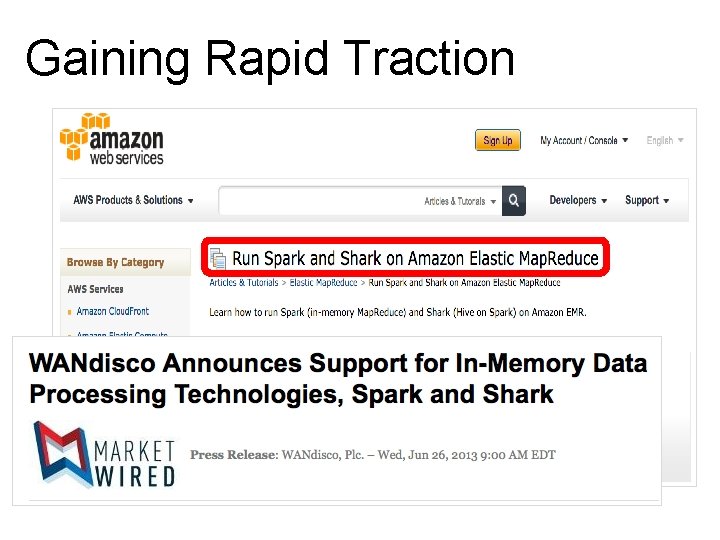
Gaining Rapid Traction MLBase Spark Blink. DB Graph. X Stream. Shark MLlib Spark Mesos Tachyon HDFS, S 3, … Sold out AMPCamp and Strata tutorials 1, 000+ Spark meetup users 20+ companies contributing code
Gaining Rapid Traction
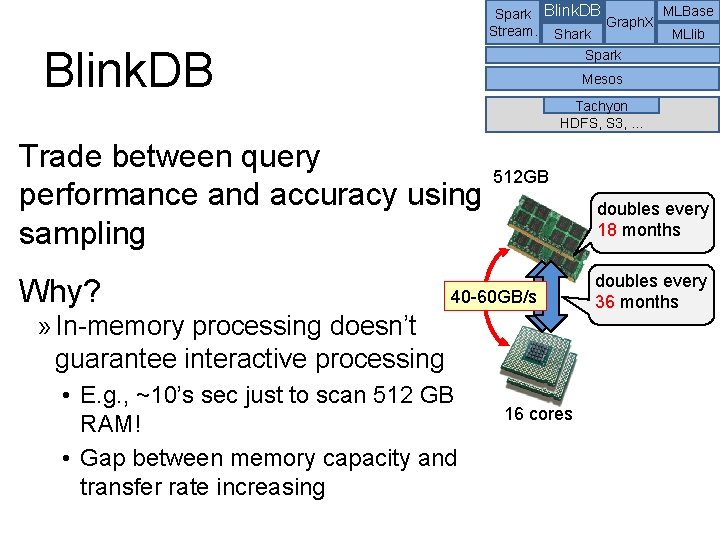
MLBase Spark Blink. DB Graph. X Stream. Shark MLlib Blink. DB Spark Mesos Tachyon HDFS, S 3, … Trade between query performance and accuracy using sampling Why? 512 GB doubles every 18 months 40 -60 GB/s » In-memory processing doesn’t guarantee interactive processing • E. g. , ~10’s sec just to scan 512 GB RAM! • Gap between memory capacity and transfer rate increasing 16 cores doubles every 36 months
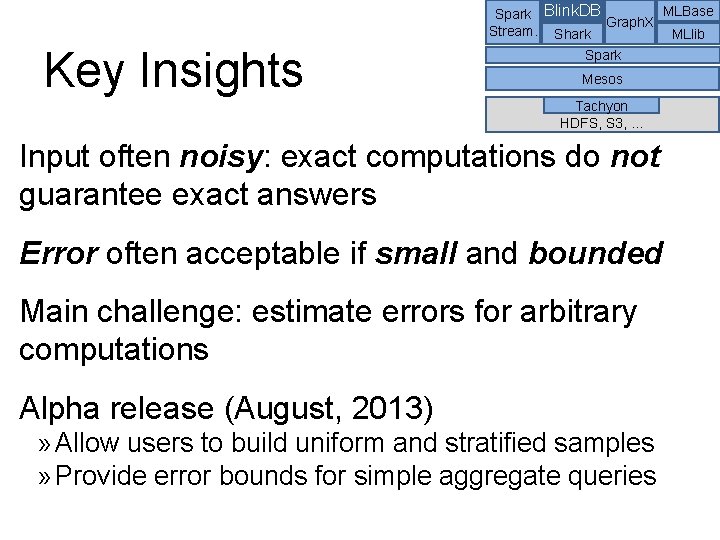
MLBase Spark Blink. DB Graph. X Stream. Shark MLlib Key Insights Spark Mesos Tachyon HDFS, S 3, … Input often noisy: exact computations do not guarantee exact answers Error often acceptable if small and bounded Main challenge: estimate errors for arbitrary computations Alpha release (August, 2013) » Allow users to build uniform and stratified samples » Provide error bounds for simple aggregate queries
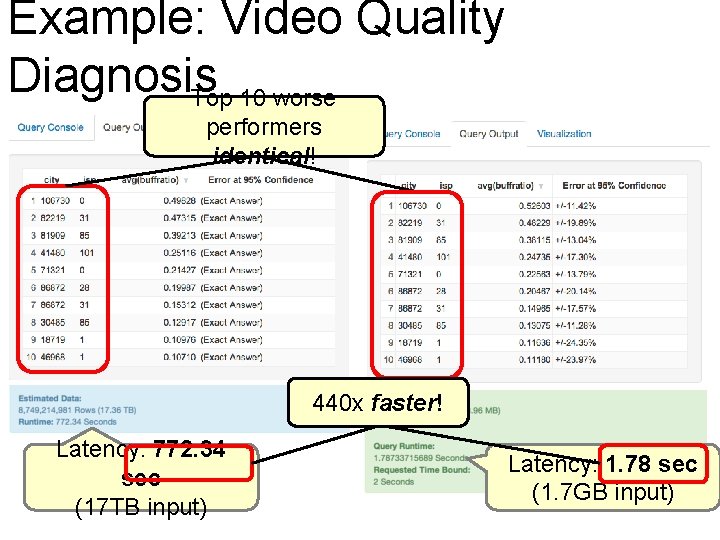
Example: Video Quality Diagnosis Top 10 worse performers identical! 440 x faster! Latency: 772. 34 sec (17 TB input) Latency: 1. 78 sec (1. 7 GB input)
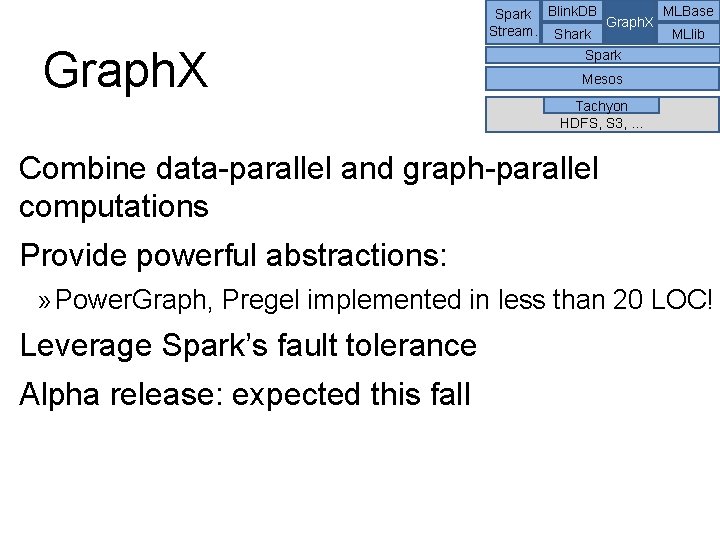
MLBase Spark Blink. DB Graph. X Stream. Shark MLlib Graph. X Spark Mesos Tachyon HDFS, S 3, … Combine data-parallel and graph-parallel computations Provide powerful abstractions: » Power. Graph, Pregel implemented in less than 20 LOC! Leverage Spark’s fault tolerance Alpha release: expected this fall
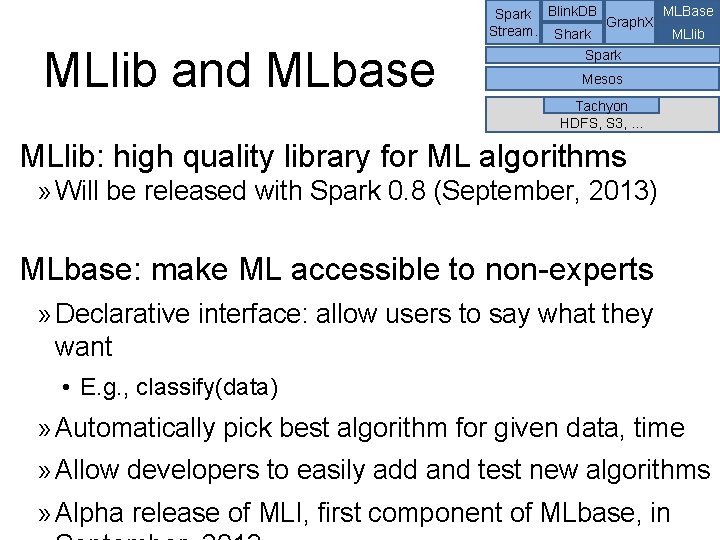
MLBase Spark Blink. DB Graph. X Stream. Shark MLlib and MLbase Spark Mesos Tachyon HDFS, S 3, … MLlib: high quality library for ML algorithms » Will be released with Spark 0. 8 (September, 2013) MLbase: make ML accessible to non-experts » Declarative interface: allow users to say what they want • E. g. , classify(data) » Automatically pick best algorithm for given data, time » Allow developers to easily add and test new algorithms » Alpha release of MLI, first component of MLbase, in
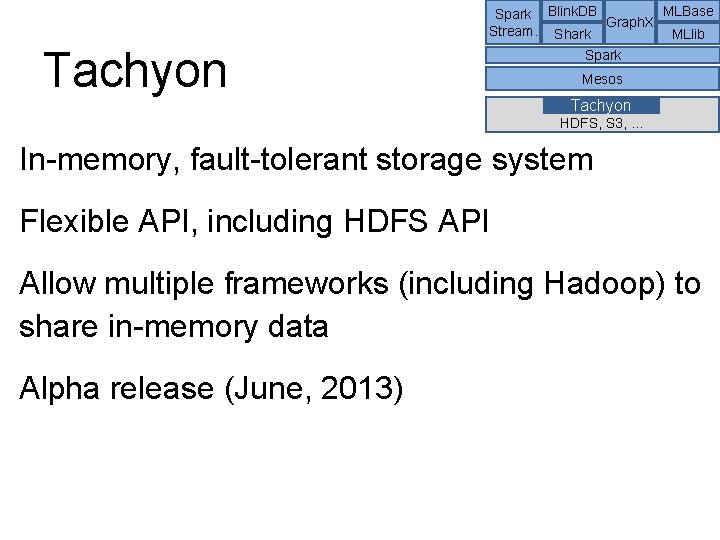
MLBase Spark Blink. DB Graph. X Stream. Shark MLlib Tachyon Spark Mesos Tachyon HDFS, S 3, … In-memory, fault-tolerant storage system Flexible API, including HDFS API Allow multiple frameworks (including Hadoop) to share in-memory data Alpha release (June, 2013)
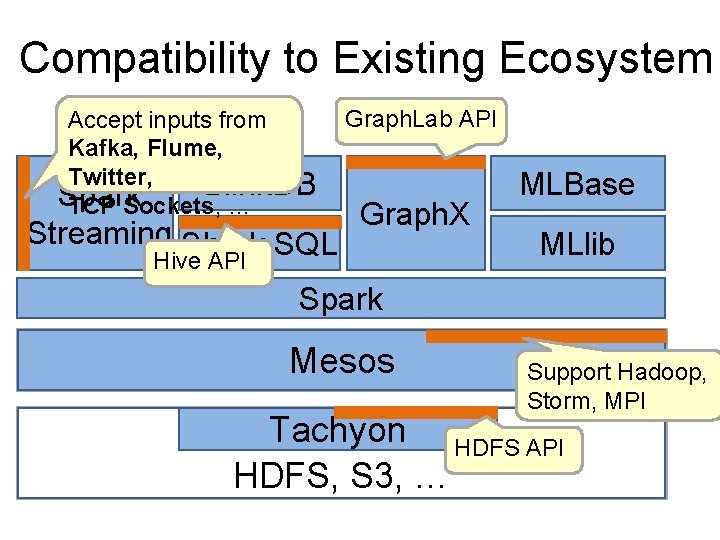
Compatibility to Existing Ecosystem Accept inputs from Kafka, Flume, Twitter, Blink. DB Spark TCP Sockets, … Streaming Shark SQL Graph. Lab API Graph. X Hive API MLBase MLlib Spark Mesos Resource Management Layer Support Hadoop, Storm, MPI Tachyon HDFS API Storage Layer HDFS, S 3, …
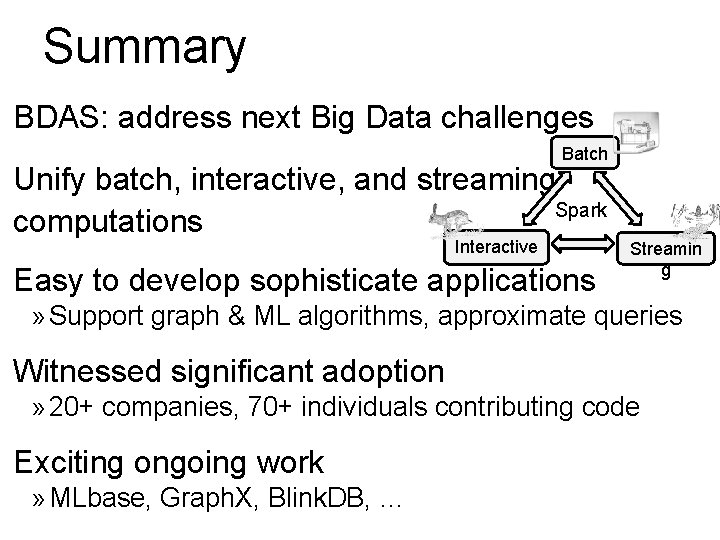
Summary BDAS: address next Big Data challenges Batch Unify batch, interactive, and streaming Spark computations Interactive Easy to develop sophisticate applications Streamin g » Support graph & ML algorithms, approximate queries Witnessed significant adoption » 20+ companies, 70+ individuals contributing code Exciting ongoing work » MLbase, Graph. X, Blink. DB, …
AMPCamp Schedule (Today) Rest of this session: AMPCamp Curriculum, Mesos 10: 45 -12: 45 pm: Spark, Shark, and Spark Streaming 12: 45 -2 pm: Lunch 2 -4: 30 pm: Hand-on exercises (Spark, Shark, Spark Streaming) 5 -6: 30 pm: User presentations (Conviva, Ooyala, Yahoo!)
AMPCamp Schedule (Tomorrow) 9 -10: 15 pm: Blink. DB, MLbase 10: 45 -12: 45 pm: Hand-on exercises (Blink. DB, MLbase, Mesos) 12: 45 -2: 15 pm: Lunch 2: 15 -3: 15 pm: Introduction to Tachyon and Garph. X 3: 15 -3: 30 pm: Wrap Up and Concluding Remarks
- Slides: 31