
UAH Can Ultralight Sails be made from Dust
UAH Can Ultralight Sails be made from Dust? Robert Sheldon 1, Dennis Gallagher 2, Mark Adrian 2, Paul Craven 2, Ed Thomas 3, Jr. 1 University of Alabama in Huntsville, 2 National Space Science and Technology Center, 3 Auburn University Advanced Propulsion Workshop April 4, 2001
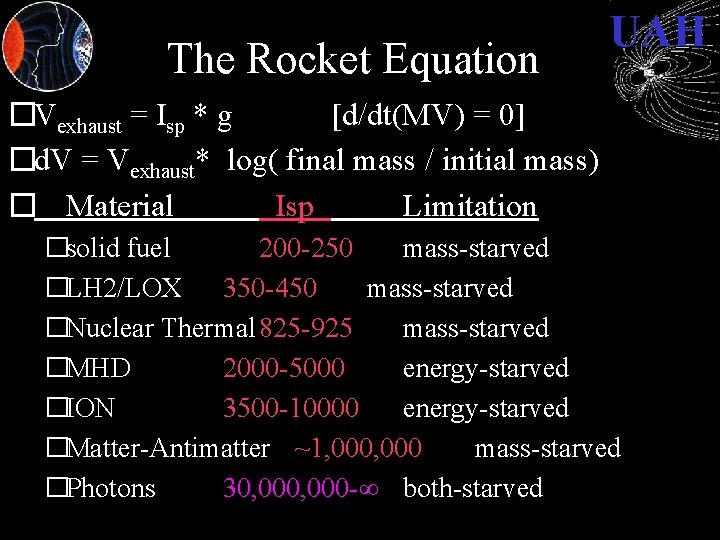
The Rocket Equation UAH �Vexhaust = Isp * g [d/dt(MV) = 0] �d. V = Vexhaust* log( final mass / initial mass) � Material Isp Limitation �solid fuel 200 -250 mass-starved �LH 2/LOX 350 -450 mass-starved �Nuclear Thermal 825 -925 mass-starved �MHD 2000 -5000 energy-starved �ION 3500 -10000 energy-starved �Matter-Antimatter ~1, 000 mass-starved �Photons 30, 000 -¥ both-starved
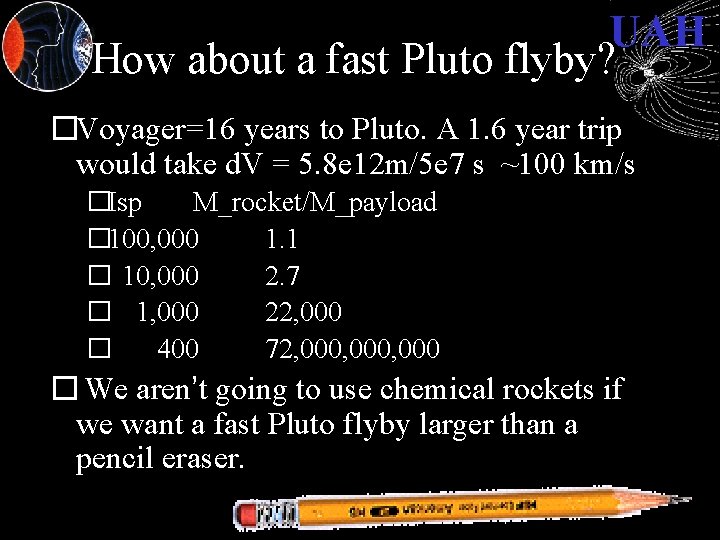
UAH How about a fast Pluto flyby? �Voyager=16 years to Pluto. A 1. 6 year trip would take d. V = 5. 8 e 12 m/5 e 7 s ~100 km/s �Isp M_rocket/M_payload � 100, 000 1. 1 � 10, 000 2. 7 � 1, 000 22, 000 � 400 72, 000, 000 � We aren’t going to use chemical rockets if we want a fast Pluto flyby larger than a pencil eraser.
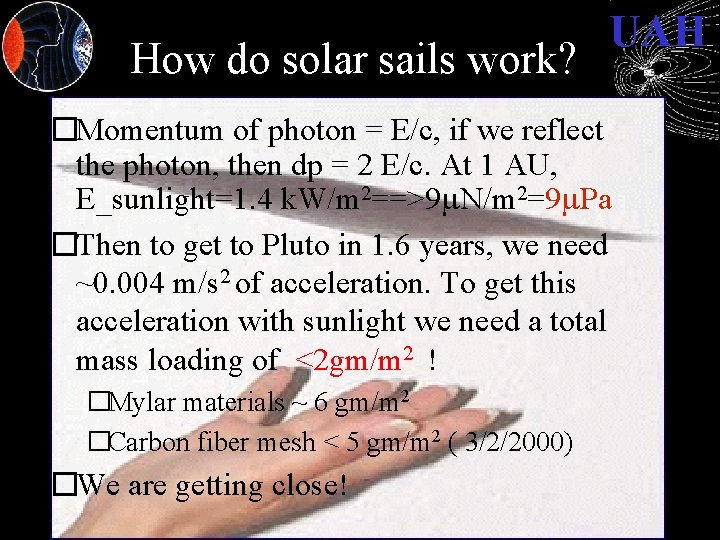
How do solar sails work? UAH �Momentum of photon = E/c, if we reflect the photon, then dp = 2 E/c. At 1 AU, E_sunlight=1. 4 k. W/m 2==>9 m. N/m 2=9 m. Pa �Then to get to Pluto in 1. 6 years, we need ~0. 004 m/s 2 of acceleration. To get this acceleration with sunlight we need a total mass loading of <2 gm/m 2 ! �Mylar materials ~ 6 gm/m 2 �Carbon fiber mesh < 5 gm/m 2 ( 3/2/2000) �We are getting close!
Issues in Solar Sails UAH �Mass loading of reflective foils �Albedo or reflectivity of thin foils �Deployment of thin films �Extra mass of booms, deployers, etc �Survival of thin films in hostile environment of UV, flares, particle radiation, charging �"packageability, areal density, structural stability, deployability, controllability, and scalability. . . strength, modulus, areal density, reflectivity, emissivity, electrical conductivity, thermal tolerance, toughness, and radiation sensitivity. " Gossamer AO
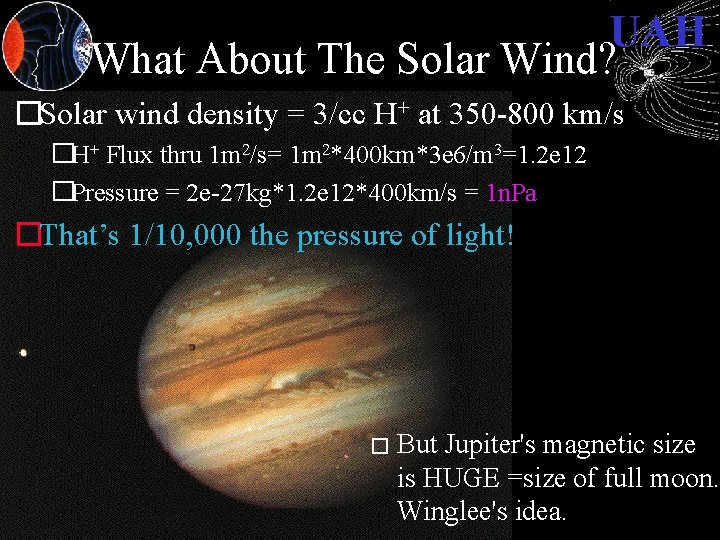
UAH What About The Solar Wind? �Solar wind density = 3/cc H+ at 350 -800 km/s �H+ Flux thru 1 m 2/s= 1 m 2*400 km*3 e 6/m 3=1. 2 e 12 �Pressure = 2 e-27 kg*1. 2 e 12*400 km/s = 1 n. Pa �That’s 1/10, 000 the pressure of light! � But Jupiter's magnetic size is HUGE =size of full moon. Winglee's idea.

Plasma Sail Capabilities UAH � It isn’t pressure, it’s acceleration we want. A plasma sail that is lighter than a solar sail will achieve higher acceleration � Magnetic fields don’t weigh much for their size. � Trapped plasma inflates the magnetic field, e. g. Jupiter is pumped up by Io. � Robust
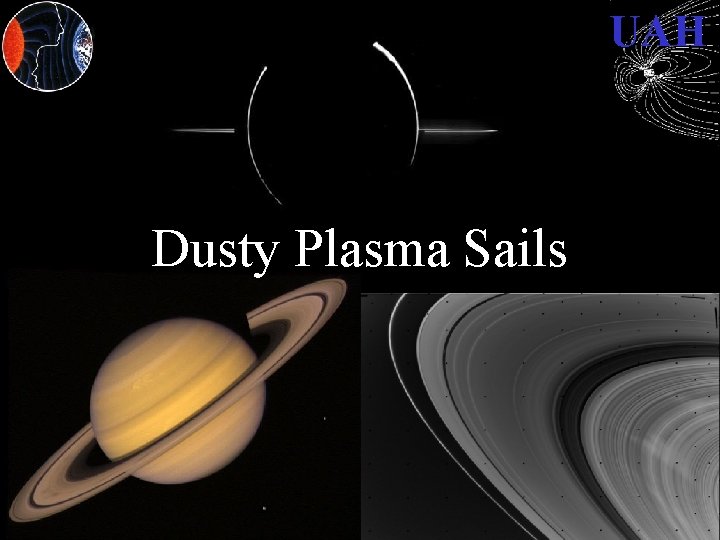
UAH Dusty Plasma Sails
Hybrid Vigour UAH � Q: Can we combine a sunlight sail having high light pressure, with a robust plasma sail (M 2 P 2) having easy deployment? � A: Yes, by suspending opaque material in M 2 P 2. � For each 1% change in albedo, we increase thrust by 50 X compared to solar wind alone (at Earth orbit). � Optically thick plasma < 1% opacity, dust is better. � Q: Can we suspend dust in a plasma sail (M 2 P 2)? � A: Several experiments have already demonstrated the feasibility.
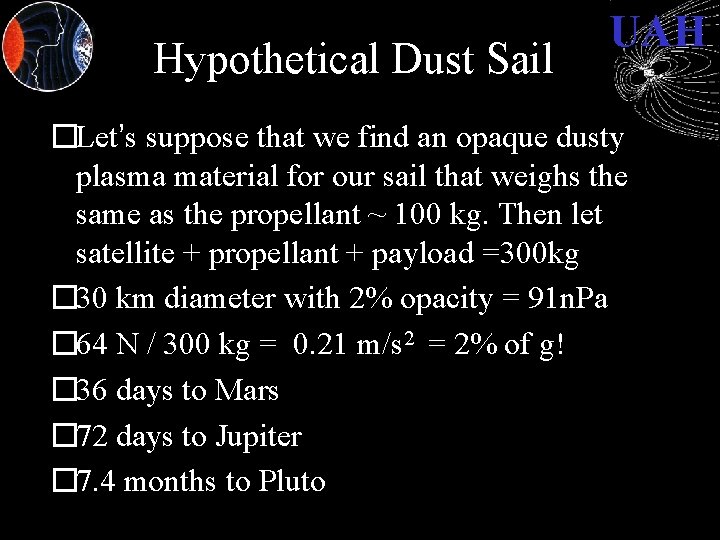
Hypothetical Dust Sail UAH �Let’s suppose that we find an opaque dusty plasma material for our sail that weighs the same as the propellant ~ 100 kg. Then let satellite + propellant + payload =300 kg � 30 km diameter with 2% opacity = 91 n. Pa � 64 N / 300 kg = 0. 21 m/s 2 = 2% of g! � 36 days to Mars � 72 days to Jupiter � 7. 4 months to Pluto
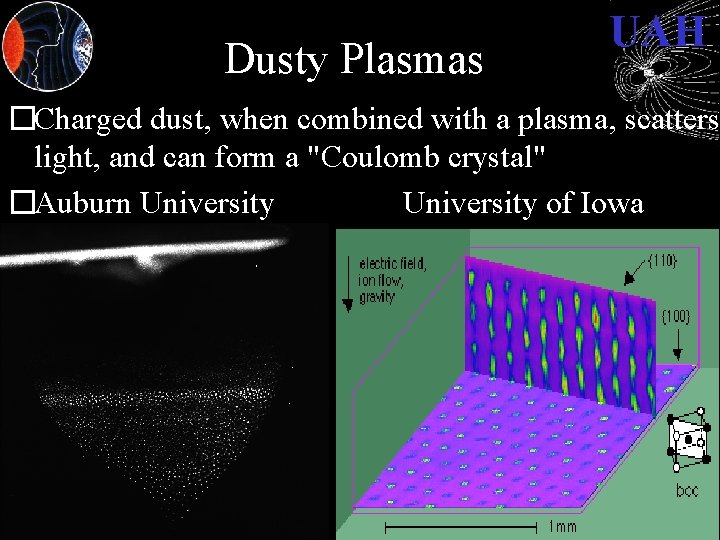
Dusty Plasmas UAH �Charged dust, when combined with a plasma, scatters light, and can form a "Coulomb crystal" �Auburn University of Iowa
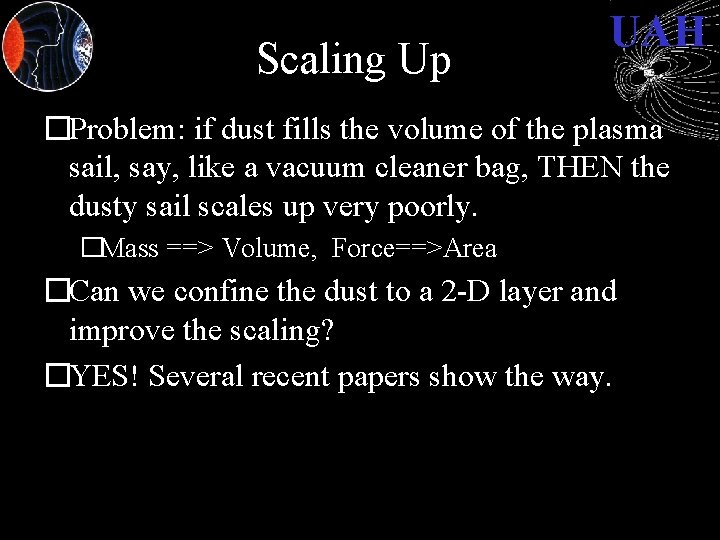
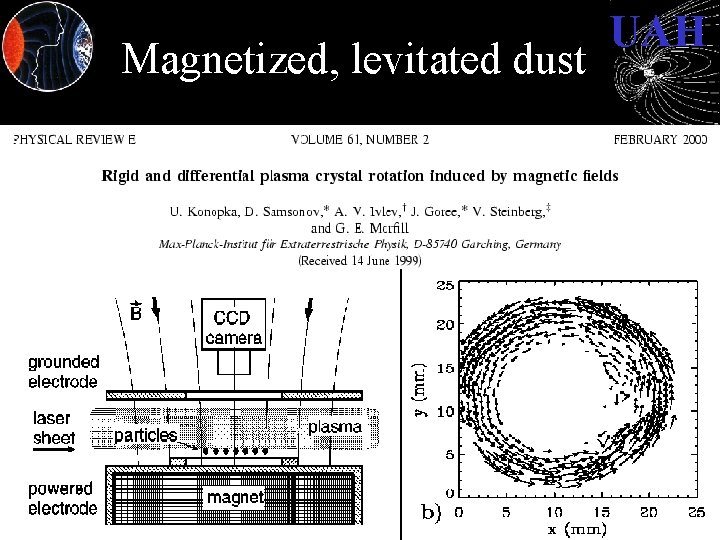
Scaling Up UAH �Problem: if dust fills the volume of the plasma sail, say, like a vacuum cleaner bag, THEN the dusty sail scales up very poorly. �Mass ==> Volume, Force==>Area �Can we confine the dust to a 2 -D layer and improve the scaling? �YES! Several recent papers show the way.
Magnetized, levitated dust UAH
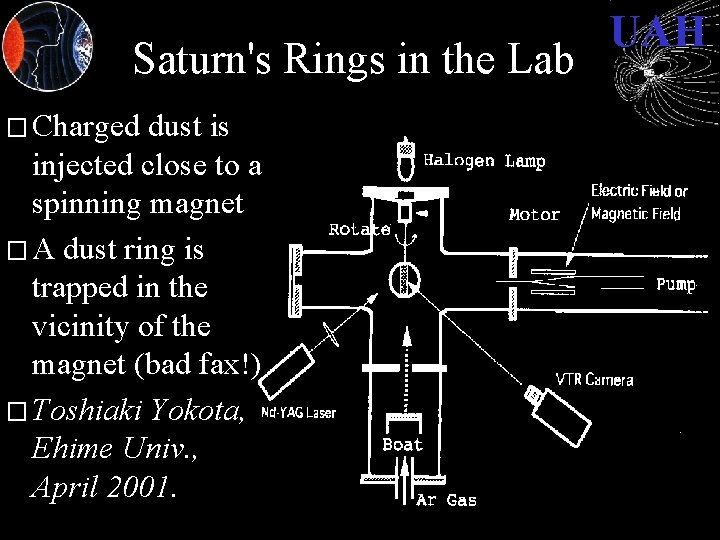
Saturn's Rings in the Lab � Charged dust is injected close to a spinning magnet � A dust ring is trapped in the vicinity of the magnet (bad fax!) � Toshiaki Yokota, Ehime Univ. , April 2001. UAH
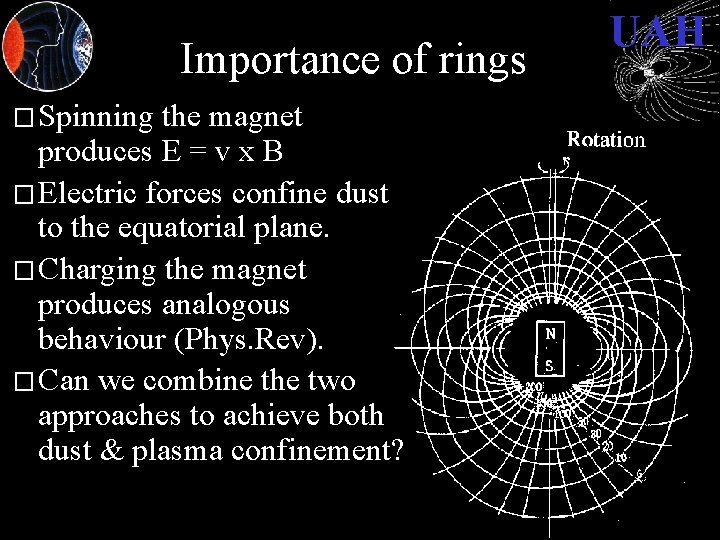
Importance of rings � Spinning the magnet produces E = v x B � Electric forces confine dust to the equatorial plane. � Charging the magnet produces analogous behaviour (Phys. Rev). � Can we combine the two approaches to achieve both dust & plasma confinement? UAH
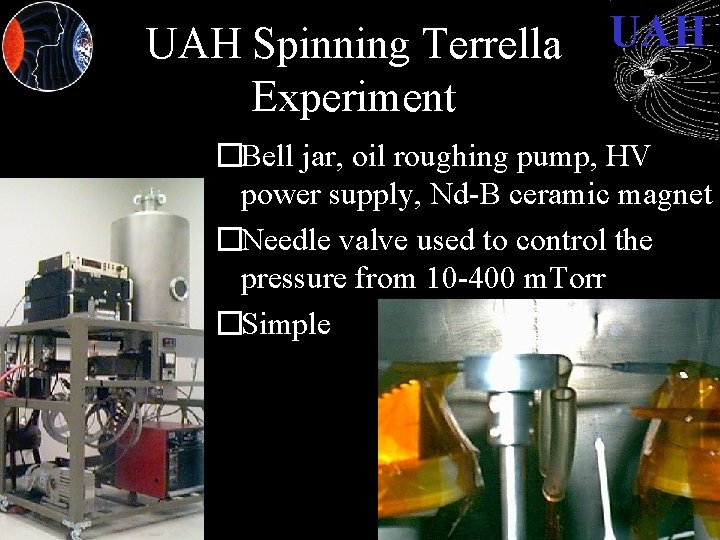
UAH Spinning Terrella Experiment UAH �Bell jar, oil roughing pump, HV power supply, Nd-B ceramic magnet �Needle valve used to control the pressure from 10 -400 m. Torr �Simple
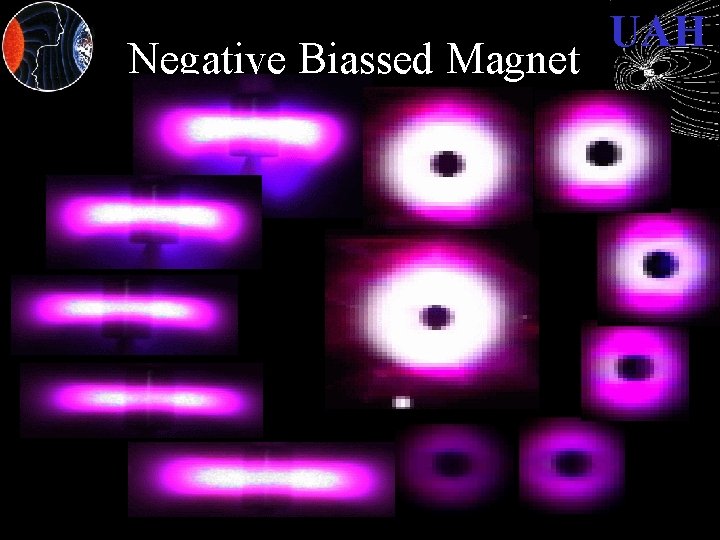
Negative Biassed Magnet UAH
Adding Dust? UAH �We’ve discovered that levitating dust is still a black art, and we are still in the dark. �We’ve tried 3 micron Si. O 2, Xerox toner (carbon polymer) without success. Our ionization method (which others have used) was plasma arcing. However, our system runs hot, fusing the dust. �We are modifying the experiment to add a UV light source, as a gentler ionization technique. �We emphasize that our approach is unsophisticated and LOTS (Lowes-off-the-shelf). One shouldn’t conclude that a better organized effort wouldn’t be successful.
Future Directions UAH �Can we make the dust lighter and more reflective? Perhaps buckeyballs with chelated sodium atoms. Or even reflective ions - e. g. , transition metal ions. This is fundamental research into scattering cross sections. �Is there an optimum size dust grain? We have used 3 micron Si. O 2, and Xerox toner. Yokota used 0. 5 micron Al dust. �What are the differences between spinning the magnet and applying a potential? Is there an optimum combination?
Conclusions UAH �While apparently "one-way", it can be combined with gravity assist, momentum-tethers, etc to provide complete round-trip travel to the planets. �What a dusty sail lacks in efficiency, it makes up for in deployment, weight, and durability, giving a new meaning to the word "gossamer". �Dusty plasma sails may be the fastest way out of the solar system. They offer COTS technology for very fast transport. �Basic dusty plasma physics, and its interaction with a dipole magnetic field still need to be done.

UAH
- Slides: 21