
U S REGULATORY IMPLEMENTATION OF ESTIMAND FRAMEWORK BACKGROUND
U. S. REGULATORY IMPLEMENTATION OF ESTIMAND FRAMEWORK: BACKGROUND AND STATUS John Scott, Ph. D. , FDA/CBER/OBE Joint PSI, EFSPI & ASA BIOP Webinar: Estimands November 5, 2020 www. fda. gov 1
Disclaimer This presentation reflects the views of the author and should not be construed to represent FDA’s views or policies. 2
Pre-history • Missing data long-recognized as a problem in medical studies – Bias, power / precision • PDUFA IV commitment (2008) called on FDA to begin to address missing data in clinical trials – Circa 2008, missing data discussions focused on analysis set definitions and often ad hoc single imputation – LOCF widely used • FDA commissioned a National Academy of Sciences study panel to investigate missing data in clinical trials www. fda. gov 3

The NAS report • “The Prevention and Treatment of Missing Data in Clinical Trials” – Avoiding missing data – Analysis methods for missing data – Estimands – Sensitivity analyses • Panel observed that clinical trial practitioners were often vague about what they actually cared to know – Substituting defaults like “ITT” or “per protocol” for spelling out estimand www. fda. gov 4
Translational issues • Much of the missing data literature comes from survey statistics or designed experiments – Not always good fit for clinical trials • Avoiding missing data is intuitive, but doesn’t always make sense – Some “missing” data is meaningless – e. g. pain scores after death – Some data that’s not missing can change meaning – e. g. survival after crossover in an oncology trial • These and related considerations led to ICH E 9(R 1): Estimands and Sensitivity Analyses in Clinical Trials – Considerable emphasis on intercurrent events www. fda. gov 5

ICH E 9(R 1) framework • “A framework to align planning, design, conduct, analysis and interpretation” • Primary estimand discussion should achieve alignment on estimand attributes – Treatment condition of interest – Population of patients targeted by the clinical question – Variable / endpoint – Handling of intercurrent events – Population-level summary www. fda. gov 6

Intercurrent event strategies • Treatment policy strategy – Variable value used regardless of intercurrent event – Note: requires value to exist • Hypothetical strategy – “A scenario is envisaged in which the intercurrent event would not occur” • Composite variable strategy – The intercurrent event is absorbed into the endpoint • While on treatment strategy – The observation period ends at the intercurrent event • Principal stratum strategy – The population of interest is those in whom the intercurrent event would not occur www. fda. gov 7
Current status of E 9(R 1) • Guideline reached Step 4 (final ICH draft) in November, 2019 • Still being finalized in regulatory regions – Implemented: EC, Canada, Switzerland – Not yet: U. S. A. , Brazil, Asian regulators • Considerable uptake among sponsors – Anticipate more as protocol templates developed and widely adopted • Some FDA review teams currently prompting estimand discussion if not addressed by sponsor • More uptake to come www. fda. gov 8
Estimands appearing in guidances www. fda. gov 9
Growing pains • Some elements difficult to communicate between statistical and clinical teams – E. g. hypothetical vs. principal stratum strategies • In some cases, sponsors want to continue business as usual and “backfit” estimand framework to existing practice – It’s even theoretically possible that regulators may succumb to same impulse • For example, consider what used to be ad hoc use of an m. ITT analysis set now being described as a m. Treatment Policy strategy www. fda. gov 10
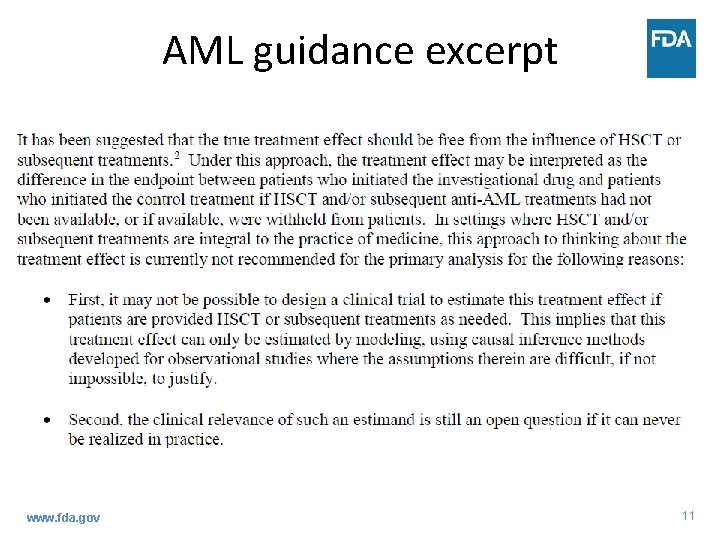
AML guidance excerpt www. fda. gov 11
Hypothetical issues • The existence of hypothetical strategies has become a bit of a temptation to take a somewhat naïve approach to some pretty tough problems • “This intercurrent event is inconvenient, so what if it never happened? ” – E. g. AEs, rescue, adherence • Sometimes principal stratum strategies make sense for the underlying, but there seems to be reluctance to invoke the C word – Doesn’t mean hypothetical strategies require fewer unverifiable assumptions than principal stratum approaches • Useful to think ahead to labeling – Picture yourself telling a patient the effect in the label is what they should care about www. fda. gov 12
Using communication as a guide • Sometimes useful to think ahead to labeling – Picture yourself telling a patient the effect in the label is what they should care about • “This is the mean effect among people who wouldn’t need rescue” vs. • “This is the mean effect in everyone if rescue medication didn’t exist” www. fda. gov 13
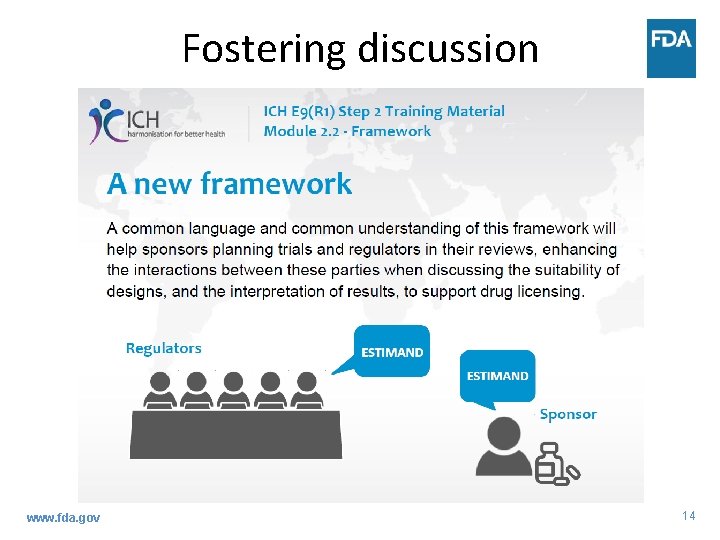
Fostering discussion www. fda. gov 14

- Slides: 15