
U S Marine Corps Alcohol Abuse Prevention Campaign
U. S. Marine Corps Alcohol Abuse Prevention Campaign Plan Briefing for Commandant of the Marine Corps
Agenda • • Background Methodology Purpose Mission Framework Goals Pending Initiatives Implementation
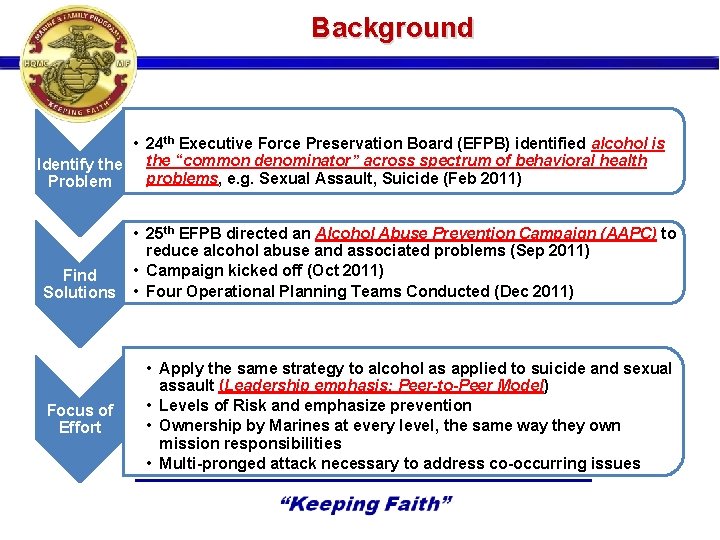
Background • 24 th Executive Force Preservation Board (EFPB) identified alcohol is Identify the “common denominator” across spectrum of behavioral health problems, e. g. Sexual Assault, Suicide (Feb 2011) Problem Find Solutions Focus of Effort • 25 th EFPB directed an Alcohol Abuse Prevention Campaign (AAPC) to reduce alcohol abuse and associated problems (Sep 2011) • Campaign kicked off (Oct 2011) • Four Operational Planning Teams Conducted (Dec 2011) • Apply the same strategy to alcohol as applied to suicide and sexual assault (Leadership emphasis; Peer-to-Peer Model) • Levels of Risk and emphasize prevention • Ownership by Marines at every level, the same way they own mission responsibilities • Multi-pronged attack necessary to address co-occurring issues
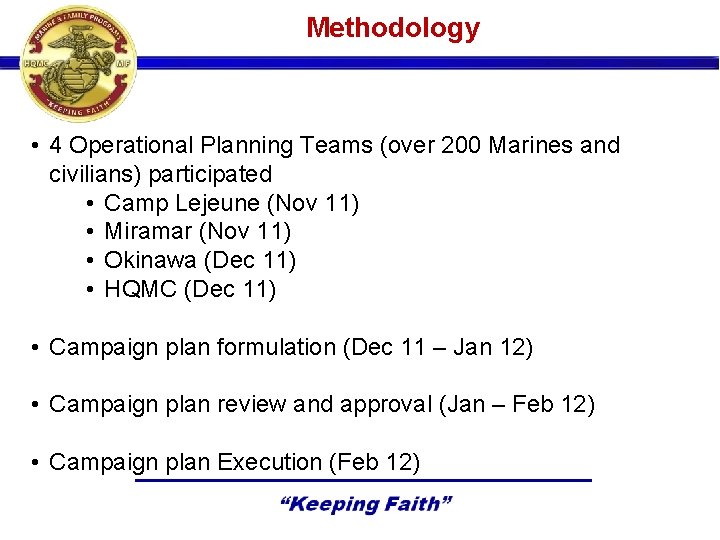
Methodology • 4 Operational Planning Teams (over 200 Marines and civilians) participated • Camp Lejeune (Nov 11) • Miramar (Nov 11) • Okinawa (Dec 11) • HQMC (Dec 11) • Campaign plan formulation (Dec 11 – Jan 12) • Campaign plan review and approval (Jan – Feb 12) • Campaign plan Execution (Feb 12)
Purpose Alcohol Abuse Prevention Campaign Plan: • Provides structure for how to reduce negative effects of alcohol abuse • Provides overview of specific tasks and efforts required to accomplish a reduction in alcohol-related incidents • 7 goals with 67 assorted tasks
Mission Increase Operational Readiness of the Marine Corps by Reducing Alcohol Abuse and Misuse through Revolutionary Changes to Prevention and Treatment Three Foundational Efforts: • “Levels of Risk” replace “Responsible Drinking” • Change focus from the “Boom” being an alcohol-related incident to the “Boom” being alcohol use • NCOs are the key; supported by SNCOs and Officers
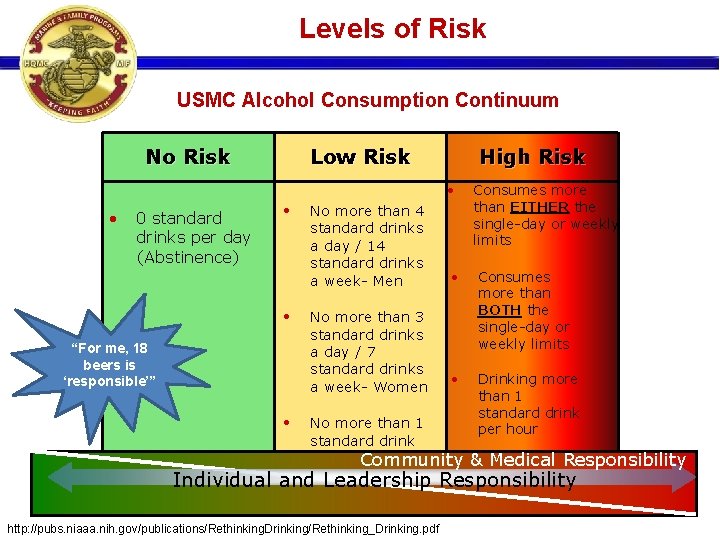
Levels of Risk USMC Alcohol Consumption Continuum No Risk Low Risk High Risk • • 0 standard drinks per day (Abstinence) • • “For me, 18 beers is ‘responsible’” • No more than 4 standard drinks a day / 14 standard drinks a week- Men No more than 3 standard drinks a day / 7 standard drinks a week- Women Consumes more than EITHER the single-day or weekly limits • Consumes more than BOTH the single-day or weekly limits • Drinking more than 1 standard drink per hour No more than 1 standard drink per hour Community & Medical Responsibility Individual and Leadership Responsibility http: //pubs. niaaa. nih. gov/publications/Rethinking. Drinking/Rethinking_Drinking. pdf
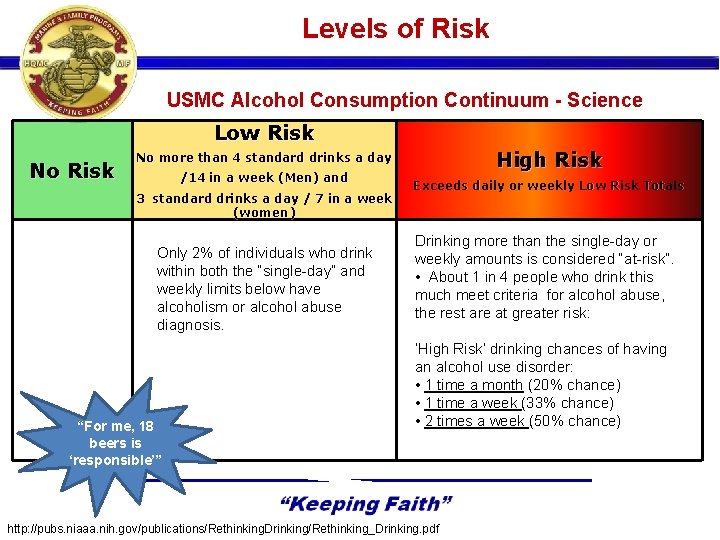
Levels of Risk USMC Alcohol Consumption Continuum - Science Low Risk No Risk High Risk No more than 4 standard drinks a day /14 in a week (Men) and 3 standard drinks a day / 7 in a week (women) Only 2% of individuals who drink within both the “single-day” and weekly limits below have alcoholism or alcohol abuse diagnosis. “For me, 18 beers is ‘responsible’” Exceeds daily or weekly Low Risk Totals Drinking more than the single-day or weekly amounts is considered “at-risk”. • About 1 in 4 people who drink this much meet criteria for alcohol abuse, the rest are at greater risk: ‘High Risk’ drinking chances of having an alcohol use disorder: • 1 time a month (20% chance) • 1 time a week (33% chance) • 2 times a week (50% chance) http: //pubs. niaaa. nih. gov/publications/Rethinking. Drinking/Rethinking_Drinking. pdf
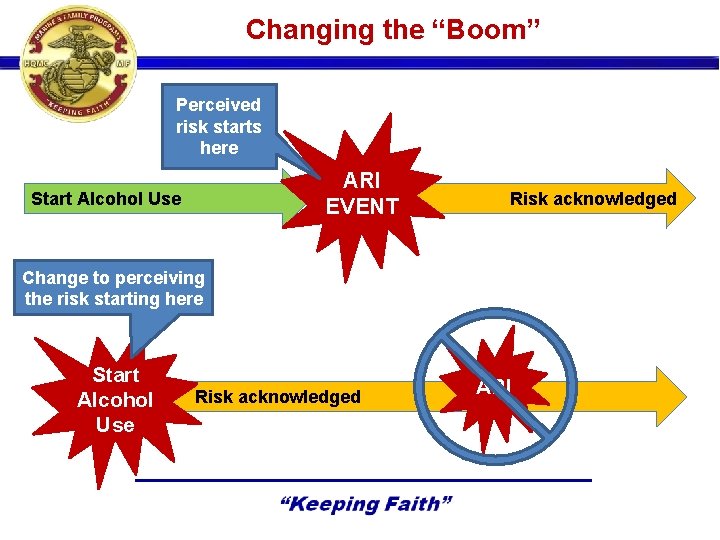
Changing the “Boom” Perceived risk starts here ARI EVENT Start Alcohol Use Risk acknowledged Change to perceiving the risk starting here Start Alcohol Use Risk acknowledged ARI
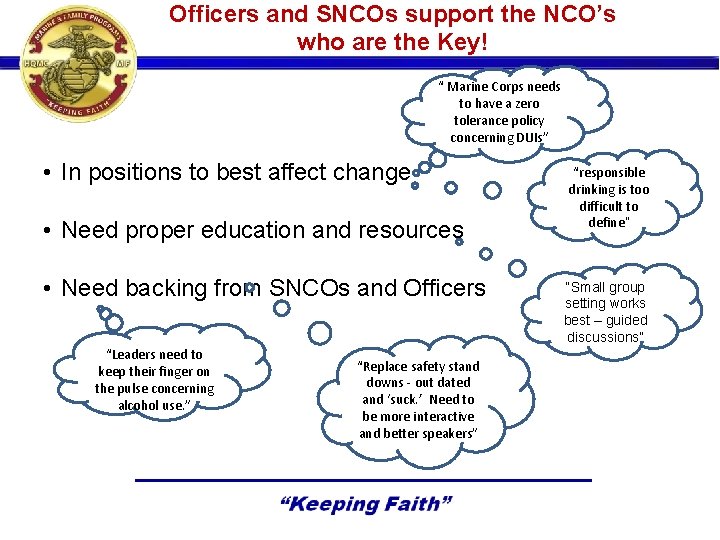
Officers and SNCOs support the NCO’s who are the Key! “ Marine Corps needs to have a zero tolerance policy concerning DUIs” • In positions to best affect change • Need proper education and resources • Need backing from SNCOs and Officers “Leaders need to keep their finger on the pulse concerning alcohol use. ” “Replace safety stand downs - out dated and ‘suck. ’ Need to be more interactive and better speakers” “responsible drinking is too difficult to define” “Small group setting works best – guided discussions”
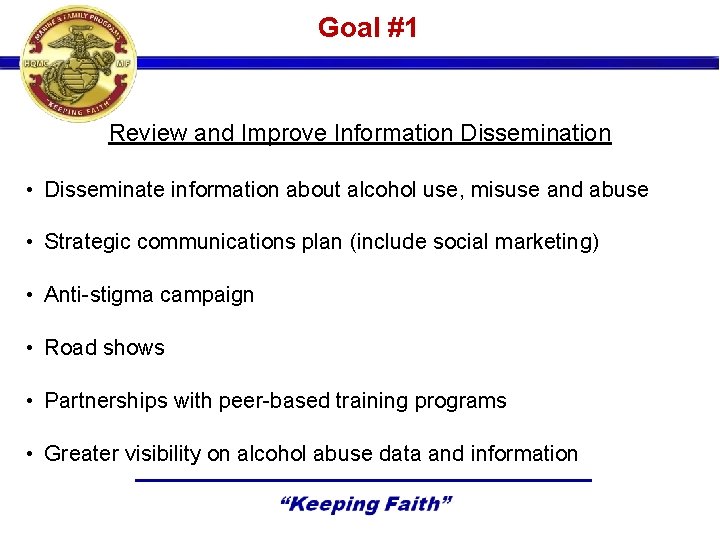
Goal #1 Review and Improve Information Dissemination • Disseminate information about alcohol use, misuse and abuse • Strategic communications plan (include social marketing) • Anti-stigma campaign • Road shows • Partnerships with peer-based training programs • Greater visibility on alcohol abuse data and information
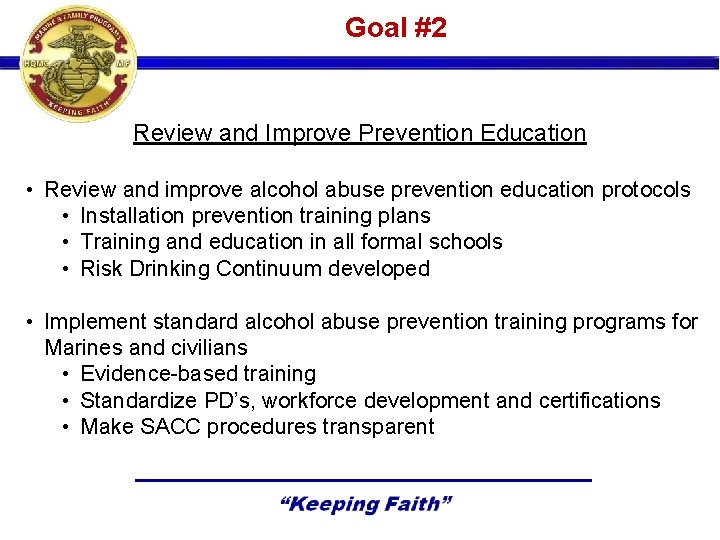
Goal #2 Review and Improve Prevention Education • Review and improve alcohol abuse prevention education protocols • Installation prevention training plans • Training and education in all formal schools • Risk Drinking Continuum developed • Implement standard alcohol abuse prevention training programs for Marines and civilians • Evidence-based training • Standardize PD’s, workforce development and certifications • Make SACC procedures transparent
Goal #3 Review and Improve Environmental Strategies • Assess alcohol marketing • Sales, consumption, policies, and regulations • Quality assurance measures and accountability • Promote low-risk drinking • Command climate and intrusive leadership • Provide resources and tools • Increase deterrent measures • Gate checks • Breathalyzer pilot
Goal #4 Review and Improve Alternative Activities • Increase the use of alternative activities • Assessment of current installation activities • Provide host of exciting alternatives based on location • Single Marine Representative as command team member • Develop partnerships/coalitions
Goal #5 Review and Improve Community-Based Processes • Build community-based partnerships • Preservation boards encourage early intervention for highrisk alcohol users • Develop local initiatives that promote low or no-risk alcohol consumption • Develop national and federal partnerships • Exploit pre-existing family support networks
Goal #6 Review and Improve Problem Identification & Referral • Implement strategies to identify and assist Marines needing support before an event happens • Streamlined referral process for self-referrals and all ARIs • Alcohol abuse prevention needs assessments • Implement strategies to assist Marines needing support after an event happens • Increase information sharing methods between medical, behavioral health, law enforcement and commands • Evaluate effectiveness of problem id & referral efforts
Goal #7 Review and Improve Treatment Processes • Standardize substance abuse prevention and treatment services • Standard practices and treatment protocols • Case management system • Substance Abuse Control Officer improvements • Standardize training • Professionalize billet • Quality of care improvements • Staffing model assessment • Aftercare treatment protocol
Goal #7 (cont’d) Review and Improve Treatment Processes • Develop new ways to offer and improve substance abuse services • Evaluate use of non-traditional working hours • Develop partnerships and share best practices • Evaluate the effectiveness of substance abuse treatments • Develop and implement strong quality assurance practices and protocols • Standardize accreditation practices
Pending Initiatives Evaluation of Alcohol Abuse Prevention Campaign • Develop and execute an evaluation to determine effectiveness of Campaign efforts with assistance from Navy Marine Corps Public Health Center • Recommend course of action changes as appropriate
Implementation • CMC/ACMC approval • Briefing to senior USMC leadership at 26 th EFPB (Mar 12) • Draft Plan of Action and Milestones (POA&M) • Develop working groups based on assigned tasks • Tracking and reporting on designated tasks
Alcohol Abuse Prevention Campaign Plan Discussions
- Slides: 21