
U S History The Age of Jackson Jackson
- Slides: 39
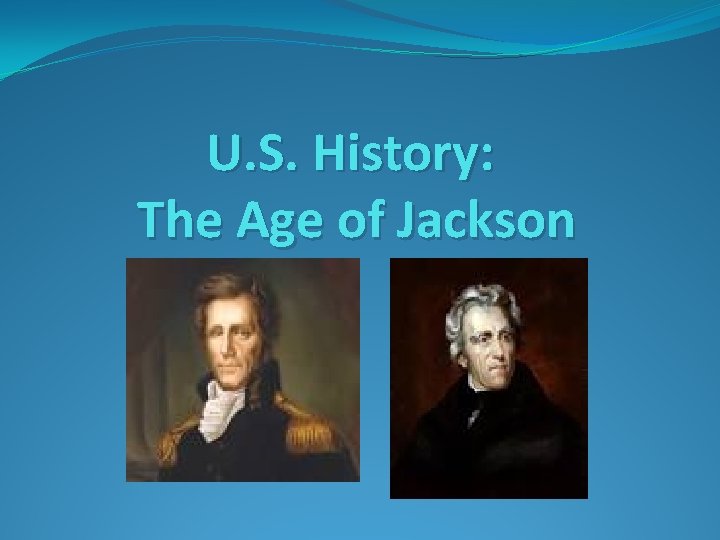
U. S. History: The Age of Jackson
Jackson vs. Adams �The Age of Jackson actually began with the election of John Quincy Adams (over Jackson) in 1824. �Jackson was famous for his military service in the War of 1812, especially the Battle of New Orleans. �Adams was famous for his negotiations with foreign nations, such as the Adams-Onis Treaty, which had resulted in Spain ceding Florida to the U. S. �Adams was the son of John Adams, who had been the second President of the U. S. from 1797 -1801; they were the only father-son combo to each serve as president until George Bush and George W. Bush came along over 150 years later.
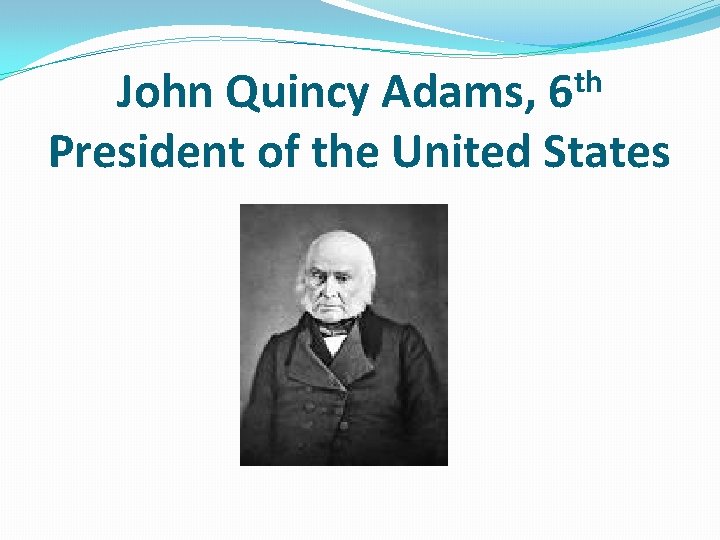
th 6 John Quincy Adams, President of the United States
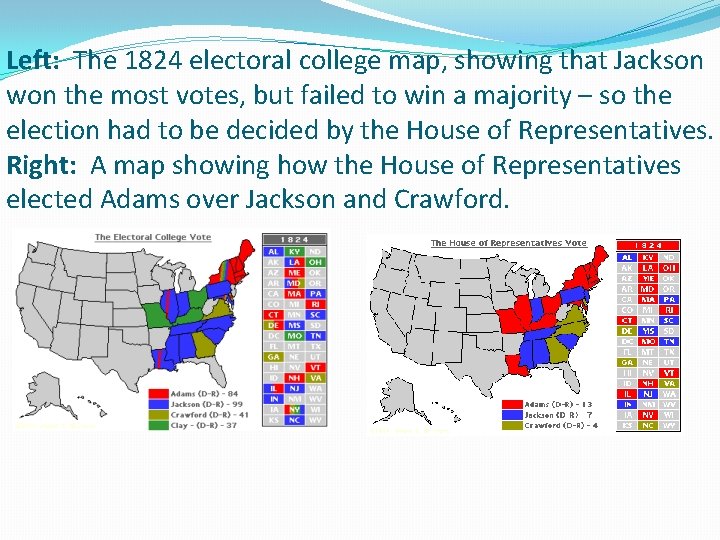
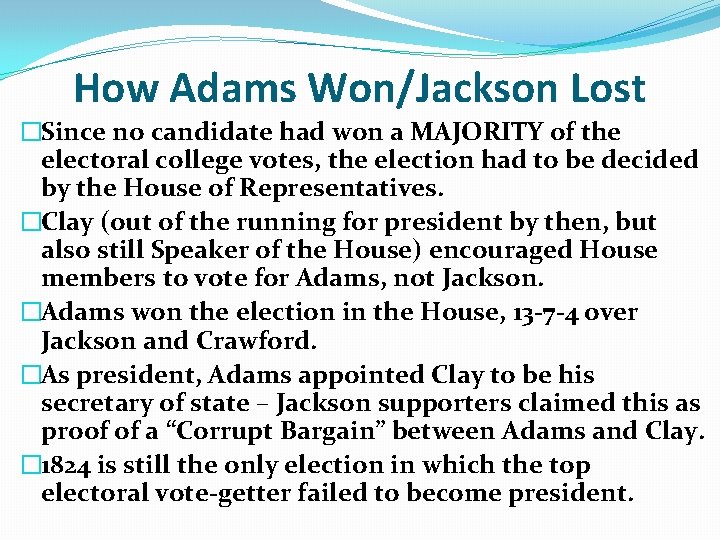
Controversy over the 1824 Election �Only major political party in U. S. at the time was the Democratic-Republican Party. � 4 candidates for president: William Crawford, Henry Clay, John Quincy Adams, and Andrew Jackson – even though they ran against each other, all were from the same party (Democratic-Republican). �Jackson won popular vote with 41% to Adams’ 31% (Crawford and Clay got 11% and 13%). �Jackson also got the most electoral votes: 99 (compared to 84 for Adams, 41 for Crawford, and 37 for Clay). �So, how did Jackson LOSE to Adams?
Left: The 1824 electoral college map, showing that Jackson won the most votes, but failed to win a majority – so the election had to be decided by the House of Representatives. Right: A map showing how the House of Representatives elected Adams over Jackson and Crawford.
How Adams Won/Jackson Lost �Since no candidate had won a MAJORITY of the electoral college votes, the election had to be decided by the House of Representatives. �Clay (out of the running for president by then, but also still Speaker of the House) encouraged House members to vote for Adams, not Jackson. �Adams won the election in the House, 13 -7 -4 over Jackson and Crawford. �As president, Adams appointed Clay to be his secretary of state – Jackson supporters claimed this as proof of a “Corrupt Bargain” between Adams and Clay. � 1824 is still the only election in which the top electoral vote-getter failed to become president.
Aftermath of the 1824 Election �Clay (from Kentucky, then considered a western state – like Tennessee, where Jackson was from) was called a “traitor to the West” for supporting the northeasterner, Adams, over Jackson. �Jackson immediately began campaigning for the election of 1828, reminding voters he’d been “robbed” by the “Corrupt Bargain” in 1824. �The days of the U. S. having only 1 political party ended as the Democratic Republicans split apart: supporters of Adams & Clay became the National Republicans; Jackson’s supporters still called themselves Democratic Republicans, but soon shortened the name to just “Democrats” – marking the beginning of today’s Democrat Party.
The New Politics �Changes in voting: by 1828 most white men in U. S. could vote because states had dropped requirement that you had to own a certain amount of property to have right to vote; also, printed ballots had replaced public voice votes. �Voting was now open to the “common man, ” whereas only men of property had been able to vote before – this meant that: �Formal, aristocratic, elitist candidates were now less appealing to voters and “common” candidates, i. e. , “he was born in a log cabin!” were more appealing. �Charisma became more important for candidates to connect with and influence voters.
The New Politics Helped Jackson �Although Jackson was rich, he was a self-made man who had started out poor – the son of Irish immigrants, he was born on the frontier – so he could relate to poor voters as “one of their own. ” �He had become a lawyer without going to college (fairly common back then – many became lawyers by just reading law books and passing their state’s bar exam). �He was a war hero and often fought in brawls and duels in his younger days – this tough, rugged image also appealed to common men.
National Republicans vs. Democratic Republicans �National Republicans supported John Quincy Adams, lived mainly in the Northeast, favored upper-class & business interests, and a strong national government. �Democratic Republicans (Democrats) supported Andrew Jackson, lived mainly in the South and West, favored skilled workers, small business owners, and farmers, believed in states’ rights and opposed a strong national government. �HOWEVER – once Jackson became president, he mostly favored a strong national government over states’ rights (since he was head of the national government, he had more power if it had more power).
Election of 1828 �Adams’ term as president had been undistinguished – – he was mostly viewed as having stolen the 1824 election from Jackson. �The one major accomplishment of Adams’ term was the passage of a high protective tariff in 1828 – called the Tariff of Abominations by Jackson supporters, it was seen as protecting northeastern businesses from foreign competition at the expense of driving up prices for common southerners and westerners. �Jackson’s four years of campaigning had voters fired up to “right the wrongs” of 1824 by electing Jackson over Adams. �This time, Jackson easily beat Adams: 178 to 83 in the Electoral College and 56% to 44% in the popular vote.
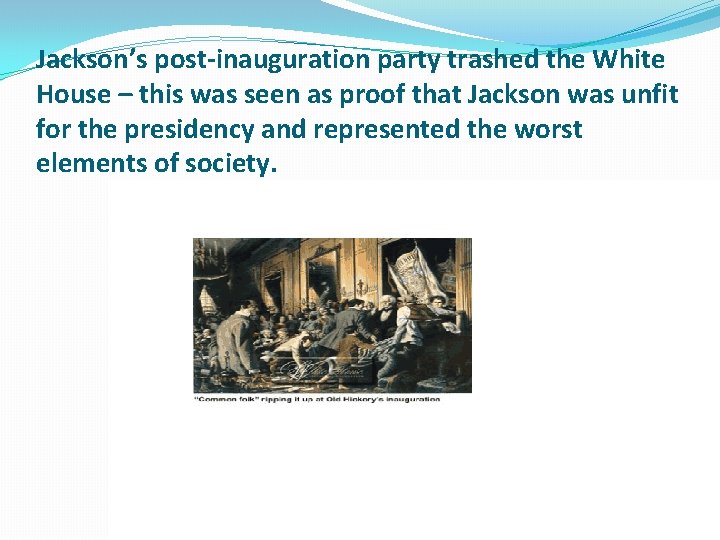
Jackson’s post-inauguration party trashed the White House – this was seen as proof that Jackson was unfit for the presidency and represented the worst elements of society.
Jackson: “The People’s President” �The Spoils System: Jackson openly rewarded his supporters by giving them government jobs (usually after firing whoever had the job before) – this practice is officially called patronage and had been done by earlier presidents, too – but Jackson did it more and was very public about it, even arguing that it was a good thing that would prevent government corruption. �Later presidents followed Jackson’s precedent, and the Spoils System became common practice for government hiring until the 1880 s.
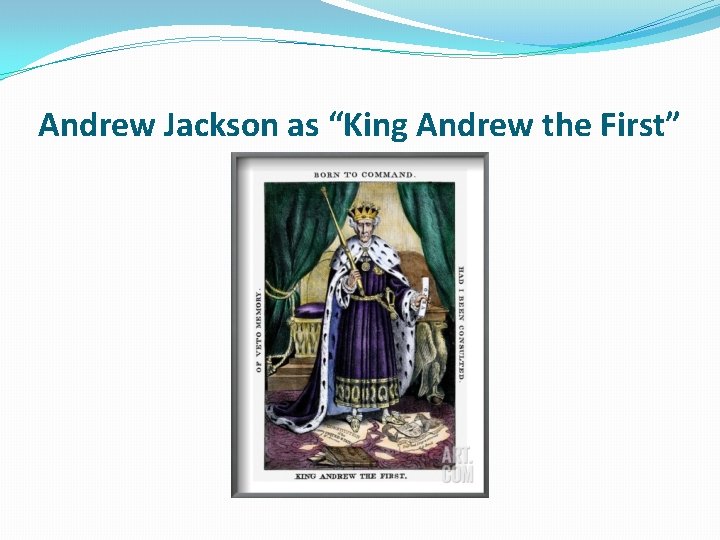
Jackson in Office �Used the veto power to stop Congress from passing laws he didn’t like more often than earlier presidents ever had – critics called him “King Andrew I” for this imperial practice. �Jacksonian Democracy replaced Jeffersonian Democracy: �Jeffersonians favored small government, low taxes, personal freedom, and valued highly-educated leaders. �Jacksonians favored voting rights for all white males and didn’t value highly-educated leaders – and favored the strength of the president and executive branch over Congress and the courts (Jackson’s use of the veto was a good example of this).
Andrew Jackson as “King Andrew the First”
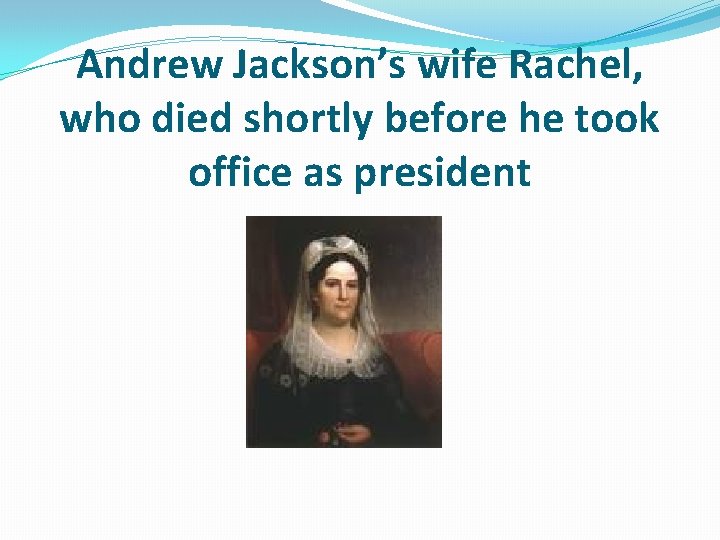
Jackson’s “Kitchen Cabinet” �Jackson’s wife, Rachel, died before he became president – he grieved deeply for her. �Rachel had once been accused of bigamy – that she was still married to her first husband when she got married to Jackson – Jackson was always bitter about such accusations. �Peggy Eaton, wife of Jackson’s secretary of war, John Eaton, was accused by other cabinet members’ wives of having had several affairs before marrying Eaton – soon other cabinet members and their wives shunned the Eatons. �Accusations against Peggy Eaton reminded Jackson of those against his beloved Rachel, so he sided with the Eatons.
Andrew Jackson’s wife Rachel, who died shortly before he took office as president
The Kitchen Cabinet, Part II �Because he couldn’t/didn’t want to meet with his real cabinet, President Jackson began taking advice from friends who weren’t officially part of the government at all. �These meetings sometimes took place in the White House kitchen, hence the media’s nickname for them: the Kitchen Cabinet. �Only Secretary of State Martin Van Buren remained in Jackson’s favor – Jackson decided to replace VP John C. Calhoun with Van Buren for Jackson’s next run for president in the 1832 election – Jackson won again, and Van Buren became vice president.
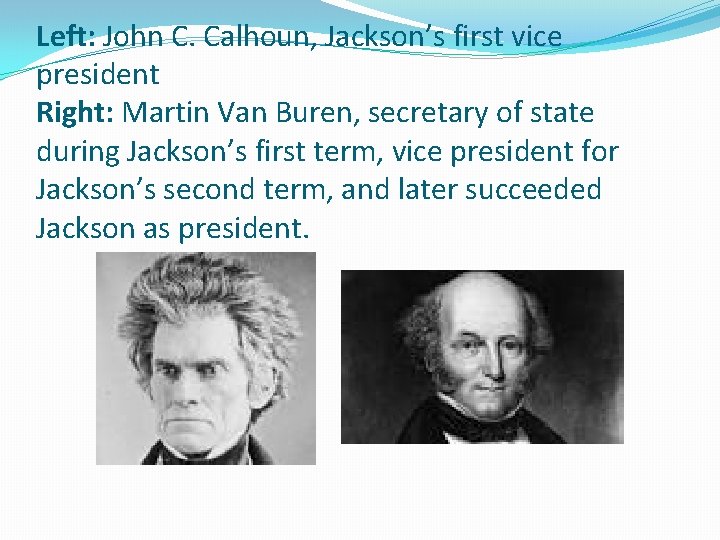
Left: John C. Calhoun, Jackson’s first vice president Right: Martin Van Buren, secretary of state during Jackson’s first term, vice president for Jackson’s second term, and later succeeded Jackson as president.
Sectional Issues �Tariff of 1828 (Tariff of Abominations) helped northern factories, but drove up prices, which especially hurt the South, where most wealth was in property (land, cotton, slaves, etc. ), not cash. �South also feared slave revolts and any criticism of slavery – debate about slavery was usually avoided by both parties during Jacksonian period. �Nullification: Calhoun (Jackson’s VP from 1829 -1833) argued that individual states had power to declare federal laws, like the Tariff of 1828, null and void – in other words they didn’t have to be obeyed in that state if the state didn’t want to. �Jackson was against nullification – clashed with Calhoun.
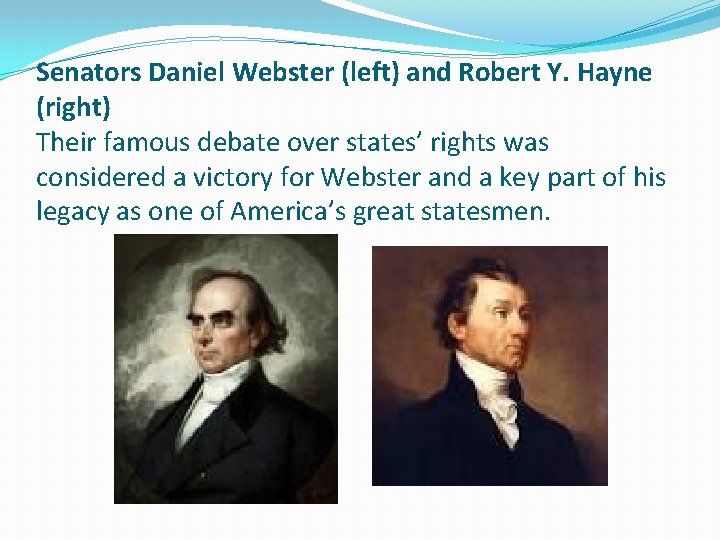
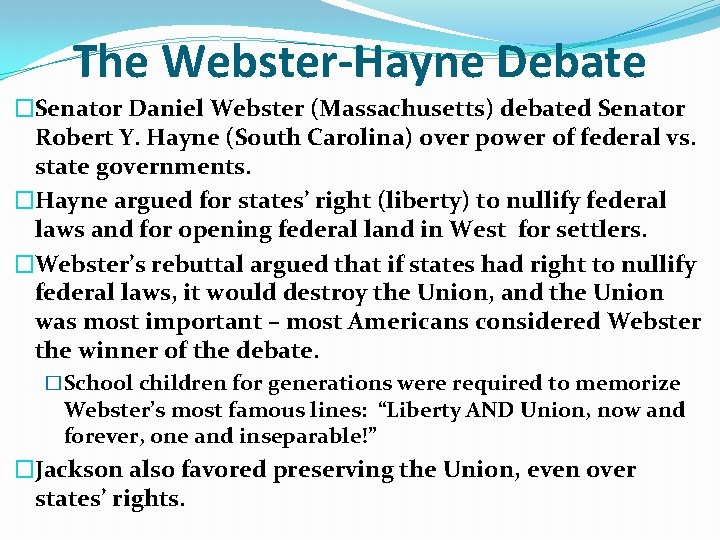
Senators Daniel Webster (left) and Robert Y. Hayne (right) Their famous debate over states’ rights was considered a victory for Webster and a key part of his legacy as one of America’s great statesmen.
The Webster-Hayne Debate �Senator Daniel Webster (Massachusetts) debated Senator Robert Y. Hayne (South Carolina) over power of federal vs. state governments. �Hayne argued for states’ right (liberty) to nullify federal laws and for opening federal land in West for settlers. �Webster’s rebuttal argued that if states had right to nullify federal laws, it would destroy the Union, and the Union was most important – most Americans considered Webster the winner of the debate. �School children for generations were required to memorize Webster’s most famous lines: “Liberty AND Union, now and forever, one and inseparable!” �Jackson also favored preserving the Union, even over states’ rights.
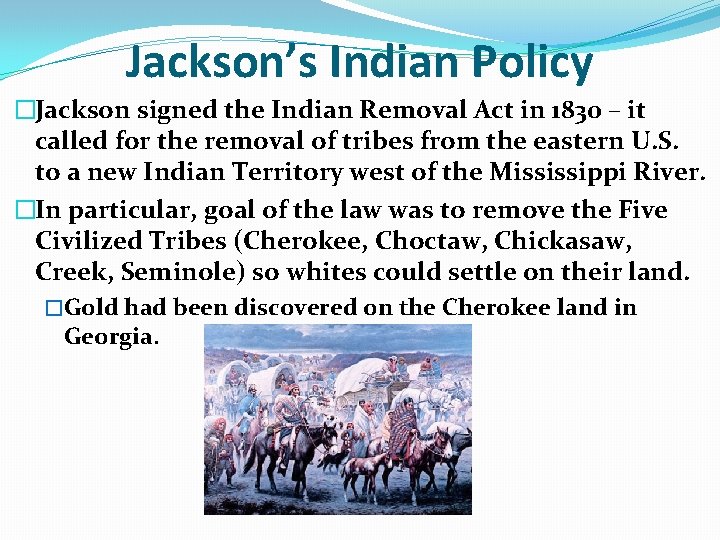
Jackson’s Indian Policy �Jackson signed the Indian Removal Act in 1830 – it called for the removal of tribes from the eastern U. S. to a new Indian Territory west of the Mississippi River. �In particular, goal of the law was to remove the Five Civilized Tribes (Cherokee, Choctaw, Chickasaw, Creek, Seminole) so whites could settle on their land. �Gold had been discovered on the Cherokee land in Georgia.
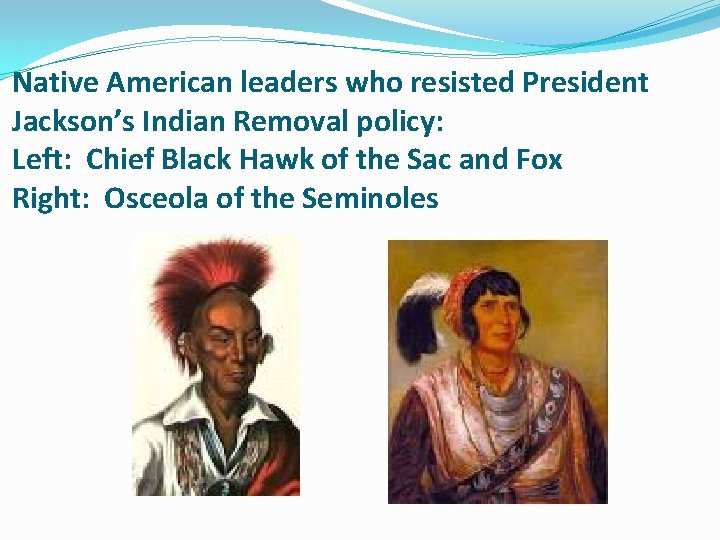
Native American leaders who resisted President Jackson’s Indian Removal policy: Left: Chief Black Hawk of the Sac and Fox Right: Osceola of the Seminoles
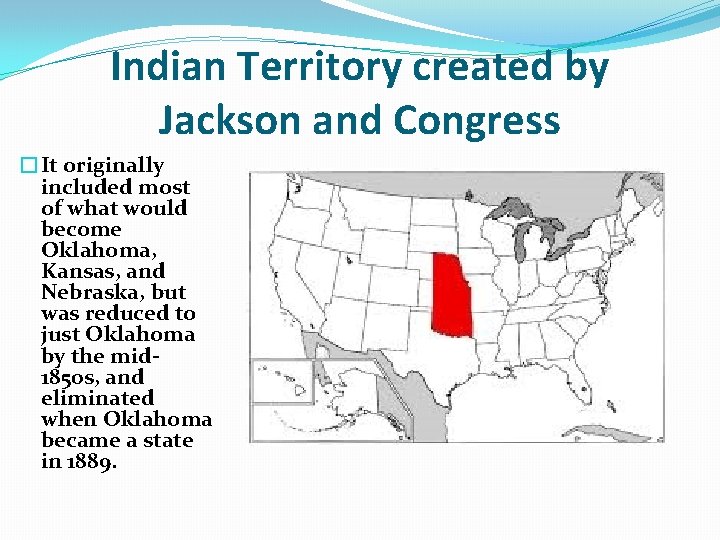
Indian Territory created by Jackson and Congress �It originally included most of what would become Oklahoma, Kansas, and Nebraska, but was reduced to just Oklahoma by the mid 1850 s, and eliminated when Oklahoma became a state in 1889.
Indian Removal �Some tribes resisted removal by fighting: �Black Hawk’s War: the Sac and Fox tribe in Illinois fought against removal but were defeated and forced to move anyway. �The First and Second Seminole Wars: Seminoles in Florida, led by Chief Osceola, fought against removal – ended when Osceola was captured in 1837; most Seminoles were then moved to Indian Territory. �Osceola later died in prison. �Some Seminoles hid out & lived in the Everglades – some descendants still live there today. �Great Plains (which included Indian Territory – what is now Oklahoma, Kansas, & Nebraska) were often called the Great American Desert at that time – considered almost uninhabitable.
The Case of the Cherokee �As one of the “civilized tribes, ” the Cherokee had adapted well to southern “white” way of life: they had farms (some even owned slaves!), mills, factories, schools, newspapers – had devised a written language, published a newspaper, had a tribal constitution similar to the U. S. Constitution. �Fought in Supreme Court to keep their land – and won (Worcester v. Georgia, 1832) – but were still forced to move to Indian Territory. � Jackson: “John Marshall (Chief Justice 0 f Supreme Court) has made his decision – now let him enforce it. ” Another example of Jacksonian democracy’s preference for power of president over Congress & the courts. �Trail of Tears: Cherokee name for route they walked from Georgia to Oklahoma after being forced out in 1838 – at least 1, 500 of them died along the way, then had difficulty adjusting to life in Indian Territory – Jackson’s Indian removal policy had a huge impact on their culture. �Most historians condemn Jackson’s Indian removal, but some do say removal saved tribes from being killed off if they had stayed where they were.
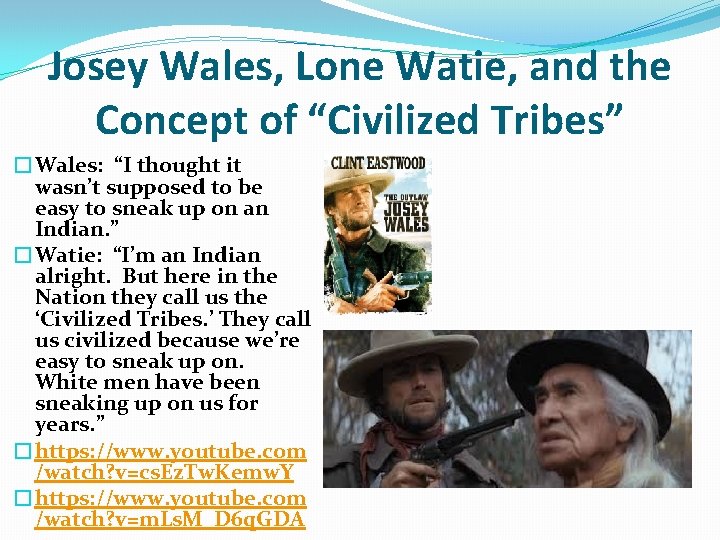
Josey Wales, Lone Watie, and the Concept of “Civilized Tribes” �Wales: “I thought it wasn’t supposed to be easy to sneak up on an Indian. ” �Watie: “I’m an Indian alright. But here in the Nation they call us the ‘Civilized Tribes. ’ They call us civilized because we’re easy to sneak up on. White men have been sneaking up on us for years. ” �https: //www. youtube. com /watch? v=cs. Ez. Tw. Kemw. Y �https: //www. youtube. com /watch? v=m. Ls. M_D 6 q. GDA
The Nullification Crisis of 1832 -33 �South Carolina (instigated by Calhoun) ruled the high tariffs of 1828 and 1832 null and void in the state of S. C. �South Carolina threatened to secede from the Union if forced to obey the tariff laws. �Jackson ordered South Carolina to obey the law; threatened to send troops to force South Carolina to obey the tariffs and prevent it from seceding. �Henry Clay created a compromise that ended the crisis: if South Carolina backed down and stayed in the Union, the tariff would be gradually lowered over time. �South Carolina agreed to Clay’s compromise, and the Nullification Crisis ended.
Election of 1832 �Henry Clay ran against Jackson as the new Whig Party’s candidate (Whigs had replaced the National Republicans as the anti-Jackson party). �Jackson was opposed to the Bank of the United States (the National Bank, originally planned as part of Clay’s American System). �Bank’s charter was ending in 1836, had to be renewed by passing a new bank charter law. �Clay’s strategy: pass new bank charter law through Congress early (in 1832), knowing Jackson would veto it. �Clay could then campaign on the bank issue, calling Jackson an enemy of the national bank – Clay thought this would result in him winning the election….
Clay’s plan works… halfway �Jackson DID veto the bank re-charter bill, just as Clay had hoped… �But people didn’t care as much as Clay thought they would – Jackson still defeated Clay in the 1832 election. �Jackson then decided to really “kill” the national bank.
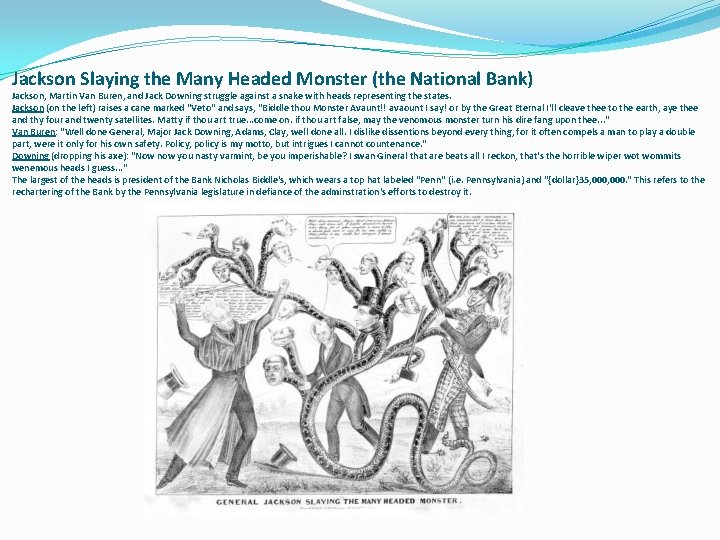
Jackson Slaying the Many Headed Monster (the National Bank) Jackson, Martin Van Buren, and Jack Downing struggle against a snake with heads representing the states. Jackson (on the left) raises a cane marked "Veto" and says, "Biddle thou Monster Avaunt!! avaount I say! or by the Great Eternal I'll cleave thee to the earth, aye thee and thy four and twenty satellites. Matty if thou art true. . . come on. if thou art false, may the venomous monster turn his dire fang upon thee. . . " Van Buren: "Well done General, Major Jack Downing, Adams, Clay, well done all. I dislike dissentions beyond every thing, for it often compels a man to play a double part, were it only for his own safety. Policy, policy is my motto, but intrigues I cannot countenance. " Downing (dropping his axe): "Now now you nasty varmint, be you imperishable? I swan Gineral that are beats all I reckon, that's the horrible wiper wot wommits wenemous heads I guess. . . " The largest of the heads is president of the Bank Nicholas Biddle's, which wears a top hat labeled "Penn" (i. e. Pennsylvania) and "{dollar}35, 000. " This refers to the rechartering of the Bank by the Pennsylvania legislature in defiance of the adminstration's efforts to destroy it.
Jackson Kills the Bank �Jackson announced that the U. S. Government would no longer deposit money in the Bank of the U. S. �Money already in the Bank would be spent to pay off the national debt. �Future deposits of government money would be made in hundreds of small “pet banks” located in states throughout the U. S. �With no money left, the Bank of the U. S. effectively ceased to exist.
Aftermath of Killing the Bank �Heavy speculation in public land sales thanks to easy credit from “pet banks” (almost ANYONE could borrow money from them!). �Economy grew out of control – too much buying on credit that might not get paid back. �To stop the insanity, Jackson issued the Specie Circular in July 1836, which said that only specie (gold & silver), not bank notes, could be used to buy public lands. �Land boom stopped immediately, because very few had real gold & silver money. �Banks stopped loaning out money AND stopped redeeming bank notes for specie (so bank notes became worthless)!
The Panic of 1837 �Caused by the Specie Circular, a financial crisis in Britain, and a bad crop year in 1836. �First major economic depression in U. S. history – banks closed, factories closed, construction projects stopped – thousands were out of work, lost homes, etc. �If any president should have been blamed for this, it was Jackson – but he left office in 1837; his VP, Martin Van Buren, was elected president in 1836 & took office in 1837 – since Van Buren was president now, the public mostly blamed him for the recession. �No government action was taken to end the recession (that was unheard of back then) – it gradually ended on its own.
An easy way to remember that Van Buren was the 8 th president! �Thanks to the TV show, “Seinfeld, ” and the “Van Buren Boys” more people now remember Martin Van Buren than before. �https: //www. youtube. com/watch? v=qkpn. OTr 8 k 9 I �https: //www. youtube. com/watch? v=p. CF-DUR 0 Gm. U �https: //www. youtube. com/watch? v=f 3 q 1 y 7 DIBSw
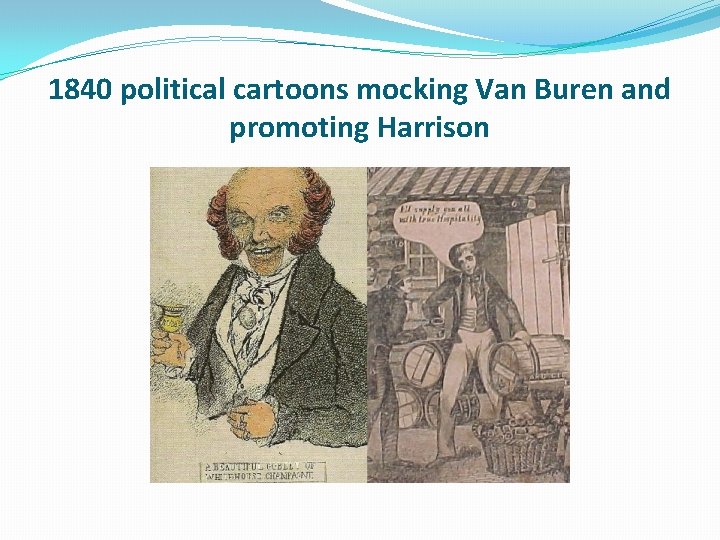
Election of 1840 �Van Buren was unpopular, but Democrats had no other option, so nominated him again. �Whigs nominated William Henry Harrison for president; John Tyler, from Virginia, was Whigs’ VP candidate (idea was that a Virginian would attract southern votes). �Harrison was remembered as a hero from War of 1812. �Harrison’s “Log Cabin and Hard Cider” campaign focused on his popularity, not specific issues – he was shown as a hard-cider drinking “man’s man, ” while Van Buren was shown as a little wimp who drank champagne!
1840 political cartoons mocking Van Buren and promoting Harrison
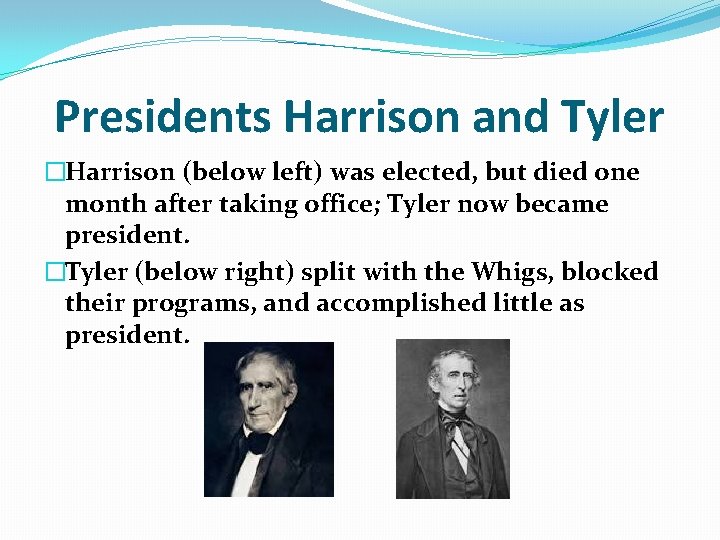
Presidents Harrison and Tyler �Harrison (below left) was elected, but died one month after taking office; Tyler now became president. �Tyler (below right) split with the Whigs, blocked their programs, and accomplished little as president.