
U S HISTORY INDUSTRIALIZATION AND URBANIZATION Bellwork What
U. S. HISTORY: INDUSTRIALIZATION AND URBANIZATION Bellwork: • What are some characteristics of a good business? • How do businesses make a profit? • Provide an example of a modern business you believe performs well Learning Target: Today we will explain the tactics used by industrialists/robber barons to grow their businesses and dominate their competition.
Tactics of Big Business during Industrialization • Using the handout, complete the definition for each business term from the following slides • Include examples of each from the slides or your own that you can think of during discussion
Corporations and Stock • A corporation is an organization owned by many people but treated by law as though it were a person. – It can own property, pay taxes, make contracts, and sue and be sued – Examples: Google, Ford Motor Co. , Microsoft Corporation • Stockholders are the people who own a corporation and they each own shares of ownership – referred to as stocks
Types of Business Organizations: • Use the book on pg. 423 and the chart at the top of the page to complete the needed information about sole proprietorships, partnerships, and corporations • Examples: – Proprietorship: single person art studio, local grocery – Partnership: Apple and Master. Card (Apple Pay), Nike and Apple (Nike+)
Economies of Scale • When money was raised from the sell of stock, corporations could invest in new tech, hire large workforces, and purchase many machines which would greatly increase their efficiency • Doing this would allow corporation to achieve economies of scale which is when the cost of manufacturing is decreased by producing goods quickly in large quantities – Small businesses with high operating costs found it difficult to compete with large corporations during the industrialization of America; many went out of business
Pools • Many business leaders did not like the intense competition that had been forced on them. • Falling prices benefited consumers, but cut into profits • To stop prices from falling, many companies organized pools – agreements to keep prices at a certain level.
Vertical Integration • A company owns all of the different businesses on which it depends for its operation – Instead of paying other companies for your resources, you own them yourself – What would be an example of this using someone’s shoes?
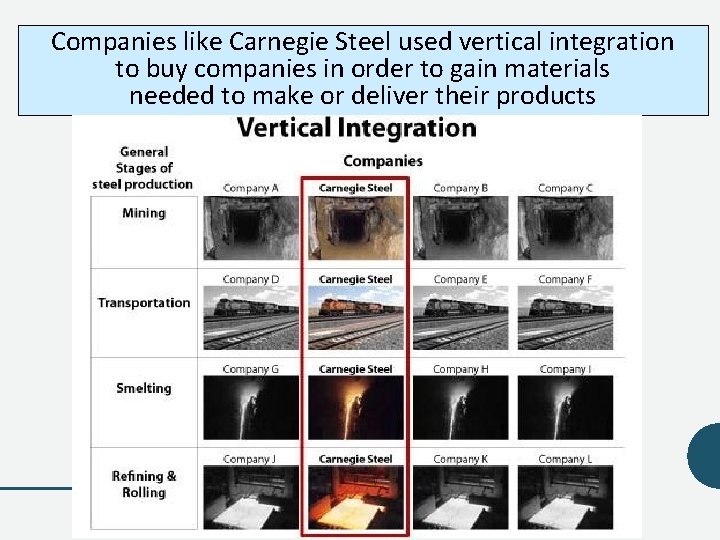
Companies like Carnegie Steel used vertical integration to buy companies in order to gain materials needed to make or deliver their products
Horizontal Integration • Combining firms in the same business into one large corporation – Essentially, buying up stock in a business that is the same as your own – What could be an example of this?
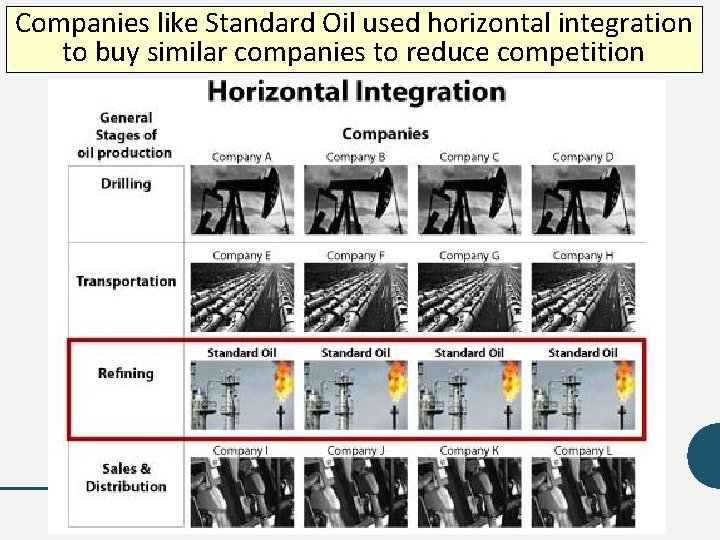
Companies like Standard Oil used horizontal integration to buy similar companies to reduce competition
Monopoly • One company controls an entire industry. • Oil and steel companies were both controlled by monopolies – U. S. government would make it illegal for one company to own stock in another company to try to prevent monopolies and horizontal integration
Trusts • Company tried to find a way around the antimonopoly laws in the U. S. • A way to do this, was forming a trust = legal arrangement that allows one person to manage another’s property (and therefore not owning it or any stocks) – Standard Oil company used trusts when taking over the competition
Holding Company • Owns the stock of companies that do produce goods (does not produce anything itself though) • Holding companies manage the companies they own, which effectively merges them into one large enterprise. – Example: Walt Disney Company owns assets ranging from TV networks (ABC, ESPN, Disney Channel) to entertainment providers (Lucas. Film, Marvel Entertainment, Muppets Studio) to film production facilities (Walt Disney Studios, Pixar Animation).
Create your own business model • Using the information from your chart, create your own business plan/layout • Use the principles of horizontal and vertical integration to expand your business • Then, explain how you personally would handle treatment of your workers, your spending, and philanthropy
Exit Slip: • Explain the difference between vertical and horizontal integration • What is a tactic big businesses used to get around anti-monopoly laws?
- Slides: 15