
U S History End of Course Review Table
U. S. History End of Course Review
Table of Contents • • • • Early American Period Industrialization and the Gilded Age American Society in Transition The Progressive Era America Builds an Empire World War I Roaring 20’s Great Depression and the New Deal World War II Cold War and the Civil Rights Years The Sixties Crisis and Resurgence America in the New Millennium Amendments Words to Remember Eras pg. 4 pg. 7 pg. 11 pg. 15 pg. 20 pg 27 pg. 32 pg. 38 pg. 42 pg. 50 pg. 56 pg. 61 pg. 67 pg. 71 pg. 73 pg. 74
Early American Period Declaration of Independence July 4 th 1776 • Written primarily by Thomas Jefferson • Listed Grievances against the king • Demanded independence from Britain U. S. CONSTITUTION 1787 • Replaced the Articles of Confederation • Created three branches of government: • Executive, Legislative, Judiciary
Constitutional Principles • –Republicanism, Popular Sovereignty, Federalism, Checks and Balances, Separation of Powers, Limited Government, • Individual Rights ts Righ f o Bill 791 1
Bill of Rights Added to further safeguard individual freedoms. 1 st – freedoms of speech, religion, press, assembly, and petition 2 nd - right to keep and bear arms 3 rd – protects against the quartering of soldiers during peacetime 4 th – protects against unreasonable searches and seizures 5 th – cannot be deprived of life, liberty, or property without due process 6 th – right to a speedy trial and to an attorney 7 th – right to a trial by jury 8 th – protects against cruel and unusual punishment and against excessive fines and bail 9 th – rights of the people 10 th – rights granted to the states
Alexis de Toqueville Wrote Democracy in America Key characteristics of American democracy: • Liberty • Egalitarianism (belief in human equality) • Individualism • Populism • Laissez-faire Pluribus Unum “Out of many (comes) one” Jonathan Trumbull was the only colonial governor to side with the colonists. John Peter Muhlenberg was a Protestant minister who recruited soldiers and rose to the rank of general. Charles Carroll (Scottish merchant) helped finance the Revolution-- signed the Declaration. John Hancock. President of the Second Continental Congress; signer of the Declaration. Benjamin Rush Father of American Medicine. Signer of the Declaration. John Witherspoon. Signer of the Declaration. John Jay. Helped write the Federalist Papers.
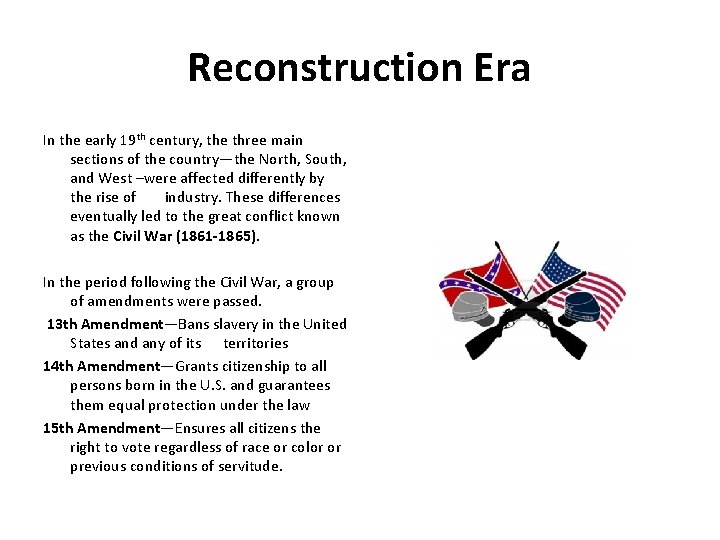
Reconstruction Era In the early 19 th century, the three main sections of the country—the North, South, and West –were affected differently by the rise of industry. These differences eventually led to the great conflict known as the Civil War (1861 -1865). In the period following the Civil War, a group of amendments were passed. 13 th Amendment—Bans slavery in the United States and any of its territories 14 th Amendment—Grants citizenship to all persons born in the U. S. and guarantees them equal protection under the law 15 th Amendment—Ensures all citizens the right to vote regardless of race or color or previous conditions of servitude.
Under the U. S. Constitution, the government may not take private property unless — A. the land requires extensive restoration B. the government determines that the land is critical to developers’ profits C. the landowner refuses to build a home on the land D. the government pays the owner fair compensation for the land
Industrialization and the Gilded Age American Industrializes rapidly after the Civil War • Free Enterprise System FREE to produce and sell. People go into business for profit. Prices are set by supply and demand.
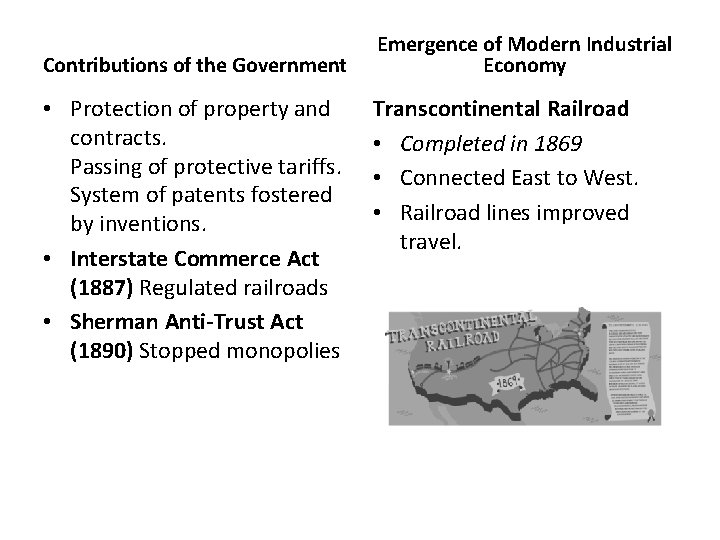
Contributions of the Government Emergence of Modern Industrial Economy • Protection of property and Transcontinental Railroad contracts. • Completed in 1869 Passing of protective tariffs. • Connected East to West. System of patents fostered • Railroad lines improved by inventions. travel. • Interstate Commerce Act (1887) Regulated railroads • Sherman Anti-Trust Act (1890) Stopped monopolies
Technological Progress • Bessemer Process in steel production & lighting and mechanical uses of electricity –gives birth to new industries. Thomas Edison • Telephone service - Alexander Graham Bell • Oil Industry replaced whale oil.
Great Entrepreneurs Robber Barons- Entrepreneurs who were perceived as being greedy and corrupt. John D. Rockefeller (Standard Oil), • Controlled the refining of oil. • Forced to dissolve stronghold on company. Andrew Carnegie (Steel Corporation) • Fostered the Gospel of Wealth • Steel Production in Pittsburg. Cornelius Vanderbilt railroad consolidation, J. P. Morgan investment banking
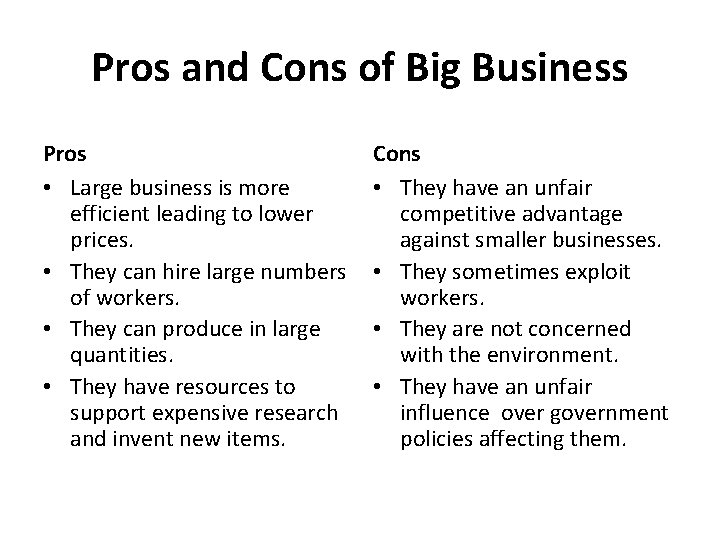
Pros and Cons of Big Business Pros • Large business is more efficient leading to lower prices. • They can hire large numbers of workers. • They can produce in large quantities. • They have resources to support expensive research and invent new items. Cons • They have an unfair competitive advantage against smaller businesses. • They sometimes exploit workers. • They are not concerned with the environment. • They have an unfair influence over government policies affecting them.
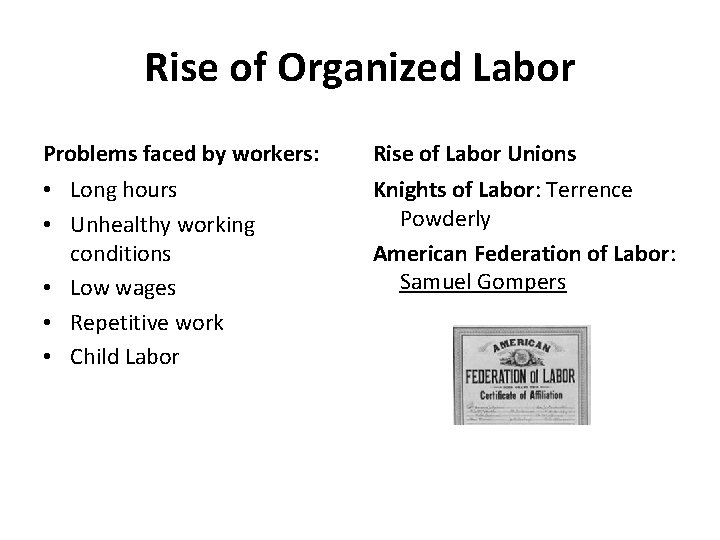
Rise of Organized Labor Problems faced by workers: Rise of Labor Unions • Long hours • Unhealthy working conditions • Low wages • Repetitive work • Child Labor Knights of Labor: Terrence Powderly American Federation of Labor: Samuel Gompers
“the man of wealth thus becoming the mere agent and trustee for his poorer brethren, bring to their service his superior wisdom, experience, and ability to administer, doing for them better than they would or could do for themselves. ” The quote reflects the point of view of— A. B. C. D. John D. Rockefeller J. P. Morgan Jay Gould Andrew Carnegie
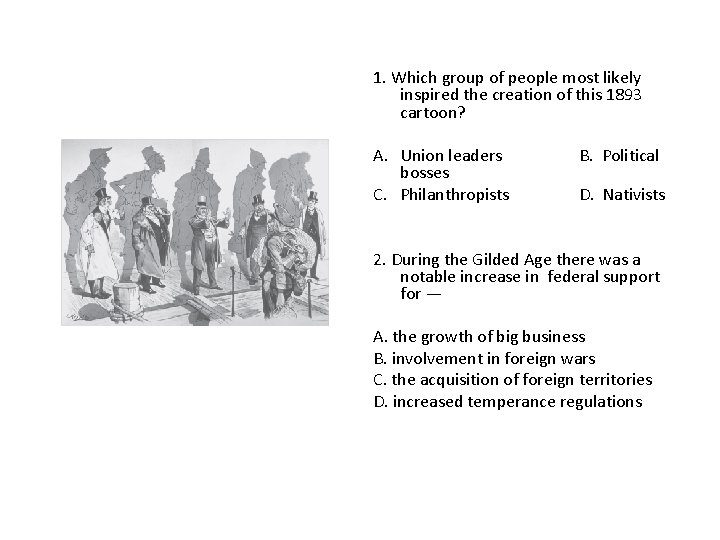
1. Which group of people most likely inspired the creation of this 1893 cartoon? A. Union leaders B. Political bosses C. Philanthropists D. Nativists 2. During the Gilded Age there was a notable increase in federal support for — A. the growth of big business B. involvement in foreign wars C. the acquisition of foreign territories D. increased temperance regulations
American Society in Transition • Industrialization contributed to the process of urbanization: Movement of people from the countryside to the cities. • New farm machinery reduced the number of farm jobs. Rise in industry created more jobs in the cities.
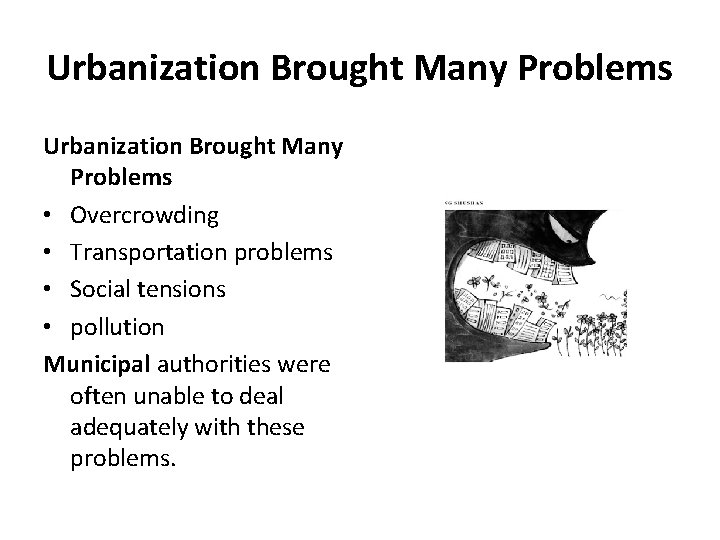
Urbanization Brought Many Problems Urbanization Brought Many Problems • Overcrowding • Transportation problems • Social tensions • pollution Municipal authorities were often unable to deal adequately with these problems.
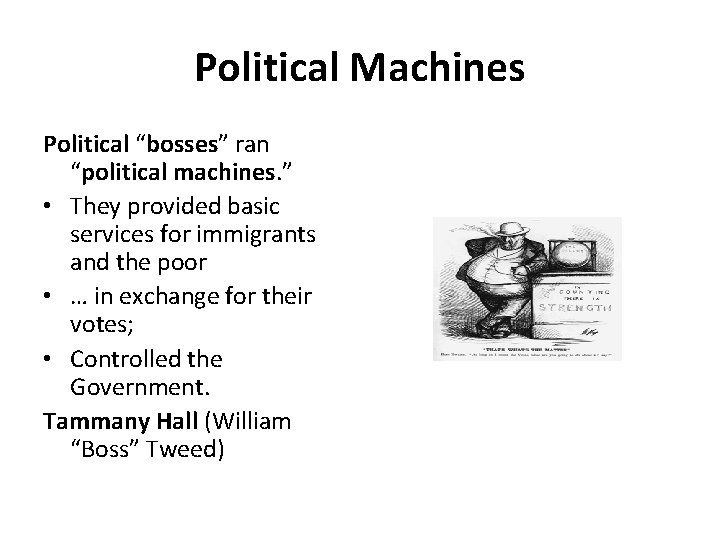
Political Machines Political “bosses” ran “political machines. ” • They provided basic services for immigrants and the poor • … in exchange for their votes; • Controlled the Government. Tammany Hall (William “Boss” Tweed)
Immigration Late 1800’s Why They Came. . . • Stayed in New York or moved to other parts of the country near relatives. “Push” Factors: Oppression, • Poor, dressed differently, little poverty, wars, and ethnic English, persecution “Pull “Factors: belief in • Lived in ethnic American freedom , ghettos=tenements economic opportunity, and • Adult immigrants worked cultural ties. • Cared for families. “New Immigrants” came from • Children “Americanized” Southern and Eastern Europe, mostly Catholics and • Optimistic when they arrived. Jewish; often less educated.
• Nativists wanted to restrict immigration. • Believed that people of other races , religions, and nationalities were inferior. • Chinese Exclusion Act (1882) was the first federal law to restrict immigration. Called for a 10 year ban on immigration of Chinese workers. Later made it permanent.
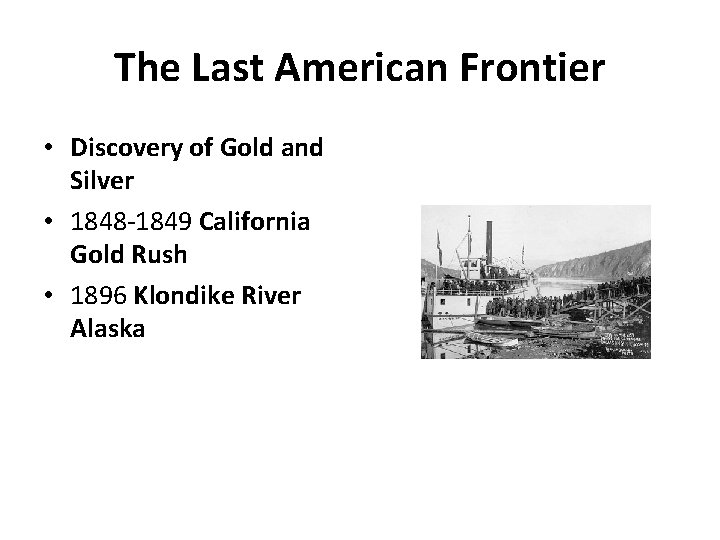
The Last American Frontier • Discovery of Gold and Silver • 1848 -1849 California Gold Rush • 1896 Klondike River Alaska
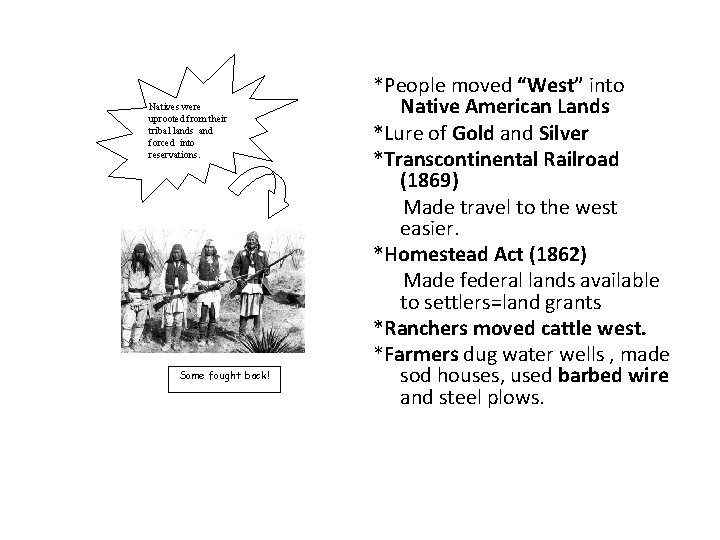
Natives were uprooted from their tribal lands and forced into reservations. Some fought back! *People moved “West” into Native American Lands *Lure of Gold and Silver *Transcontinental Railroad (1869) Made travel to the west easier. *Homestead Act (1862) Made federal lands available to settlers=land grants *Ranchers moved cattle west. *Farmers dug water wells , made sod houses, used barbed wire and steel plows.
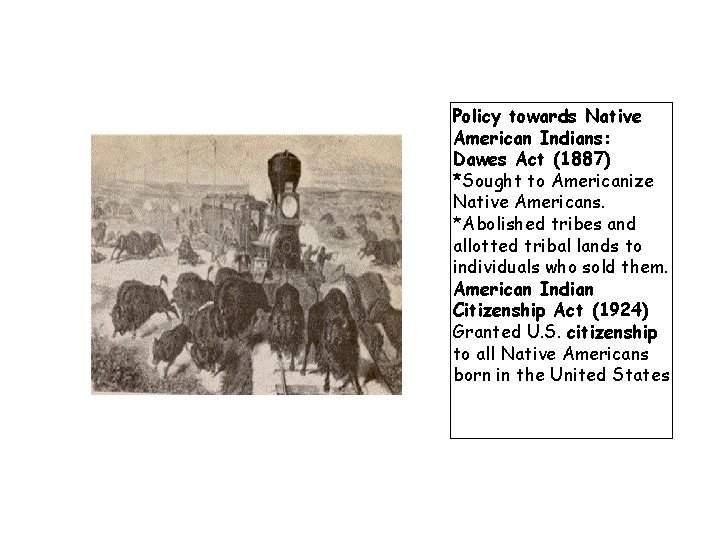
Policy towards Native American Indians: Dawes Act (1887) *Sought to Americanize Native Americans. *Abolished tribes and allotted tribal lands to individuals who sold them. American Indian Citizenship Act (1924) Granted U. S. citizenship to all Native Americans born in the United States
Which of the following was the main reason for the rapid settlement of the Great Plains during the late 1800 s? • A. Congress passed a law requiring all public lands to be sold at auction. • B. Congress passed a law allowing people to claim public land convert it to private property through homesteading. • C. Speculators bought large parcels of land then built factory towns to attract new immigrants. • D. Native Americans sold most of their tribal lands directly to railroad companies.
Why did the United States restrict immigration with the Chinese Exclusion Act of 1882? A. In response to the Boxer rebellion B. Fear of Chinese organized crime C. In an effort to quarantine the Bird Flu Epidemic D. Protect American job interests
During the nineteenth century, one way political bosses gained voter support was by — A. campaigning for women’s suffrage B. advocating the use of poll taxes C. making improvements in urban infrastructure D. providing public assistance former slaves
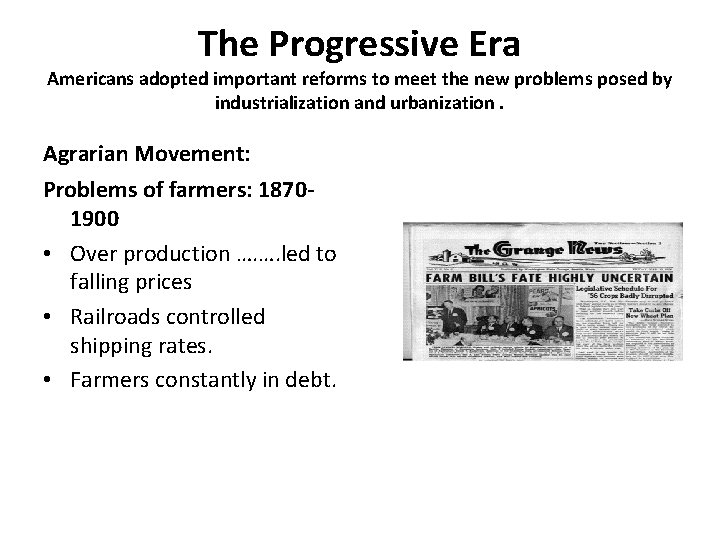
The Progressive Era Americans adopted important reforms to meet the new problems posed by industrialization and urbanization. Agrarian Movement: Problems of farmers: 1870 1900 • Over production …. …. led to falling prices • Railroads controlled shipping rates. • Farmers constantly in debt.
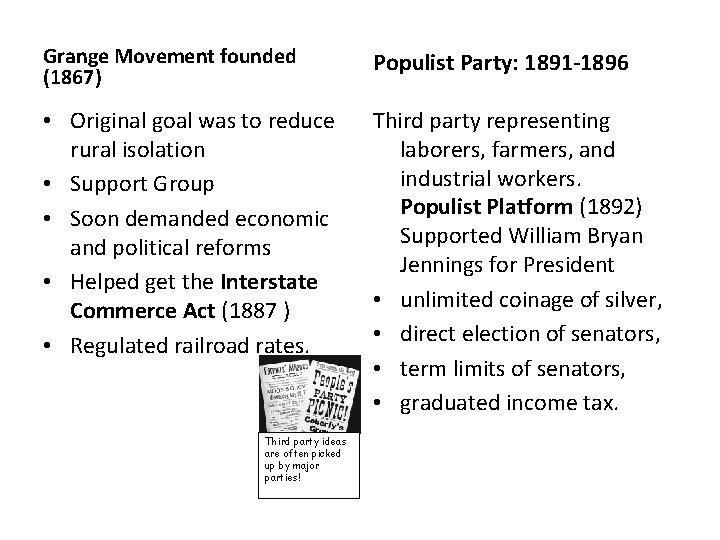
Grange Movement founded (1867) Populist Party: 1891 -1896 • Original goal was to reduce Third party representing rural isolation laborers, farmers, and industrial workers. • Support Group Populist Platform (1892) • Soon demanded economic Supported William Bryan and political reforms Jennings for President • Helped get the Interstate • unlimited coinage of silver, Commerce Act (1887 ) • Regulated railroad rates. • direct election of senators, • term limits of senators, • graduated income tax. Third party ideas are often picked up by major parties!
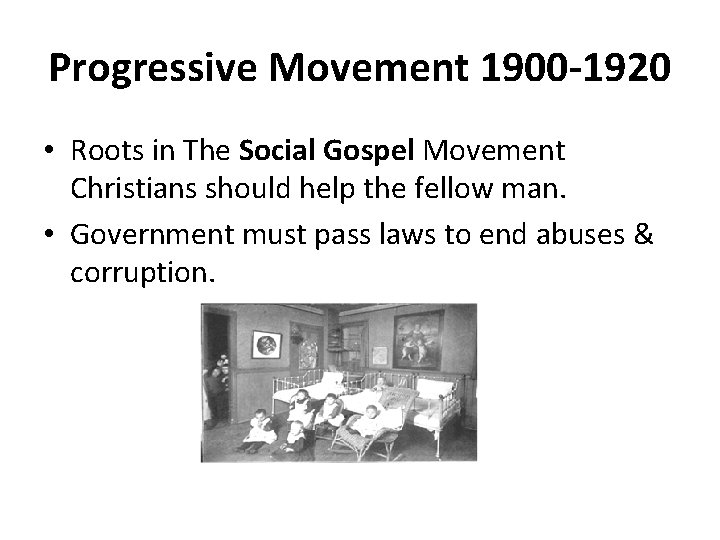
Progressive Movement 1900 -1920 • Roots in The Social Gospel Movement Christians should help the fellow man. • Government must pass laws to end abuses & corruption.
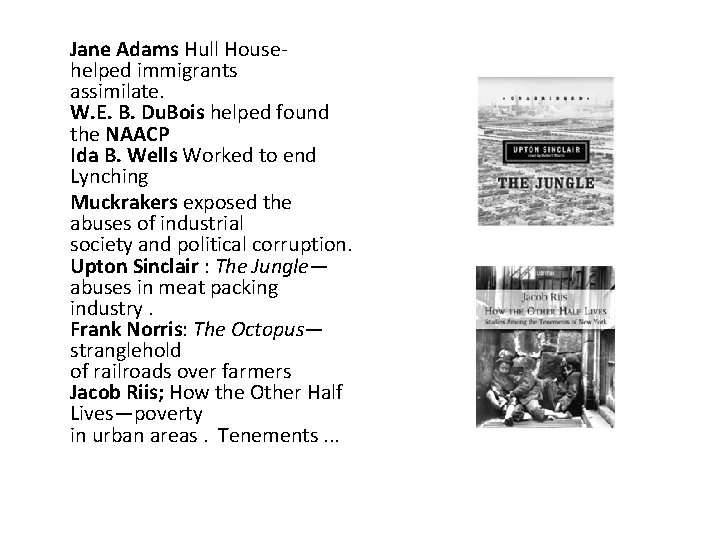
Jane Adams Hull House helped immigrants assimilate. W. E. B. Du. Bois helped found the NAACP Ida B. Wells Worked to end Lynching Muckrakers exposed the abuses of industrial society and political corruption. Upton Sinclair : The Jungle— abuses in meat packing industry. Frank Norris: The Octopus— stranglehold of railroads over farmers Jacob Riis; How the Other Half Lives—poverty in urban areas. Tenements. . .
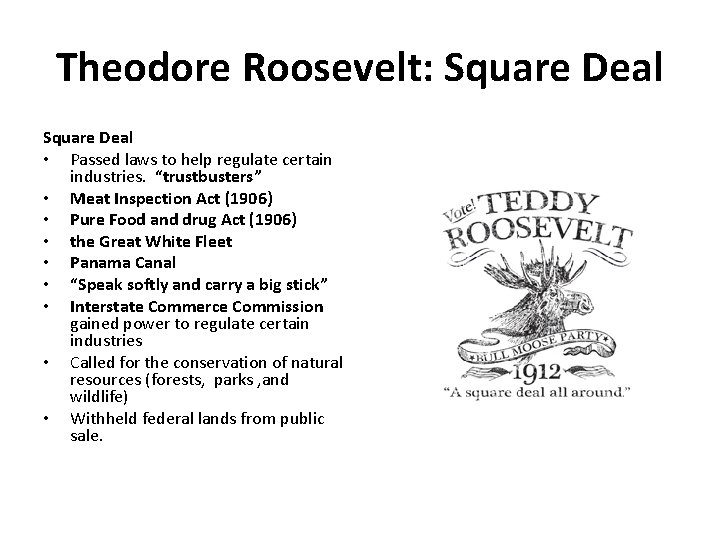
Theodore Roosevelt: Square Deal • Passed laws to help regulate certain industries. “trustbusters” • Meat Inspection Act (1906) • Pure Food and drug Act (1906) • the Great White Fleet • Panama Canal • “Speak softly and carry a big stick” • Interstate Commerce Commission gained power to regulate certain industries • Called for the conservation of natural resources (forests, parks , and wildlife) • Withheld federal lands from public sale.
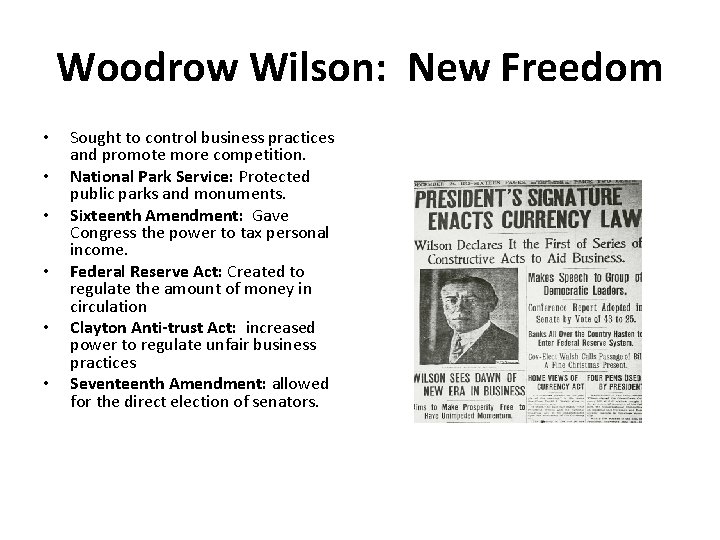
Woodrow Wilson: New Freedom • • • Sought to control business practices and promote more competition. National Park Service: Protected public parks and monuments. Sixteenth Amendment: Gave Congress the power to tax personal income. Federal Reserve Act: Created to regulate the amount of money in circulation Clayton Anti-trust Act: increased power to regulate unfair business practices Seventeenth Amendment: allowed for the direct election of senators.
The right of citizens of the United States to vote shall not be denied or abridged by the United States or by any State on account of sex. . 19 th Amendment to the U. S. Constitution What was one way the constitutional amendment excerpted above helped advance the cause of gender equality? A. It gave women a greater opportunity to influence government. B. It gave women new economic rights, such as property ownership. C. It established the idea that women should contribute to all sectors of the economy. D. It contributed to a long-term decline in the number of men voting in elections.
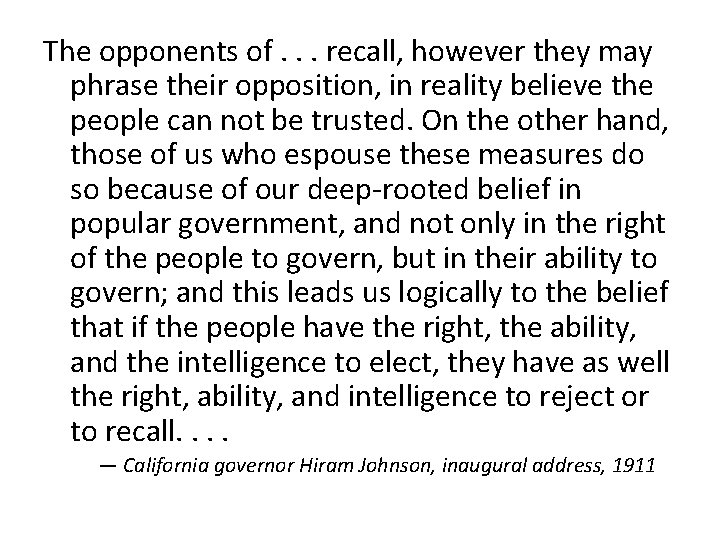
The opponents of. . . recall, however they may phrase their opposition, in reality believe the people can not be trusted. On the other hand, those of us who espouse these measures do so because of our deep-rooted belief in popular government, and not only in the right of the people to govern, but in their ability to govern; and this leads us logically to the belief that if the people have the right, the ability, and the intelligence to elect, they have as well the right, ability, and intelligence to reject or to recall. . — California governor Hiram Johnson, inaugural address, 1911
The reform discussed by Governor Johnson in this excerpt — A. required elected officials to communicate regularly with the public B. provided citizens with more resources to run for office C. made elected officials more directly accountable to their constituents D. created new eligibility requirements for candidates for public office
America Builds an Empire ***The Spanish American War, 1898 -a four month conflict between Spain and the United States, provoked by word of Spanish colonial brutality in Cuba. Origins of the Spanish American War • Jose Marti– led Cuban exiles to declare Cuban independence from Spain in 1895 • William Randolph Hearst-Joseph Pulitzer sensationalized newspapers about atrocities in Cuba. • Yellow Journalism-Exaggerated stories published in newspapers in order to increase circulation. Gave Americans an inaccurate picture of events in Cuba
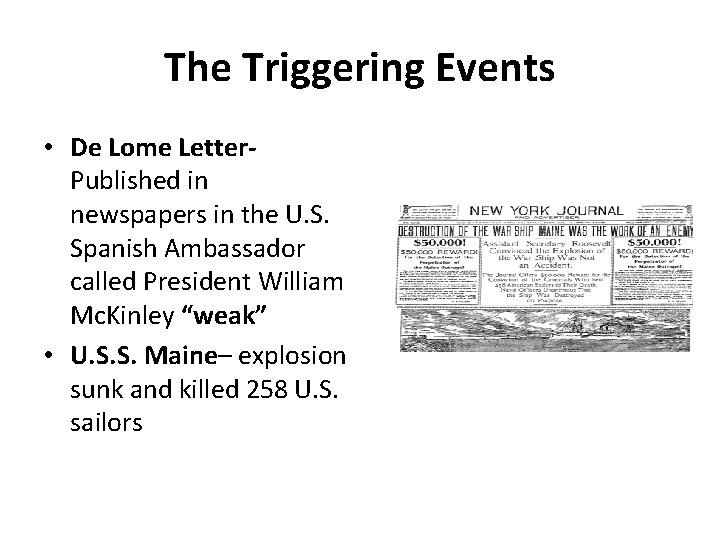
The Triggering Events • De Lome Letter Published in newspapers in the U. S. Spanish Ambassador called President William Mc. Kinley “weak” • U. S. S. Maine– explosion sunk and killed 258 U. S. sailors
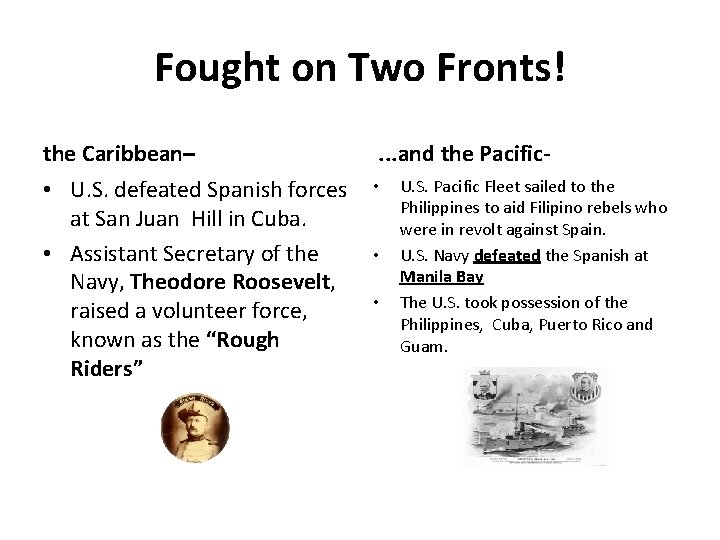
Fought on Two Fronts! the Caribbean– . . . and the Pacific- • U. S. defeated Spanish forces at San Juan Hill in Cuba. • Assistant Secretary of the Navy, Theodore Roosevelt, raised a volunteer force, known as the “Rough Riders” • • • U. S. Pacific Fleet sailed to the Philippines to aid Filipino rebels who were in revolt against Spain. U. S. Navy defeated the Spanish at Manila Bay The U. S. took possession of the Philippines, Cuba, Puerto Rico and Guam.
The Spanish American War as a Turning Point. . . • Marked an end to Spain’s colonial empire • The U. S. emerges as a world power • U. S. demonstrated its naval strength
American Imperialism—Reasons • Need for Raw Materials and Markets for U. S. • colonies could provide raw materials for factories, • guaranteed market for manufacturers and farmers • Strategic reasons-the U. S. /naval bases in the pacific • Navy could protect U. S. interests • Nationalism-through expansionism the U. S. could show the world they were a great and powerful nation • Many Americans thought that they were a superior race that should “rule” others. • Alfred Thayer Mahan. President of the Naval War College and America’s leading advocate for imperial expansion and a powerful navy.
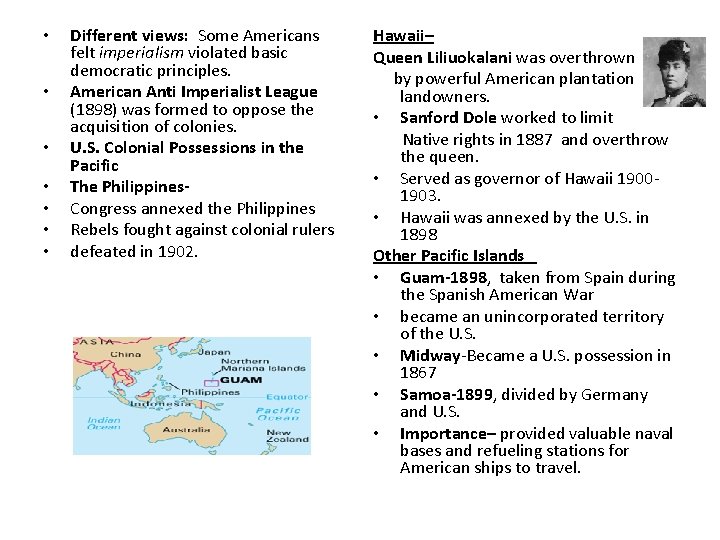
• • Different views: Some Americans felt imperialism violated basic democratic principles. American Anti Imperialist League (1898) was formed to oppose the acquisition of colonies. U. S. Colonial Possessions in the Pacific The Philippines- Congress annexed the Philippines Rebels fought against colonial rulers defeated in 1902. Hawaii– Queen Liliuokalani was overthrown by powerful American plantation landowners. • Sanford Dole worked to limit Native rights in 1887 and overthrow the queen. • Served as governor of Hawaii 19001903. • Hawaii was annexed by the U. S. in 1898 Other Pacific Islands • Guam-1898, taken from Spain during the Spanish American War • became an unincorporated territory of the U. S. • Midway-Became a U. S. possession in 1867 • Samoa-1899, divided by Germany and U. S. • Importance– provided valuable naval bases and refueling stations for American ships to travel.
America and East Asia…. . • After 1898, US acquisitions of several Pacific islands • influence in the Pacific with…opportunities to trade with China and Japan China • “Spheres of Influence”areas where countries enjoyed special privileges, • John Hay-U. S. Secretary of State who wanted to protect American interests in China • Open door Policy-giving equal trading rights to all foreign nations in China Boxer Rebellion • led by group of Boxers • opposed Western influence in China. • U. S. and other countries crushed rebellion
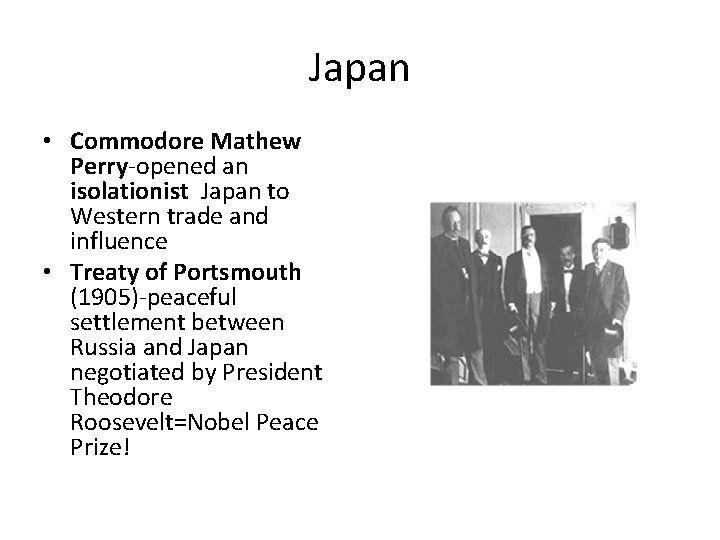
Japan • Commodore Mathew Perry-opened an isolationist Japan to Western trade and influence • Treaty of Portsmouth (1905)-peaceful settlement between Russia and Japan negotiated by President Theodore Roosevelt=Nobel Peace Prize!
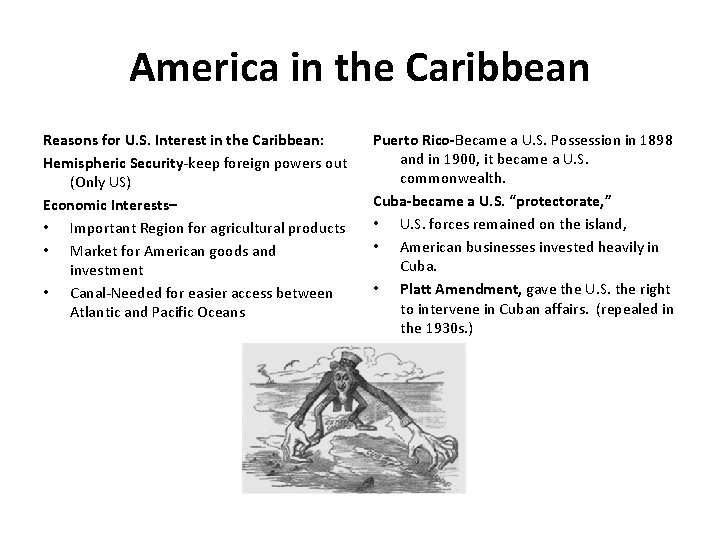
America in the Caribbean Reasons for U. S. Interest in the Caribbean: Hemispheric Security-keep foreign powers out (Only US) Economic Interests– • Important Region for agricultural products • Market for American goods and investment • Canal-Needed for easier access between Atlantic and Pacific Oceans Puerto Rico-Became a U. S. Possession in 1898 and in 1900, it became a U. S. commonwealth. Cuba-became a U. S. “protectorate, ” • U. S. forces remained on the island, • American businesses invested heavily in Cuba. • Platt Amendment, gave the U. S. the right to intervene in Cuban affairs. (repealed in the 1930 s. )
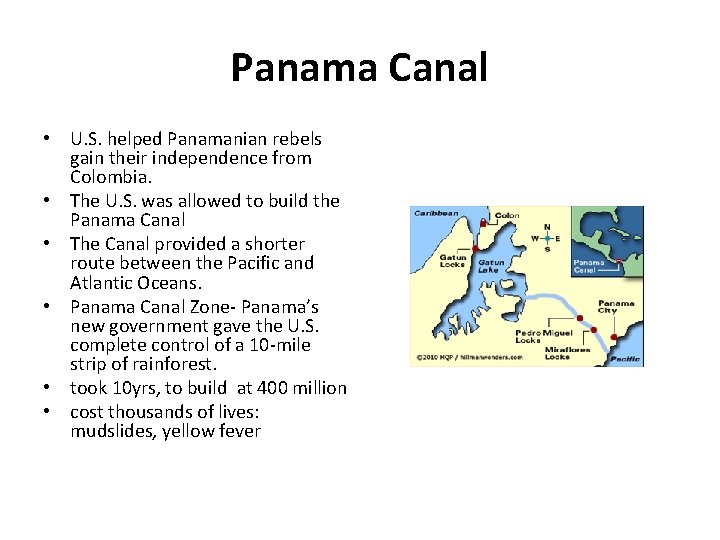
Panama Canal • U. S. helped Panamanian rebels gain their independence from Colombia. • The U. S. was allowed to build the Panama Canal • The Canal provided a shorter route between the Pacific and Atlantic Oceans. • Panama Canal Zone- Panama’s new government gave the U. S. complete control of a 10 -mile strip of rainforest. • took 10 yrs, to build at 400 million • cost thousands of lives: mudslides, yellow fever
The Caribbean as an “American Lake” • U. S. acted as “international police power” in Latin American countries. • “Roosevelt Corollary” to the Monroe Doctrine. (Popularly known as the Big Stick Policy) • Taft and Dollar Diplomacy-President Taft promoted investments in Caribbean countries & US Foreign Policy • Wilson’s Latin American Policy– followed the pattern of Presidents Roosevelt and Taft by sending troops to several Latin American countries to protect American interests
To His Excellency William Mc. Kinley, President, and the Senate, of the United States of America. . . • We, the undersigned, native Hawaiian citizens. . . who are members of the Hawaiian Patriotic League of the Hawaiian Islands, and others who are in sympathy with the said League, earnestly protest against the. . . [addition] of the said Hawaiian Islands to the said United States of America in any form or shape. — Petition, 1897
What were these Hawaiian citizens protesting? • A. The forced annexation of the islands as a U. S. territory after the overthrow of the Hawaiian monarchy • B. The classification of the islands as a protectorate after the Hawaiian government signed a treaty with the United States • C. The granting of U. S. statehood to the islands after they were purchased from the Hawaiian monarch
v • Statement 1: The U. S. oil industry boomed due to oil deposits found in conquered territories. • Statement 2: Rebuilding its devastated army cost the United States an enormous amount of money. • Statement 3: The acquisition of new territories allowed for the expansion of U. S. commercial trade. • Statement 4: Territorial losses forced the United States to purchase expensive natural resources from other countries. Which statement would most likely be found in a history of the economic impact of the Spanish-American War on the United States? • • A. Statement 1 B. Statement 2 C. Statement 3 D. Statement 4
World War I Causes of World War I • Militarism-European countries had established powerful militaries • Alliances-By the 1890 s, Europe divided into two alliances. Germany and Austria vs. Russia, France, and Great Britain • Imperialism and competing economic and colonial claims • Nationalism-(Pride in ones country) led to rivalries between France, Germany, Austria-Hungary, and Russia. *Several nationalities wanted to form their own states M A I N
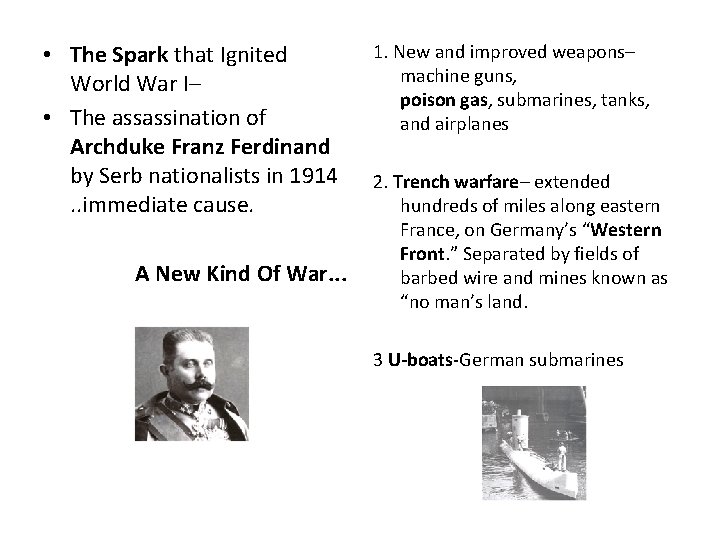
• The Spark that Ignited World War I– • The assassination of Archduke Franz Ferdinand by Serb nationalists in 1914 . . immediate cause. A New Kind Of War. . . 1. New and improved weapons– machine guns, poison gas, submarines, tanks, and airplanes 2. Trench warfare– extended hundreds of miles along eastern France, on Germany’s “Western Front. ” Separated by fields of barbed wire and mines known as “no man’s land. 3 U-boats-German submarines
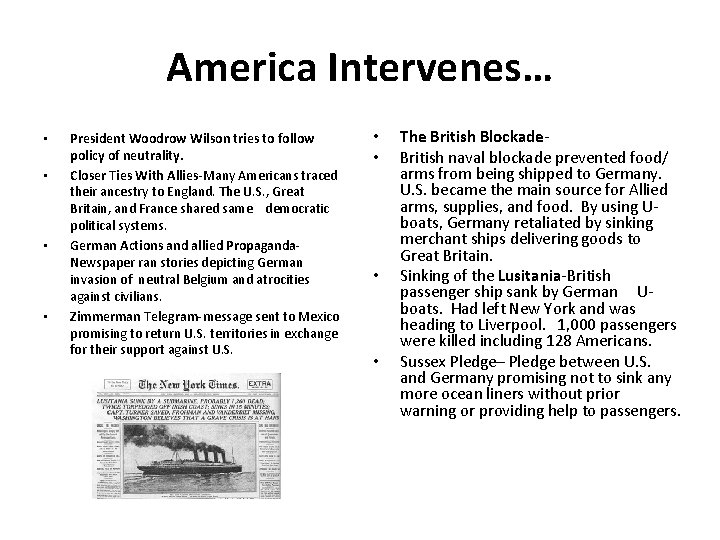
America Intervenes… • • • The British Blockade. President Woodrow Wilson tries to follow policy of neutrality. • British naval blockade prevented food/ arms from being shipped to Germany. Closer Ties With Allies-Many Americans traced U. S. became the main source for Allied their ancestry to England. The U. S. , Great arms, supplies, and food. By using UBritain, and France shared same democratic boats, Germany retaliated by sinking political systems. merchant ships delivering goods to German Actions and allied Propaganda- Great Britain. Newspaper ran stories depicting German • Sinking of the Lusitania-British invasion of neutral Belgium and atrocities passenger ship sank by German Uagainst civilians. boats. Had left New York and was Zimmerman Telegram-message sent to Mexico heading to Liverpool. 1, 000 passengers promising to return U. S. territories in exchange were killed including 128 Americans. for their support against U. S. • Sussex Pledge– Pledge between U. S. and Germany promising not to sink any more ocean liners without prior warning or providing help to passengers.
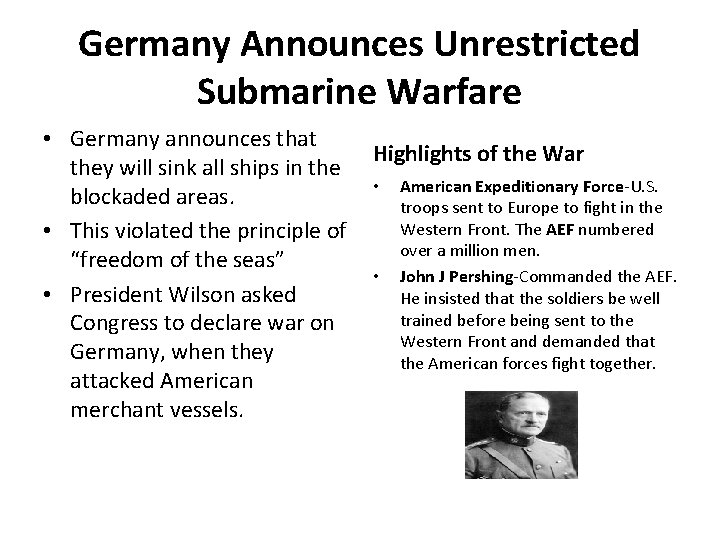
Germany Announces Unrestricted Submarine Warfare • Germany announces that Highlights of the War they will sink all ships in the • American Expeditionary Force-U. S. blockaded areas. troops sent to Europe to fight in the Western Front. The AEF numbered • This violated the principle of over a million men. “freedom of the seas” • John J Pershing-Commanded the AEF. • President Wilson asked He insisted that the soldiers be well trained before being sent to the Congress to declare war on Western Front and demanded that Germany, when they the American forces fight together. attacked American merchant vessels.
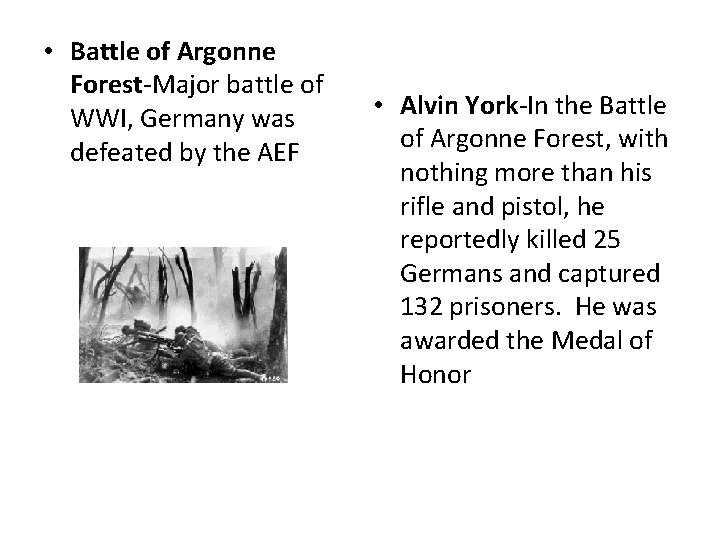
• Battle of Argonne Forest-Major battle of WWI, Germany was defeated by the AEF • Alvin York-In the Battle of Argonne Forest, with nothing more than his rifle and pistol, he reportedly killed 25 Germans and captured 132 prisoners. He was awarded the Medal of Honor
The Home Front 1917 -1918 - The Treaty Of Versailles • Ended World War I. • The Selective Service Act • Dealt harshly with Germany. (1917)- All males 18 - 45 • Germany lost territory to France and Poland. had to register for a draft • Austria-Hungary and Turkey-The Austro-Hungarian. • The Espionage Act of 1917 Empire was divided into several new nation states. Turkey lost its territories in the middle east. made it a crime to criticize • Germany-Germany lost its navy, while its army was the war effort reduced to a small police force. • Sedition Act • Germany was forced to accept blame for starting the war in the War Guilt Clause and was required to • Wilson’s Fourteen Pointspay huge reparations Proposed by President Wilson • League of Nations-an organization of nations pledged to defend each other against aggressors. as a basis for the peace treaty • The U. S. senate Rejects the Treaty. Congress argued and to make the world “safe for democracy. ”# 14 League of that it would drag the country into unnecessary military commitments Nations. • Henry Cabot Lodge-Senate majority Leader was a strong opponent of the League of Nations. He * Schenck v. U. S. (1919) believed that the U. S. would lose its freedom of Supreme court ruled that action if it joined the League of Nations. there were limits to free • America Retreats Into Isolationism. speech.
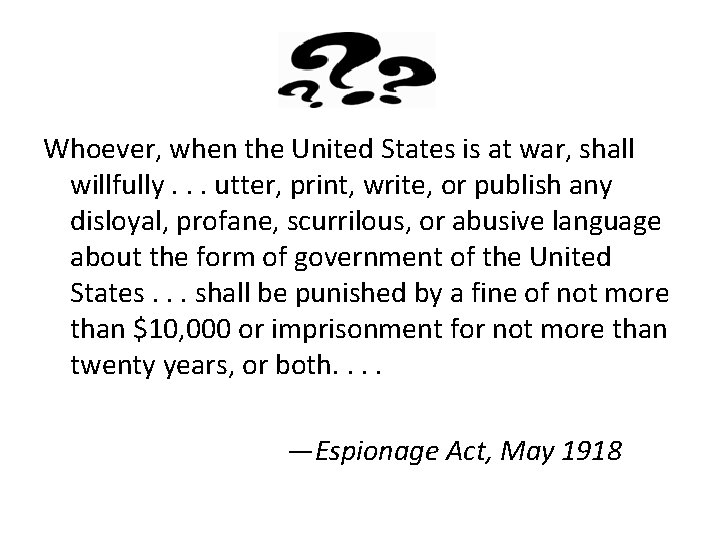
Whoever, when the United States is at war, shall willfully. . . utter, print, write, or publish any disloyal, profane, scurrilous, or abusive language about the form of government of the United States. . . shall be punished by a fine of not more than $10, 000 or imprisonment for not more than twenty years, or both. . —Espionage Act, May 1918
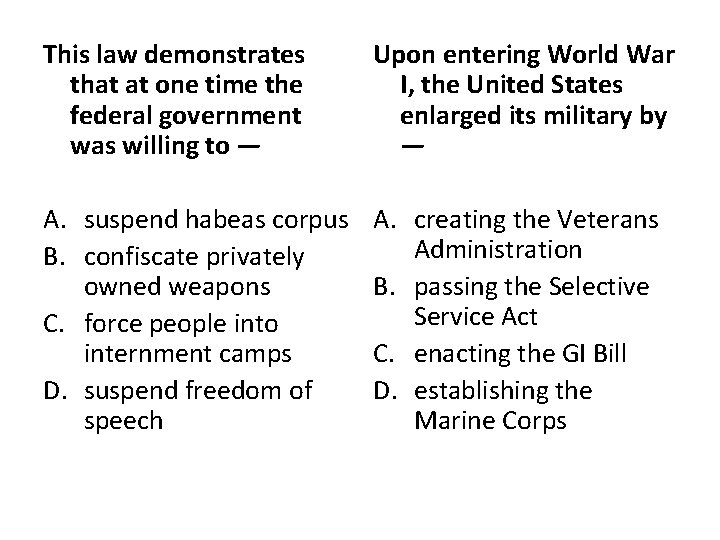
This law demonstrates that at one time the federal government was willing to — Upon entering World War I, the United States enlarged its military by — A. suspend habeas corpus B. confiscate privately owned weapons C. force people into internment camps D. suspend freedom of speech A. creating the Veterans Administration B. passing the Selective Service Act C. enacting the GI Bill D. establishing the Marine Corps
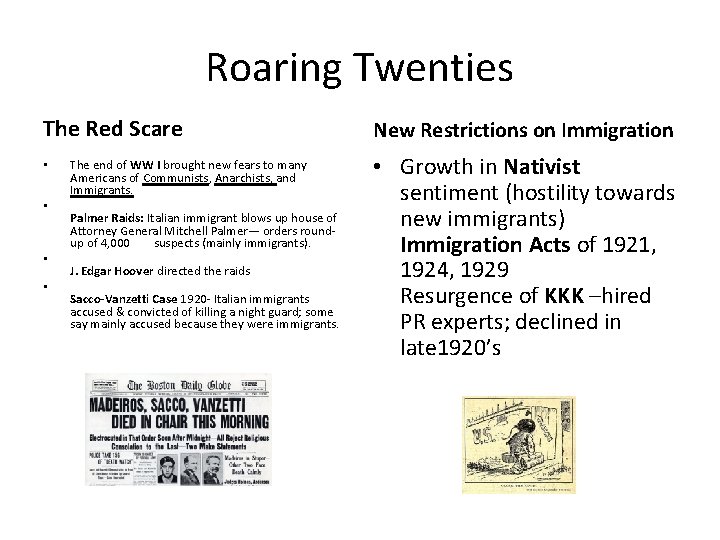
Roaring Twenties The Red Scare • • New Restrictions on Immigration • Growth in Nativist sentiment (hostility towards new immigrants) Immigration Acts of 1921, 1924, 1929 Resurgence of KKK –hired PR experts; declined in late 1920’s The end of WW I brought new fears to many Americans of Communists, Anarchists, and Immigrants. Palmer Raids: Italian immigrant blows up house of Attorney General Mitchell Palmer— orders roundup of 4, 000 suspects (mainly immigrants). J. Edgar Hoover directed the raids Sacco-Vanzetti Case 1920 - Italian immigrants accused & convicted of killing a night guard; some say mainly accused because they were immigrants.
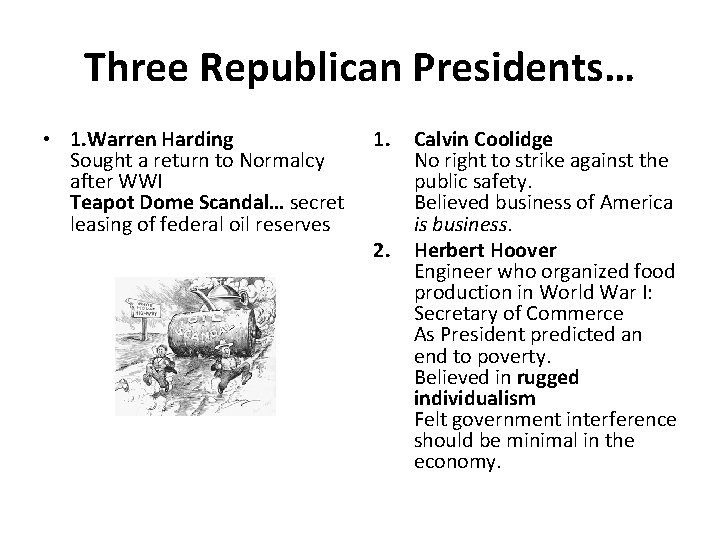
Three Republican Presidents… • 1. Warren Harding 1. Calvin Coolidge Sought a return to Normalcy No right to strike against the after WWI public safety. Teapot Dome Scandal… secret Believed business of America leasing of federal oil reserves is business. 2. Herbert Hoover Engineer who organized food production in World War I: Secretary of Commerce As President predicted an end to poverty. Believed in rugged individualism Felt government interference should be minimal in the economy.
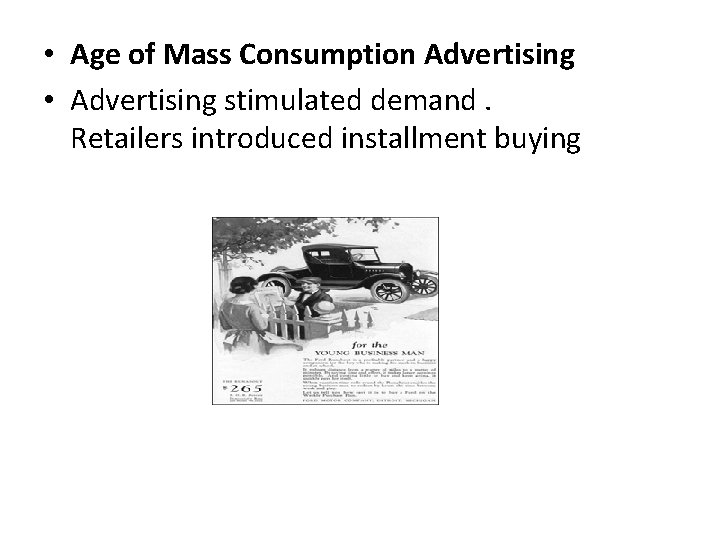
• Age of Mass Consumption Advertising • Advertising stimulated demand. Retailers introduced installment buying
Reasons for Prosperity of 1920’s Results of improved transportation brought by affordable automobiles Communication changes • Greater mobility • Automobile industry/jobs • Movement to suburban areas • Use of the assembly line • Henry Ford (automobile) Model T • Increased availability of telephones • Development of the radio • Broadcast industry • Development of movies
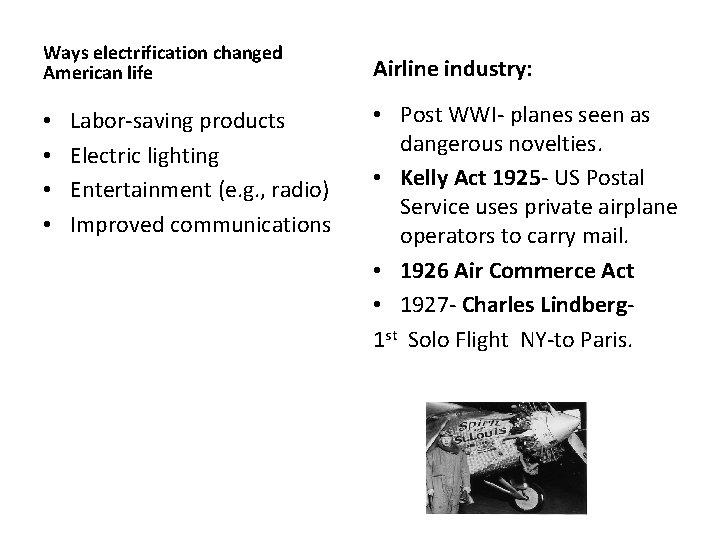
Ways electrification changed American life • • Labor-saving products Electric lighting Entertainment (e. g. , radio) Improved communications Airline industry: • Post WWI- planes seen as dangerous novelties. • Kelly Act 1925 - US Postal Service uses private airplane operators to carry mail. • 1926 Air Commerce Act • 1927 - Charles Lindberg- 1 st Solo Flight NY-to Paris.
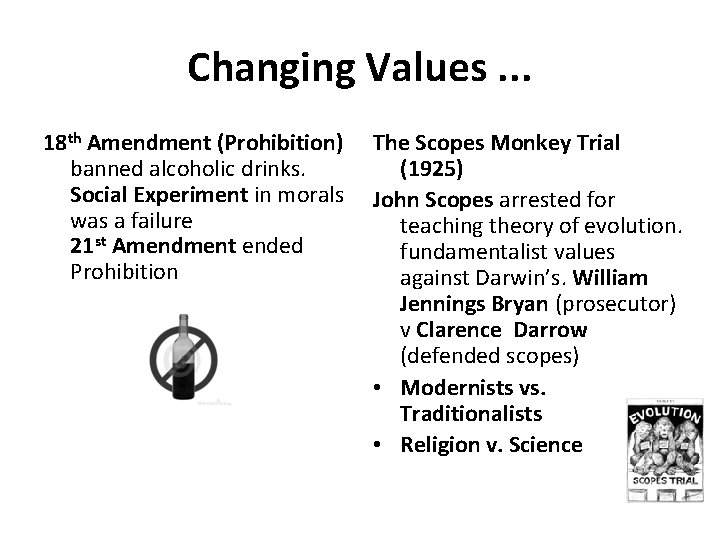
Changing Values. . . 18 th Amendment (Prohibition) The Scopes Monkey Trial banned alcoholic drinks. (1925) Social Experiment in morals John Scopes arrested for was a failure teaching theory of evolution. st 21 Amendment ended fundamentalist values Prohibition against Darwin’s. William Jennings Bryan (prosecutor) v Clarence Darrow (defended scopes) • Modernists vs. Traditionalists • Religion v. Science
• Eugenics was a pseudo-scientific belief that the human race could be improved by breeding. • Charles Davenport was a leading proponent of eugenics. • Social Darwinists believed that different human races competed for survivals just like plants and animals.
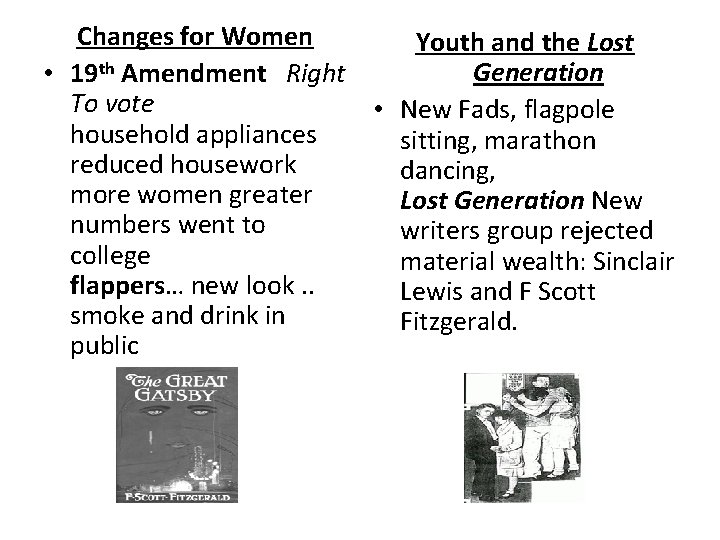
Changes for Women Youth and the Lost Generation • 19 th Amendment Right To vote • New Fads, flagpole household appliances sitting, marathon reduced housework dancing, more women greater Lost Generation New numbers went to writers group rejected college material wealth: Sinclair flappers… new look. . Lewis and F Scott smoke and drink in Fitzgerald. public
Harlem Renaissance • The leaders of the Harlem Renaissance drew upon the heritage of black culture to establish themselves as powerful forces for cultural change.
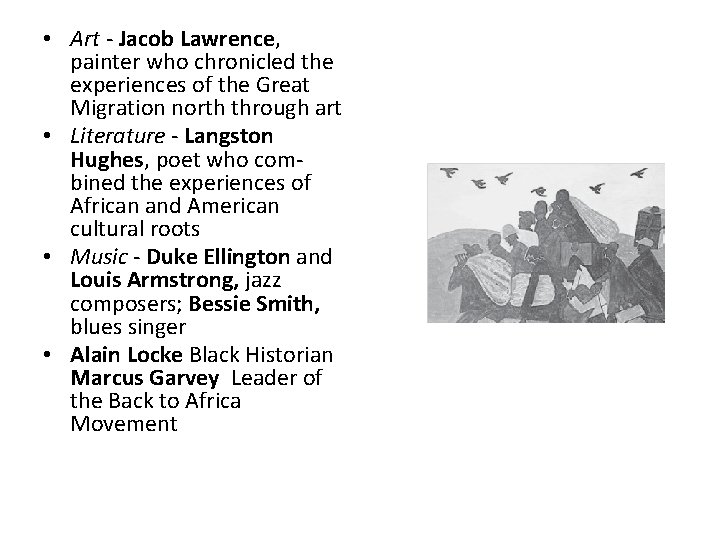
• Art - Jacob Lawrence, painter who chronicled the experiences of the Great Migration north through art • Literature - Langston Hughes, poet who combined the experiences of African and American cultural roots • Music - Duke Ellington and Louis Armstrong, jazz composers; Bessie Smith, blues singer • Alain Locke Black Historian Marcus Garvey Leader of the Back to Africa Movement
A 1920’s “flapper” girl would have supported— Which of these resulted from the prohibition of alcohol during the 1920 s? A. Traditional feminine roles A. A decline in immigration rates B. Men as preferred choice for national executive office B. A growing fear of communism C. Equal power for women and men in the same C. The expansion of the consumer economy occupation D. The rise of organized crime D. The double standard ideal During the 1920 s, Clarence Darrow and William Jennings Bryan were most closely identified with the — A. increased use of credit by U. S. consumers B. development of new forms of popular entertainment C. decline of public support for Progressive reforms D. conflict between modernism and traditionalism
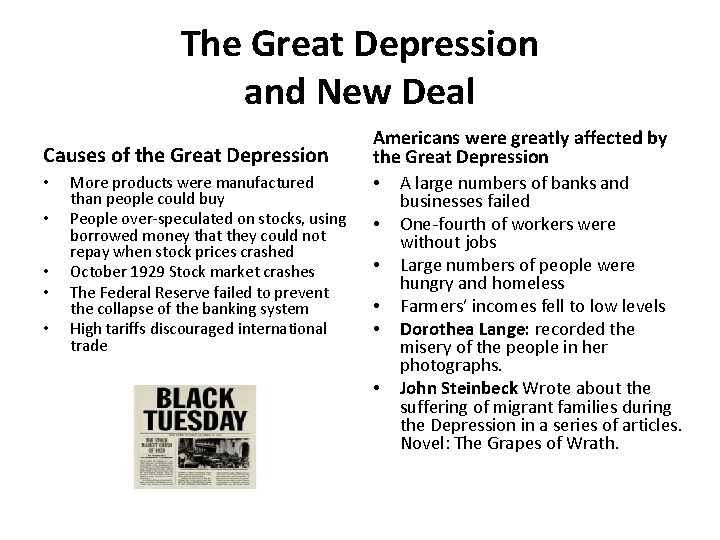
The Great Depression and New Deal Causes of the Great Depression • • • More products were manufactured than people could buy People over-speculated on stocks, using borrowed money that they could not repay when stock prices crashed October 1929 Stock market crashes The Federal Reserve failed to prevent the collapse of the banking system High tariffs discouraged international trade Americans were greatly affected by the Great Depression • A large numbers of banks and • • • businesses failed One-fourth of workers were without jobs Large numbers of people were hungry and homeless Farmers’ incomes fell to low levels Dorothea Lange: recorded the misery of the people in her photographs. John Steinbeck Wrote about the suffering of migrant families during the Depression in a series of articles. Novel: The Grapes of Wrath.
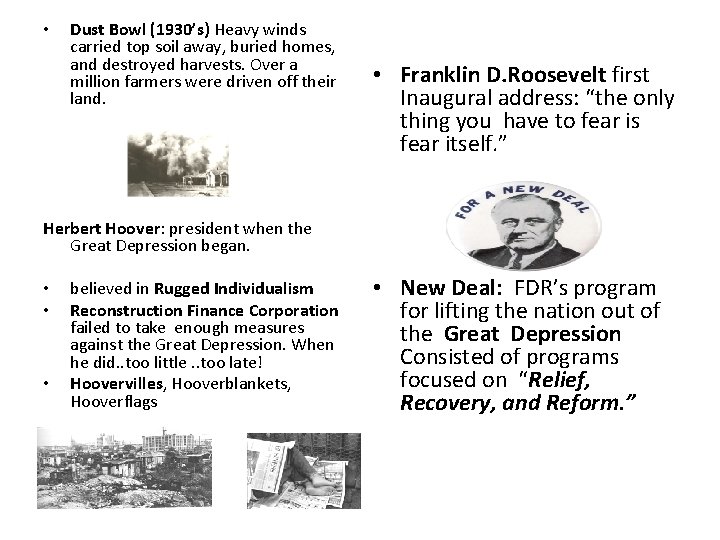
• Dust Bowl (1930’s) Heavy winds carried top soil away, buried homes, and destroyed harvests. Over a million farmers were driven off their land. Herbert Hoover: president when the Great Depression began. • believed in Rugged Individualism • Reconstruction Finance Corporation failed to take enough measures against the Great Depression. When he did. . too little. . too late! • Hoovervilles, Hooverblankets, Hooverflags • Franklin D. Roosevelt first Inaugural address: “the only thing you have to fear is fear itself. ” • New Deal: FDR’s program for lifting the nation out of the Great Depression Consisted of programs focused on “Relief, Recovery, and Reform. ”
Some major features of the New Deal Relief: Short term actions $=Jobs Bank Holiday. Closed all Banks. Civilian Conservation Corps (CCC) Public Works Administration (PWA) Works Progress Administration (WPA) Tennessee Valley Authority (TVA) Recovery: Restore Incentives to produce. Priming the Pump National Recovery Administration (1933) Agriculture Adjustment Acts Reform: Remedy defects of the US Economy=laws FDCI insured bank deposits SEC watchdog Agency over stock markets Social Security Act Federal Housing Authority (FHA) Eleanor Roosevelt served as “eyes and ears. ” As first lady, she traveled throughout the country. Political activist for women’s rights, the cause of peace, and the poor.
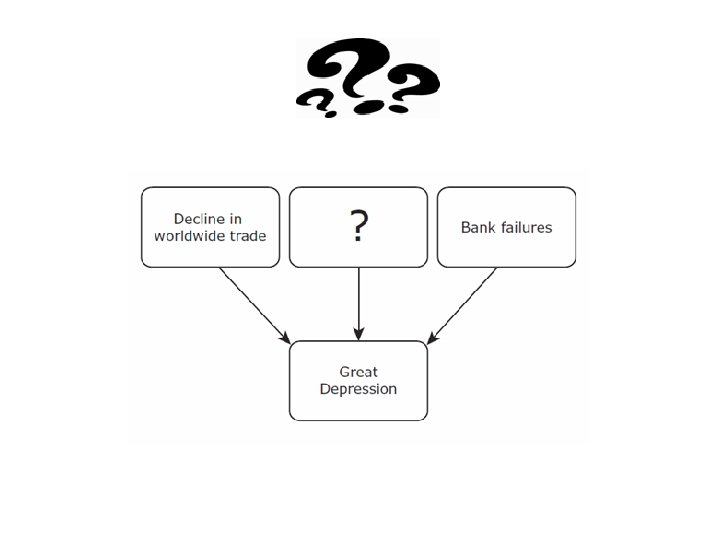
Which of the following best completes this graphic organizer? A. Increase in consumer spending B. Over speculation in the stock market C. Decrease in military spending D. Government subsidization of agriculture For the purpose of enabling each State to furnish financial assistance, as far as practicable under the conditions in such State, to aged needy individuals, there is hereby authorized to be appropriated. . . for each fiscal year a sum sufficient to carry out the purposes of this title. —Social Security Act of 1935, Title 1, Section 1 How did the legislation excerpted above affect the relationship between the U. S. government and its citizens? A. It allowed the government to tax investment income. B. It allowed people to have more direct input in government decisions. C. It made most people distrust the power of the government. D. It made the government more responsible for the people’s economic welfare.
America in World War II Causes of World War II Political and economic conditions in Europe following World War I led to the rise of fascism and to World War II. The rise of fascism threatened peace in Europe and Asia. As conflict grew in Europe and Asia, American foreign policy evolved from neutrality to direct involvement.
How did post-World War I set the stage for World War II? Political instability and economic devastation in Europe Resulting from World War I • Worldwide depression • High war debt owed by Germany • High inflation • Massive unemployment World War II 1931 -1945 Fascism - political philosophy in which total power is given to dictator and individual freedoms are denied. Fascist dictators included Adolf Hitler (Germany), Benito Mussolini (Italy), and Hideki Tojo (Japan). These dictators led the countries that became known as the Axis Powers. The Axis Powers • Benito Mussolini—Fascist Party ( Italy) • Adolf Hitler—Nazi Party (They condemned Jews and others) - (Germany) • Hideki Tojo-Leader of the militarists in Japan and responsible for the attack on Pearl Harbor. (Japan)
Allies 1. USA—Franklin D. Roosevelt and later Harry S. Truman (United States) 2. Winston Churchill (Great Britain) 3. Joseph Stalin (Soviet Union). As conflict grew in Europe and Asia, American foreign policy evolved from neutrality to direct conflict. Allies: democratic nations of the United States, Great Britain, and Canada. The Soviet Union joined the Allies after being invaded by The Axis. How did American policy toward events in Europe and Asia change over time? There was a gradual change in American policy from neutrality to involvement - 1. Isolationism (Great Depression, legacy of World War I) 2. Economic aid to Allies 3. Direct involvement in the war War in the Pacific 1. Rising tension developed between United States and Japan because of Japanese aggression in East Asia. 2. On December 7, 1941, Japan attacked United States at Pearl Harbor without warning. 3. The United States declared war on Japan. 4. Germany declared war on the United States.
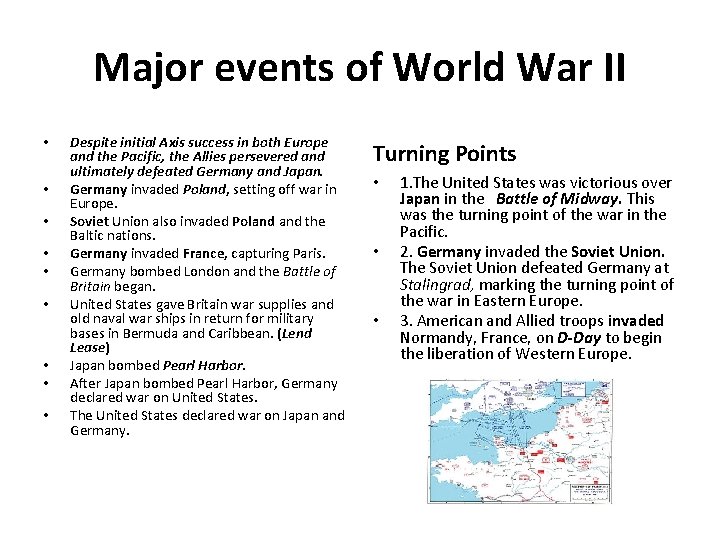
Major events of World War II • • • Despite initial Axis success in both Europe and the Pacific, the Allies persevered and ultimately defeated Germany and Japan. Germany invaded Poland, setting off war in Europe. Soviet Union also invaded Poland the Baltic nations. Germany invaded France, capturing Paris. Germany bombed London and the Battle of Britain began. United States gave Britain war supplies and old naval war ships in return for military bases in Bermuda and Caribbean. (Lend Lease) Japan bombed Pearl Harbor. After Japan bombed Pearl Harbor, Germany declared war on United States. The United States declared war on Japan and Germany. Turning Points • • • 1. The United States was victorious over Japan in the Battle of Midway. This was the turning point of the war in the Pacific. 2. Germany invaded the Soviet Union. The Soviet Union defeated Germany at Stalingrad, marking the turning point of the war in Eastern Europe. 3. American and Allied troops invaded Normandy, France, on D-Day to begin the liberation of Western Europe.
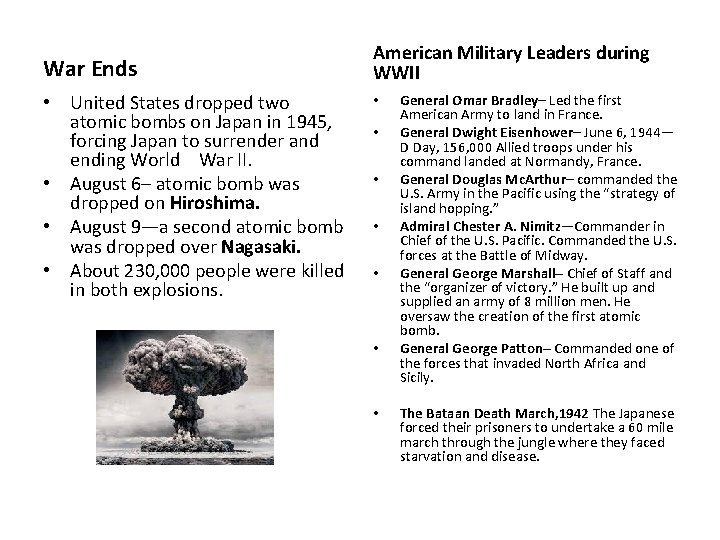
War Ends • United States dropped two atomic bombs on Japan in 1945, forcing Japan to surrender and ending World War II. • August 6– atomic bomb was dropped on Hiroshima. • August 9—a second atomic bomb was dropped over Nagasaki. • About 230, 000 people were killed in both explosions. American Military Leaders during WWII • • General Omar Bradley– Led the first American Army to land in France. General Dwight Eisenhower– June 6, 1944— D Day, 156, 000 Allied troops under his command landed at Normandy, France. General Douglas Mc. Arthur– commanded the U. S. Army in the Pacific using the “strategy of island hopping. ” Admiral Chester A. Nimitz—Commander in Chief of the U. S. Pacific. Commanded the U. S. forces at the Battle of Midway. General George Marshall– Chief of Staff and the “organizer of victory. ” He built up and supplied an army of 8 million men. He oversaw the creation of the first atomic bomb. General George Patton– Commanded one of the forces that invaded North Africa and Sicily. The Bataan Death March, 1942 The Japanese forced their prisoners to undertake a 60 mile march through the jungle where they faced starvation and disease.
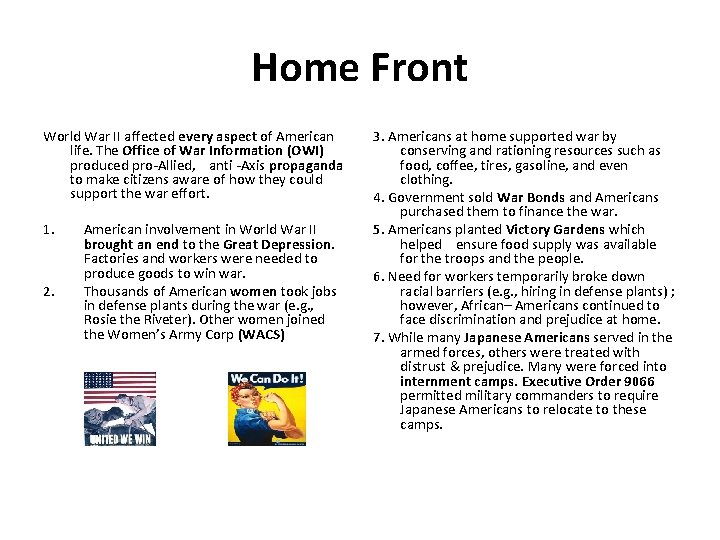
Home Front World War II affected every aspect of American life. The Office of War Information (OWI) produced pro-Allied, anti -Axis propaganda to make citizens aware of how they could support the war effort. 1. 2. American involvement in World War II brought an end to the Great Depression. Factories and workers were needed to produce goods to win war. Thousands of American women took jobs in defense plants during the war (e. g. , Rosie the Riveter). Other women joined the Women’s Army Corp (WACS) 3. Americans at home supported war by conserving and rationing resources such as food, coffee, tires, gasoline, and even clothing. 4. Government sold War Bonds and Americans purchased them to finance the war. 5. Americans planted Victory Gardens which helped ensure food supply was available for the troops and the people. 6. Need for workers temporarily broke down racial barriers (e. g. , hiring in defense plants) ; however, African– Americans continued to face discrimination and prejudice at home. 7. While many Japanese Americans served in the armed forces, others were treated with distrust & prejudice. Many were forced into internment camps. Executive Order 9066 permitted military commanders to require Japanese Americans to relocate to these camps.
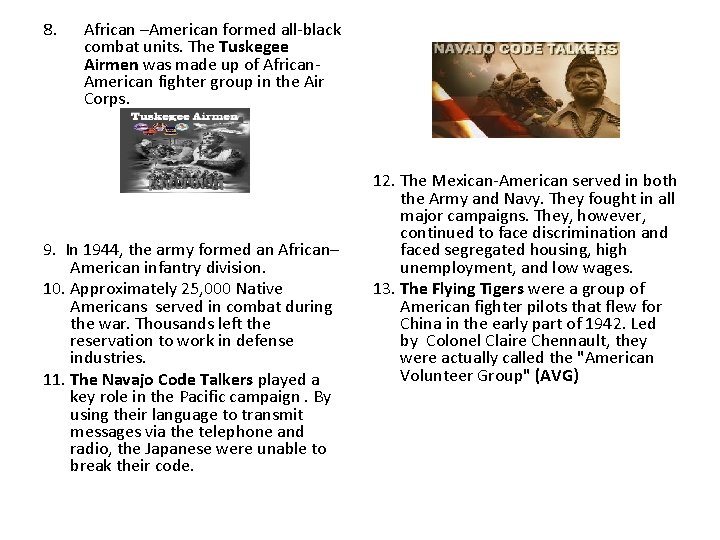
8. African –American formed all-black combat units. The Tuskegee Airmen was made up of African. American fighter group in the Air Corps. 9. In 1944, the army formed an African– American infantry division. 10. Approximately 25, 000 Native Americans served in combat during the war. Thousands left the reservation to work in defense industries. 11. The Navajo Code Talkers played a key role in the Pacific campaign. By using their language to transmit messages via the telephone and radio, the Japanese were unable to break their code. 12. The Mexican-American served in both the Army and Navy. They fought in all major campaigns. They, however, continued to face discrimination and faced segregated housing, high unemployment, and low wages. 13. The Flying Tigers were a group of American fighter pilots that flew for China in the early part of 1942. Led by Colonel Claire Chennault, they were actually called the "American Volunteer Group" (AVG)
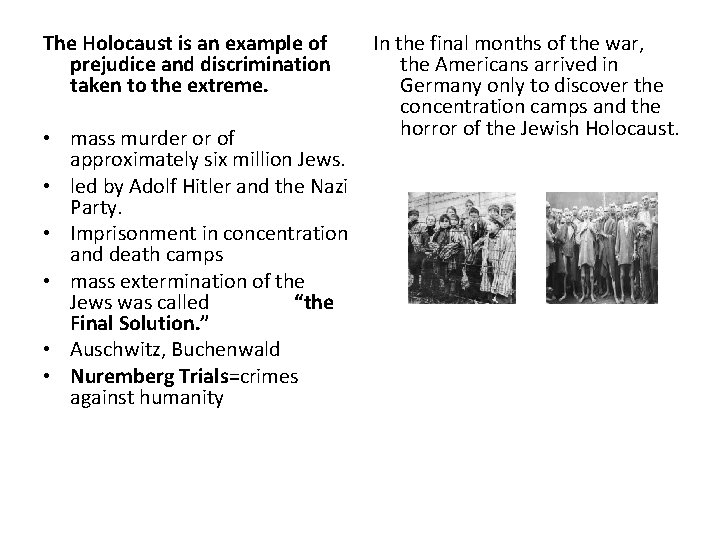
The Holocaust is an example of prejudice and discrimination taken to the extreme. • mass murder or of approximately six million Jews. • led by Adolf Hitler and the Nazi Party. • Imprisonment in concentration and death camps • mass extermination of the Jews was called “the Final Solution. ” • Auschwitz, Buchenwald • Nuremberg Trials=crimes against humanity In the final months of the war, the Americans arrived in Germany only to discover the concentration camps and the horror of the Jewish Holocaust.
The primary purpose of the Nuremberg trials following World War II was to determine the guilt or innocence of— (A) Individuals responsible for the Holocaust (B) men who invaded the draft during the war (C) Americans who opposed United States participation in the war (D) Communists who supported the war The skill and courage of the Tuskegee Airmen served to A. Give the United States an advantage in military encryption B. Encourage immigrant enlistment in the U. S. Army during World War II. C. Decrease opposition to integrating the armed forces. D. Increase the number of women joining the U. S. military during World War II.
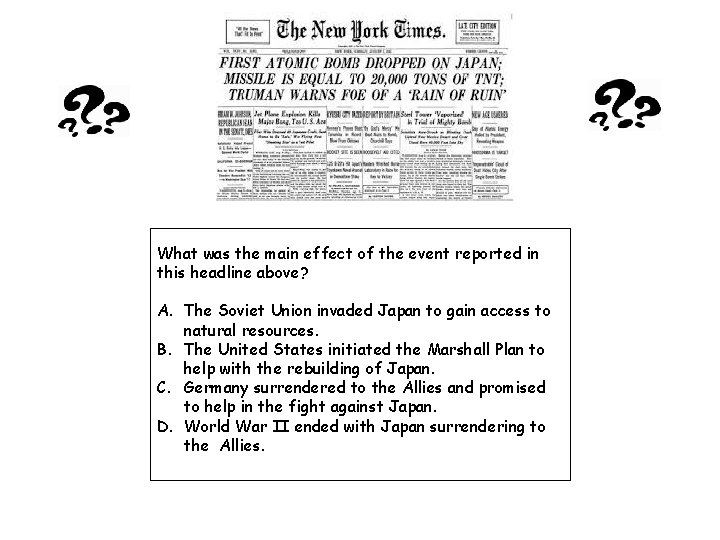
What was the main effect of the event reported in this headline above? A. The Soviet Union invaded Japan to gain access to natural resources. B. The United States initiated the Marshall Plan to help with the rebuilding of Japan. C. Germany surrendered to the Allies and promised to help in the fight against Japan. D. World War II ended with Japan surrendering to the Allies.
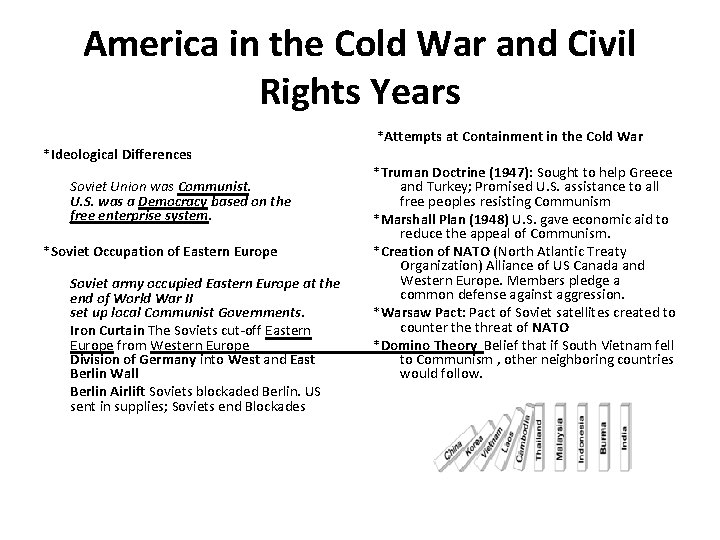
America in the Cold War and Civil Rights Years *Attempts at Containment in the Cold War *Ideological Differences *Truman Doctrine (1947): Sought to help Greece Soviet Union was Communist. and Turkey; Promised U. S. assistance to all U. S. was a Democracy based on the free peoples resisting Communism free enterprise system. *Marshall Plan (1948) U. S. gave economic aid to reduce the appeal of Communism. *Soviet Occupation of Eastern Europe *Creation of NATO (North Atlantic Treaty Organization) Alliance of US Canada and Western Europe. Members pledge a Soviet army occupied Eastern Europe at the common defense against aggression. end of World War II set up local Communist Governments. *Warsaw Pact: Pact of Soviet satellites created to counter the threat of NATO Iron Curtain The Soviets cut-off Eastern Europe from Western Europe *Domino Theory Belief that if South Vietnam fell Division of Germany into West and East to Communism , other neighboring countries Berlin Wall would follow. Berlin Airlift Soviets blockaded Berlin. US sent in supplies; Soviets end Blockades
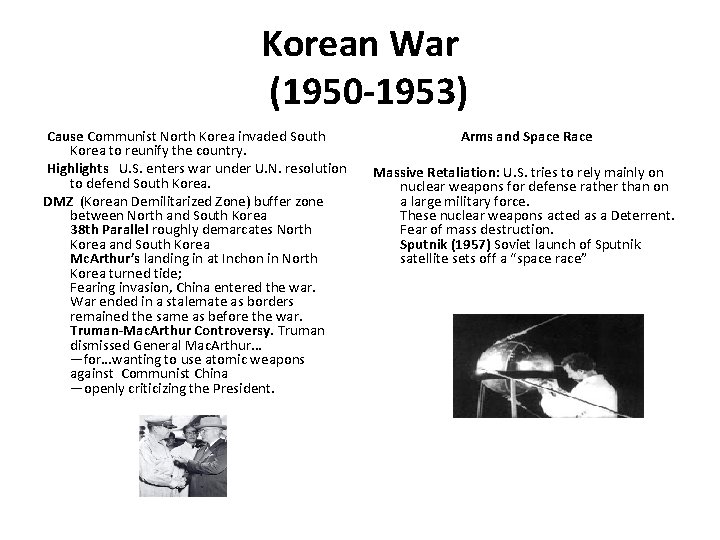
Korean War (1950 -1953) Cause Communist North Korea invaded South Arms and Space Race Korea to reunify the country. Highlights U. S. enters war under U. N. resolution Massive Retaliation: U. S. tries to rely mainly on to defend South Korea. nuclear weapons for defense rather than on DMZ (Korean Demilitarized Zone) buffer zone a large military force. between North and South Korea These nuclear weapons acted as a Deterrent. 38 th Parallel roughly demarcates North Fear of mass destruction. Korea and South Korea Sputnik (1957) Soviet launch of Sputnik Mc. Arthur’s landing in at Inchon in North satellite sets off a “space race” Korea turned tide; Fearing invasion, China entered the war. War ended in a stalemate as borders remained the same as before the war. Truman-Mac. Arthur Controversy. Truman dismissed General Mac. Arthur. . . —for…wanting to use atomic weapons against Communist China —openly criticizing the President.
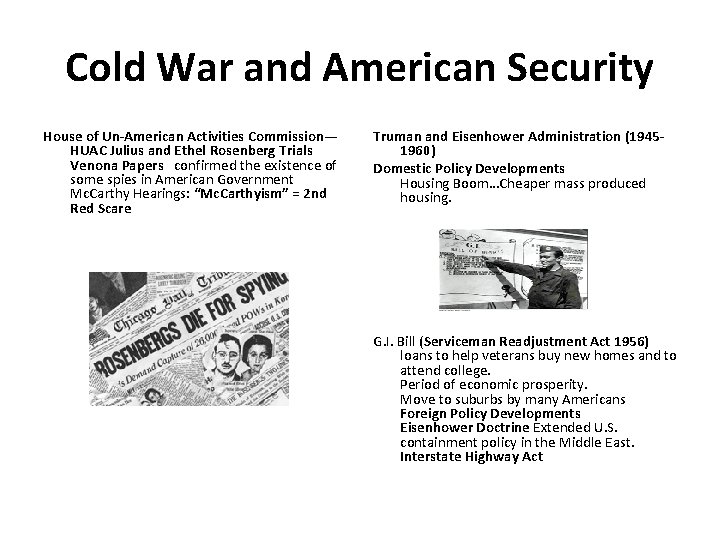
Cold War and American Security House of Un-American Activities Commission— Truman and Eisenhower Administration (1945 HUAC Julius and Ethel Rosenberg Trials 1960) Venona Papers confirmed the existence of Domestic Policy Developments some spies in American Government Housing Boom…Cheaper mass produced Mc. Carthy Hearings: “Mc. Carthyism” = 2 nd housing. Red Scare G. I. Bill (Serviceman Readjustment Act 1956) loans to help veterans buy new homes and to attend college. Period of economic prosperity. Move to suburbs by many Americans Foreign Policy Developments Eisenhower Doctrine Extended U. S. containment policy in the Middle East. Interstate Highway Act
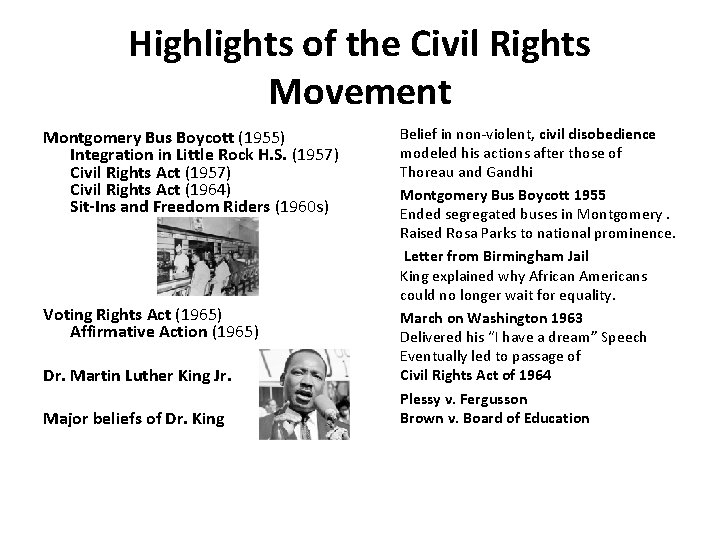
Highlights of the Civil Rights Movement Belief in non-violent, civil disobedience Montgomery Bus Boycott (1955) modeled his actions after those of Integration in Little Rock H. S. (1957) Thoreau and Gandhi Civil Rights Act (1957) Civil Rights Act (1964) Montgomery Bus Boycott 1955 Sit-Ins and Freedom Riders (1960 s) Ended segregated buses in Montgomery. Raised Rosa Parks to national prominence. Letter from Birmingham Jail King explained why African Americans could no longer wait for equality. Voting Rights Act (1965) March on Washington 1963 Affirmative Action (1965) Delivered his “I have a dream” Speech Eventually led to passage of Civil Rights Act of 1964 Dr. Martin Luther King Jr. Plessy v. Fergusson Brown v. Board of Education Major beliefs of Dr. King
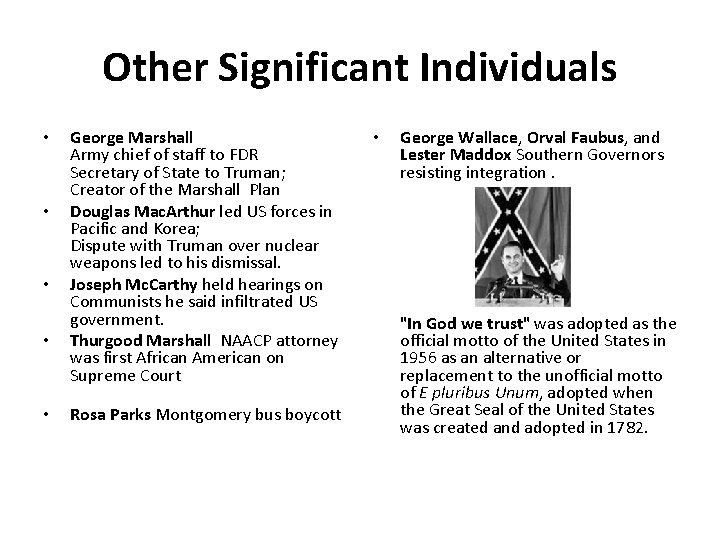
Other Significant Individuals • • • George Marshall • George Wallace, Orval Faubus, and Army chief of staff to FDR Lester Maddox Southern Governors Secretary of State to Truman; resisting integration. Creator of the Marshall Plan Douglas Mac. Arthur led US forces in Pacific and Korea; Dispute with Truman over nuclear weapons led to his dismissal. Joseph Mc. Carthy held hearings on Communists he said infiltrated US government. "In God we trust" was adopted as the Thurgood Marshall NAACP attorney official motto of the United States in was first African American on 1956 as an alternative or Supreme Court replacement to the unofficial motto of E pluribus Unum, adopted when the Great Seal of the United States Rosa Parks Montgomery bus boycott was created and adopted in 1782.
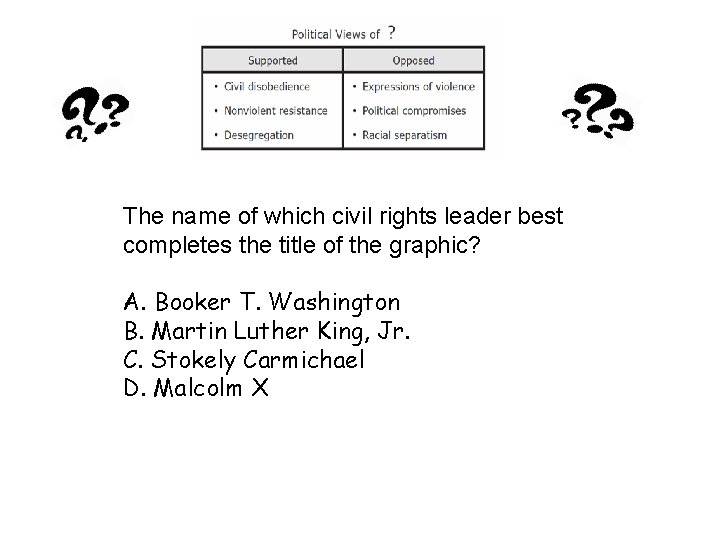
The name of which civil rights leader best completes the title of the graphic? A. Booker T. Washington B. Martin Luther King, Jr. C. Stokely Carmichael D. Malcolm X
During the 1950 s the federal government funded educational initiatives in math and science in response to— A. the development of the ENIAC computer B. the announcement of international education guidelines C. the successful launch of the first artificial satellite D. the discovery of new chemical elements Why was the policy of containment used during the Cold War? A. to support parliamentary democracy B. to abolish absolute monarchy C. limit the spread of communism D. to limit fascism
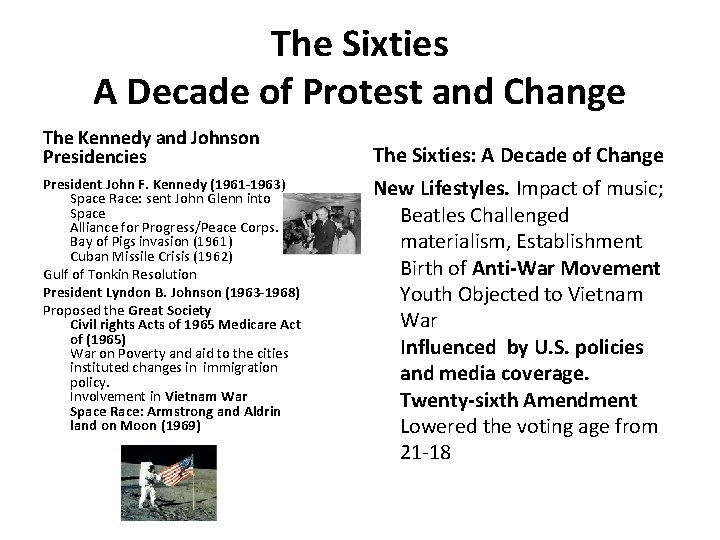
The Sixties A Decade of Protest and Change The Kennedy and Johnson Presidencies The Sixties: A Decade of Change President John F. Kennedy (1961 -1963) New Lifestyles. Impact of music; Space Race: sent John Glenn into Space Beatles Challenged Alliance for Progress/Peace Corps. Bay of Pigs invasion (1961) materialism, Establishment Cuban Missile Crisis (1962) Birth of Anti-War Movement Gulf of Tonkin Resolution President Lyndon B. Johnson (1963 -1968) Youth Objected to Vietnam Proposed the Great Society War Civil rights Acts of 1965 Medicare Act of (1965) Influenced by U. S. policies War on Poverty and aid to the cities instituted changes in immigration policy. and media coverage. Involvement in Vietnam War Twenty-sixth Amendment Space Race: Armstrong and Aldrin land on Moon (1969) Lowered the voting age from 21 -18
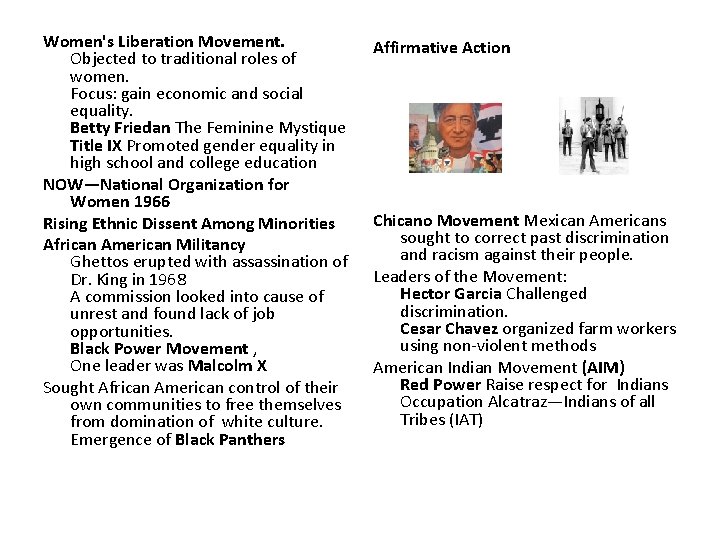
Women's Liberation Movement. Affirmative Action Objected to traditional roles of women. Focus: gain economic and social equality. Betty Friedan The Feminine Mystique Title IX Promoted gender equality in high school and college education NOW—National Organization for Women 1966 Chicano Movement Mexican Americans Rising Ethnic Dissent Among Minorities sought to correct past discrimination African American Militancy and racism against their people. Ghettos erupted with assassination of Leaders of the Movement: Dr. King in 1968 Hector Garcia Challenged A commission looked into cause of discrimination. unrest and found lack of job opportunities. Cesar Chavez organized farm workers using non-violent methods Black Power Movement , One leader was Malcolm X American Indian Movement (AIM) Red Power Raise respect for Indians Sought African American control of their Occupation Alcatraz—Indians of all own communities to free themselves Tribes (IAT) from domination of white culture. Emergence of Black Panthers
The Battle for Racial Equality in the Courts The Vietnam War 1954 -1975 • Gulf of Tonkin Incident- Johnson announces • Mendez vs. Westminster that Vietnamese boats fired upon US ships. School District • Gulf of Tonkin Resolution- Congress turns power of war making over to president; No segregation of Mexican Johnson has a blank check in Vietnam. American Children without • Operation Rolling Thunder- Johnson bombs specific state laws North Vietnam; Johnson sends first US combat troops to Vietnam. • Hernandez vs. Texas 1954 • Ho Chi Minh Trail, Agent Orange, napalm, Mexican Americans cannot credibility gap, draft resistance, be systematically excluded in • Tet Offensive: Viet Cong and North Vietnam launch massive surprise attack; US & South practice from juries Vietnam repell enemy- US citizens shocked that “weak” enemy could launch invasion= • Delgado v Bastrop ISD 1948 US media start to criticize the war=Johnson’s Segregation of Mexican public opinion drops. American Children in schools • Roy Benavidez : Awarded Medal of Honor • 1968 Johnson announces he will not seek in Texas is illegal. another term. • Edgewood ISD v Kirby 1984 State must revise its school funding system.
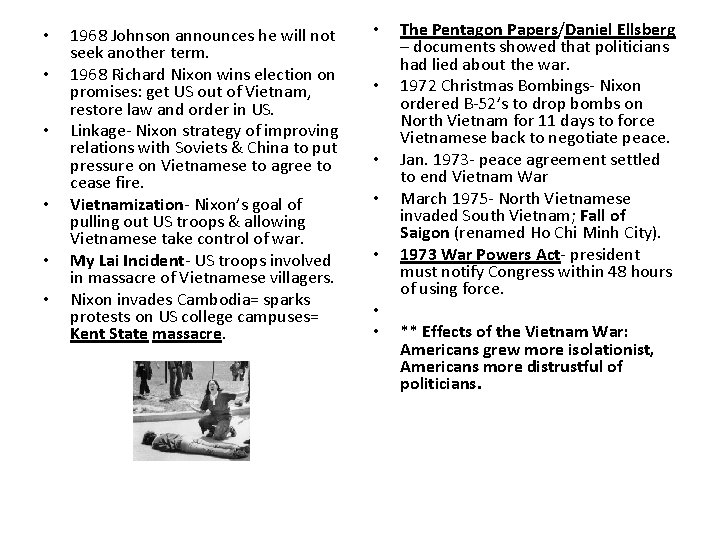
• • • 1968 Johnson announces he will not seek another term. 1968 Richard Nixon wins election on promises: get US out of Vietnam, restore law and order in US. Linkage- Nixon strategy of improving relations with Soviets & China to put pressure on Vietnamese to agree to cease fire. Vietnamization- Nixon’s goal of pulling out US troops & allowing Vietnamese take control of war. My Lai Incident- US troops involved in massacre of Vietnamese villagers. Nixon invades Cambodia= sparks protests on US college campuses= Kent State massacre. • • The Pentagon Papers/Daniel Ellsberg – documents showed that politicians had lied about the war. 1972 Christmas Bombings- Nixon ordered B-52’s to drop bombs on North Vietnam for 11 days to force Vietnamese back to negotiate peace. Jan. 1973 - peace agreement settled to end Vietnam War March 1975 - North Vietnamese invaded South Vietnam; Fall of Saigon (renamed Ho Chi Minh City). 1973 War Powers Act- president must notify Congress within 48 hours of using force. ** Effects of the Vietnam War: Americans grew more isolationist, Americans more distrustful of politicians.
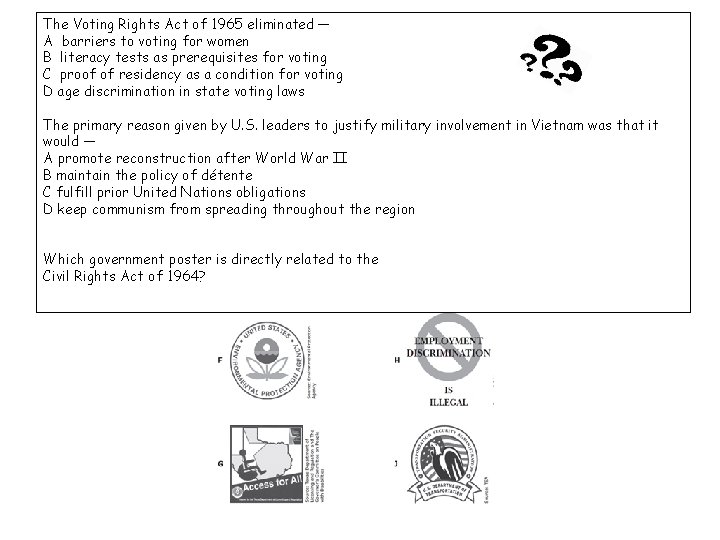
The Voting Rights Act of 1965 eliminated — A barriers to voting for women B literacy tests as prerequisites for voting C proof of residency as a condition for voting D age discrimination in state voting laws The primary reason given by U. S. leaders to justify military involvement in Vietnam was that it would — A promote reconstruction after World War II B maintain the policy of détente C fulfill prior United Nations obligations D keep communism from spreading throughout the region • Which government poster is directly related to the Civil Rights Act of 1964?
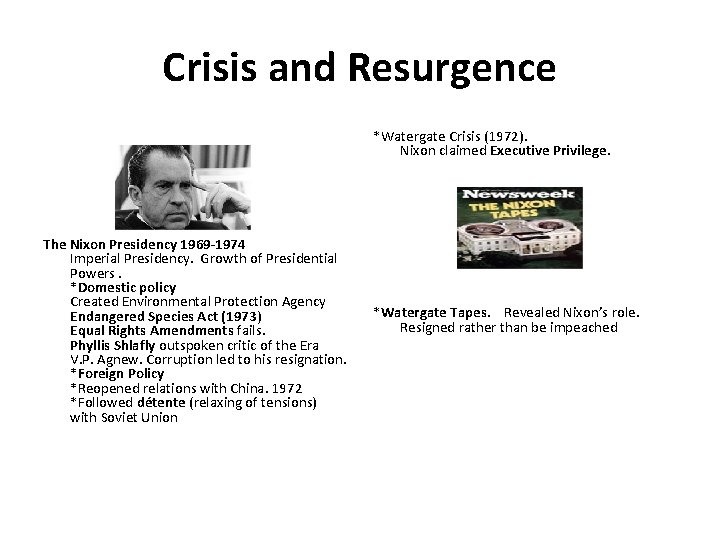
Crisis and Resurgence *Watergate Crisis (1972). Nixon claimed Executive Privilege. The Nixon Presidency 1969 -1974 Imperial Presidency. Growth of Presidential Powers. *Domestic policy Created Environmental Protection Agency *Watergate Tapes. Revealed Nixon’s role. Endangered Species Act (1973) Resigned rather than be impeached Equal Rights Amendments fails. Phyllis Shlafly outspoken critic of the Era V. P. Agnew. Corruption led to his resignation. *Foreign Policy *Reopened relations with China. 1972 *Followed détente (relaxing of tensions) with Soviet Union
• The Carter Presidency, 1977 -1981 Stagflation Inflation and unemployment. • The Ford Presidency, 1974 -1977 Created a Department Energy Only president appointed, not Community Reinvestment Act 1973 elected Seeks morality in foreign policy. Pardon to Nixon very unpopular OPEC Oil Boycott (1973) Panama Canal Treaty. U. S. gave up Helsinki Accords (1975) canal. Camp David Accords. Peace between Prime Minister Begin (Israel) and President Sadat (Egypt) Iran Hostage Crisis
The Reagan Presidency 1981 -1989 Roots of Conservatism • • 1980 Ronald Reagan received the support of a number of leading American conservative groups. NRA endorsed Reagan, marking the first time in its history to support a candidate. Moral Majority: mainly composed of Christian fundamentalists. Jerry Falwell =strict interpretation of the bible. Heritage Foundation: promotes conservative values based on principles of free enterprise, limited government, individual freedom, values, and a strong national defense. Reagonomics. . . • • *Reversed trend of large government. Supply-side economics to end stagflation. Deregulation of many industries. Tax Cuts and cuts in domestic spending. *Sandra Day O’Connor first women appointed to U. S. Supreme Court (1981) People fled the Rust Belt for the Sun Belt. *Iran Contra Affair. Negotiated with Iran to free hostages in Lebanon. Sold arms to Contras. STAR WARS (Strategic Defense Initiative)
The Bush Presidency. 1989 -1993 • George Herbert Walker Bush Faces a growing budget deficit=increased defense spending. Civil unrest after Rodney King beating. American with Disabilities Act, 1990 Cold War ends Soviet Union dissolves. Invasion of Panama. Berlin Wall torn down (1989) Persian Gulf War (1990) U. S. forces sent to prevent invasion of Kuwait by Iraq. Somalia. . . Humanitarian airlift food.
The Clinton Presidency 1993 -2001 Domestic Policy • 1998 Kosovo (Serbian province): Albanians wanted Cut federal spending: raised taxes on rich. Kosovo separate from Bosnia. Proposed health care reform; failed to pass. Serbian leader Slobodan Milosevic orders a crackdown on *Albanians = civil war= NATO led by • Hilary Clinton major supporter of health care. US bombed Serbia= Serbia pulls its troops out of • 1994 Republican “Contract with America”- Newt Kosovo. Gingrich (Rep. / Ga. ) program proposed 10 changes: • China. His efforts failed to end human rights abuses. lower taxes, welfare reform, anticrime laws, Helped China join World Trade Organization. balanced budget etc. Notable Entrepreneurs • Computer industry success and “peace” dividend” led to economic prosperity. Bill Gates. Microsoft founder Impeachment proceedings along party lines. Sam Watson Founder of Wal-Mart Foreign Policy: NAFTA Treaty gradually phased out Estee Lauder Founder of one of the world’s largest tariffs between Canada, USA, and Mexico cosmetic lines. Robert Johnson African American Entrepreneur • Bosnian Crisis (Balkans Crisis)- 1991 a civil war Founder of BET (Black Entertainment Television) broke out in former Yugoslav republic of Bosnia; Orthodox Christian Serbs v. Catholic Croatians v. Lionel Sosa Hispanic advertising genius who saw the Bosnian Muslims. enormous potential of the US Hispanic market. • Serbs began “ethnic cleansing” of Muslims; NATO led by US bombed the Serbs. • 1996 Dayton Accords- peace plan to end Bosnian civil war.
In the face of all the pressure the ERAers are exerting this month, we need to remind all our Senators and Representatives that we are counting on them — 1) To vote NO on ERA, and 2) To resist all efforts to eliminate the 3/5 th majority that the Illinois Constitution requires for constitutional amendments. —Letter from the National Chairman of Stop ERA, December 6, 1978 The author of this letter was — A. a leader of the Civil Rights movement B. the cofounder of the National Organization for Women C. a leader of a conservative interest group D. the cofounder of Ms. magazine
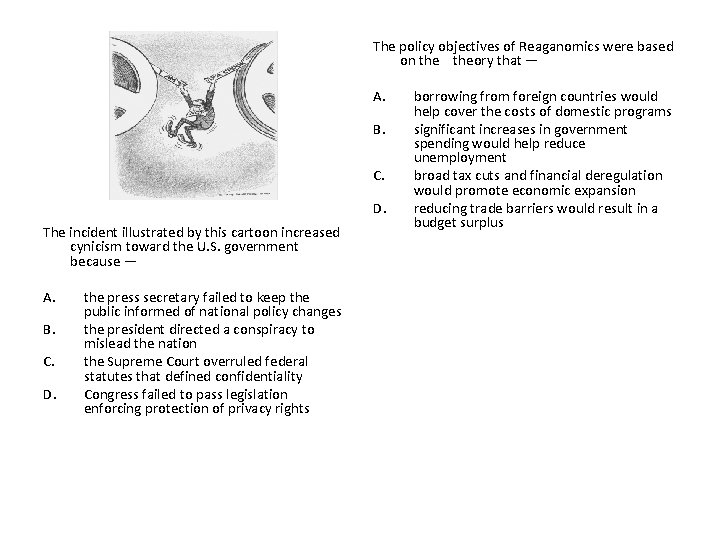
The policy objectives of Reaganomics were based on theory that — A. B. C. D. The incident illustrated by this cartoon increased cynicism toward the U. S. government because — A. the press secretary failed to keep the public informed of national policy changes B. the president directed a conspiracy to mislead the nation C. the Supreme Court overruled federal statutes that defined confidentiality D. Congress failed to pass legislation enforcing protection of privacy rights borrowing from foreign countries would help cover the costs of domestic programs significant increases in government spending would help reduce unemployment broad tax cuts and financial deregulation would promote economic expansion reducing trade barriers would result in a budget surplus
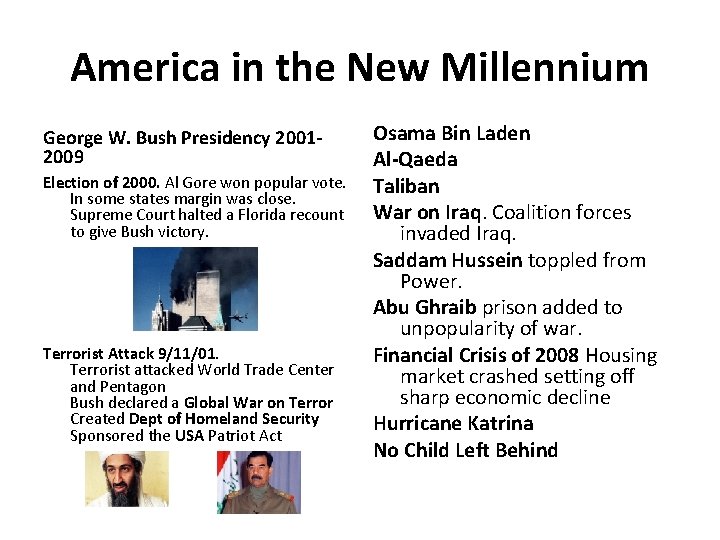
America in the New Millennium Osama Bin Laden Al-Qaeda Election of 2000. Al Gore won popular vote. Taliban In some states margin was close. Supreme Court halted a Florida recount War on Iraq. Coalition forces to give Bush victory. invaded Iraq. Saddam Hussein toppled from Power. Abu Ghraib prison added to unpopularity of war. Terrorist Attack 9/11/01. Financial Crisis of 2008 Housing Terrorist attacked World Trade Center market crashed setting off and Pentagon sharp economic decline Bush declared a Global War on Terror Created Dept of Homeland Security Hurricane Katrina Sponsored the USA Patriot Act No Child Left Behind George W. Bush Presidency 20012009
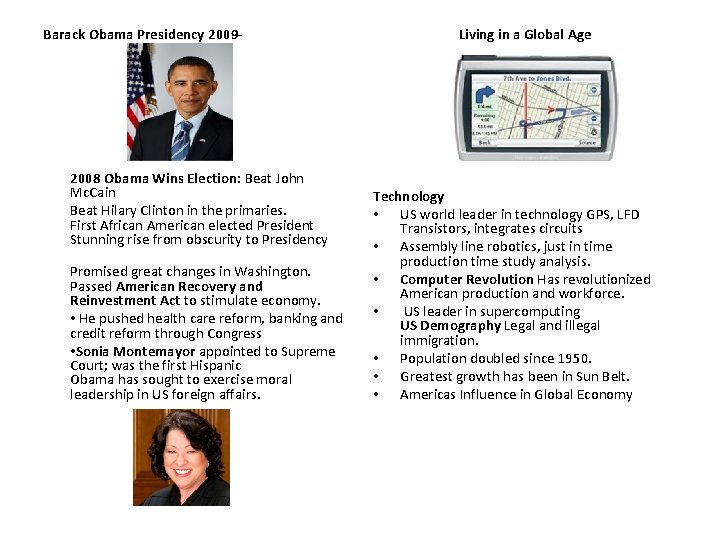
Barack Obama Presidency 2009 - Living in a Global Age 2008 Obama Wins Election: Beat John Mc. Cain Technology Beat Hilary Clinton in the primaries. • US world leader in technology GPS, LFD First African American elected President Transistors, integrates circuits Stunning rise from obscurity to Presidency • Assembly line robotics, just in time production time study analysis. Promised great changes in Washington. • Computer Revolution Has revolutionized Passed American Recovery and American production and workforce. Reinvestment Act to stimulate economy. • US leader in supercomputing • He pushed health care reform, banking and US Demography Legal and illegal credit reform through Congress immigration. • Sonia Montemayor appointed to Supreme • Population doubled since 1950. Court; was the first Hispanic • Greatest growth has been in Sun Belt. Obama has sought to exercise moral leadership in US foreign affairs. • Americas Influence in Global Economy
• Role of Multinational Corporations Companies doing business all over world. Managing Environment Rise of pollution threat in the environment. Energy Growing population and rising living standards raised demands for energy • Impact of American Culture on the world • American Culture passed to world through music, movies, and Internet : America dress styles, food and music
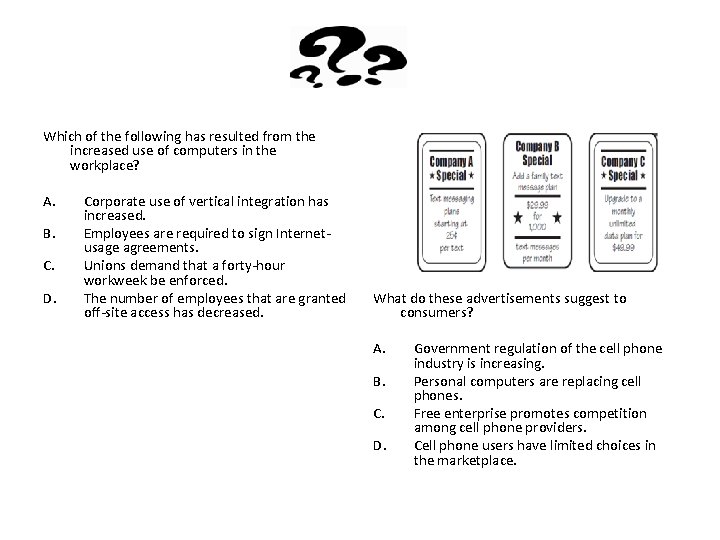
Which of the following has resulted from the increased use of computers in the workplace? A. Corporate use of vertical integration has increased. B. Employees are required to sign Internetusage agreements. C. Unions demand that a forty-hour workweek be enforced. D. The number of employees that are granted off-site access has decreased. What do these advertisements suggest to consumers? A. Government regulation of the cell phone industry is increasing. B. Personal computers are replacing cell phones. C. Free enterprise promotes competition among cell phone providers. D. Cell phone users have limited choices in the marketplace.
Amendments 1 st Amendment- freedom of speech, religion, press, assembly, and petition. 2 nd Amendment- right to bear arms (guns). 3 rd Amendment- no quartering of troops in private citizen’s home in times of peace; during a crisis, Congress may allow it. th 4 Amendment- protects against unreasonable searches & seizures; search warrants needed - probable cause. 5 th Amendment- several rights: Right to a grand jury hearing No self-incrimination No double jeopardy Rules for eminent domain- Due process rights- government must follow certain procedures & constitution when it comes to rights. 6 th Amendment – right to a fair & speedy trial; right to an attorney 7 th Amendment- right to trial by jury in civil cases of $20 or more. 8 th Amendment- prevents cruel & unusual punishments & excessive fines or fees for accused. th 9 Amendment- citizens have additional rights not listed. 10 th Amendment- powers not given to the federal government are reserved for the states & people. th 11 Amendment- states cannot be sued in federal court by a citizen from another state or country. th 12 Amendment (1804)- changed the way the Electoral College chose president & vice president; electors vote separately for president & vice president- to prevent problem elections like 1796 & 1800.
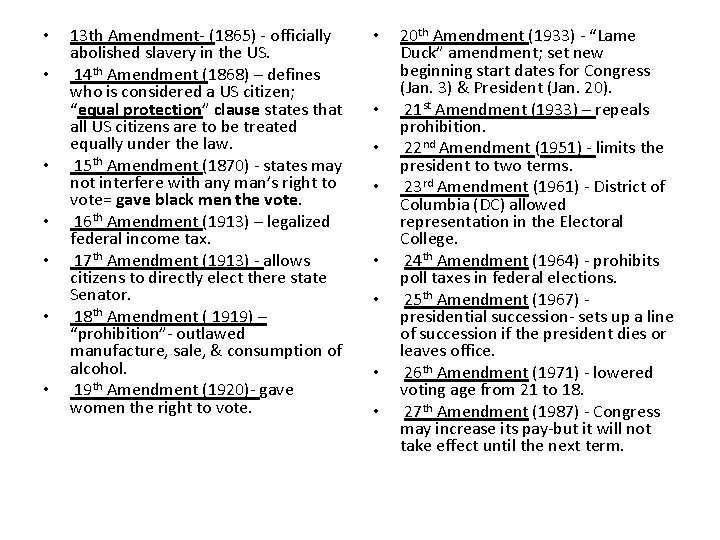
• • 13 th Amendment- (1865) - officially abolished slavery in the US. 14 th Amendment (1868) – defines who is considered a US citizen; “equal protection” clause states that all US citizens are to be treated equally under the law. 15 th Amendment (1870) - states may not interfere with any man’s right to vote= gave black men the vote. 16 th Amendment (1913) – legalized federal income tax. 17 th Amendment (1913) - allows citizens to directly elect there state Senator. 18 th Amendment ( 1919) – “prohibition”- outlawed manufacture, sale, & consumption of alcohol. 19 th Amendment (1920)- gave women the right to vote. • • 20 th Amendment (1933) - “Lame Duck” amendment; set new beginning start dates for Congress (Jan. 3) & President (Jan. 20). 21 st Amendment (1933) – repeals prohibition. 22 nd Amendment (1951) - limits the president to two terms. 23 rd Amendment (1961) - District of Columbia (DC) allowed representation in the Electoral College. 24 th Amendment (1964) - prohibits poll taxes in federal elections. 25 th Amendment (1967) - presidential succession- sets up a line of succession if the president dies or leaves office. 26 th Amendment (1971) - lowered voting age from 21 to 18. 27 th Amendment (1987) - Congress may increase its pay-but it will not take effect until the next term.
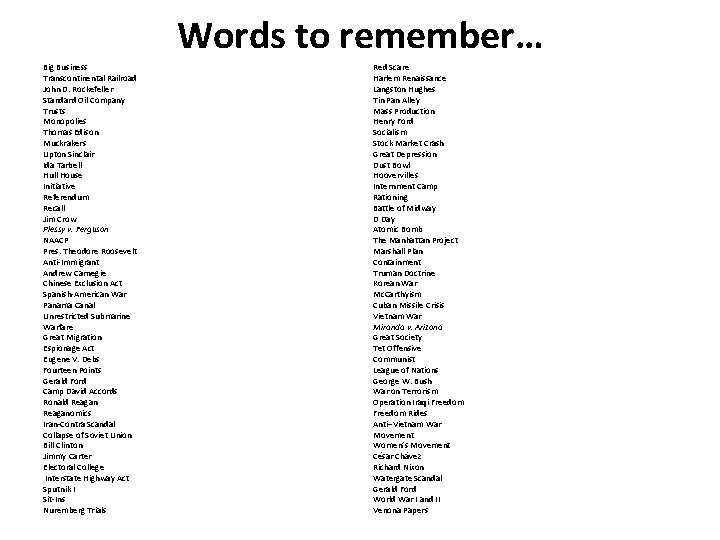
Words to remember… Big Business Red Scare Transcontinental Railroad Harlem Renaissance John D. Rockefeller Langston Hughes Standard Oil Company Tin Pan Alley Trusts Mass Production Monopolies Henry Ford Thomas Edison Socialism Muckrakers Stock Market Crash Upton Sinclair Great Depression Ida Tarbell Dust Bowl Hull House Hoovervilles Initiative Internment Camp Referendum Rationing Recall Battle of Midway Jim Crow D Day Plessy v. Ferguson Atomic Bomb NAACP The Manhattan Project Pres. Theodore Roosevelt Marshall Plan Anti-Immigrant Containment Andrew Carnegie Truman Doctrine Chinese Exclusion Act Korean War Spanish-American War Mc. Carthyism Panama Canal Cuban Missile Crisis Unrestricted Submarine Vietnam Warfare Miranda v. Arizona Great Migration Great Society Espionage Act Tet Offensive Eugene V. Debs Communist Fourteen Points League of Nations Gerald Ford George W. Bush Camp David Accords War on Terrorism Ronald Reagan Operation Iraqi Freedom Reaganomics Freedom Rides Iran-Contra Scandal Anti–Vietnam War Collapse of Soviet Union Movement Bill Clinton Women’s Movement Jimmy Carter César Chávez Electoral College Richard Nixon Interstate Highway Act Watergate Scandal Sputnik I Gerald Ford Sit-Ins World War I and II Nuremberg Trials Venona Papers
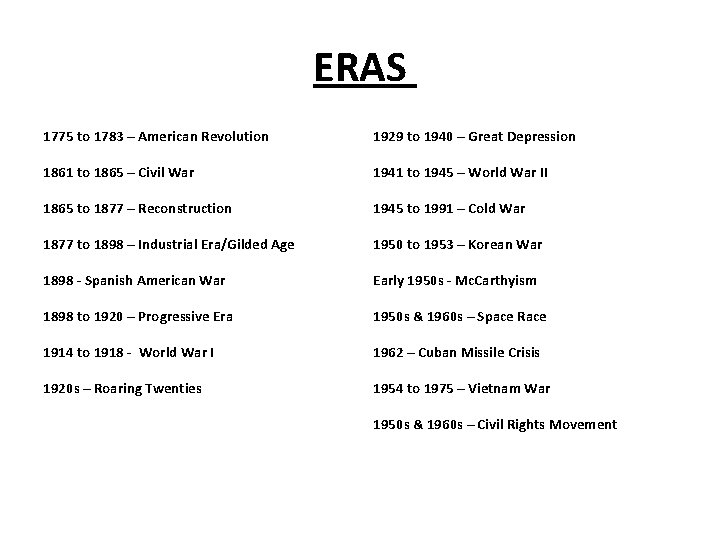
ERAS 1775 to 1783 – American Revolution 1861 to 1865 – Civil War 1865 to 1877 – Reconstruction 1877 to 1898 – Industrial Era/Gilded Age 1898 - Spanish American War 1898 to 1920 – Progressive Era 1914 to 1918 - World War I 1920 s – Roaring Twenties 1929 to 1940 – Great Depression 1941 to 1945 – World War II 1945 to 1991 – Cold War 1950 to 1953 – Korean War Early 1950 s - Mc. Carthyism 1950 s & 1960 s – Space Race 1962 – Cuban Missile Crisis 1954 to 1975 – Vietnam War 1950 s & 1960 s – Civil Rights Movement
- Slides: 111