
U S Geological Survey Earth Resources Operation Systems


- Slides: 23
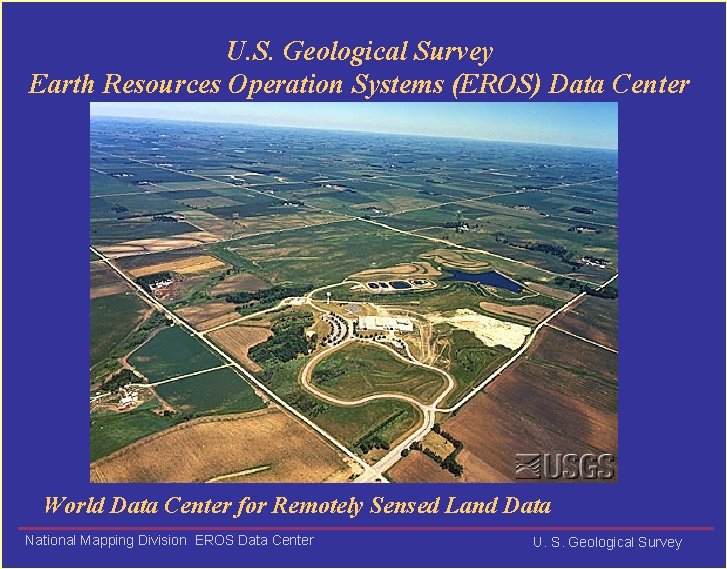
U. S. Geological Survey Earth Resources Operation Systems (EROS) Data Center World Data Center for Remotely Sensed Land Data National Mapping Division EROS Data Center U. S. Geological Survey
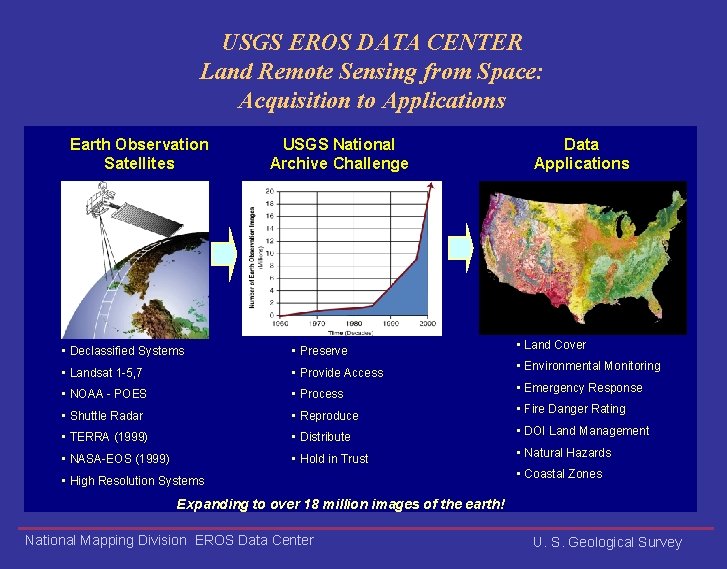
USGS EROS DATA CENTER Land Remote Sensing from Space: Acquisition to Applications Earth Observation Satellites USGS National Archive Challenge • Declassified Systems • Preserve • Landsat 1 -5, 7 • Provide Access • NOAA - POES • Process • Shuttle Radar • Reproduce • TERRA (1999) • Distribute • NASA-EOS (1999) • Hold in Trust • High Resolution Systems Data Applications • Land Cover • Environmental Monitoring • Emergency Response • Fire Danger Rating • DOI Land Management • Natural Hazards • Coastal Zones Expanding to over 18 million images of the earth! National Mapping Division EROS Data Center U. S. Geological Survey
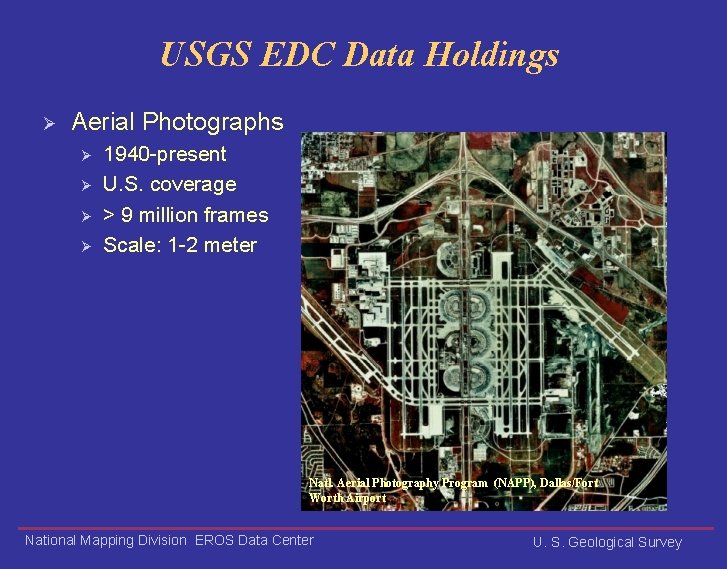
USGS EDC Data Holdings Ø Aerial Photographs Ø Ø 1940 -present U. S. coverage > 9 million frames Scale: 1 -2 meter Natl. Aerial Photography Program (NAPP), Dallas/Fort Worth Airport National Mapping Division EROS Data Center U. S. Geological Survey
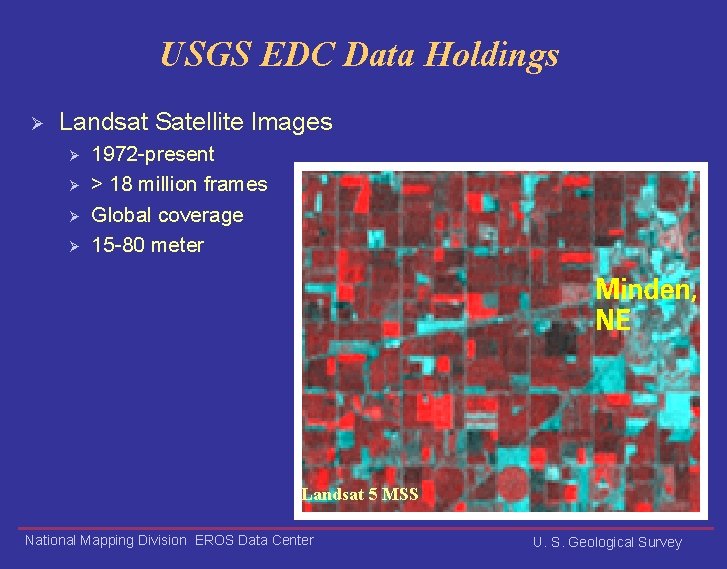
USGS EDC Data Holdings Ø Landsat Satellite Images Ø Ø 1972 -present > 18 million frames Global coverage 15 -80 meter Landsat 5 MSS National Mapping Division EROS Data Center U. S. Geological Survey
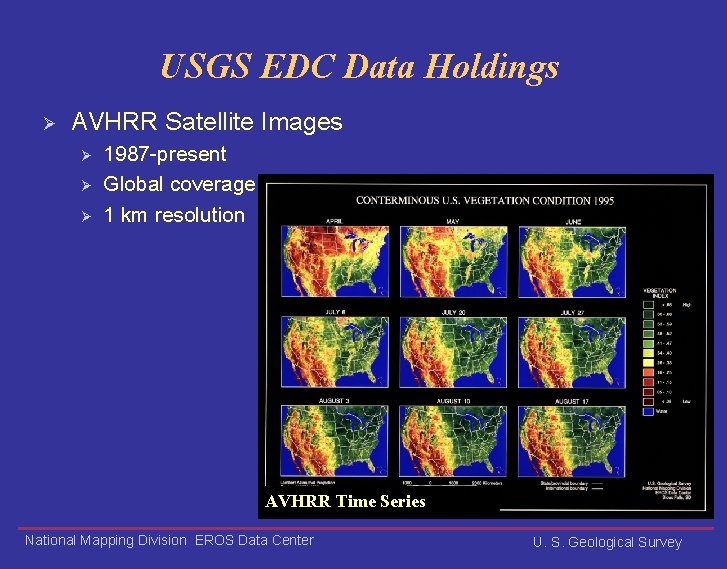
USGS EDC Data Holdings Ø AVHRR Satellite Images Ø Ø Ø 1987 -present Global coverage 1 km resolution AVHRR Time Series National Mapping Division EROS Data Center U. S. Geological Survey
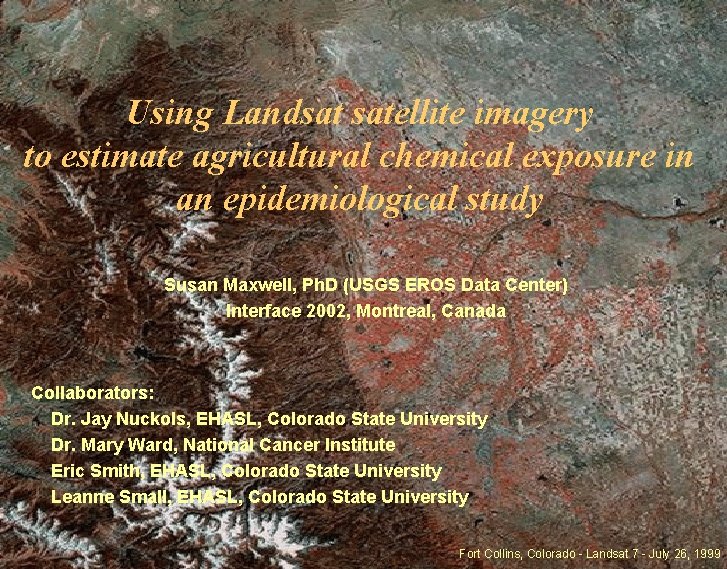
Using Landsat satellite imagery to estimate agricultural chemical exposure in an epidemiological study Susan Maxwell, Ph. D (USGS EROS Data Center) Interface 2002, Montreal, Canada Collaborators: Dr. Jay Nuckols, EHASL, Colorado State University Dr. Mary Ward, National Cancer Institute Eric Smith, EHASL, Colorado State University Leanne Small, EHASL, Colorado State University National Mapping Division EROS Data Center U. S. Geological Survey Fort Collins, Colorado - Landsat 7 - July 26, 1999
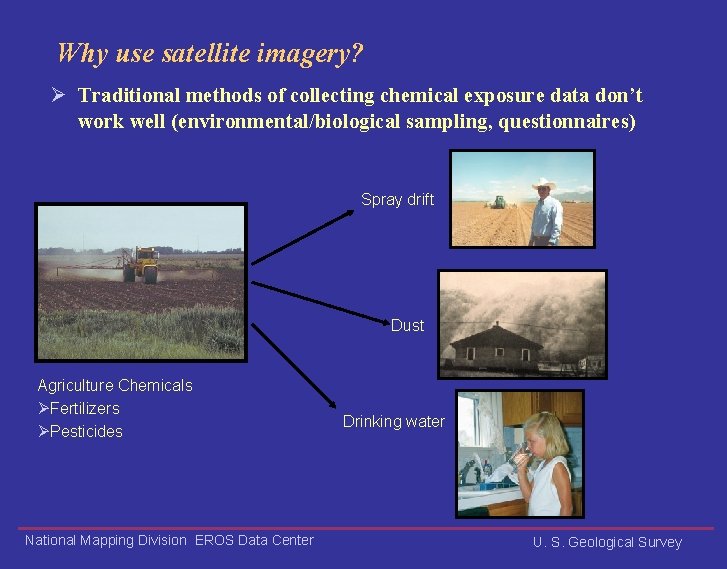
Why use satellite imagery? Ø Traditional methods of collecting chemical exposure data don’t work well (environmental/biological sampling, questionnaires) Spray drift Dust Agriculture Chemicals ØFertilizers ØPesticides National Mapping Division EROS Data Center Drinking water U. S. Geological Survey
Why use satellite imagery? Ø Cancers generally take several years to develop, therefore need to reconstruct historical exposure Ø Our approach: use Landsat imagery to create historical land use/crop type maps – integrate with other data (chemical use, soils, wind, etc. ) to estimate exposure National Mapping Division EROS Data Center U. S. Geological Survey
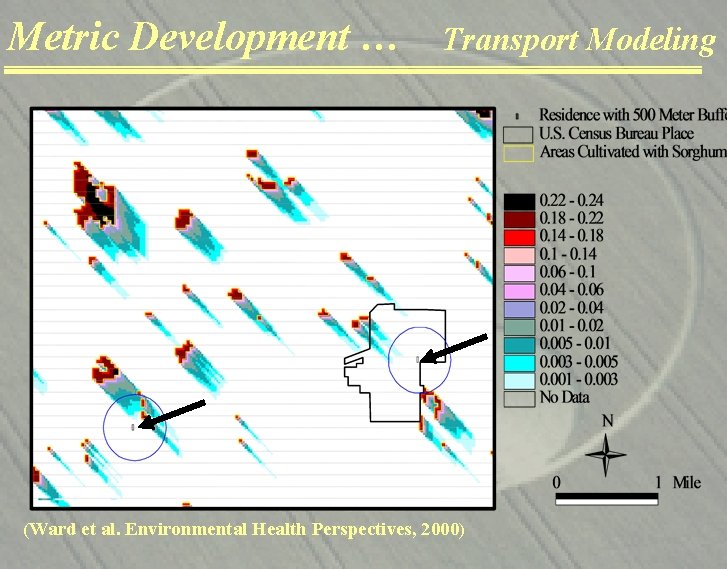
Metric Development … Transport Modeling (Ward et al. Environmental Health Perspectives, 2000) National Mapping Division EROS Data Center U. S. Geological Survey
Why Landsat ? Ø Longest running satellite sensor (1972 -current) Ø Successful crop type mapping applications (AGRISTARS, etc. ) Ø Appropriate spectral bands (visible, near infrared, middle infrared) Ø Appropriate spatial resolution (30 -80 meter) Ø Inexpensive (compared to higher resolution data sets) National Mapping Division EROS Data Center U. S. Geological Survey
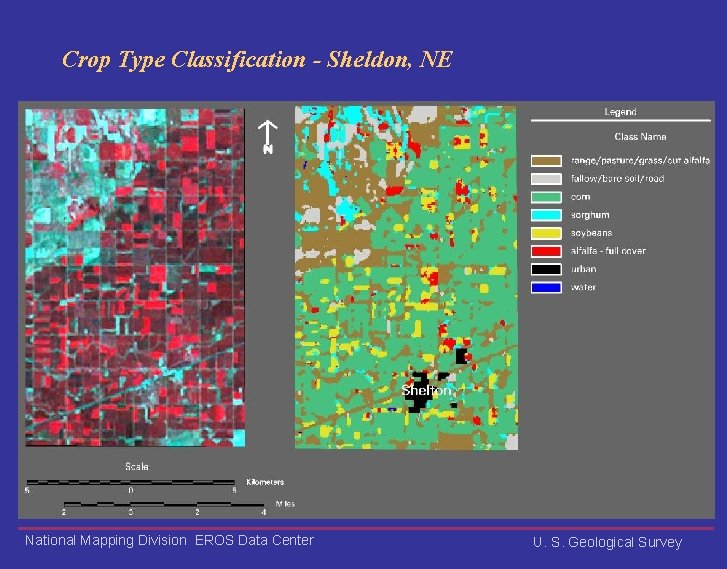
Crop Type Classification - Sheldon, NE National Mapping Division EROS Data Center U. S. Geological Survey
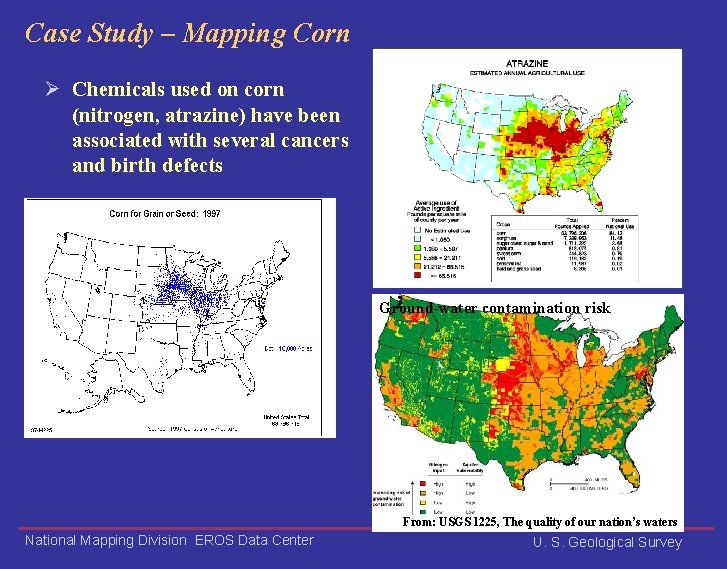
Case Study – Mapping Corn Ø Chemicals used on corn (nitrogen, atrazine) have been associated with several cancers and birth defects Ground-water contamination risk From: USGS 1225, The quality of our nation’s waters National Mapping Division EROS Data Center U. S. Geological Survey
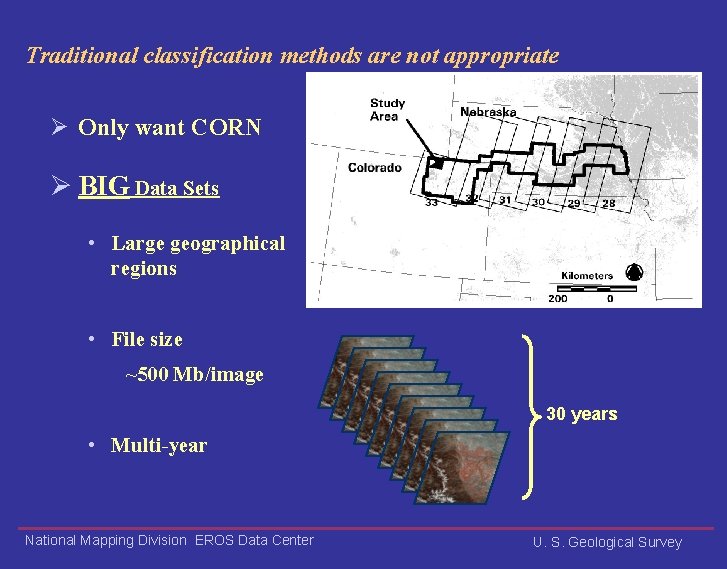
Traditional classification methods are not appropriate Ø Only want CORN Ø BIG Data Sets • Large geographical regions • File size ~500 Mb/image 30 years • Multi-year National Mapping Division EROS Data Center U. S. Geological Survey
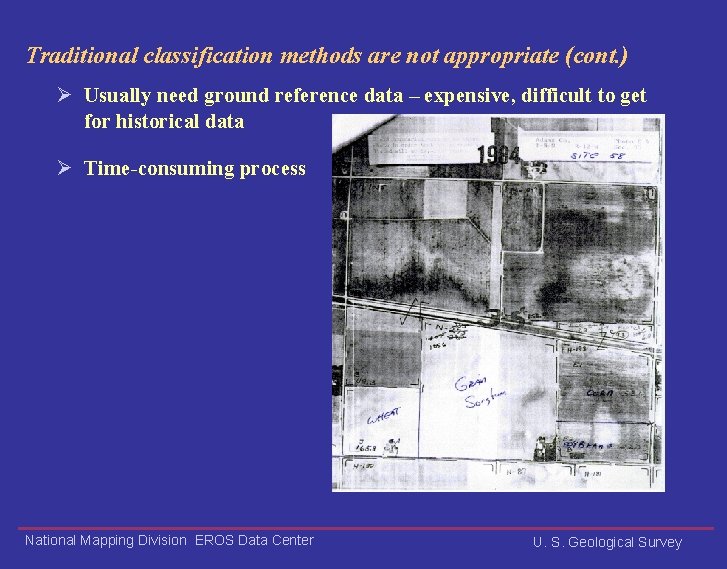
Traditional classification methods are not appropriate (cont. ) Ø Usually need ground reference data – expensive, difficult to get for historical data Ø Time-consuming process National Mapping Division EROS Data Center U. S. Geological Survey
Crop characteristics Ø Corn dominates National Mapping Division EROS Data Center U. S. Geological Survey
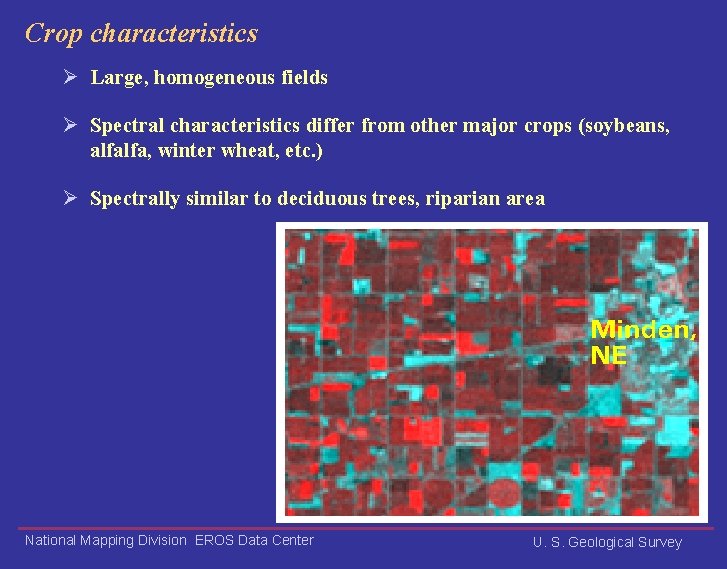
Crop characteristics Ø Large, homogeneous fields Ø Spectral characteristics differ from other major crops (soybeans, alfalfa, winter wheat, etc. ) Ø Spectrally similar to deciduous trees, riparian area National Mapping Division EROS Data Center U. S. Geological Survey
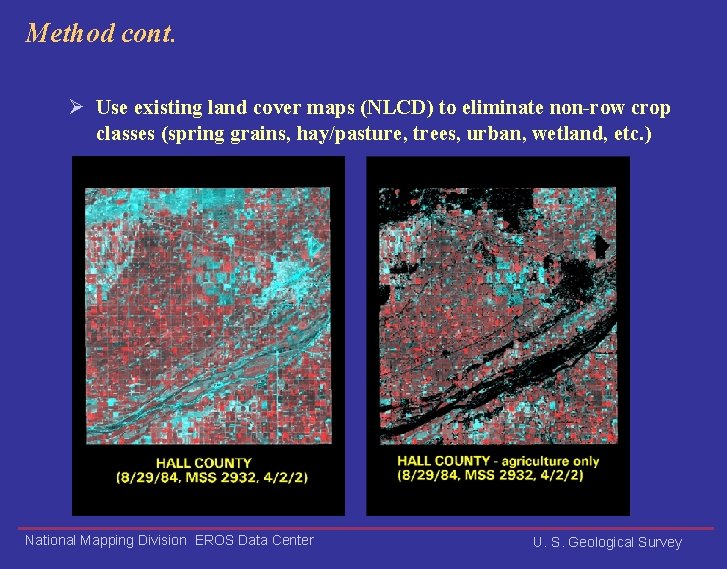
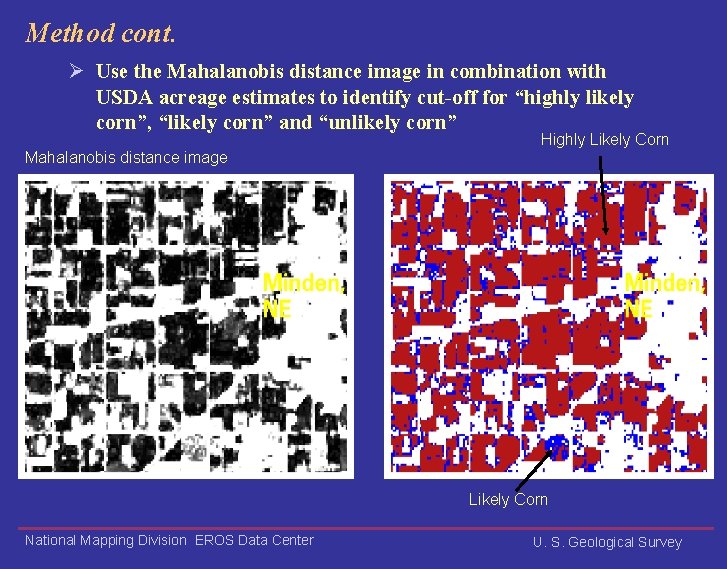
Case Study – Mapping Corn Ø Initial method – software was developed to …. Ø Use existing land cover maps (NLCD) to eliminate non-row crop classes (spring grains, hay/pasture, trees, urban, wetland, etc. ) Ø Use existing USDA acreage estimates to target specific geographic region (i. e. , county) to collect training statistics Ø Use maximum likelihood algorithm to classify the entire image Ø Use the Mahalanobis distance image in combination with USDA acreage estimates to identify cut-off for “highly likely corn”, “likely corn” and “unlikely corn” National Mapping Division EROS Data Center U. S. Geological Survey
Method cont. Ø Use existing land cover maps (NLCD) to eliminate non-row crop classes (spring grains, hay/pasture, trees, urban, wetland, etc. ) National Mapping Division EROS Data Center U. S. Geological Survey
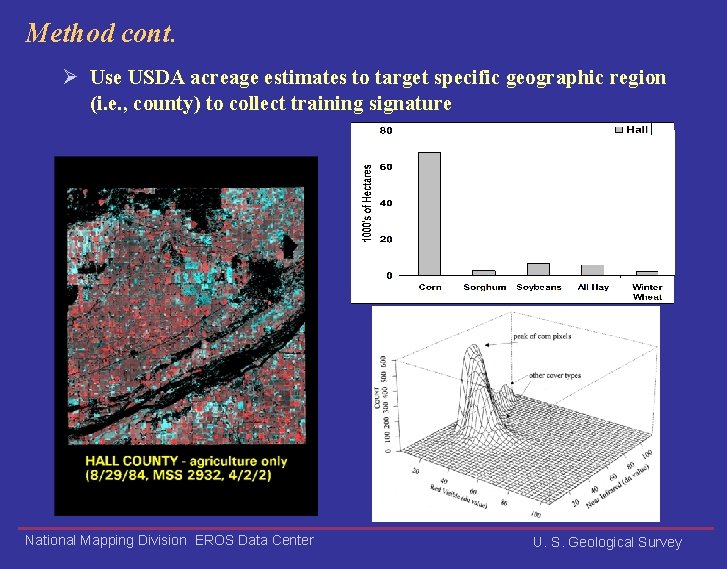
Method cont. Ø Use USDA acreage estimates to target specific geographic region (i. e. , county) to collect training signature National Mapping Division EROS Data Center U. S. Geological Survey
Method cont. Ø Use the Mahalanobis distance image in combination with USDA acreage estimates to identify cut-off for “highly likely corn”, “likely corn” and “unlikely corn” Highly Likely Corn Mahalanobis distance image Likely Corn National Mapping Division EROS Data Center U. S. Geological Survey
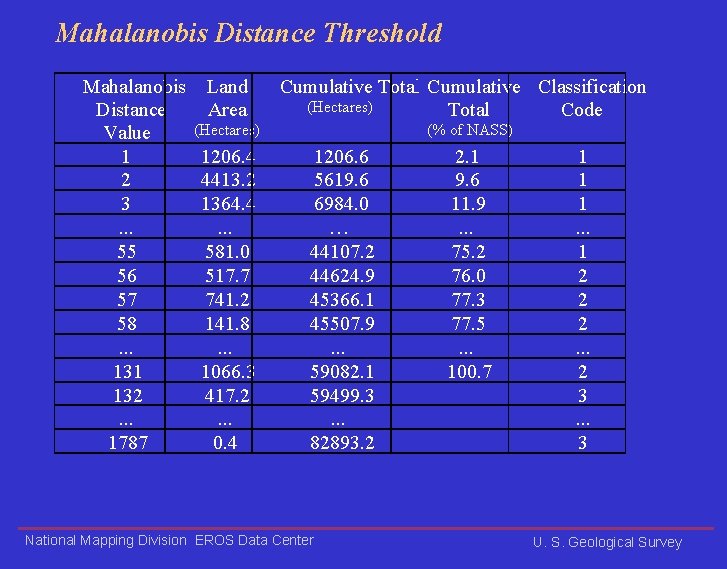
Mahalanobis Distance Threshold n. Mahalanobis n. Land n. Cumulative Totaln. Cumulative n. Classification n(Hectares) n. Distance n. Area n. Total n. Code n(% of NASS) n. Value n(Hectares) n 1206. 4 n 1206. 6 n 2. 1 n 2 n 4413. 2 n 5619. 6 n 1 n 3 n 1364. 4 n 6984. 0 n 11. 9 n 1 n. . . n… n. . . n 55 n 581. 0 n 44107. 2 n 75. 2 n 1 n 56 n 517. 7 n 44624. 9 n 76. 0 n 2 n 57 n 741. 2 n 45366. 1 n 77. 3 n 2 n 58 n 141. 8 n 45507. 9 n 77. 5 n 2 n. . . n 131 n 1066. 3 n 59082. 1 n 100. 7 n 2 n 132 n 417. 2 n 59499. 3 n. . . n 1787 n 0. 4 n 82893. 2 n 3 National Mapping Division EROS Data Center U. S. Geological Survey
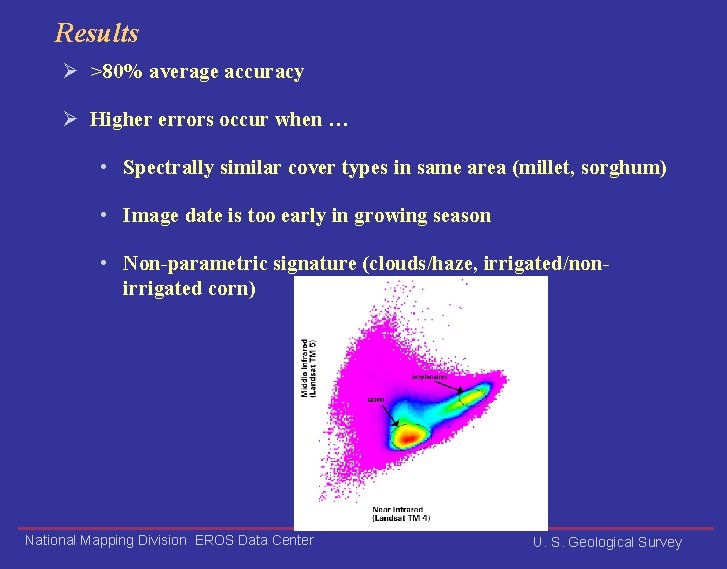
Results Ø >80% average accuracy Ø Higher errors occur when … • Spectrally similar cover types in same area (millet, sorghum) • Image date is too early in growing season • Non-parametric signature (clouds/haze, irrigated/nonirrigated corn) National Mapping Division EROS Data Center U. S. Geological Survey
Thank You Susan Maxwell maxwell@usgs. gov National Mapping Division EROS Data Center U. S. Geological Survey