
U S GAAP Loss Recognition Testing Actuarial Science










- Slides: 32
U. S. GAAP Loss Recognition Testing: Actuarial Science Session Lisa Kuklinski SVP & US Chief Actuary, Met. Life October 26, 2017
Agenda Confidential – for Met. Life internal use only • Overview • Theory – Basics • Theory – Advanced • Practice • Setting Assumptions • Future of LRT To edit go to: Insert > Header and Footer 2
Overview 3
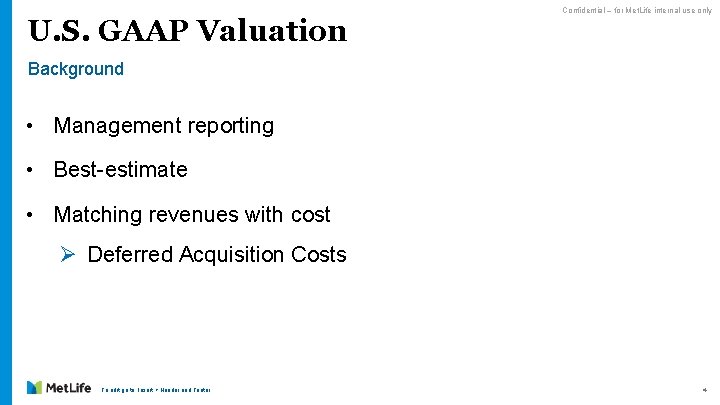
U. S. GAAP Valuation Confidential – for Met. Life internal use only Background • Management reporting • Best-estimate • Matching revenues with cost Ø Deferred Acquisition Costs To edit go to: Insert > Header and Footer 4
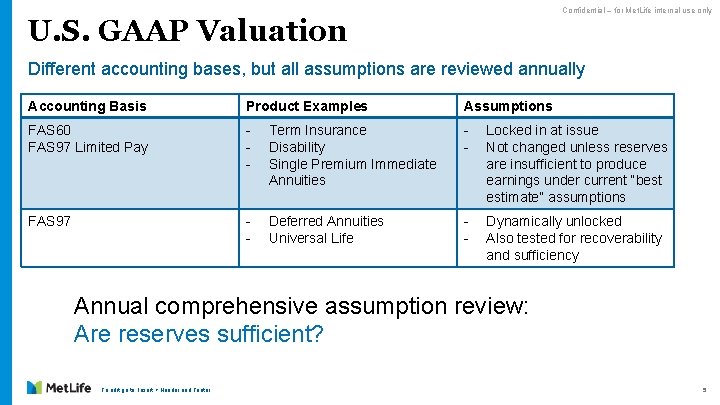
Confidential – for Met. Life internal use only U. S. GAAP Valuation Different accounting bases, but all assumptions are reviewed annually Accounting Basis Product Examples Assumptions FAS 60 FAS 97 Limited Pay - Term Insurance Disability Single Premium Immediate Annuities - Locked in at issue Not changed unless reserves are insufficient to produce earnings under current “best estimate” assumptions FAS 97 - Deferred Annuities Universal Life - Dynamically unlocked Also tested for recoverability and sufficiency Annual comprehensive assumption review: Are reserves sufficient? To edit go to: Insert > Header and Footer 5
Theory – Basics 6
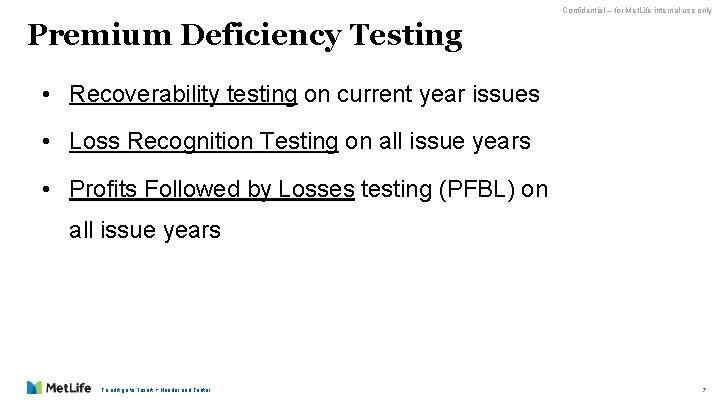
Confidential – for Met. Life internal use only Premium Deficiency Testing • Recoverability testing on current year issues • Loss Recognition Testing on all issue years • Profits Followed by Losses testing (PFBL) on all issue years To edit go to: Insert > Header and Footer 7
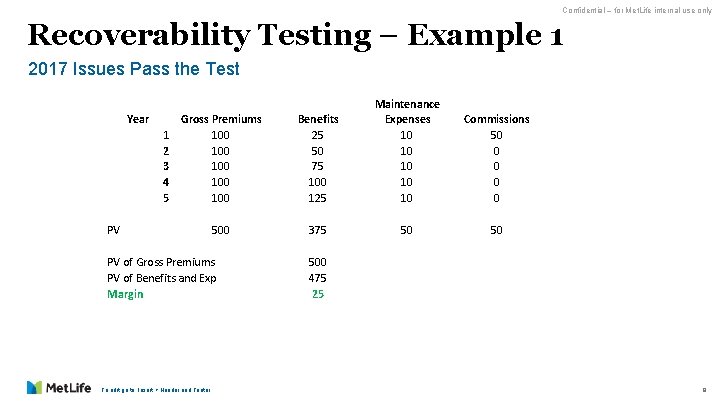
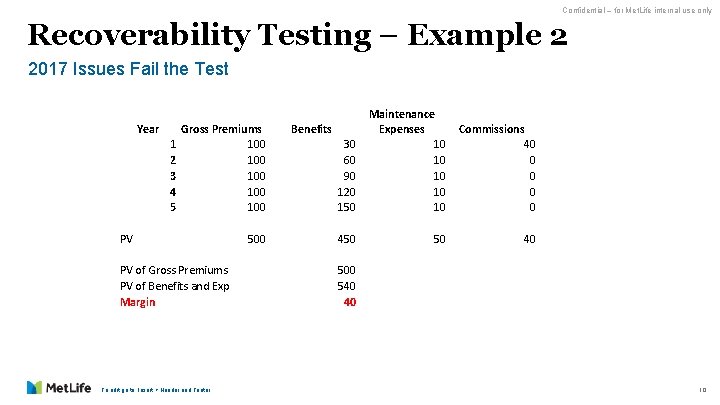
Confidential – for Met. Life internal use only Recoverability Testing Are current year issues profitable? Are acquisition expenses recoverable? • Current year issues (e. g. 2017) • Test: PV of Gross Premiums >= PV of Future Benefits and Expenses Ø Best estimate assumptions with no Provision for Adverse Deviation Ø Maintenance expenses only • Pass? OK to Defer Acquisition Expenses • Fail? Cannot Defer Acquisition Expenses To edit go to: Insert > Header and Footer 8
Confidential – for Met. Life internal use only Recoverability Testing – Example 1 2017 Issues Pass the Test Year 1 2 3 4 5 Gross Premiums 100 100 100 Benefits 25 50 75 100 125 Maintenance Expenses 10 10 10 Commissions 50 0 0 500 375 50 50 PV PV of Gross Premiums PV of Benefits and Exp Margin To edit go to: Insert > Header and Footer 500 475 25 9
Confidential – for Met. Life internal use only Recoverability Testing – Example 2 2017 Issues Fail the Test Year 1 2 3 4 5 Gross Premiums 100 100 100 PV PV of Gross Premiums PV of Benefits and Exp Margin To edit go to: Insert > Header and Footer 500 30 60 90 120 150 Maintenance Expenses 10 10 10 Commissions 40 0 0 450 50 40 Benefits 500 540 40 10
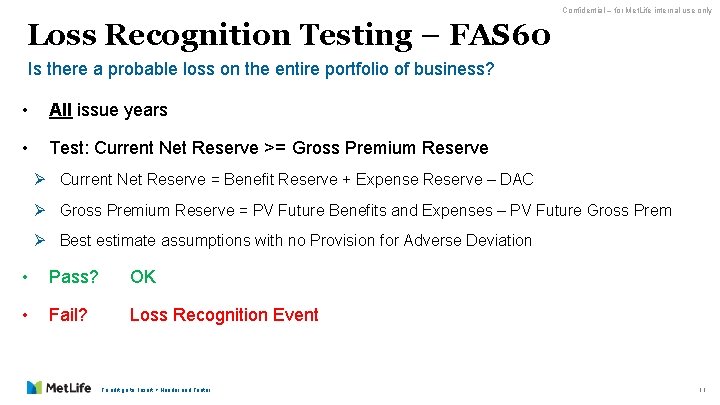
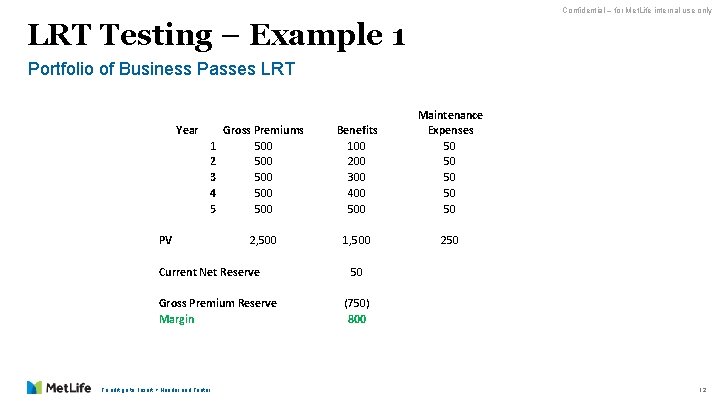
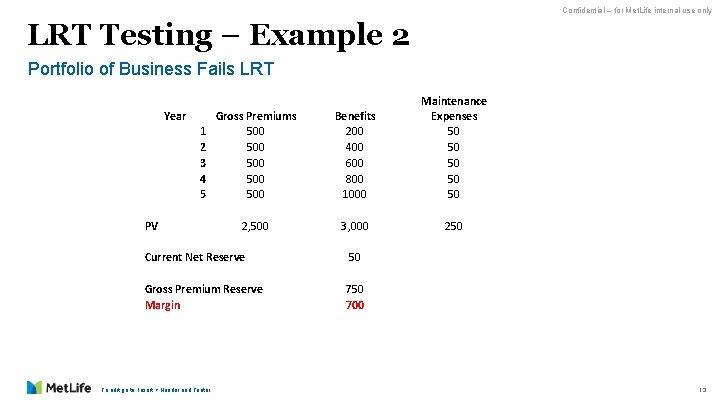
Confidential – for Met. Life internal use only Loss Recognition Testing – FAS 60 Is there a probable loss on the entire portfolio of business? • All issue years • Test: Current Net Reserve >= Gross Premium Reserve Ø Current Net Reserve = Benefit Reserve + Expense Reserve – DAC Ø Gross Premium Reserve = PV Future Benefits and Expenses – PV Future Gross Prem Ø Best estimate assumptions with no Provision for Adverse Deviation • Pass? OK • Fail? Loss Recognition Event To edit go to: Insert > Header and Footer 11
Confidential – for Met. Life internal use only LRT Testing – Example 1 Portfolio of Business Passes LRT Year 1 2 3 4 5 PV Gross Premiums 500 500 500 Benefits 100 200 300 400 500 Maintenance Expenses 50 50 50 2, 500 1, 500 250 Current Net Reserve Gross Premium Reserve Margin To edit go to: Insert > Header and Footer 50 (750) 800 12
Confidential – for Met. Life internal use only LRT Testing – Example 2 Portfolio of Business Fails LRT Year 1 2 3 4 5 PV Gross Premiums 500 500 500 Benefits 200 400 600 800 1000 Maintenance Expenses 50 50 50 2, 500 3, 000 250 Current Net Reserve 50 Gross Premium Reserve Margin 750 700 To edit go to: Insert > Header and Footer 13
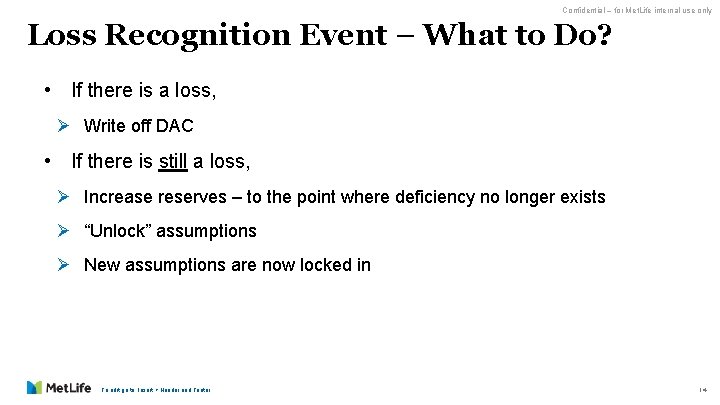
Confidential – for Met. Life internal use only Loss Recognition Event – What to Do? • If there is a loss, Ø Write off DAC • If there is still a loss, Ø Increase reserves – to the point where deficiency no longer exists Ø “Unlock” assumptions Ø New assumptions are now locked in To edit go to: Insert > Header and Footer 14
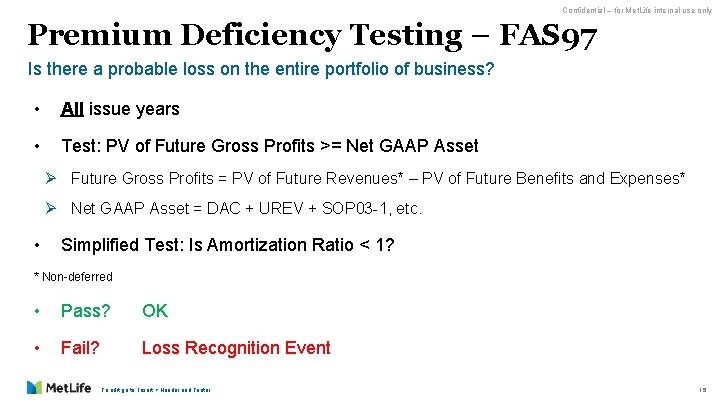
Confidential – for Met. Life internal use only Premium Deficiency Testing – FAS 97 Is there a probable loss on the entire portfolio of business? • All issue years • Test: PV of Future Gross Profits >= Net GAAP Asset Ø Future Gross Profits = PV of Future Revenues* – PV of Future Benefits and Expenses* Ø Net GAAP Asset = DAC + UREV + SOP 03 -1, etc. • Simplified Test: Is Amortization Ratio < 1? * Non-deferred • Pass? OK • Fail? Loss Recognition Event To edit go to: Insert > Header and Footer 15
Theory – Advanced 16
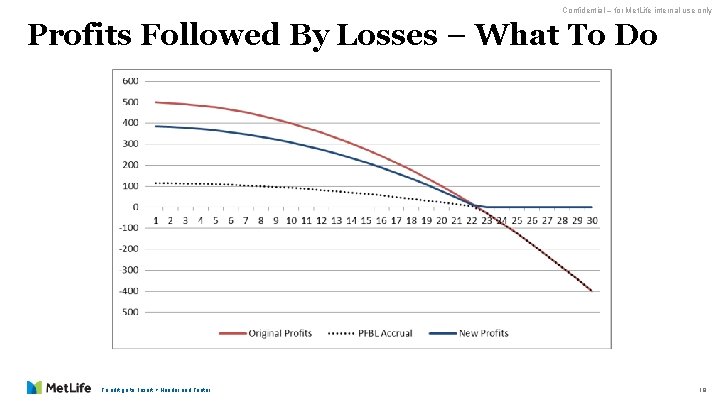
Confidential – for Met. Life internal use only Profits Followed By Losses • Required by FAS 60, paragraph 37 • Even if pass LRT, if pattern of earnings is Ø Profits in early years Ø Losses in later years • Must increase liability to offset future losses To edit go to: Insert > Header and Footer 17
Confidential – for Met. Life internal use only Profits Followed By Losses – What To Do To edit go to: Insert > Header and Footer 18
Confidential – for Met. Life internal use only Aggregation Can we use surplus in one product to offset deficiencies in other products? • Depends on how business is Ø Acquired Ø Serviced Ø Managed • Within legal entities To edit go to: Insert > Header and Footer 19
Confidential – for Met. Life internal use only Sensitivity Tests • Not required • But, helpful to understand margins in different environments • Interest rates? • Liability assumptions? To edit go to: Insert > Header and Footer 20
Practice 21
Best Practices for Liability Models Confidential – for Met. Life internal use only Results are only as good as your model • Static Validation • Dynamic Validation • Year-over-year change in margin attribution Ø Contribution from new business Ø Impact of mortality / loss ratio assumption changes Ø Impact of persistency assumption changes Ø Impact of expense changes To edit go to: Insert > Header and Footer 22
Best Practices for Asset Models Confidential – for Met. Life internal use only Variety of possible approaches • Interest rates should reflect best-estimate of current and future earned rates on investment assets • Set assets = GAAP reserves Ø Consistent allocation • Assume reinvestment based on best-estimate yield curve • Possible simplifications: Ø For example, current portfolio rates To edit go to: Insert > Header and Footer 23
Setting Assumptions 24
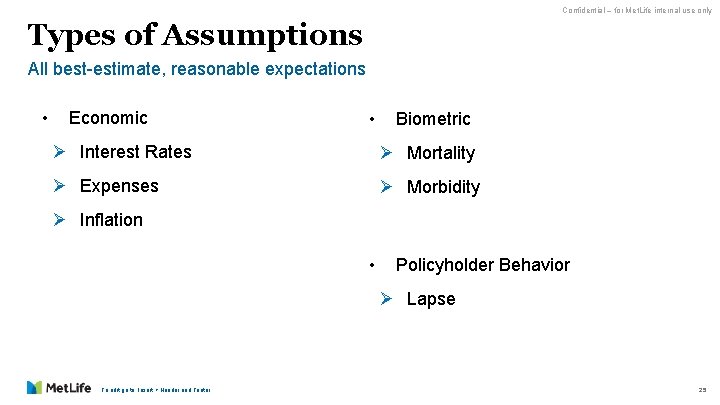
Confidential – for Met. Life internal use only Types of Assumptions All best-estimate, reasonable expectations • Economic • Biometric Ø Interest Rates Ø Mortality Ø Expenses Ø Morbidity Ø Inflation • Policyholder Behavior Ø Lapse To edit go to: Insert > Header and Footer 25
Experience Studies Confidential – for Met. Life internal use only Actual to Expected Credibility Predictive Modeling Behavioral Economic Dynamic Functions 26
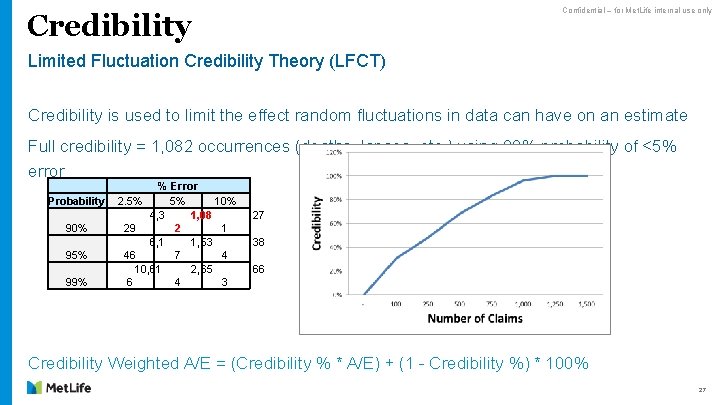
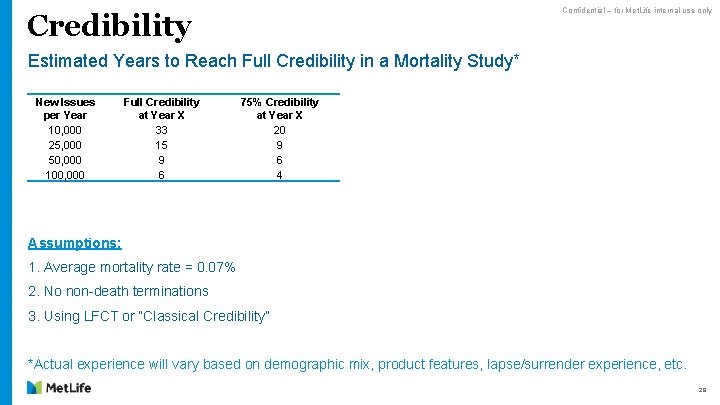
Credibility Confidential – for Met. Life internal use only Limited Fluctuation Credibility Theory (LFCT) Credibility is used to limit the effect random fluctuations in data can have on an estimate Full credibility = 1, 082 occurrences (deaths, lapses, etc. ) using 90% probability of <5% error Probability 90% 95% 99% % Error 2. 5% 5% 10% 4, 3 1, 08 27 29 2 1 6, 1 1, 53 38 46 7 4 10, 61 2, 65 66 6 4 3 Credibility Weighted A/E = (Credibility % * A/E) + (1 - Credibility %) * 100% 27
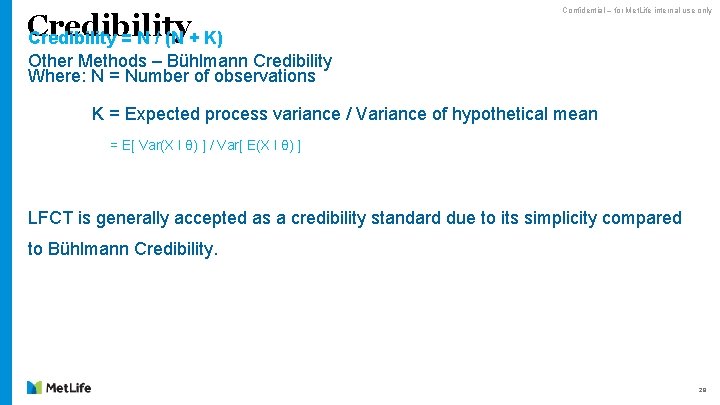
Credibility = N / (N + K) Confidential – for Met. Life internal use only Other Methods – Bühlmann Credibility Where: N = Number of observations K = Expected process variance / Variance of hypothetical mean = E[ Var(X l θ) ] / Var[ E(X l θ) ] LFCT is generally accepted as a credibility standard due to its simplicity compared to Bühlmann Credibility. 28
Confidential – for Met. Life internal use only Credibility Estimated Years to Reach Full Credibility in a Mortality Study* New Issues per Year 10, 000 25, 000 50, 000 100, 000 Full Credibility at Year X 33 15 9 6 75% Credibility at Year X 20 9 6 4 Assumptions: 1. Average mortality rate = 0. 07% 2. No non-death terminations 3. Using LFCT or “Classical Credibility” *Actual experience will vary based on demographic mix, product features, lapse/surrender experience, etc. 29
Future of LRT 30
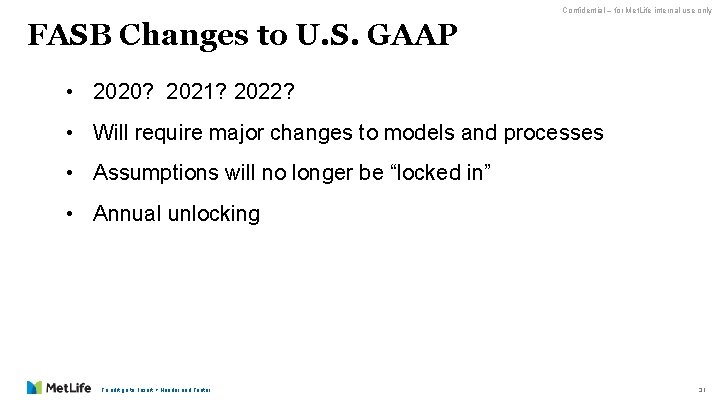
Confidential – for Met. Life internal use only FASB Changes to U. S. GAAP • 2020? 2021? 2022? • Will require major changes to models and processes • Assumptions will no longer be “locked in” • Annual unlocking To edit go to: Insert > Header and Footer 31
Q&A 32