
U S Flag History Learning Objectives Add your
U. S. Flag History
Learning Objectives ▪ Add your first bullet point here ▪ Add your second bullet point here ▪ Add your third bullet point here
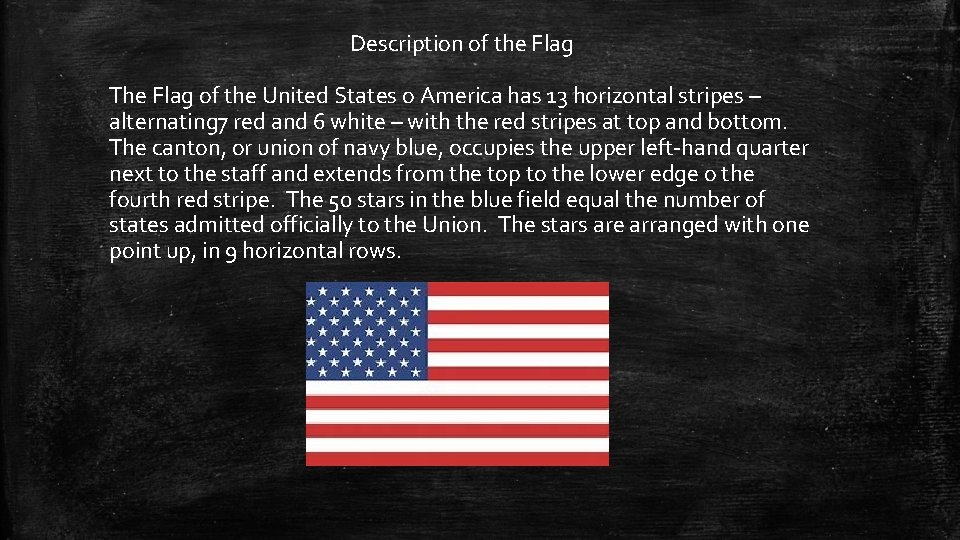
Description of the Flag The Flag of the United States o America has 13 horizontal stripes – alternating 7 red and 6 white – with the red stripes at top and bottom. The canton, or union of navy blue, occupies the upper left-hand quarter next to the staff and extends from the top to the lower edge o the fourth red stripe. The 50 stars in the blue field equal the number of states admitted officially to the Union. The stars are arranged with one point up, in 9 horizontal rows.
Federal Flag Code Public Law 344, passed by the 94 th Congress, is known as the Federal Flag Code. It is the guide for all handling an display of the United States Flag. It was established for the use of such civilians or civilian groups or organizations as may not be required to conform with regulations promulgated by one or more executive department of the Government of the United States.
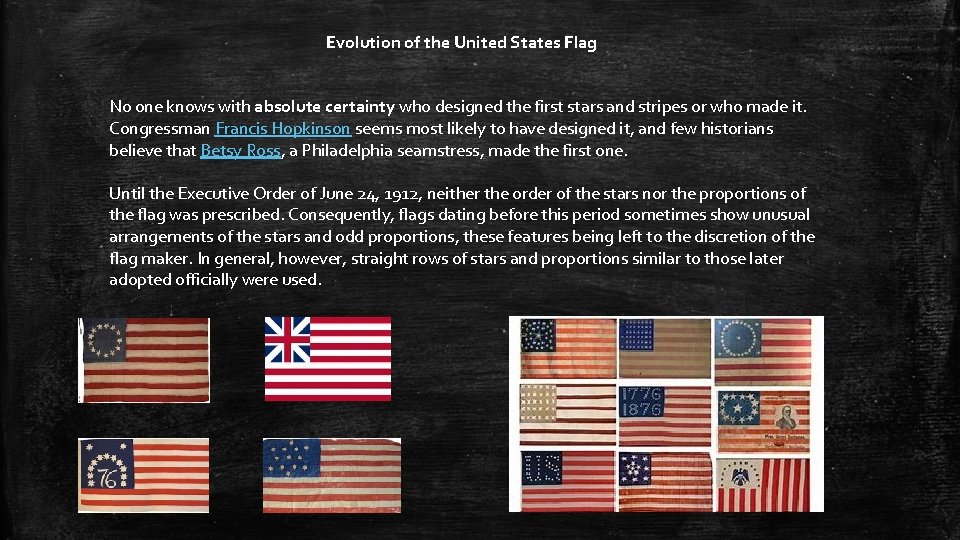
Evolution of the United States Flag No one knows with absolute certainty who designed the first stars and stripes or who made it. Congressman Francis Hopkinson seems most likely to have designed it, and few historians believe that Betsy Ross, a Philadelphia seamstress, made the first one. Until the Executive Order of June 24, 1912, neither the order of the stars nor the proportions of the flag was prescribed. Consequently, flags dating before this period sometimes show unusual arrangements of the stars and odd proportions, these features being left to the discretion of the flag maker. In general, however, straight rows of stars and proportions similar to those later adopted officially were used.
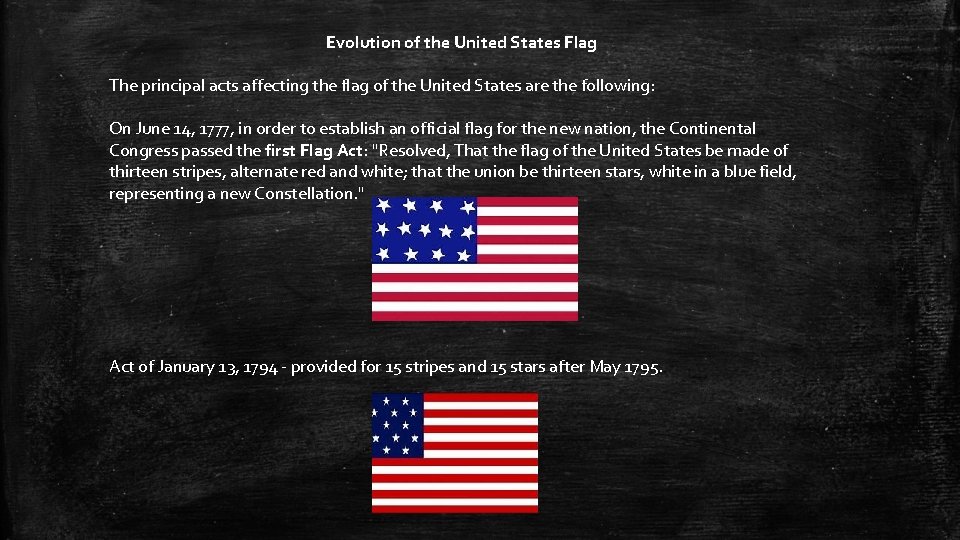
Evolution of the United States Flag The principal acts affecting the flag of the United States are the following: On June 14, 1777, in order to establish an official flag for the new nation, the Continental Congress passed the first Flag Act: "Resolved, That the flag of the United States be made of thirteen stripes, alternate red and white; that the union be thirteen stars, white in a blue field, representing a new Constellation. " Act of January 13, 1794 - provided for 15 stripes and 15 stars after May 1795.

Evolution of the United States Flag Act of April 4, 1818 - provided for 13 stripes and one star for each state, to be added to the flag on the 4 th of July following the admission of each new state, signed by President Monroe. Executive Order of President Taft dated June 24, 1912 - established proportions of the flag and provided for arrangement of the stars in six horizontal rows of eight each, a single point of each star to be upward.

Evolution of the United States Flag Executive Order of President Eisenhower dated January 3, 1959 - provided for the arrangement of the stars in seven rows of seven stars each, staggered horizontally and vertically. Executive Order of President Eisenhower dated August 21, 1959 - provided for the arrangement of the stars in nine rows of stars staggered horizontally and eleven rows of stars staggered vertically.
Francis Scott Key and the Star Spangled Banner 1780 -1843 Francis Scott Key was a respected young lawyer living in Georgetown just west of where the modern day Key Bridge crosses the Potomac River (the house was torn down after years of neglect in 1947). He made his home there from 1804 to around 1833 with his wife Mary and their six sons and five daughters. At the time, Georgetown was a thriving town of 5, 000 people just a few miles from the Capitol, the White House, and the Federal buildings of Washington. But, after war broke out in 1812 over Britian's attempts to regulate American shipping and other activities while Britain was at war with France, all was not tranquil in Georgetown. The British had entered Chesapeake Bay on August 19 th, 1814, and by the evening of the 24 th of August, the British had invaded and captured Washington. They set fire to the Capitol and the White House, the flames visible 40 miles away in Baltimore. President James Madison, his wife Dolley, and his Cabinet had already fled to a safer location. Such was their haste to leave that they had to rip the Stuart portrait of George Washington from the walls without its frame! A thunderstorm at dawn kept the fires from spreading. The next day more buildings were burned and again a thunderstorm dampened the fires. Having done their work the British troops returned to their ships in and around the Chesapeake Bay. In the days following the attack on Washington, the American forces prepared for the assault on Baltimore (population 40, 000) that they knew would come by both land sea. Word soon reached Francis Scott Key that the British had carried off an elderly and much loved town physician of Upper Marlboro, Dr. William Beanes, and was being held on the British flagship TONNANT. The townsfolk feared that Dr. Beanes would be hanged. They asked Francis Scott Key for his help, and he agreed, and arranged to have Col. John Skinner, an American agent for prisoner exchange to accompany him.
Francis Scott Key and the Star Spangled Banner 1780 -1843 On the morning of September 3 rd, he and Col. Skinner set sail from Baltimore aboard a sloop flying a flag of truce approved by President Madison. On the 7 th they found and boarded the TONNANT to confer with Gen. Ross and Adm. Alexander Cochrane. At first they refused to release Dr. Beanes. But Key and Skinner produced a pouch of letters written by wounded British prisoners praising the care they were receiving from the Americans, among them Dr. Beanes. The British officers relented but would not release three Americans immediately because they had seen and heard too much of the preparations for the attack on Baltimore. They were placed under guard, first aboard the H. M. S. Surprise, then onto the sloop and forced to wait out the battle behind the British fleet. Now let's go back to the summer of 1813 for a moment. At the star-shaped Fort Mc. Henry, the commander, Maj. George Armistead, asked for a flag so big that "the British would have no trouble seeing it from a distance". Two officers, a Commodore and a General, were sent to the Baltimore home of Mary Young Pickersgill, a "maker of colours, " and commisioned the flag. Mary and her thirteen year old daughter Caroline, working in an upstairs front bedroom, used 400 yards of best quality wool bunting. They cut 15 stars that measured two feet from point to point. Eight red and seven white stripes, each two feet wide, were cut. Laying out the material on the malthouse floor of Claggett's Brewery, a neighborhood establishment, the flag was sewn together. By August it was finished. It measured 30 by 42 feet and cost $405. 90. The Baltimore Flag House, a museum, now occupies her premises, which were restored in 1953. At 7 a. m. on the morning of September 13, 1814, the British bombardment began, and the flag was ready to meet the enemy. The bombardment continued for 25 hours, the British firing 1, 500 bombshells that weighed as much as 220 pounds and carried lighted fuses that would supposedly cause it to explode when it reached its target. But they weren't very dependable and often blew up in mid air. From special small boats the British fired the new Congreve rockets that traced wobbly arcs of red flame across the sky. The Americans had sunk 22 vessels so a close approach by the British was not possible. That evening the connonading stopped, but at about 1 a. m. on the 14 th, the British fleet roared to life, lighting the rainy night sky with grotesque fireworks.
Francis Scott Key and the Star Spangled Banner 1780 -1843 Key, Col. Skinner, and Dr. Beanes watched the battle with apprehension. They knew that as long as the shelling continued, Fort Mc. Henry had not surrendered. But, long before daylight there came a sudden and mysterious silence. What the three Americans did not know was that the British land assault on Baltimore as well as the naval attack, had been abandoned. Judging Baltimore as being too costly a prize, the British officers ordered a retreat. Waiting in the predawn darkness, Key waited for the sight that would end his anxiety; the joyous sight of Gen. Armisteads great flag blowing in the breeze. When at last daylight came, the flag was still there! Being an amatuer poet and having been so uniquely inspired, Key began to write on the back of a letter he had in his pocket. Sailing back to Baltimore he composed more lines and in his lodgings at the Indian Queen Hotel he finished the poem. Judge J. H. Nicholson, his brother-in-law, took it to a printer and copies were circulated around Baltimore under the title "Defence of Fort M'Henry". Two of these copies survive. It was printed in a newspaper for the first time in the Baltimore Patriot on September 20 th, 1814, then in papers as far away as Georgia and New Hampshire. To the verses was added a note "Tune: Anacreon in Heaven. " In October a Baltimore actor sang Key's new song in a public performance and called it "The Star-Spangled Banner". Immediately popular, it remained just one of several patriotic airs until it was finally adopted as our national anthem on March 3, 1931. But the actual words were not included in the legal documents. Key himself had written several versions with slight variations so discrepancies in the exact wording still occur.
Francis Scott Key and the Star Spangled Banner 1780 -1843 The flag, our beloved Star-Spangled Banner, went on view , for the first time after flying over Fort Mc. Henry, on January 1 st, 1876 at the Old State House in Philadelphia for the nations' Centennial celebration. It now resides in the Smithsonian Institution's Museum of American History. An opaque curtain shields the now fragile flag from light and dust. The flag is exposed for viewing for a few moments once every hour during museum hours. Francis Scott Key was a witness to the last enemy fire to fall on Fort Mc. Henry. The Fort was designed by a Frenchman named Jean Foncin and was named for then Secretary of war James Mc. Henry. Fort Mc. Henry holds the unique designation of national monument and historic shrine. Since May 30 th, 1949 the flag has flown continuously, by a Joint Resolution of Congress, over the monument marking the site of Francis Scott Key's birthplace, Terra Rubra Farm, Carroll County, Keymar, Maryland. The copy that Key wrote in his hotel September 14, 1814, remained in the Nicholson family for 93 years. In 1907 it was sold to Henry Walters of Baltimore. In 1934 it was bought at auction in New York from the Walters estate by the Walters Art Gallery, Baltimore for $26, 400. The Walters Gallery in 1953 sold the manuscript to the Maryland Historical Society for the same price. Another copy that Key made is in the Library of Congress.
The History Of Flag Day The Fourth of July was traditionally celebrated as America's birthday, but the idea of an annual day specifically celebrating the Flag is believed to have first originated in 1885. BJ Cigrand, a schoolteacher, arranged for the pupils in the Fredonia, Wisconsin Public School, District 6, to observe June 14 (the 108 th anniversary of the official adoption of The Stars and Stripes) as 'Flag Birthday'. In numerous magazines and newspaper articles and public addresses over the following years, Cigrand continued to enthusiastically advocate the observance of June 14 as 'Flag Birthday', or 'Flag Day’. On June 14, 1889, George Balch, a kindergarten teacher in New York City, planned appropriate ceremonies for the children of his school, and his idea of observing Flag Day was later adopted by the State Board of Education of New York. On June 14, 1891, the Betsy Ross House in Philadelphia held a Flag Day celebration, and on June 14 of the following year, the New York Society of the Sons of the Revolution, celebrated Flag Day.
The History Of Flag Day Following the suggestion of Colonel J Granville Leach (at the time historian of the Pennsylvania Society of the Sons of the Revolution), the Pennsylvania Society of Colonial Dames of America on April 25, 1893 adopted a resolution requesting the mayor of Philadelphia and all others in authority and all private citizens to display the Flag on June 14 th. Leach went on to recommend that thereafter the day be known as 'Flag Day', and on that day, school children be assembled for appropriate exercises, with each child being given a small Flag. Two weeks later on May 8 th, the Board of Managers of the Pennsylvania Society of Sons of the Revolution unanimously endorsed the action of the Pennsylvania Society of Colonial Dames. As a result of the resolution, Dr. Edward Brooks, then Superintendent of Public Schools of Philadelphia, directed that Flag Day exercises be held on June 14, 1893 in Independence Square. School children were assembled, each carrying a small Flag, and patriotic songs were sung and addresses delivered.
The History Of Flag Day In 1894, the governor of New York directed that on June 14 the Flag be displayed on all public buildings. With BJ Cigrand Leroy Van Horn as the moving spirits, the Illinois organization, known as the American Flag Day Association, was organized for the purpose of promoting the holding of Flag Day exercises. On June 14 th, 1894, under the auspices of this association, the first general public school children's celebration of Flag Day in Chicago was held in Douglas, Garfield, Humboldt, Lincoln, and Washington Parks, with more than 300, 000 children participating. Adults, too, participated in patriotic programs. Franklin K. Lane, Secretary of the Interior, delivered a 1914 Flag Day address in which he repeated words he said the flag had spoken to him that morning: "I am what you make me; nothing more. I swing before your eyes as a bright gleam of color, a symbol of yourself. " Inspired by these three decades of state and local celebrations, Flag Day - the anniversary of the Flag Resolution of 1777 - was officially established by the Proclamation of President Woodrow Wilson on May 30 th, 1916. While Flag Day was celebrated in various communities for years after Wilson's proclamation, it was not until August 3 rd, 1949, that President Truman signed an Act of Congress designating June 14 th of each year as National Flag Day.
- Slides: 18