
U S Environmental Protection Agency ENERGY STAR Program
- Slides: 23
U. S. Environmental Protection Agency ENERGY STAR Program Albany City Council Meeting February 5, 2007 Kathy M. Diehl Energy Star Program Manager
U. S. EPA & ENERGY STAR l EPA Organization l ENERGY STAR Program Overview l ENERGYSTAR Partnerships l Training to Support Partnerships l Financing Municipal Energy Efficiency Projects l Recap l Contact Information
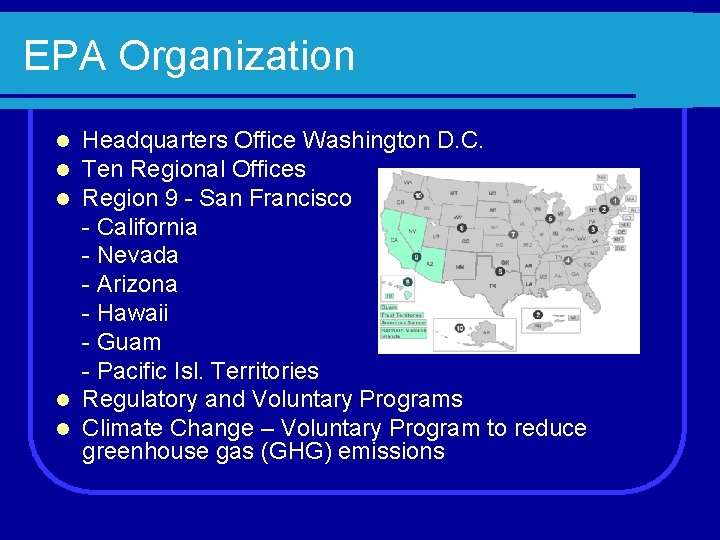
EPA Organization Headquarters Office Washington D. C. Ten Regional Offices Region 9 - San Francisco - California - Nevada - Arizona - Hawaii - Guam - Pacific Isl. Territories l Regulatory and Voluntary Programs l Climate Change – Voluntary Program to reduce greenhouse gas (GHG) emissions l l l
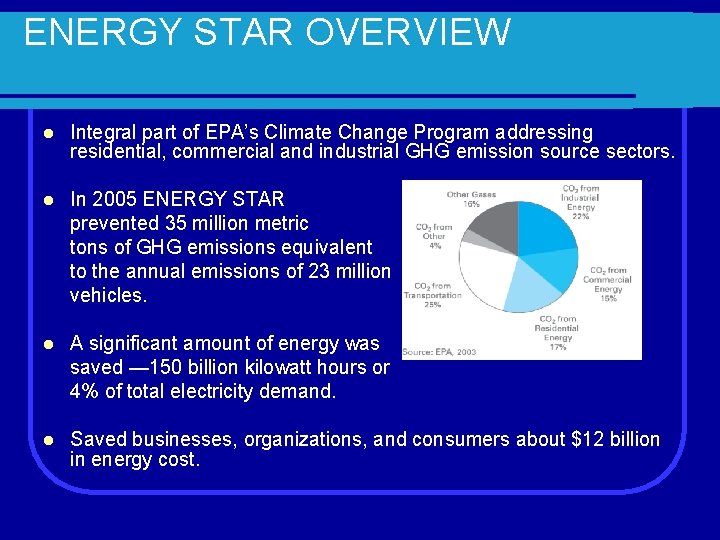
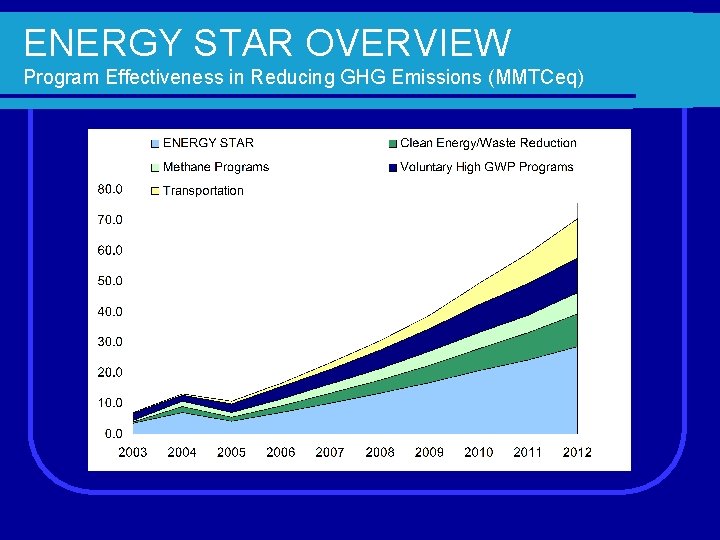
ENERGY STAR OVERVIEW l Integral part of EPA’s Climate Change Program addressing residential, commercial and industrial GHG emission source sectors. l In 2005 ENERGY STAR prevented 35 million metric tons of GHG emissions equivalent to the annual emissions of 23 million vehicles. l A significant amount of energy was saved — 150 billion kilowatt hours or 4% of total electricity demand. l Saved businesses, organizations, and consumers about $12 billion in energy cost.
ENERGY STAR OVERVIEW Program Effectiveness in Reducing GHG Emissions (MMTCeq)
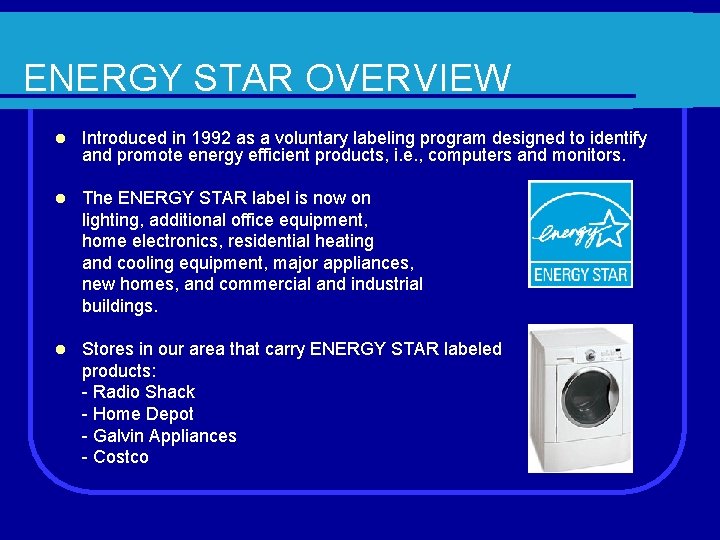
ENERGY STAR OVERVIEW l Introduced in 1992 as a voluntary labeling program designed to identify and promote energy efficient products, i. e. , computers and monitors. l The ENERGY STAR label is now on lighting, additional office equipment, home electronics, residential heating and cooling equipment, major appliances, new homes, and commercial and industrial buildings. l Stores in our area that carry ENERGY STAR labeled products: - Radio Shack - Home Depot - Galvin Appliances - Costco
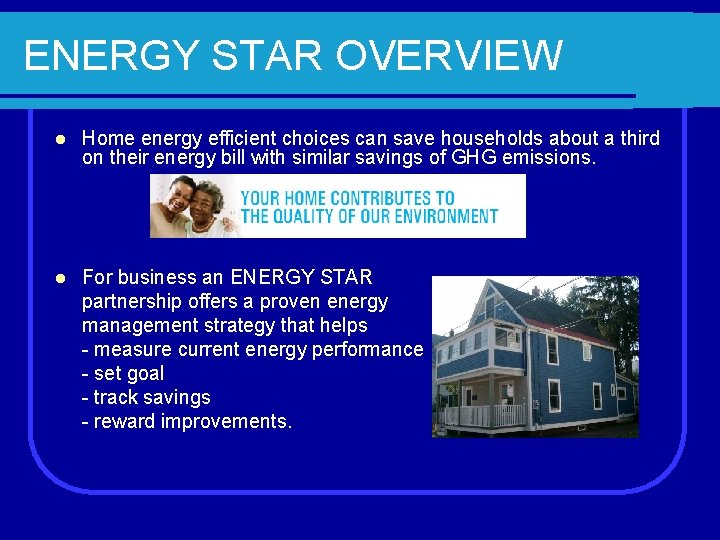
ENERGY STAR OVERVIEW l Home energy efficient choices can save households about a third on their energy bill with similar savings of GHG emissions. l For business an ENERGY STAR partnership offers a proven energy management strategy that helps - measure current energy performance - set goal - track savings - reward improvements.
ENERGY STAR Partnerships l EPA has partnered with more than 8000 private and public sector organizations investing in energy efficiency and reducing energy use in their buildings. l ENERGY STAR delivers the technical information and tools that organizations and consumers need to choose energy efficient solutions and best management practices. l Currently there are eight city partners in California including the City of Pleasanton.
ENERGY STAR PARTNERSHIPS WHY JOIN ENERGY STAR? l ENERGY STAR gives an organization the power to reduce GHG. l Partnering with ENERGY STAR demonstrates environmental leadership, improves energy efficiency, and saves money.
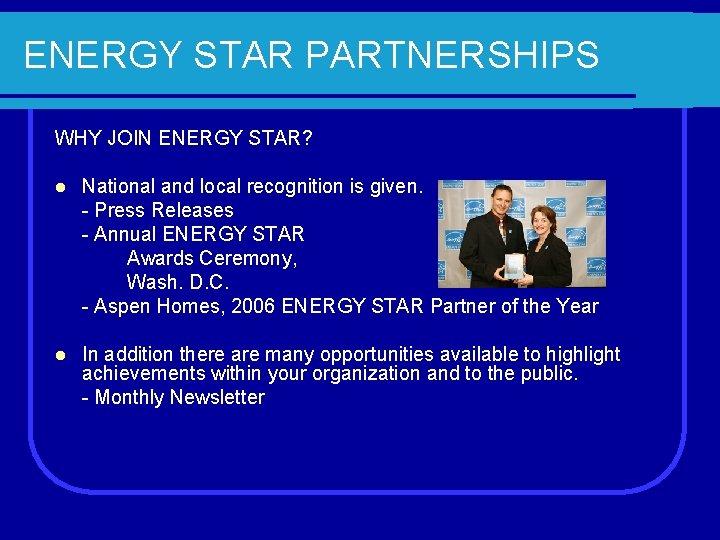
ENERGY STAR PARTNERSHIPS WHY JOIN ENERGY STAR? l National and local recognition is given. - Press Releases - Annual ENERGY STAR Awards Ceremony, Wash. D. C. - Aspen Homes, 2006 ENERGY STAR Partner of the Year l In addition there are many opportunities available to highlight achievements within your organization and to the public. - Monthly Newsletter
ENERGY STAR PARTNERSHIPS Cities eligible for two types of partnerships: l Promote ENERGY STAR as an Energy Efficiency Program Sponsor (States, Utilities, or Regional Programs). l Buildings & Plants ( Business, School, or Government committed to improving its energy efficiency)
ENERGY STAR PARTNERSHIPS PROGRAM SPONSOR REQUIREMENTS l Sign a Partnership Agreement with US DOE & US EPA to work toward improving the energy performance of external commercial or industrial organizations l Promote ENERGY STAR awareness through national messaging and promotional campaigns l Submit an action plan outlining ENERGY STAR initiatives
ENERGY STAR Partnerships BUILDING & PLANTS PARTNER REQUIREMENTS l Top administrator must sign partnership letter with US EPA Headquarters committing organization to continuous improvement of your energy efficiency - measure, track, and benchmark your energy performance - develop and implement a plan to improve your energy performance - educate staff and public about partnership and achievements with ENERGY STAR l Form a dedicated team & appoint energy director
ENERGY STAR PARTNERSHIPS Local Government Partnership Examples l City of Pleasanton - Building and Plants Partner - ENERGY STAR retrofit city buildings 1. re-lamping 2. HVAC system 3. computers & appliances l City of Scottsdale - Building and Plants Partner - Formed Energy Committee
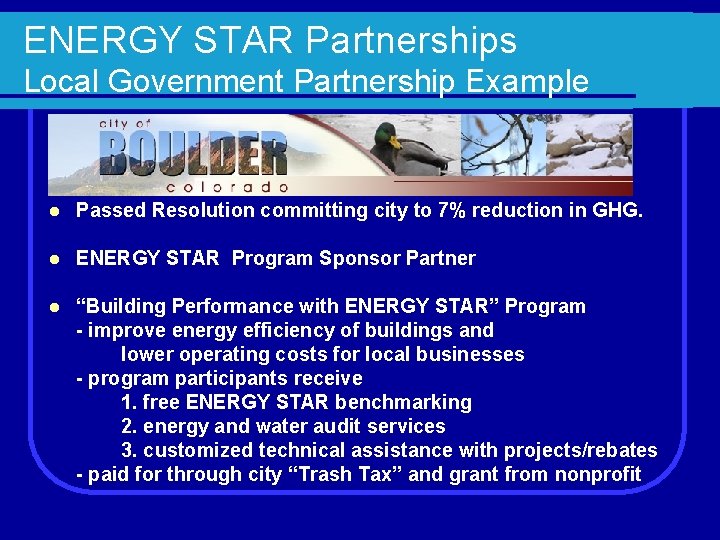
ENERGY STAR Partnerships Local Government Partnership Example l Passed Resolution committing city to 7% reduction in GHG. l ENERGY STAR Program Sponsor Partner l “Building Performance with ENERGY STAR” Program - improve energy efficiency of buildings and lower operating costs for local businesses - program participants receive 1. free ENERGY STAR benchmarking 2. energy and water audit services 3. customized technical assistance with projects/rebates - paid for through city “Trash Tax” and grant from nonprofit
ENERGY STAR TRAINING ENERGY STAR Online Training Sessions l Assist partners in meeting ENERGY STAR requirements l Introduction to ENERGY STAR l Creating Action Plans l Assessing Performance l Financing Strategies l FAQs
ENERGY STAR TRAINING Building & Plant Partners: Recommend Starting with Assessing Performance l l l How to Rate Energy Performance against similar facilities nationwide with EPA’s Portfolio Manager. Performance ratings provide valuable information for making decisions re: investments in energy efficiency, developing energy management plans, and measuring improvements over time. Eligible building categories include offices, k-12 schools, medical offices, supermarkets, refrigerated & unrefrigerated warehouses
Funding Municipal Energy Efficiency Projects l Federal Tax Credits l California Energy Partnership & Bright Schools Programs l Performance Contracts
Federal Tax Credits for Energy Efficiency Commercial Buildings - $1. 80 per sq. ft. to owners or designers of new or existing buildings - save at least 50% of heating and cooling energy of building that meets ASHRAE Standard 90. 1 -2001 - up to $. 60 per sq. ft. for measures affecting any one of the following: building envelope, lighting, or heating & cooling - available for buildings or systems placed in service from January 2006/December 2007 l See ENERGY STAR website l
California Energy Commission Government Energy Partnership & Bright Schools Programs l Existing Facilities & New Construction l Identify cost-effective energy efficient projects l Provide design and follow-up assistance l Fund engineering and/or architectural consultant’s cost - up to $10, 000 for government projects - up to $20, 000 for school projects l Low interest loans available to finance recommendations
Energy Service Performance Contracts l Agreement between a government and private energy services provider (ESP) l ESP identifies and evaluates energy-saving opportunities and recommends improvements that can be paid for through energy savings. l ESP usually guarantees that savings will at least meet annual payments to cover project cost or pay the difference.
ENERGY STAR Recap l ENERGY STAR is an integral part of EPA’s overall Climate Change Program effort to reduce GHG. l Encourages the use of ENERGY STAR products and design to address energy efficiency in buildings l Tools and training available to support energy efficiency efforts l Benefits of partnership: save energy, enhance financial value, demonstrate environmental leadership, achieve national and local recognition
ENERGY STAR Contacts & Websites l Contacts: Kathy Diehl, EPA Region 9, San Francisco, 415 972 -3996, diehl. kathy@epa. gov, ENERGY STAR Residential Buildings, Energy Benchmarking, & Partnerships Dennis Juido, Program Manager, Pacific Gas & Electric Local Government Energy Watch Partnership, 415 972 -5429 l Websites: www. epa. gov www. energystar. gov www. epa. gov/climatechange www. steppfoundation. org/main. htm www. energy. ca. gov/efficiency/partnership www. energy. ca. gov/efficiency/brightschools www. pge. com/biz/rebates/partnerships