
U S Employment Disability Discrimination Charges Implications for
U. S. Employment Disability Discrimination Charges: Implications for Disability Management Practice Susanne M. Bruyère Sarah von Schrader Cornell University and Wendy Coduti Michigan State University IFDMRN-GLADNET Researchers Network September 18, 2010 Advancing the World of Work 1 www. edi. cornell. edu
Funding Acknowledgement U. S. Department of Education National Institute of Disability and Rehabilitation Research (NIDRR) • Field-Initiated Research Project (FIR) on Using the U. S. Equal Employment Opportunity Commission (EEOC) Employment Discrimination Charge Data System for Research and Dissemination Purposes (Grant No. H 133 G 040265) • Rehabilitation Research and Training Center (RRTC) on Employment Policy for Persons with Disabilities (Grant No. H 133 B 040013) 2
Presentation Overview • Overview of the problem – Continuing economic disparities – Continuing employment disability discrimination • Analysis of U. S. EEOC Charge Data – – Where charges of discrimination are occurring With which types of disabilities Employer characteristics Intersection of disability and employment process • Implications for effective disability management 3
Economic Disparities • In 2008, 39. 5 percent people with a disability were employed, compared to 79. 9 percent for those without disabilities. • The median annual household income of households that include any working age people with a disability in 2008 was $ 39, 600, compared to $ 61, 200 for households that do not have any person with disability. • In 2008, 25. 3 percent of U. S. persons with a disability in the United States were living below the poverty line, compared to 9. 6 of those without disabilities (Erickson, Lee, & Von Schrader, 2010) 4
Need to Examine Workplace • Charges of discrimination continue to occur • With an aging workforce, need is increasing • Other emerging populations of concern in return to work process (e. g. Veterans with mental health and traumatic brain injury disorders) • Recognition of the importance of workplace culture, social capital, and employee engagement • Disability management as a facilitator for change 5

U. S. EEOC Charge Data • Must have an Intergovernmental Personnel Act Agreement with the U. S. EEOC to access the data • All employment discrimination charges from 1993 – 2007 with a focus on the ADA/disability charges • 462, 956 charges filed under ADA alone or jointly • Includes the basis (trait upon which discrimination is based) and issue (discriminatory behaviour) • Includes characteristics of the charging party (age, sex, and race), employer (Standard Industry Code and size of the firm), case-specific details 6
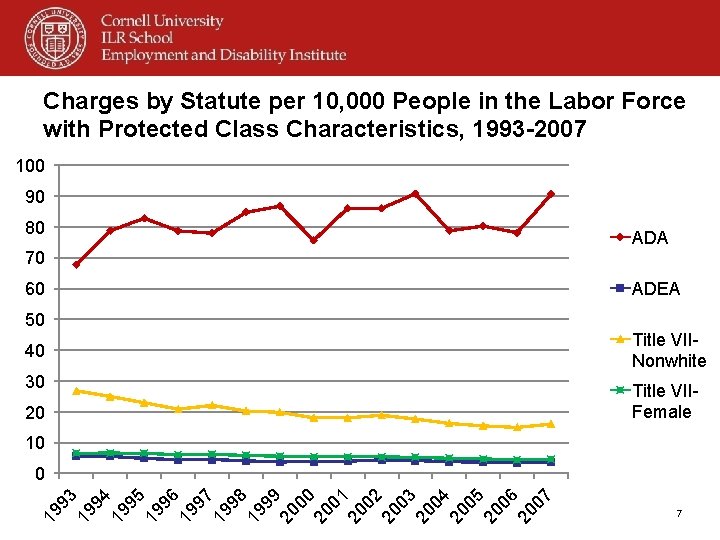
Charges by Statute per 10, 000 People in the Labor Force with Protected Class Characteristics, 1993 -2007 100 90 80 ADA 70 60 50 40 30 20 ADEA Title VIINonwhite Title VIIFemale 10 19 93 19 94 19 95 19 96 19 97 19 98 19 99 20 00 20 01 20 02 20 03 20 04 20 05 20 06 20 07 0 7
Results • Employment disability discrimination charges trends over time • Most often cited impairments where charges occur • Most often cited employment processes • Business size and industry findings • Impairments crossed w/ employment processes 8
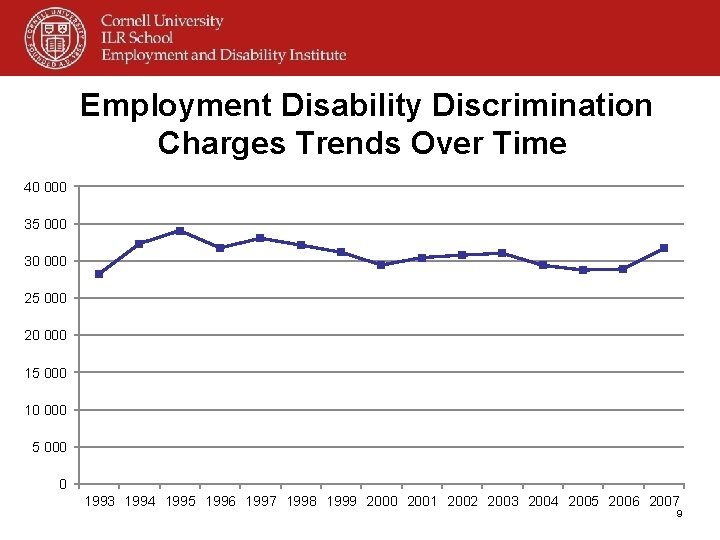
Employment Disability Discrimination Charges Trends Over Time 40 000 35 000 30 000 25 000 20 000 15 000 10 000 5 000 0 1993 1994 1995 1996 1997 1998 1999 2000 2001 2002 2003 2004 2005 2006 2007 9
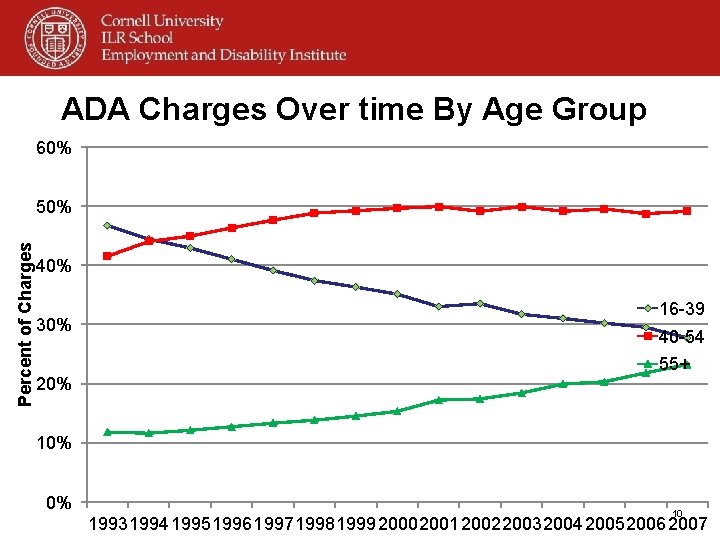
ADA Charges Over time By Age Group 60% Percent of Charges 50% 40% 30% 20% 16 -39 40 -54 55+ 10% 0% 10 199319941995199619971998199920002001200220032004200520062007
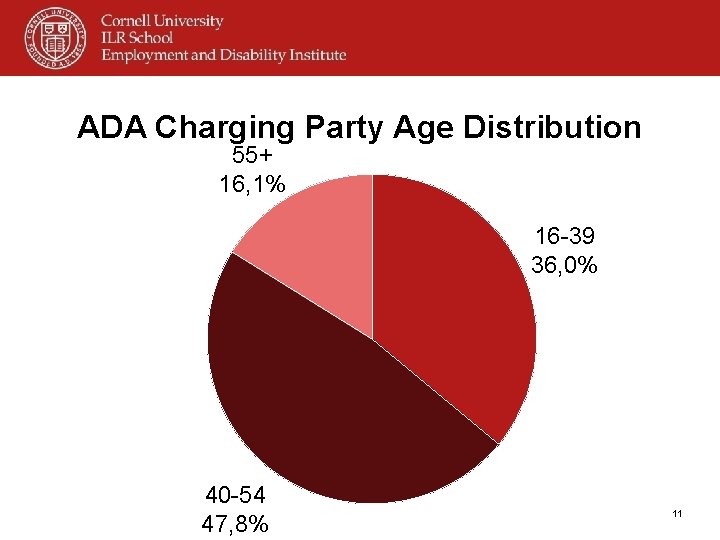
ADA Charging Party Age Distribution 55+ 16, 1% 16 -39 36, 0% 40 -54 47, 8% 11
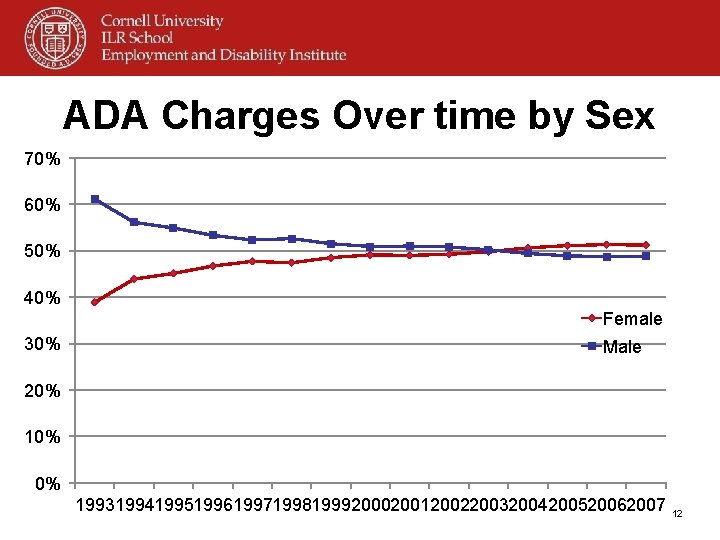
ADA Charges Over time by Sex 70% 60% 50% 40% Female 30% Male 20% 10% 0% 199319941995199619971998199920002001200220032004200520062007 12
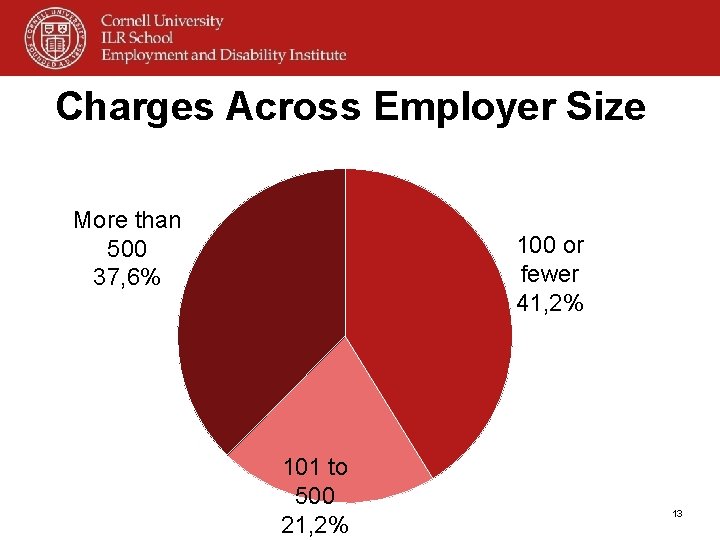
Charges Across Employer Size More than 500 37, 6% 100 or fewer 41, 2% 101 to 500 21, 2% 13
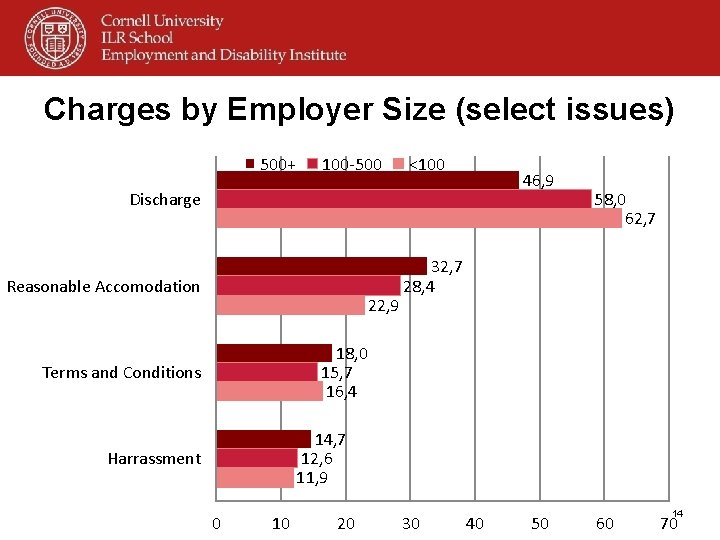
Charges by Employer Size (select issues) 500+ 100 -500 <100 46, 9 Discharge Reasonable Accomodation 22, 9 58, 0 62, 7 32, 7 28, 4 18, 0 15, 7 16, 4 Terms and Conditions 14, 7 12, 6 11, 9 Harrassment 0 10 20 30 40 50 60 14 70
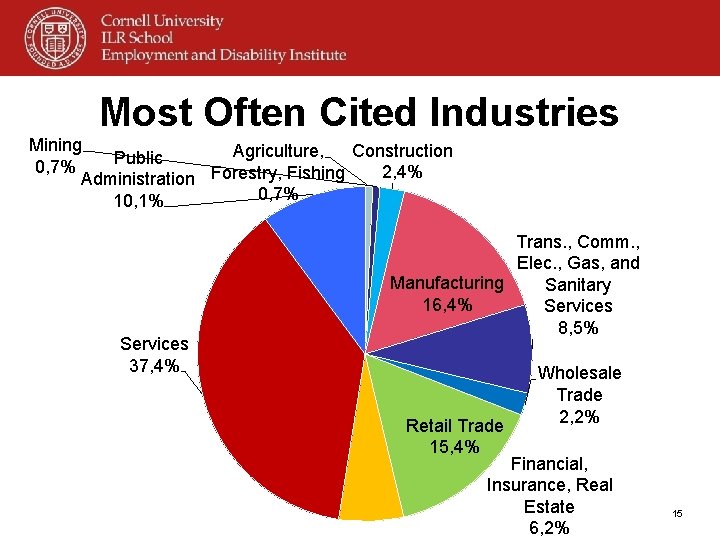
Most Often Cited Industries Mining Construction Agriculture, Public 0, 7% 2, 4% Administration Forestry, Fishing 0, 7% 10, 1% Services 37, 4% Trans. , Comm. , Elec. , Gas, and Manufacturing Sanitary 16, 4% Services 8, 5% Retail Trade 15, 4% Wholesale Trade 2, 2% Financial, Insurance, Real Estate 6, 2% 15
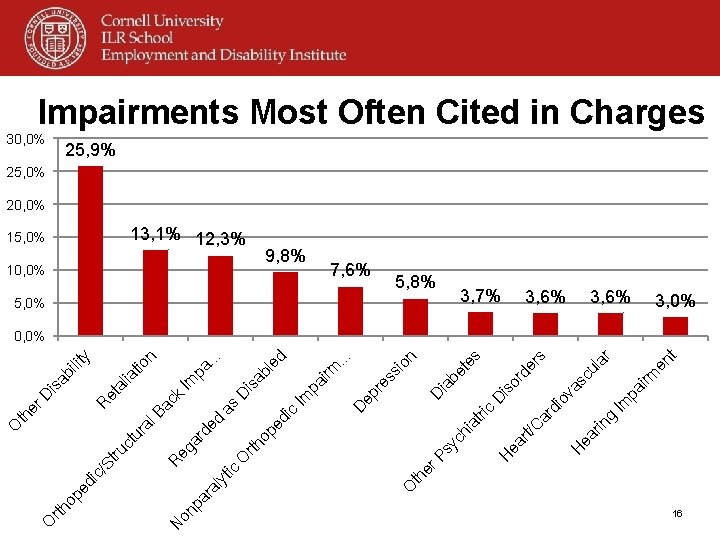
g ea rin en t irm 3, 6% Im pa s ar cu l va s di o ar de r or is 3, 7% H t/C ea r 5, 0% D s be te ia D 5, 8% H tri c yc hi a Ps 7, 6% er on ss i re ep 9, 8% D . . . rm pa i le d ab is D Im as pa. . . Im 10, 0% ic ed rth op O ed ar d ac k 13, 1% 12, 3% O th yt ic al pa r eg R 15, 0% N on n ia tio al et R y is ab ilit 30, 0% l. B ct ur a ru St ic / rth op ed O er D th O Impairments Most Often Cited in Charges 25, 9% 25, 0% 20, 0% 3, 6% 3, 0% 0, 0% 16
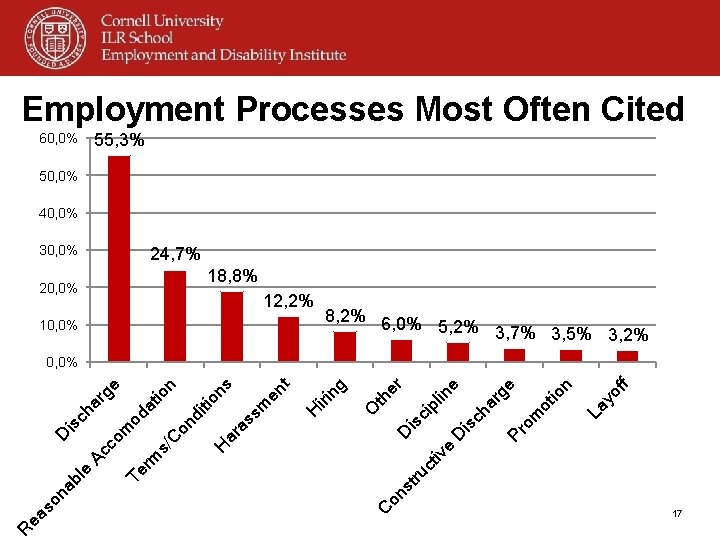
Employment Processes Most Often Cited 55, 3% 60, 0% 50, 0% 40, 0% 30, 0% 24, 7% 18, 8% 20, 0% 12, 2% 10, 0% 8, 2% 6, 0% 5, 2% 3, 7% 3, 5% 3, 2% R f La yo f n io ot Pr o m ar ge ch e D is ct iv e D is ci pl in er O th ng H iri en t as s m s H ar di tio n n io s/ C on od at Ac co m on st ru Te rm C ea so na bl e D is ch ar ge 0, 0% 17
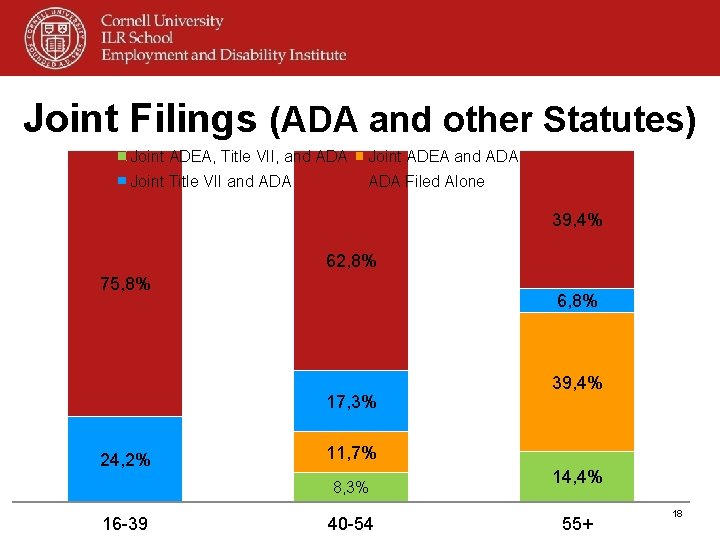
Joint Filings (ADA and other Statutes) • Joint ADEA, Title VII, and ADA Joint ADEA and ADA Joint Title VII and ADA Filed Alone 39, 4% 62, 8% 75, 8% 6, 8% 17, 3% 24, 2% 11, 7% 8, 3% 16 -39 39, 4% 40 -54 14, 4% 55+ 18
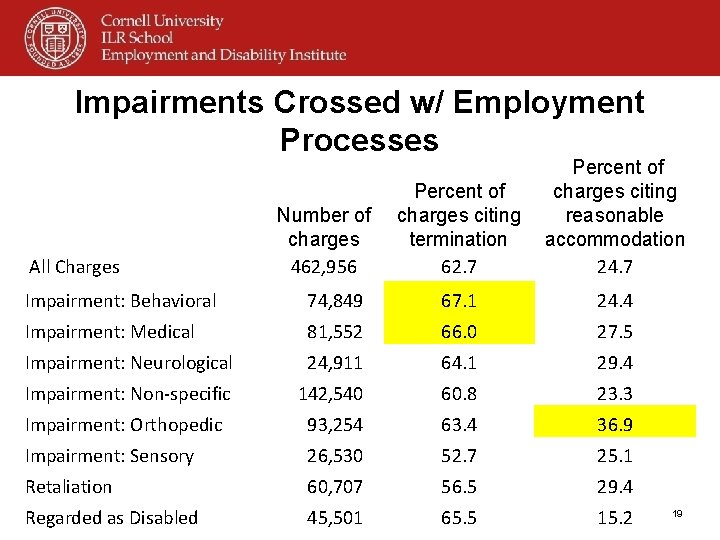
Impairments Crossed w/ Employment Processes All Charges Number of charges 462, 956 Percent of charges citing termination 62. 7 Percent of charges citing reasonable accommodation 24. 7 Impairment: Behavioral 74, 849 67. 1 24. 4 Impairment: Medical 81, 552 66. 0 27. 5 Impairment: Neurological 24, 911 64. 1 29. 4 Impairment: Non-specific 142, 540 60. 8 23. 3 Impairment: Orthopedic 93, 254 63. 4 36. 9 Impairment: Sensory 26, 530 52. 7 25. 1 Retaliation 60, 707 56. 5 29. 4 Regarded as Disabled 45, 501 65. 5 15. 2 19
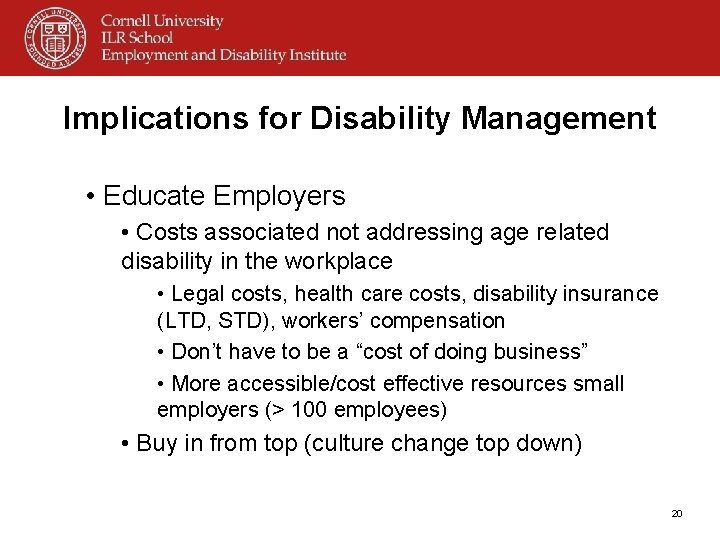
Implications for Disability Management • Educate Employers • Costs associated not addressing age related disability in the workplace • Legal costs, health care costs, disability insurance (LTD, STD), workers’ compensation • Don’t have to be a “cost of doing business” • More accessible/cost effective resources small employers (> 100 employees) • Buy in from top (culture change top down) 20
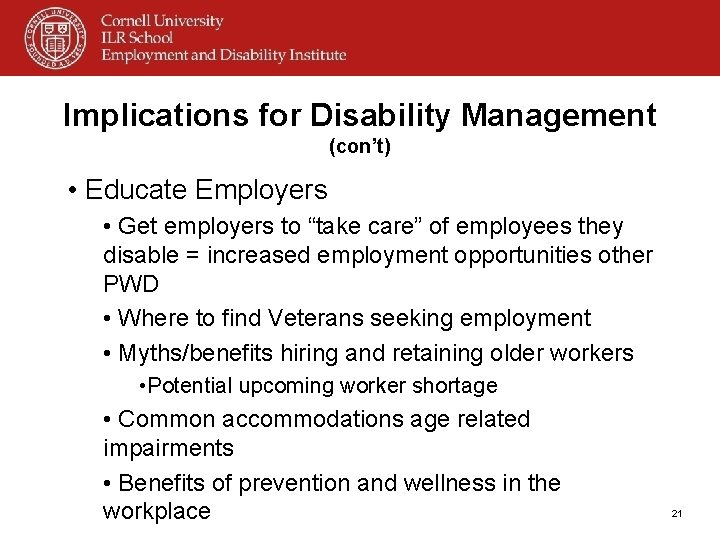
Implications for Disability Management (con’t) • Educate Employers • Get employers to “take care” of employees they disable = increased employment opportunities other PWD • Where to find Veterans seeking employment • Myths/benefits hiring and retaining older workers • Potential upcoming worker shortage • Common accommodations age related impairments • Benefits of prevention and wellness in the workplace 21
Implications for Disability Management (con’t) • Who is going to do this? • Who will bring this information/education to employers? • Know addition Level III DM • Evidence based practice in absence mgmt, presenteeism, integrated benefits, health/wellness programs (Rosenthal et al, 2007) • Where/how will this be taught to those doing DM? • Dissertation findings = Not in RC, yet Rosenthal, D. A. , Hursh, N. , Lui, J. , Isom, R. , & Sasson, J. (2007). A survey of current disability management practice: Emerging trends and implications for certification. Rehabilitation Counseling Bulletin, 50(2), 76 -86. 22
Implications for Disability Management (con’t) • How are we going to do this? • More DM/Employer specific training in RC programs • More DM & disability awareness courses in HR programs and for HR professionals • Training aging workforce for employers and current DM/HR practitioners • Training empirical based practices/interventions • Show me the money 23
For Further Information • USEEOC Charge Data Statistics http: //www. eeoc. gov/eeoc/statistics/enforcement/ada. cfm • The Authors: Susanne Bruyere – smb 23@cornell. edu Sarah von Schrader – sv 282@cornell. edu Wendy Coduti – coduti@msu. edu 24
- Slides: 24