
U S Department of Transportation Federal Railroad Administration

- Slides: 41
U. S. Department of Transportation Federal Railroad Administration New Tank Car Standards for Crude Oil and Ethanol Rail Shipments FRA Alaskan Outreach May 3, 2016
U. S. Department of Transportation Federal Railroad Administration • HM-251 New Tank Car Standards and Operational Controls for High-Hazard Flammable Trains Published May 8, 2015 • Fixing America’s Surface Transportation Act (FAST Act) Signed by President Obama on Dec. 4, 2015
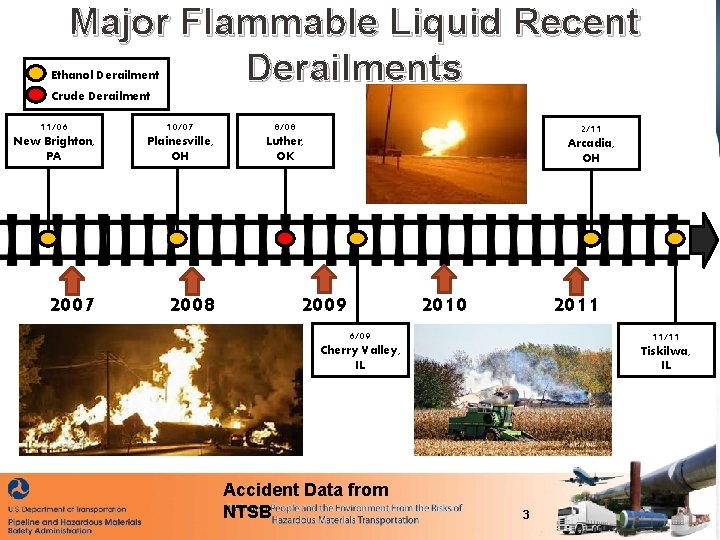
Major Flammable Liquid Recent Derailments Ethanol Derailment Crude Derailment 11/06 10/07 8/08 2/11 New Brighton, PA Plainesville, OH Luther, OK Arcadia, OH 2007 2008 2009 2010 2011 6/09 11/11 Cherry Valley, IL Tiskilwa, IL Accident Data from NTSB 3
December 2012 • Rail Accident Mitigation Project (RAMP) – Additional FRA Inspections – Conducted Safety Seminars – Highway-rail grade crossing safety and trespass prevention outreach • including public service announcements and advertisements at major truck stops
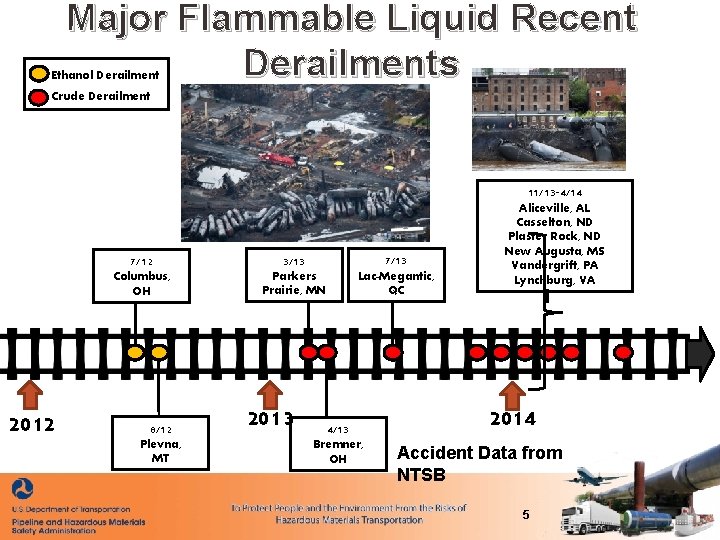
Major Flammable Liquid Recent Derailments Ethanol Derailment Crude Derailment 11/13 -4/14 2012 7/12 3/13 7/13 Columbus, OH Parkers Prairie, MN Lac-Megantic, QC 8/12 Plevna, MT 2013 4/13 Bremner, OH Aliceville, AL Casselton, ND Plaster Rock, ND New Augusta, MS Vandergrift, PA Lynchburg, VA 2014 Accident Data from NTSB 5
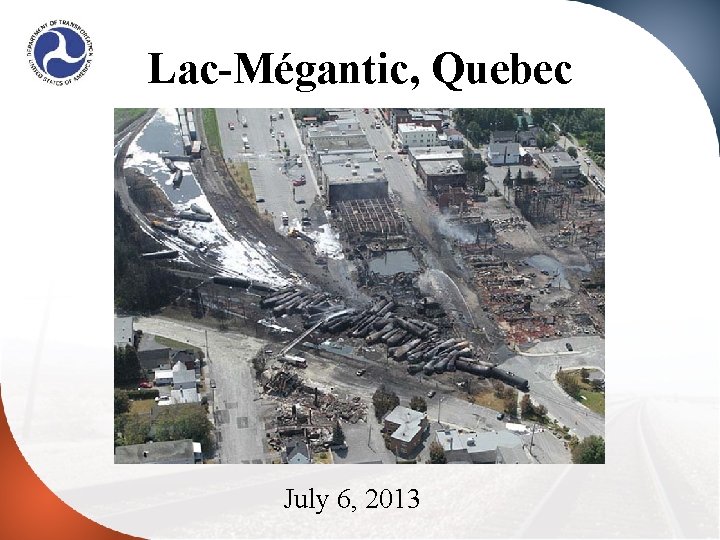
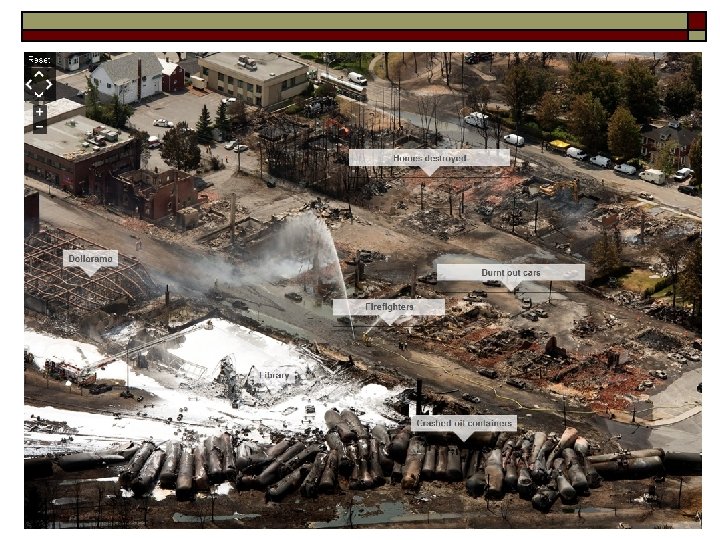
Lac-Mégantic, Quebec July 6, 2013
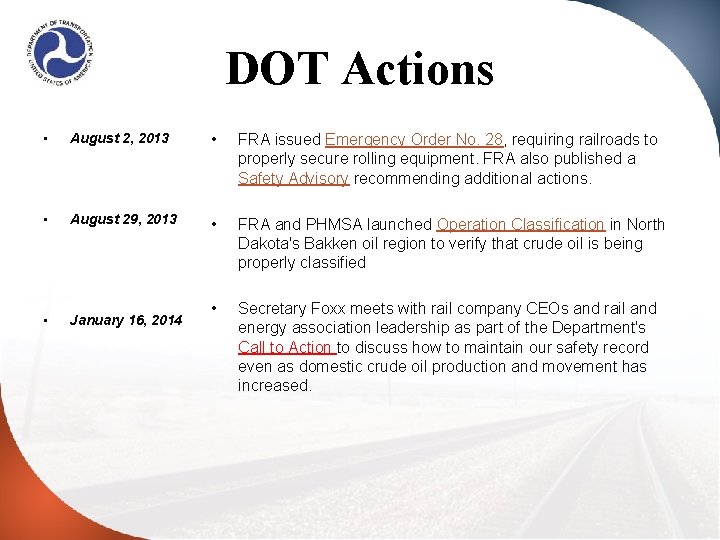
DOT Actions • August 2, 2013 • FRA issued Emergency Order No. 28, requiring railroads to properly secure rolling equipment. FRA also published a Safety Advisory recommending additional actions. • August 29, 2013 • FRA and PHMSA launched Operation Classification in North Dakota's Bakken oil region to verify that crude oil is being properly classified • January 16, 2014 • Secretary Foxx meets with rail company CEOs and rail and energy association leadership as part of the Department's Call to Action to discuss how to maintain our safety record even as domestic crude oil production and movement has increased.
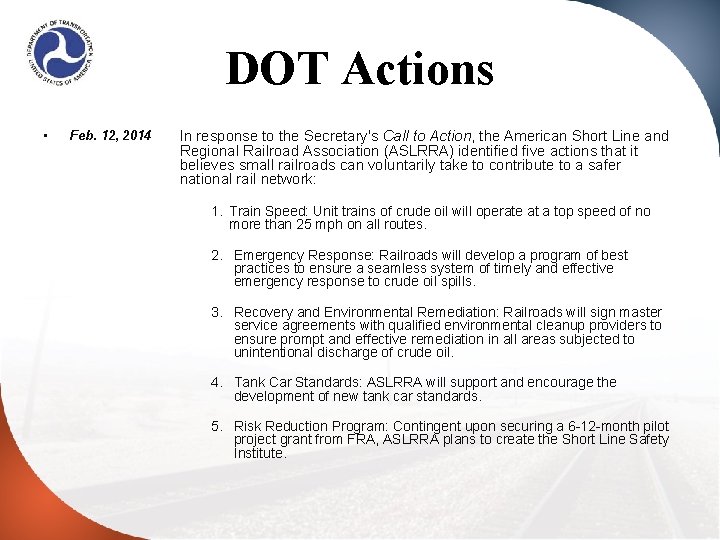
DOT Actions • Feb. 12, 2014 In response to the Secretary's Call to Action, the American Short Line and Regional Railroad Association (ASLRRA) identified five actions that it believes small railroads can voluntarily take to contribute to a safer national rail network: 1. Train Speed: Unit trains of crude oil will operate at a top speed of no more than 25 mph on all routes. 2. Emergency Response: Railroads will develop a program of best practices to ensure a seamless system of timely and effective emergency response to crude oil spills. 3. Recovery and Environmental Remediation: Railroads will sign master service agreements with qualified environmental cleanup providers to ensure prompt and effective remediation in all areas subjected to unintentional discharge of crude oil. 4. Tank Car Standards: ASLRRA will support and encourage the development of new tank car standards. 5. Risk Reduction Program: Contingent upon securing a 6 -12 -month pilot project grant from FRA, ASLRRA plans to create the Short Line Safety Institute.
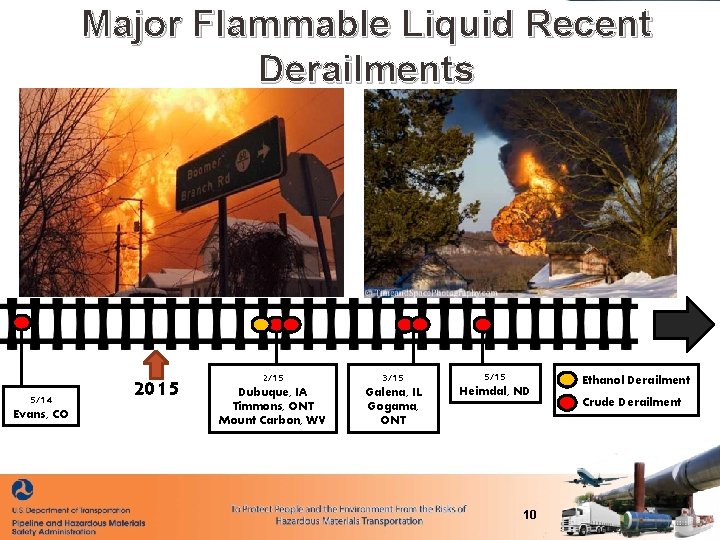
Major Flammable Liquid Recent Derailments 5/14 Evans, CO 2015 2/15 3/15 5/15 Dubuque, IA Timmons, ONT Mount Carbon, WV Galena, IL Gogama, ONT Heimdal, ND 10 Ethanol Derailment Crude Derailment
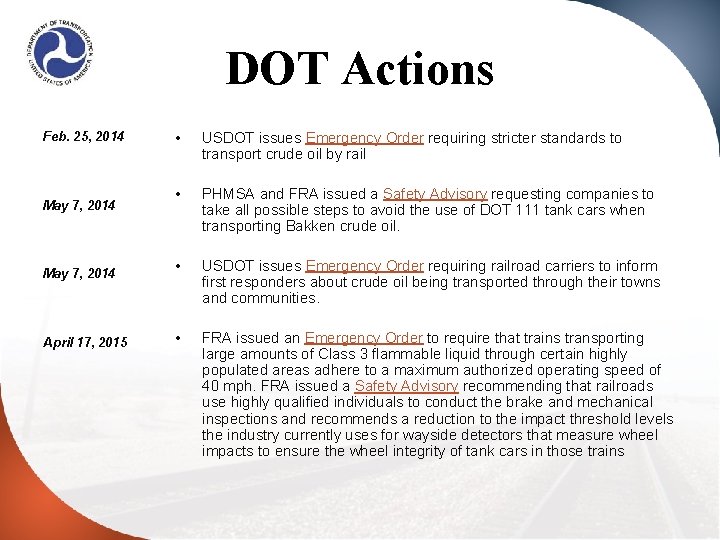
DOT Actions Feb. 25, 2014 May 7, 2014 April 17, 2015 • USDOT issues Emergency Order requiring stricter standards to transport crude oil by rail • PHMSA and FRA issued a Safety Advisory requesting companies to take all possible steps to avoid the use of DOT 111 tank cars when transporting Bakken crude oil. • USDOT issues Emergency Order requiring railroad carriers to inform first responders about crude oil being transported through their towns and communities. • FRA issued an Emergency Order to require that trains transporting large amounts of Class 3 flammable liquid through certain highly populated areas adhere to a maximum authorized operating speed of 40 mph. FRA issued a Safety Advisory recommending that railroads use highly qualified individuals to conduct the brake and mechanical inspections and recommends a reduction to the impact threshold levels the industry currently uses for wayside detectors that measure wheel impacts to ensure the wheel integrity of tank cars in those trains
HM-251 • New Tank Car Standards and Operational Controls for High-Hazard Flammable Trains – Scope of Rulemaking • A continuous block of 20 or more tank cars loaded with a flammable liquid or 35 or more tank cars loaded with a flammable liquid dispersed through a train. Published May 1, 2015
HM-251 • Enhanced Braking • Reduced Operating Speeds • More Accurate Classification of Unrefined Petroleum -Based Products • Rail routing - Risk Assessment • Rail routing – Information Access • Enhanced Standards for New and Existing Tank Cars Used in HHFT
New Tank Car Specs • DOT 117 R (Retrofit) • DOT 117 P (Performance)
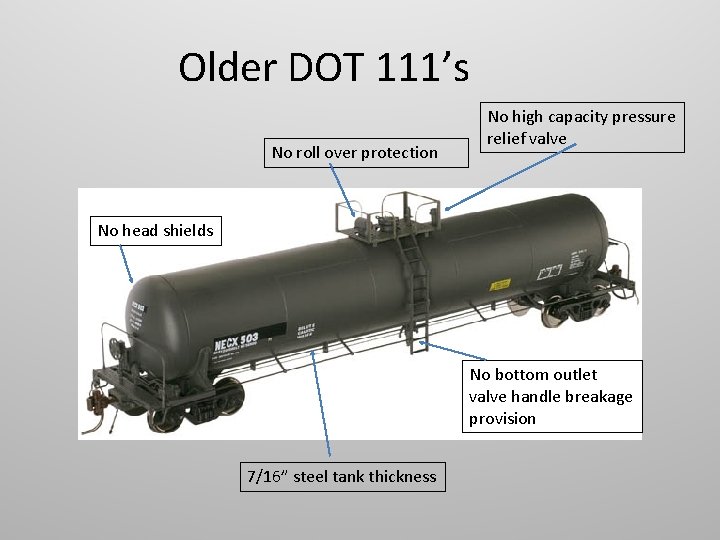
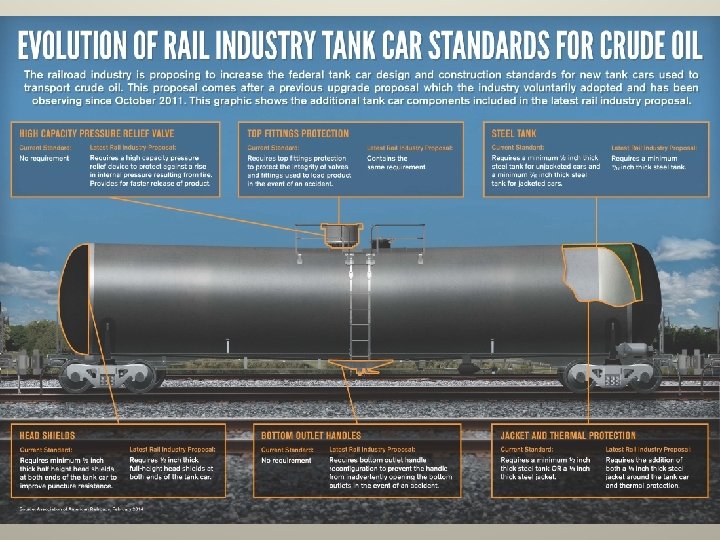
Older DOT 111’s No roll over protection No high capacity pressure relief valve No head shields No bottom outlet valve handle breakage provision 7/16” steel tank thickness
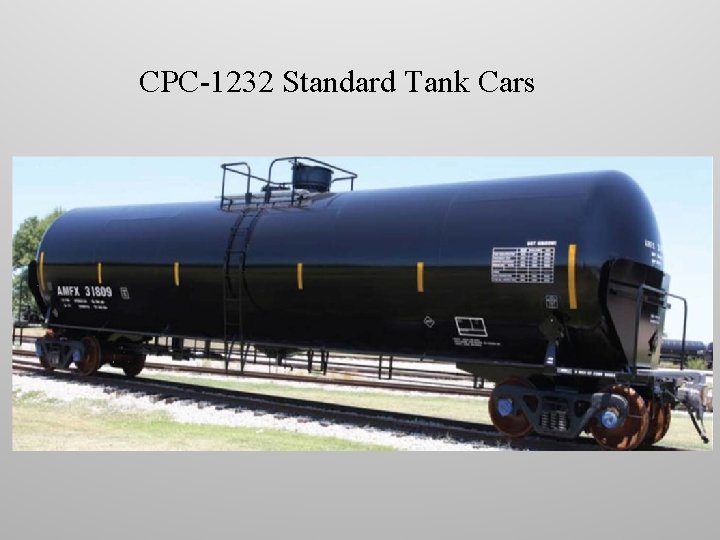
CPC-1232 Standard Tank Cars
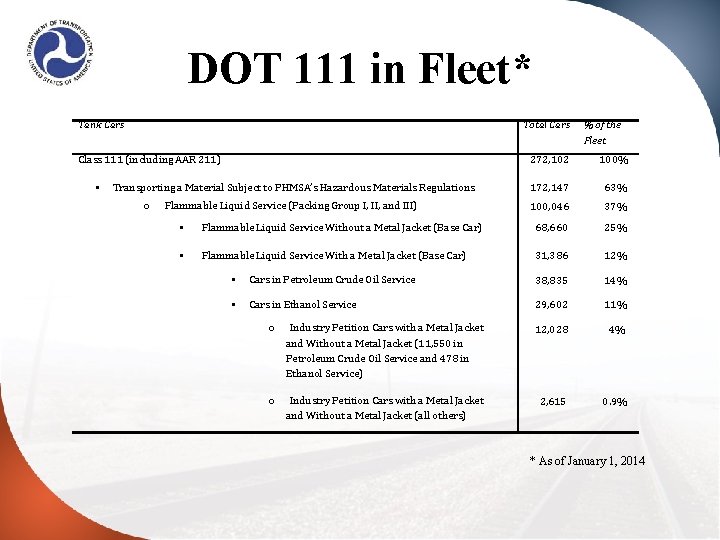
DOT 111 in Fleet* Tank Cars Total Cars Class 111 (including AAR 211) 272, 102 100% 172, 147 63% 100, 046 37% • Transporting a Material Subject to PHMSA’s Hazardous Materials Regulations o Flammable Liquid Service (Packing Group I, II, and III) % of the Fleet § Flammable Liquid Service Without a Metal Jacket (Base Car) 68, 660 25% § Flammable Liquid Service With a Metal Jacket (Base Car) 31, 386 12% • Cars in Petroleum Crude Oil Service 38, 835 14% • Cars in Ethanol Service 29, 602 11% o Industry Petition Cars with a Metal Jacket and Without a Metal Jacket (11, 550 in Petroleum Crude Oil Service and 478 in Ethanol Service) 12, 028 4% o Industry Petition Cars with a Metal Jacket and Without a Metal Jacket (all others) 2, 615 0. 9% * As of January 1, 2014
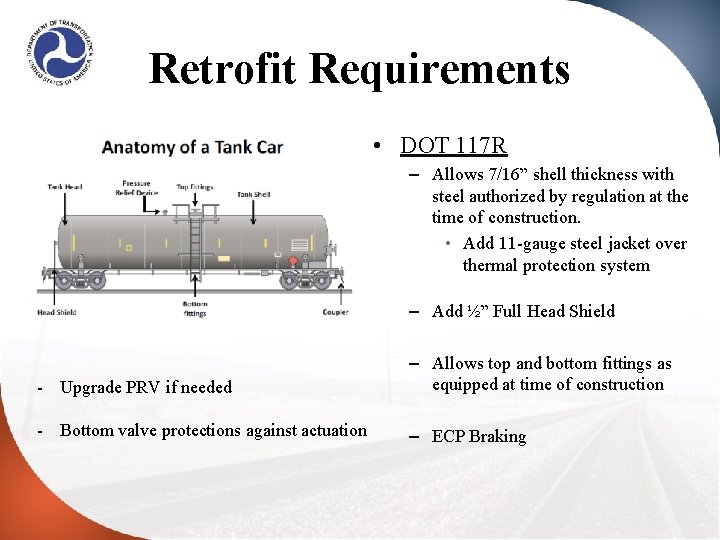
Retrofit Requirements • DOT 117 R – Allows 7/16” shell thickness with steel authorized by regulation at the time of construction. • Add 11 -gauge steel jacket over thermal protection system – Add ½” Full Head Shield - Upgrade PRV if needed – Allows top and bottom fittings as equipped at time of construction - Bottom valve protections against actuation – ECP Braking
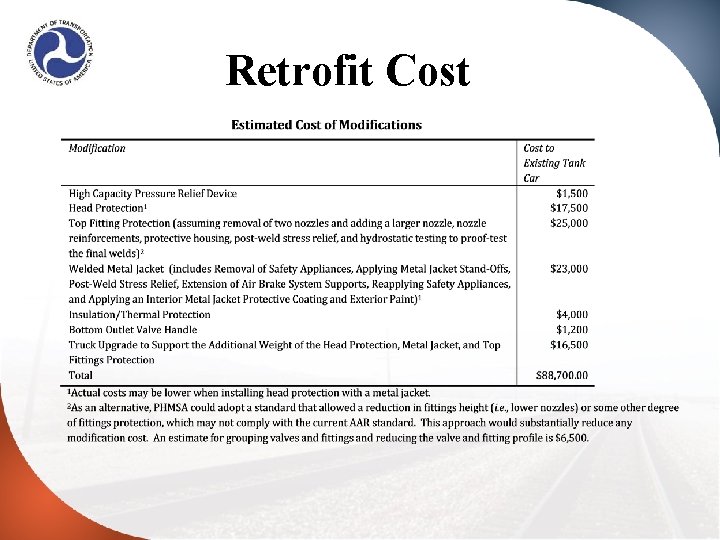
Retrofit Cost
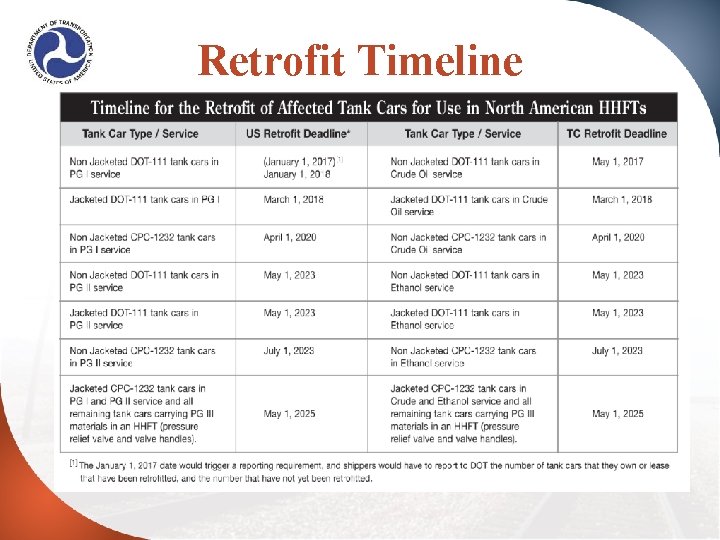
Retrofit Timeline
Retrofit Capacity* – 8, 400 – 19, 600 cars/yr – Unjacketed DOT 111’s and CPC 1232’s in crude oil service could all be retrofitted in 3. 7 years – Similar cars in Ethanol service could be retrofitted in 2. 3 years * Cambridge Systematics
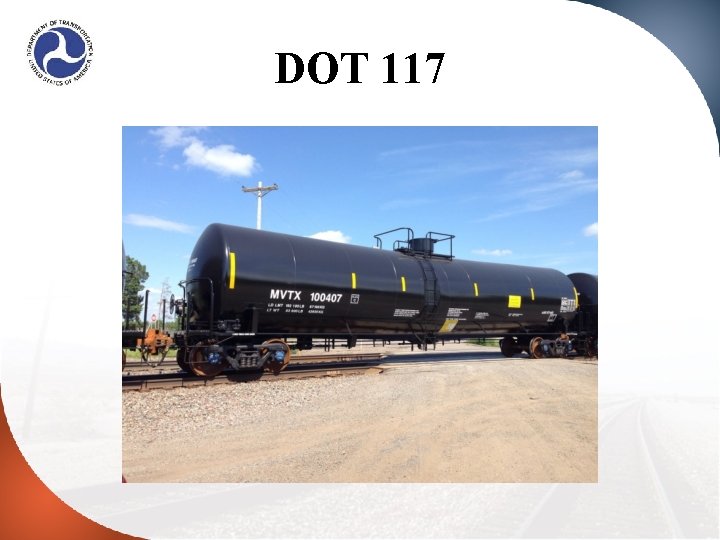
DOT 117
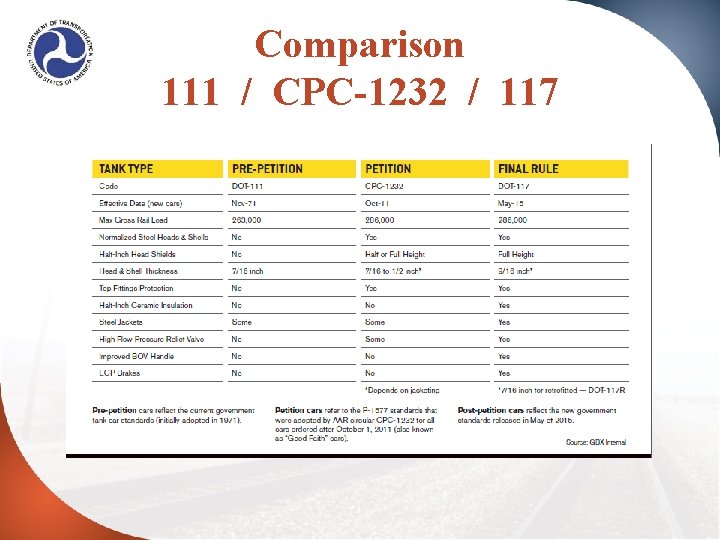
Comparison 111 / CPC-1232 / 117
New Car Manufacturing Capacity* – Could reach 40, 000 cars/yr * Cambridge Systematics
Replacement vs Retrofit - Assuming an average purchase cost of $140, 000 per tank car to conform to the industry standard, the replacement cost of the fleet of Class 111 cars is approximately $36 billion (257, 459 * $140, 000). - Assuming an average modification cost of $88, 700 per tank car, the modification cost of the fleet of Class 111 cars is approximately $22. 8 billion (257, 459 * $88, 700), or approximately $8. 9 billion (100, 046*$88, 700) for those cars in flammable liquid service alone.
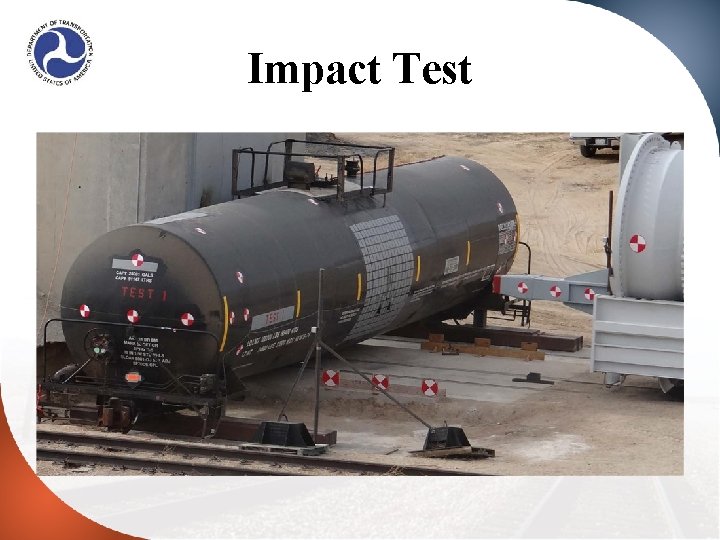
DOT 117 P • Same as the DOT 117 except: – Shell and jacket thickness could be less provided that it incorporates some type of protection or energy absorption systems on the shell and heads. – Must be capable of resisting a side impact of 12 mph and a head impact of 18 mph from a 12 x 12 inch impactor weight 286, 000 pounds.
Impact Test
New Fleet of Tank Cars* The entire tank car fleet could be replaced in less than five years with new cars that meet the new standards of safety! * Cambridge Systematics
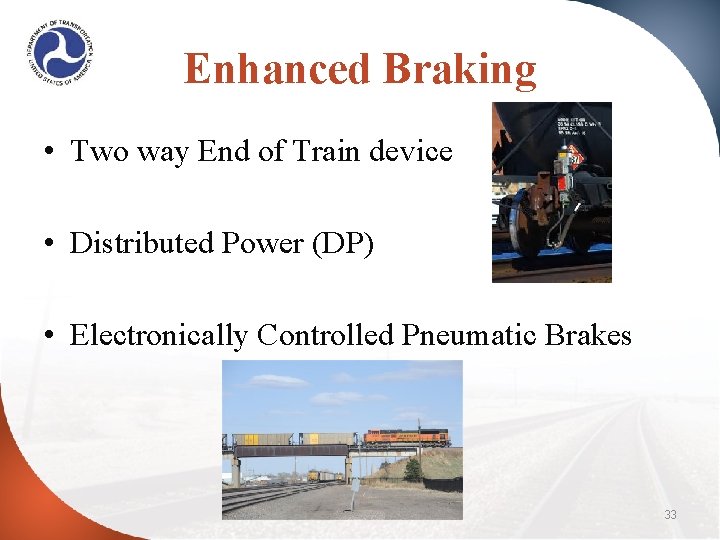
Enhanced Braking • Two way End of Train device • Distributed Power (DP) • Electronically Controlled Pneumatic Brakes 33
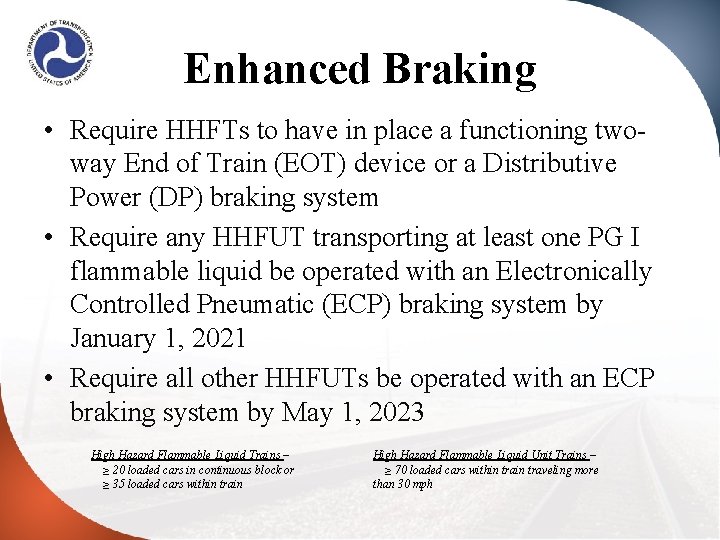
Enhanced Braking • Require HHFTs to have in place a functioning twoway End of Train (EOT) device or a Distributive Power (DP) braking system • Require any HHFUT transporting at least one PG I flammable liquid be operated with an Electronically Controlled Pneumatic (ECP) braking system by January 1, 2021 • Require all other HHFUTs be operated with an ECP braking system by May 1, 2023 High Hazard Flammable Liquid Trains – ≥ 20 loaded cars in continuous block or ≥ 35 loaded cars within train High Hazard Flammable Liquid Unit Trains – ≥ 70 loaded cars within traveling more than 30 mph
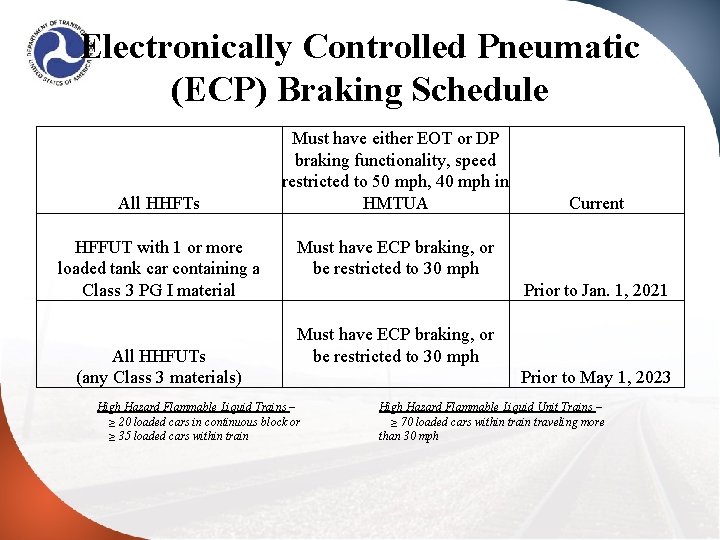
Electronically Controlled Pneumatic (ECP) Braking Schedule All HHFTs HFFUT with 1 or more loaded tank car containing a Class 3 PG I material All HHFUTs (any Class 3 materials) Must have either EOT or DP braking functionality, speed restricted to 50 mph, 40 mph in HMTUA Current Must have ECP braking, or be restricted to 30 mph Prior to Jan. 1, 2021 Must have ECP braking, or be restricted to 30 mph High Hazard Flammable Liquid Trains – ≥ 20 loaded cars in continuous block or ≥ 35 loaded cars within train Prior to May 1, 2023 High Hazard Flammable Liquid Unit Trains – ≥ 70 loaded cars within traveling more than 30 mph
FAST Act
FAST Act • • Fixing America’s Surface Transportation Act • Signed by President Obama on Dec. 4, 2015 • Effective date: October 1, 2016
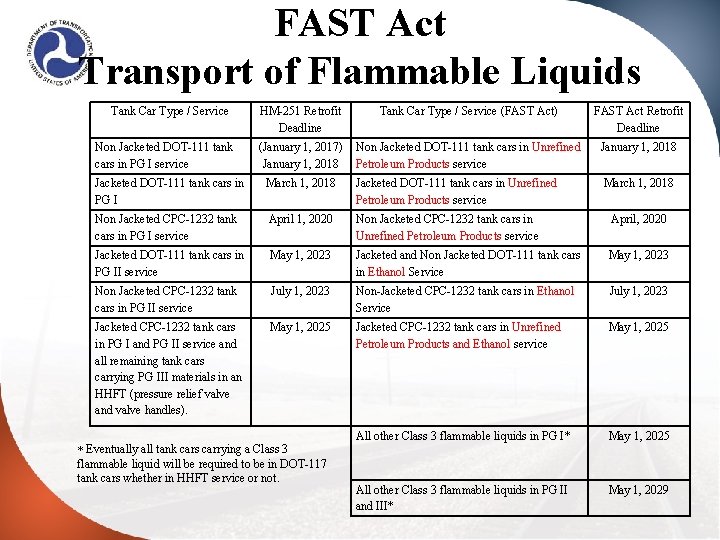
FAST Act Transport of Flammable Liquids Tank Car Type / Service Non Jacketed DOT-111 tank cars in PG I service HM-251 Retrofit Deadline Tank Car Type / Service (FAST Act) FAST Act Retrofit Deadline (January 1, 2017) January 1, 2018 Non Jacketed DOT-111 tank cars in Unrefined Petroleum Products service January 1, 2018 March 1, 2018 Jacketed DOT-111 tank cars in PG I March 1, 2018 Jacketed DOT-111 tank cars in Unrefined Petroleum Products service Non Jacketed CPC-1232 tank cars in PG I service April 1, 2020 Non Jacketed CPC-1232 tank cars in Unrefined Petroleum Products service April, 2020 Jacketed DOT-111 tank cars in PG II service May 1, 2023 Jacketed and Non Jacketed DOT-111 tank cars in Ethanol Service May 1, 2023 Non Jacketed CPC-1232 tank cars in PG II service July 1, 2023 Non-Jacketed CPC-1232 tank cars in Ethanol Service July 1, 2023 Jacketed CPC-1232 tank cars in PG I and PG II service and all remaining tank cars carrying PG III materials in an HHFT (pressure relief valve and valve handles). May 1, 2025 Jacketed CPC-1232 tank cars in Unrefined Petroleum Products and Ethanol service May 1, 2025 All other Class 3 flammable liquids in PG I* May 1, 2025 All other Class 3 flammable liquids in PG II and III* May 1, 2029 Eventually all tank cars carrying a Class 3 flammable liquid will be required to be in DOT-117 tank cars whether in HHFT service or not.
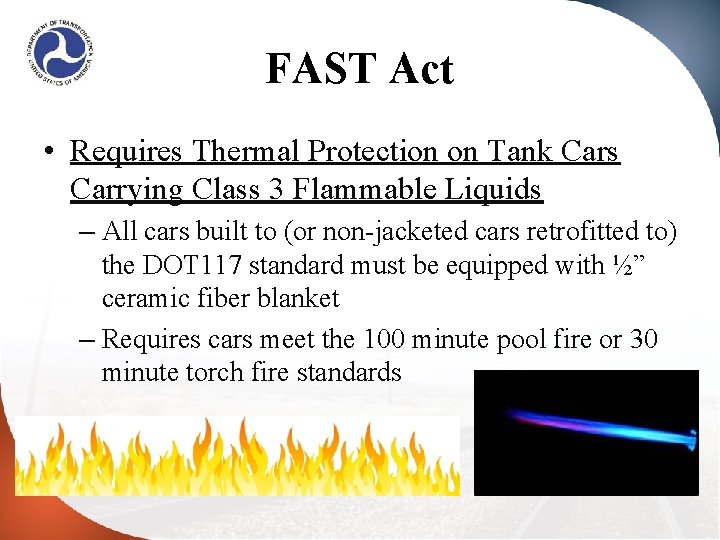
FAST Act • Requires Thermal Protection on Tank Cars Carrying Class 3 Flammable Liquids – All cars built to (or non-jacketed cars retrofitted to) the DOT 117 standard must be equipped with ½” ceramic fiber blanket – Requires cars meet the 100 minute pool fire or 30 minute torch fire standards
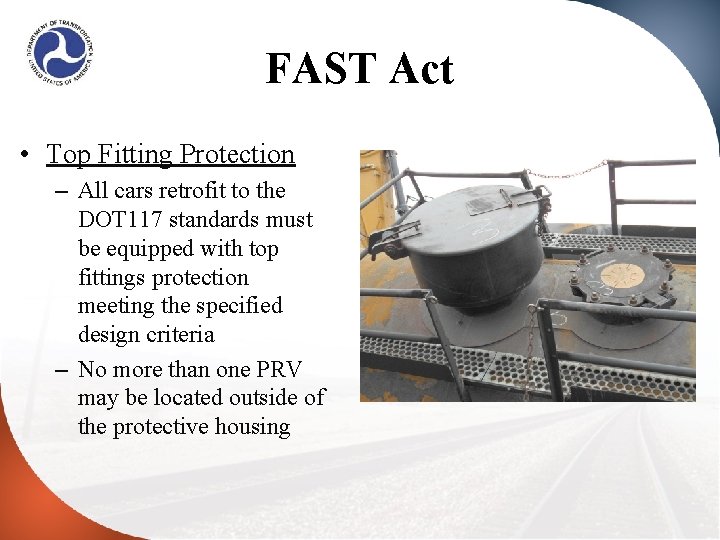
FAST Act • Top Fitting Protection – All cars retrofit to the DOT 117 standards must be equipped with top fittings protection meeting the specified design criteria – No more than one PRV may be located outside of the protective housing
FAST Act • Reporting of Modifications – Requirement to report retrofitted tank cars – Survey of tank car facilities retrofitting tank cars – Requires rulemaking
FAST Act • ECP Braking – Requires a Government Accountability Office audit of the data and analysis related to ECP brakes and the justification made for in HM-251 final rule. – Requires at least one test of a 70 car unit trains consisting of DOT 117 tank cars. – Very tight timeline for audit, test and evaluations. • • • 18 months for test and report 90 days to update Regulatory Impact analysis (RIA) Publish RIA for 30 days Publish final RIA 60 days later Overall the Department has 2 years to determine whether ECP brakes are cost beneficial • If secretary does not publish this determination, the requirement for ECP Brakes are to be repealed.
FAST Act • Other Topic in FAST Act • Crude oil characteristic study • Hazmat by Rail Liability study • Oil spill response plans
Thank You !!! 44