
U S Department of Energy Building Energy Codes
U. S. Department of Energy Building Energy Codes Program 2018 National Energy Codes Conference Pre-Conference, July 15, 2018 Austin, TX Energy Codes 101 / What’s New in Codes? Rosemarie Bartlett Bob Schultz AIA Provider # 1014 AIA Course # PRECDS 1 ICC Preferred Education Provider
AIA and ICC Continuing Education Provider Continuing Education Credits Earned on Completion of this Live Session: • 1. 0 LU/HSWs will be reported to AIA CES for AIA members. • 0. 10 ICC CEUs for ICC members must self-report to ICC with the Certificate of Completion. • This course is registered with AIA CES and ICC PP for continuing professional education. As such, it does not include content that may be deemed or construed to be an approval or endorsement by the AIA or ICC of any material of construction or any method or manner of handling, using, distributing, or dealing in any material or product. ____________________ • Certificates of Completion for selfreporting to your professional organization for non-AIA and non-ICC members are available upon request.
RESNET Professional Development Credits • • Raters can earn a maximum of 12 PDHs if they attend: • all pre-conference and • full conference sessions • Exception – commercial buildings sessions Certificates of Completion for self-reporting are available upon request.
Course Description Discuss what has changed from the previous editions of ASHRAE 90. 1 and IECC, compliance paths and how the requirements of the commercial chapter of the IECC and ASHRAE 90. 1 differ. Also covered will be the IECC development process and an analysis of the voting that occurred.
Learning Objectives At the end of the this course, participants will be able to: • • • Identify changes in the new residential model energy code. Identify changes in the new commercial model energy code. Understand different compliance paths in the 2018 IECC and Standard 90. 1 -2016 commercial requirements. Understand the code development process. Learn the basics of the ICC code development process and summary of last code cycle.
Energy Codes 101 ROSE BARTLETT BOB SCHULTZ 2018 Department of Energy National Energy Codes Conference Building Energy Codes Program July 15, 2018 Building Energy Codes Program 6
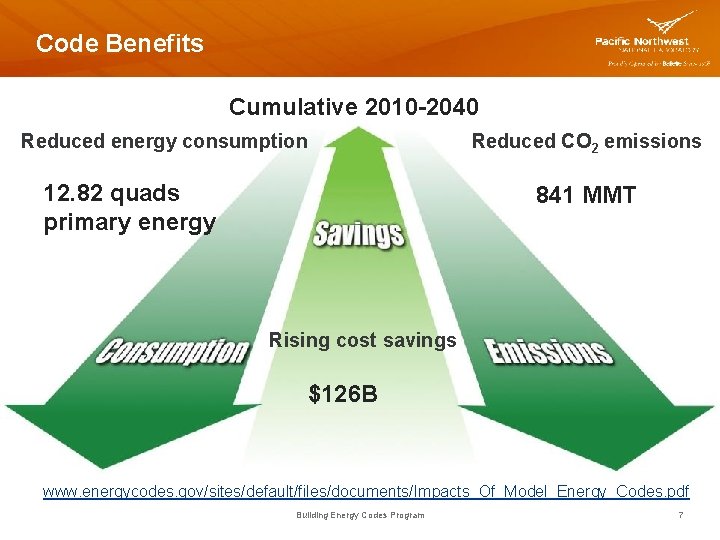
Code Benefits Cumulative 2010 -2040 Reduced energy consumption 12. 82 quads primary energy Reduced CO 2 emissions 841 MMT Rising cost savings $126 B www. energycodes. gov/sites/default/files/documents/Impacts_Of_Model_Energy_Codes. pdf Building Energy Codes Program 7
Major Players ASHRAE ICC Jurisdictions From DOE’s perspective, the model / baseline codes are ASHRAE 90. 1 for Commercial ICC IECC for Residential Building Energy Codes Program 8
DOE’s Role DOE is directed by statute to participate in industry processes to Develop model building energy codes Issue determinations as to whether updated codes result in energy savings Provide technical assistance to states to implement and comply with the codes For specific statutory language, visit https: //www. energycodes. gov/about/statutory-requirements Building Energy Codes Program 9
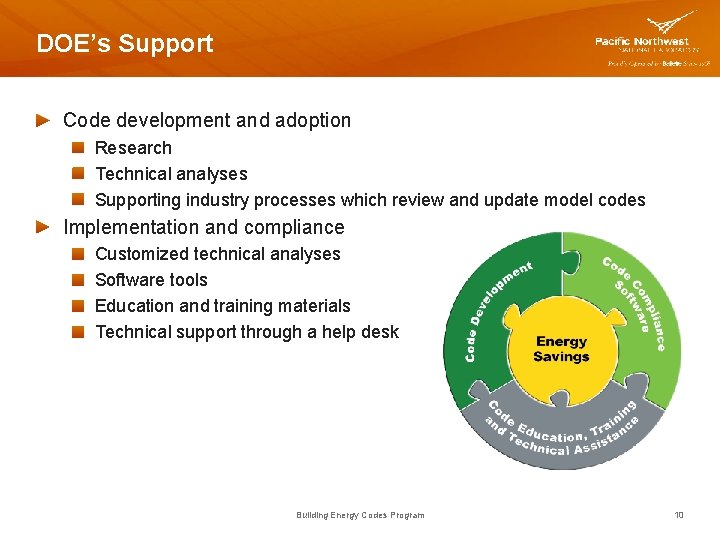
DOE’s Support Code development and adoption Research Technical analyses Supporting industry processes which review and update model codes Implementation and compliance Customized technical analyses Software tools Education and training materials Technical support through a help desk Building Energy Codes Program 10
DOE Determinations DOE is required by law (the Energy Conservation and Production Act, as amended (ECPA)) to issue a determination as to whether the latest edition of ASHRAE Standard 90. 1 (for commercial and multi -family high-rise residential buildings) or the latest version of the International Energy Conservation Code (for low-rise residential buildings) will improve energy efficiency compared to the previous edition of the corresponding standard or code. DOE has one year to publish a determination in the Federal Register after each new edition of the standard/code is published
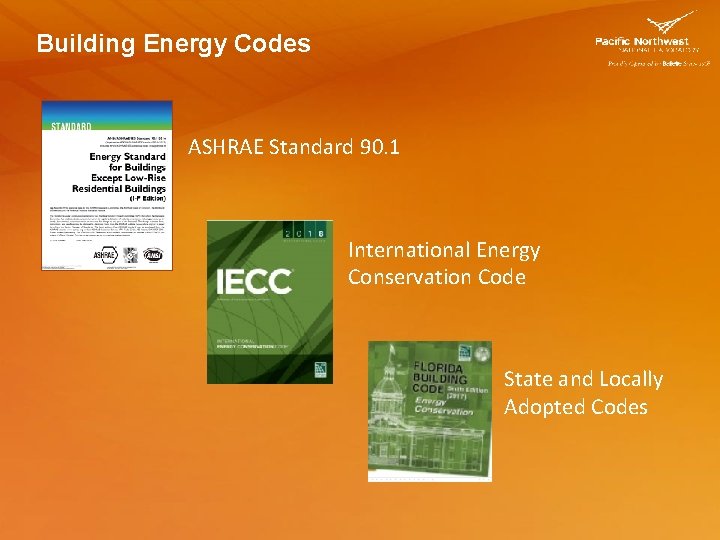
Building Energy Codes ASHRAE Standard 90. 1 International Energy Conservation Code State and Locally Adopted Codes
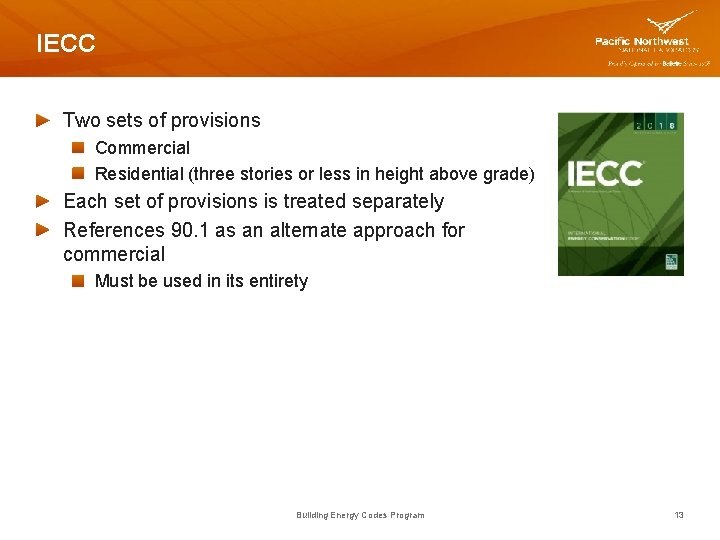
IECC Two sets of provisions Commercial Residential (three stories or less in height above grade) Each set of provisions is treated separately References 90. 1 as an alternate approach for commercial Must be used in its entirety Building Energy Codes Program 13
What Do Building Energy Codes and Standards Cover? For both residential and commercial: • Building Envelope • Mechanical • Service Water Heating • Lighting • Electrical Power
Residential vs. Commercial Residential codes are typically less complex than commercial Commercial buildings usually have more systems More requirements for lighting, including daylighting and controls Detailed control requirements for mechanical systems Etc. Building Energy Codes Program 15
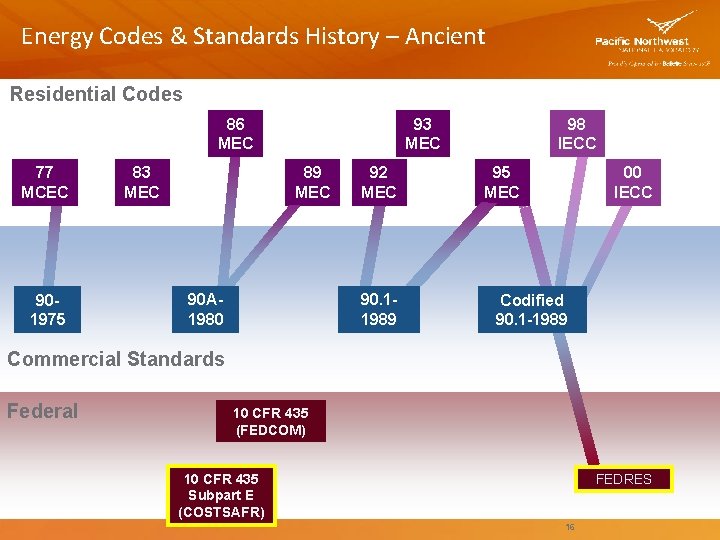
Energy Codes & Standards History – Ancient Residential Codes 86 MEC 77 MCEC 901975 83 MEC 93 MEC 89 MEC 90 A 1980 92 MEC 90. 11989 98 IECC 95 MEC 00 IECC Codified 90. 1 -1989 Commercial Standards Federal 10 CFR 435 (FEDCOM) 10 CFR 435 Subpart E (COSTSAFR) FEDRES 16
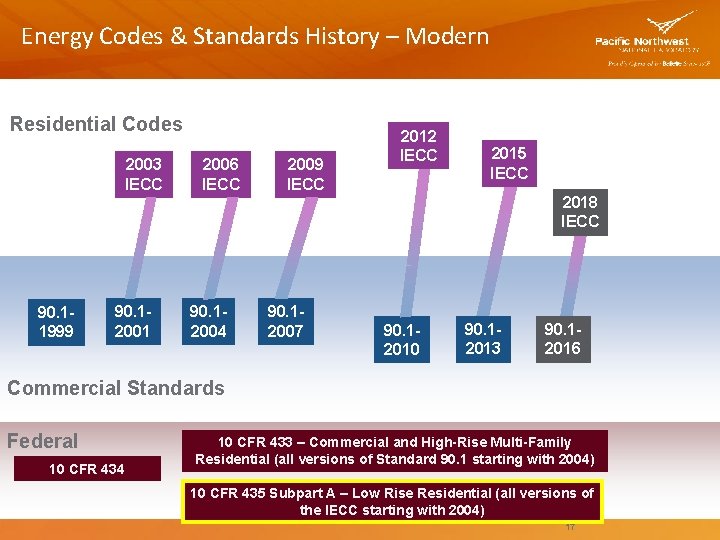
Energy Codes & Standards History – Modern Residential Codes 2003 IECC 2006 IECC 2009 IECC 2012 IECC 2015 IECC 2018 IECC 90. 11999 90. 12001 90. 12004 90. 12007 90. 12010 90. 12013 90. 12016 Commercial Standards Federal 10 CFR 434 10 CFR 433 – Commercial and High-Rise Multi-Family Residential (all versions of Standard 90. 1 starting with 2004) 10 CFR 435 Subpart A – Low Rise Residential (all versions of the IECC starting with 2004) 17
Three Main Aspects Development Adoption Compliance Building Energy Codes Program 18
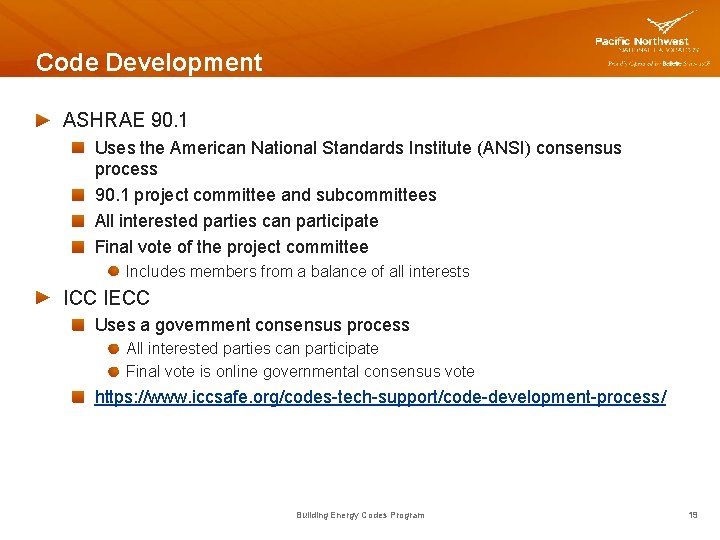
Code Development ASHRAE 90. 1 Uses the American National Standards Institute (ANSI) consensus process 90. 1 project committee and subcommittees All interested parties can participate Final vote of the project committee Includes members from a balance of all interests ICC IECC Uses a government consensus process All interested parties can participate Final vote is online governmental consensus vote https: //www. iccsafe. org/codes-tech-support/code-development-process/ Building Energy Codes Program 19
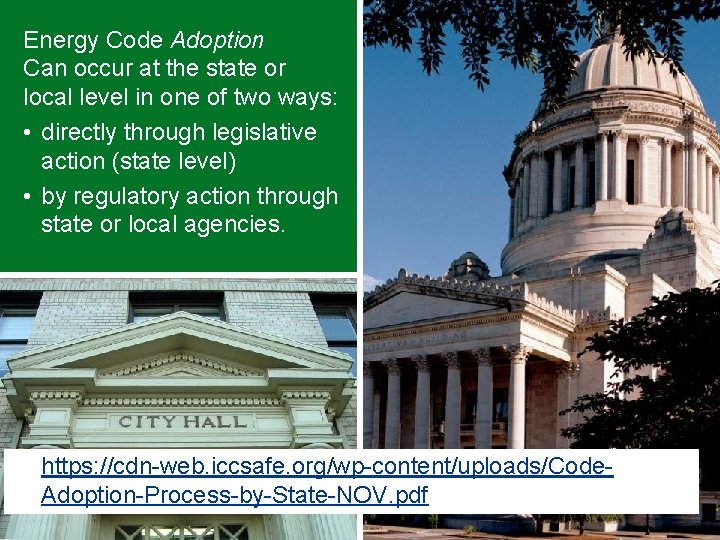
Energy Code Adoption Can occur at the state or local level in one of two ways: • directly through legislative action (state level) • by regulatory action through state or local agencies. https: //cdn-web. iccsafe. org/wp-content/uploads/Code. Adoption-Process-by-State-NOV. pdf
Adoption Date vs. Effective Date Usually these dates are different Sometimes a grace period is allowed where the predecessor code can be used Because buildings may be in different stages of design or construction Stakeholders need time to learn the new code Manufacturers may need time to provide products Effective date is sometime tied to publication date of a model energy code.
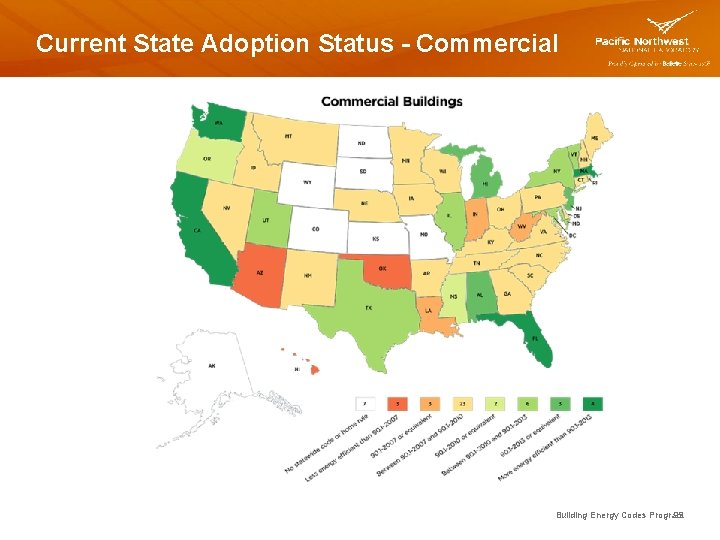
Current State Adoption Status - Commercial Building Energy Codes Program 22
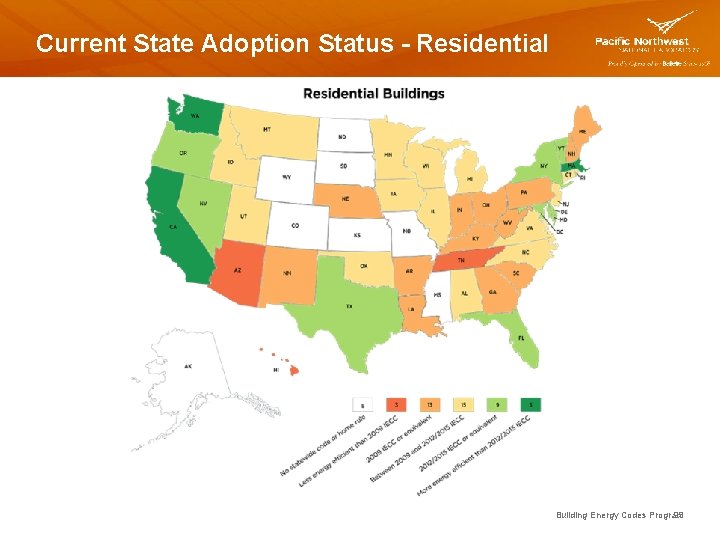
Current State Adoption Status - Residential Building Energy Codes Program 23
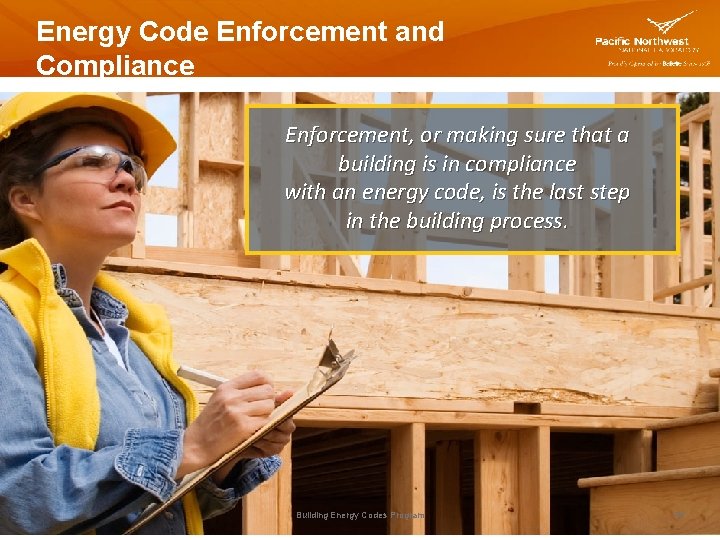
Energy Code Enforcement and Compliance Enforcement, or making sure that a building is in compliance with an energy code, is the last step in the building process. Building Energy Codes Program 24
Energy Code Compliance The key to realizing the full benefits associated with building energy codes is through compliance verification. Materials and tools to help the building industry achieve, document and verify compliance with energy codes. Methodologies and tools (and funding) to help state and local jurisdictions measure and report energy code compliance. http: //www. energycodes. gov/compliance Building Energy Codes Program 25
REScheck™ DOE’s residential compliance software Desktop Software Tools Web-Based Tools No-cost, easy-to-use software that will demonstrate compliance. https: //www. energycodes. gov/software-and-web-tools Building Energy Codes Program 26
COMcheck™ DOE’s commercial compliance software Desktop Software Tools Web-Based Tools No-cost, easy-to-use software that will demonstrate compliance. https: //www. energycodes. gov/software-and-web-tools Building Energy Codes Program 27
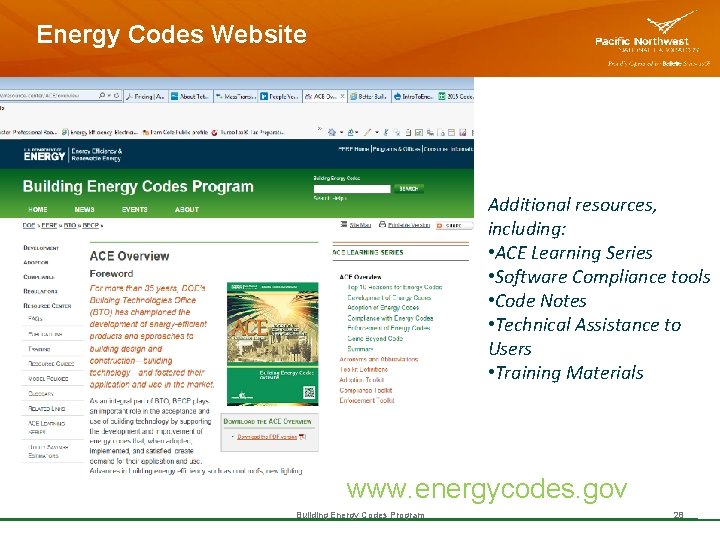
Energy Codes Website Additional resources, including: • ACE Learning Series • Software Compliance tools • Code Notes • Technical Assistance to Users • Training Materials www. energycodes. gov Building Energy Codes Program PNNL-SA-72577 28
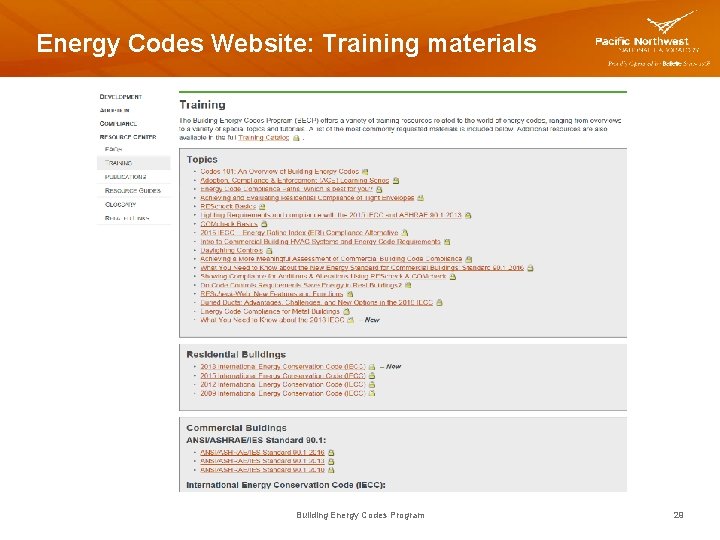
Energy Codes Website: Training materials Building Energy Codes Program 29

What’s New In Codes? Building Energy Codes Program 30
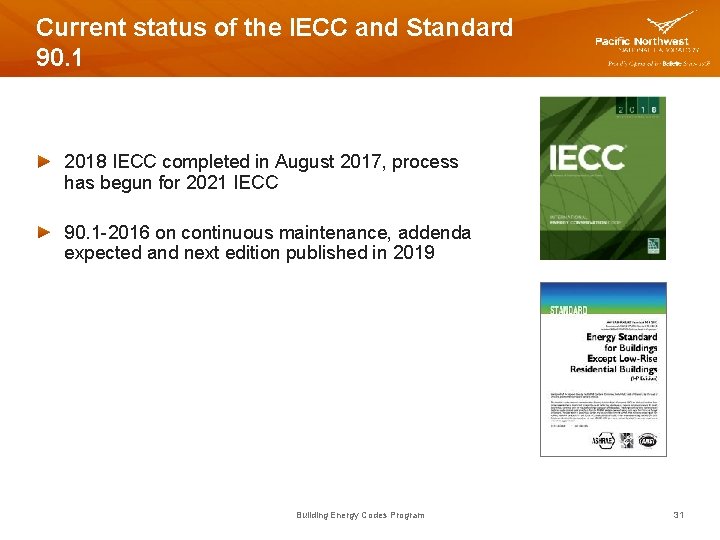
Current status of the IECC and Standard 90. 1 2018 IECC completed in August 2017, process has begun for 2021 IECC 90. 1 -2016 on continuous maintenance, addenda expected and next edition published in 2019 Building Energy Codes Program 31
Building Energy Codes Program 32
Summary of Major Changes – 2018 IECC Residential Log Homes can use Standard ICC-400 Adds exception to the residential thermal envelope requirements for log homes complying with ICC-400. High efficacy lighting to 90% Low-rise multi-family - certain types of small multifamily buildings to be tested for compliance with the code in batches, rather than testing each individual unit. The rationale was that these units should be built identically, but this opens up the possibility of not every unit complying with the code. Building Energy Codes Program 33
Summary of Major Changes – 2018 IECC Residential Cont’d Windows: approximately 0. 6 to 1. 1% improvement in the prescriptive path U-factors in CZ 3 & 4 from 0. 35 to 0. 32 and CZ 5 -8 from 0. 32 to 0. 30 Heated slab-on-grade required to have R-5 insulation under the entire slab (in addition to perimeter insulation requirements) Vapor diffusion port(s) required where unvented attics with airpermeable insulation in zones 1 -3 exist New provisions for ducts depending upon insulation and placement Ducts buried with ceiling insulation Deeply buried ducts Ducts to be considered within the conditioned space Building Energy Codes Program 34
Summary of Major Changes – 2018 IECC Residential Cont’d Clarifies that new HVAC and duct systems in additions and alterations must meet all the mechanical requirements. Prior wording arguably exempted such new systems from mechanical system piping insulation for additions, and from both piping insulation and duct insulation/sealing in alterations. HRV/ERV ventilation systems have new fan efficacy requirement ERI trade offs can incorporate on-site renewable energy into the ERI calculation ERI scores from 51 -55 to 57 -62 Building Energy Codes Program 35
Summary of Major Changes – 2018 IECC Commercial: Total of 129 approved proposals Expanded efficiency measure choices Enhanced Envelope Performance (+15%) Reduced Air Infiltration Increased allowable skylight area when daylighting Modest SHGC reductions in zones 4 -5 to match 90. 1 -2016 Daylighting control trade off Heated slabs required to have R-5 under-slab insulation Section 4 (mechanical) completely reorganized Additional lighting controls for certain spaces Reduced lighting power allowances Lighting space exemptions modified Building Energy Codes Program 36
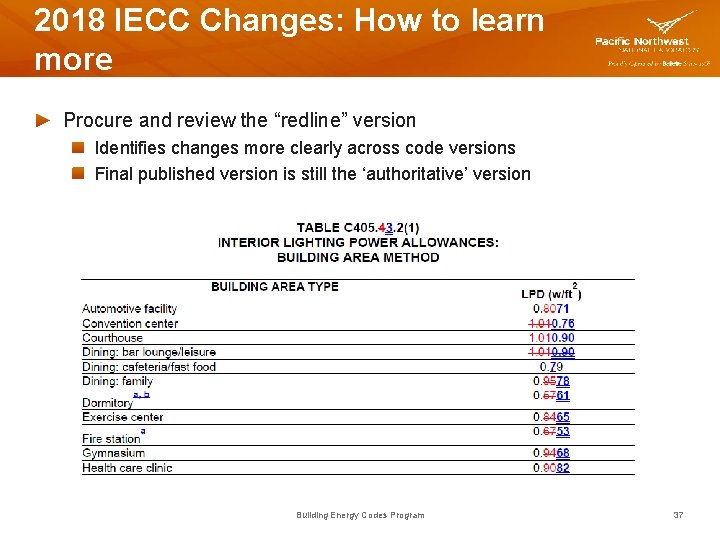
2018 IECC Changes: How to learn more Procure and review the “redline” version Identifies changes more clearly across code versions Final published version is still the ‘authoritative’ version Building Energy Codes Program 37
Summary of Major Changes – ASHRAE 90. 1 -2016 : Total of 121 revisions and enhancements Major format changes for ease of use New climate maps aligning with ASHRAE Standard 169 New performance-based compliance path Significant whole building energy savings Building Energy Codes Program 38
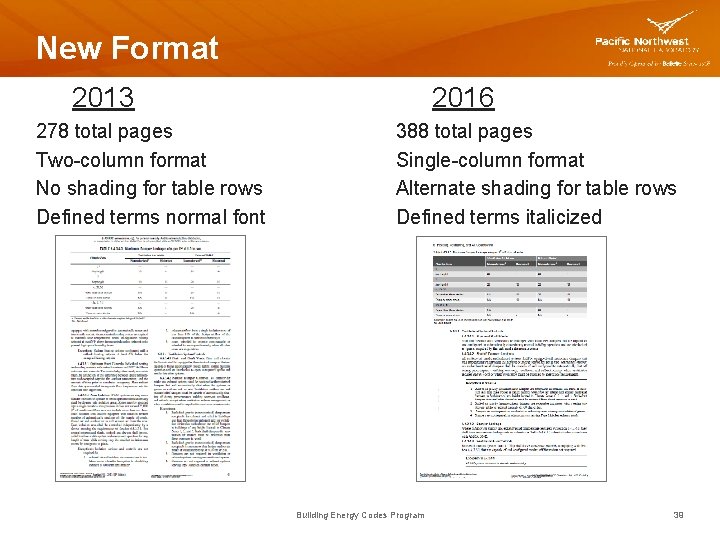
New Format 2013 278 total pages Two-column format No shading for table rows Defined terms normal font 2016 388 total pages Single-column format Alternate shading for table rows Defined terms italicized Building Energy Codes Program 39

New Climate Zone Map Aligns with new ASHRAE Standard 169 Reflects global warming trends over the most recent 30 years Adds new Climate Zone 0 (extremely hot) Approximately 10% of US counties reassigned to a warmer climate zone Building Energy Codes Program 40
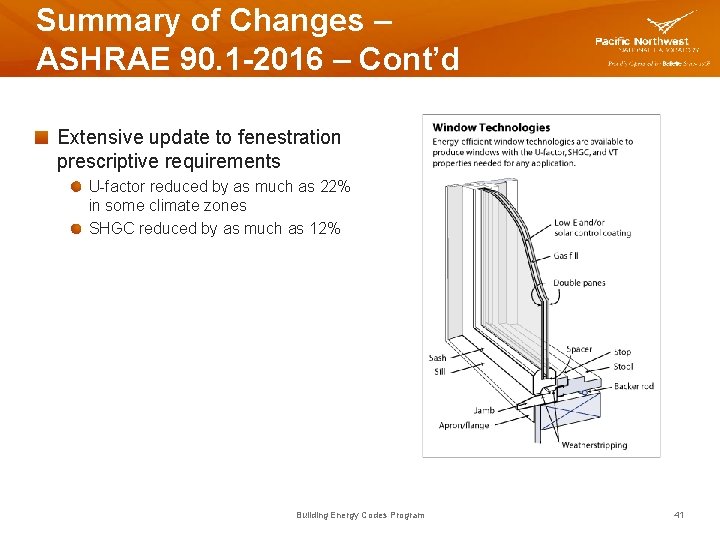
Summary of Changes – ASHRAE 90. 1 -2016 – Cont’d Extensive update to fenestration prescriptive requirements U-factor reduced by as much as 22% in some climate zones SHGC reduced by as much as 12% Building Energy Codes Program 41
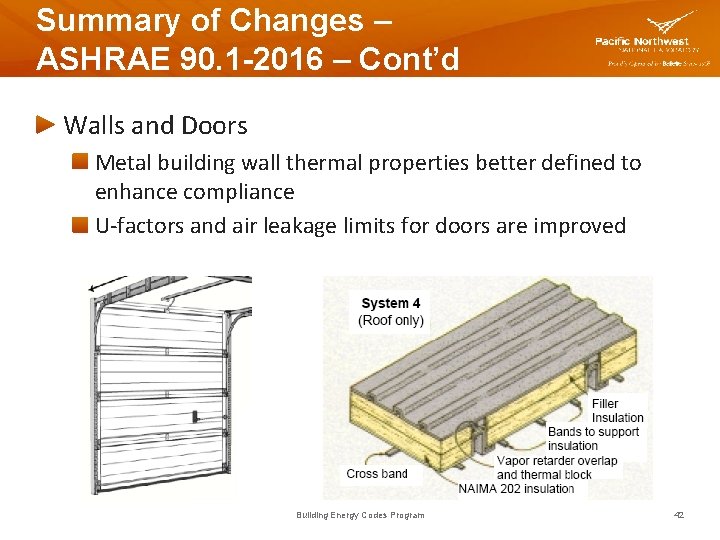
Summary of Changes – ASHRAE 90. 1 -2016 – Cont’d Walls and Doors Metal building wall thermal properties better defined to enhance compliance U-factors and air leakage limits for doors are improved Building Energy Codes Program 42
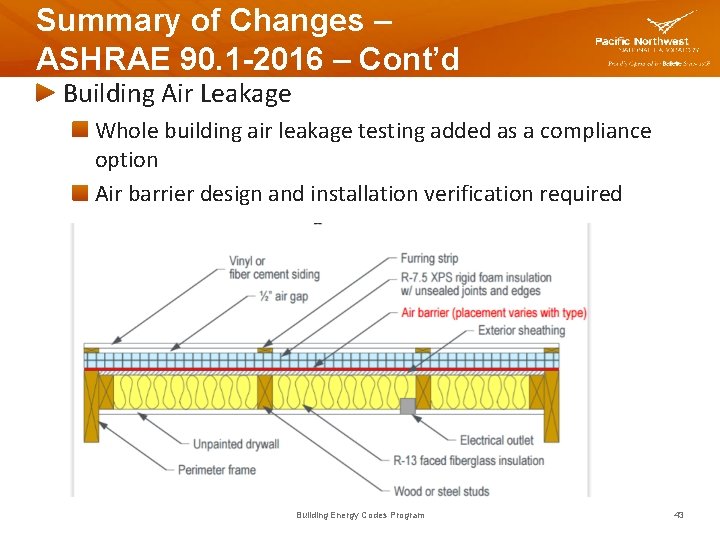
Summary of Changes – ASHRAE 90. 1 -2016 – Cont’d Building Air Leakage Whole building air leakage testing added as a compliance option Air barrier design and installation verification required Building Energy Codes Program 43
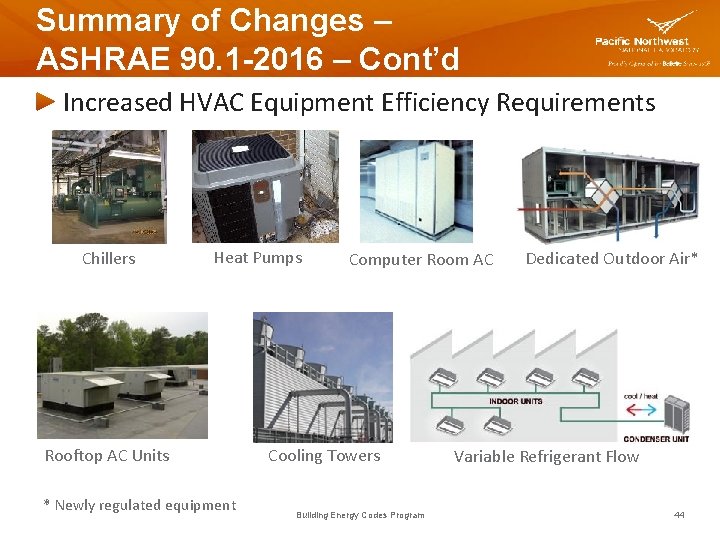
Summary of Changes – ASHRAE 90. 1 -2016 – Cont’d Increased HVAC Equipment Efficiency Requirements Chillers Heat Pumps Rooftop AC Units * Newly regulated equipment Computer Room AC Cooling Towers Building Energy Codes Program Dedicated Outdoor Air* Variable Refrigerant Flow 44
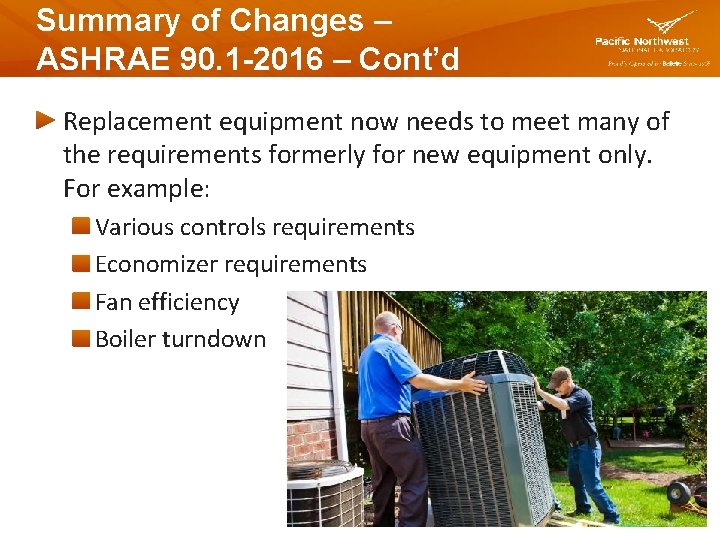
Summary of Changes – ASHRAE 90. 1 -2016 – Cont’d Replacement equipment now needs to meet many of the requirements formerly for new equipment only. For example: Various controls requirements Economizer requirements Fan efficiency Boiler turndown Building Energy Codes Program 45
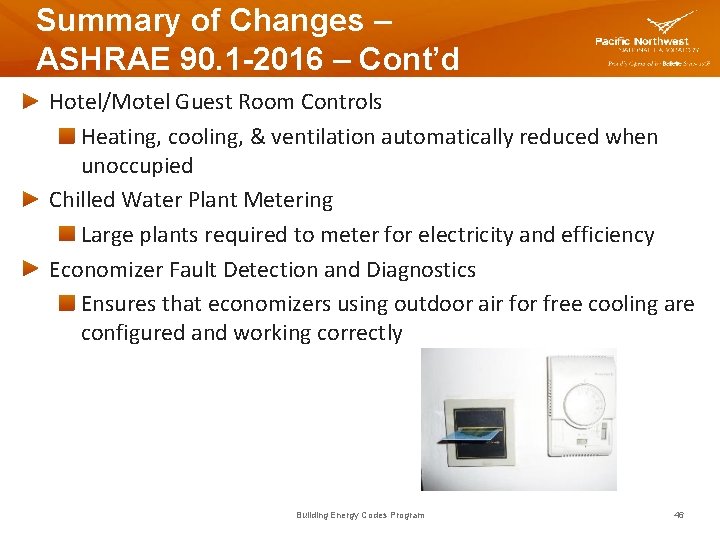
Summary of Changes – ASHRAE 90. 1 -2016 – Cont’d Hotel/Motel Guest Room Controls Heating, cooling, & ventilation automatically reduced when unoccupied Chilled Water Plant Metering Large plants required to meter for electricity and efficiency Economizer Fault Detection and Diagnostics Ensures that economizers using outdoor air for free cooling are configured and working correctly Building Energy Codes Program 46
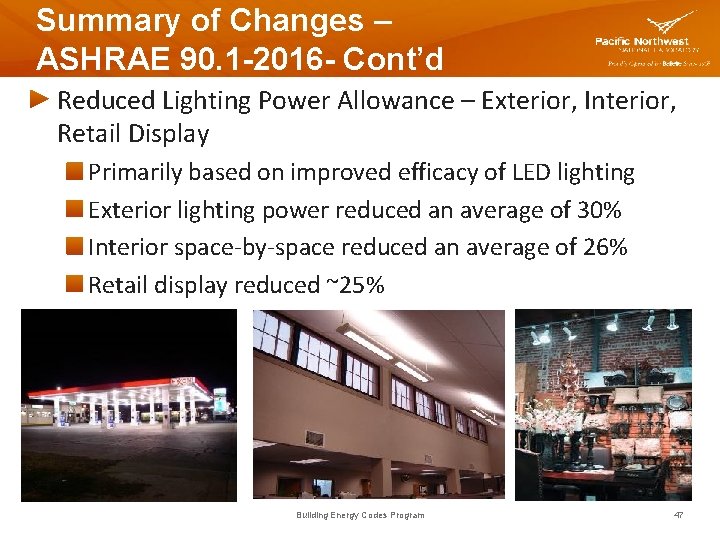
Summary of Changes – ASHRAE 90. 1 -2016 - Cont’d Reduced Lighting Power Allowance – Exterior, Interior, Retail Display Primarily based on improved efficacy of LED lighting Exterior lighting power reduced an average of 30% Interior space-by-space reduced an average of 26% Retail display reduced ~25% Building Energy Codes Program 47
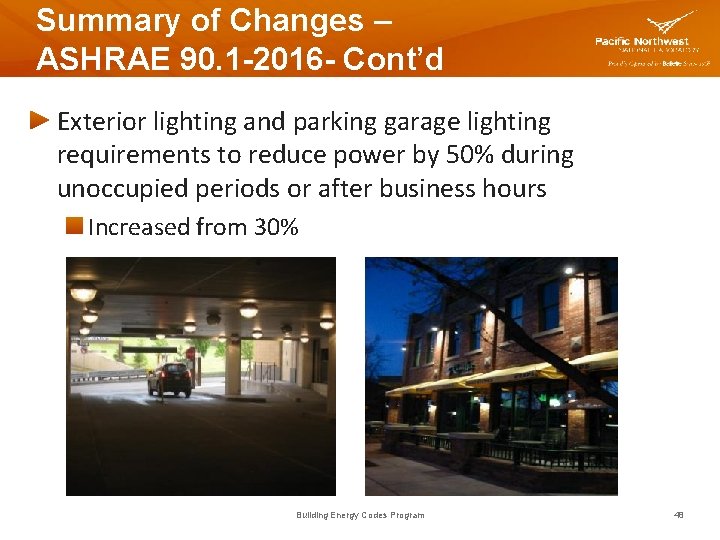
Summary of Changes – ASHRAE 90. 1 -2016 - Cont’d Exterior lighting and parking garage lighting requirements to reduce power by 50% during unoccupied periods or after business hours Increased from 30% Building Energy Codes Program 48
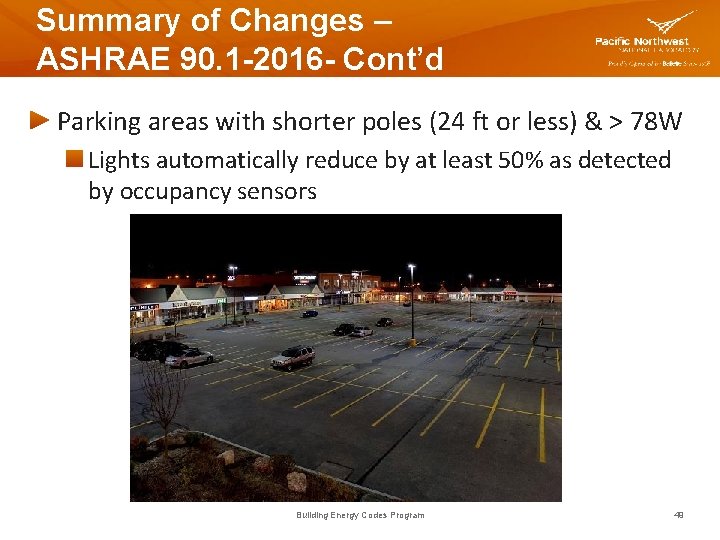
Summary of Changes – ASHRAE 90. 1 -2016 - Cont’d Parking areas with shorter poles (24 ft or less) & > 78 W Lights automatically reduce by at least 50% as detected by occupancy sensors Building Energy Codes Program 49
Summary of Changes – ASHRAE 90. 1 -2016 - Cont’d Dwelling Unit Lighting Apartments, condos, living space must have at least 75% of permanently installed fixtures with minimum lamp efficacy of 55 lumens/Watt Likely requires LED or fluorescent Building Energy Codes Program 50
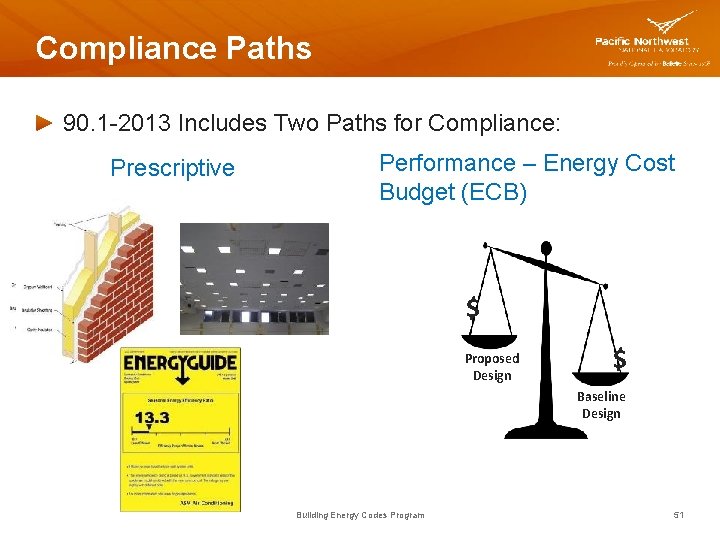
Compliance Paths 90. 1 -2013 Includes Two Paths for Compliance: Prescriptive Performance – Energy Cost Budget (ECB) $ Proposed Design $ Baseline Design Building Energy Codes Program 51
New Compliance Path 90. 1 -2016 Introduces a Third Path for Compliance Appendix G – Performance Rating Method Previously only allowed for “beyond code” programs like LEED Provides increased flexibility Saves time and money dedicated to energy modeling by allowing a single modeling approach to be used for multiple functions Encourages the creation of tools that automate the simulation process as the market is increased Provides credit for good design practices that were previously not recognized for code compliance Building Energy Codes Program 52
Key Takeaways for Designers Residential ERI path new rating index and backstop Consideration and use of renewable energy sources Increased emphasis on building modeling in larger commercial buildings More rigorous thermal envelope criteria that are increasingly recognizing the value of daylighting Decreased lighting power limits, more automatic lighting controls and increased consideration of how fenestration impacts daylighting and building energy use More opportunities for architects to look at the total building and lead as the project design professional The advent of a new compliance path for energy based on the actual performance of a building over time Building Energy Codes Program 53
THANK YOU! Rose Bartlett rose. bartlett@pnnl. gov Bob Schultz robert. schultz@pnnl. gov Building Energy Codes Program www. energycodes. gov PNNL-SA-xxxxxx Building Energy Codes Program 54
- Slides: 54