
U S Court System Global Law Society Forum
U. S. Court System (Global Law & Society Forum) Hong, Seok Mo 2009. 9. 30 1
Federalism Pre-existing independent states delegated their power to the federal government. The federal government has certain express powers spelled out in the Constitution, including the right to levy taxes, declare war, and regulate interstate and foreign commerce. Each state and federal government has its own executive branch, legislative branch, and judicial branch. 2
State Court - Structure • • The Constitution and laws of each state establish the state courts. Each state has a court system that exist independently from the federal courts. Supreme Court : A court of last resort (the highest court) Court of Appeals: intermediate court Trial courts. Some are referred to as Circuit or District Courts. Inconsistent naming NY: supreme court, appellate division, court of appeals CA: superior court, court of appeals, supreme court 3
State Court - Judges • • State court judges are selected in a variety of ways, including election, appointment for a given number of years, appointment for life, and combinations of these methods 4
State Court - General Over 95% of the nation's legal cases are decided in state courts. Some states have two appellate levels, and others have only a single appellate court. Family courts settle such issues as divorce and child-custody disputes, and probate courts handle the settlement of the estates of deceased persons. less formal trial courts, such as magistrate courts and justice of the peace courts. : minor cases, such as traffic offenses, and usually do not use a jury. Cases that originate in state courts can be appealed to a federal court if a federal issue is involved. In 1990, 88 million cases heard at the state trial courts throughout the U. S. 160, 000 cases were appealed, while 62, 000 made it to the state courts of last resort. 5
Federal Court - Jurisdiction Federal Question Cases that deal with the constitutionality of a law; Cases involving the laws and treaties of the U. S. ; Diversity of citizenship: Disputes between two or more states; Admiralty law, and Ambassadors 6
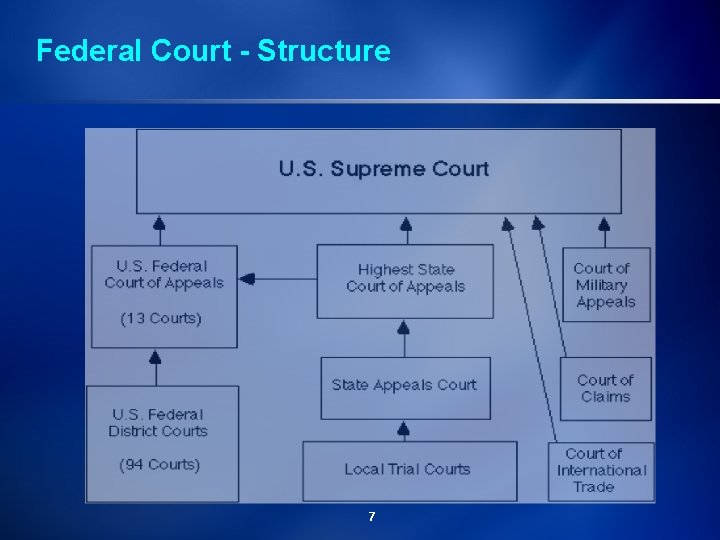
Federal Court - Structure 7
Federal Court – Judges 550 judges for federal district court 158 judges for federal court of appeal 9 judges for US Supreme Court appointed by the president with the advice of the Senate They hold office during good behavior, typically, for life. Only through Congressional impeachment proceedings, federal judges may be removed from office for misbehavior. 8
Federal Court – District Court 94 federal district courts across the country, with at least one in every state (larger states have up to four). juries hear testimony in some cases, and most cases at this level are presented before a single judge. 267, 000 cases in 1990. 9
Federal Court – Court of Appeal Courts of appeals do not use juries or witnesses. No new evidence is submitted in an appealed case; appellate courts base their decisions on a review of lower-court records. In 1990, about 41, 000 cases. 12 general appeals courts. All but one of them (which serves only the District of Columbia) serve an area consisting of three to nine states (called a circuit. ) There is also the U. S. Court of Appeals for the Federal Circuit, which specializes in patents, contract claims against the federal government, federal employment cases and international trade. Between four and twenty six judges sit on each court of appeals, and each case is usually heard by a panel of three judges. 10
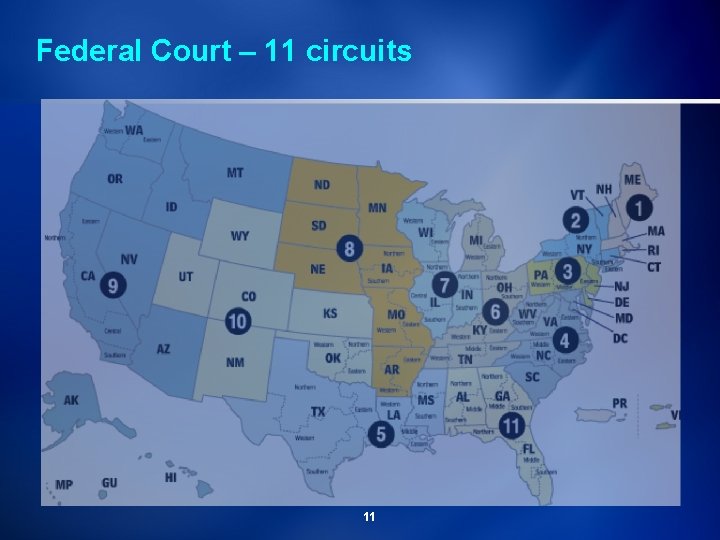
Federal Court – 11 circuits 11
Federal Court – Supreme Court Fewer than 1 percent of the cases heard by federal appeals courts (about 200) are later reviewed by the Supreme Court three ways for a case to make its way to the US Supreme Court. 1) US Supreme Court has original jurisdiction: Cases in which a state is a party and cases dealing with diplomatic personnel, like ambassadors. 2) Those cases appealed from lower federal courts can be heard at the Supreme Court. 3) appeals from state supreme courts in which a constitutional right has been denied in the state courts. 12
- Slides: 12