
U S Congress STRUCTURE AND FUNCTIONS House of



- Slides: 17
U. S. Congress STRUCTURE AND FUNCTIONS
House of Representatives> 435 members > Representation based upon state population > All seats Elected Every two years (even years) w/ 2 -year terms Senate> 100 members > Equal representation for all states > 1/3 (roughly) of seats elected every two years w/ 6 -year terms - BICAMERAL LEGISLATURE
House of Reps: Requirements: live in the district you represent, citizen of the state (7 years), at least 25 years old > Incumbent re-election rate is high (nearly 90%) > Special Role: Tax and Appropriations bills must start in the House of Reps (cannot start in Senate) > House Ways and Means Committee oversees this > House leader: Speaker of the House (currently Nancy Pelosi) who is chosen by the majority party in the House (currently Dem. ) >Powerful position be he/she can direct floor debate and has influence over committee assignment & the Rules Committee > Majority and Minority Leaders keep their parties members in line and direct their party’s legislative agenda
Senate Requirements: live in the state you represent (9 years), U. S. Citizen, minimum 30 years old > Special roles: ratify all treaties (check & balances), confirmation of Presidential nominations to federal courts & foreign ambassadorships > Leadership: Vice-President (technically) is the presiding officer of the Senate (only Constitutional responsibility given to V-P) but mostly overseen by President pro tempore (currently Chuck Grassley-R) ◦ PPT is usually the longest serving member in the Senate majority party, real power sits with the Senate Majority Leader b/c they control the legislative agenda and act as power broker and policy initiator
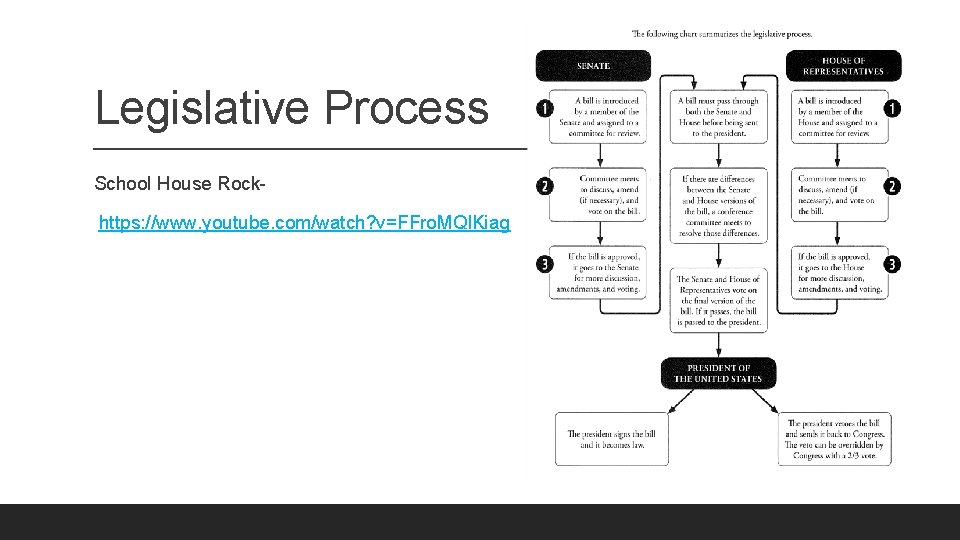
Legislative Process School House Rockhttps: //www. youtube. com/watch? v=FFro. MQl. Kiag
Committees ◦ ◦ Most legislation happens in committee Committee chair-person is always a member of the party that controls that house of Congress Committee assignments are controlled by the party leadership Committee play a huge role in whether a bill survives, and the sponsor of a bill tends to draft the bill in a way that steers it towards sympathetic committees. ◦ Committees also have responsibilities of oversight of various bureaucratic agencies and listening to testimony from agencies asking for money from the budget ◦ Committees perform the tasks of researching, investigating, and debating bills that due to time constraints could never be given time consideration on the whole congress floor. If a bill survives committee it is then submitted to be brought to the floor of the house of congress for an official vote ◦ House of Reps has far more committees than the Senate, but Representatives tend to serve on fewer committees and become more specialized in particular areas and are considered to have more expertise in their area than Senators. ◦ Most bills die in subcommittee due to lack of interest in the bill, unless a member takes a particular interest. Otherwise it is generally rejected or ignored. Lobbyists and/or expert witnesses can be called to testify/provide information on bills or in investigations. Once investigation conclude, committees begin the process amending/rewriting bills
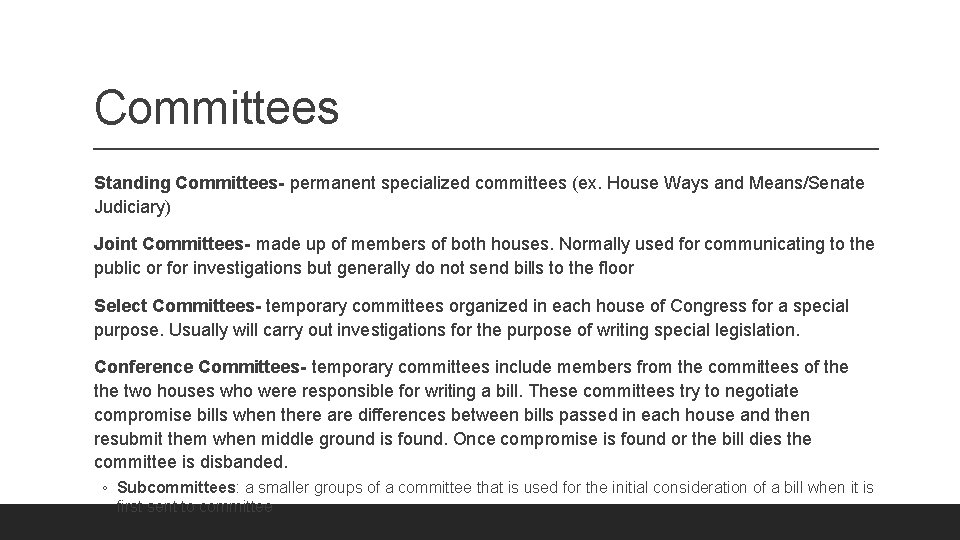
Committees Standing Committees- permanent specialized committees (ex. House Ways and Means/Senate Judiciary) Joint Committees- made up of members of both houses. Normally used for communicating to the public or for investigations but generally do not send bills to the floor Select Committees- temporary committees organized in each house of Congress for a special purpose. Usually will carry out investigations for the purpose of writing special legislation. Conference Committees- temporary committees include members from the committees of the two houses who were responsible for writing a bill. These committees try to negotiate compromise bills when there are differences between bills passed in each house and then resubmit them when middle ground is found. Once compromise is found or the bill dies the committee is disbanded. ◦ Subcommittees: a smaller groups of a committee that is used for the initial consideration of a bill when it is first sent to committee
> Debrief Simulation > Congressional behavior & governing effectiveness (size matters) > Budget, Pork-barrel legislation, and logrolling > Redistricting - CONGRESSIONAL FUNCTIONS
Size and structure matters in Congress • House- Rules Committee normally proposes time limitations on debate for any bill. (A larger number of rules needed to oversee such a large legislative body) • Discharge Petition- Ho. R can use an absolute majority (218 votes) to force a bill to the floor of the house that a committee has refused to vote on or consider. • Shorter term limits in House of Reps… what does this do? • Coalitions- alliances in Congress, that can arise that cross party lines. Usually temporary and in response to a specific bill. (normally party lines are the true division) • Logrolling- an arrangment by two or more congressmen to agree in advance to support each other’s bills • Senate- due to the lack of rules, Senators have the option of the filibuster • the use of unlimited debate as a delaying tactic to block a bill. • Before a bill is debated, the Senate can vote for Cloture, which is a formal limit on the length of a debate
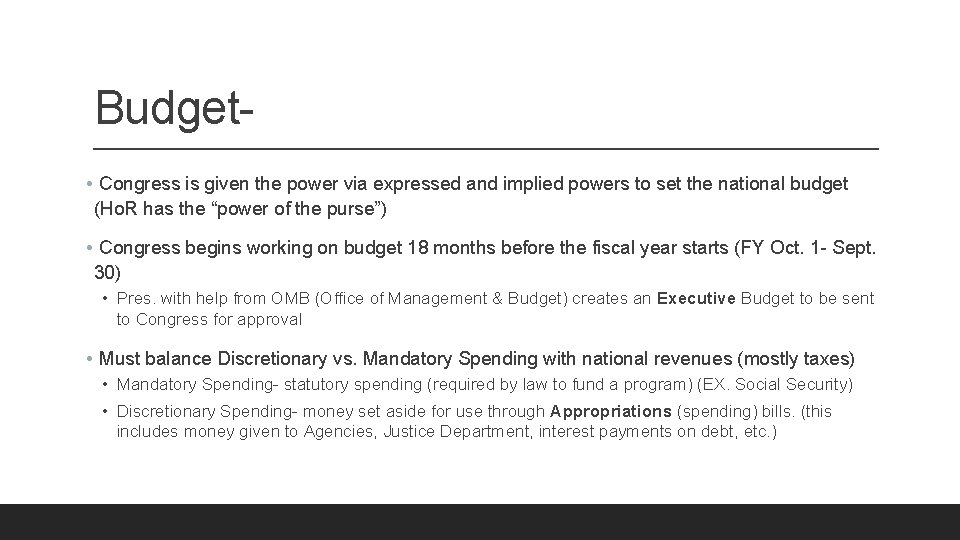
Budget • Congress is given the power via expressed and implied powers to set the national budget (Ho. R has the “power of the purse”) • Congress begins working on budget 18 months before the fiscal year starts (FY Oct. 1 - Sept. 30) • Pres. with help from OMB (Office of Management & Budget) creates an Executive Budget to be sent to Congress for approval • Must balance Discretionary vs. Mandatory Spending with national revenues (mostly taxes) • Mandatory Spending- statutory spending (required by law to fund a program) (EX. Social Security) • Discretionary Spending- money set aside for use through Appropriations (spending) bills. (this includes money given to Agencies, Justice Department, interest payments on debt, etc. )
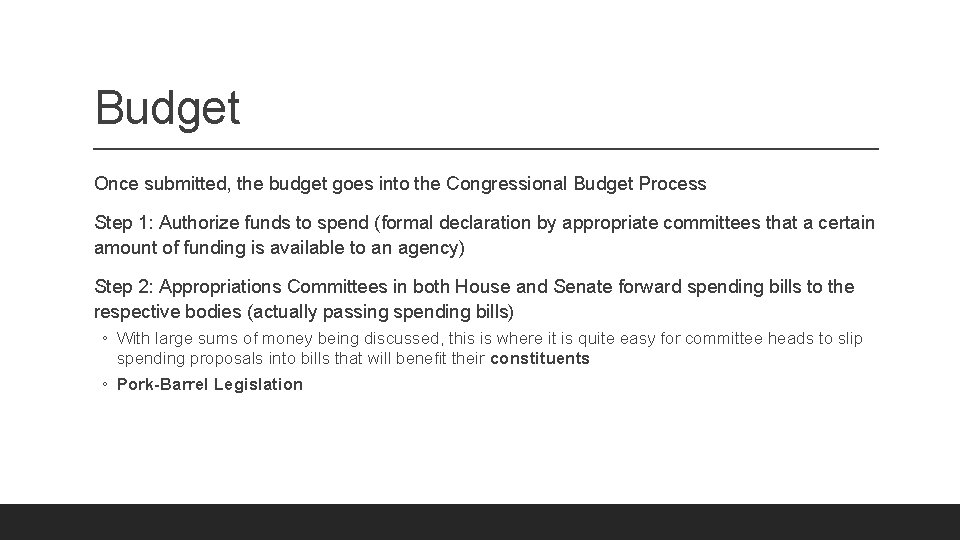
Budget Once submitted, the budget goes into the Congressional Budget Process Step 1: Authorize funds to spend (formal declaration by appropriate committees that a certain amount of funding is available to an agency) Step 2: Appropriations Committees in both House and Senate forward spending bills to the respective bodies (actually passing spending bills) ◦ With large sums of money being discussed, this is where it is quite easy for committee heads to slip spending proposals into bills that will benefit their constituents ◦ Pork-Barrel Legislation
Redistricting- what is it and how does it work? Define: Census. Reapportionment. Redistricting. Gerrymandering-
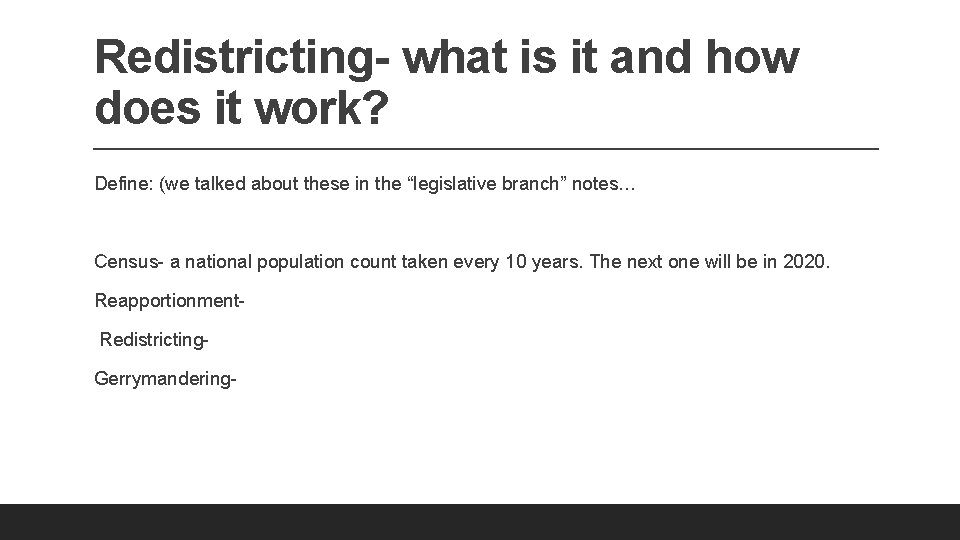
Redistricting- what is it and how does it work? Define: (we talked about these in the “legislative branch” notes… Census- a national population count taken every 10 years. The next one will be in 2020. Reapportionment. Redistricting. Gerrymandering-
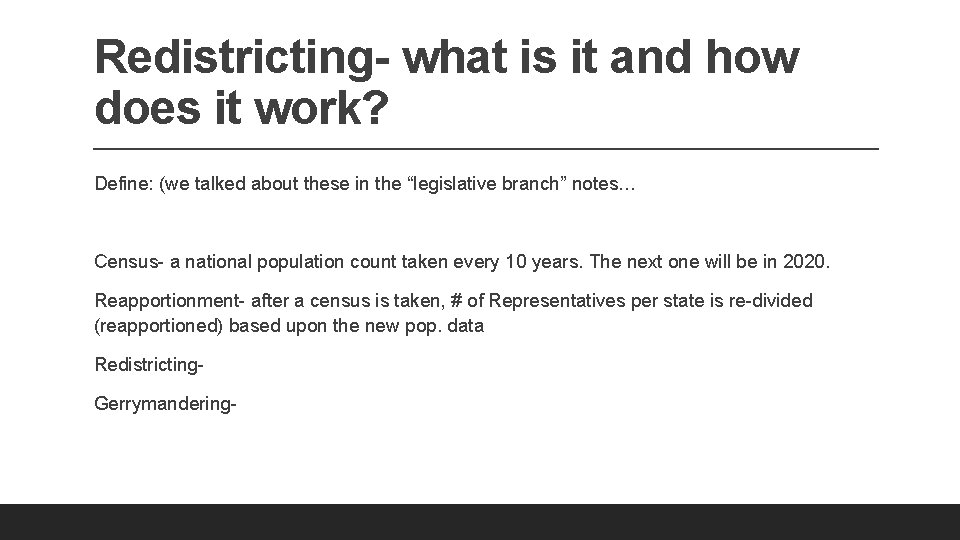
Redistricting- what is it and how does it work? Define: (we talked about these in the “legislative branch” notes… Census- a national population count taken every 10 years. The next one will be in 2020. Reapportionment- after a census is taken, # of Representatives per state is re-divided (reapportioned) based upon the new pop. data Redistricting. Gerrymandering-
Redistricting- what is it and how does it work? Define: (we talked about these in the “legislative branch” notes… Census- a national population count taken every 10 years. The next one will be in 2020. Reapportionment- after a census is taken, # of Representatives per state is re-divided (reapportioned) based upon the new pop. data Redistricting- Once a state has a new # of Representatives (either via addition or subtraction) new congressional districts are redrawn Gerrymandering-
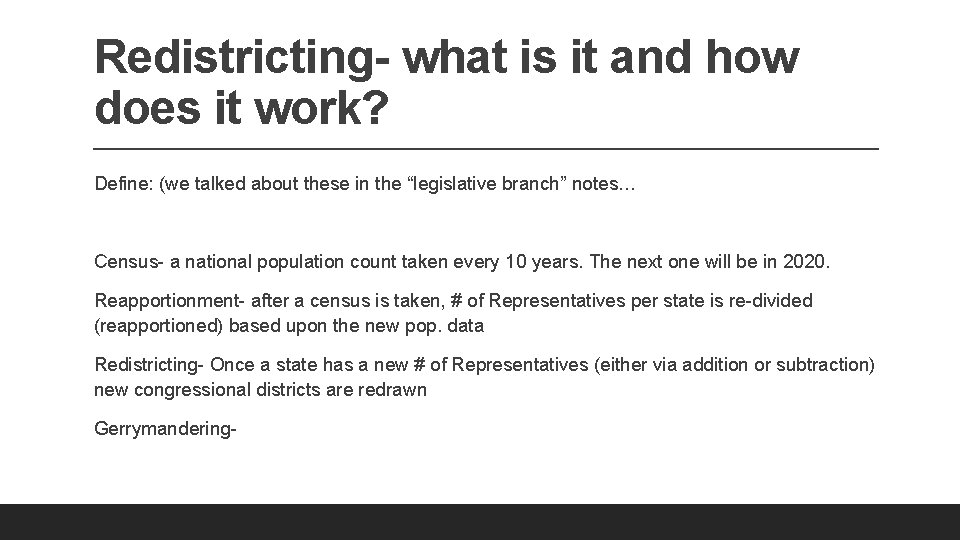
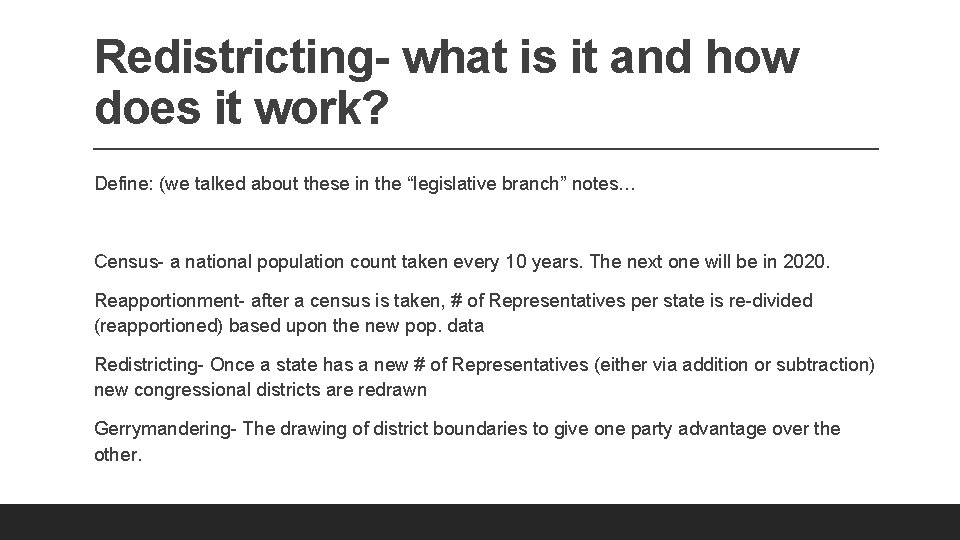
Redistricting- what is it and how does it work? Define: (we talked about these in the “legislative branch” notes… Census- a national population count taken every 10 years. The next one will be in 2020. Reapportionment- after a census is taken, # of Representatives per state is re-divided (reapportioned) based upon the new pop. data Redistricting- Once a state has a new # of Representatives (either via addition or subtraction) new congressional districts are redrawn Gerrymandering- The drawing of district boundaries to give one party advantage over the other.
examples https: //www. washingtonpost. com/news/wonk/wp/2014/05/15/americas-most-gerrymanderedcongressional-districts/? noredirect=on&utm_term=. 124 cf 8 da 8599