
U S Army ATR Training Program 10 US
- Slides: 51
U. S. Army ATR Training Program 10 US Code 2302 (PL 102 -484, S 326) Army Acquisition Executive Environmental Support Office
Army Dependency on ODS … In Weapon Systems and Equipment Is a READINESS ISSUE The Goal of the Army ODS Program Is to ELIMINATE ALL DEPENDENCY ON ODS – CLASS I AND II
Part 1 Ø What is the Ozone Layer? Ø Response to Concerns Ø Army Applications
What Is the Ozone Layer? Ø Ø Ø Stratospheric Ozone Discovery of Ozone Depletion Ozone Depleting Substances Typical ODS Do. D Share of Ozone Depletion
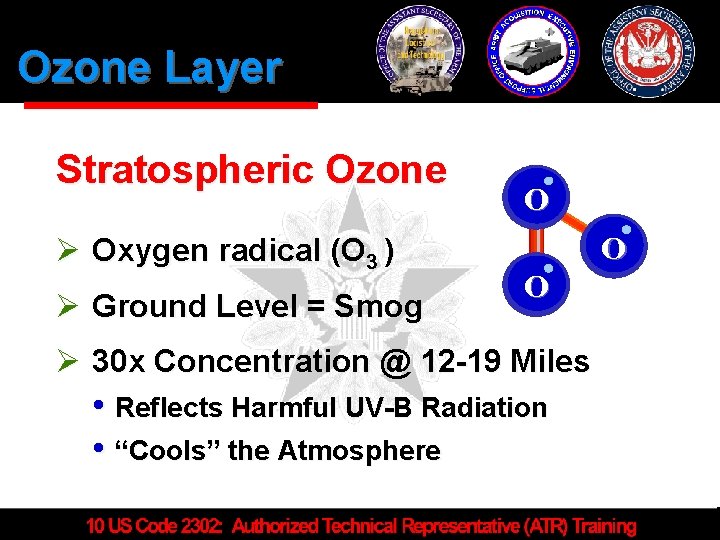
Ozone Layer Stratospheric Ozone Ø Oxygen radical (O 3 ) Ø Ground Level = Smog O O O Ø 30 x Concentration @ 12 -19 Miles • Reflects Harmful UV-B Radiation • “Cools” the Atmosphere
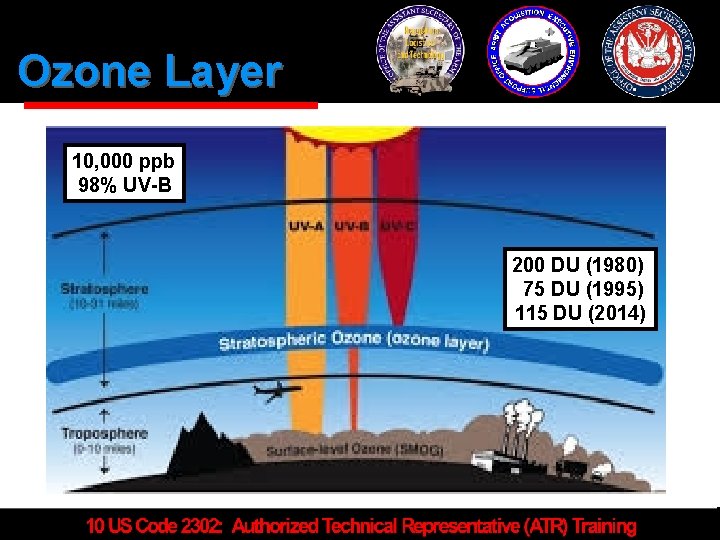
Ozone Layer 10, 000 ppb 98% UV-B 200 DU (1980) 75 DU (1995) 115 DU (2014)
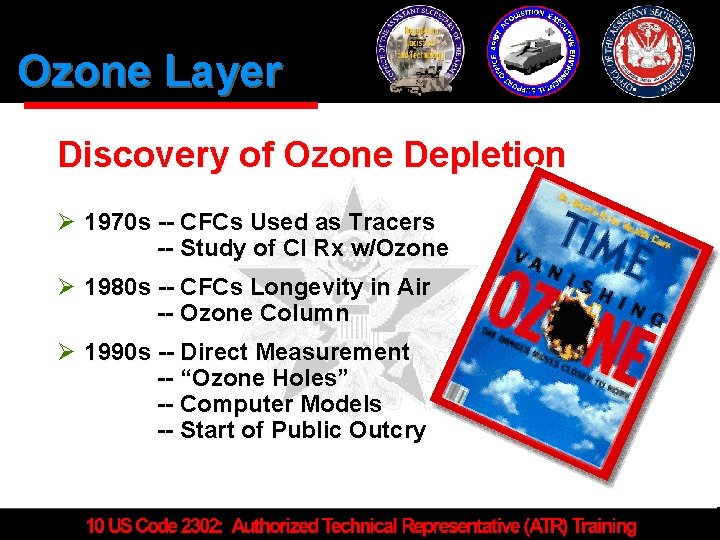
Ozone Layer Discovery of Ozone Depletion Ø 1970 s -- CFCs Used as Tracers -- Study of Cl Rx w/Ozone Ø 1980 s -- CFCs Longevity in Air -- Ozone Column Ø 1990 s -- Direct Measurement -- “Ozone Holes” -- Computer Models -- Start of Public Outcry --
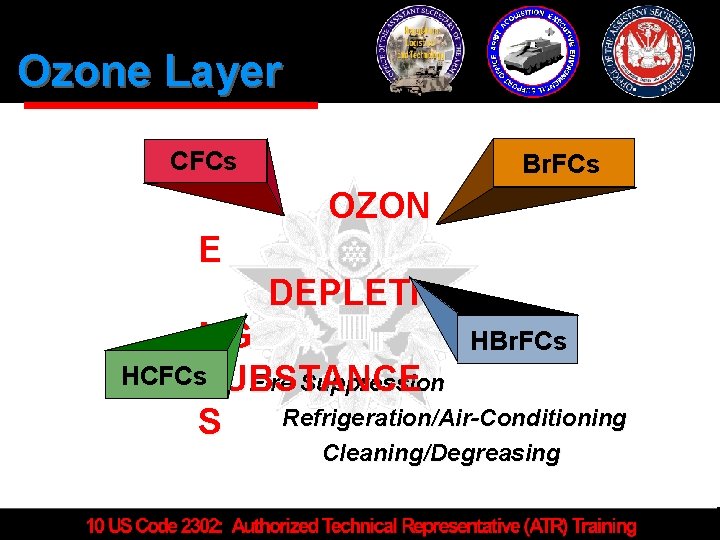
Ozone Layer CFCs Br. FCs OZON E DEPLETI NG HBr. FCs HCFCs. SUBSTANCE Fire Suppression Refrigeration/Air-Conditioning S Cleaning/Degreasing
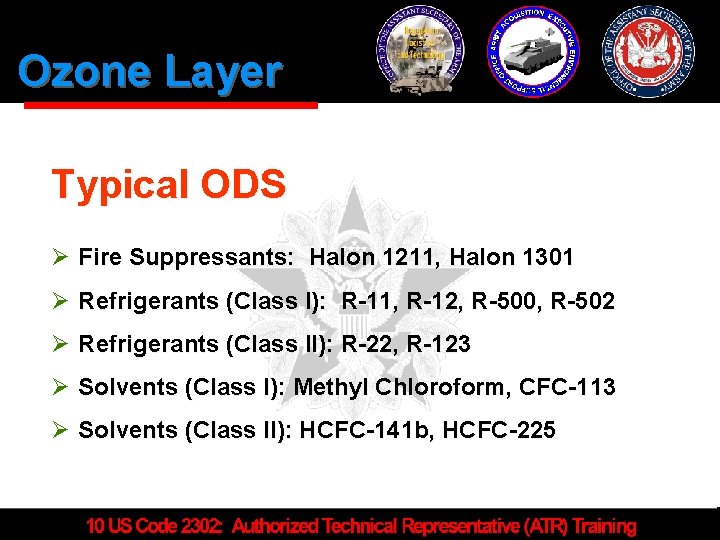
Ozone Layer Typical ODS Ø Fire Suppressants: Halon 1211, Halon 1301 Ø Refrigerants (Class I): R-11, R-12, R-500, R-502 Ø Refrigerants (Class II): R-22, R-123 Ø Solvents (Class I): Methyl Chloroform, CFC-113 Ø Solvents (Class II): HCFC-141 b, HCFC-225
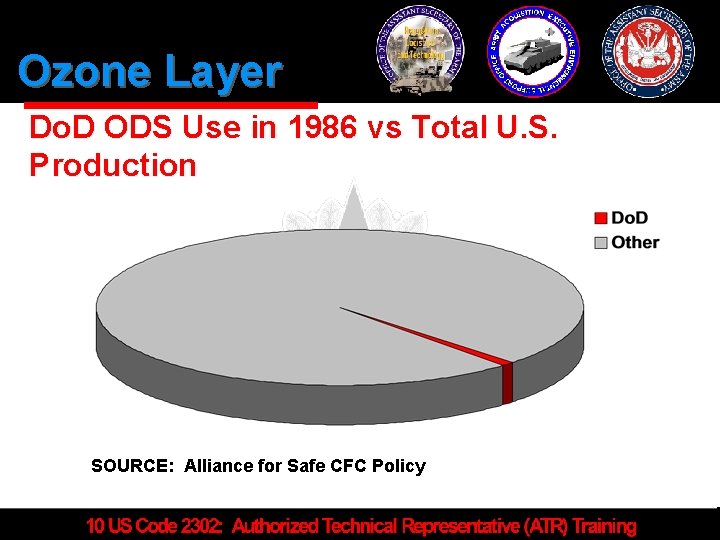
Ozone Layer Do. D ODS Use in 1986 vs Total U. S. Production SOURCE: Alliance for Safe CFC Policy
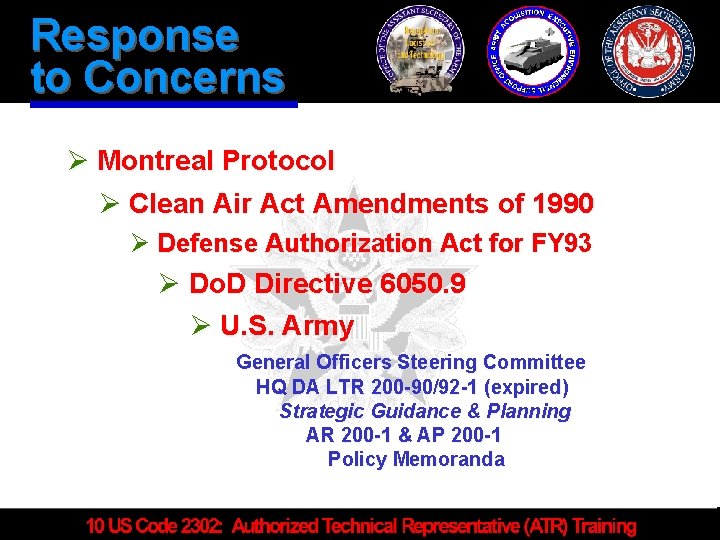
Response to Concerns Ø Montreal Protocol Ø Clean Air Act Amendments of 1990 Ø Defense Authorization Act for FY 93 Ø Do. D Directive 6050. 9 Ø U. S. Army General Officers Steering Committee HQ DA LTR 200 -90/92 -1 (expired) Strategic Guidance & Planning AR 200 -1 & AP 200 -1 Policy Memoranda
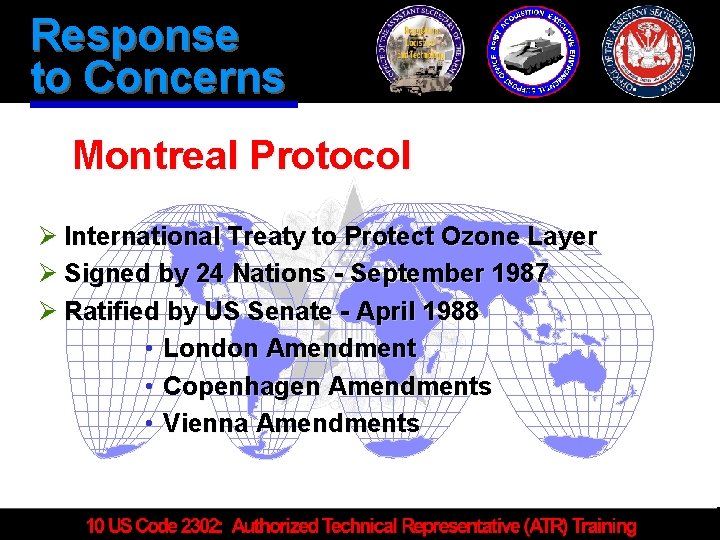
Response to Concerns Montreal Protocol Ø International Treaty to Protect Ozone Layer Ø Signed by 24 Nations - September 1987 Ø Ratified by US Senate - April 1988 • London Amendment • Copenhagen Amendments • Vienna Amendments
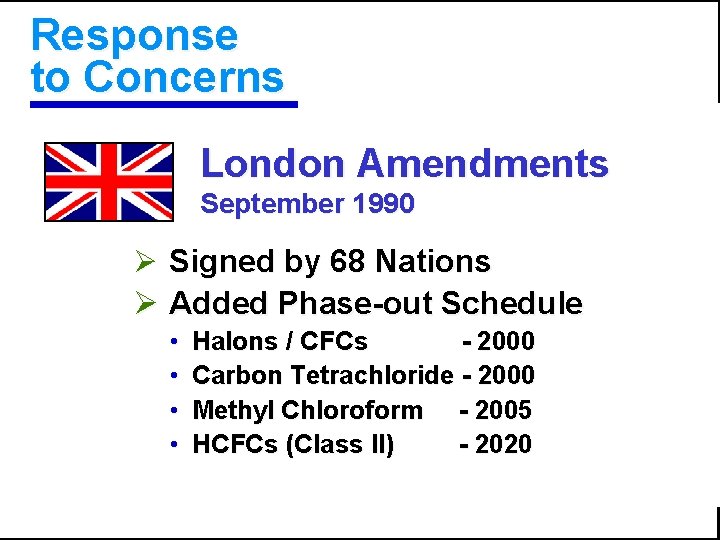
Response to Concerns London Amendments September 1990 Ø Signed by 68 Nations Ø Added Phase-out Schedule • • Halons / CFCs - 2000 Carbon Tetrachloride - 2000 Methyl Chloroform - 2005 HCFCs (Class II) - 2020
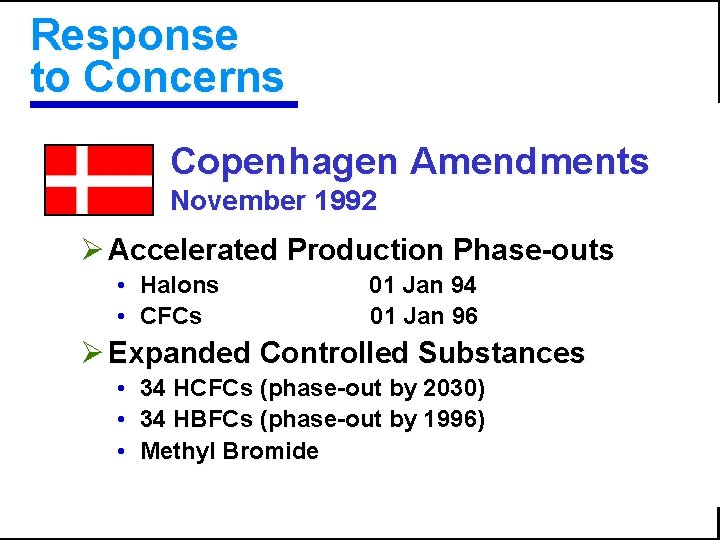
Response to Concerns Copenhagen Amendments November 1992 Ø Accelerated Production Phase-outs • Halons • CFCs 01 Jan 94 01 Jan 96 Ø Expanded Controlled Substances • • • 34 HCFCs (phase-out by 2030) 34 HBFCs (phase-out by 1996) Methyl Bromide
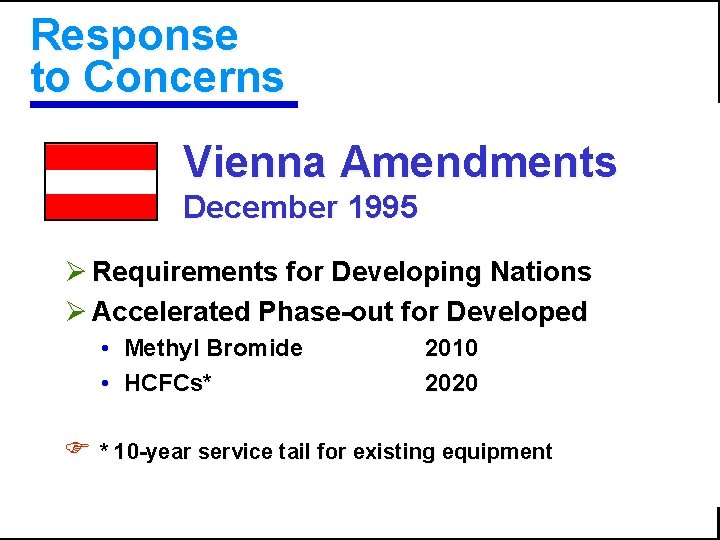
Response to Concerns Vienna Amendments December 1995 Ø Requirements for Developing Nations Ø Accelerated Phase-out for Developed • Methyl Bromide • HCFCs* 2010 2020 F * 10 -year service tail for existing equipment
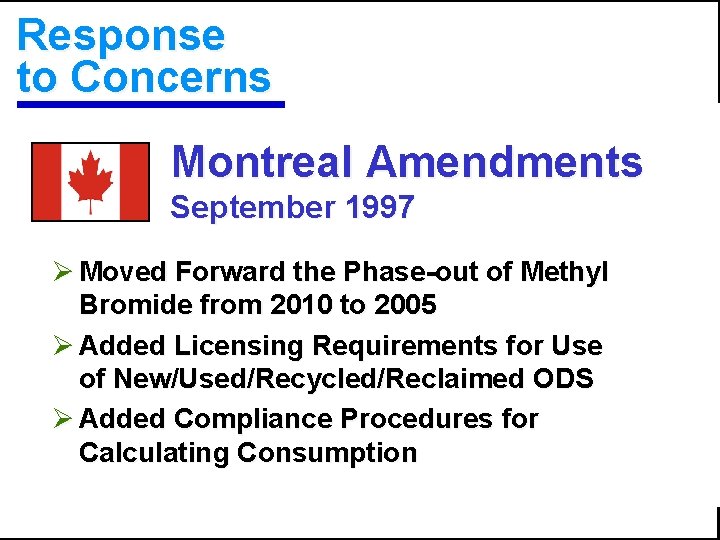
Response to Concerns Montreal Amendments September 1997 Ø Moved Forward the Phase-out of Methyl Bromide from 2010 to 2005 Ø Added Licensing Requirements for Use of New/Used/Recycled/Reclaimed ODS Ø Added Compliance Procedures for Calculating Consumption
Response to Concerns Beijing Amendments December 1999 (adjusted 2007) Ø Added Bromochloromethane and Established the Phase-out for 2002 Ø Expanded Compliance Procedures for Calculating CFC/HCFC Compliance
Response to Concerns Kigali Amendments October 2016 Ø U. S. Is a Signatory to the Amendment but Congress Did Not Ratify Ø Added HFC Greenhouse Gases (GHG) - HFCs Are Not ODS - Set Cap at 90% 2011 -2013 Baseline - Set Graduated Reduction Schedule - Set Target (15% of Baseline) at 2036
Response to Concerns Clean Air Act Amendments (1990) Title VI - Stratospheric Ozone Protection Ø Class I ODS • • • CFCs / Halons Carbon Tetrachloride Methyl Chloroform HBFCs Methyl Bromide Ø Class II ODS (HCFCs) Ø Production Phase-outs • CFCs 31 Dec 95 • Halons 01 Jan 94
Response to Concerns National Defense Authorization Act for FY 93 (PL 102 -484) Section 326 Congress Directed Do. D to: ü Review Contracts for Class I ODS ü Determine if Can be Replaced ü Allow Class I ODS in Contract only with the Approval of a Senior Acquisition Official
Response to Concerns Do. DD 6050. 9 13 February 1989 Ø Ø Ø Identify Class I ODS Use and Criticality Implement Conservation Measures Conduct Research and Development Eliminate ODS from MILSPECs/STDs Buy & Store for Critical Applications Cancelled in 1998
Response to Concerns Army General Officer Steering Committees 07 July 89 30 April 90 19 December 91 Pursue Joint Research Support Industry Programs Fund Army R&D as a Last Resort
Response to Concerns HQDA LTR 200 -92 -1 27 July 1992 Ø Implemented Do. D 6050. 9 Ø Identified Army Responsibilities Ø Established 21 Separate Policies Ø Incorporated into AR 200 -1 F EXPIRED
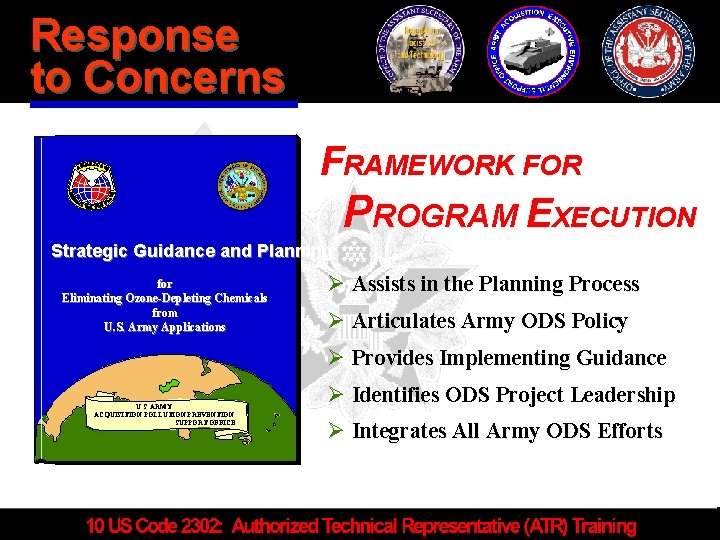
Response to Concerns FRAMEWORK FOR PROGRAM EXECUTION Strategic Guidance and Planning for Eliminating Ozone-Depleting Chemicals from U. S. Army Applications Ø Assists in the Planning Process Ø Articulates Army ODS Policy Ø Provides Implementing Guidance U. S. ARMY ACQUISITION POLLUTION PREVENTION SUPPORT OFFICE Ø Identifies ODS Project Leadership Ø Integrates All Army ODS Efforts
Response to Concerns Army Regulation 200 -1 21 March 1997 Ø Eliminate Class I ODS by FY 04 Ø Comply with PL 102 -484, S 326 Ø Document Requirements thru EPR Ø Plan to Eliminate Class II ODS UPDATED 13 December 2007 4 -1. a. (3) Air Resources Policy Eliminate dependency on ozone depleting substances.
Response to Concerns Early Policy Memos Ø AAE, Implementation of PL 102 -484 S 326, 20 May 93 Ø DASA(ESOH), Disposition of Excess ODCs at Army Installations, 18 Oct 94 Ø ASA(IL&E), ODC Elimination at Army Installations, 13 Feb 96
Response to Concerns ACSIM Policy Memo Elimination of the Dependency on ODCs in Army Facilities, 3 Jul 1997 Ø Commanders Responsible Ø Tenants Responsible to Comply Ø Class I ODS Out by the End of FY 03 Ø All Army Class I ODS Must Be Recovered Ø Alternatives Must Have EPA, ASG Clearance Ø No ODS in a Contract without SAO Approval
Response to Concerns ACSIM Policy Memo 14 January 1999 Ø Installations Must Have ODS Plans by End of FY 00 Ø MACOMs Must Report Status EOY 1999 & 2000 Prepared for: Army Acquisition Pollution Prevention Support Office Ø Class I ODS Use Must Be Eliminated by 1 Nov 2003
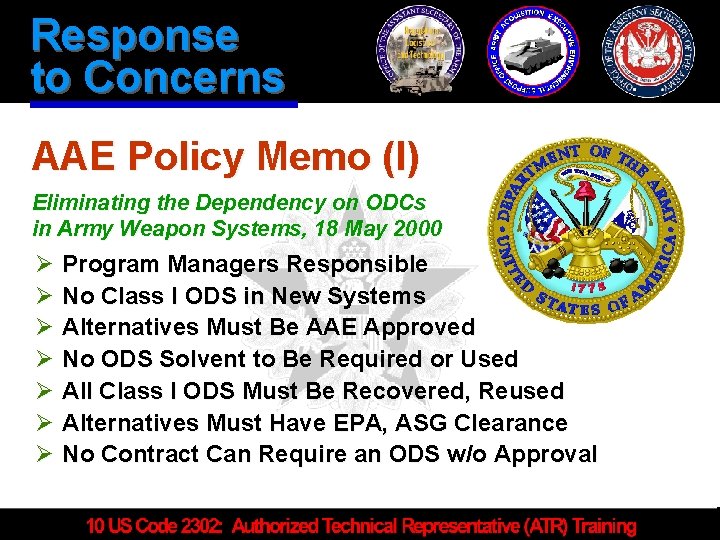
Response to Concerns AAE Policy Memo (I) Eliminating the Dependency on ODCs in Army Weapon Systems, 18 May 2000 Ø Program Managers Responsible Ø No Class I ODS in New Systems Ø Alternatives Must Be AAE Approved Ø No ODS Solvent to Be Required or Used Ø All Class I ODS Must Be Recovered, Reused Ø Alternatives Must Have EPA, ASG Clearance Ø No Contract Can Require an ODS w/o Approval
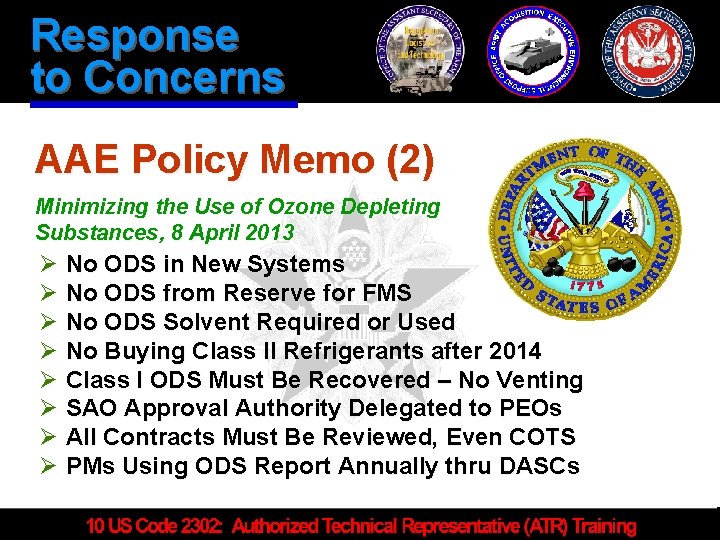
Response to Concerns AAE Policy Memo (2) Minimizing the Use of Ozone Depleting Substances, 8 April 2013 Ø No ODS in New Systems Ø No ODS from Reserve for FMS Ø No ODS Solvent Required or Used Ø No Buying Class II Refrigerants after 2014 Ø Class I ODS Must Be Recovered – No Venting Ø SAO Approval Authority Delegated to PEOs Ø All Contracts Must Be Reviewed, Even COTS Ø PMs Using ODS Report Annually thru DASCs
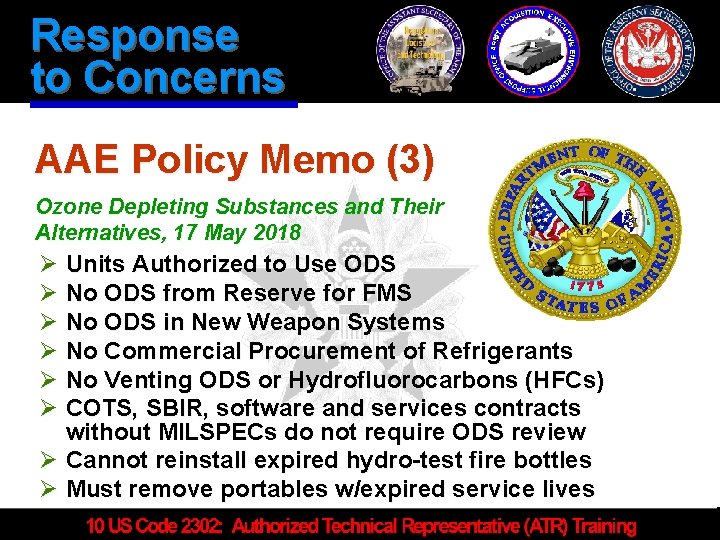
Response to Concerns AAE Policy Memo (3) Ozone Depleting Substances and Their Alternatives, 17 May 2018 Ø Units Authorized to Use ODS Ø No ODS from Reserve for FMS Ø No ODS in New Weapon Systems Ø No Commercial Procurement of Refrigerants Ø No Venting ODS or Hydrofluorocarbons (HFCs) Ø COTS, SBIR, software and services contracts without MILSPECs do not require ODS review Ø Cannot reinstall expired hydro-test fire bottles Ø Must remove portables w/expired service lives
Army ODS Applications FIRE SUPPRESSANTS REFRIGERANTS SOLVENTS
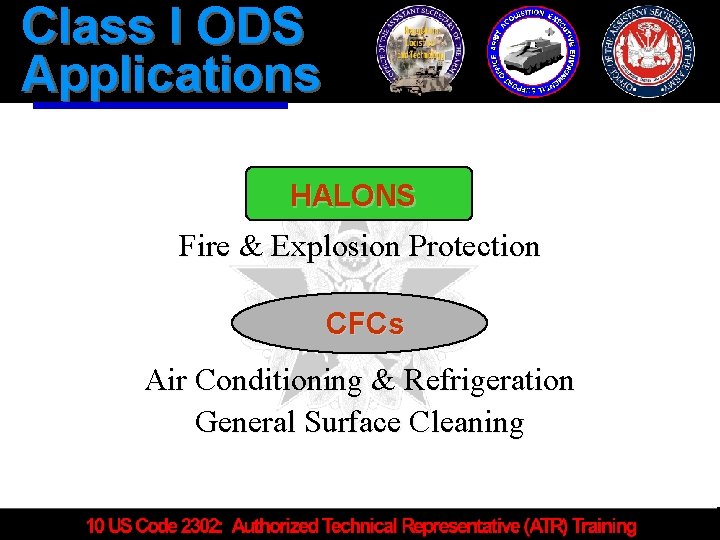
Class I ODS Applications HALONS Fire & Explosion Protection CFCs Air Conditioning & Refrigeration General Surface Cleaning
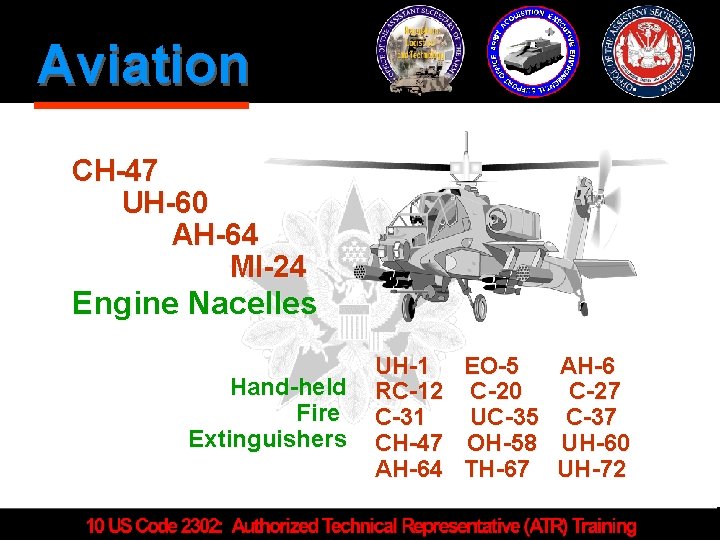
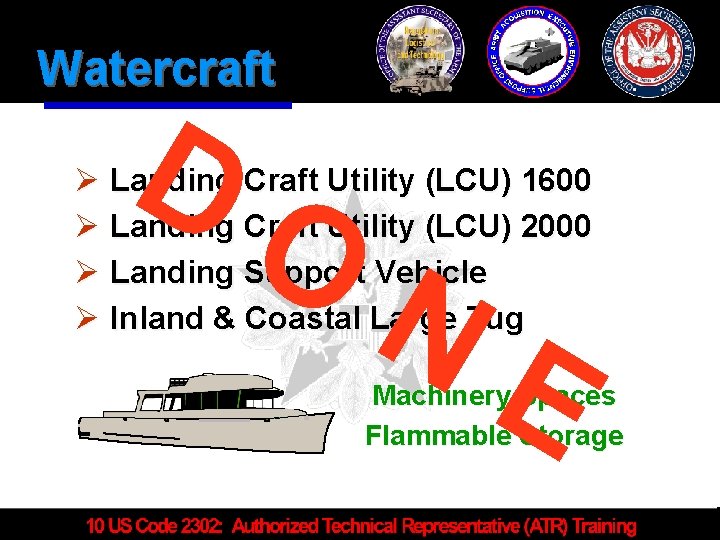
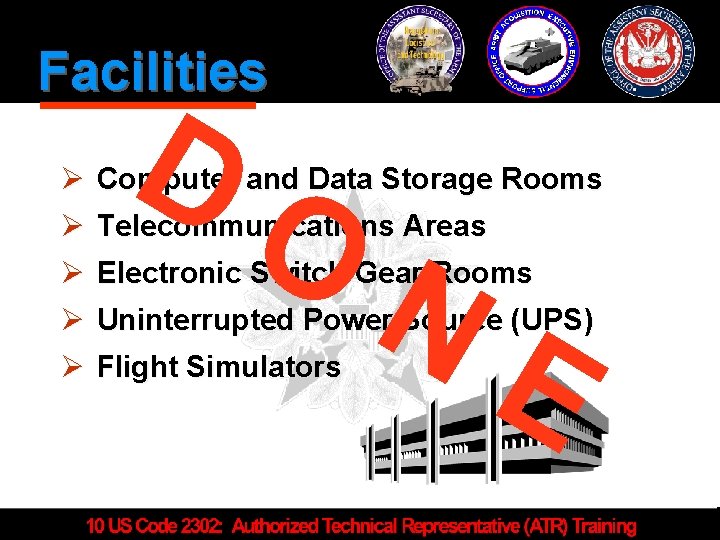
Halon Applications Ø Ground Combat Vehicles Ø Watercraft Engine Rooms Ø Aviation Nacelles Ø Facilities
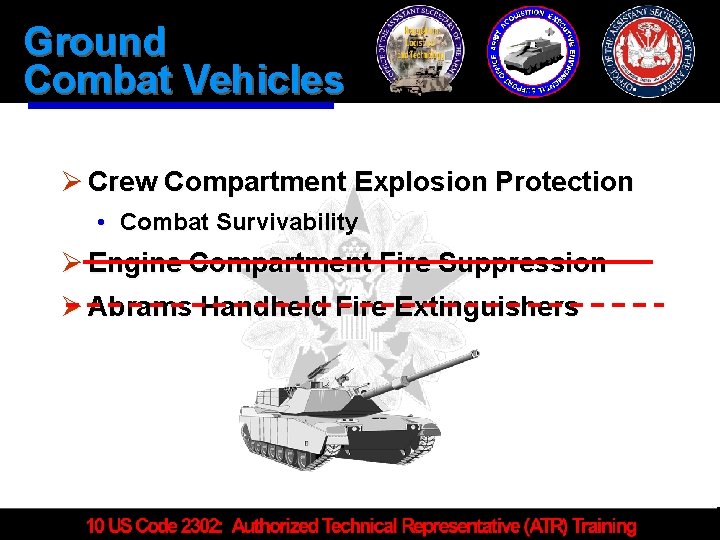
Ground Combat Vehicles Ø Crew Compartment Explosion Protection • Combat Survivability Ø Engine Compartment Fire Suppression Ø Abrams Handheld Fire Extinguishers
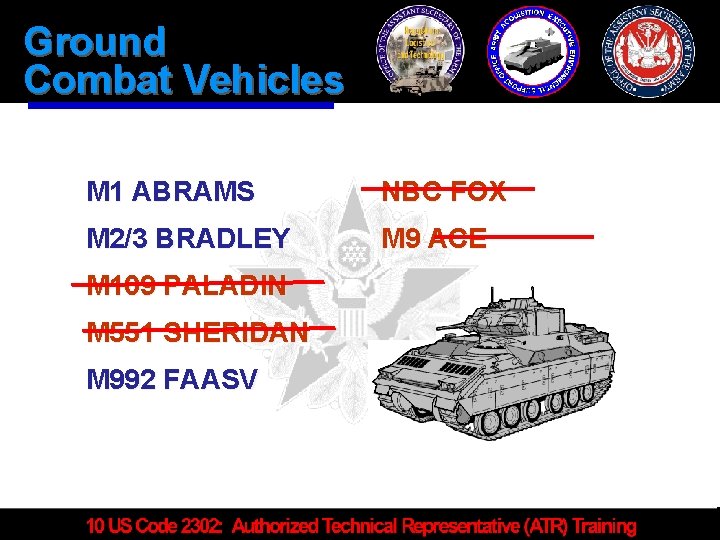
Ground Combat Vehicles M 1 ABRAMS NBC FOX M 2/3 BRADLEY M 9 ACE M 109 PALADIN M 551 SHERIDAN M 992 FAASV
Aviation CH-47 UH-60 AH-64 MI-24 Engine Nacelles Hand-held Fire Extinguishers UH-1 EO-5 AH-6 RC-12 C-20 C-27 C-31 UC-35 C-37 CH-47 OH-58 UH-60 AH-64 TH-67 UH-72
Watercraft D O Ø Landing Craft Utility (LCU) 1600 Ø Landing Craft Utility (LCU) 2000 Ø Landing Support Vehicle Ø Inland & Coastal Large Tug N E Machinery Spaces Flammable Storage
Facilities D O Ø Computer and Data Storage Rooms Ø Telecommunications Areas Ø Electronic Switch Gear Rooms N E Ø Uninterrupted Power Source (UPS) Ø Flight Simulators
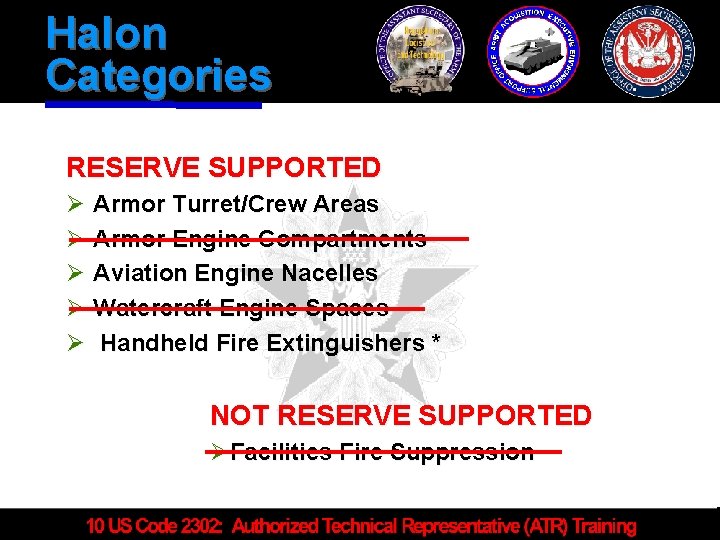
Halon Categories RESERVE SUPPORTED Ø Armor Turret/Crew Areas Ø Armor Engine Compartments Ø Aviation Engine Nacelles Ø Watercraft Engine Spaces Ø Handheld Fire Extinguishers * NOT RESERVE SUPPORTED ØFacilities Fire Suppression
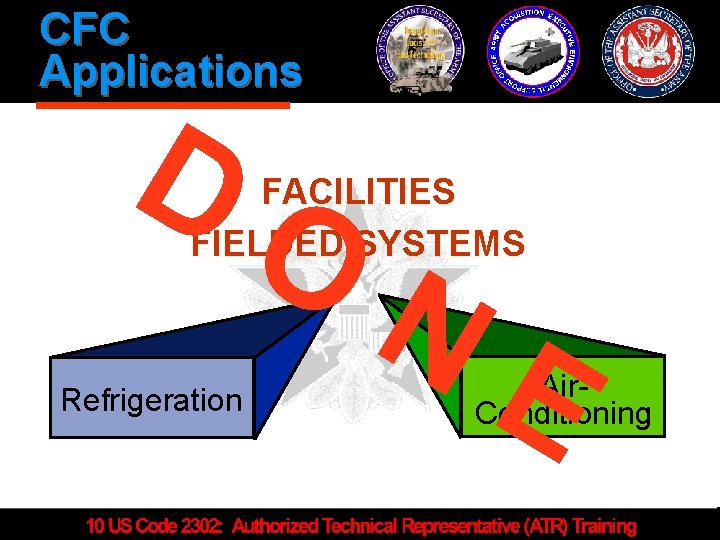
CFC Applications D O FACILITIES FIELDED SYSTEMS Refrigeration N E Air. Conditioning
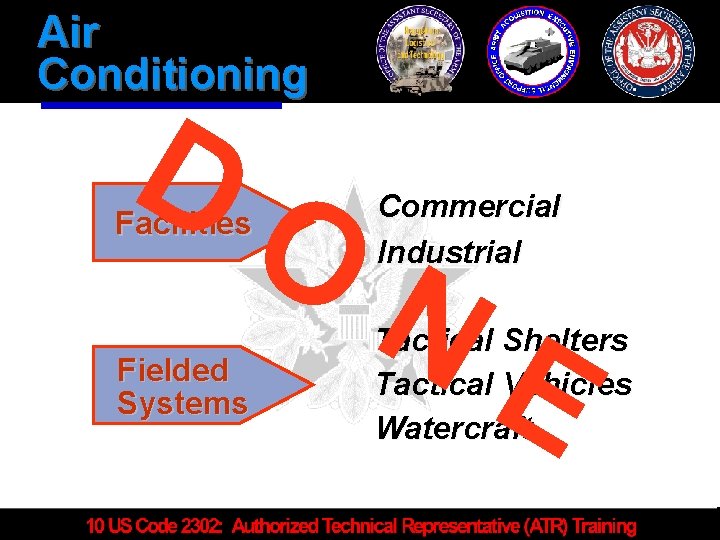
Air Conditioning D O Facilities Fielded Systems Commercial Industrial N E Tactical Shelters Tactical Vehicles Watercraft
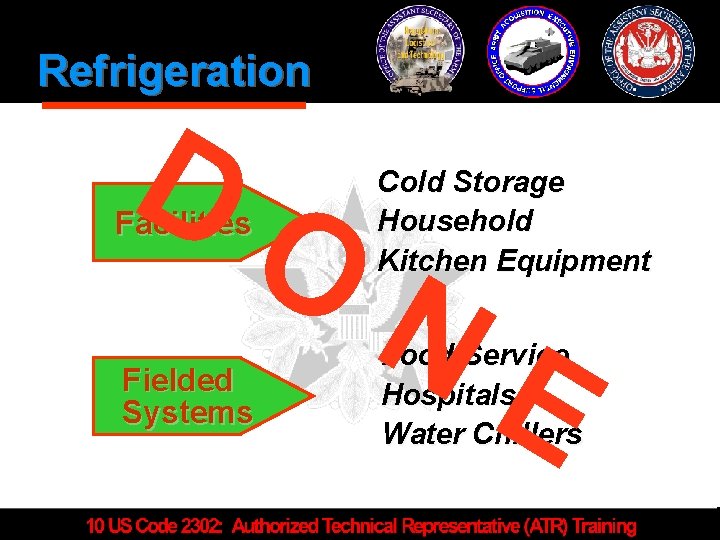
Refrigeration D O Facilities Fielded Systems Cold Storage Household Kitchen Equipment N E Food Service Hospitals Water Chillers
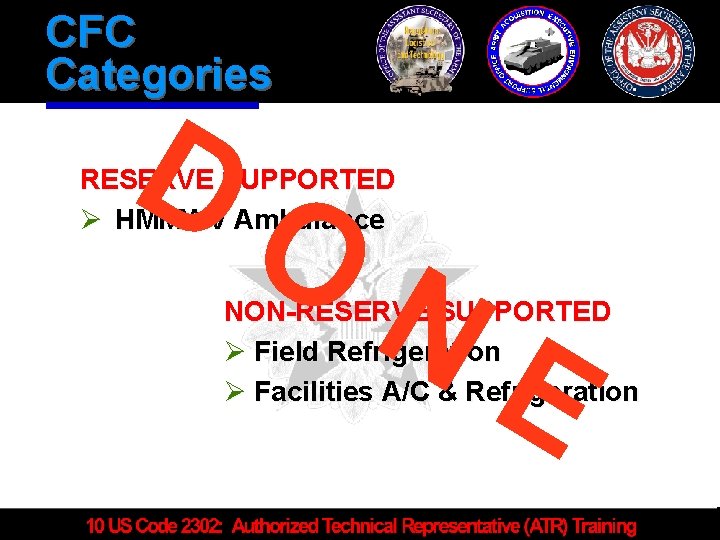
CFC Categories D O RESERVE SUPPORTED Ø HMMWV Ambulance N E NON-RESERVE SUPPORTED Ø Field Refrigeration Ø Facilities A/C & Refrigeration
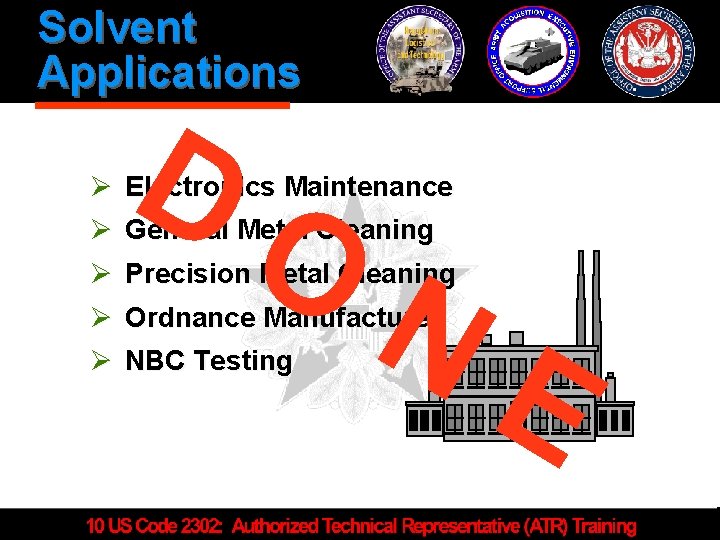
Solvent Applications Ø Ø D O Electronics Maintenance General Metal Cleaning N Ø Precision Metal Cleaning Ø Ordnance Manufacture Ø NBC Testing E
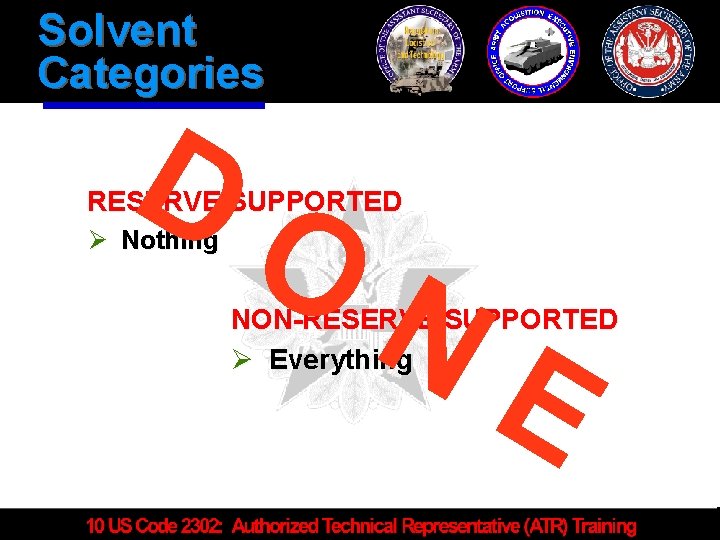
Solvent Categories D O RESERVE SUPPORTED Ø Nothing N E NON-RESERVE SUPPORTED Ø Everything
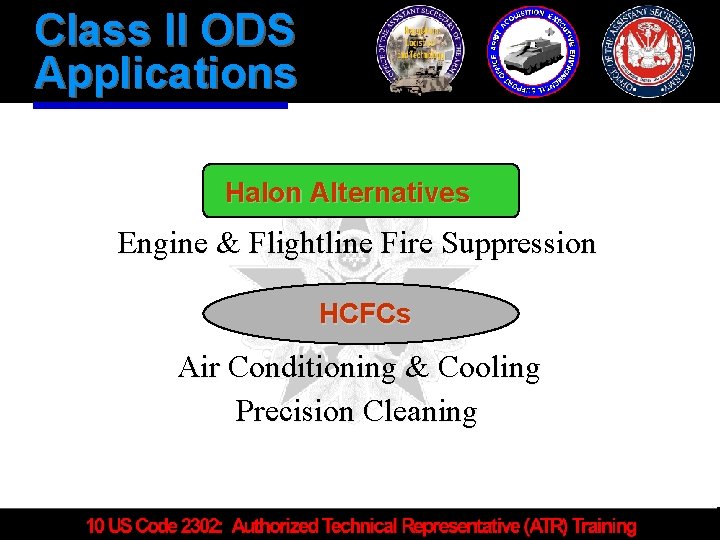
Class II ODS Applications Halon Alternatives Engine & Flightline Fire Suppression HCFCs Air Conditioning & Cooling Precision Cleaning
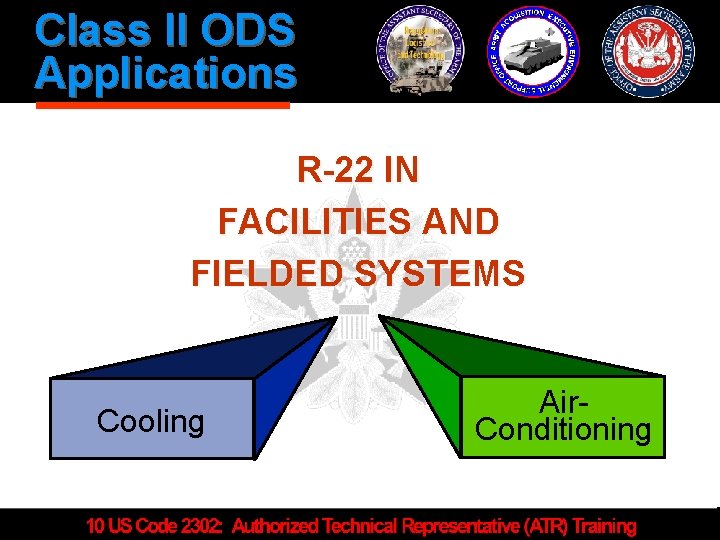
Class II ODS Applications R-22 IN FACILITIES AND FIELDED SYSTEMS Cooling Air. Conditioning
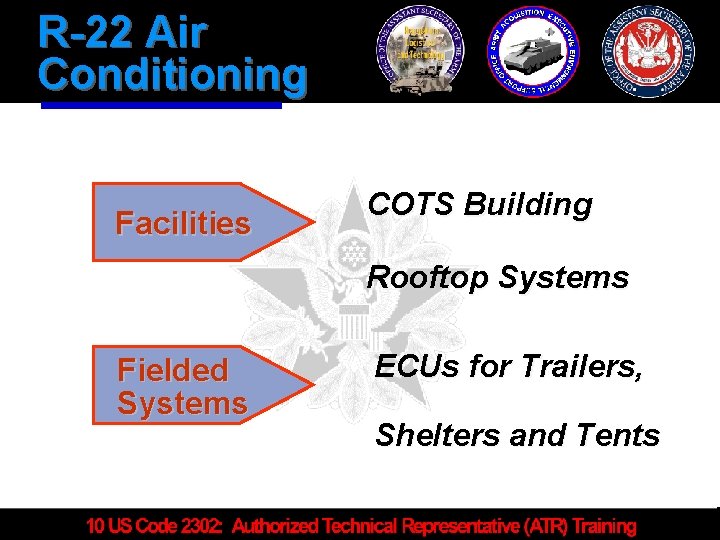
R-22 Air Conditioning Facilities COTS Building Rooftop Systems Fielded Systems ECUs for Trailers, Shelters and Tents
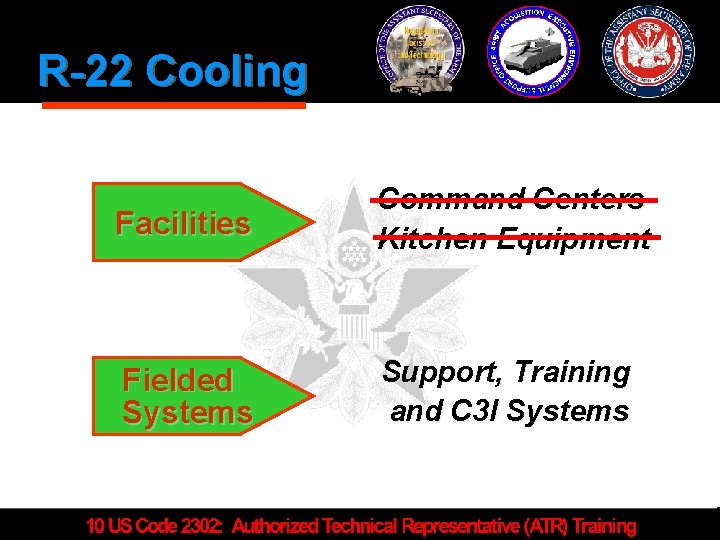
R-22 Cooling Facilities Command Centers Kitchen Equipment Fielded Systems Support, Training and C 3 I Systems
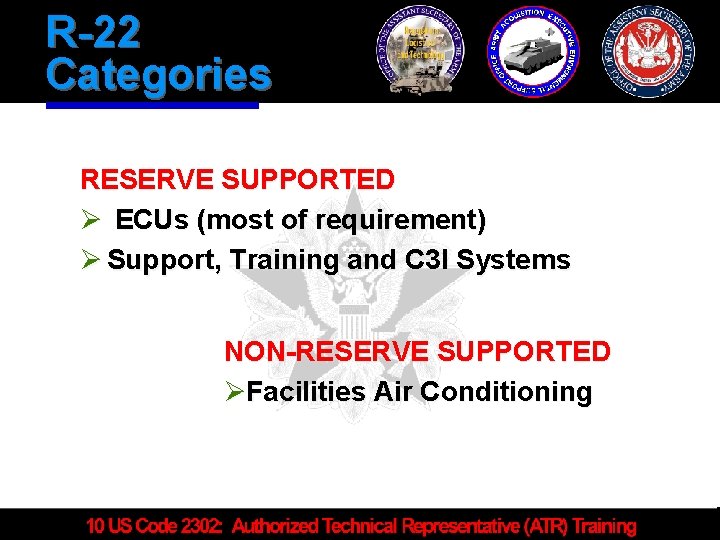
R-22 Categories RESERVE SUPPORTED Ø ECUs (most of requirement) Ø Support, Training and C 3 I Systems NON-RESERVE SUPPORTED ØFacilities Air Conditioning