
U S 2008 2013 Pork Industry Productivity Analysis

- Slides: 39
U. S. 2008 – 2013 Pork Industry Productivity Analysis J. Stock 1, C. E. Abell 1, C. Hostetler 2, and K. J. Stalder 1 1 Iowa State University, Ames, IA 50011 -3150 and National Pork Board, Des Moines, IA 50325 2014 Pork Academy Des Moines, IA June 4, 2014 IOWA STATE UNIVERSITY Department of Animal Science
Data Description Ø Production data obtained from a large U. S. data record keeping organization Ø Agreement with the National Pork Board to share limited information. ØUses: 1. Quantify the annual production levels and variation associated for several key productivity indicators 2. Establish industry benchmarks for all swine production phases Ø Breeding herd Ø Nursery Ø Wean – to – finish Ø Conventional finishing IOWA STATE UNIVERSITY Department of Animal Science
Data Description Ø Production data obtained from a large U. S. data record keeping organization Ø Agreement with the National Pork Board to share limited information. ØUses: 3. Quantify seasonal affects associated with the key productivity indicators 4. Identify research opportunities that would improve the U. S. pork industry production efficiency IOWA STATE UNIVERSITY Department of Animal Science
Data description Ø Statistical process Ø Industry Trends Ø Raw means and standard deviations were used Ø Seasonality evaluation Ø Linear model was used Ø Fixed effects Ø Company Ø Month Ø Year Ø Covariates – for nursery, grow-finish, and wean-to-finish Ø Start age Ø Start days Ø Days in facility Ø Covariates – Sow farm Ø Weaning age IOWA STATE UNIVERSITY Department of Animal Science
Data description cont’ Ø Data (records) reported monthly for each production phase Ø Nursery and finishing data – Ø Monthly averages are based on animals exiting the facility that month Ø Sow farm data – Ø Monthly averages are based on litters weaned in that month IOWA STATE UNIVERSITY Department of Animal Science
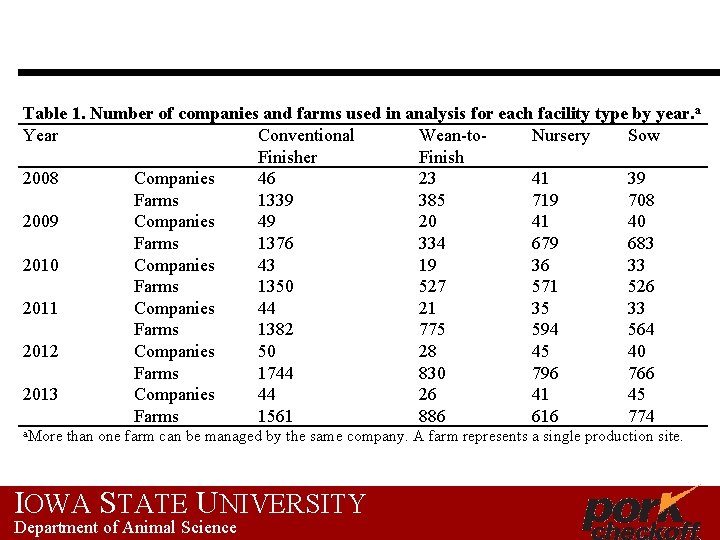
Table 1. Number of companies and farms used in analysis for each facility type by year. a Year Conventional Wean-to. Nursery Sow Finisher Finish 2008 Companies 46 23 41 39 Farms 1339 385 719 708 2009 Companies 49 20 41 40 Farms 1376 334 679 683 2010 Companies 43 19 36 33 Farms 1350 527 571 526 2011 Companies 44 21 35 33 Farms 1382 775 594 564 2012 Companies 50 28 45 40 Farms 1744 830 796 766 2013 Companies 44 26 41 45 Farms 1561 886 616 774 a. More than one farm can be managed by the same company. A farm represents a single production site. IOWA STATE UNIVERSITY Department of Animal Science
Company / farm summary Ø Increase in the number of companies and farms represented Ø Tremendous increase in the data volume evaluated Ø Results in improved information and interpretations that can be made Ø Companies becoming much more data driven in their decision making process IOWA STATE UNIVERSITY Department of Animal Science
Company / farm summary Ø Grow-finish and wean-to-finish becoming farms becoming more like their sow farm counterparts Ø Farm level decisions much more data driven Ø Continue greater use of data when guiding company decision process regarding: Ø Employee Ø Financial Ø Health Ø Nutritional Ø Genetic Ø Some combination IOWA STATE UNIVERSITY Department of Animal Science
Benchmarking - Why do it? Ø Compare with other businesses Ø Within species Ø Across species Ø Compare herd performance Ø Within company Ø Within country Ø Etc. Ø Set goals for improving herd Ø For a specific trait or several traits IOWA STATE UNIVERSITY Department of Animal Science
Overall Averages IOWA STATE UNIVERSITY Department of Animal Science
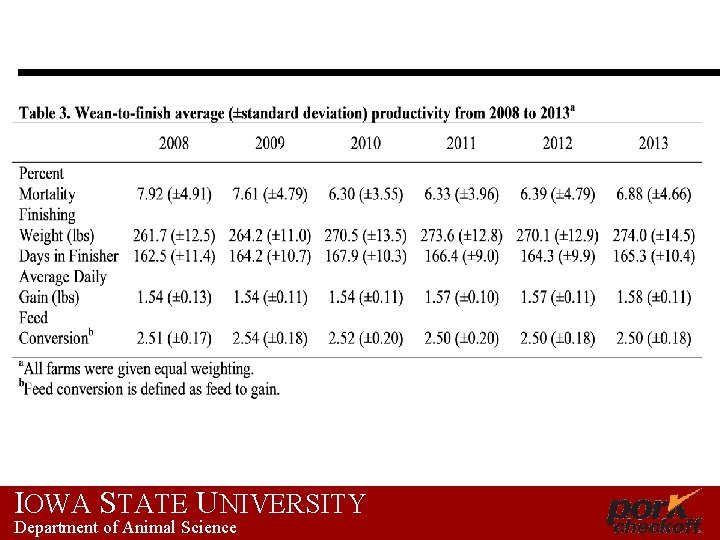
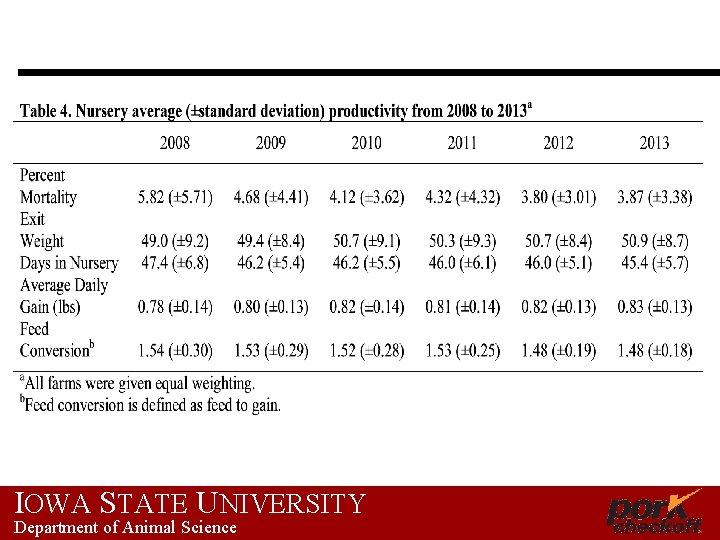
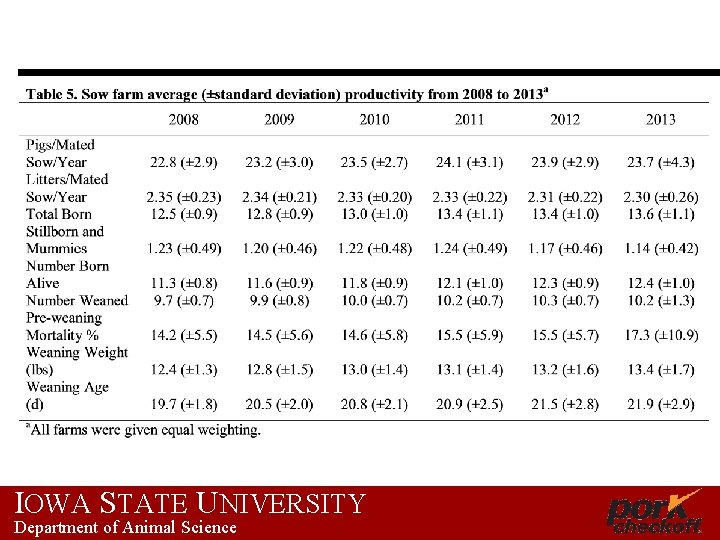
Key Productivity Indicator Averages Ø Means and standard deviations across all farms and operations. Ø Sow, nursery, wean-to-finish, and conventional growfinish data Ø Developed to examine yearly trends across the U. S. Swine industry. Ø Operations can compare one or a number of KPIs to see if they are above or below average IOWA STATE UNIVERSITY Department of Animal Science
IOWA STATE UNIVERSITY Department of Animal Science
IOWA STATE UNIVERSITY Department of Animal Science
IOWA STATE UNIVERSITY Department of Animal Science
IOWA STATE UNIVERSITY Department of Animal Science
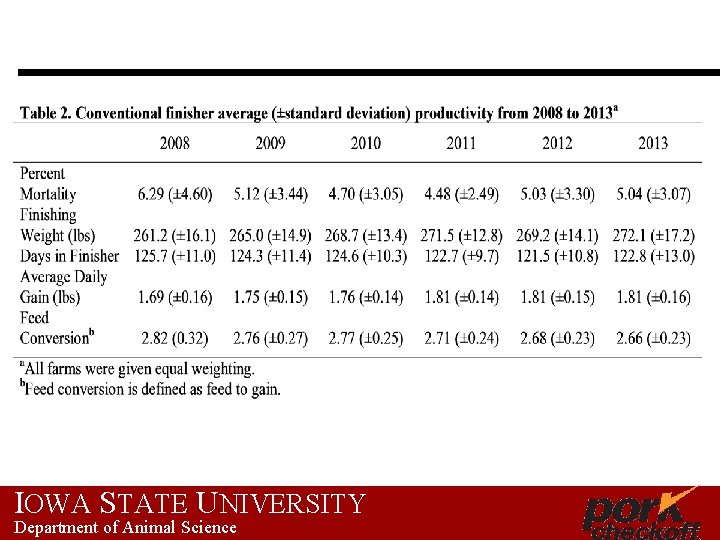
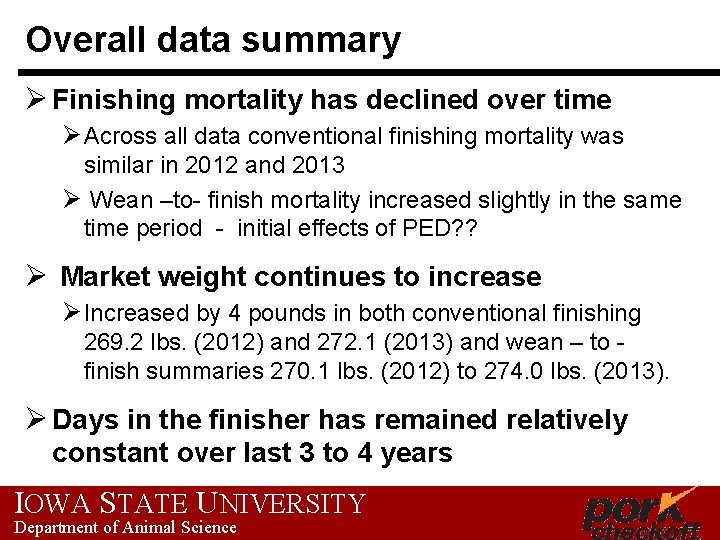
Overall data summary Ø Finishing mortality has declined over time Ø Across all data conventional finishing mortality was similar in 2012 and 2013 Ø Wean –to- finish mortality increased slightly in the same time period - initial effects of PED? ? Ø Market weight continues to increase Ø Increased by 4 pounds in both conventional finishing 269. 2 lbs. (2012) and 272. 1 (2013) and wean – to finish summaries 270. 1 lbs. (2012) to 274. 0 lbs. (2013). Ø Days in the finisher has remained relatively constant over last 3 to 4 years IOWA STATE UNIVERSITY Department of Animal Science
Overall data summary cont’ Ø Nursery performance has change little across the reporting time period Ø Pigs/mated sow/ year has increased by almost 2 pigs from 2008 to 2013. Ø Pigs/mated sow/ year was essentially the same between 2012 and 2013. Ø No improvement since 2011 Ø Why ? ? First signs of PED? ? Ø Again, litters/mated sow/year has changed little during the time period IOWA STATE UNIVERSITY Department of Animal Science
Overall data summary cont’ Ø Percent pre-weaning mortality has increased. Ø Increased in 2013 to 17. 3% from 15. 5% in 2012 Ø Early signs of PED? ? Ø Represents lost opportunity Ø Easy to improve? ? Ø Weaning age has increased by 2 days from 2008 to 2013. Ø 19. 7 days in 2008 to 21. 9 days in 2013 Ø Weaning weight has increased by 2 lb. IOWA STATE UNIVERSITY Department of Animal Science
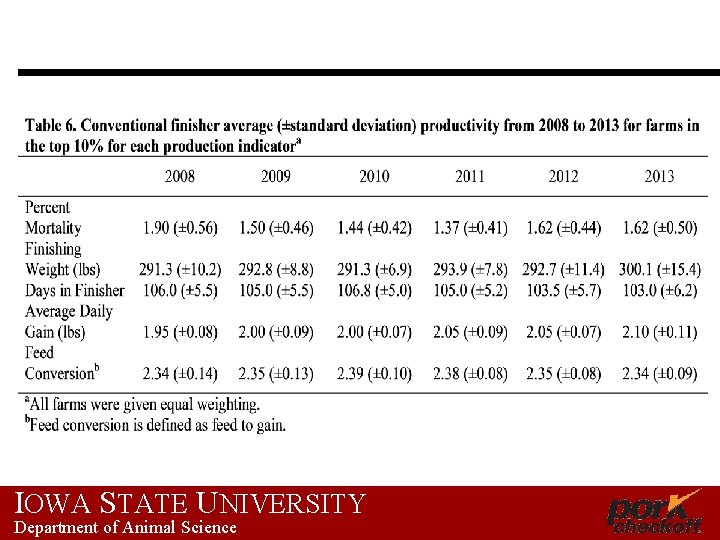
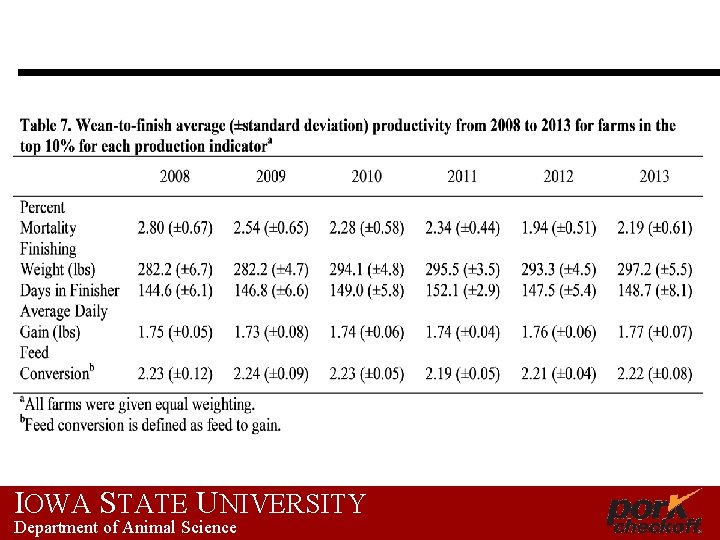
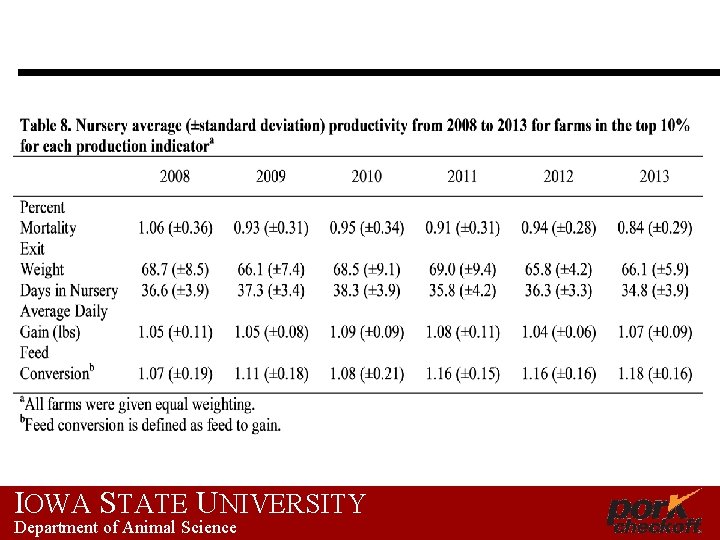
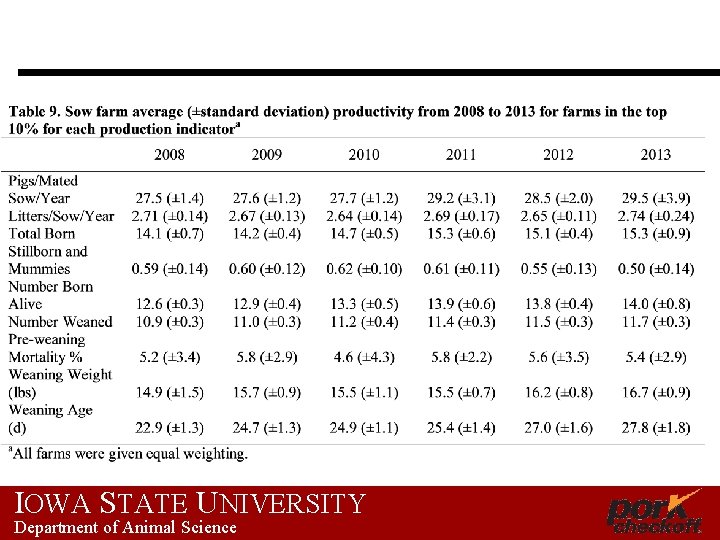
Table descriptions Ø Tables 6 -9 and 14 -17 have the average and standard deviation for each key productivity indicator by top 10% and bottom 25% of farms in each production stage, respectively. Ø Farms in each percentile were determined for each KPI Ø Farms in each percentile were not the same for each production indicator Ø The top and bottom were defined as desirable or undesirable for each trait (rather than higher or lower) IOWA STATE UNIVERSITY Department of Animal Science
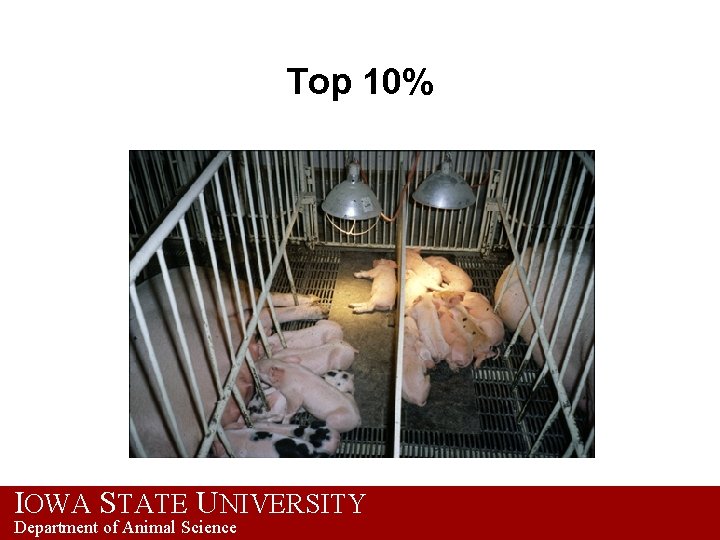
Top 10% IOWA STATE UNIVERSITY Department of Animal Science
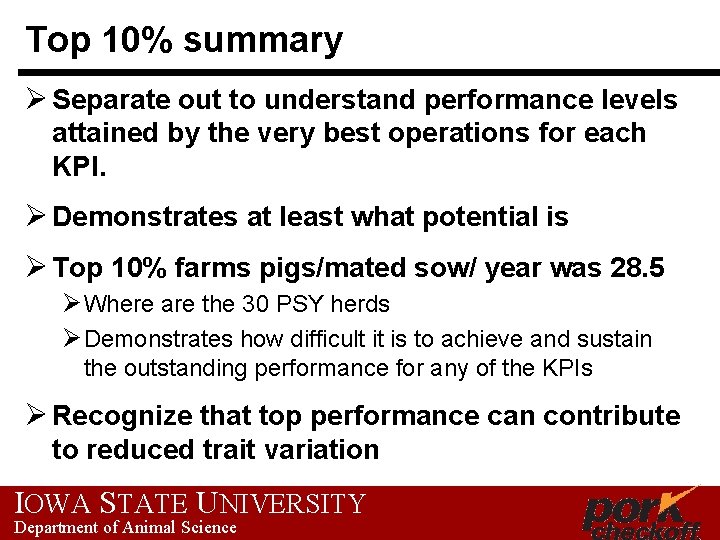
Top 10% summary Ø Separate out to understand performance levels attained by the very best operations for each KPI. Ø Demonstrates at least what potential is Ø Top 10% farms pigs/mated sow/ year was 28. 5 Ø Where are the 30 PSY herds Ø Demonstrates how difficult it is to achieve and sustain the outstanding performance for any of the KPIs Ø Recognize that top performance can contribute to reduced trait variation IOWA STATE UNIVERSITY Department of Animal Science
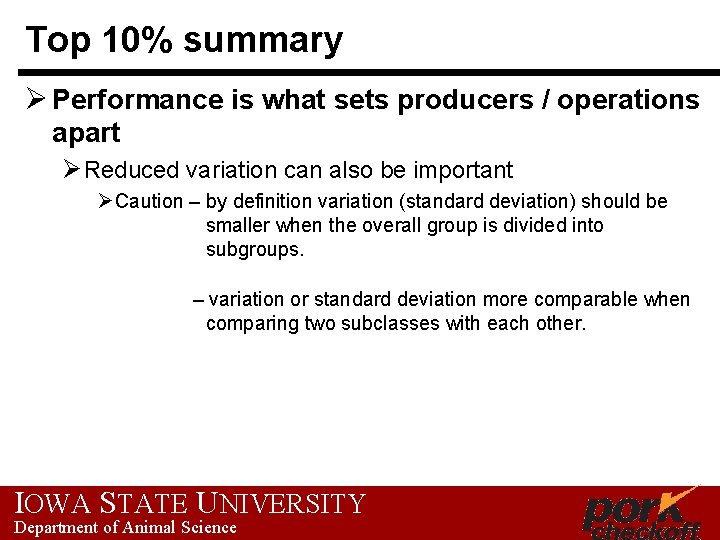
Top 10% summary Ø Performance is what sets producers / operations apart Ø Reduced variation can also be important Ø Caution – by definition variation (standard deviation) should be smaller when the overall group is divided into subgroups. – variation or standard deviation more comparable when comparing two subclasses with each other. IOWA STATE UNIVERSITY Department of Animal Science
IOWA STATE UNIVERSITY Department of Animal Science
IOWA STATE UNIVERSITY Department of Animal Science
IOWA STATE UNIVERSITY Department of Animal Science
IOWA STATE UNIVERSITY Department of Animal Science
Top 10% summary Ø Separate out to understand performance levels attained by the very best operations for each KPI. Ø Demonstrates at least what potential is Ø Recognize that top performance can contribute to reduced trait variation IOWA STATE UNIVERSITY Department of Animal Science
Top 10% summary Ø Represents above average performance for each KPI. Ø Does not describe the relationship with other KPIs and ability to maintain all at top 10%. Ø Can use this to establish goals for certain KPIs Ø Be sure that when setting goals they are attainable and are achievable in a reasonable time frame. Ø Realistic if you are in the bottom 25% to expect top 10% performance within 6 months of establish new goals Ø Goals that are set too high are not seen as incentives by barn workers IOWA STATE UNIVERSITY Department of Animal Science
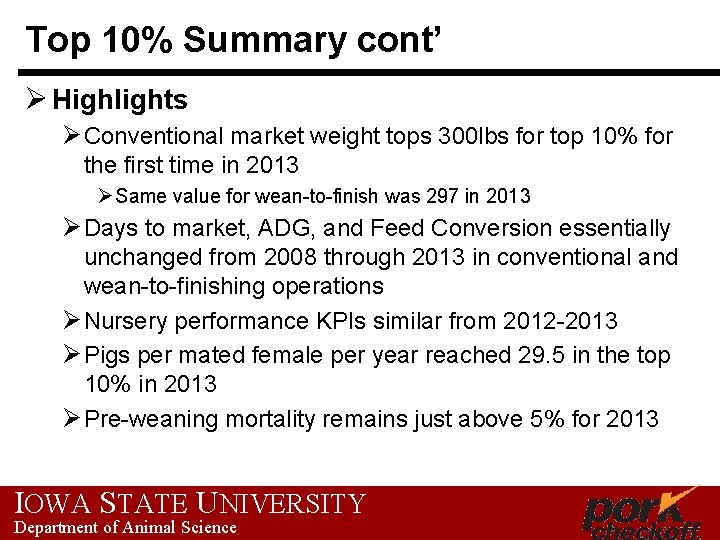
Top 10% Summary cont’ Ø Highlights Ø Conventional market weight tops 300 lbs for top 10% for the first time in 2013 Ø Same value for wean-to-finish was 297 in 2013 Ø Days to market, ADG, and Feed Conversion essentially unchanged from 2008 through 2013 in conventional and wean-to-finishing operations Ø Nursery performance KPIs similar from 2012 -2013 Ø Pigs per mated female per year reached 29. 5 in the top 10% in 2013 Ø Pre-weaning mortality remains just above 5% for 2013 IOWA STATE UNIVERSITY Department of Animal Science
Bottom 25% IOWA STATE UNIVERSITY Department of Animal Science
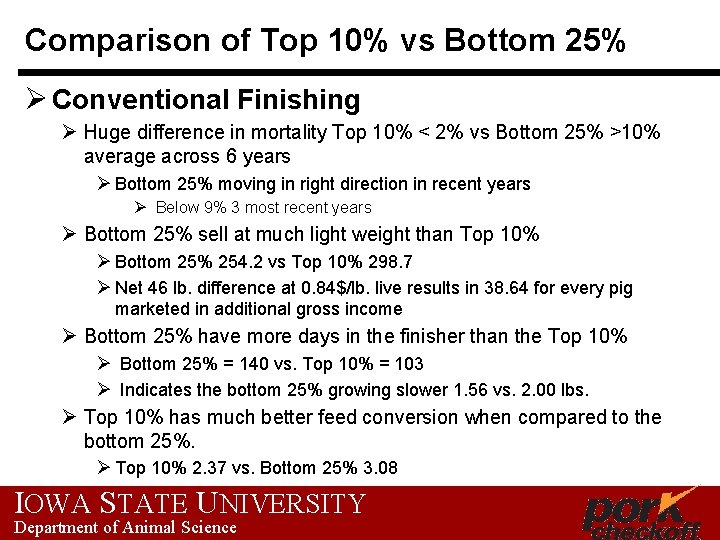
Comparison of Top 10% vs Bottom 25% Ø Conventional Finishing Ø Huge difference in mortality Top 10% < 2% vs Bottom 25% >10% average across 6 years Ø Bottom 25% moving in right direction in recent years Ø Below 9% 3 most recent years Ø Bottom 25% sell at much light weight than Top 10% Ø Bottom 25% 254. 2 vs Top 10% 298. 7 Ø Net 46 lb. difference at 0. 84$/lb. live results in 38. 64 for every pig marketed in additional gross income Ø Bottom 25% have more days in the finisher than the Top 10% Ø Bottom 25% = 140 vs. Top 10% = 103 Ø Indicates the bottom 25% growing slower 1. 56 vs. 2. 00 lbs. Ø Top 10% has much better feed conversion when compared to the bottom 25%. Ø Top 10% 2. 37 vs. Bottom 25% 3. 08 IOWA STATE UNIVERSITY Department of Animal Science
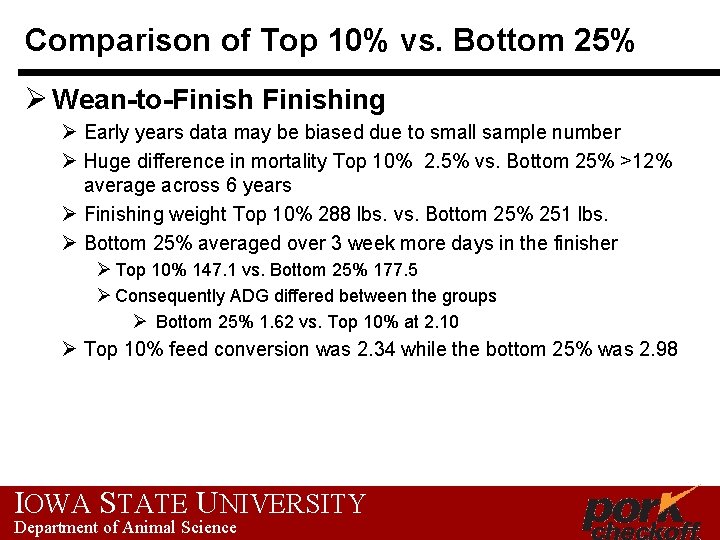
Comparison of Top 10% vs. Bottom 25% Ø Wean-to-Finishing Ø Early years data may be biased due to small sample number Ø Huge difference in mortality Top 10% 2. 5% vs. Bottom 25% >12% average across 6 years Ø Finishing weight Top 10% 288 lbs. vs. Bottom 25% 251 lbs. Ø Bottom 25% averaged over 3 week more days in the finisher Ø Top 10% 147. 1 vs. Bottom 25% 177. 5 Ø Consequently ADG differed between the groups Ø Bottom 25% 1. 62 vs. Top 10% at 2. 10 Ø Top 10% feed conversion was 2. 34 while the bottom 25% was 2. 98 IOWA STATE UNIVERSITY Department of Animal Science
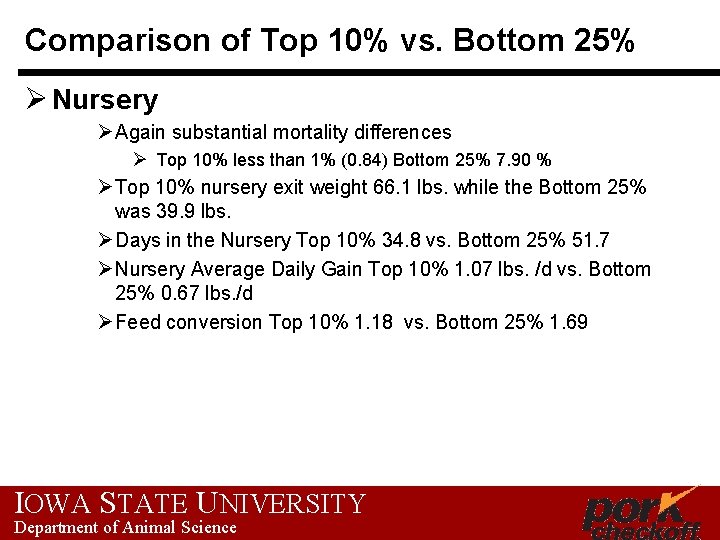
Comparison of Top 10% vs. Bottom 25% Ø Nursery Ø Again substantial mortality differences Ø Top 10% less than 1% (0. 84) Bottom 25% 7. 90 % Ø Top 10% nursery exit weight 66. 1 lbs. while the Bottom 25% was 39. 9 lbs. Ø Days in the Nursery Top 10% 34. 8 vs. Bottom 25% 51. 7 Ø Nursery Average Daily Gain Top 10% 1. 07 lbs. /d vs. Bottom 25% 0. 67 lbs. /d Ø Feed conversion Top 10% 1. 18 vs. Bottom 25% 1. 69 IOWA STATE UNIVERSITY Department of Animal Science
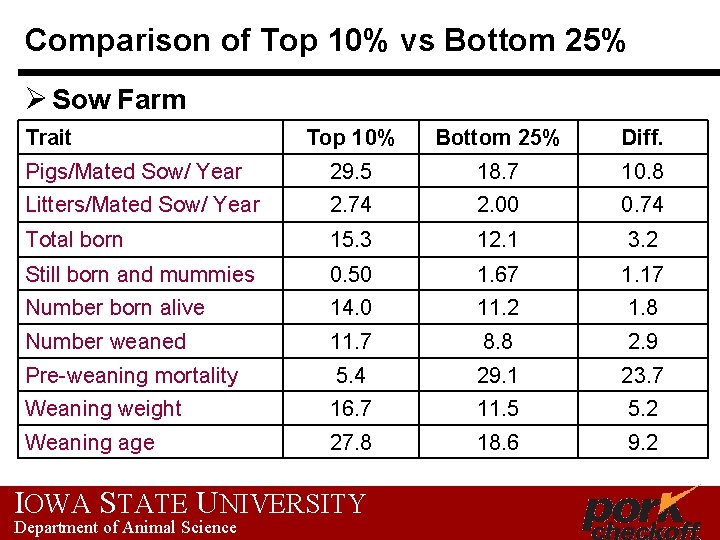
Comparison of Top 10% vs Bottom 25% Ø Sow Farm Trait Top 10% Bottom 25% Diff. Pigs/Mated Sow/ Year 29. 5 18. 7 10. 8 Litters/Mated Sow/ Year 2. 74 2. 00 0. 74 Total born 15. 3 12. 1 3. 2 Still born and mummies 0. 50 1. 67 1. 17 Number born alive 14. 0 11. 2 1. 8 Number weaned 11. 7 8. 8 2. 9 Pre-weaning mortality 5. 4 29. 1 23. 7 Weaning weight 16. 7 11. 5 5. 2 Weaning age 27. 8 18. 6 9. 2 IOWA STATE UNIVERSITY Department of Animal Science
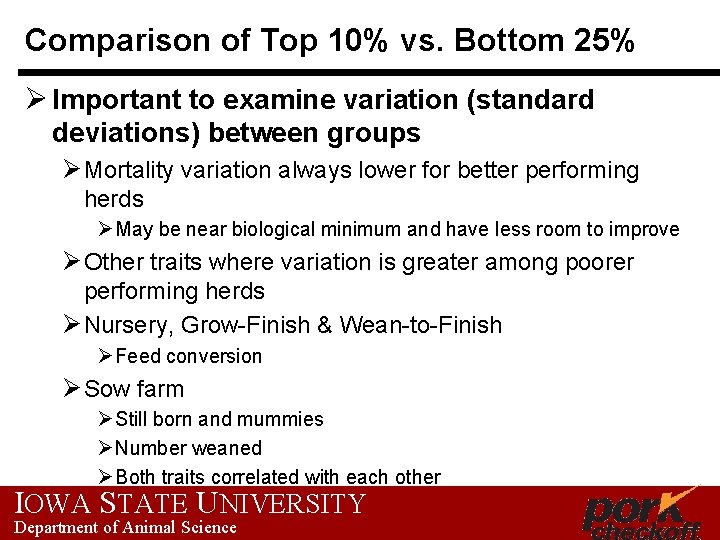
Comparison of Top 10% vs. Bottom 25% Ø Important to examine variation (standard deviations) between groups Ø Mortality variation always lower for better performing herds Ø May be near biological minimum and have less room to improve Ø Other traits where variation is greater among poorer performing herds Ø Nursery, Grow-Finish & Wean-to-Finish Ø Feed conversion Ø Sow farm Ø Still born and mummies Ø Number weaned Ø Both traits correlated with each other IOWA STATE UNIVERSITY Department of Animal Science
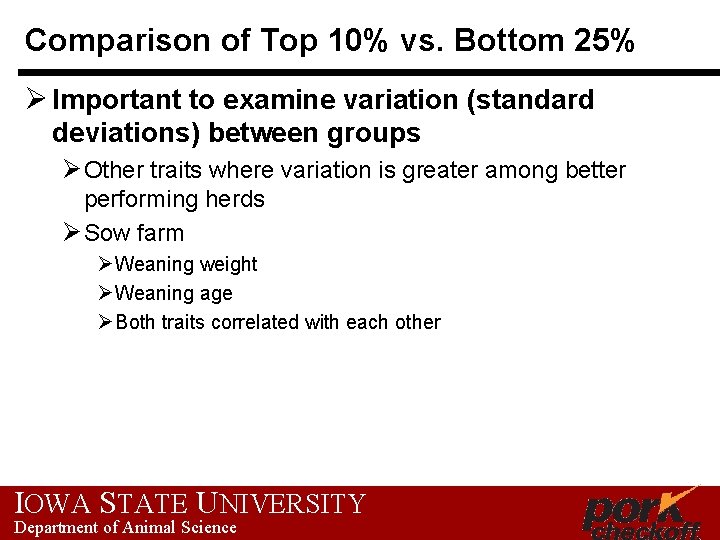
Comparison of Top 10% vs. Bottom 25% Ø Important to examine variation (standard deviations) between groups Ø Other traits where variation is greater among better performing herds Ø Sow farm Ø Weaning weight Ø Weaning age Ø Both traits correlated with each other IOWA STATE UNIVERSITY Department of Animal Science
Additional information available Ø Plots of averages Ø Top 25% Ø Average Ø Bottom 25% Ø Examine rate of change over time across relative productivity levels Ø Seasonality estimates Ø Monthly averages across time using a more sophisticated statistical model Ø Seasonality estimates tables – sets one month to average 0 and compares other months relative to the average month IOWA STATE Usummary NIVERSITY Ø Seasonality Department of Animal Science
Full Report Ø The full report can be found at: www. pork. org/animalscience IOWA STATE UNIVERSITY Department of Animal Science
Thank you for your time and attention ! Do you have any questions or comments? IOWA STATE UNIVERSITY Department of Animal Science