
U n o c E 6 t i

- Slides: 78
U n o c E 6 t i n e G c i m o y h p a r g o 2012 g n i r Sp sher m i r h c S Vicky
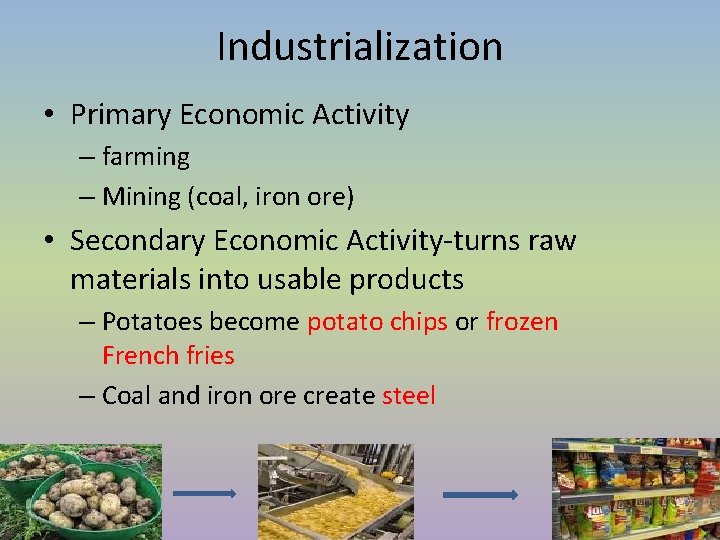
Industrialization • Primary Economic Activity – farming – Mining (coal, iron ore) • Secondary Economic Activity-turns raw materials into usable products – Potatoes become potato chips or frozen French fries – Coal and iron ore create steel
• Tertiary Economic Activity- focus on moving, selling, and trading the products made in the primary and secondary sector; also includes financial services, such as banks, carpet cleaning businesses, and fast-food restaurants – Quaternary Economic Activity- involves information creation and transfer; assemble, distribute, and process information; manage other business operations (University research and investment analysis are examples) – Quinary Economic Activity- involves the highest level of decision making like a legislature or president
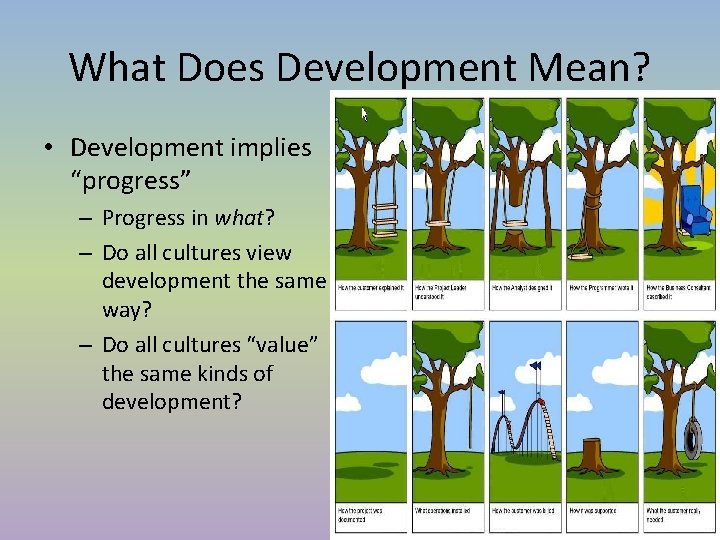
What Does Development Mean? • Development implies “progress” – Progress in what? – Do all cultures view development the same way? – Do all cultures “value” the same kinds of development?
3 Types of Economic Development 1. Primary Sector-agriculture, raising animals, fishing, forestry, and mining 2. Secondary Sector (industry)-refining petroleum, turning metals into tools or automobiles 3. Tertiary Sector (service)-construction, trade, finance, real estate, private services, government, and transportation
• MDC-More developed country (core) • LDC- Less developed country (periphery) • NIC- Newly Industrialized Country – Examples: South Korea transformed to an industrialized country in 50 years. This is called compressed modernity. – Example: Mexico beginning in the 1980 s do to the oil industry – The Four Tigers
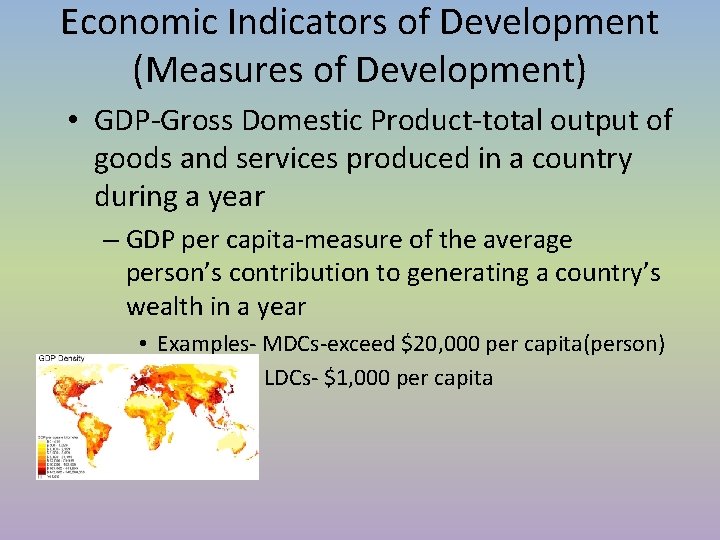
Economic Indicators of Development (Measures of Development) • GDP-Gross Domestic Product-total output of goods and services produced in a country during a year – GDP per capita-measure of the average person’s contribution to generating a country’s wealth in a year • Examples- MDCs-exceed $20, 000 per capita(person) LDCs- $1, 000 per capita
Measuring Development Continued… Gross National Product (GNP) Measure of the total value of the officially recorded goods and services produced by the citizens and corporations of a country in a given year. Includes things produced inside and outside a country’s territory. Gross National Income (GNI) Measure of the monetary worth of what is produced within a country plus income received from investments outside the country. ** Most common measurement used today.
Measures of Development Continued… • Big Mac Index- compares the prices of Mc. Donald’s Big Mac throughout the world; the more expensive the Big Mac the more developed the country • Types of Jobs – MDCs (Core)-few people in the primary sector; more in the tertiary – LDCs (Periphery)-Most in the primary sector – Newly Industrialized (semi-periphery)-all three sectors are represented
Measures of Development Continued… • United Nation’s Human Development Index (HDI) -measure of development that can be used to compare the various development levels of regions and countries. There are three factors considered: – Life expectancy – Average educational level – Standard of living (uses GDP as measure) • Worker Productivity – MDCs have access to machines, tools, and equipment – LDCs rely on human and animal power
Measures of Development Continued… • Access to raw materials • Availability of Consumer Goods – MDCs have money for essential and nonessential goods Essential Nonessential Food cars Shelter telephones Clothing televisions
Social development usually follows economic development. This includes: 1. Rates of literacy 2. Formal education 3. Better health care *Economic development also has an affect on life expectancy, CBR, and CDR
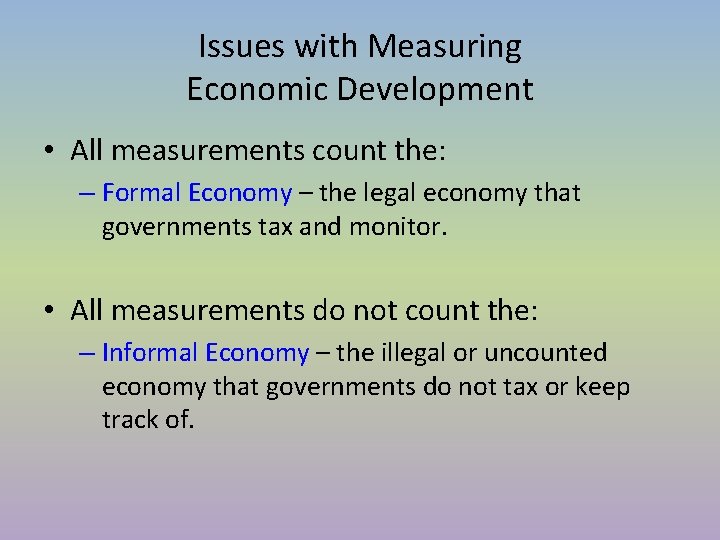
Issues with Measuring Economic Development • All measurements count the: – Formal Economy – the legal economy that governments tax and monitor. • All measurements do not count the: – Informal Economy – the illegal or uncounted economy that governments do not tax or keep track of.
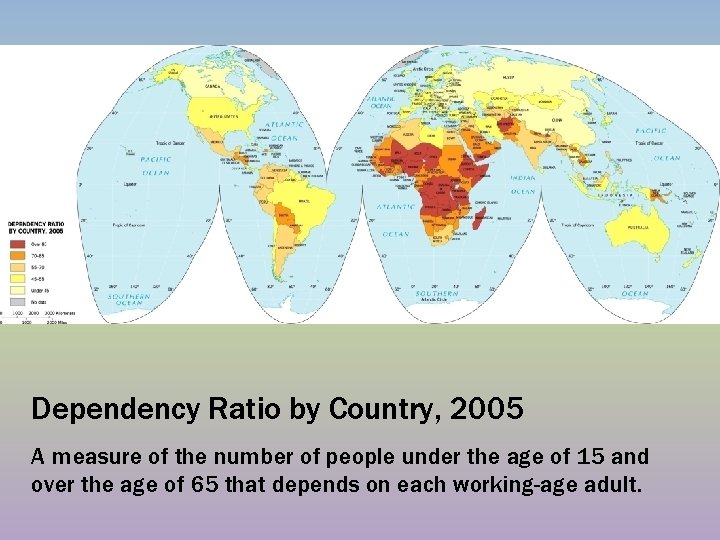
Dependency Ratio by Country, 2005 A measure of the number of people under the age of 15 and over the age of 65 that depends on each working-age adult.
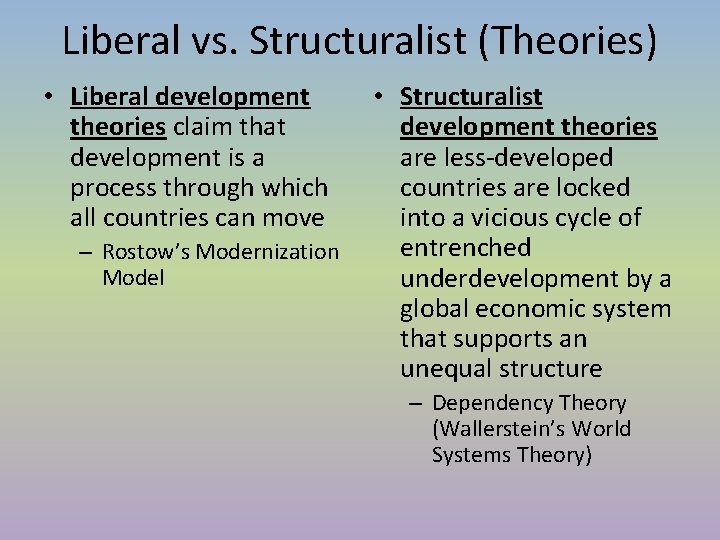
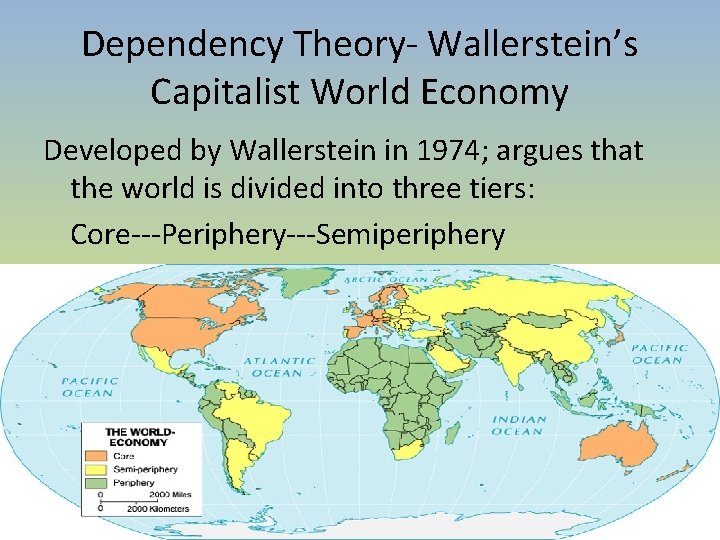
Liberal vs. Structuralist (Theories) • Liberal development theories claim that development is a process through which all countries can move – Rostow’s Modernization Model • Structuralist development theories are less-developed countries are locked into a vicious cycle of entrenched underdevelopment by a global economic system that supports an unequal structure – Dependency Theory (Wallerstein’s World Systems Theory)
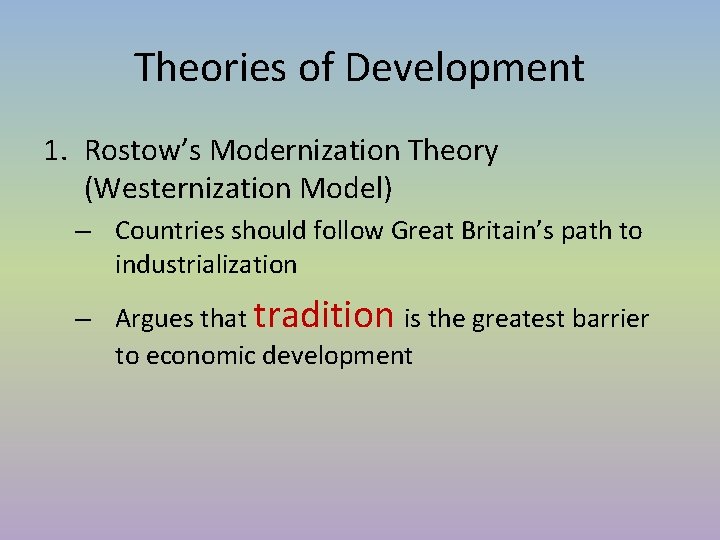
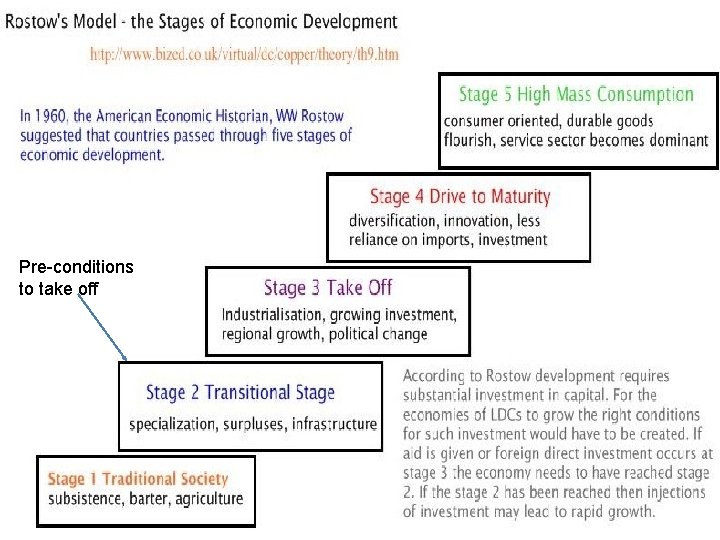
Theories of Development 1. Rostow’s Modernization Theory (Westernization Model) – Countries should follow Great Britain’s path to industrialization – Argues that tradition is the greatest barrier to economic development
Pre-conditions to take off
Dependency Theory- Wallerstein’s Capitalist World Economy Developed by Wallerstein in 1974; argues that the world is divided into three tiers: Core---Periphery---Semiperiphery
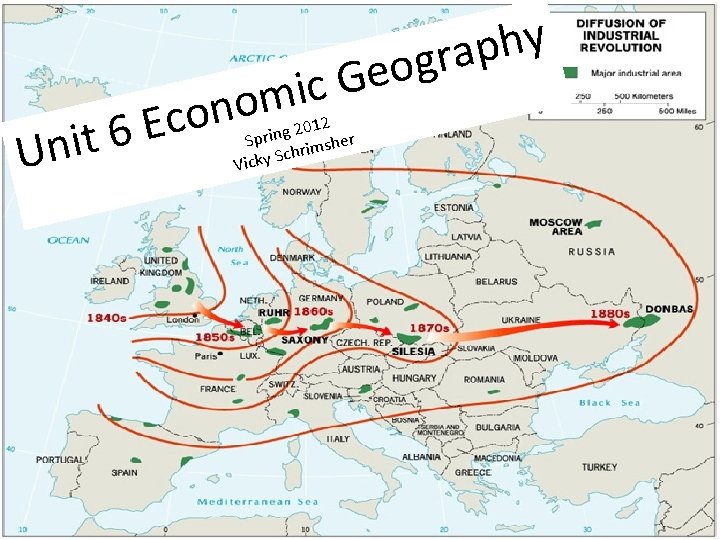
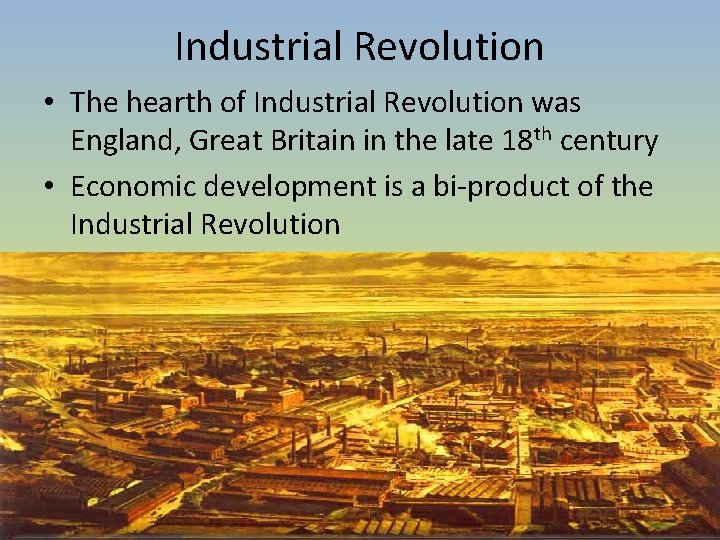
Industrial Revolution • The hearth of Industrial Revolution was England, Great Britain in the late 18 th century • Economic development is a bi-product of the Industrial Revolution
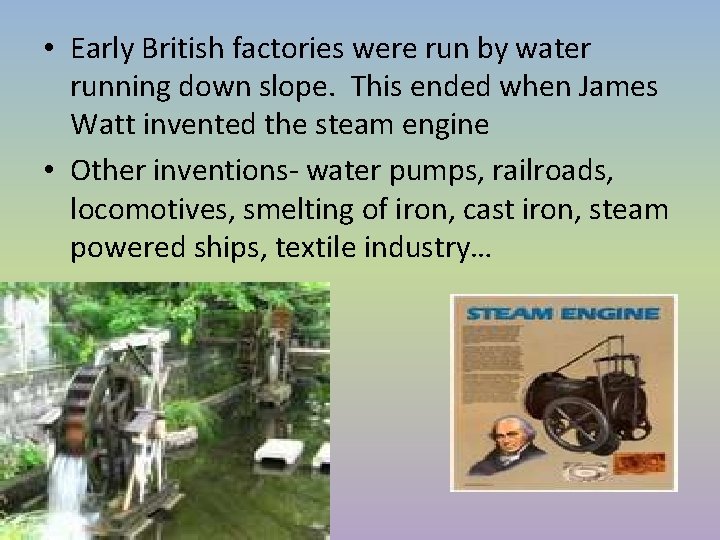
• Early British factories were run by water running down slope. This ended when James Watt invented the steam engine • Other inventions- water pumps, railroads, locomotives, smelting of iron, cast iron, steam powered ships, textile industry…
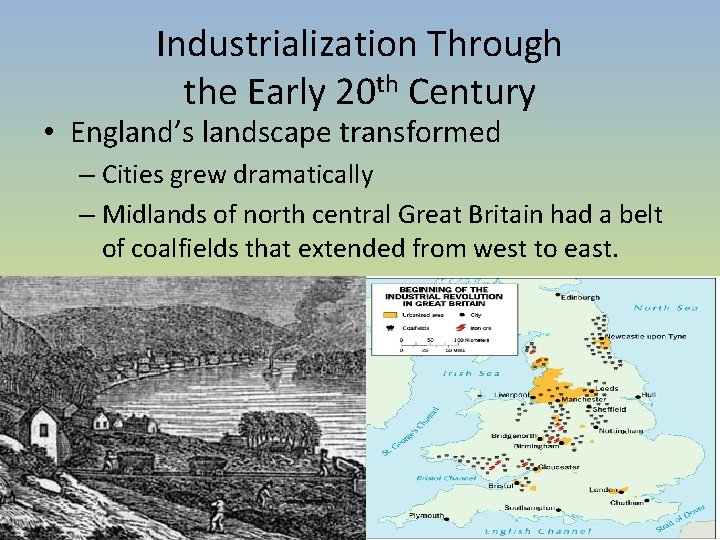
Industrialization Through the Early 20 th Century • England’s landscape transformed – Cities grew dramatically – Midlands of north central Great Britain had a belt of coalfields that extended from west to east.
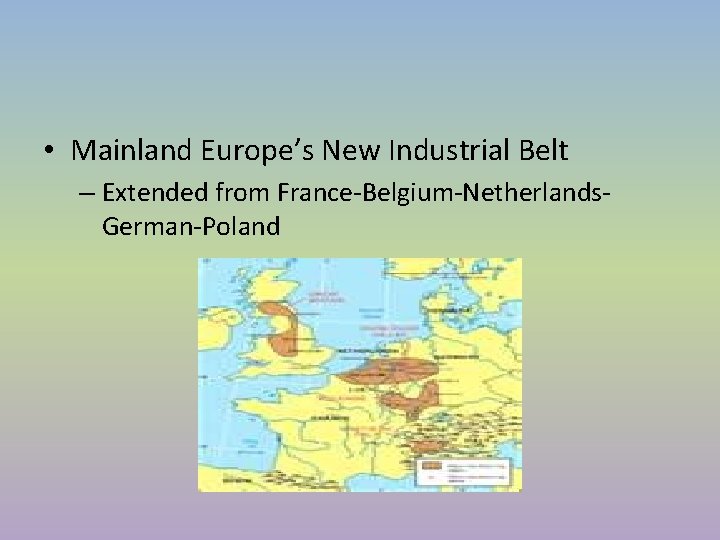
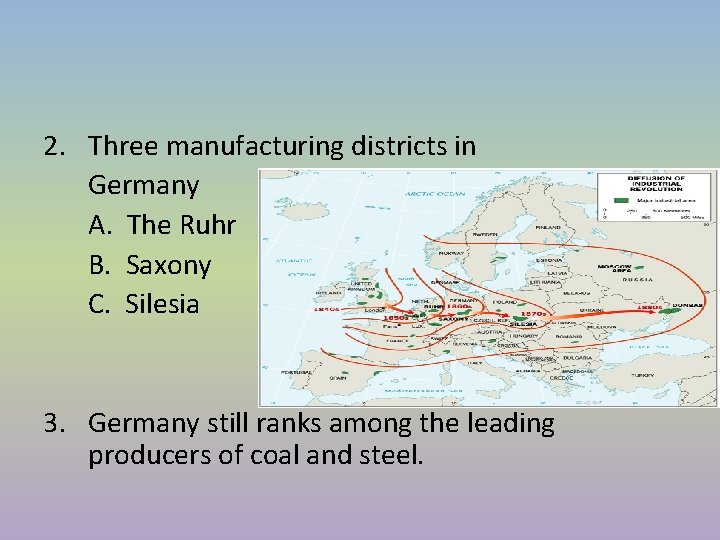
• Mainland Europe’s New Industrial Belt – Extended from France-Belgium-Netherlands. German-Poland
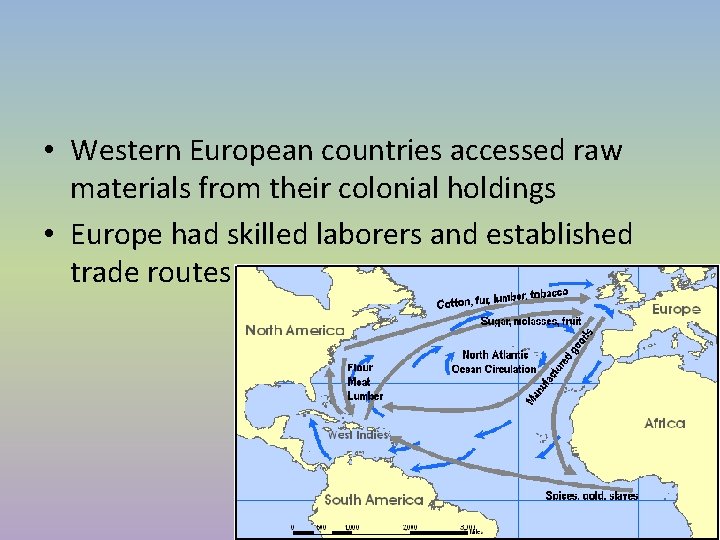
• Western European countries accessed raw materials from their colonial holdings • Europe had skilled laborers and established trade routes
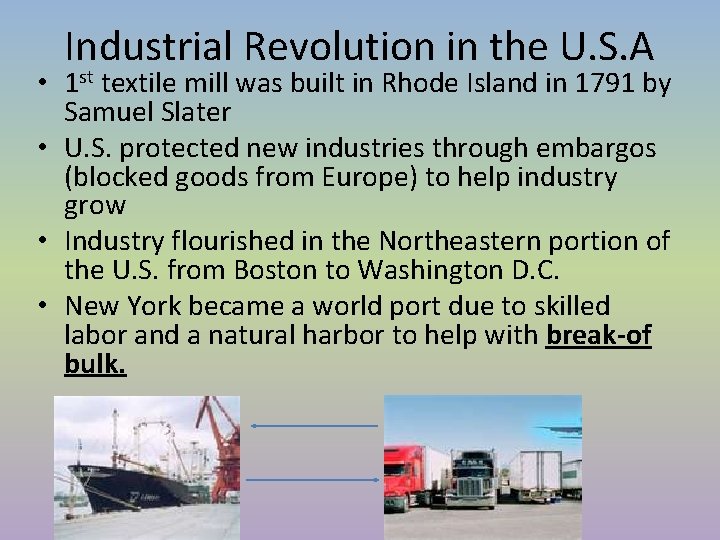
Industrial Revolution in the U. S. A • 1 st textile mill was built in Rhode Island in 1791 by Samuel Slater • U. S. protected new industries through embargos (blocked goods from Europe) to help industry grow • Industry flourished in the Northeastern portion of the U. S. from Boston to Washington D. C. • New York became a world port due to skilled labor and a natural harbor to help with break-of bulk.
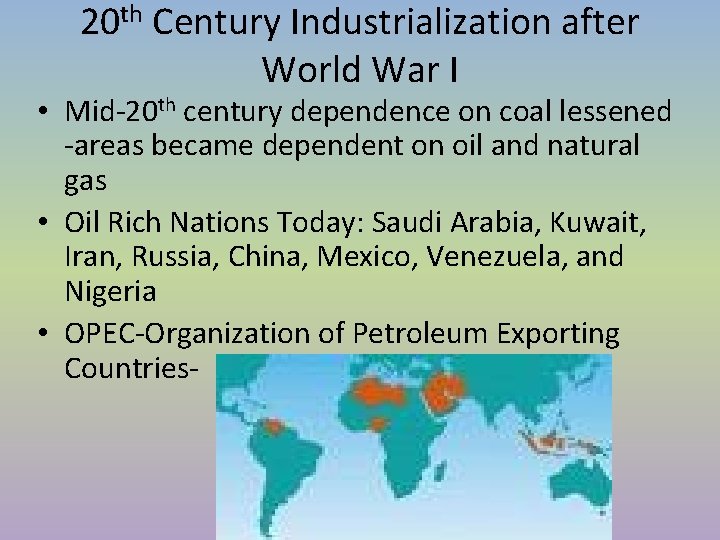
20 th Century Industrialization after World War I • Mid-20 th century dependence on coal lessened -areas became dependent on oil and natural gas • Oil Rich Nations Today: Saudi Arabia, Kuwait, Iran, Russia, China, Mexico, Venezuela, and Nigeria • OPEC-Organization of Petroleum Exporting Countries-
• • • OPEC Member Countries Algeria 1969 Angola 2007 Ecuador(**) rejoined 2007 Iran* 1960 Iraq* 1960 Kuwait* 1960 Libya 1962 Nigeria 1971 Qatar 1961 Saudi Arabia* 1960 United Arab Emirates 1967 Venezuela* 1960 *founder Members ** Ecuador joined OPEC in 1973, suspended its membership from Dec. 1992 -Oct. 2007
Economic Terms to Know
International trade approach- method of improving a country’s development that pushes the country to identify its unique set of strengths in the world and to channel investment toward building on these strengths. To compete internationally, this approach argues, a country must find out what it can offer the world and capitalize on that good or service.
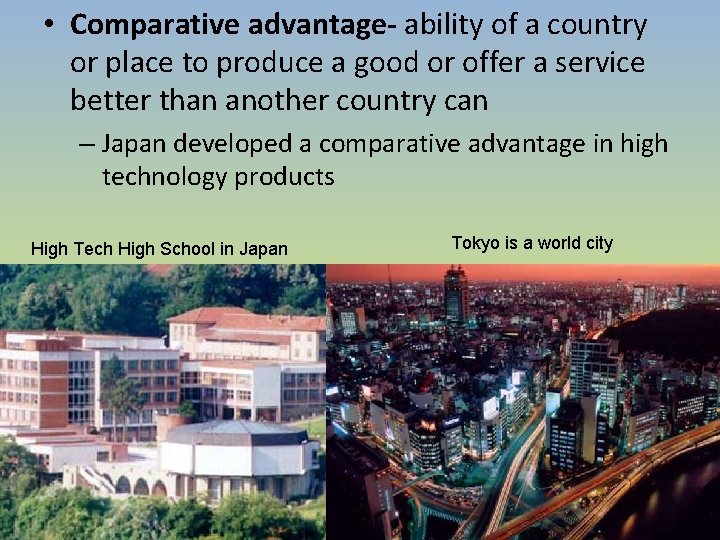
• Comparative advantage- ability of a country or place to produce a good or offer a service better than another country can – Japan developed a comparative advantage in high technology products High Tech High School in Japan Tokyo is a world city
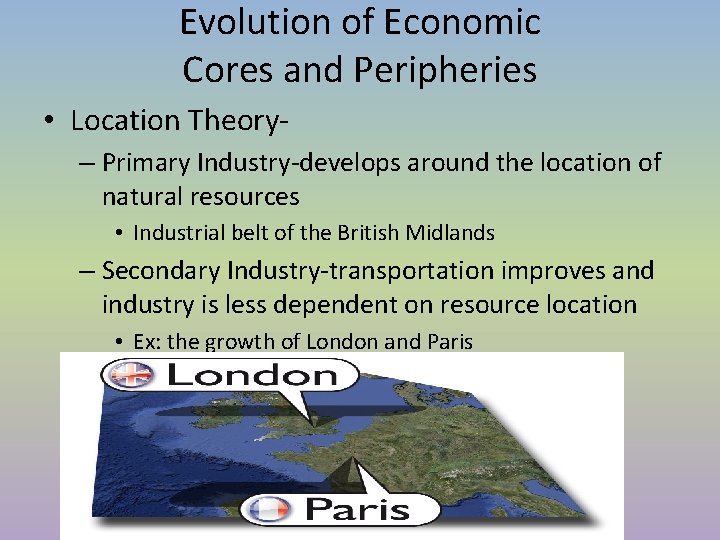
Evolution of Economic Cores and Peripheries • Location Theory– Primary Industry-develops around the location of natural resources • Industrial belt of the British Midlands – Secondary Industry-transportation improves and industry is less dependent on resource location • Ex: the growth of London and Paris
Location depends on… 1. Variable Costs 2. Friction of Distance 3. Distance Decay
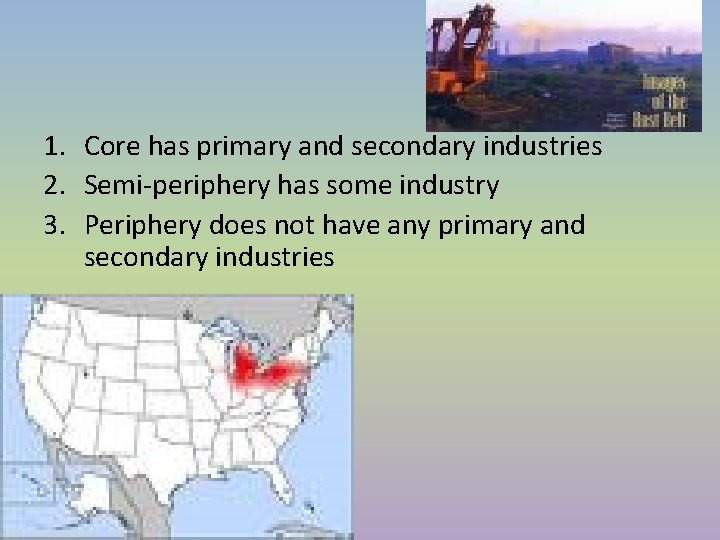
1. Core has primary and secondary industries 2. Semi-periphery has some industry 3. Periphery does not have any primary and secondary industries
Location Theories For Secondary Industries 1. Weber’s Least Cost Theory – – – Transportation (most important consideration) Labor Agglomeration (this sometimes leads to deglomeration)
Agglomeration-clustering of industries for mutual advantage • Agglomeration economy- factories in the same area can share cost associated with resources such as electrical lines, roads, pollution control, etc, which leads to lower costs for the consumer • High -Tech Corridor- a place where technology and computer industries agglomerate (Silicon Valley, CA) • Technopole- region of high tech agglomeration • Backwash effect- occurs when other regions suffer a drain of resources and talent due to agglomeration in another region
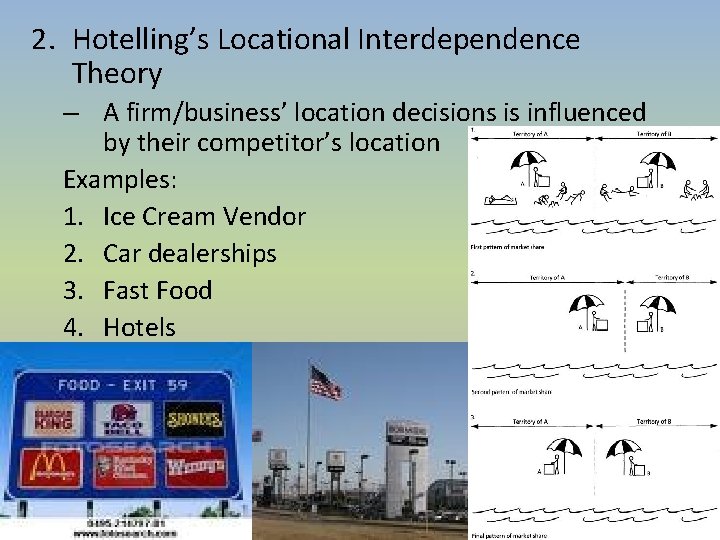
2. Hotelling’s Locational Interdependence Theory – A firm/business’ location decisions is influenced by their competitor’s location Examples: 1. Ice Cream Vendor 2. Car dealerships 3. Fast Food 4. Hotels
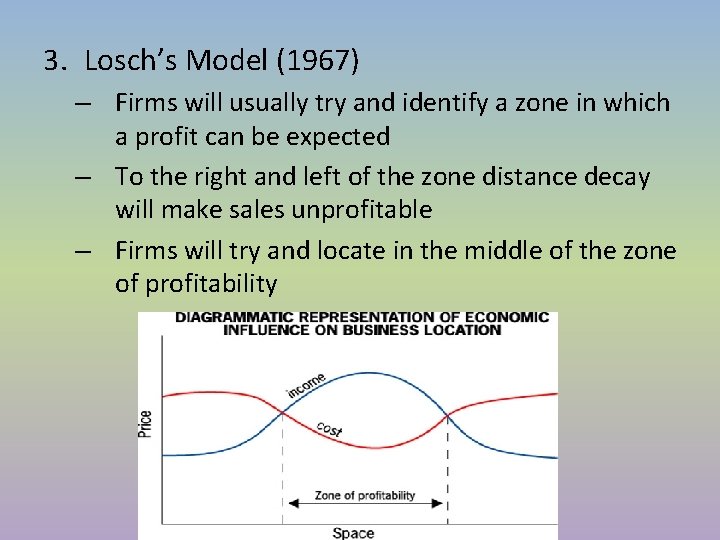
3. Losch’s Model (1967) – Firms will usually try and identify a zone in which a profit can be expected – To the right and left of the zone distance decay will make sales unprofitable – Firms will try and locate in the middle of the zone of profitability
Two types of production costs 1. Situation Factors – Transportation – Manufacturer tries to locate as close to the buyer and seller to cut costs – Bulk-reducing industries-raw materials are heavy and bulky, but finished product weighs less and takes up less room EX: North American Copper – Bulk-gaining industries-cans, bottles, containers, and ingredients are brought to the factory then combined– weight is gained EX: Cars and Soda
2. Site Factors-particular to a geographic area and focus on varying costs of land, labor, and capital EX: Modern factories are located in the suburbs or rural areas, Why? – Land costs in the center city promotes businesses that can locate in skyscrapers – Climate – Cost of labor – Business loans
Major Industrial Regions • • Western and Central Europe Eastern North America Russia and the Ukraine Eastern Asia
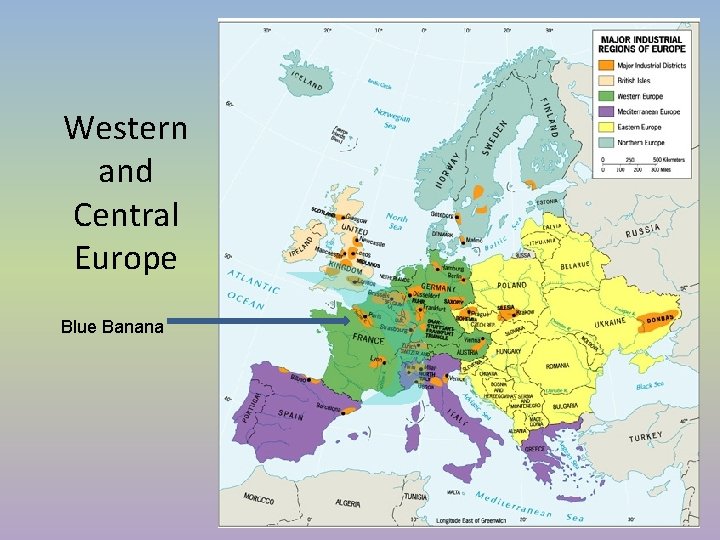
Western and Central Europe Blue Banana
Western and Central Europe 1. Experienced industrialization between 18 th and 20 th centuries A. ECSC-European Coal and Steel Community - EU would eventually evolve from this B. Coal deposits from France to southern Poland -refer to the map on page 371
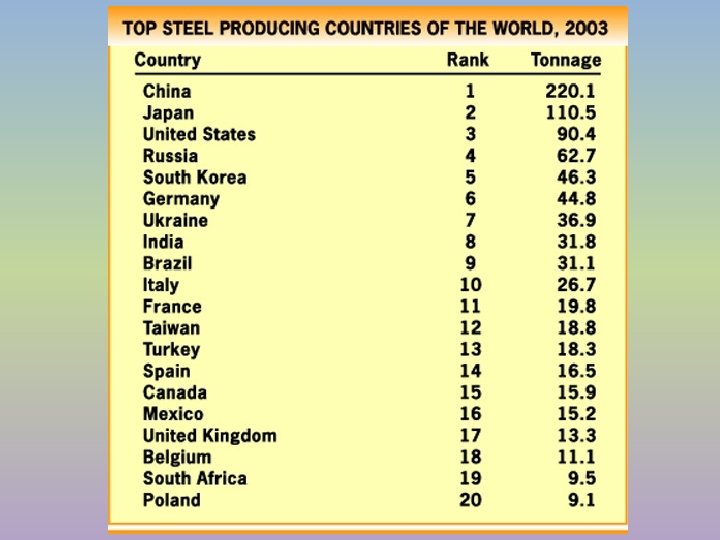
2. Three manufacturing districts in Germany A. The Ruhr B. Saxony C. Silesia 3. Germany still ranks among the leading producers of coal and steel.
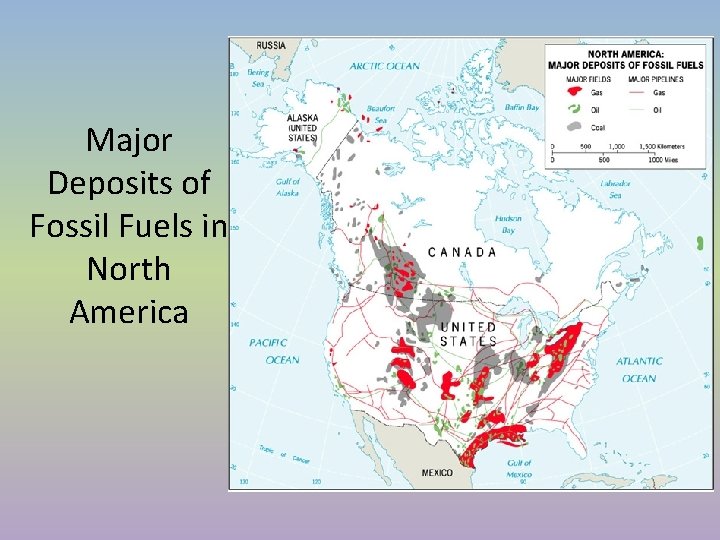
Major Deposits of Fossil Fuels in North America
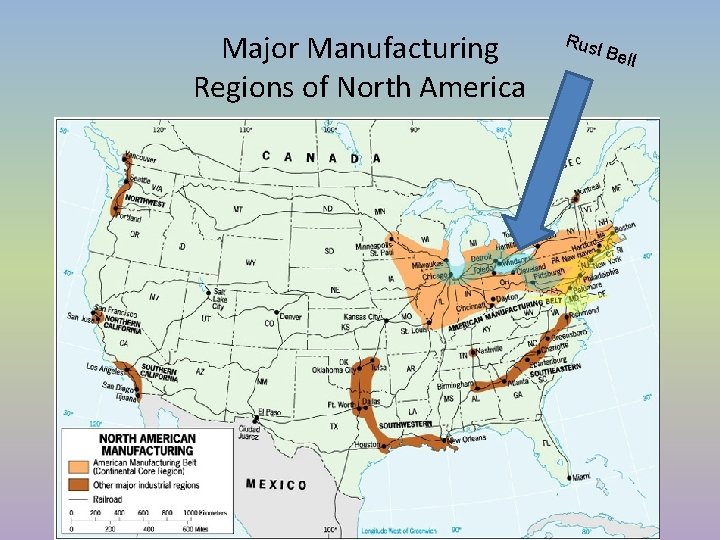
Major Manufacturing Regions of North America Rus t Be lt
North America 1. Only serious industrial rival to Europe 2. Coal was the chief fuel for industries A. U. S. coal reserves are among the world’s largest B. Found from the Appalachian Mountains to the Great Plains C. U. S. competes with China as the world’s largest coal producer
3. Steel industry A. Plants built on northeastern seaboard because the U. S. has to ship iron ore in B. Unload iron ore straight into the plant C. Distant ore deposits affected the location of industry in the U. S.
4. U. S. Benefited from the destruction that WWI brought Europe A. Gained political power B. Developed an infrastructure C. Highly trained workforce 5. The U. S. also gained industrial power after WWII
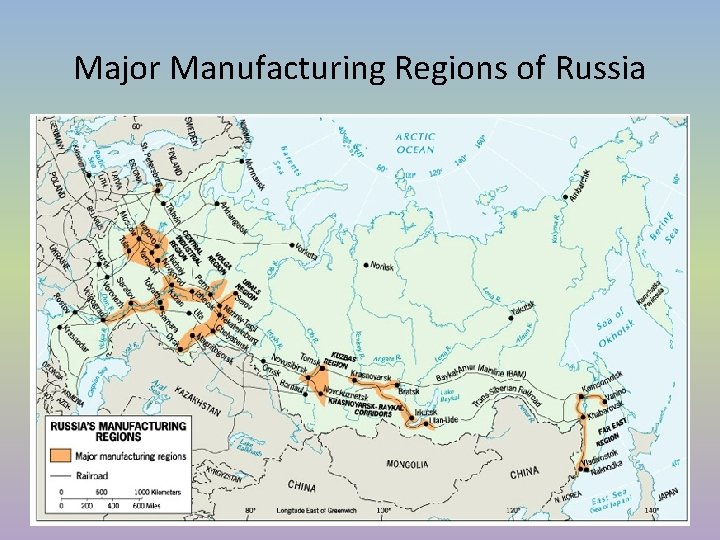
Major Manufacturing Regions of Russia
Former Soviet Union 1. Industrialization focused mainly on Western Russia (near Moscow) 2. Moscow offered A. Local markets B. Converging transportation routes C. Large labor force D. Strong centrality 3. Nizhni Novgorod became the “Soviet Detroit”
4. Ural Mountains yielded iron ore, copper, nickel, chromite, and bauxite 5. Krasnoyarsk-Baykal Corridor-many resources such as coal, timber, and water 6. St. Petersburg is one of the oldest manufacturing centers A. High quality machine building
B. Optical products C. Medical equipment D. Ship building 7. Volga has raw materials and convenient transportation; still one of Russia’s largest industrial regions due to improved infrastructure
8. The Ukraine Manufacturing Belt A. Annexed by the Soviets after WWII B. Produced 90% of coal for the Soviet Union, which helped the Soviet Union grow into the largest manufacturing complexes during the 20 th century
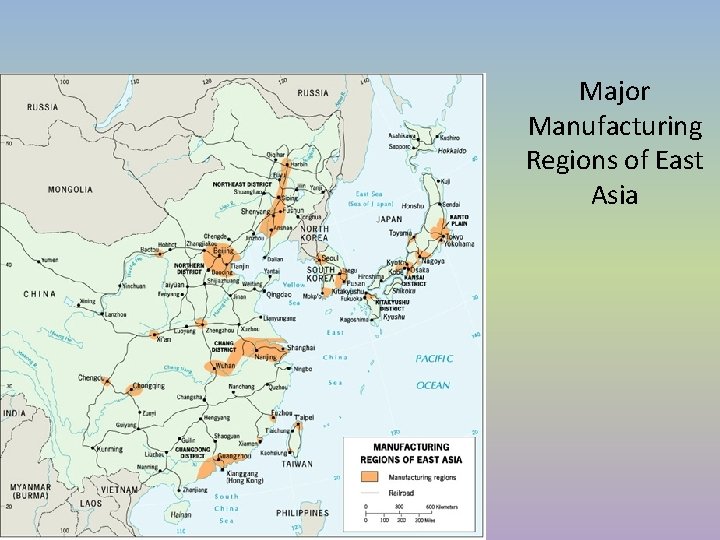
Major Manufacturing Regions of East Asia
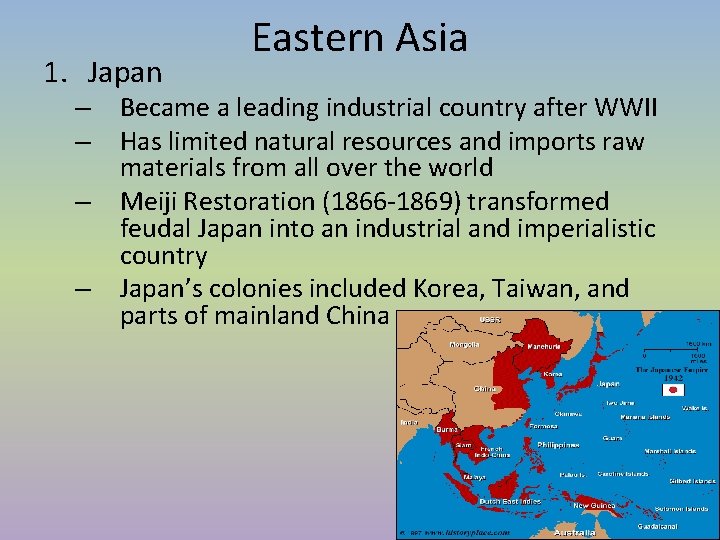
1. Japan – – Eastern Asia Became a leading industrial country after WWII Has limited natural resources and imports raw materials from all over the world Meiji Restoration (1866 -1869) transformed feudal Japan into an industrial and imperialistic country Japan’s colonies included Korea, Taiwan, and parts of mainland China
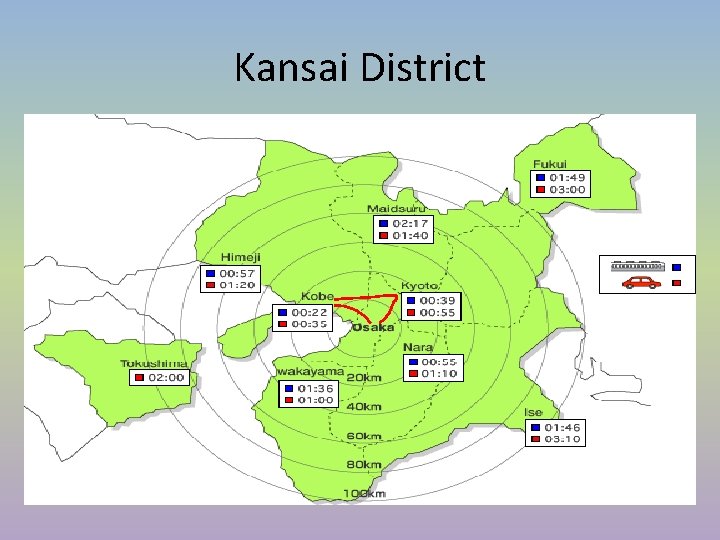
2. Japan’s Manufacturing Belt – Kanto Plain includes Tokyo-Yokohama. Kawasaki metropolitan areas that produces 20% of Japan’s national output – Kansai District: Kobe-Kyoto-Osaka triangle – – 2 nd largest industrial area Steel mills, chemical production, auto, shipbuilding, and textile factories
Kanto Plain
Kansai District
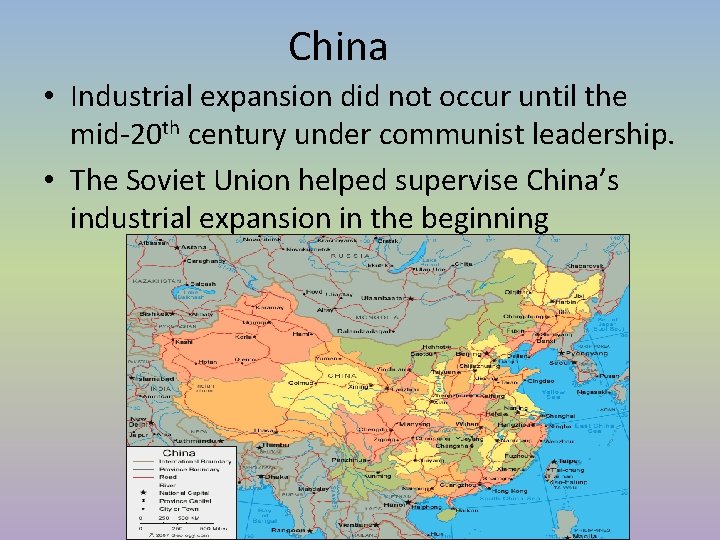
China • Industrial expansion did not occur until the mid-20 th century under communist leadership. • The Soviet Union helped supervise China’s industrial expansion in the beginning
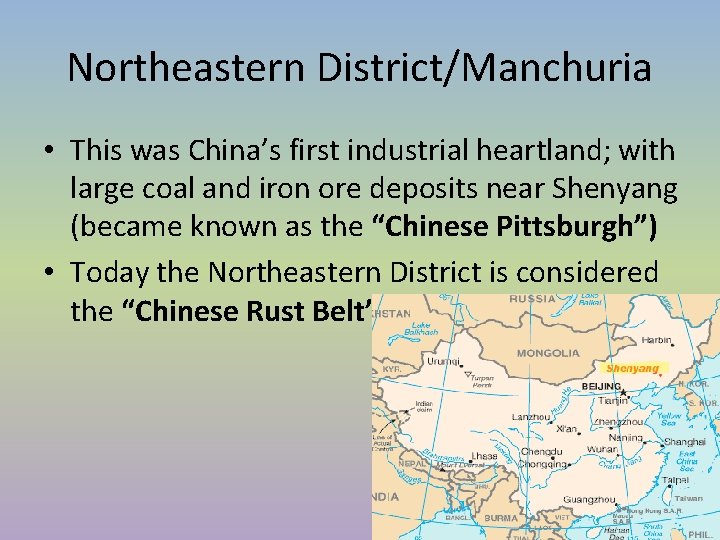
Northeastern District/Manchuria • This was China’s first industrial heartland; with large coal and iron ore deposits near Shenyang (became known as the “Chinese Pittsburgh”) • Today the Northeastern District is considered the “Chinese Rust Belt”
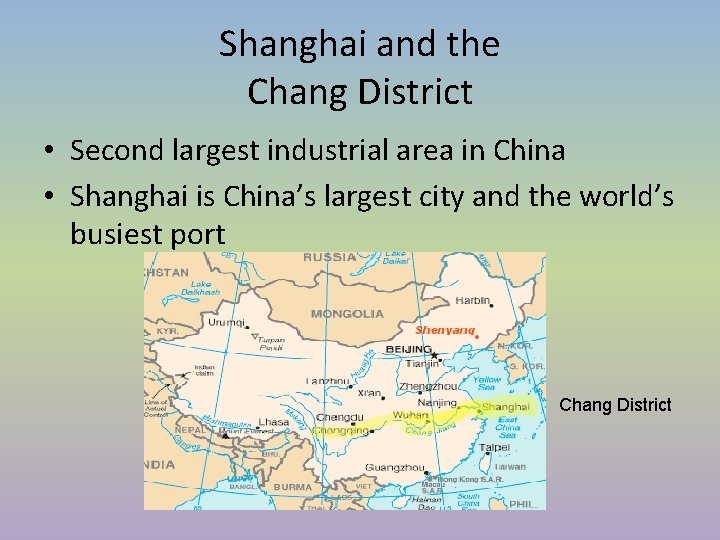
Shanghai and the Chang District • Second largest industrial area in China • Shanghai is China’s largest city and the world’s busiest port Chang District
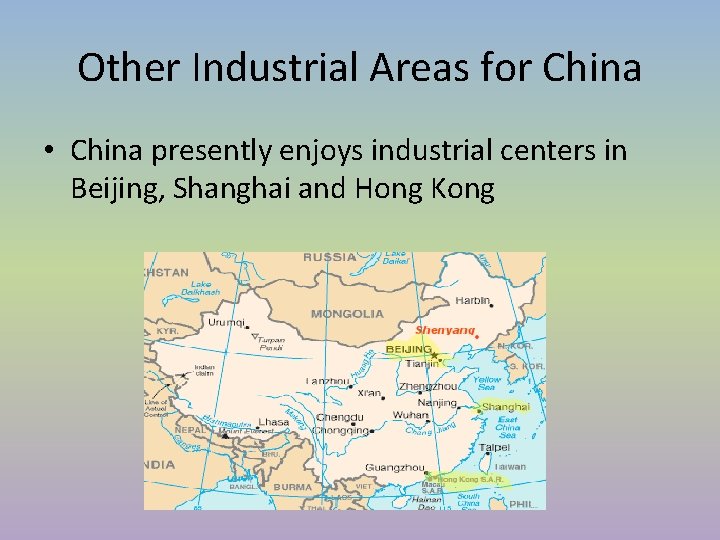
Other Industrial Areas for China • China presently enjoys industrial centers in Beijing, Shanghai and Hong Kong
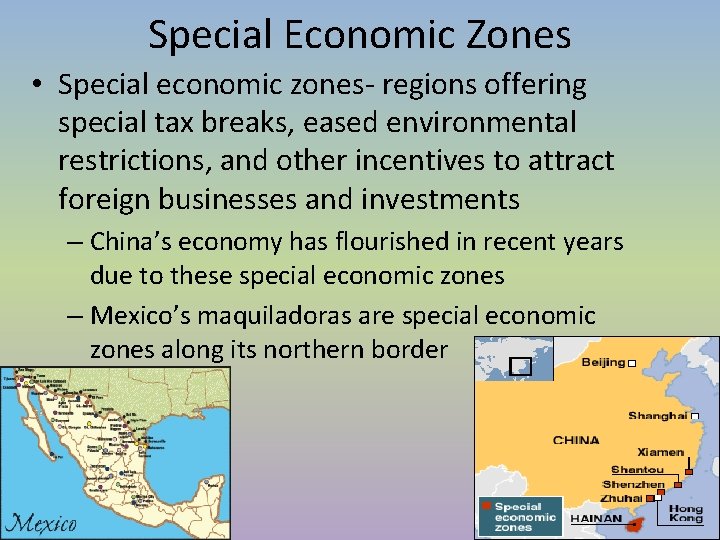
Special Economic Zones • Special economic zones- regions offering special tax breaks, eased environmental restrictions, and other incentives to attract foreign businesses and investments – China’s economy has flourished in recent years due to these special economic zones – Mexico’s maquiladoras are special economic zones along its northern border
• Export-processing zone- refers to regions that offer tax breaks and loosened labor restrictions in less-developed countries to attract export driven production processes – Many times these are referred to as free-trade zones due to tariffs and duties being waived
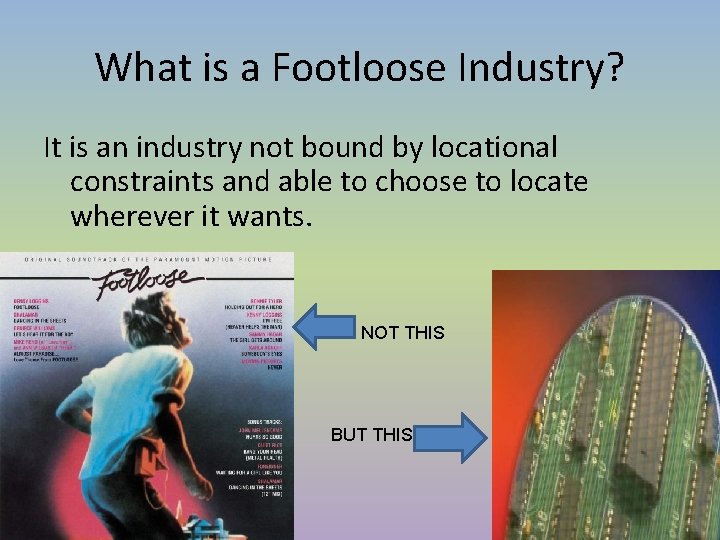
What is a Footloose Industry? It is an industry not bound by locational constraints and able to choose to locate wherever it wants. NOT THIS BUT THIS
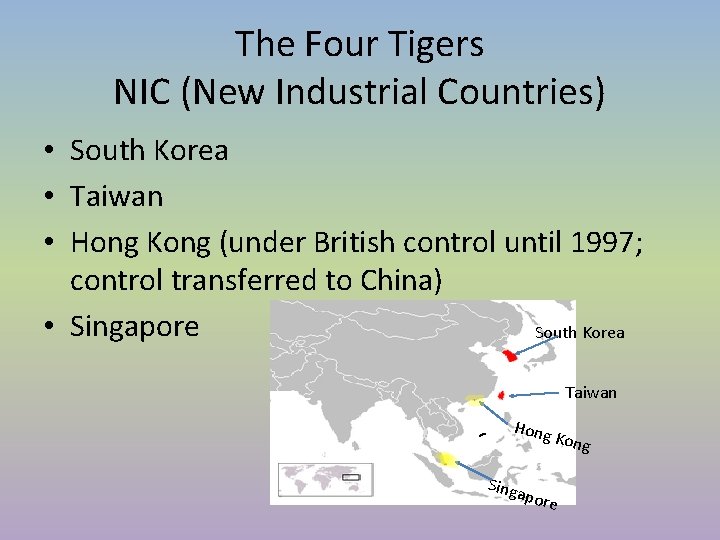
The Four Tigers NIC (New Industrial Countries) • South Korea • Taiwan • Hong Kong (under British control until 1997; control transferred to China) • Singapore South Korea Taiwan Hong Singa Kong pore
• The Four Tigers use export-oriented industrialization. 1. An innovator country produced something new 2. Next the country move to another innovation 3. Other countries think of ways to make the first product better Ex: televisions, automobiles, electronics
Secondary Industrial Regions • Most lie south of the primary industrial regions • Examples: – Southeast Asia: Thailand, Malaysia, Indonesia, and Vietnam – Africa: Cairo, Egypt and Johannesburg, South Africa – Western Hemisphere: • Mexico ( Mexico City to Guadalajara) • Brazil (Sao Paulo & Rio de Janeiro)
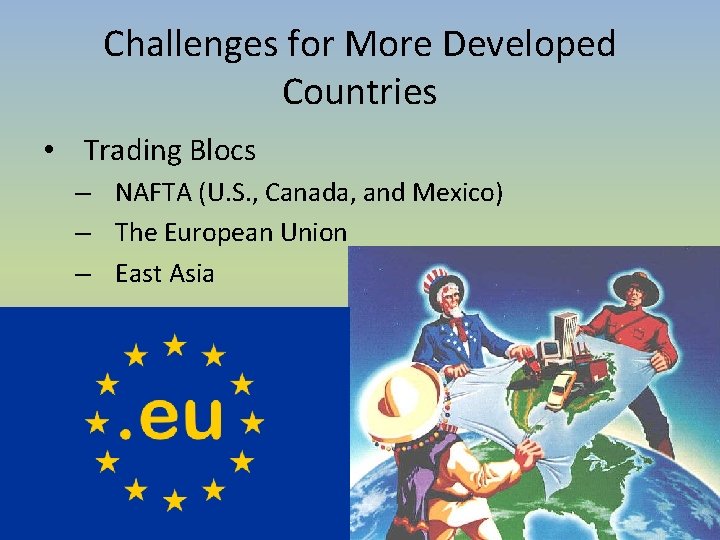
Challenges for More Developed Countries • Trading Blocs – NAFTA (U. S. , Canada, and Mexico) – The European Union – East Asia
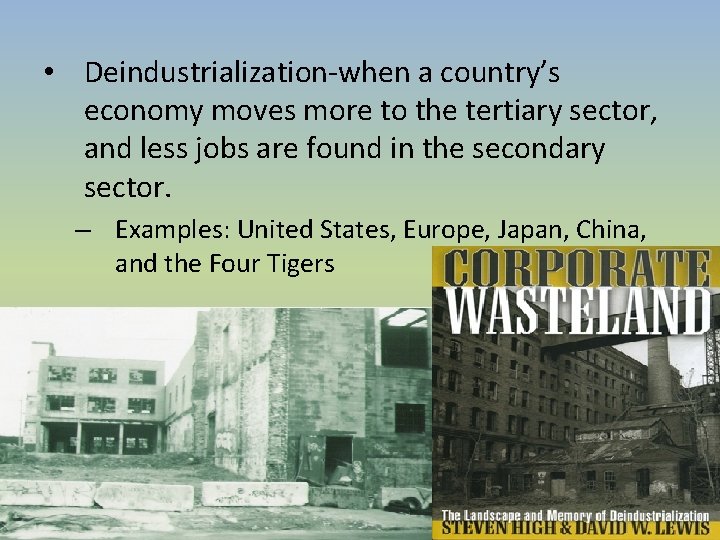
• Deindustrialization-when a country’s economy moves more to the tertiary sector, and less jobs are found in the secondary sector. – Examples: United States, Europe, Japan, China, and the Four Tigers
Fordist Vs. Post-Fordist – dominant mode of mass production during the twentieth century, production of consumer goods at a single site. Post-Fordist – current mode of production with a more flexible set of production practices in which goods are not mass produced. Production is accelerated and dispersed around the globe by multinational companies that shift production, outsourcing it around the world. Ex: Nike Shoes
Free Trade vs. Fair Trade • Free trade- allowing MNCs to outsource without any regulation except for the basic forces of market capitalism – Critics argue that free trade only protects the MNC; nothing helps or safeguards the workers • Fair Trade- policies that want oversight of foreign investment and outsourcing to ensure workers are guaranteed a living wage for their work
Challenges for Less Developed Countries • Distance from markets • Inadequate infrastructure • Competition with existing manufacturers in other countries • Low Levels of Social Welfare • Foreign Debt (IMF and World Bank) • Political Instability • Widespread Disease
Non-Governmental Organizations (NGO) • These organizations are not run by state or local governments • These organizations operate independently, and many times are referred to as nonprofits • Churches and charities are types of NGOs • 20, 000 NGOs in Bangladesh • They combat causes such as women’s rights, health care, poverty, and animal rights – Examples: Doctor’s Without Borders & Save the Children Fund
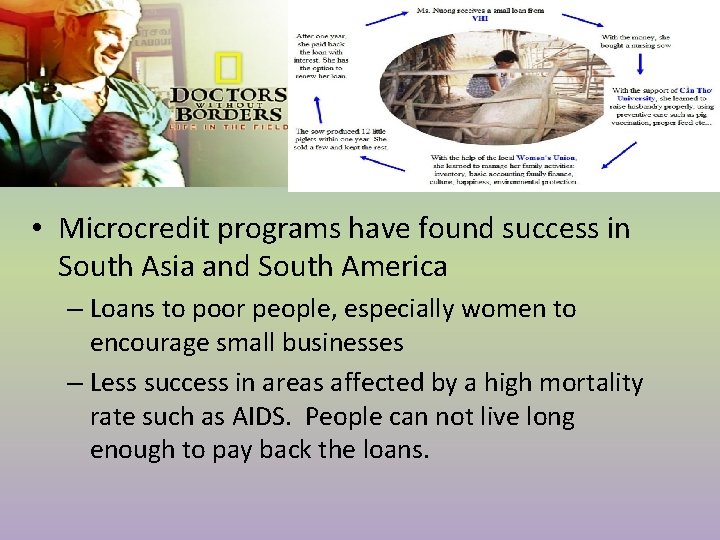
• Microcredit programs have found success in South Asia and South America – Loans to poor people, especially women to encourage small businesses – Less success in areas affected by a high mortality rate such as AIDS. People can not live long enough to pay back the loans.
Multinational Corporations • MNCs are also known as transnational corporations, are the primary agents of globalization. • Business with headquarters in one country and production facilities in one or more other countries • Conglomerate corporations- one massive corporation owns and operates a collection of smaller companies that provide a specific service(s) in the production process
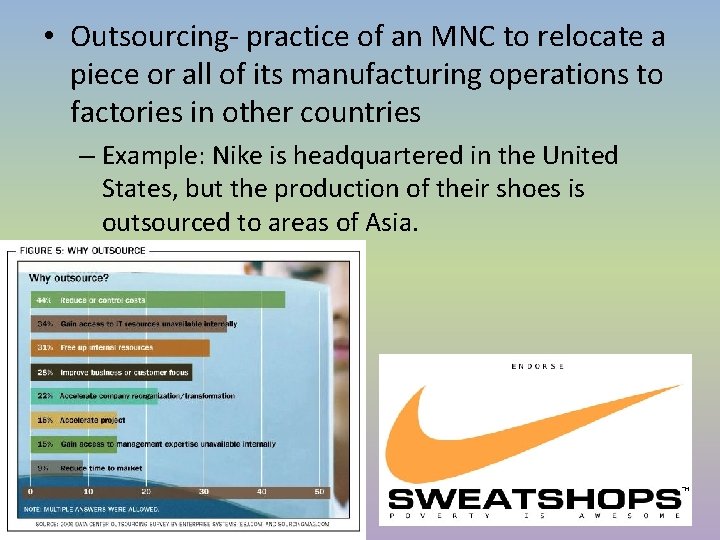
• Outsourcing- practice of an MNC to relocate a piece or all of its manufacturing operations to factories in other countries – Example: Nike is headquartered in the United States, but the production of their shoes is outsourced to areas of Asia.
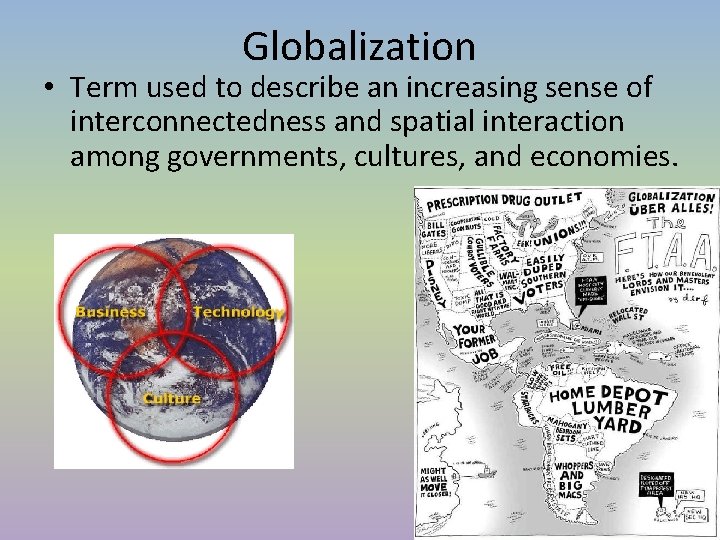
Globalization • Term used to describe an increasing sense of interconnectedness and spatial interaction among governments, cultures, and economies.