
u Lean Six Sigma Measure Phase Tollgate Review
- Slides: 38
u Lean Six Sigma Measure Phase Tollgate Review Measure Phase
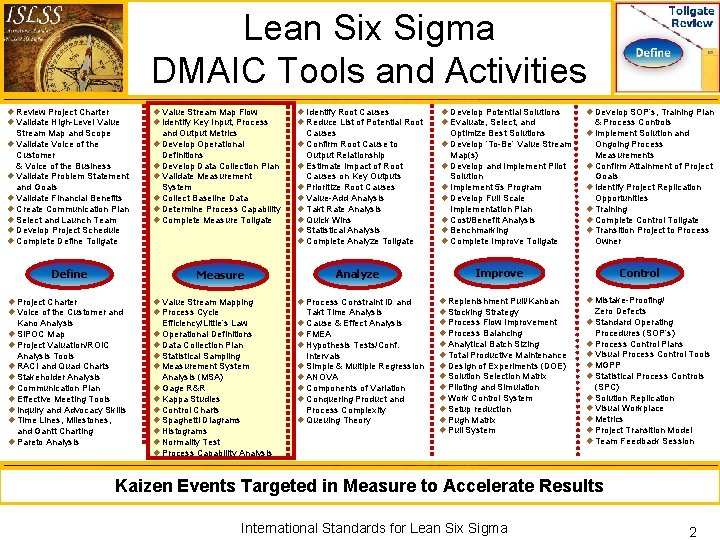
Lean Six Sigma DMAIC Tools and Activities u Review Project Charter u Validate High-Level Value u Value Stream Map Flow u Identify Key Input, Process u Identify Root Causes u Reduce List of Potential Root u Develop Potential Solutions u Evaluate, Select, and u Develop SOP’s, Training Plan Stream Map and Scope u Validate Voice of the Customer & Voice of the Business u Validate Problem Statement and Goals u Validate Financial Benefits u Create Communication Plan u Select and Launch Team u Develop Project Schedule u Complete Define Tollgate and Output Metrics u Develop Operational Definitions u Develop Data Collection Plan u Validate Measurement System u Collect Baseline Data u Determine Process Capability u Complete Measure Tollgate Causes u Confirm Root Cause to Output Relationship u Estimate Impact of Root Causes on Key Outputs u Prioritize Root Causes u Value-Add Analysis u Takt Rate Analysis u Quick Wins u Statistical Analysis u Complete Analyze Tollgate Optimize Best Solutions u Develop ‘To-Be’ Value Stream Map(s) u Develop and Implement Pilot Solution u Implement 5 s Program u Develop Full Scale Implementation Plan u Cost/Benefit Analysis u Benchmarking u Complete Improve Tollgate u Implement Solution and Define Measure u Project Charter u Voice of the Customer and u Value Stream Mapping u Process Cycle Kano Analysis u SIPOC Map u Project Valuation/ROIC Analysis Tools u RACI and Quad Charts u Stakeholder Analysis u Communication Plan u Effective Meeting Tools u Inquiry and Advocacy Skills u Time Lines, Milestones, and Gantt Charting u Pareto Analysis Efficiency/Little’s Law u Operational Definitions u Data Collection Plan u Statistical Sampling u Measurement System Analysis (MSA) u Gage R&R u Kappa Studies u Control Charts u Spaghetti Diagrams u Histograms u Normality Test u Process Capability Analysis Analyze u Process Constraint ID and Takt Time Analysis u Cause & Effect Analysis u FMEA u Hypothesis Tests/Conf. Intervals u Simple & Multiple Regression u ANOVA u Components of Variation u Conquering Product and Process Complexity u Queuing Theory & Process Controls Ongoing Process Measurements u Confirm Attainment of Project Goals u Identify Project Replication Opportunities u Training u Complete Control Tollgate u Transition Project to Process Owner Improve u Replenishment Pull/Kanban u Stocking Strategy u Process Flow Improvement u Process Balancing u Analytical Batch Sizing u Total Productive Maintenance u Design of Experiments (DOE) u Solution Selection Matrix u Piloting and Simulation u Work Control System u Setup reduction u Pugh Matrix u Pull System Control u Mistake-Proofing/ Zero Defects u Standard Operating Procedures (SOP’s) u Process Control Plans u Visual Process Control Tools u MGPP u Statistical Process Controls (SPC) u Solution Replication u Visual Workplace u Metrics u Project Transition Model u Team Feedback Session Kaizen Events Targeted in Measure to Accelerate Results International Standards for Lean Six Sigma 2
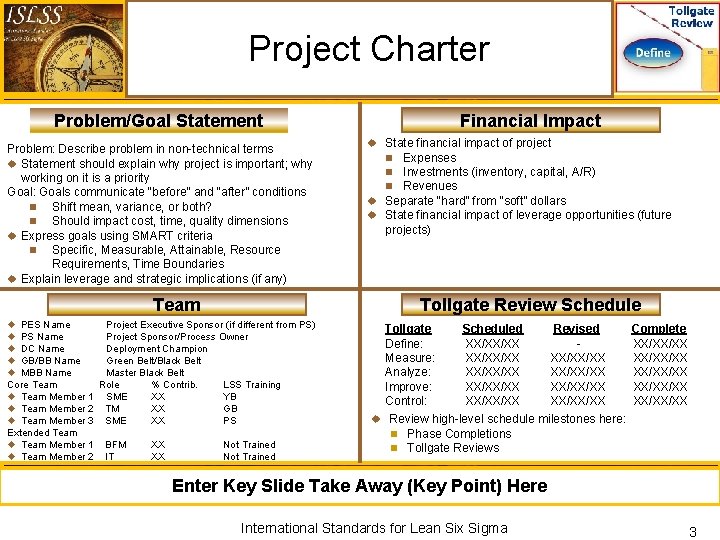
Project Charter Financial Impact Problem/Goal Statement Problem: Describe problem in non-technical terms u Statement should explain why project is important; why working on it is a priority Goal: Goals communicate “before” and “after” conditions n Shift mean, variance, or both? n Should impact cost, time, quality dimensions u Express goals using SMART criteria n Specific, Measurable, Attainable, Resource Requirements, Time Boundaries u Explain leverage and strategic implications (if any) Team projects) Tollgate Review Schedule PES Name Project Executive Sponsor (if different from PS) PS Name Project Sponsor/Process Owner DC Name Deployment Champion GB/BB Name Green Belt/Black Belt MBB Name Master Black Belt Core Team Role % Contrib. LSS Training u Team Member 1 SME XX YB u Team Member 2 TM XX GB u Team Member 3 SME XX PS Extended Team u Team Member 1 BFM XX Not Trained u Team Member 2 IT XX Not Trained u u u State financial impact of project n Expenses n Investments (inventory, capital, A/R) n Revenues u Separate “hard” from “soft” dollars u State financial impact of leverage opportunities (future Tollgate Scheduled Revised Define: XX/XX/XX Measure: XX/XX/XX Analyze: XX/XX/XX Improve: XX/XX/XX Control: XX/XX/XX u Review high-level schedule milestones here: n Phase Completions n Tollgate Reviews Complete XX/XX/XX XX/XX/XX Enter Key Slide Take Away (Key Point) Here International Standards for Lean Six Sigma 3
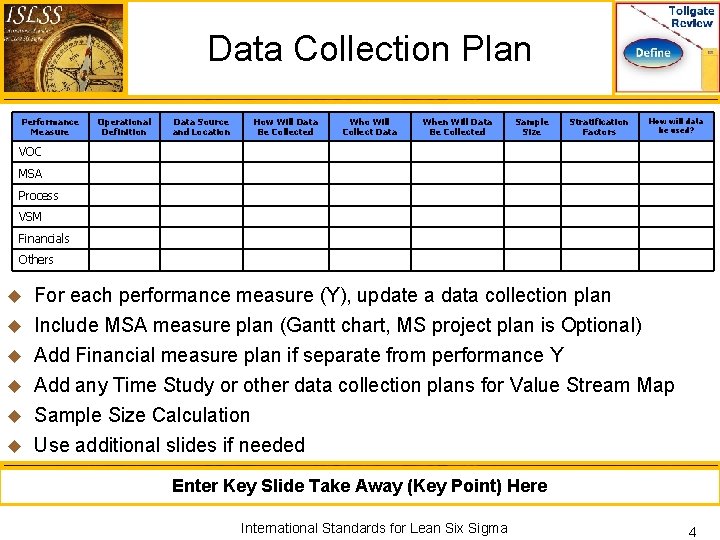
Data Collection Plan Performance Measure Operational Definition Data Source and Location How Will Data Be Collected Who Will Collect Data When Will Data Be Collected Sample Size Stratification Factors How will data be used? VOC MSA Process VSM Financials Others For each performance measure (Y), update a data collection plan u Include MSA measure plan (Gantt chart, MS project plan is Optional) u Add Financial measure plan if separate from performance Y u Add any Time Study or other data collection plans for Value Stream Map u Sample Size Calculation u Use additional slides if needed u Enter Key Slide Take Away (Key Point) Here International Standards for Lean Six Sigma 4
Operational Definitions u u u Y – Continuous data (Process start/stop and cycle time boundaries (such as the unit of measure (ex minutes), the unit (the thing you are measuring), will you include weekends, holidays, non-business hours? ) Y – Discrete data (Define Success/Defect or other attribute values you will measure X – The subgroups values or X-factor groupings you will use on your project data collection Other unique terms that apply to your project that require clear operational definitions Use additional slides as needed to complete your operational definitions Enter Key Slide Take Away (Key Point) Here International Standards for Lean Six Sigma 5
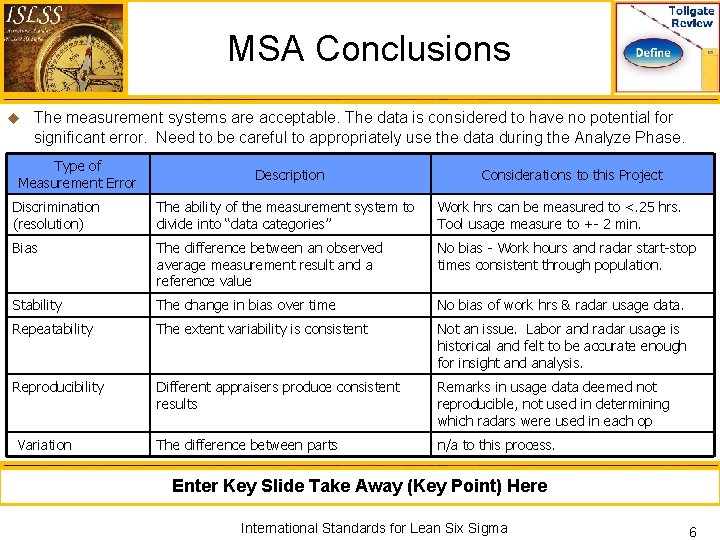
MSA Conclusions u The measurement systems are acceptable. The data is considered to have no potential for significant error. Need to be careful to appropriately use the data during the Analyze Phase. Type of Measurement Error Description Considerations to this Project Discrimination (resolution) The ability of the measurement system to divide into “data categories” Work hrs can be measured to <. 25 hrs. Tool usage measure to +- 2 min. Bias The difference between an observed average measurement result and a reference value No bias - Work hours and radar start-stop times consistent through population. Stability The change in bias over time No bias of work hrs & radar usage data. Repeatability The extent variability is consistent Not an issue. Labor and radar usage is historical and felt to be accurate enough for insight and analysis. Reproducibility Different appraisers produce consistent results Remarks in usage data deemed not reproducible, not used in determining which radars were used in each op The difference between parts n/a to this process. Variation Enter Key Slide Take Away (Key Point) Here International Standards for Lean Six Sigma 6
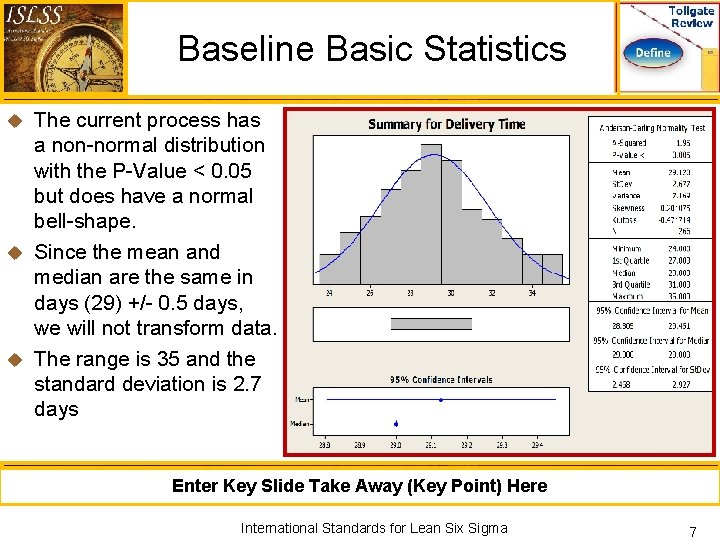
Baseline Basic Statistics The current process has a non-normal distribution with the P-Value < 0. 05 but does have a normal bell-shape. u Since the mean and median are the same in days (29) +/- 0. 5 days, we will not transform data. u The range is 35 and the standard deviation is 2. 7 days u Enter Key Slide Take Away (Key Point) Here International Standards for Lean Six Sigma 7
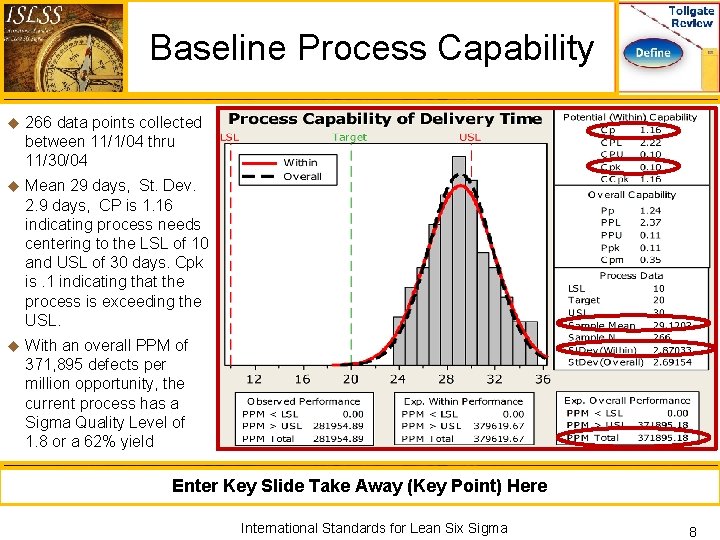
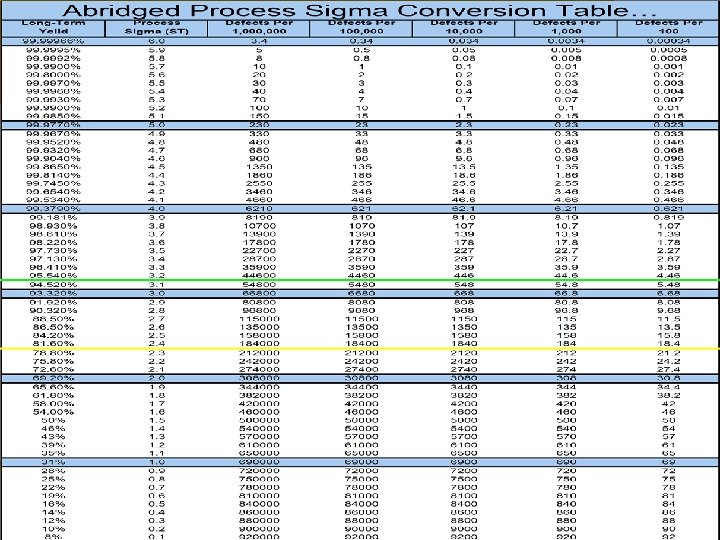
Baseline Process Capability u 266 data points collected between 11/1/04 thru 11/30/04 u Mean 29 days, St. Dev. 2. 9 days, CP is 1. 16 indicating process needs centering to the LSL of 10 and USL of 30 days. Cpk is. 1 indicating that the process is exceeding the USL. u With an overall PPM of 371, 895 defects per million opportunity, the current process has a Sigma Quality Level of 1. 8 or a 62% yield Enter Key Slide Take Away (Key Point) Here International Standards for Lean Six Sigma 8
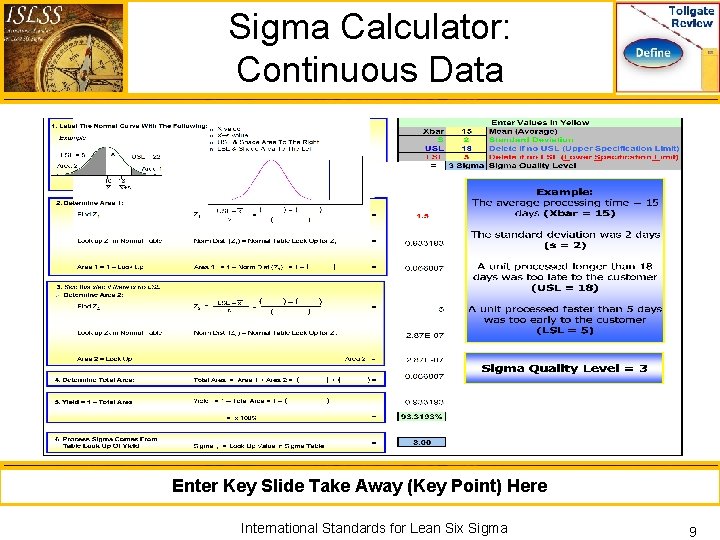
Sigma Calculator: Continuous Data Enter Key Slide Take Away (Key Point) Here International Standards for Lean Six Sigma 9
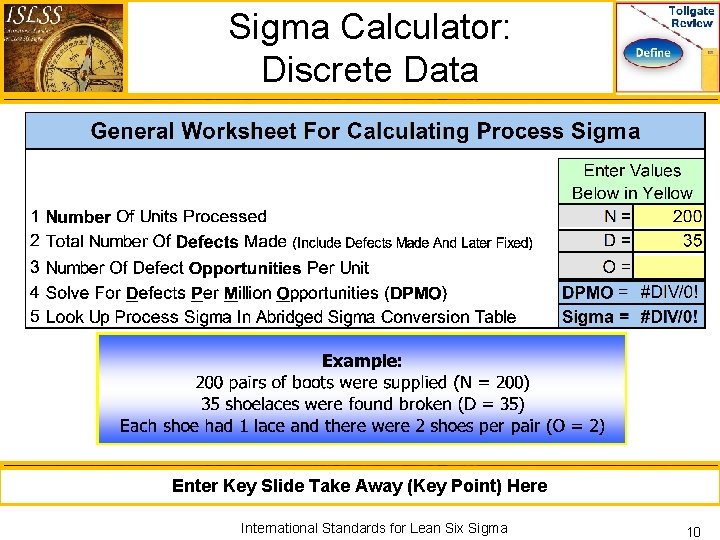
Sigma Calculator: Discrete Data Enter Key Slide Take Away (Key Point) Here International Standards for Lean Six Sigma 10
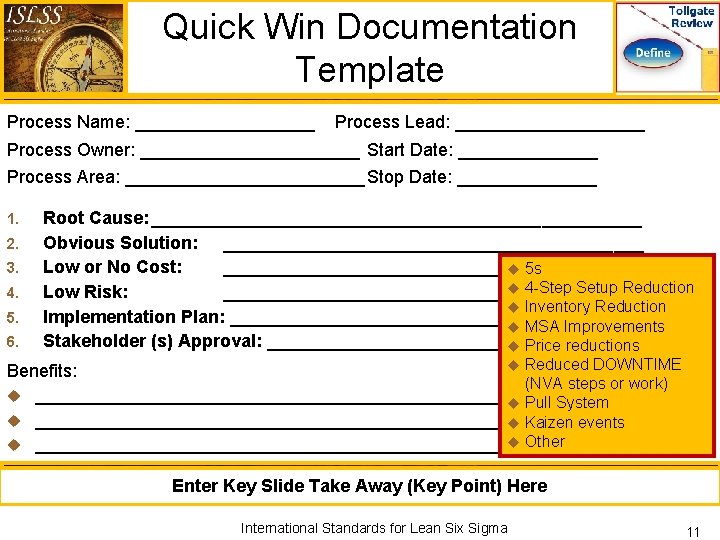
Quick Win Documentation Template Process Name: _________ Process Lead: __________ Process Owner: ___________ Start Date: _______ Process Area: ____________ Stop Date: _______ 1. 2. 3. 4. 5. 6. Root Cause: _________________________ Obvious Solution: _____________________ Low or No Cost: _____________________ u 5 s u 4 -Step Setup Reduction Low Risk: ________________________ u Inventory Reduction Implementation Plan: _______________________ u MSA Improvements Stakeholder (s) Approval: ______________________ u Price reductions u Reduced DOWNTIME Benefits: (NVA steps or work) u _____________________________ u Pull System u _____________________________ u Kaizen events u Other u _____________________________ Enter Key Slide Take Away (Key Point) Here International Standards for Lean Six Sigma 11
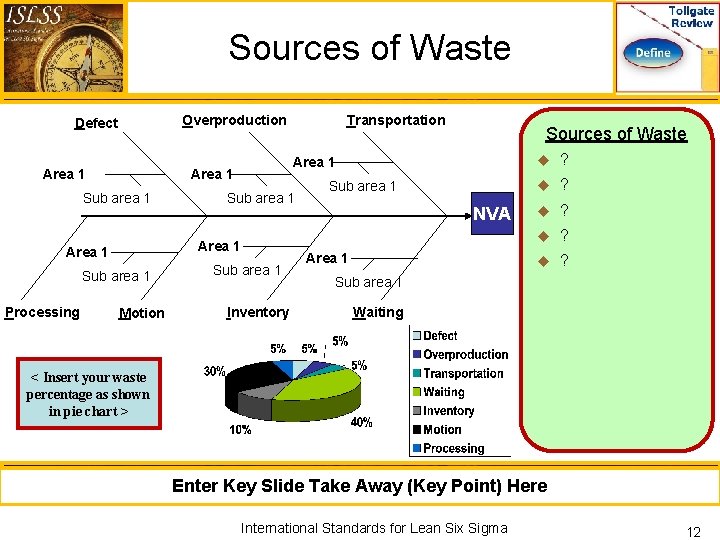
Sources of Waste Overproduction Defect Area 1 Sub area 1 Processing Sub area 1 Area 1 Motion Sources of Waste Area 1 Sub area 1 Transportation Sub area 1 Inventory Sub area 1 NVA Area 1 u ? u ? Sub area 1 Waiting < Insert your waste percentage as shown in pie chart > Enter Key Slide Take Away (Key Point) Here International Standards for Lean Six Sigma 12
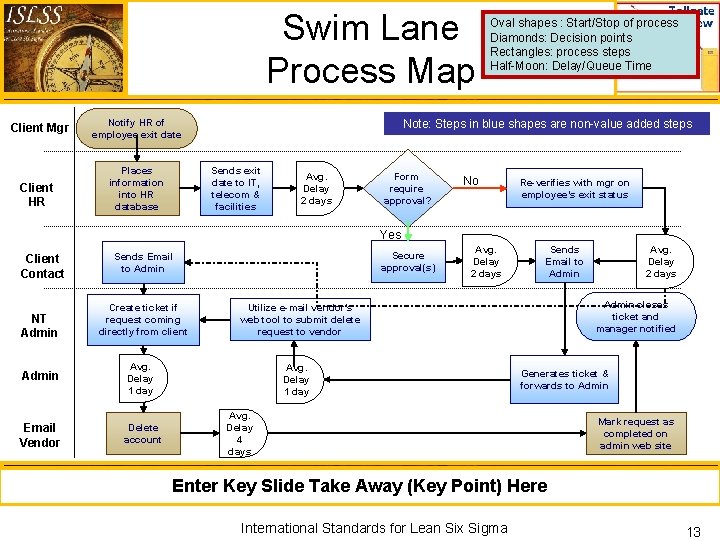
Swim Lane Process Map Client Mgr Client HR Notify HR of employee exit date Places information into HR database Oval shapes : Start/Stop of process Diamonds: Decision points Rectangles: process steps Half-Moon: Delay/Queue Time Note: Steps in blue shapes are non-value added steps Sends exit date to IT, telecom & facilities Avg. Delay 2 days Form require approval? No Re-verifies with mgr on employee’s exit status Yes Client Contact NT Admin Secure approval(s) Sends Email to Admin Create ticket if request coming directly from client Admin Avg. Delay 1 day Email Vendor Delete account Avg. Delay 2 days Sends Email to Admin closes ticket and manager notified Utilize e-mail vendor’s web tool to submit delete request to vendor Avg. Delay 1 day Avg. Delay 2 days Generates ticket & forwards to Admin Avg. Delay 4 days Mark request as completed on admin web site Enter Key Slide Take Away (Key Point) Here International Standards for Lean Six Sigma 13
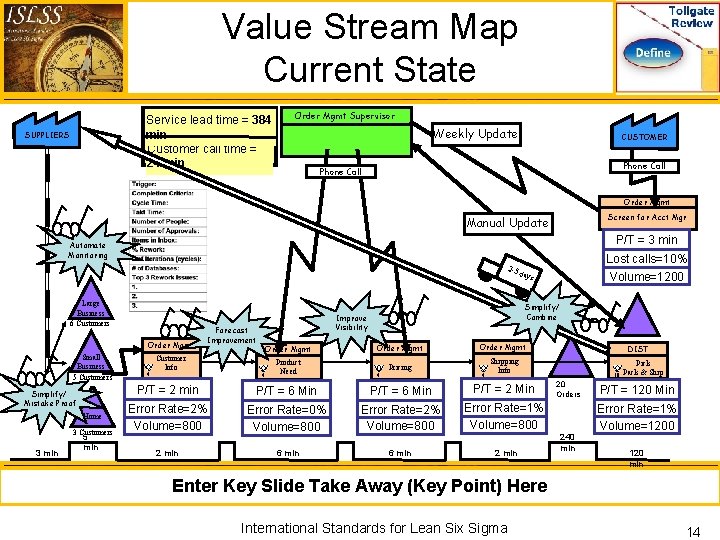
Value Stream Map Current State Service lead time = 384 min Customer call time = 24 min SUPPLIERS Order Mgmt Supervisor Weekly Update CUSTOMER Phone Call Order Mgmt Screen for Acct Mgr Manual Update P/T = 3 min Automate Monitoring 2 -5 Large Business 6 Customers Order Mgmt Small Business 5 Customers Simplify/ Mistake Proof Home 3 Customers 3 min 5 min 4 Customer Info Order Mgmt 4 Product Need s Simplify/ Combine Improve Visibility Forecast Improvement Lost calls=10% Volume=1200 day Order Mgmt Pricing Shipping Info 4 4 P/T = 2 min P/T = 6 Min P/T = 2 Min Error Rate=2% Volume=800 Error Rate=0% Volume=800 Error Rate=2% Volume=800 Error Rate=1% Volume=800 2 min 6 min 2 min DIST 10 20 Orders 240 min Pick Pack & Ship P/T = 120 Min Error Rate=1% Volume=1200 120 min Enter Key Slide Take Away (Key Point) Here International Standards for Lean Six Sigma 14
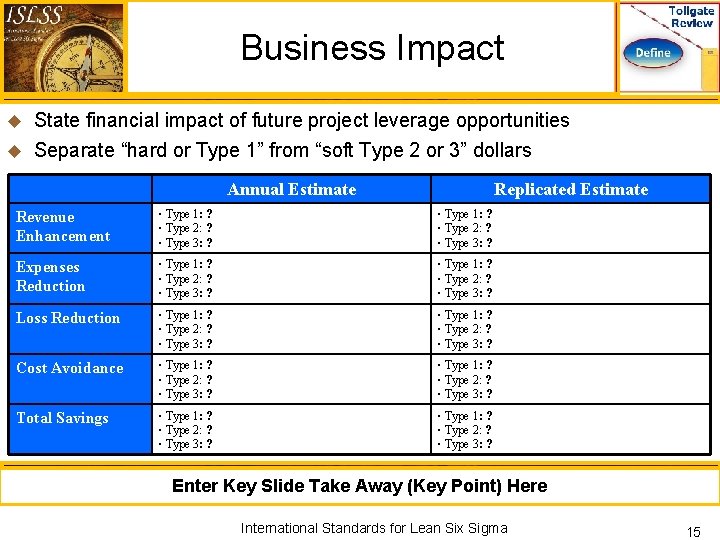
Business Impact State financial impact of future project leverage opportunities u Separate “hard or Type 1” from “soft Type 2 or 3” dollars u Annual Estimate Replicated Estimate Revenue Enhancement • Type 1: ? • Type 2: ? • Type 3: ? Expenses Reduction • Type 1: ? • Type 2: ? • Type 3: ? Loss Reduction • Type 1: ? • Type 2: ? • Type 3: ? Cost Avoidance • Type 1: ? • Type 2: ? • Type 3: ? Total Savings • Type 1: ? • Type 2: ? • Type 3: ? Enter Key Slide Take Away (Key Point) Here International Standards for Lean Six Sigma 15
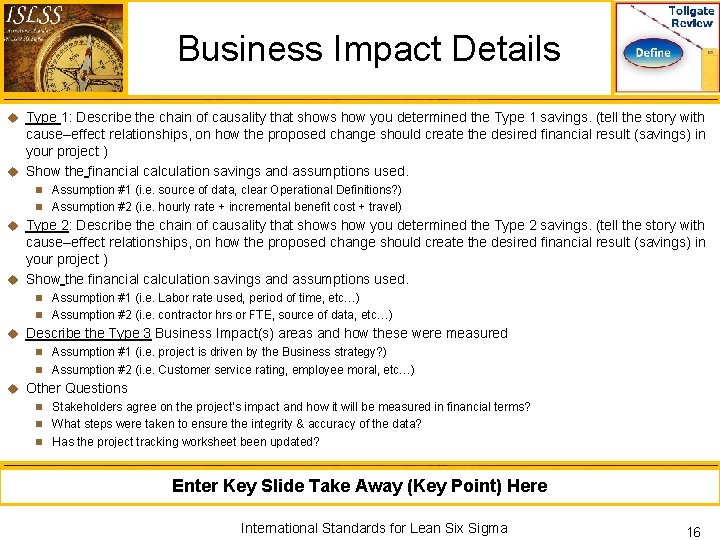
Business Impact Details u Type 1: Describe the chain of causality that shows how you determined the Type 1 savings. (tell the story with cause–effect relationships, on how the proposed change should create the desired financial result (savings) in your project ) u Show the financial calculation savings and assumptions used. n Assumption #1 (i. e. source of data, clear Operational Definitions? ) n Assumption #2 (i. e. hourly rate + incremental benefit cost + travel) u Type 2: Describe the chain of causality that shows how you determined the Type 2 savings. (tell the story with cause–effect relationships, on how the proposed change should create the desired financial result (savings) in your project ) u Show the financial calculation savings and assumptions used. n Assumption #1 (i. e. Labor rate used, period of time, etc…) n Assumption #2 (i. e. contractor hrs or FTE, source of data, etc…) u Describe the Type 3 Business Impact(s) areas and how these were measured n Assumption #1 (i. e. project is driven by the Business strategy? ) n Assumption #2 (i. e. Customer service rating, employee moral, etc…) u Other Questions n Stakeholders agree on the project’s impact and how it will be measured in financial terms? n What steps were taken to ensure the integrity & accuracy of the data? n Has the project tracking worksheet been updated? Enter Key Slide Take Away (Key Point) Here International Standards for Lean Six Sigma 16
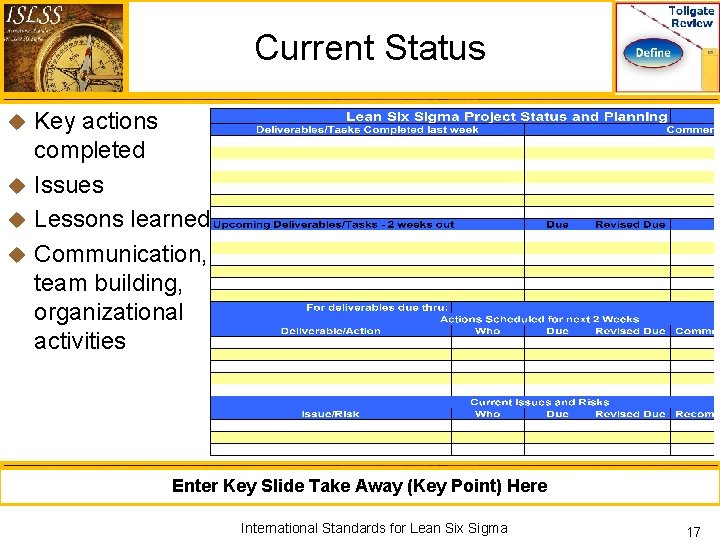
Current Status Key actions completed u Issues u Lessons learned u Communication, team building, organizational activities u Enter Key Slide Take Away (Key Point) Here International Standards for Lean Six Sigma 17
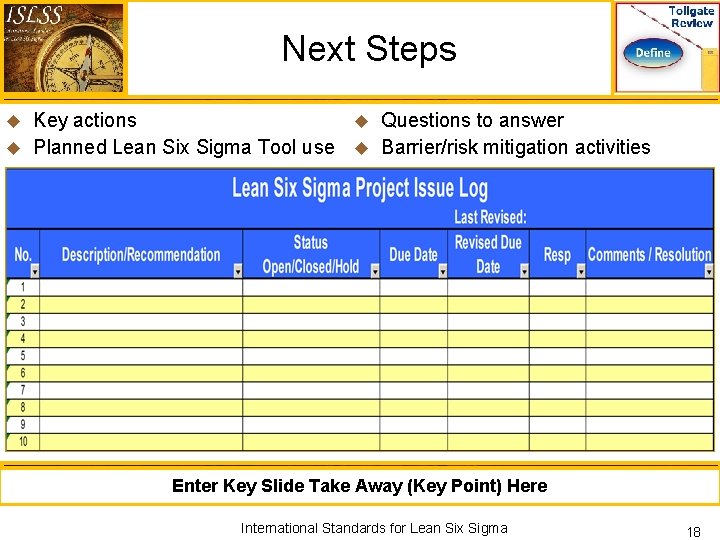
Next Steps Key actions u Questions to answer u Planned Lean Six Sigma Tool use u Barrier/risk mitigation activities u Enter Key Slide Take Away (Key Point) Here International Standards for Lean Six Sigma 18
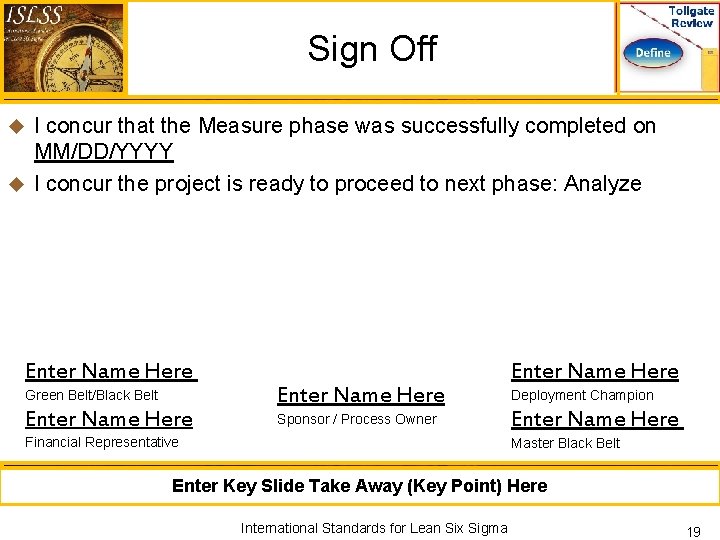
Sign Off I concur that the Measure phase was successfully completed on MM/DD/YYYY u I concur the project is ready to proceed to next phase: Analyze u Enter Name Here Green Belt/Black Belt Enter Name Here Sponsor / Process Owner Financial Representative Enter Name Here Deployment Champion Enter Name Here Master Black Belt Enter Key Slide Take Away (Key Point) Here International Standards for Lean Six Sigma 19
Tollgate Reviews Backup Slides Go Forward D ld o H t l Ha M Wait - Go Back A I C
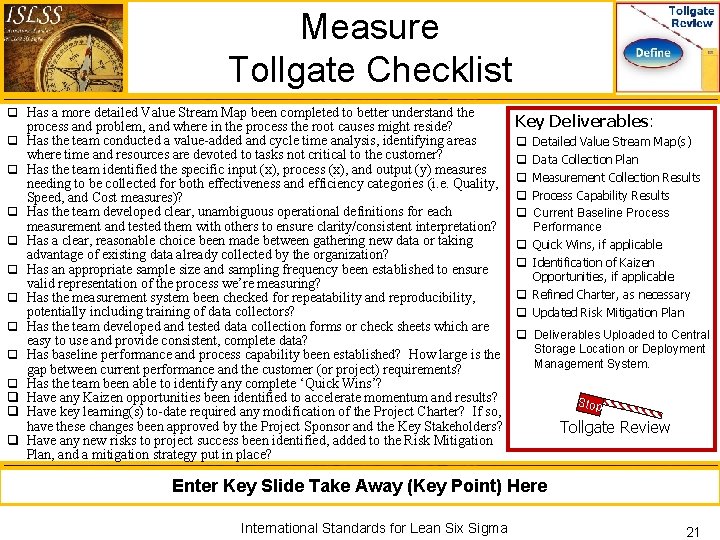
Measure Tollgate Checklist q Has a more detailed Value Stream Map been completed to better understand the q q q process and problem, and where in the process the root causes might reside? Has the team conducted a value-added and cycle time analysis, identifying areas where time and resources are devoted to tasks not critical to the customer? Has the team identified the specific input (x), process (x), and output (y) measures needing to be collected for both effectiveness and efficiency categories (i. e. Quality, Speed, and Cost measures)? Has the team developed clear, unambiguous operational definitions for each measurement and tested them with others to ensure clarity/consistent interpretation? Has a clear, reasonable choice been made between gathering new data or taking advantage of existing data already collected by the organization? Has an appropriate sample size and sampling frequency been established to ensure valid representation of the process we’re measuring? Has the measurement system been checked for repeatability and reproducibility, potentially including training of data collectors? Has the team developed and tested data collection forms or check sheets which are easy to use and provide consistent, complete data? Has baseline performance and process capability been established? How large is the gap between current performance and the customer (or project) requirements? Has the team been able to identify any complete ‘Quick Wins’? Have any Kaizen opportunities been identified to accelerate momentum and results? Have key learning(s) to-date required any modification of the Project Charter? If so, have these changes been approved by the Project Sponsor and the Key Stakeholders? Have any new risks to project success been identified, added to the Risk Mitigation Plan, and a mitigation strategy put in place? Key Deliverables: q q q Detailed Value Stream Map(s) Data Collection Plan Measurement Collection Results Process Capability Results Current Baseline Process Performance q Quick Wins, if applicable q Identification of Kaizen Opportunities, if applicable q Refined Charter, as necessary q Updated Risk Mitigation Plan q Deliverables Uploaded to Central Storage Location or Deployment Management System. Stop Tollgate Review Enter Key Slide Take Away (Key Point) Here International Standards for Lean Six Sigma 21
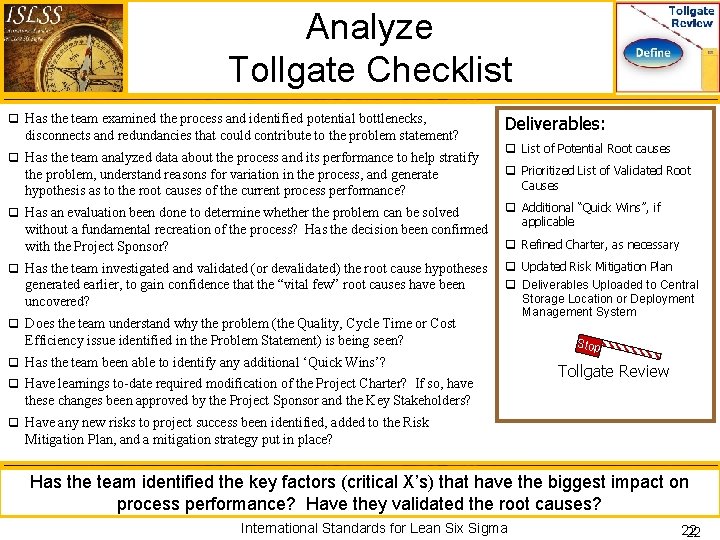
Analyze Tollgate Checklist q Has the team examined the process and identified potential bottlenecks, disconnects and redundancies that could contribute to the problem statement? q Has the team analyzed data about the process and its performance to help stratify the problem, understand reasons for variation in the process, and generate hypothesis as to the root causes of the current process performance? q Has an evaluation been done to determine whether the problem can be solved without a fundamental recreation of the process? Has the decision been confirmed with the Project Sponsor? q Has the team investigated and validated (or devalidated) the root cause hypotheses generated earlier, to gain confidence that the “vital few” root causes have been uncovered? Deliverables: q List of Potential Root causes q Prioritized List of Validated Root Causes q Additional “Quick Wins”, if applicable q Refined Charter, as necessary q Updated Risk Mitigation Plan q Deliverables Uploaded to Central q Does the team understand why the problem (the Quality, Cycle Time or Cost Efficiency issue identified in the Problem Statement) is being seen? q Has the team been able to identify any additional ‘Quick Wins’? q Have learnings to-date required modification of the Project Charter? If so, have Storage Location or Deployment Management System Stop Tollgate Review these changes been approved by the Project Sponsor and the Key Stakeholders? q Have any new risks to project success been identified, added to the Risk Mitigation Plan, and a mitigation strategy put in place? Has the team identified the key factors (critical X’s) that have the biggest impact on process performance? Have they validated the root causes? International Standards for Lean Six Sigma 22 22
Bonacorsi Consulting 23
Bonacorsi Consulting 24
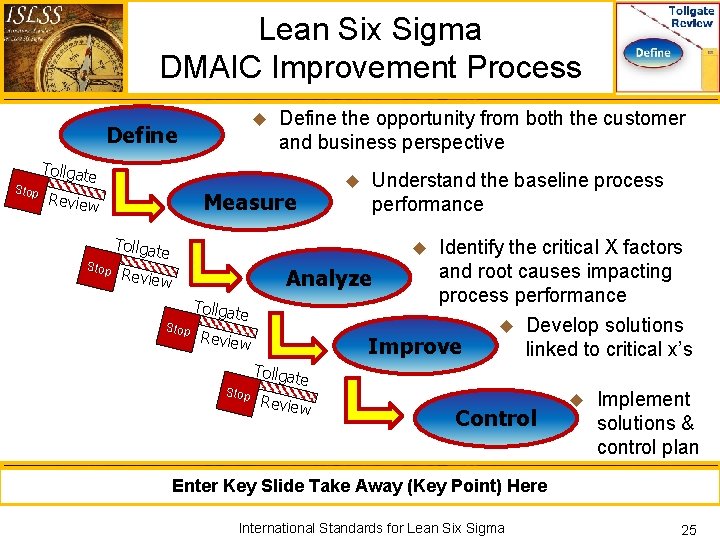
Lean Six Sigma DMAIC Improvement Process u Define Stop Define the opportunity from both the customer and business perspective Tollgat e Measure Review Stop Understand the baseline process performance u Tollgat u e Analyze Review Stop Tollgat e Review Stop Identify the critical X factors and root causes impacting process performance Improve u Develop solutions linked to critical x’s Tollgat e Review Control u Implement solutions & control plan Enter Key Slide Take Away (Key Point) Here International Standards for Lean Six Sigma 25
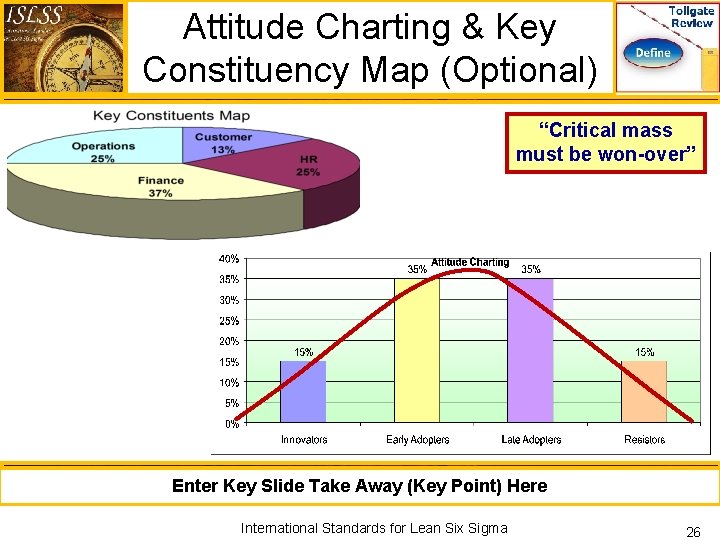
Attitude Charting & Key Constituency Map (Optional) “Critical mass must be won-over” Enter Key Slide Take Away (Key Point) Here International Standards for Lean Six Sigma 26
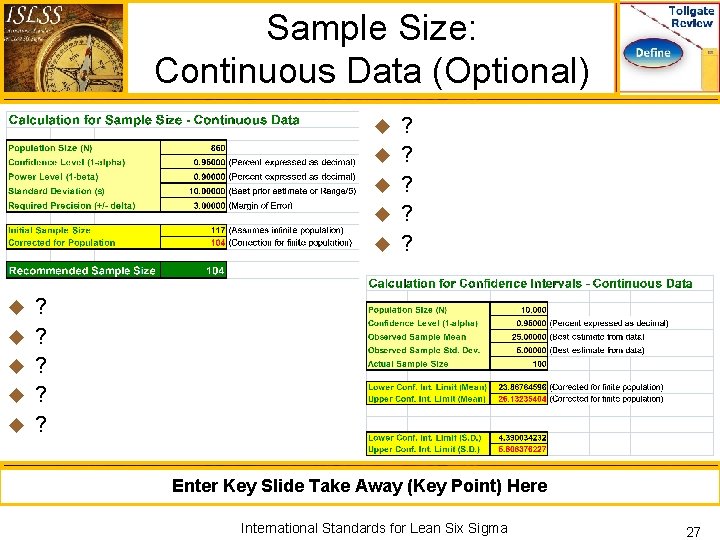
Sample Size: Continuous Data (Optional) u u u u u ? ? ? ? ? Enter Key Slide Take Away (Key Point) Here International Standards for Lean Six Sigma 27
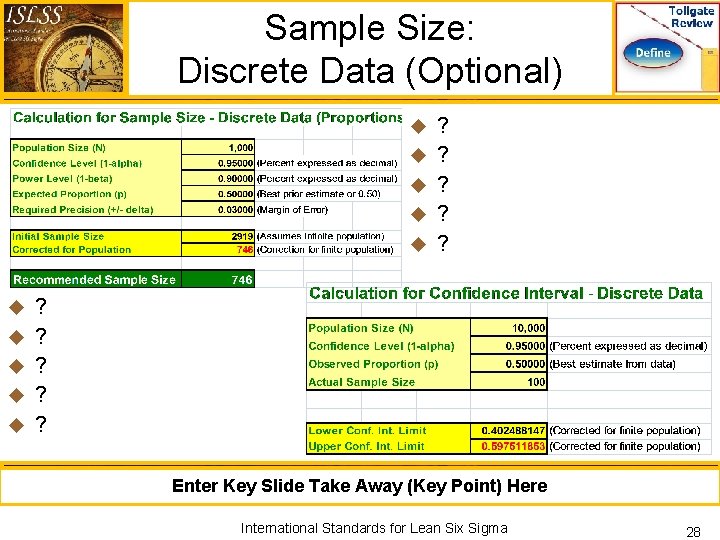
Sample Size: Discrete Data (Optional) u u u u u ? ? ? ? ? Enter Key Slide Take Away (Key Point) Here International Standards for Lean Six Sigma 28
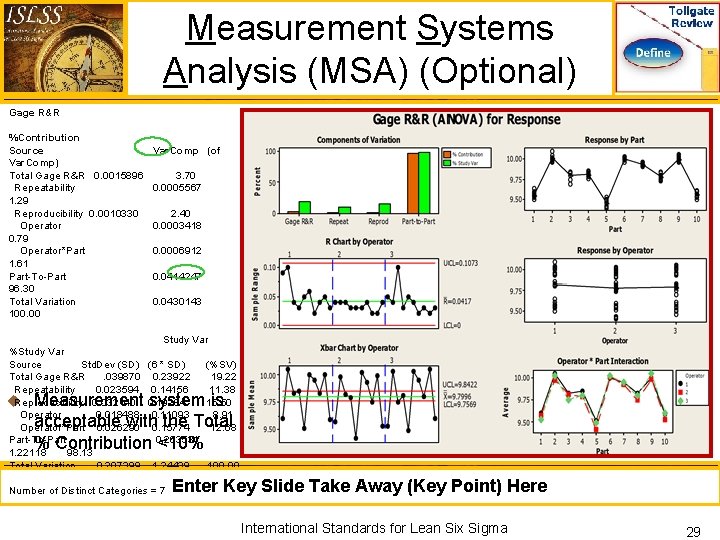
Measurement Systems Analysis (MSA) (Optional) Gage R&R %Contribution Source Var. Comp (of Var. Comp) Total Gage R&R 0. 0015896 3. 70 Repeatability 0. 0005567 1. 29 Reproducibility 0. 0010330 2. 40 Operator 0. 0003418 0. 79 Operator*Part 0. 0006912 1. 61 Part-To-Part 0. 0414247 96. 30 Total Variation 0. 0430143 100. 00 Study Var %Study Var Source Std. Dev (SD) (6 * SD) (%SV) Total Gage R&R . 039870 0. 23922 19. 22 Repeatability 0. 023594 0. 14156 11. 38 Reproducibility 0. 032140 0. 19284 15. 50 u Operator 0. 018488 0. 11093 8. 91 Operator*Part 0. 026290 0. 15774 12. 68 Part-To-Part 0. 203531 1. 22118 98. 13 Total Variation 0. 207399 1. 24439 100. 00 Measurement system is acceptable with the Total % Contribution <10% Number of Distinct Categories = 7 Enter Key Slide Take Away (Key Point) Here International Standards for Lean Six Sigma 29
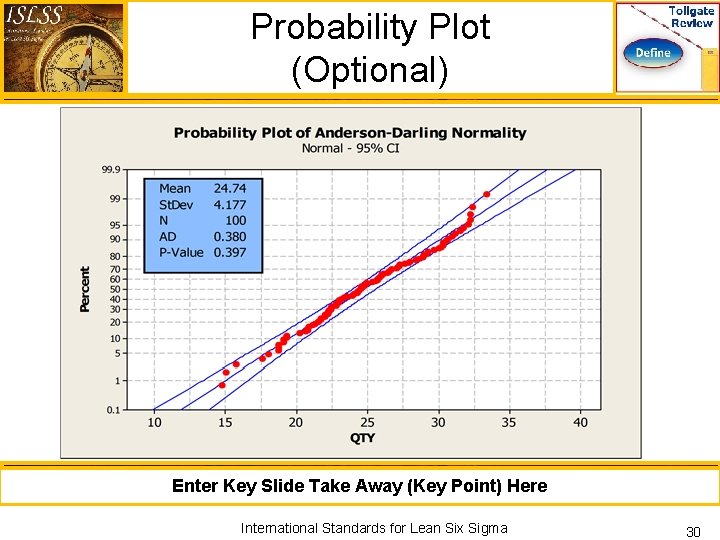
Probability Plot (Optional) Enter Key Slide Take Away (Key Point) Here International Standards for Lean Six Sigma 30
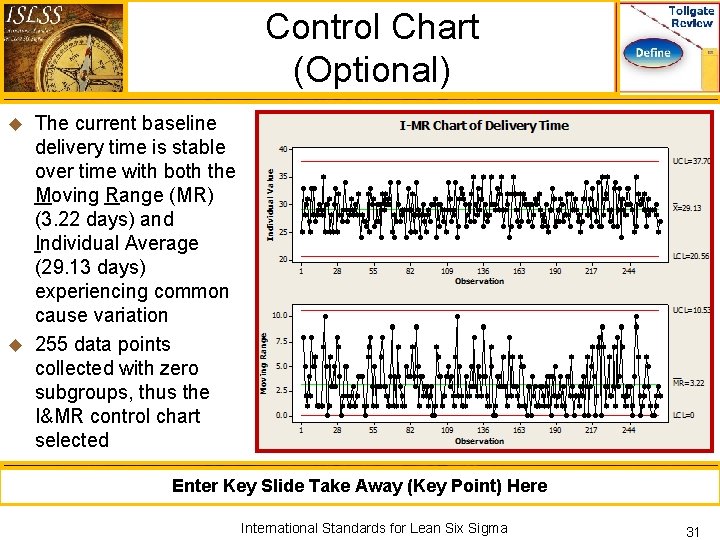
Control Chart (Optional) The current baseline delivery time is stable over time with both the Moving Range (MR) (3. 22 days) and Individual Average (29. 13 days) experiencing common cause variation u 255 data points collected with zero subgroups, thus the I&MR control chart selected u Enter Key Slide Take Away (Key Point) Here International Standards for Lean Six Sigma 31
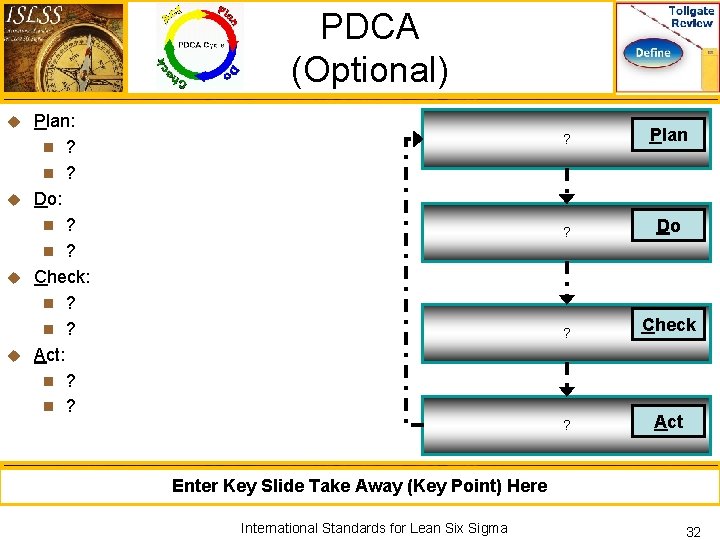
PDCA (Optional) Plan: n ? u Do: n ? u Check: n ? u Act: n ? u ? Plan ? Do ? Check ? Act Enter Key Slide Take Away (Key Point) Here International Standards for Lean Six Sigma 32
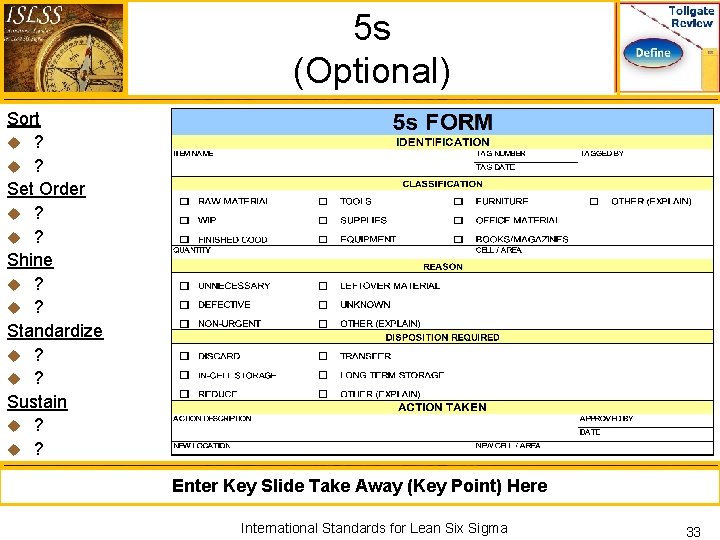
5 s (Optional) Sort u ? Set Order u ? Shine u ? Standardize u ? Sustain u ? Enter Key Slide Take Away (Key Point) Here International Standards for Lean Six Sigma 33
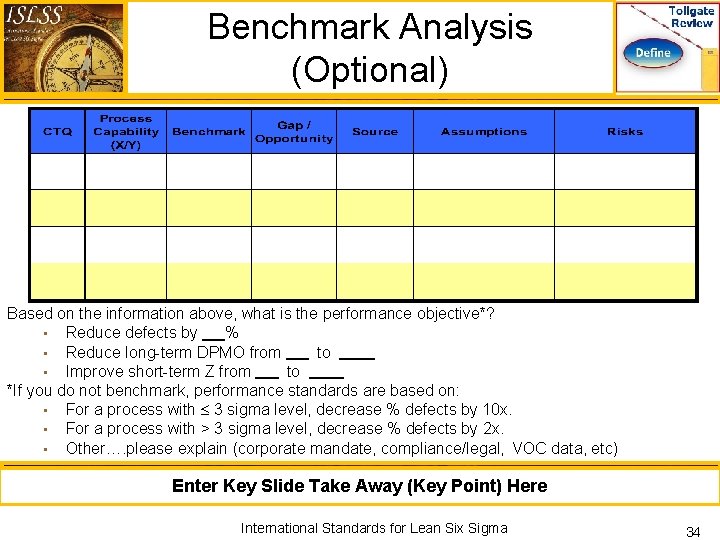
Benchmark Analysis (Optional) Based on the information above, what is the performance objective*? • Reduce defects by % • Reduce long-term DPMO from to . • Improve short-term Z from to . *If you do not benchmark, performance standards are based on: • For a process with 3 sigma level, decrease % defects by 10 x. • For a process with > 3 sigma level, decrease % defects by 2 x. • Other…. please explain (corporate mandate, compliance/legal, VOC data, etc) Enter Key Slide Take Away (Key Point) Here International Standards for Lean Six Sigma 34
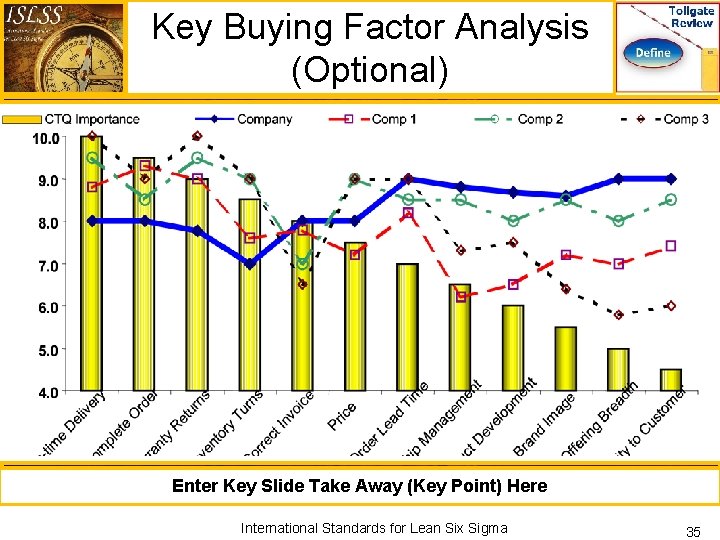
Key Buying Factor Analysis (Optional) Enter Key Slide Take Away (Key Point) Here International Standards for Lean Six Sigma 35
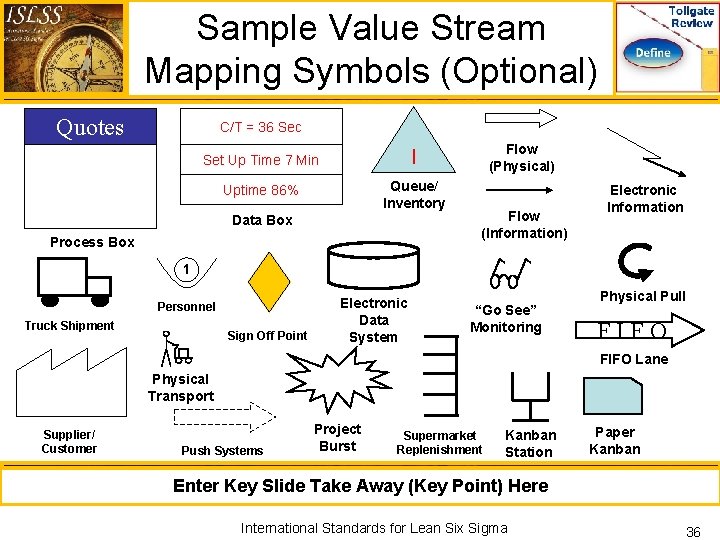
Sample Value Stream Mapping Symbols (Optional) Machining Quotes C/T = 36 Sec Set Up Time 7 Min I Uptime 86% Queue/ Inventory Data Box Process Box Flow (Physical) Flow (Information) Electronic Information 1 Personnel Truck Shipment Sign Off Point Electronic Data System “Go See” Monitoring Physical Pull FIFO Lane Physical Transport Supplier/ Customer Push Systems Project Burst Supermarket Replenishment Kanban Station Paper Kanban Enter Key Slide Take Away (Key Point) Here International Standards for Lean Six Sigma 36
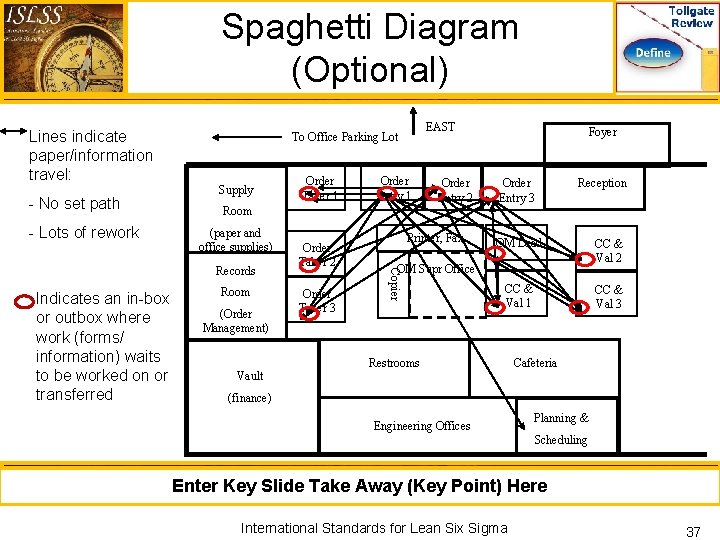
Spaghetti Diagram (Optional) Lines indicate paper/information travel: EAST To Office Parking Lot Supply - No set path Order Taker 1 Order Entry 2 Foyer Order Entry 3 Reception Room - Lots of rework (paper and office supplies) Indicates an in-box or outbox where work (forms/ information) waits to be worked on or transferred Room (Order Management) Order Taker 3 Printer, Fax OM Lead CC & Val 2 CC & Val 1 CC & Val 3 OM Supr Office Copier Records Order Taker 2 Restrooms Cafeteria Vault (finance) Engineering Offices Planning & Scheduling Enter Key Slide Take Away (Key Point) Here International Standards for Lean Six Sigma 37
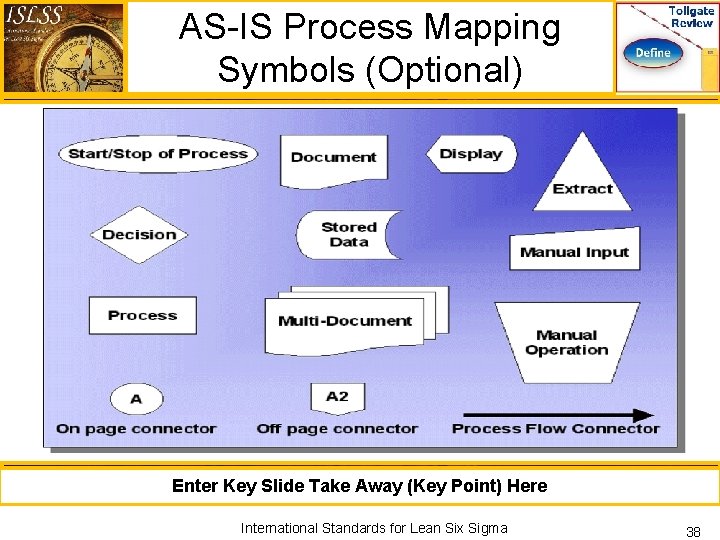
AS-IS Process Mapping Symbols (Optional) Enter Key Slide Take Away (Key Point) Here International Standards for Lean Six Sigma 38