
U 1 D 9 Stream Table Demo 107

U 1 D 9 Stream Table Demo 10/7
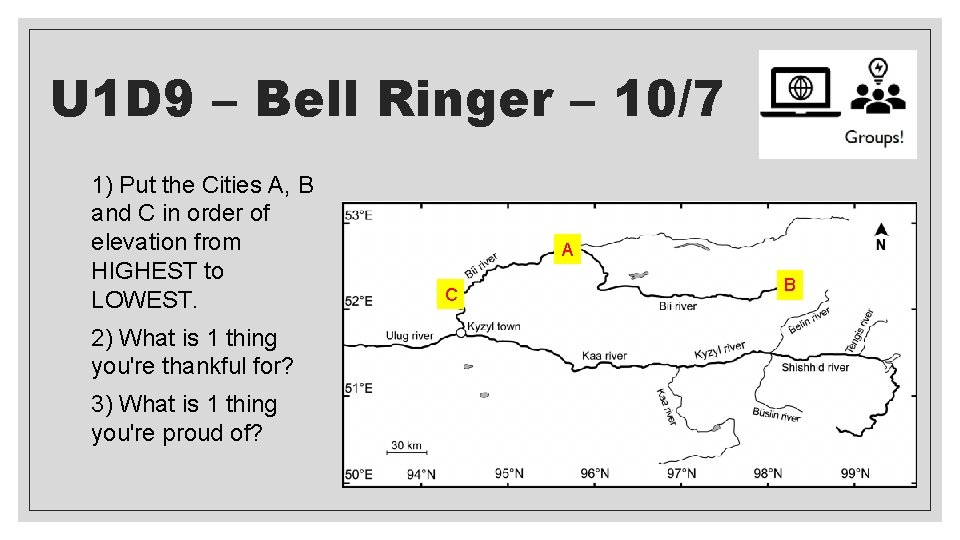
U 1 D 9 – Bell Ringer – 10/7 1) Put the Cities A, B and C in order of elevation from HIGHEST to LOWEST. 2) What is 1 thing you're thankful for? 3) What is 1 thing you're proud of? A C B
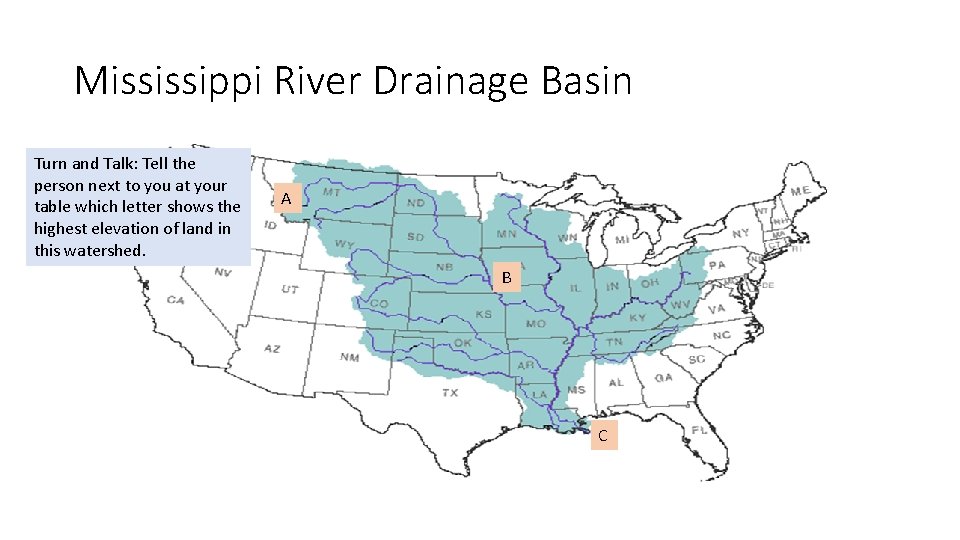
Mississippi River Drainage Basin Turn and Talk: Tell the person next to you at your table which letter shows the highest elevation of land in this watershed. A B C
Objectives Content Objective Language Objective ◦ I can identify and describe features of streams including erosion and deposition. ◦ I can record detailed observations.
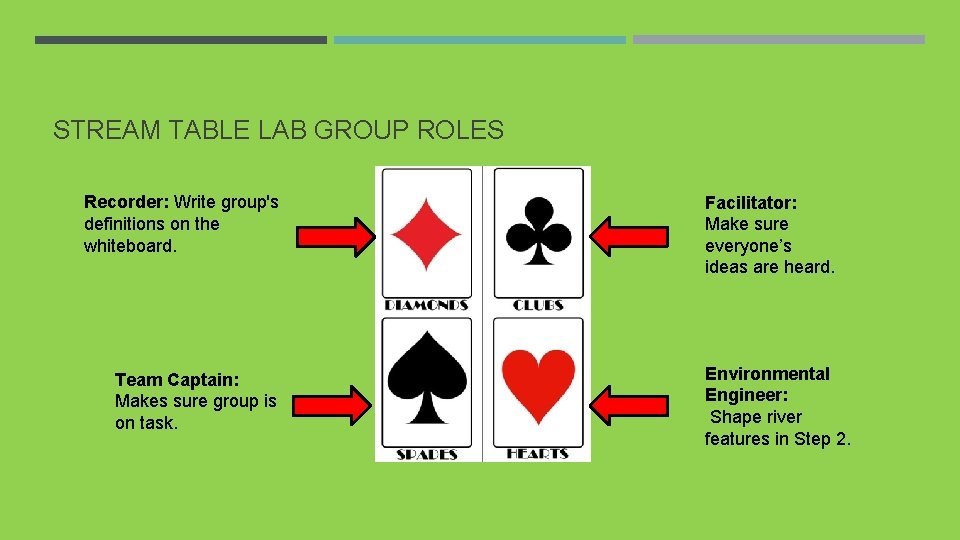
STREAM TABLE LAB GROUP ROLES Recorder: Write group's definitions on the whiteboard. Team Captain: Makes sure group is on task. Facilitator: Make sure everyone’s ideas are heard. Environmental Engineer: Shape river features in Step 2.
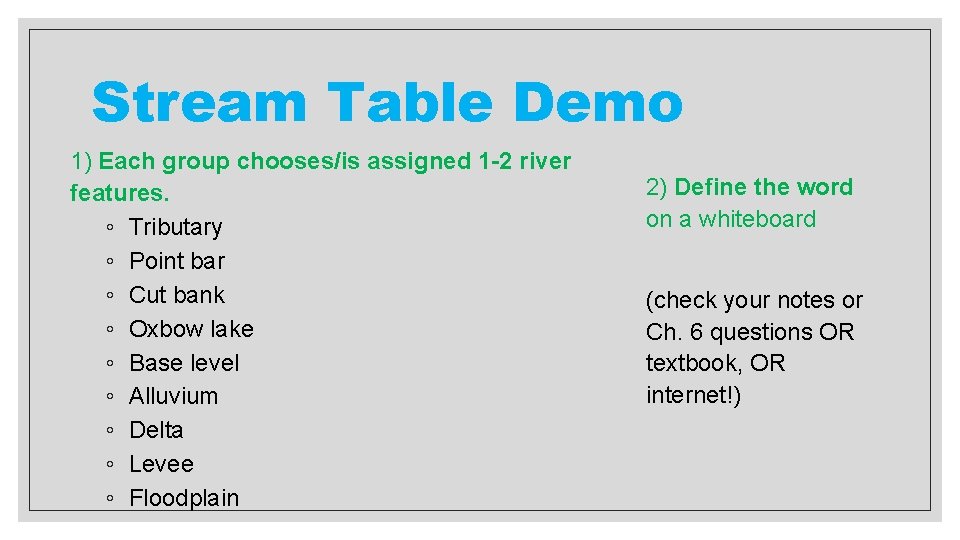
Stream Table Demo 1) Each group chooses/is assigned 1 -2 river features. ◦ Tributary ◦ Point bar ◦ Cut bank ◦ Oxbow lake ◦ Base level ◦ Alluvium ◦ Delta ◦ Levee ◦ Floodplain 2) Define the word on a whiteboard (check your notes or Ch. 6 questions OR textbook, OR internet!)
3) Use the sand your hands to shape the river features found in the list below. Remember creeks, rivers and streams flow into one larger stream. Stream Table Demo First, make your plan. Then, we'll take turns so each group can model.
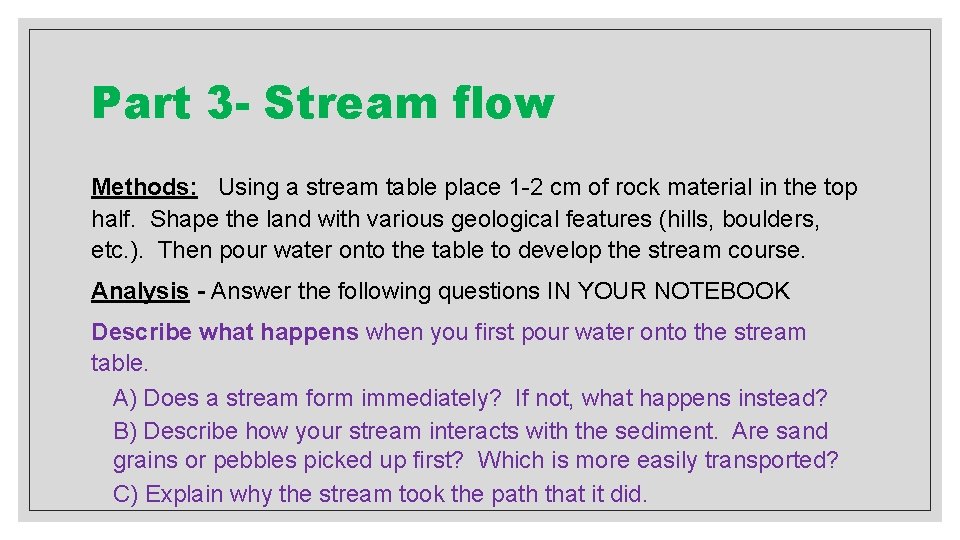
Part 3 - Stream flow Methods: Using a stream table place 1 -2 cm of rock material in the top half. Shape the land with various geological features (hills, boulders, etc. ). Then pour water onto the table to develop the stream course. Analysis - Answer the following questions IN YOUR NOTEBOOK Describe what happens when you first pour water onto the stream table. A) Does a stream form immediately? If not, what happens instead? B) Describe how your stream interacts with the sediment. Are sand grains or pebbles picked up first? Which is more easily transported? C) Explain why the stream took the path that it did.
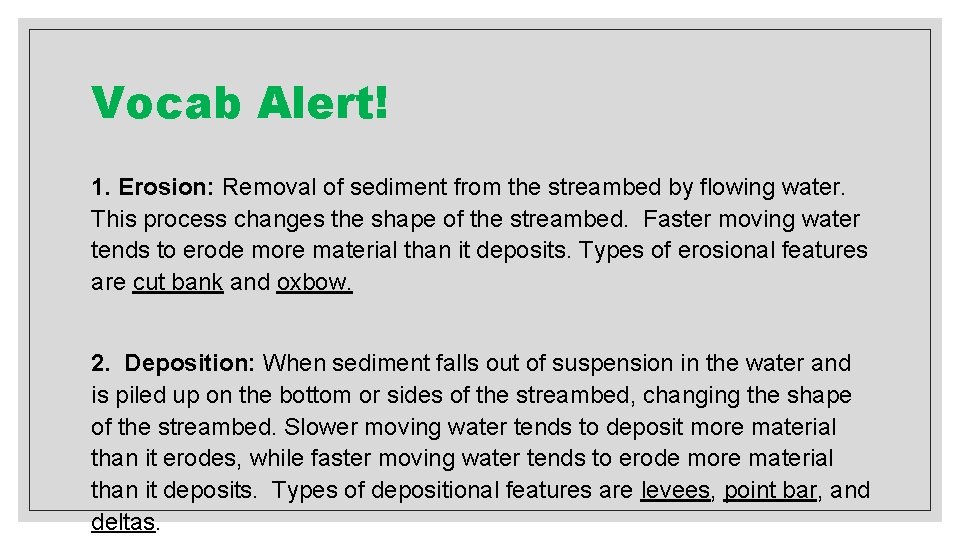
Vocab Alert! 1. Erosion: Removal of sediment from the streambed by flowing water. This process changes the shape of the streambed. Faster moving water tends to erode more material than it deposits. Types of erosional features are cut bank and oxbow. 2. Deposition: When sediment falls out of suspension in the water and is piled up on the bottom or sides of the streambed, changing the shape of the streambed. Slower moving water tends to deposit more material than it erodes, while faster moving water tends to erode more material than it deposits. Types of depositional features are levees, point bar, and deltas.
Draw a picture of the stream table IN YOUR NOTEBOOK and show the path the stream followed. Draw an arrow on your drawing to indicate the direction of water flow. Indicate On your drawing, indicate where erosion is occurring by writing an ‘E, ’ and indicate where deposition is occurring by writing a ‘D. ’ Name the erosional and depositional features where evident.
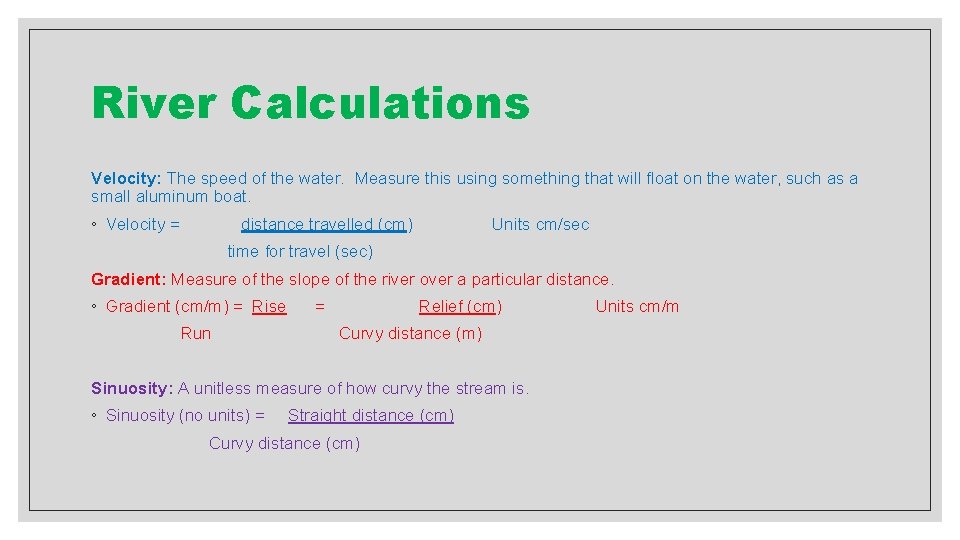
River Calculations Velocity: The speed of the water. Measure this using something that will float on the water, such as a small aluminum boat. ◦ Velocity = distance travelled (cm) Units cm/sec time for travel (sec) Gradient: Measure of the slope of the river over a particular distance. ◦ Gradient (cm/m) = Rise = Relief (cm) Units cm/m Run Curvy distance (m) Sinuosity: A unitless measure of how curvy the stream is. ◦ Sinuosity (no units) = Straight distance (cm) Curvy distance (cm)
Part V – Quick Write Conclusion (in your notebook) WRITE A PARAGRAPH ABOUT WHAT YOU LEARNED IN THE LAB. WHICH FEATURES DO YOU UNDERSTAND BETTER NOW? HOW DOES VELOCITY EFFECT EROSION AND DEPOSITION?
- Slides: 12