
Tyres Chapter Five Tyre classification by construction Crossply

Tyres Chapter Five
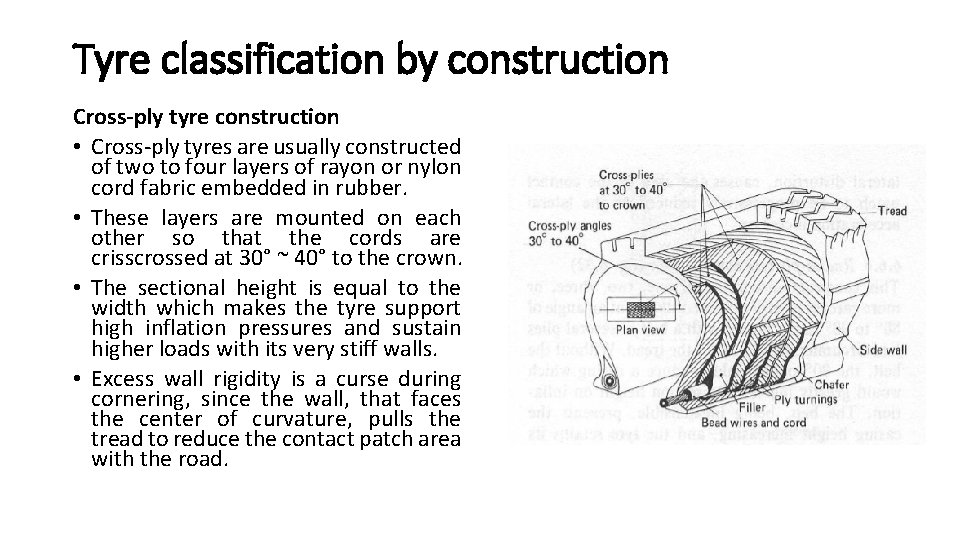
Tyre classification by construction Cross-ply tyre construction • Cross-ply tyres are usually constructed of two to four layers of rayon or nylon cord fabric embedded in rubber. • These layers are mounted on each other so that the cords are crisscrossed at 30° ~ 40° to the crown. • The sectional height is equal to the width which makes the tyre support high inflation pressures and sustain higher loads with its very stiff walls. • Excess wall rigidity is a curse during cornering, since the wall, that faces the center of curvature, pulls the tread to reduce the contact patch area with the road.
In practice, the portion of tyre that contacts the road is deflected. The inextensible cords of the deflected portion move rather than stretch or contract. This deflection causes the angle between the cords to change which will: • Shear the rubber layers between the plies to end-up with heat generation. • Cause the outer ribs of the tread to move laterally and shuffle as the tyre rolls on the road. Driving at high speeds results in • Higher rolling resistance due to the increased friction between the tyre layers. • Higher temperature of the tread. • Faster wear of the outer ribs than the inner ribs of the tread. During cornering, the shuffling action combined with the lateral distortion of the tyre, progressively reduces the contact patch area of the tyre as the lateral acceleration increases.

Radial-ply tyre construction • They are constructed from one, two, three or more carcass plies of textile cords laid at 88° ~ 90° to the bead. • Several plies of circumferential belts are laid under the tread. • These belts prohibit any changes in the cross-sectional height of the tyre when inflated. • The belt layers contain rayon and/or steel cords laid at 12° ~ 20° to the crown.
As the tyre rolls and since the belts are inextensible, there will be a little angular movement of the belt plies and they preserve the hoop shape only deformed at the road contact. However, the radial plies keep the sectional height with a limited vertical deflection rate. This arrangement results in a lower rolling resistance and a longer contact patch than the cross-ply tyre. During vehicle cornering, the stiffness of the belt prevents the tyre tread from shuffling and lateral distortion. Therefore, radial-ply tyres generate narrower slip angles than the cross-ply tyres.
- Slides: 5