
Typology Morphological typology Introduction See the big picture
Typology Morphological typology
Introduction • See «the big picture» • How does word formation work overall in specific languages? • How can the morphological systems of particular languages vary from one another? • (the subject of linguistic typology)
• We will begin by describing the morphological systems of five very different languages, looking at the kinds of lexeme formation and inflection that they display. • Then we will discuss both traditional ways of classifying the morphology of languages and more contemporary ways of doing so. • Finally, we will look at how both the family a language belongs to and the geographic area in which it is spoken can influence its typological classification.
Universals and particulars: a bit of linguistic history • Do we know anything about morphological universals? • There is a range of word formation strategies that appear in the languages of the world. • What are possible forms of reduplication or infixing and what is impossible?
The genius of languages: what’s in your toolkit? • There are unique ways inwhich the morphology of languages can package different concepts in different forms. • We will look at five very different languages-Turkish, Mandarin Chinese, Samoan, Latin, and Nishnaabemwin -- to try to see something of this unique combination of morphological processes that constitutes at least one part of the genius of each language. • All of these languages use morphology in one way or another, but each makes different choices from the universal toolbag of rule types.
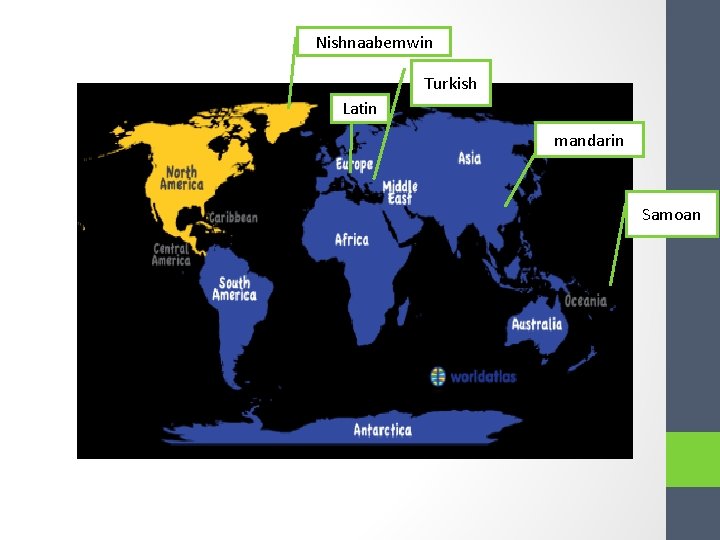
Nishnaabemwin Turkish Latin mandarin Samoan
Turkish • Turkish has a phonological rule called ‘vowel harmony’ • Although the predominant way of forming words in Turkish is through suffixation, it also has a process of compounding • Turkish uses suffixation for both derivation and inflection. • Turkish verbs are inflected for person and number, and can appear in a number of different tenses, including present, past, future, and conditional. • All of these inflections are suffixes; verb forms can be quite long and complex. • no processes of prefixation on word-formation • It marks case (Ev, evin, eve, evden)
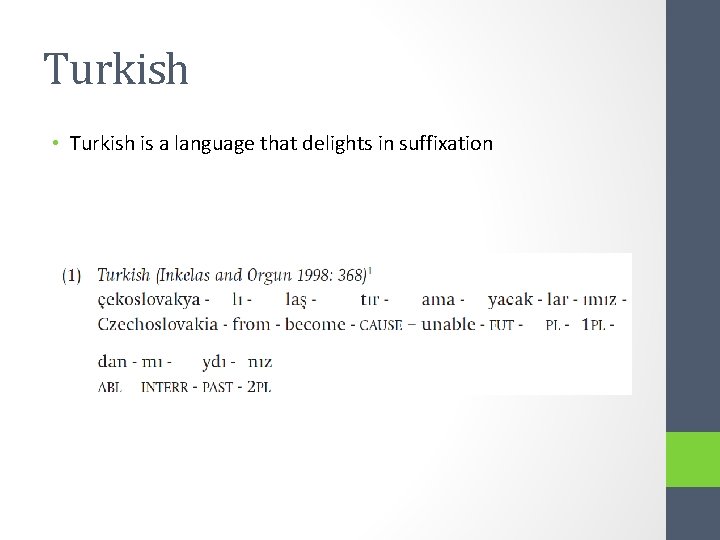
Turkish • Turkish is a language that delights in suffixation
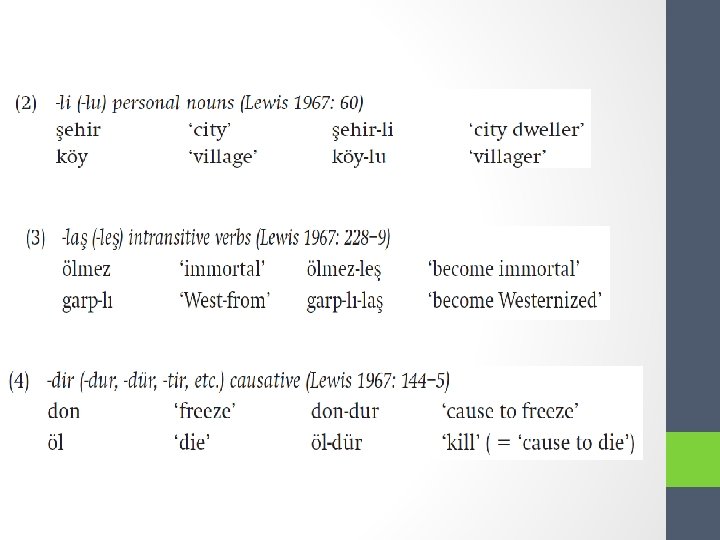
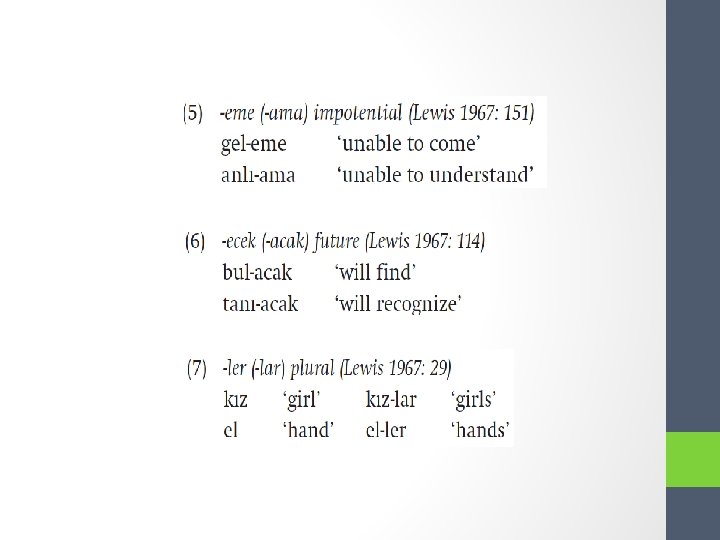
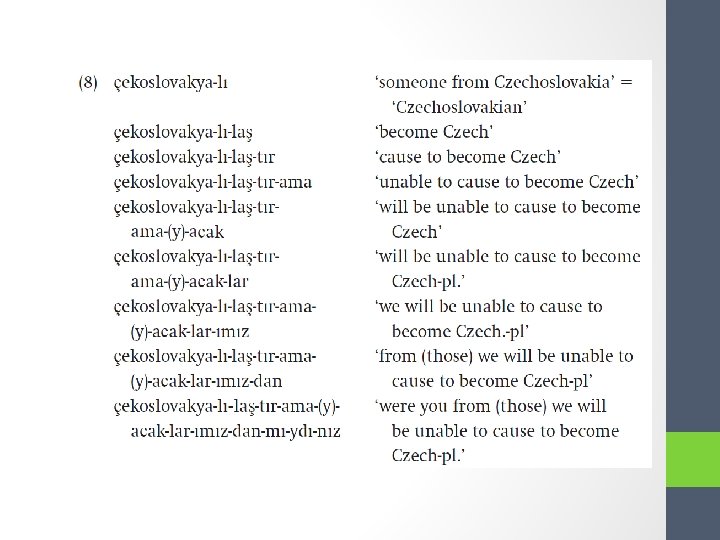
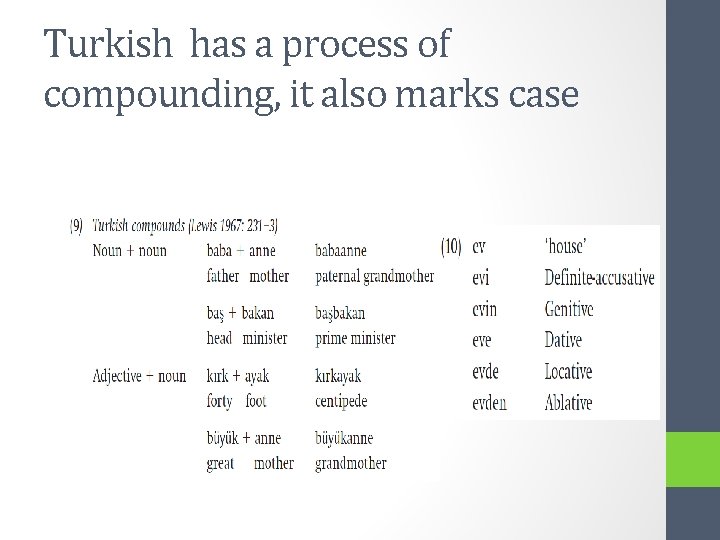
Turkish has a process of compounding, it also marks case
Mandarin chinese (Sino. Tibetan) • no processes of prefixation • tiny handful of suffixes • Mandarin has not only compound nouns and compound adjectives, also all sorts of compound verbs • Mandarin does have a system of noun classifiers that are used when counting or otherwise quantifying nouns
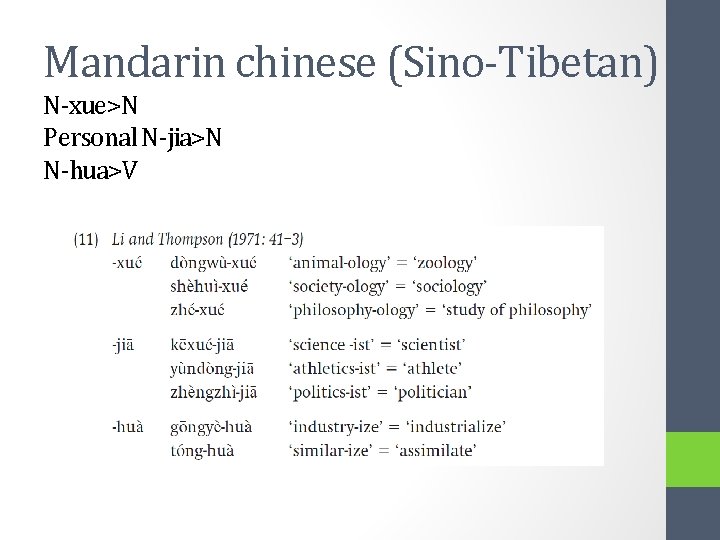
Mandarin chinese (Sino-Tibetan) N-xue>N Personal N-jia>N N-hua>V
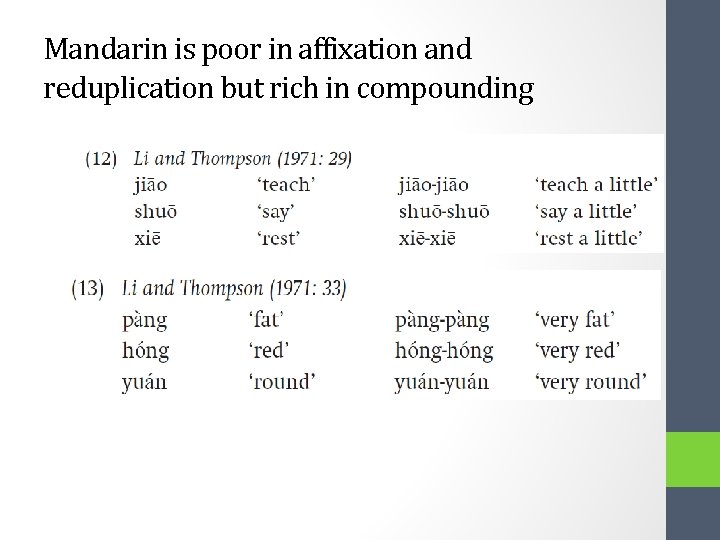
Mandarin is poor in affixation and reduplication but rich in compounding
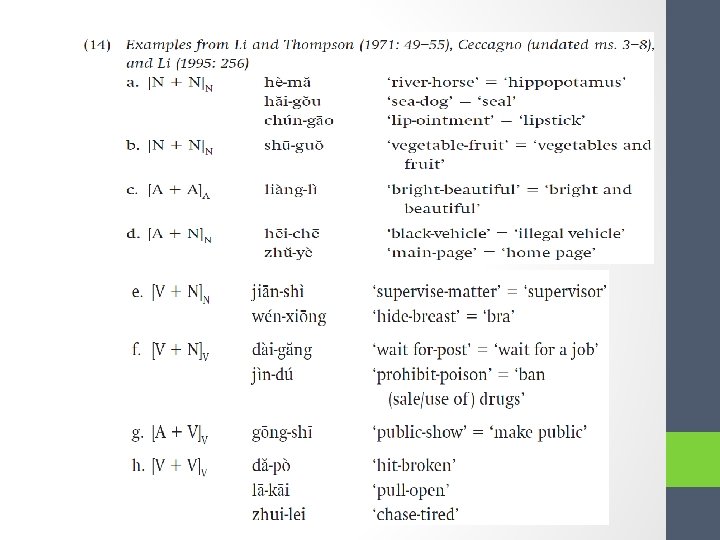
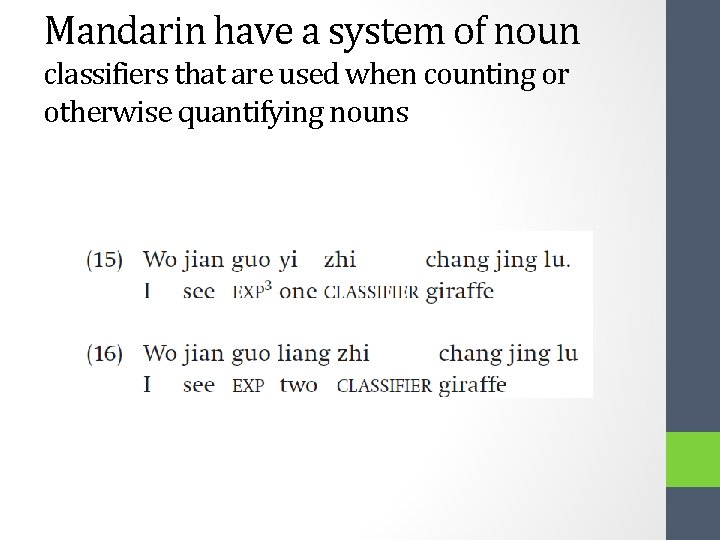
Mandarin have a system of noun classifiers that are used when counting or otherwise quantifying nouns

Samoan (Austronesian) • prefixation, suffixation, and circumfixation, both partial and full reduplication, and also to some extent compounding. • relations like case, tense, aspect, and mood are expressed by independent particles, rather than by prefixes, suffixes, or reduplication, in this language
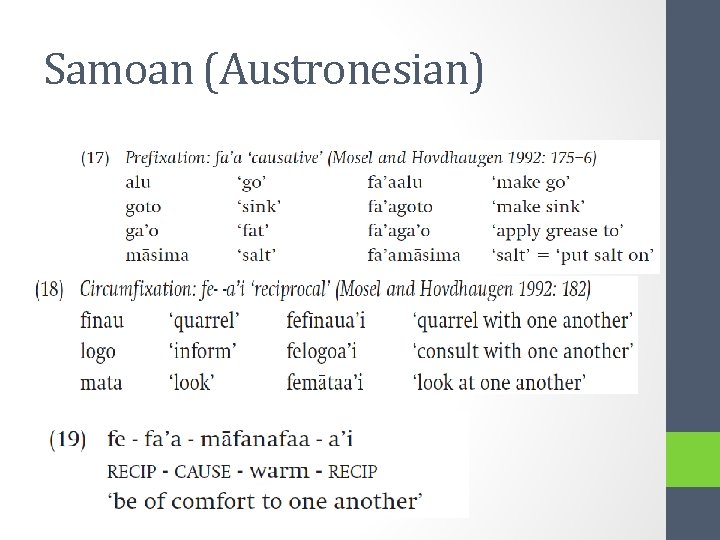
Samoan (Austronesian)
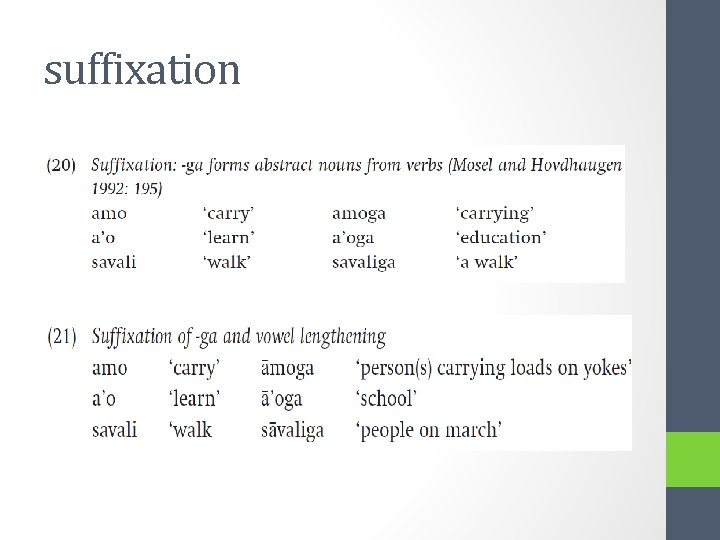
suffixation

reduplication

compounding
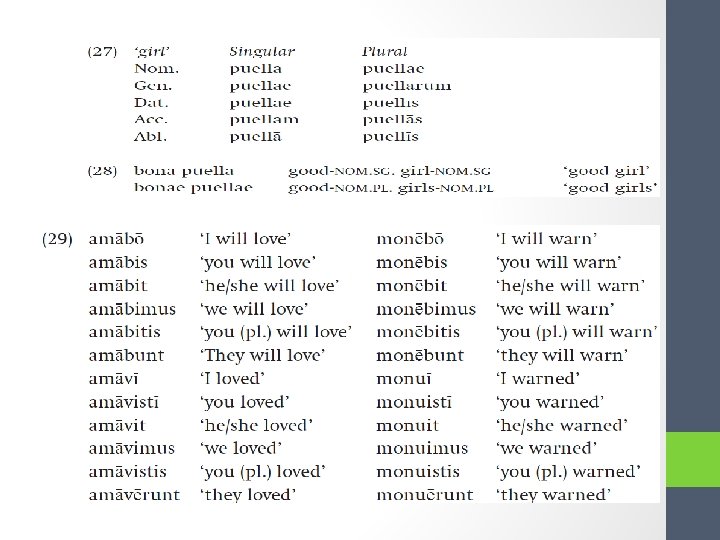
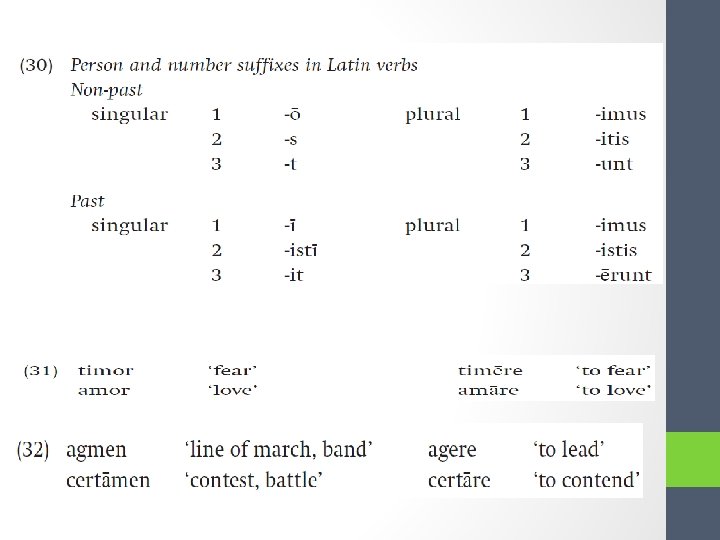
Latin (Indo-European) • Heavily inflected language, almost entirely suffixal • often several meanings are combined into a single inflectional morpheme in Latin • Latin nouns are inflected for case, number, and gender, and adjectives are inflected to agree with them • Verbs have a number of different stems which form the basis of inflectional paradigms that show aspect (imperfect vs. perfect) and voice (active vs. passive), as well as person and number • different person and number affixes are used in the past than in other tenses • Latin has both derivational suffixes and prefixes
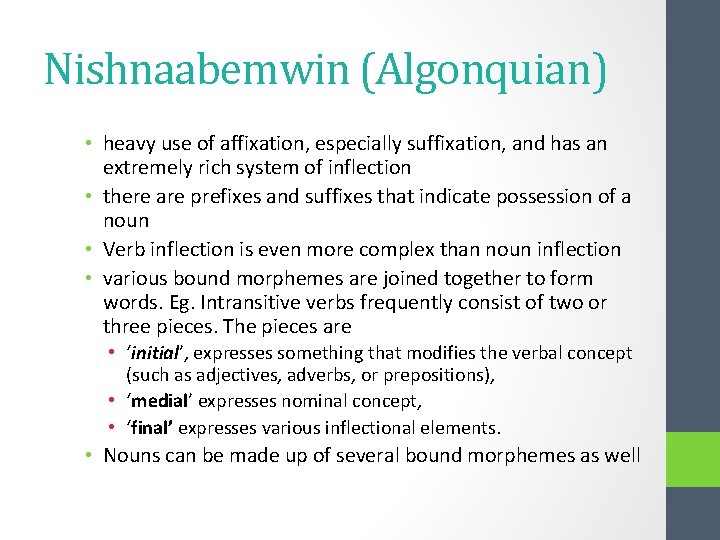
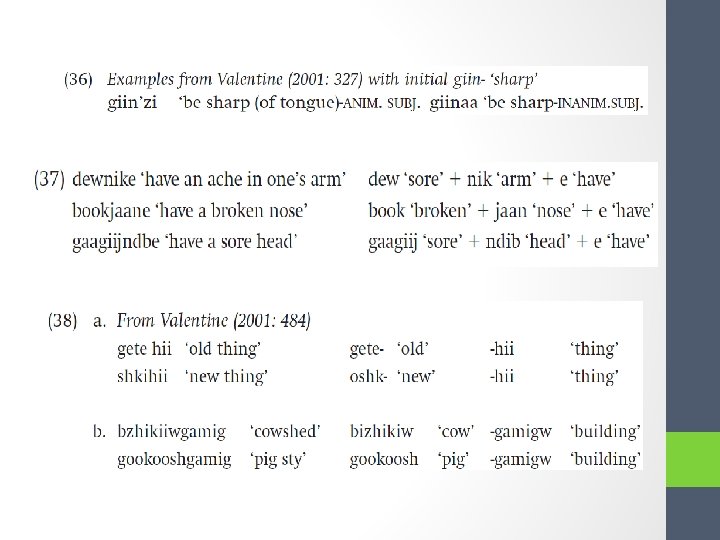
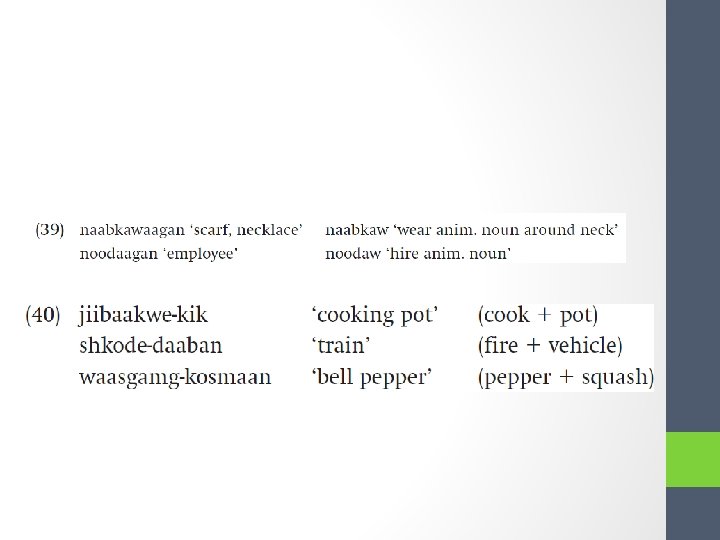
Nishnaabemwin (Algonquian) • heavy use of affixation, especially suffixation, and has an extremely rich system of inflection • there are prefixes and suffixes that indicate possession of a noun • Verb inflection is even more complex than noun inflection • various bound morphemes are joined together to form words. Eg. Intransitive verbs frequently consist of two or three pieces. The pieces are • ‘initial’, expresses something that modifies the verbal concept (such as adjectives, adverbs, or prepositions), • ‘medial’ expresses nominal concept, • ‘final’ expresses various inflectional elements. • Nouns can be made up of several bound morphemes as well
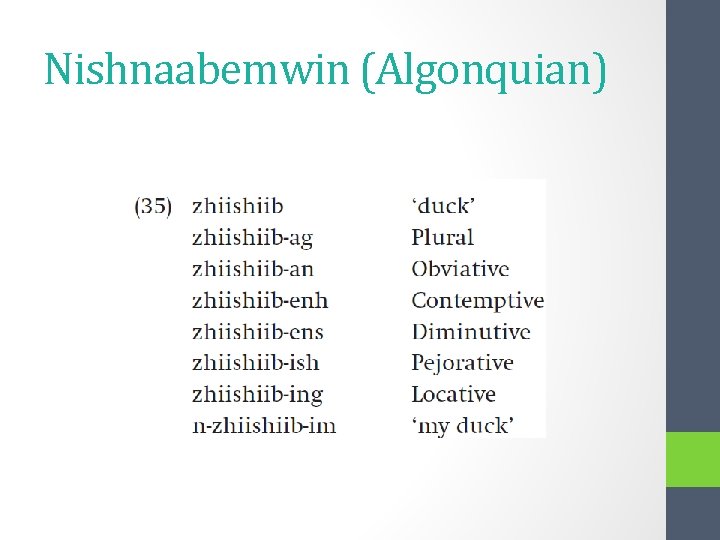
Nishnaabemwin (Algonquian)
summary • Each language has a different combination of word formation processes that gives the language its unique character • We should always be on the lookout for the commonalities or universals that mark all these languages as human languages.
- Slides: 30