
Typical wrong answer traps on the ACT reading
- Slides: 16
Typical wrong answer traps on the ACT reading test
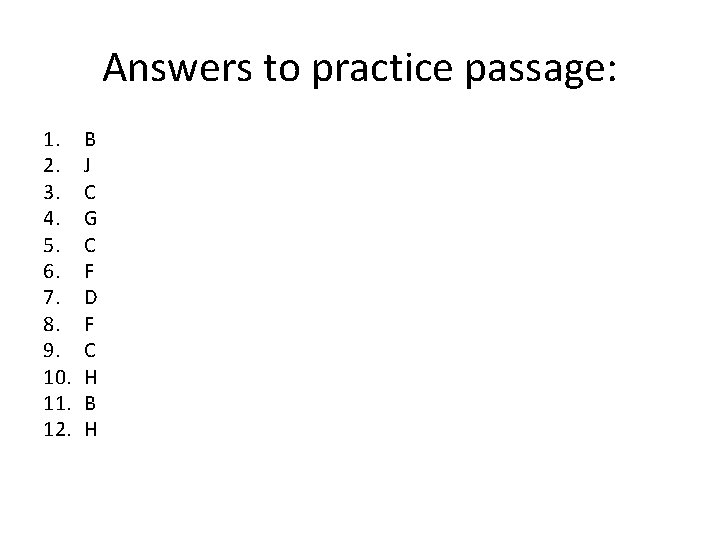
Answers to practice passage: 1. 2. 3. 4. 5. 6. 7. 8. 9. 10. 11. 12. B J C G C F D F C H B H
Misused details • Predict the answer in your own words BEFORE looking at the answer choices. Also make sure to read the question stem CAREFULLY.
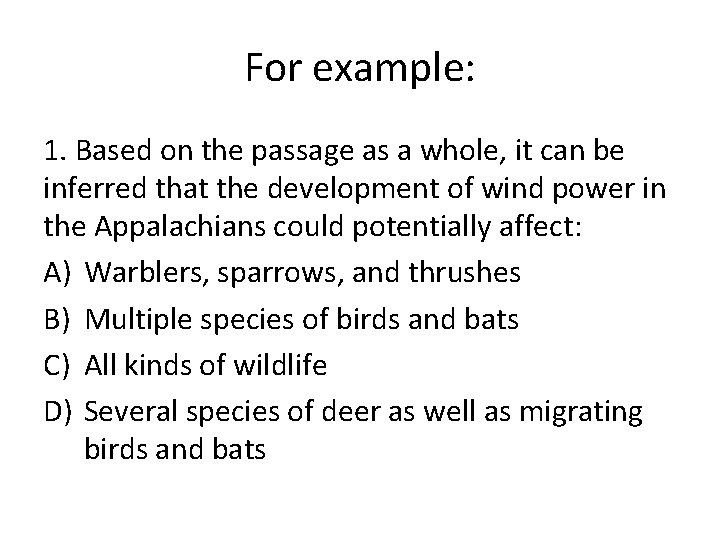
For example: 1. Based on the passage as a whole, it can be inferred that the development of wind power in the Appalachians could potentially affect: A) Warblers, sparrows, and thrushes B) Multiple species of birds and bats C) All kinds of wildlife D) Several species of deer as well as migrating birds and bats
Distortions • The distortion is a wrong answer choice that uses a detail from the passage but phrases the detail in such a way that it’s distorted, or twisted, into something that doesn’t match what’s in the passage. A distortion may combine two details from the passage in an inaccurate way, or it may combine a detail from the passage with something else that doesn’t appear in the passage at all.
7. The 7 th paragraph functions as A) An explanation of how portable radar sampling works B) Evidence about the flight attitudes of migrant animals C) A description of how spectograms are used in acoustic monitoring D) A brief mention of a kind of data collection that is used in conjunction with acoustic monitoring
Extremes • As its name suggests, an extreme answer choice uses language that is too extreme. This means that the answer choice may be something that is along the right lines to answer the question but is worded in a way that goes too far. Certain kinds of words appear frequently in extreme answer traps.
Extreme answer traps • • • • Absolutely Always All Best Certainly Ever in every case Largest Never No None Smallest Worst Without a doubt
Exceptions: • An answer choice that contains words or phrases like those listed is not necessarily the wrong answer. However, if an answer choice does contain extreme language, you should consider it a trap unless the extreme language is also used in the passage.
For example: • Suppose a write says, “Isaac Newton was one of the most brilliant scientists of his time, ” and you encounter a question that asks about the writer’s opinion of Newton. Consider the following answer choices: • A) Isaac Newton was the most brilliant scientist ever to have lived. • B) Isaac Newton displayed much brilliance in his scientific work. • C) Isaac Newton was more brilliant than any of his contemporaries were. • D) Isaac Newton was the most brilliant scientist of his day.
5. It can be inferred from the passage as a whole that A) The turbines used in generating wind power create well-defined risks for migrating bats. B) Weather surveillance radar data may be used independently to assess risks to wildlife. C) Computer technology is an essential part of investigations about the risks of wind power to wildlife. D) Acoustic monitoring is the best currently available data collection technique for assessing wind power’s potential threats to migrating bats.
Contradictions • A contradiction is a wrong answer trap that goes against what’s stated in the passage. We sometimes call this an opposite answer trap.
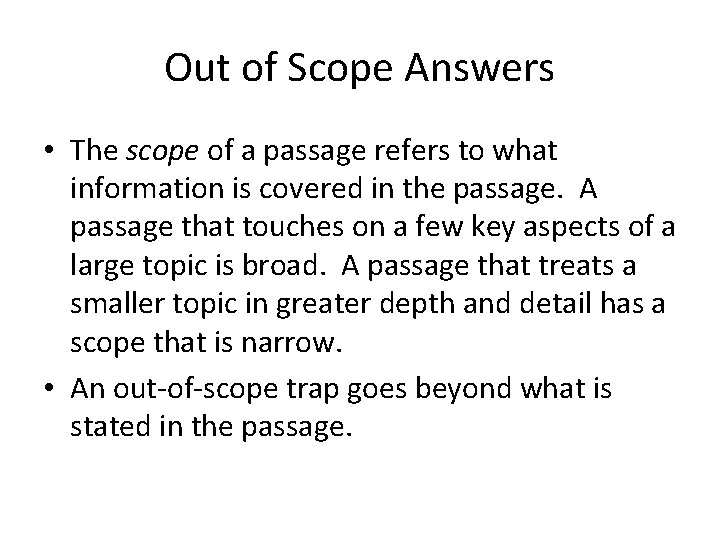
Out of Scope Answers • The scope of a passage refers to what information is covered in the passage. A passage that touches on a few key aspects of a large topic is broad. A passage that treats a smaller topic in greater depth and detail has a scope that is narrow. • An out-of-scope trap goes beyond what is stated in the passage.
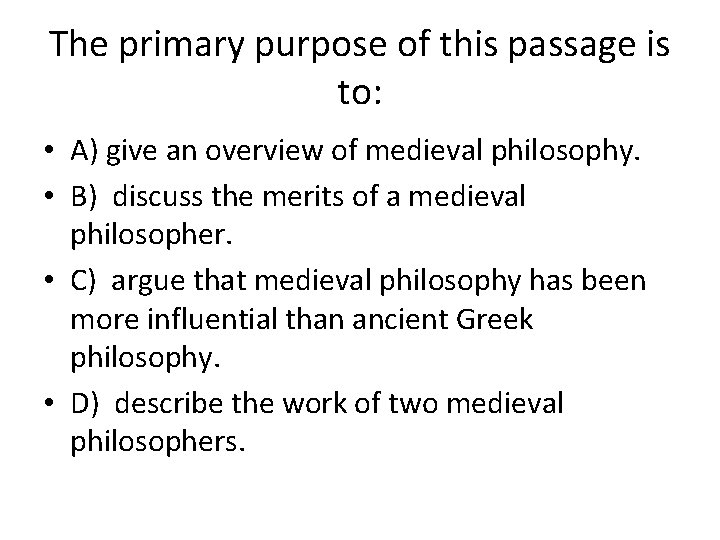
Suppose you see a passage that discusses two medieval philosophers followed by this question:
The primary purpose of this passage is to: • A) give an overview of medieval philosophy. • B) discuss the merits of a medieval philosopher. • C) argue that medieval philosophy has been more influential than ancient Greek philosophy. • D) describe the work of two medieval philosophers.
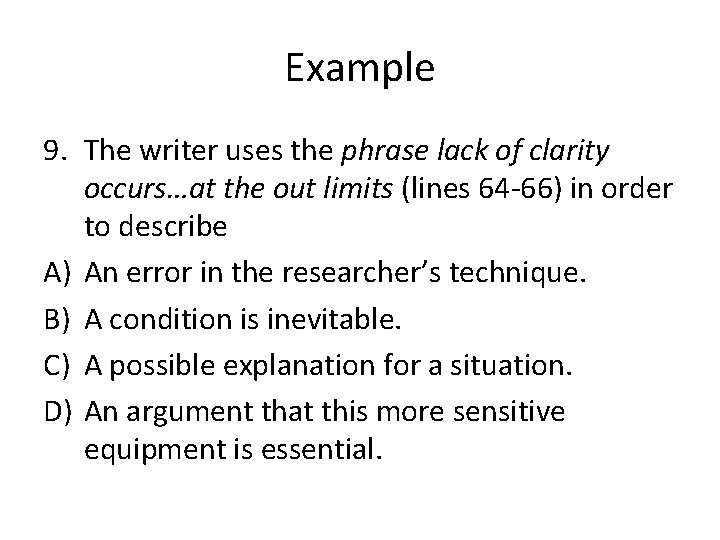
Example 9. The writer uses the phrase lack of clarity occurs…at the out limits (lines 64 -66) in order to describe A) An error in the researcher’s technique. B) A condition is inevitable. C) A possible explanation for a situation. D) An argument that this more sensitive equipment is essential.