
Typical SDLC n Feasibility study Plan Analysis Design
Typical SDLC n Feasibility study Plan Analysis Design Development) Testing Validation n Implementation n Get ready to start again n n n
System analysis II User Involvement To overcome reluctance to change, involve the people in the client organization in the development process.
An analyst must be good at: n coordinating schedules and system-related tasks with a number of people. n communicating -The analyst may need to make oral presentations and write reports for clients, users, and others involved with the system. n Other desirable qualities of a systems analyst are: u an analytical mind u self-discipline u self-direction u The ability to work without tangible results
Systems Analysis III n n n During this phase the systems analyst must: Gather data Analyze data Determine system requirements Report to management
Gathering Data n The systems analyst relies on the following sources when gathering data: u Written documents u Interviews u Questionnaires u Observations u Sampling
Written Documents n Gathering documents includes procedures manuals, forms, and any kind of material that might have bearing on the problems in the organization. Interviews n There are two types of interviews, n Structured interviews include only preplanned questions. n Unstructured interviews allow the systems analyst to digress from the formal line of questioning.

Questionnaires n Questionnaires are ideal for gathering information from a group too large to interview.
Observation n n Systems analysts must observe the flow of information in and out of an organization. Sometimes this requires them to be a temporary participant in the organization. Sampling n Sampling is the collection of data about quantities, costs, time periods, and other factors relevant to the system.
Analysing the data n Analysts use a number of “tools” to help them understand the IS n Scope diagrams; where does the IS start and finish Hierarchy charts; what modules does the IS need Input Processing Output (IPO) charts; n n n Often, analysts start looking at the whole system, then progressively break it down into smaller and smaller parts - this is called decomposition
Prototyping n Prototyping is the development of a “working model” of part or all of an IS. Prototyping is used u to get a better idea of the functional requirements (what the IS does) u or to refine some detail of the user interface n For smaller applications or applications where it is VERY hard to define a comprehensive set of requirements, prototyping may be the predominant method. In “evolutionary prototyping”, the prototype eventually becomes the application,
System Requirements n n The final segment of the systems analysis phase leads to a list of the things the system must be able to do. This list of system requirements will determine the design of the new system.
Step 3. Systems Design n This is the phase in which the systems analyst actually plans the new system. n There a number of tools used to help design The way data will be organised, The functions that will be provided The type of user interface n n n
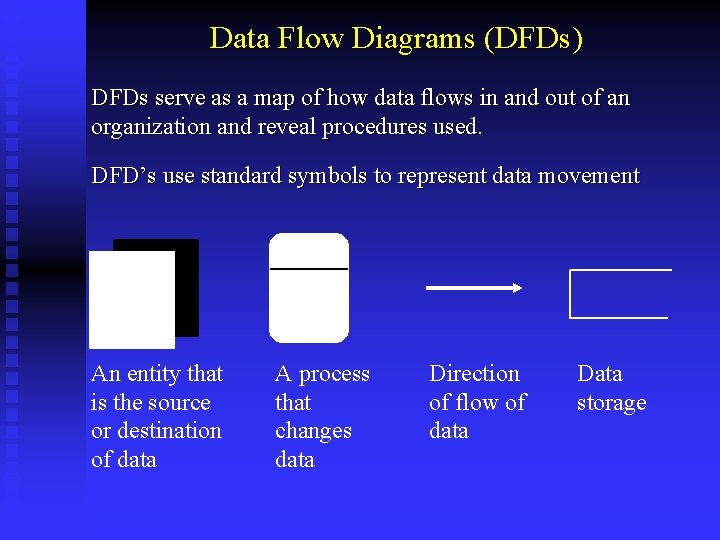
Data Flow Diagrams (DFDs) DFDs serve as a map of how data flows in and out of an organization and reveal procedures used. DFD’s use standard symbols to represent data movement An entity that is the source or destination of data A process that changes data Direction of flow of data Data storage
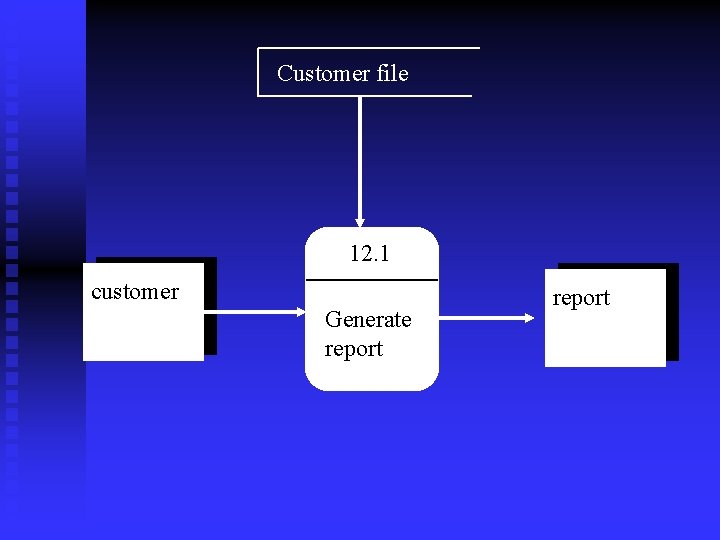
Customer file 12. 1 customer Generate report
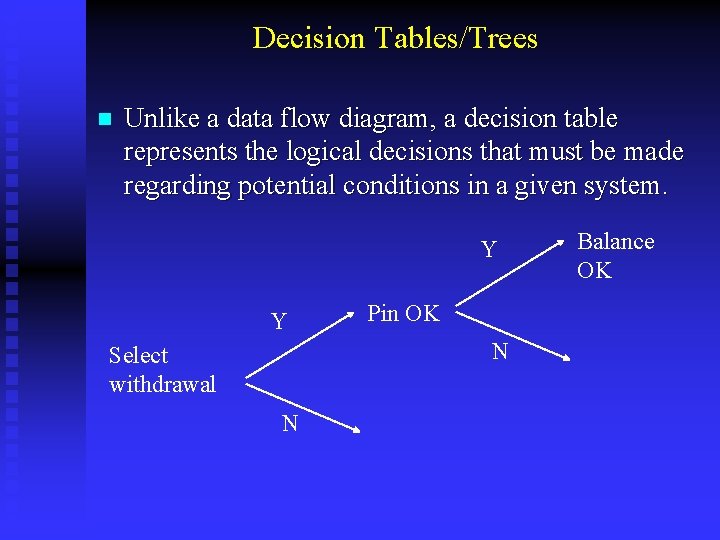
Decision Tables/Trees n Unlike a data flow diagram, a decision table represents the logical decisions that must be made regarding potential conditions in a given system. Y Y Pin OK N Select withdrawal N Balance OK
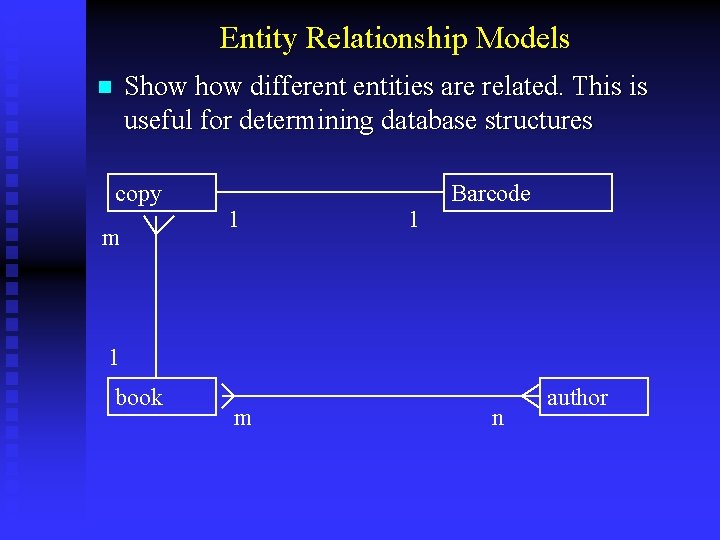
Entity Relationship Models Show different entities are related. This is useful for determining database structures n copy m 1 1 Barcode 1 book m n author
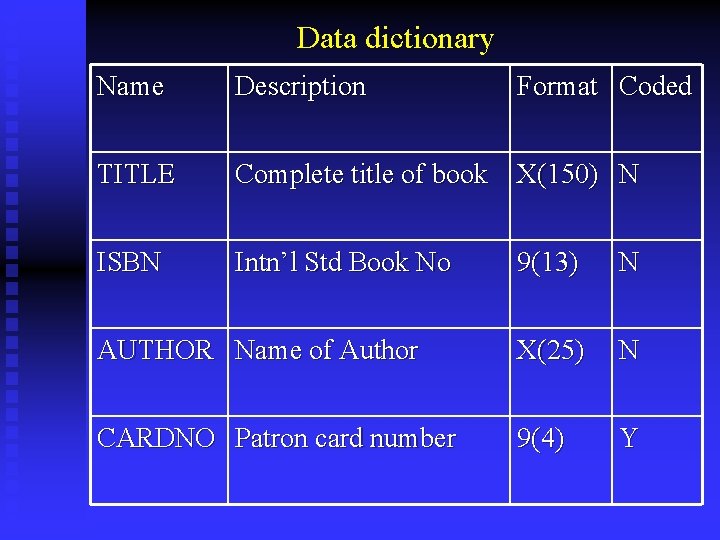
Data dictionary Name Description Format Coded TITLE Complete title of book X(150) N ISBN Intn’l Std Book No 9(13) N AUTHOR Name of Author X(25) N CARDNO Patron card number 9(4) Y
Detail Design n The systems analyst must now develop detailed design specifications, such as: u Output requirements u Input requirements u Files and databases u Systems processing u Systems controls and backups
Output Requirements n The systems analyst must determine: u what the client wants the system to produce. u the medium of the output. u the type of reports needed. u the contents of the output. Input Requirements • The systems analyst must determine what input is required to give the desired output. u what forms will be used. u what sources will provide input
Files and Databases n The systems analyst will determine whether the files should be stored sequentially, directly, or by some other method. n File storage must also be coordinated with the databases used by the client.
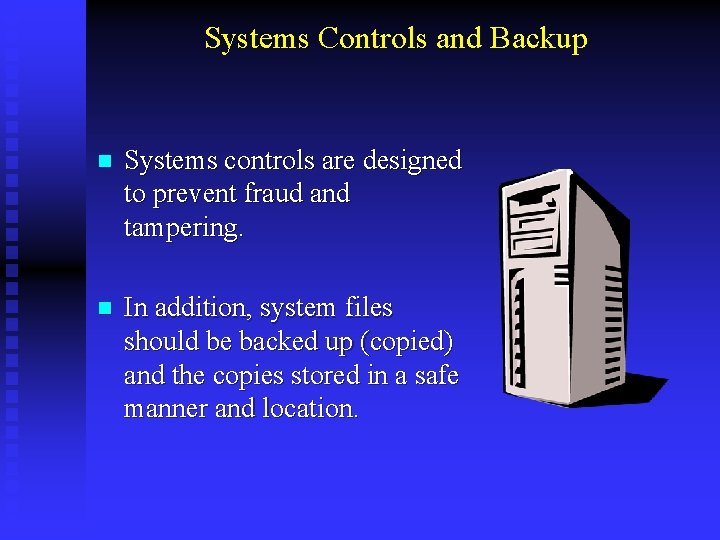
Systems Controls and Backup n Systems controls are designed to prevent fraud and tampering. n In addition, system files should be backed up (copied) and the copies stored in a safe manner and location.
Interface design n Specialist interface designers and graphic artists often work out how the IS will look and behave from a users point of view. n They design the “flow” from one function to another and how individual functions may be carried out. They are concerned with the location of edit fields, icons etc on the screen n They plan the colours and sizes of items on the screen to make it easier and more pleasant to use
- Slides: 22