
Typical Mark 1 Containment Vent Locations The NRC

- Slides: 20
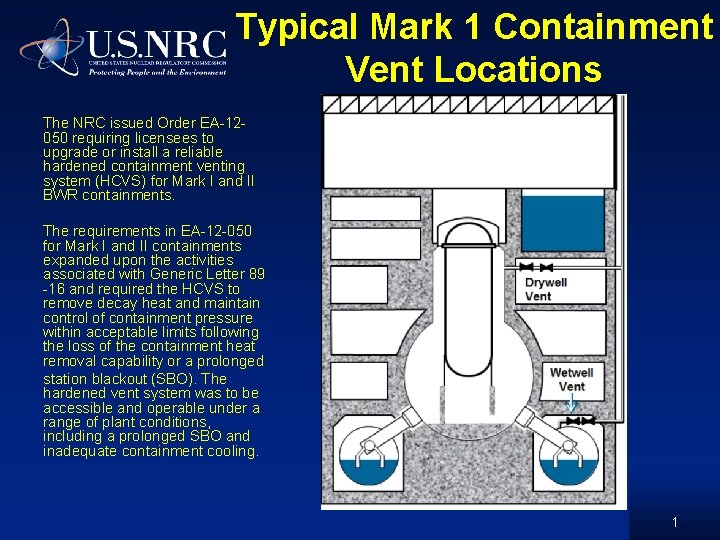
Typical Mark 1 Containment Vent Locations The NRC issued Order EA-12050 requiring licensees to upgrade or install a reliable hardened containment venting system (HCVS) for Mark I and II BWR containments. The requirements in EA-12 -050 for Mark I and II containments expanded upon the activities associated with Generic Letter 89 -16 and required the HCVS to remove decay heat and maintain control of containment pressure within acceptable limits following the loss of the containment heat removal capability or a prolonged station blackout (SBO). The hardened vent system was to be accessible and operable under a range of plant conditions, including a prolonged SBO and inadequate containment cooling. 1
Industry Perspective on Reliable Hardened Vents • Best choice is a performance-based approach to filtering for minimizing radioactive releases in the event of a severe nuclear accident • Active management and protection of containment during a severe accident. • Reliance on a combination of installed plant equipment, operator actions, and the diverse and flexible coping strategy (FLEX). • FLEX has portable backup emergency equipment that would be “protected from natural hazards” and deployed to help in the conditions likely to prevail after a severe accident - conditions in which a filtered vent might not function. 2
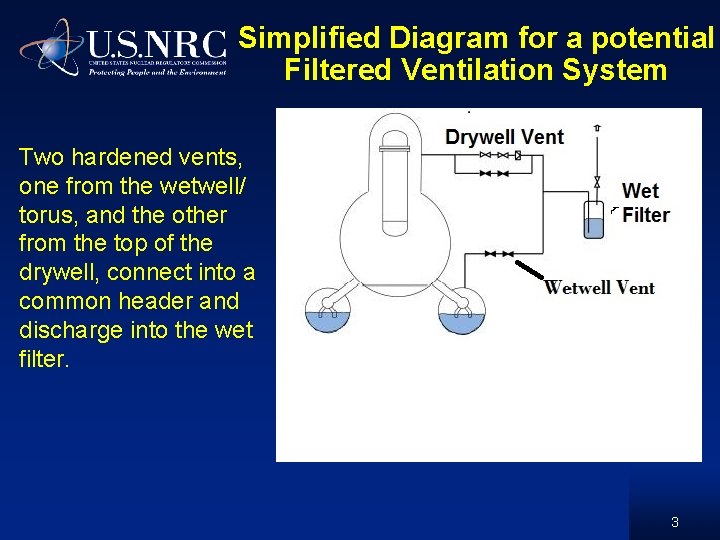
Simplified Diagram for a potential Filtered Ventilation System Two hardened vents, one from the wetwell/ torus, and the other from the top of the drywell, connect into a common header and discharge into the wet filter. 3
Filtered Vents • In June 2013, the commission directed the NRC staff to develop technical bases and rulemaking for filtering strategies and severe accident management of BWR Mark I and II containments. • In June 2015 the NRC staff submitted the requested technical basis to the Commission. • Bottom line with respect to filtered vents: Installation of filtered vents could result in reductions of offsite consequences, but these reductions do not meet the quantitative thresholds for substantial safety enhancement because early fatality risk and latent cancer fatality risks are below quantitative health objectives without additional plant modifications. (see SECY 15 -0085) 4
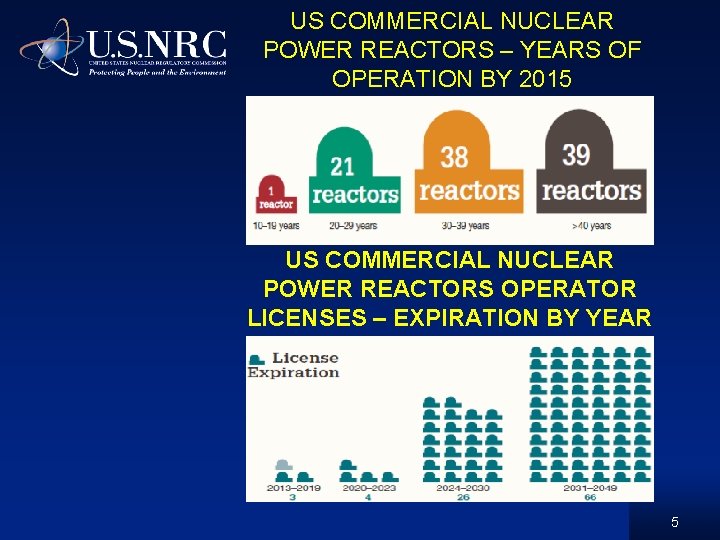
US COMMERCIAL NUCLEAR POWER REACTORS – YEARS OF OPERATION BY 2015 US COMMERCIAL NUCLEAR POWER REACTORS OPERATOR LICENSES – EXPIRATION BY YEAR 5
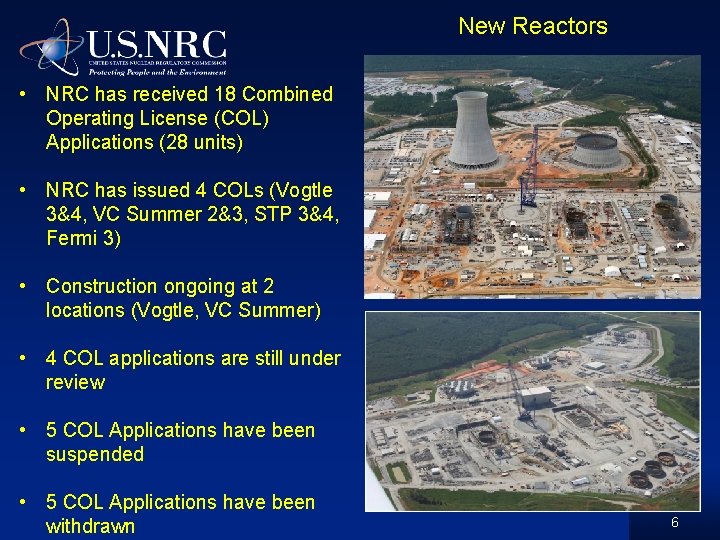
New Reactors • NRC has received 18 Combined Operating License (COL) Applications (28 units) • NRC has issued 4 COLs (Vogtle 3&4, VC Summer 2&3, STP 3&4, Fermi 3) • Construction ongoing at 2 locations (Vogtle, VC Summer) • 4 COL applications are still under review • 5 COL Applications have been suspended • 5 COL Applications have been withdrawn 6
7
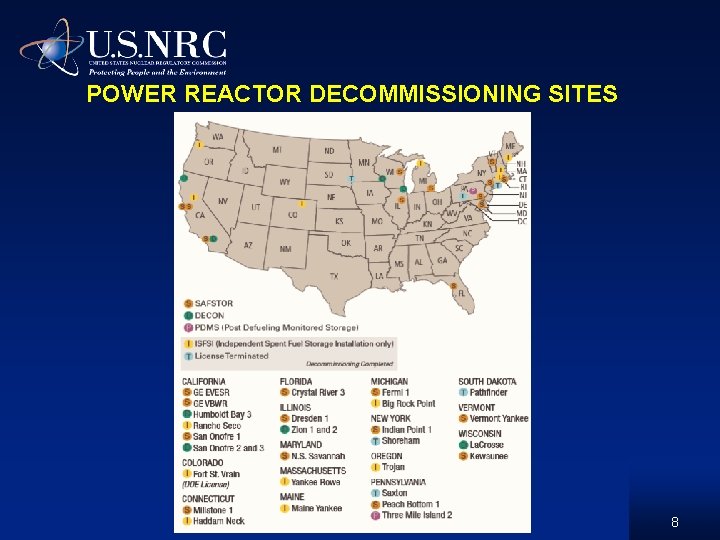
POWER REACTOR DECOMMISSIONING SITES 8
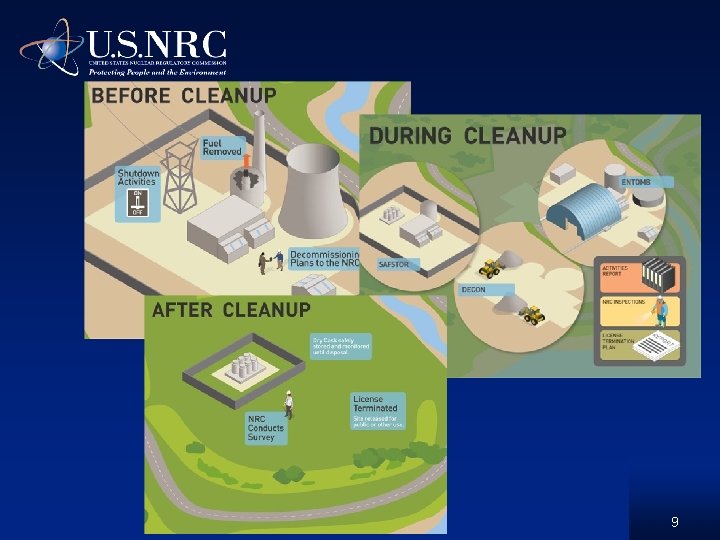
9
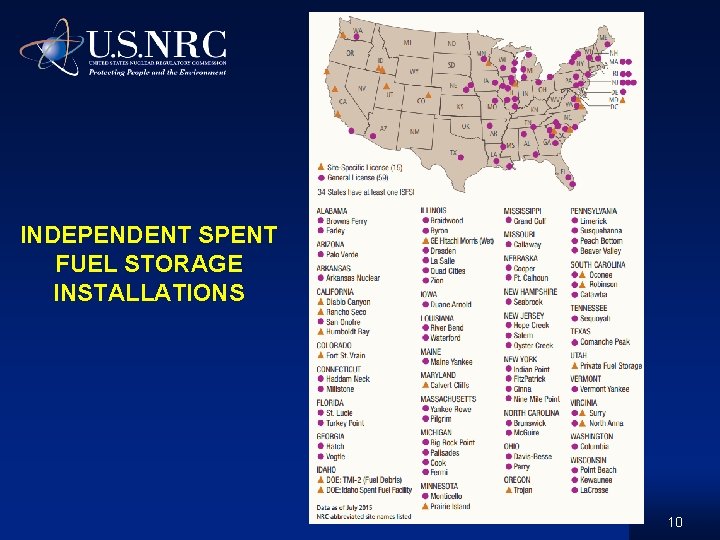
INDEPENDENT SPENT FUEL STORAGE INSTALLATIONS 10
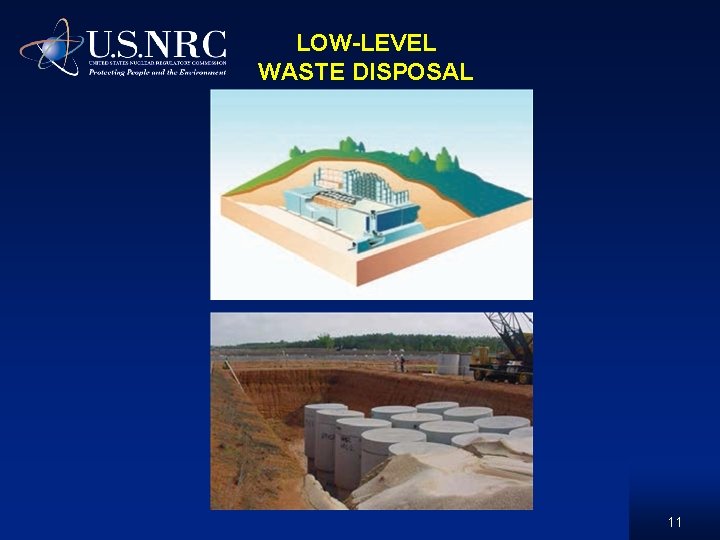
LOW-LEVEL WASTE DISPOSAL 11
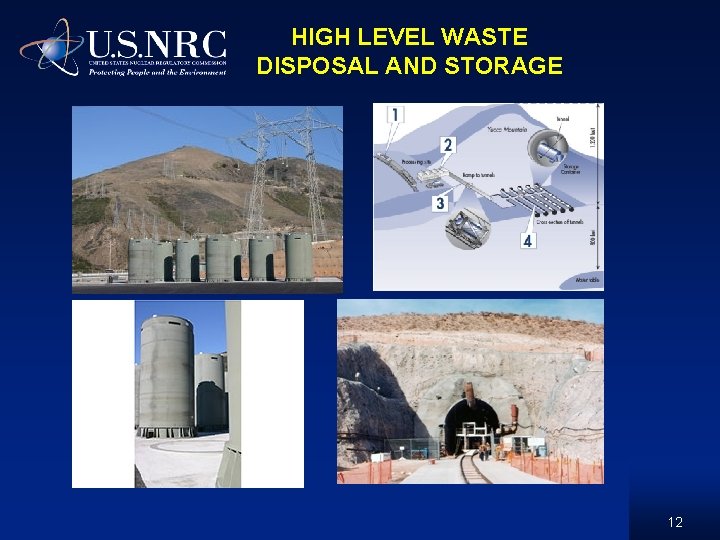
HIGH LEVEL WASTE DISPOSAL AND STORAGE 12
Small Modular Reactors (SMRs) • Small modular reactors offer a lower initial capital investment, greater scalability, and siting flexibility for locations unable to accommodate more traditional larger reactors. They also have the potential for enhanced safety and security compared to earlier designs. • Modularity: The term “modular” in the context of SMRs refers to the ability to fabricate major components of the nuclear steam supply system in a factory environment and ship to the point of use • Siting Flexibility: SMRs can provide power for applications where large plants are not needed or sites lack the infrastructure to support a large unit. 13
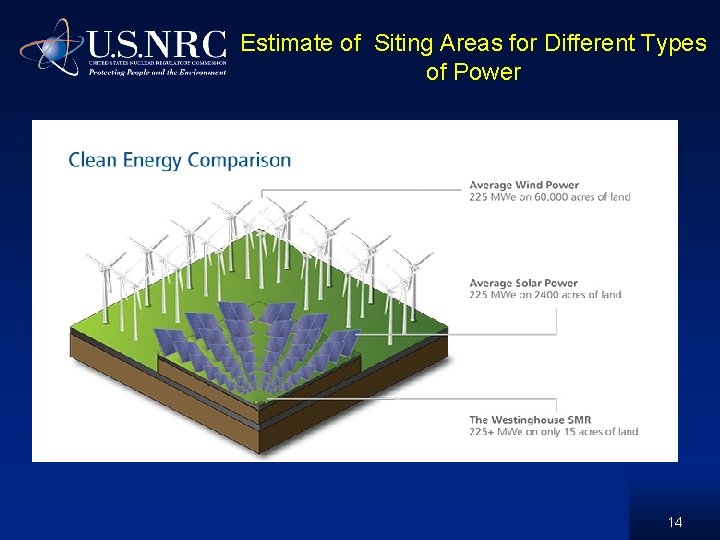
Estimate of Siting Areas for Different Types of Power 14
NRC and SMRs • The NRC has taken strategic steps to prepare itself for receiving applications for small modular reactors by proactively engaging stakeholders and potential applicants via formal and informal outreach. • Regulatory Framework Development • A number of NRC documents discussing policy issues with regard to SMR’s have been generated and are publicly available at: • http: //www. nrc. gov/reactors/advanced/policyissues. html • Clinch River Early Site Permit (Submitted May 2016) • Nu. Scale Design Certification Application (Anticipated by end 15 of 2016)
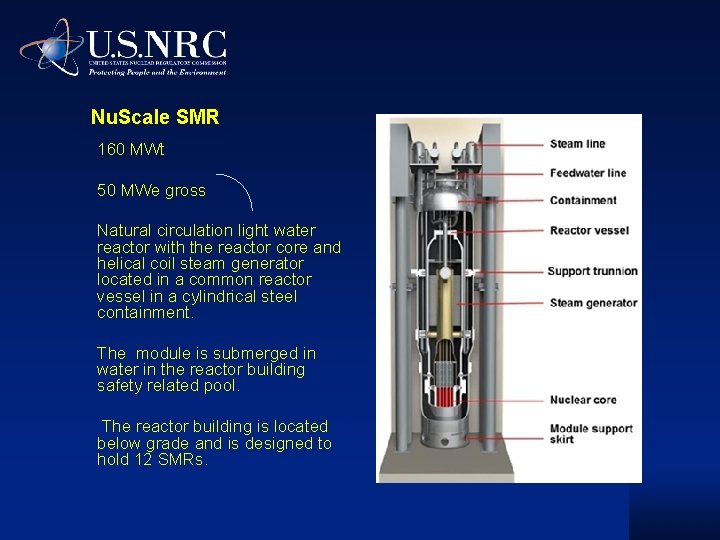
Nu. Scale SMR 160 MWt 50 MWe gross Natural circulation light water reactor with the reactor core and helical coil steam generator located in a common reactor vessel in a cylindrical steel containment. The module is submerged in water in the reactor building safety related pool. The reactor building is located below grade and is designed to hold 12 SMRs.
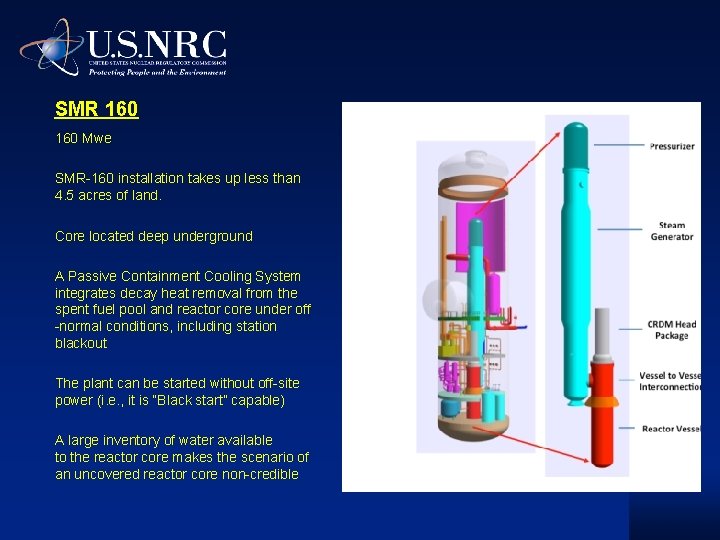
SMR 160 Mwe SMR-160 installation takes up less than 4. 5 acres of land. Core located deep underground A Passive Containment Cooling System integrates decay heat removal from the spent fuel pool and reactor core under off -normal conditions, including station blackout The plant can be started without off-site power (i. e. , it is “Black start” capable) A large inventory of water available to the reactor core makes the scenario of an uncovered reactor core non-credible
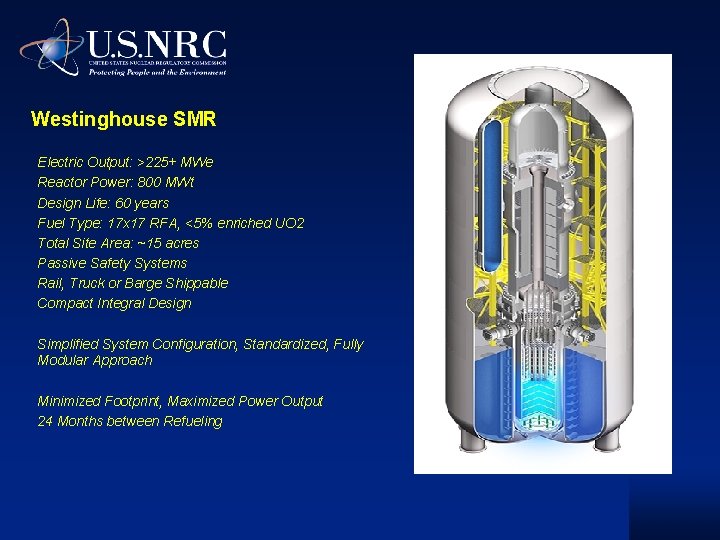
Westinghouse SMR Electric Output: >225+ MWe Reactor Power: 800 MWt Design Life: 60 years Fuel Type: 17 x 17 RFA, <5% enriched UO 2 Total Site Area: ~15 acres Passive Safety Systems Rail, Truck or Barge Shippable Compact Integral Design Simplified System Configuration, Standardized, Fully Modular Approach Minimized Footprint, Maximized Power Output 24 Months between Refueling
19
Questions? 20