
Typical ATR FTIR spectra series for PolySodium 4
- Slides: 6
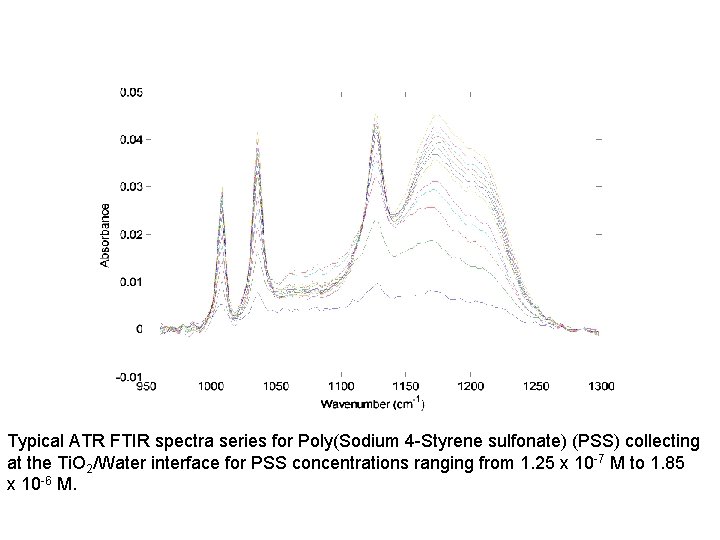
Typical ATR FTIR spectra series for Poly(Sodium 4 -Styrene sulfonate) (PSS) collecting at the Ti. O 2/Water interface for PSS concentrations ranging from 1. 25 x 10 -7 M to 1. 85 x 10 -6 M.
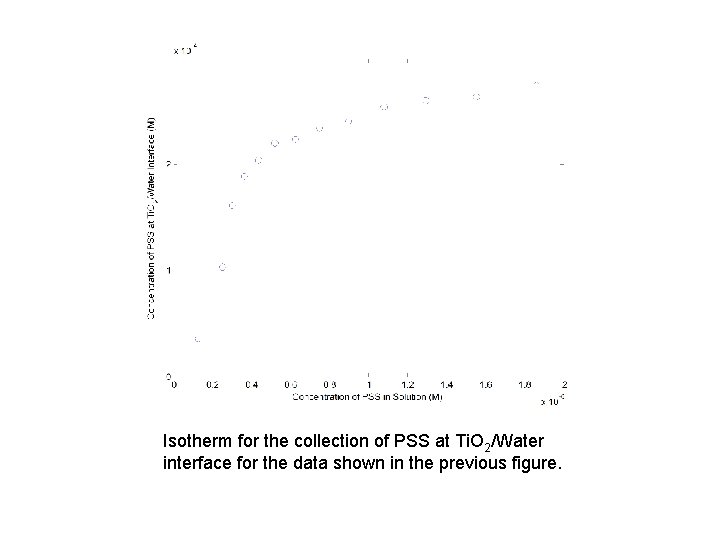
Isotherm for the collection of PSS at Ti. O 2/Water interface for the data shown in the previous figure.
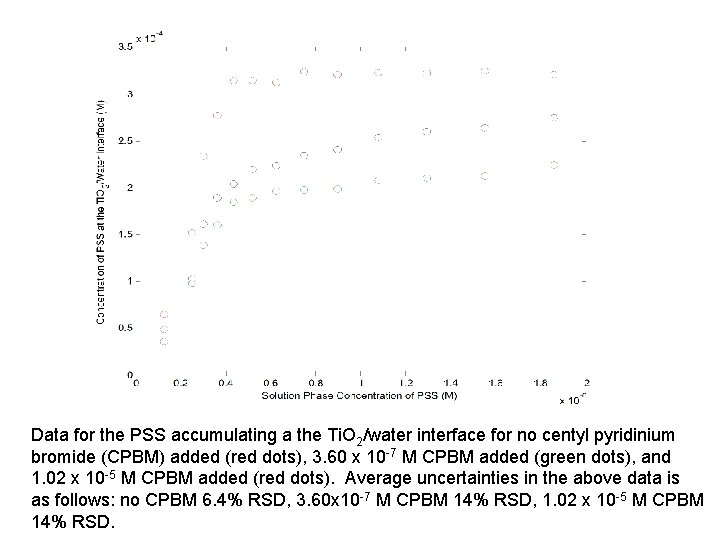
Data for the PSS accumulating a the Ti. O 2/water interface for no centyl pyridinium bromide (CPBM) added (red dots), 3. 60 x 10 -7 M CPBM added (green dots), and 1. 02 x 10 -5 M CPBM added (red dots). Average uncertainties in the above data is as follows: no CPBM 6. 4% RSD, 3. 60 x 10 -7 M CPBM 14% RSD, 1. 02 x 10 -5 M CPBM 14% RSD.
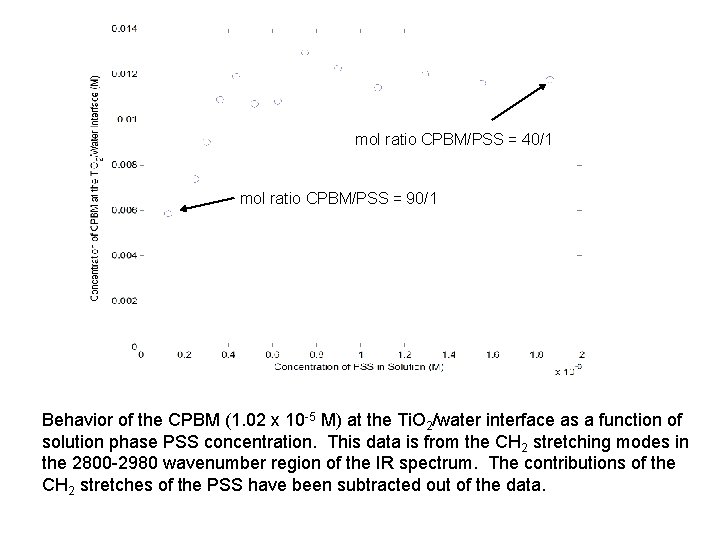
mol ratio CPBM/PSS = 40/1 mol ratio CPBM/PSS = 90/1 Behavior of the CPBM (1. 02 x 10 -5 M) at the Ti. O 2/water interface as a function of solution phase PSS concentration. This data is from the CH 2 stretching modes in the 2800 -2980 wavenumber region of the IR spectrum. The contributions of the CH 2 stretches of the PSS have been subtracted out of the data.
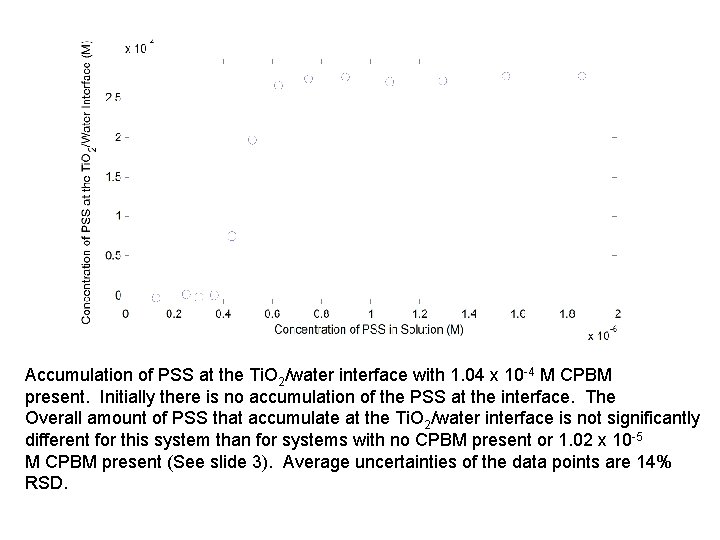
Accumulation of PSS at the Ti. O 2/water interface with 1. 04 x 10 -4 M CPBM present. Initially there is no accumulation of the PSS at the interface. The Overall amount of PSS that accumulate at the Ti. O 2/water interface is not significantly different for this system than for systems with no CPBM present or 1. 02 x 10 -5 M CPBM present (See slide 3). Average uncertainties of the data points are 14% RSD.
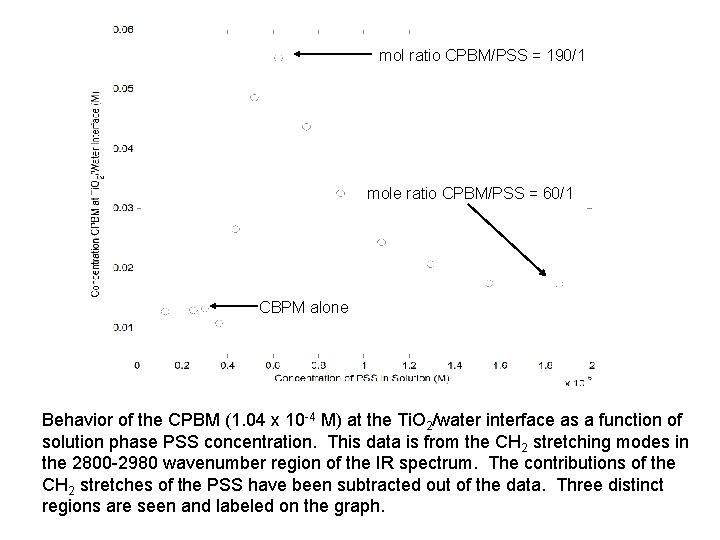
mol ratio CPBM/PSS = 190/1 mole ratio CPBM/PSS = 60/1 CBPM alone Behavior of the CPBM (1. 04 x 10 -4 M) at the Ti. O 2/water interface as a function of solution phase PSS concentration. This data is from the CH 2 stretching modes in the 2800 -2980 wavenumber region of the IR spectrum. The contributions of the CH 2 stretches of the PSS have been subtracted out of the data. Three distinct regions are seen and labeled on the graph.