
Typhoid Fever in Santiago Chile Modern Insights Where

- Slides: 42
Typhoid Fever in Santiago, Chile: Modern Insights Where Historical Data Meet Mathematical Modeling Jillian Gauld Institute for Disease Modeling April 20, 2017 1 | Copyright © 2017 Intellectual Ventures Management, LLC (IVM). All rights reserved.
Outline • Typhoid and Santiago overview • Modeling approach • Lessons learned: – Age distribution and immunity/exposure – Chronic carriage and short cycle transmission – Vaccine impacts • Take-aways: site specific and new locations 2 | Copyright © 2017 Intellectual Ventures Management, LLC (IVM). All rights reserved.
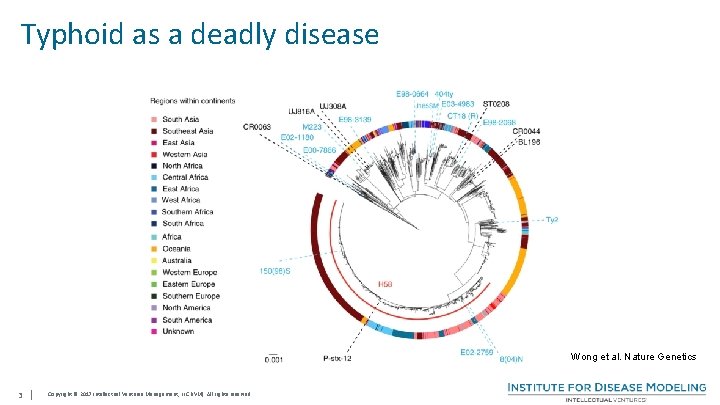
Typhoid as a deadly disease Wong et al. Nature Genetics 3 | Copyright © 2017 Intellectual Ventures Management, LLC (IVM). All rights reserved.
Typhoid modeling initiative Motivating questions: Is local elimination feasible with current and upcoming tools? What do we need to know in order to make informed decisions around control and elimination? 4 | Copyright © 2017 Intellectual Ventures Management, LLC (IVM). All rights reserved.
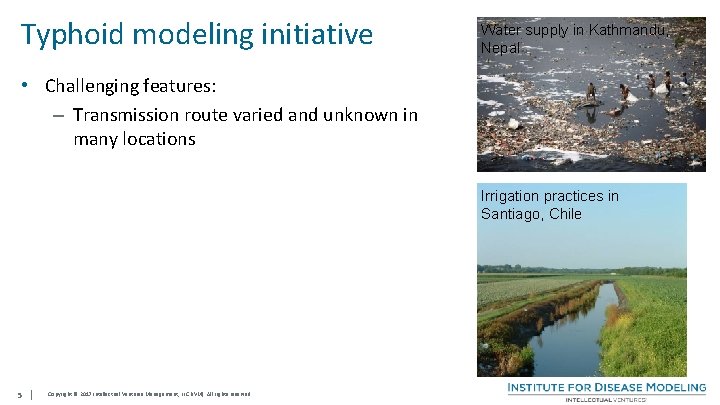
Typhoid modeling initiative Water supply in Kathmandu, Nepal • Challenging features: – Transmission route varied and unknown in many locations Irrigation practices in Santiago, Chile 5 | Copyright © 2017 Intellectual Ventures Management, LLC (IVM). All rights reserved.
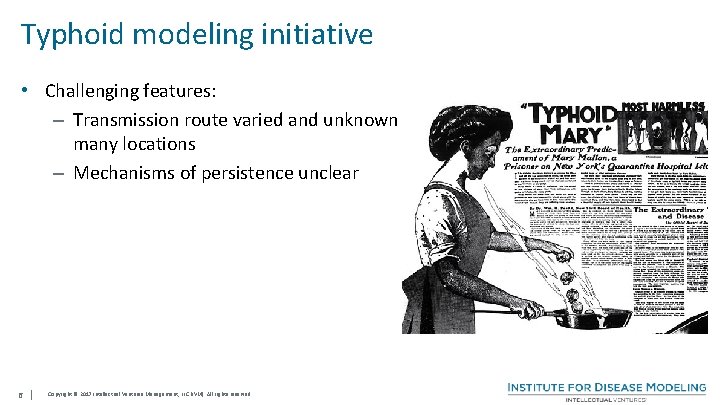
Typhoid modeling initiative • Challenging features: – Transmission route varied and unknown in many locations – Mechanisms of persistence unclear 6 | Copyright © 2017 Intellectual Ventures Management, LLC (IVM). All rights reserved.
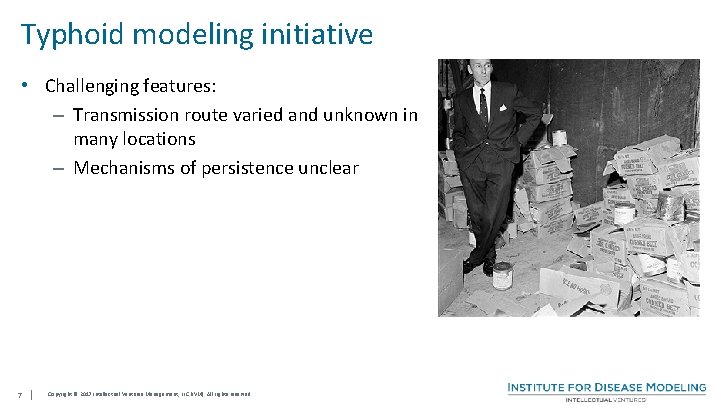
Typhoid modeling initiative • Challenging features: – Transmission route varied and unknown in many locations – Mechanisms of persistence unclear 7 | Copyright © 2017 Intellectual Ventures Management, LLC (IVM). All rights reserved.
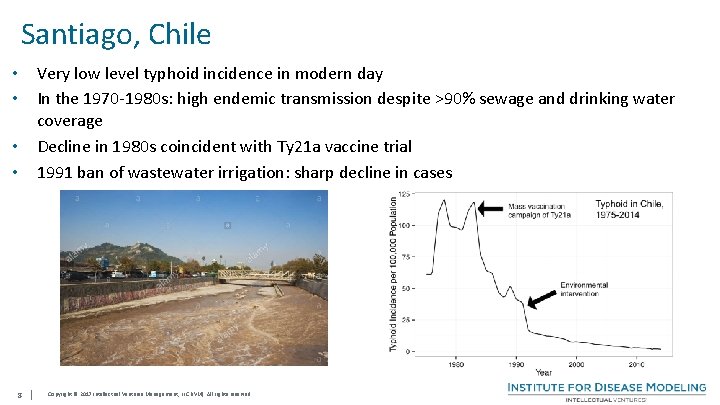
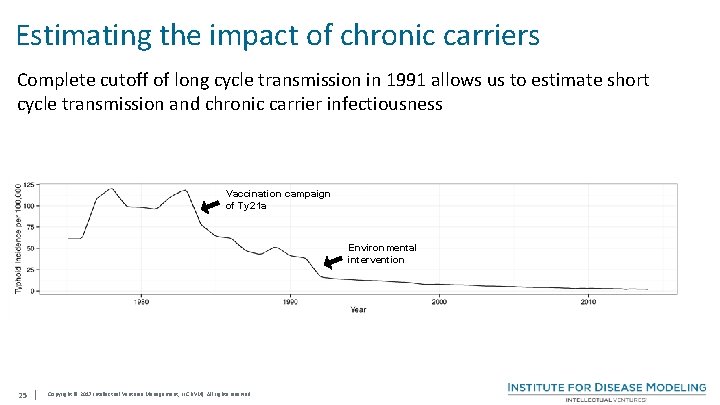
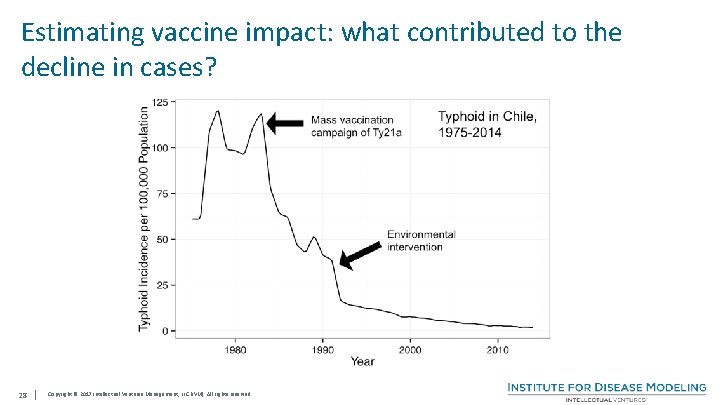
Santiago, Chile • Very low level typhoid incidence in modern day • In the 1970 -1980 s: high endemic transmission despite >90% sewage and drinking water coverage • Decline in 1980 s coincident with Ty 21 a vaccine trial • 1991 ban of wastewater irrigation: sharp decline in cases 8 | Copyright © 2017 Intellectual Ventures Management, LLC (IVM). All rights reserved.
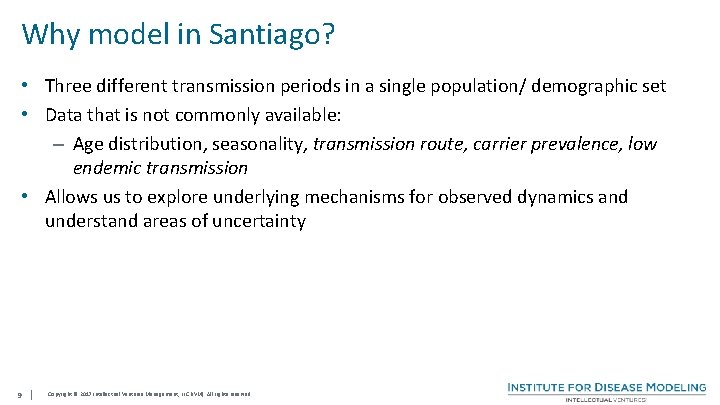
Why model in Santiago? • Three different transmission periods in a single population/ demographic set • Data that is not commonly available: – Age distribution, seasonality, transmission route, carrier prevalence, low endemic transmission • Allows us to explore underlying mechanisms for observed dynamics and understand areas of uncertainty 9 | Copyright © 2017 Intellectual Ventures Management, LLC (IVM). All rights reserved.
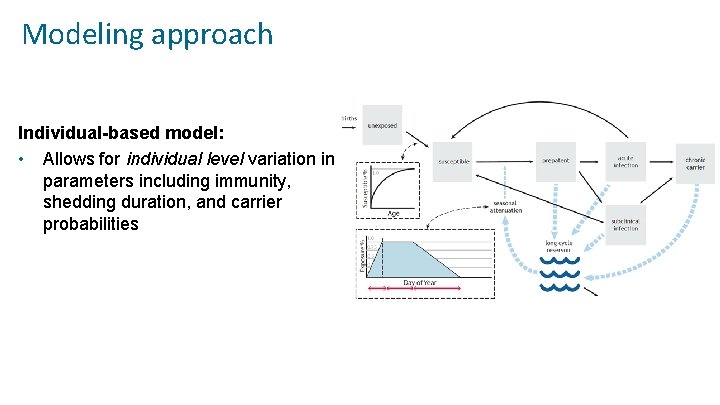
Modeling approach Individual-based model: • Allows for individual level variation in parameters including immunity, shedding duration, and carrier probabilities
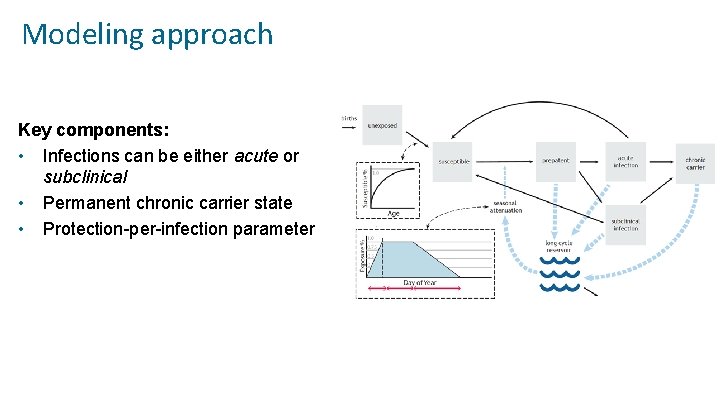
Modeling approach Key components: • Infections can be either acute or subclinical • Permanent chronic carrier state • Protection-per-infection parameter
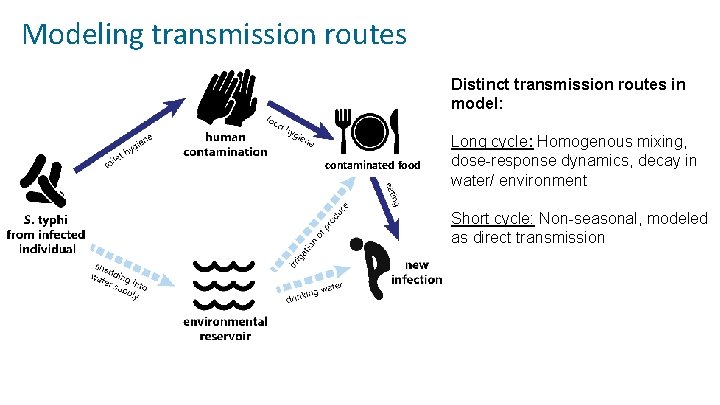
Modeling transmission routes Distinct transmission routes in model: contaminated food Long cycle: Homogenous mixing, dose-response dynamics, decay in water/ environment Short cycle: Non-seasonal, modeled as direct transmission
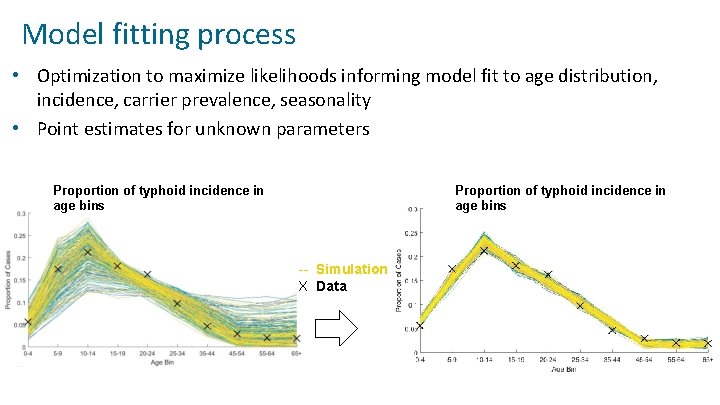
Model fitting process • Optimization to maximize likelihoods informing model fit to age distribution, incidence, carrier prevalence, seasonality • Point estimates for unknown parameters Proportion of typhoid incidence in age bins -- Simulation X Data
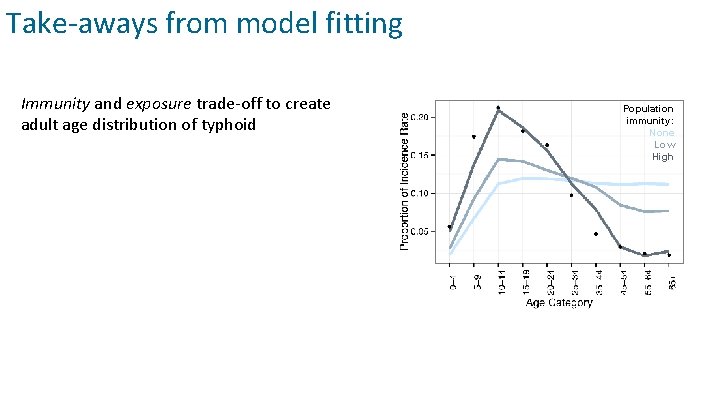
Take-aways from model fitting Immunity and exposure trade-off to create adult age distribution of typhoid Population immunity: None Low High
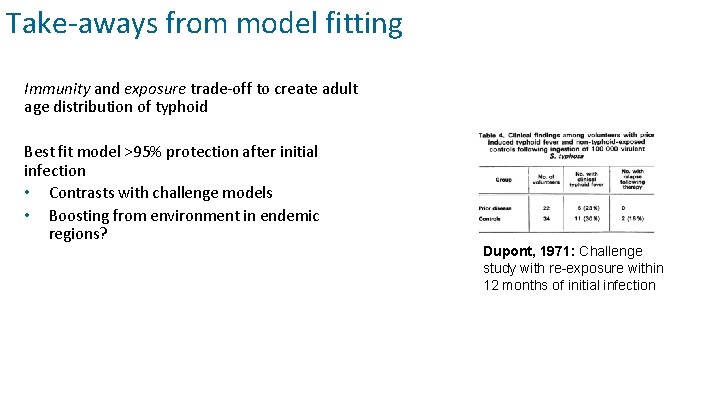
Take-aways from model fitting Immunity and exposure trade-off to create adult age distribution of typhoid Best fit model >95% protection after initial infection • Contrasts with challenge models • Boosting from environment in endemic regions? Dupont, 1971: Challenge study with re-exposure within 12 months of initial infection
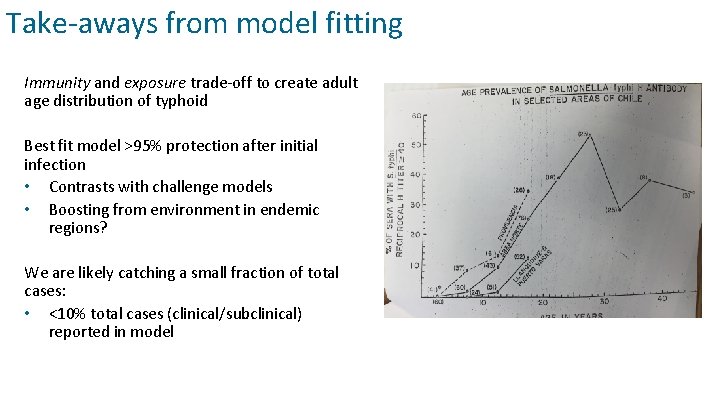
Take-aways from model fitting Immunity and exposure trade-off to create adult age distribution of typhoid Best fit model >95% protection after initial infection • Contrasts with challenge models • Boosting from environment in endemic regions? We are likely catching a small fraction of total cases: • <10% total cases (clinical/subclinical) reported in model
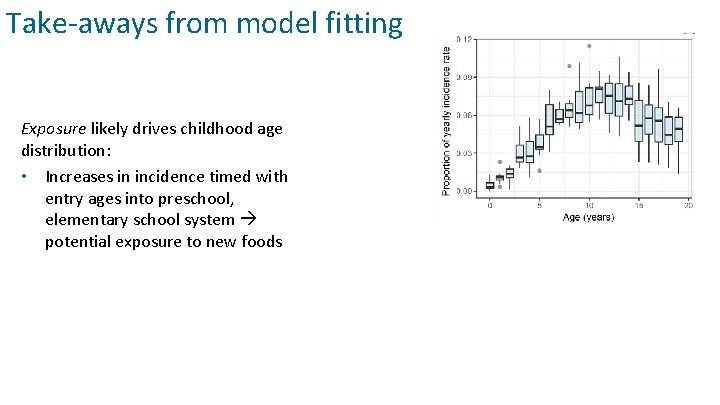
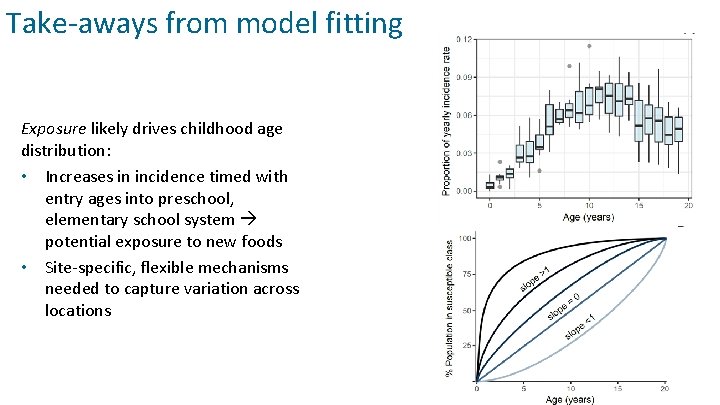
Take-aways from model fitting Exposure likely drives childhood age distribution: • Increases in incidence timed with entry ages into preschool, elementary school system potential exposure to new foods
Take-aways from model fitting Exposure likely drives childhood age distribution: • Increases in incidence timed with entry ages into preschool, elementary school system potential exposure to new foods • Site-specific, flexible mechanisms needed to capture variation across locations
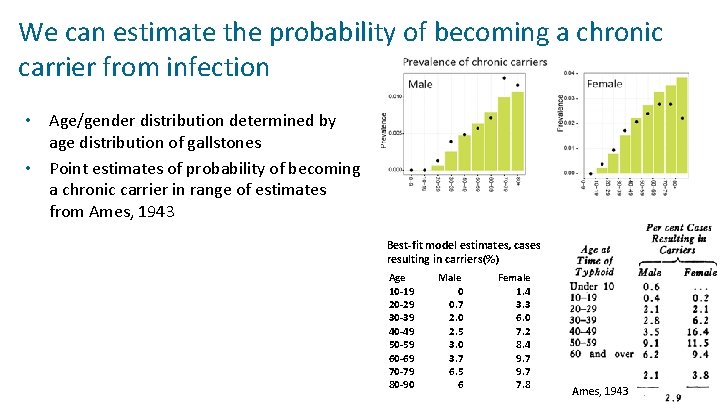
We can estimate the probability of becoming a chronic carrier from infection • Age/gender distribution determined by age distribution of gallstones • Point estimates of probability of becoming a chronic carrier in range of estimates from Ames, 1943 Best-fit model estimates, cases resulting in carriers(%) Age 10 -19 20 -29 30 -39 40 -49 50 -59 60 -69 70 -79 80 -90 Male 0 0. 7 2. 0 2. 5 3. 0 3. 7 6. 5 6 Female 1. 4 3. 3 6. 0 7. 2 8. 4 9. 7 7. 8 Ames, 1943
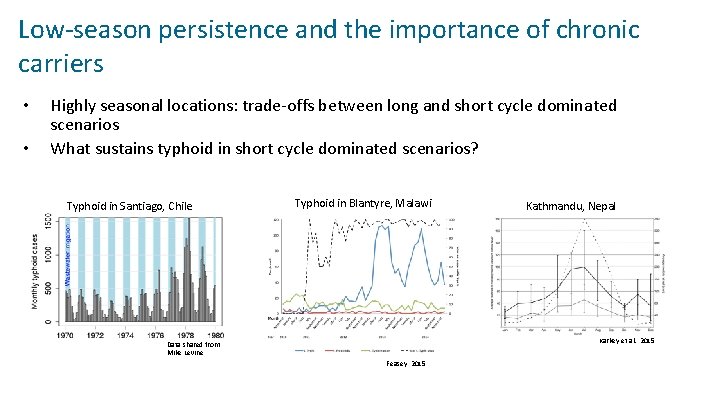
Low-season persistence and the importance of chronic carriers • • Highly seasonal locations: trade-offs between long and short cycle dominated scenarios What sustains typhoid in short cycle dominated scenarios? Typhoid in Santiago, Chile Typhoid in Blantyre, Malawi Kathmandu, Nepal Karkey et al. , 2015 Data shared from Mike Levine Feasey, 2015
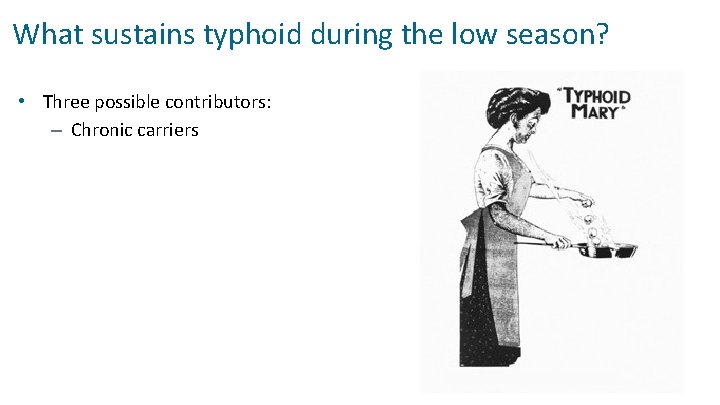
What sustains typhoid during the low season? • Three possible contributors: – Chronic carriers
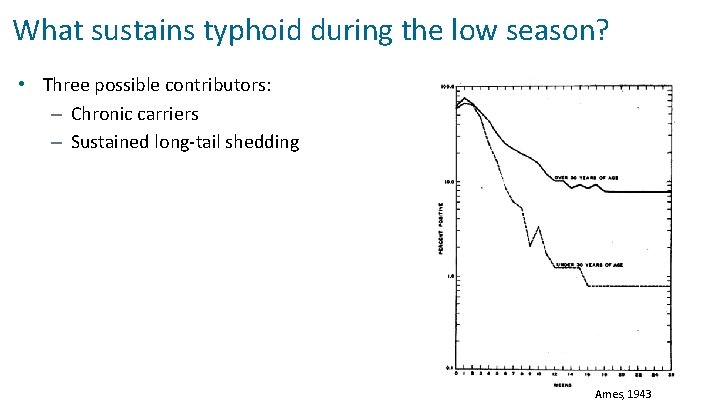
What sustains typhoid during the low season? • Three possible contributors: – Chronic carriers – Sustained long-tail shedding Ames, 1943
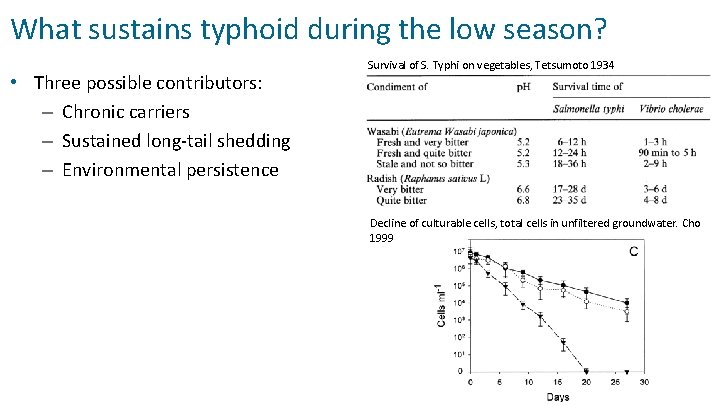
What sustains typhoid during the low season? • Three possible contributors: – Chronic carriers – Sustained long-tail shedding – Environmental persistence Survival of S. Typhi on vegetables, Tetsumoto 1934 Decline of culturable cells, total cells in unfiltered groundwater. Cho 1999
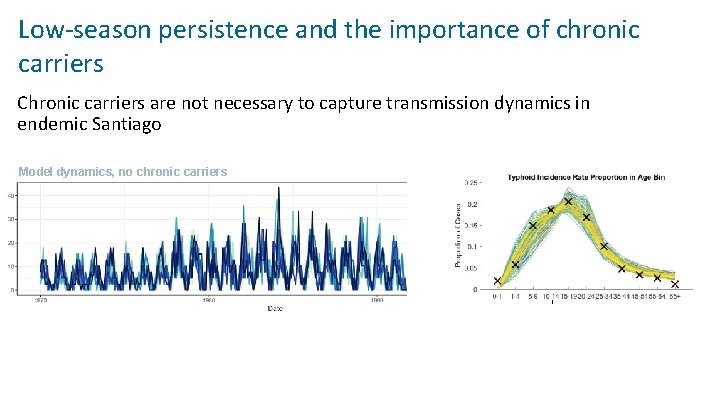
Low-season persistence and the importance of chronic carriers Chronic carriers are not necessary to capture transmission dynamics in endemic Santiago Model dynamics, no chronic carriers
Estimating the impact of chronic carriers Complete cutoff of long cycle transmission in 1991 allows us to estimate short cycle transmission and chronic carrier infectiousness Vaccination campaign of Ty 21 a Environmental intervention 25 | Copyright © 2017 Intellectual Ventures Management, LLC (IVM). All rights reserved.
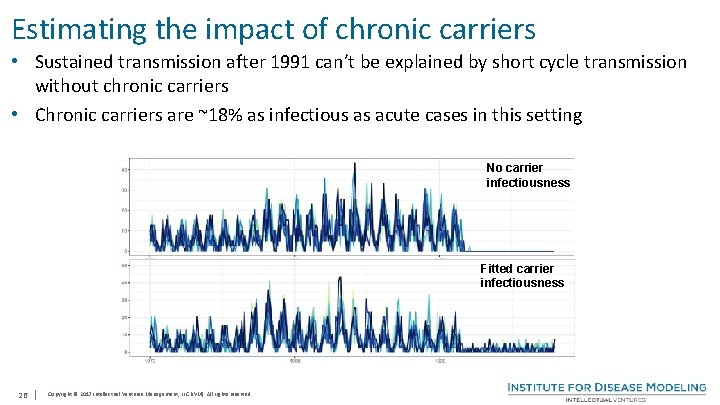
Estimating the impact of chronic carriers • Sustained transmission after 1991 can’t be explained by short cycle transmission without chronic carriers • Chronic carriers are ~18% as infectious as acute cases in this setting No carrier infectiousness Fitted carrier infectiousness 26 | Copyright © 2017 Intellectual Ventures Management, LLC (IVM). All rights reserved.
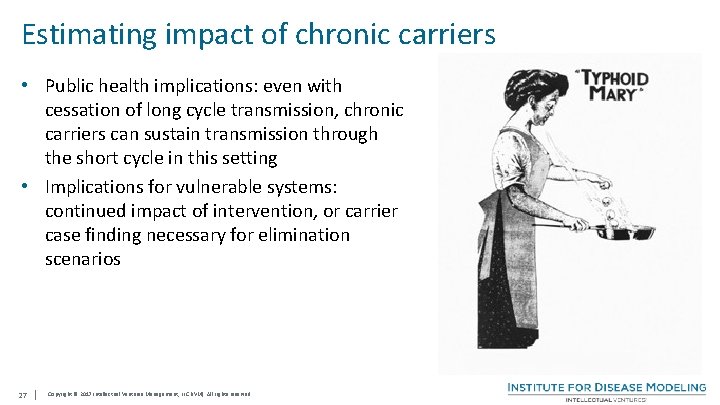
Estimating impact of chronic carriers • Public health implications: even with cessation of long cycle transmission, chronic carriers can sustain transmission through the short cycle in this setting • Implications for vulnerable systems: continued impact of intervention, or carrier case finding necessary for elimination scenarios 27 | Copyright © 2017 Intellectual Ventures Management, LLC (IVM). All rights reserved.
Estimating vaccine impact: what contributed to the decline in cases? 28 | Copyright © 2017 Intellectual Ventures Management, LLC (IVM). All rights reserved.
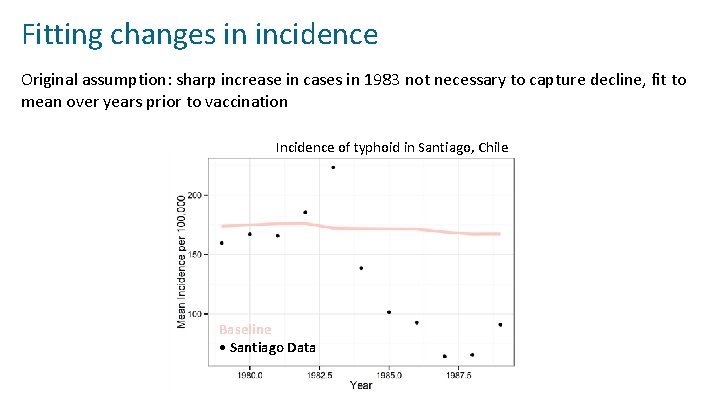
Fitting changes in incidence Original assumption: sharp increase in cases in 1983 not necessary to capture decline, fit to mean over years prior to vaccination Incidence of typhoid in Santiago, Chile Baseline • Santiago Data
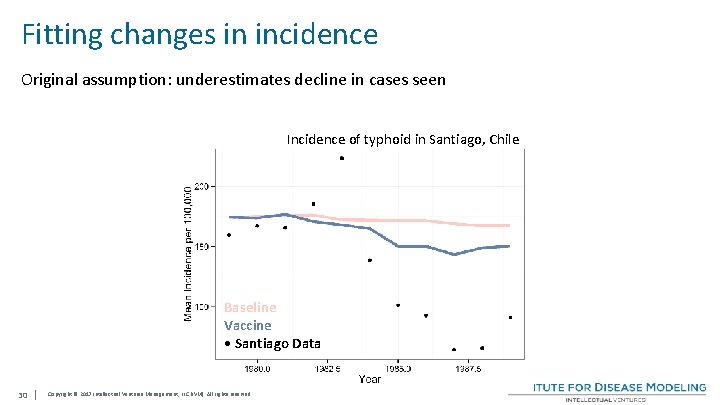
Fitting changes in incidence Original assumption: underestimates decline in cases seen Incidence of typhoid in Santiago, Chile Baseline Vaccine • Santiago Data 30 | Copyright © 2017 Intellectual Ventures Management, LLC (IVM). All rights reserved.
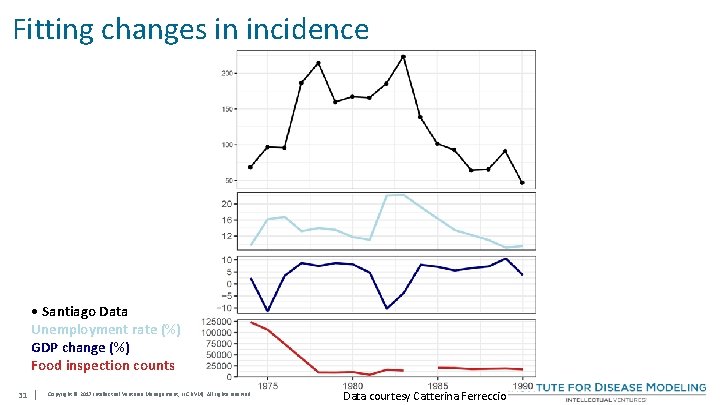
Fitting changes in incidence • Santiago Data Unemployment rate (%) GDP change (%) Food inspection counts 31 | Copyright © 2017 Intellectual Ventures Management, LLC (IVM). All rights reserved. Data courtesy Catterina Ferreccio
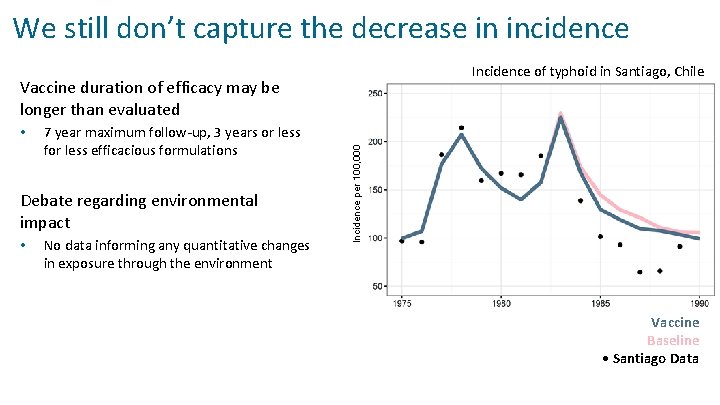
We still don’t capture the decrease in incidence Incidence of typhoid in Santiago, Chile • 7 year maximum follow-up, 3 years or less for less efficacious formulations Debate regarding environmental impact • No data informing any quantitative changes in exposure through the environment Incidence per 100, 000 Vaccine duration of efficacy may be longer than evaluated Vaccine Baseline • Santiago Data
We still don’t capture the decrease in incidence Proportion of total incidence Hint: age distribution of typhoid during/ after the vaccination period
Age distribution differs by intervention type Proportion of total incidence • Model fitted to decline in incidence between 1983 and 1991: 100% attributed to environment vs. vaccine • Distinct shifts in age distribution when decline is due to vaccine • Age distribution conserved across decline for environmental change Decline due to environmental intervention Decline due to vaccine Age bin
Age distribution and vaccine duration • Fitting vaccine duration to age distribution indicates duration may be longer than originally evaluated • Indication of herd effects from typhoid vaccine in Santiago • Application to present day Best fit model results for age distribution over time - Simulation • Santiago Data
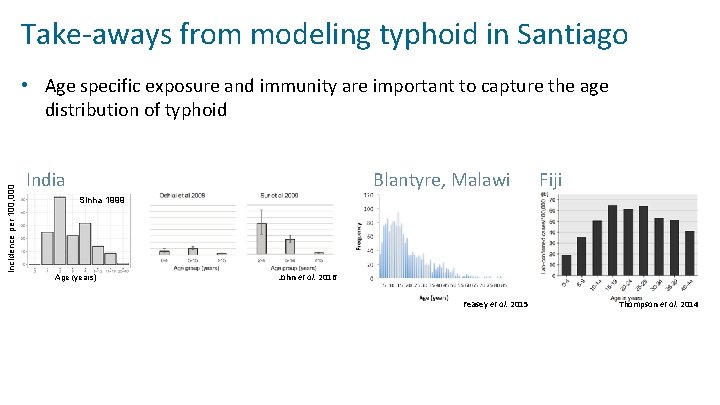
Take-aways from modeling typhoid in Santiago Incidence per 100, 000 • Age specific exposure and immunity are important to capture the age distribution of typhoid Blantyre, Malawi India Fiji Sinha 1999 Age (years) John et al. 2016 Feasey et al. 2015 Thompson et al. 2014
Take-aways from modeling typhoid in Santiago • Age specific exposure and immunity are important in explaining the age distribution of typhoid • Chronic carriers played a large role in Santiago persistence after long cycle cutoff
Take-aways from modeling typhoid in Santiago • Age specific exposure and immunity are important in explaining the age distribution of typhoid • Chronic carriers played a large role in Santiago persistence after long cycle cutoff • Utilize contextual approaches for vaccine impact estimation
Take-aways from modeling typhoid in Santiago • Age specific exposure and immunity are important in explaining the age distribution of typhoid • Chronic carriers played a large role in Santiago persistence after long cycle cutoff • Utilize contextual approaches for vaccine impact estimation Parameter uncertainty: how do assumptions change across unknowns?
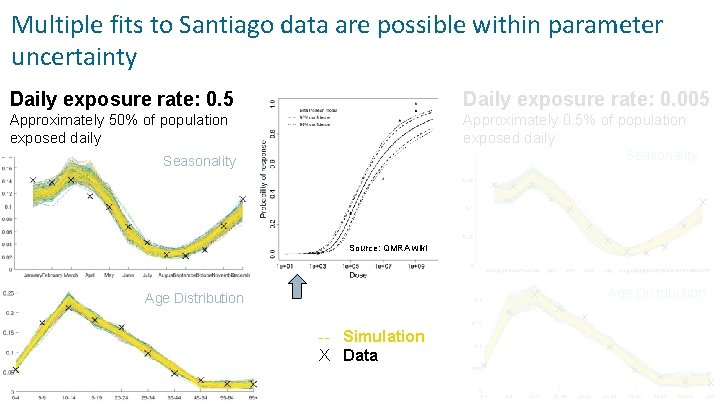
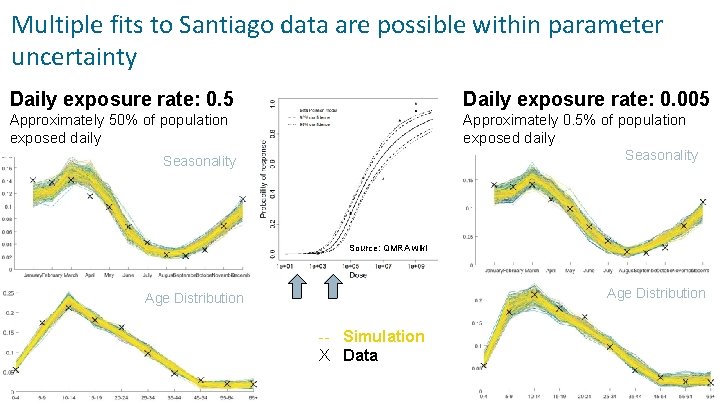
Multiple fits to Santiago data are possible within parameter uncertainty Daily exposure rate: 0. 5 Daily exposure rate: 0. 005 Approximately 50% of population exposed daily Approximately 0. 5% of population exposed daily Seasonality Source: QMRA wiki Age Distribution -- Simulation X Data
Multiple fits to Santiago data are possible within parameter uncertainty Daily exposure rate: 0. 5 Daily exposure rate: 0. 005 Approximately 50% of population exposed daily Approximately 0. 5% of population exposed daily Seasonality Source: QMRA wiki Age Distribution -- Simulation X Data
Thanks! jgauld@intven. com Hao Hu, Dennis Chao & Epidemiology Team Thank you to Mike Levine, University of Maryland, for data sharing and collaboration