
Types of Writing in English th 7 Grade
- Slides: 54
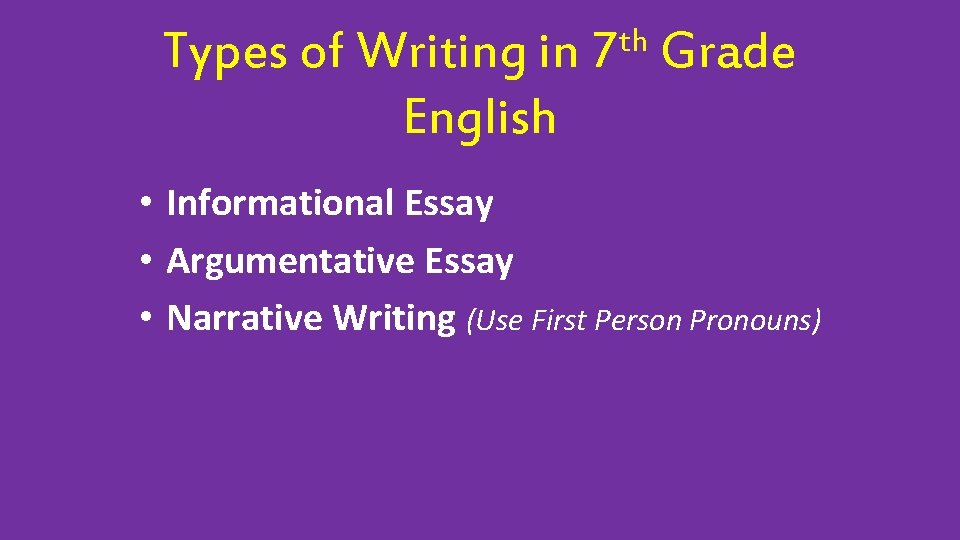
Types of Writing in English th 7 Grade • Informational Essay • Argumentative Essay • Narrative Writing (Use First Person Pronouns)
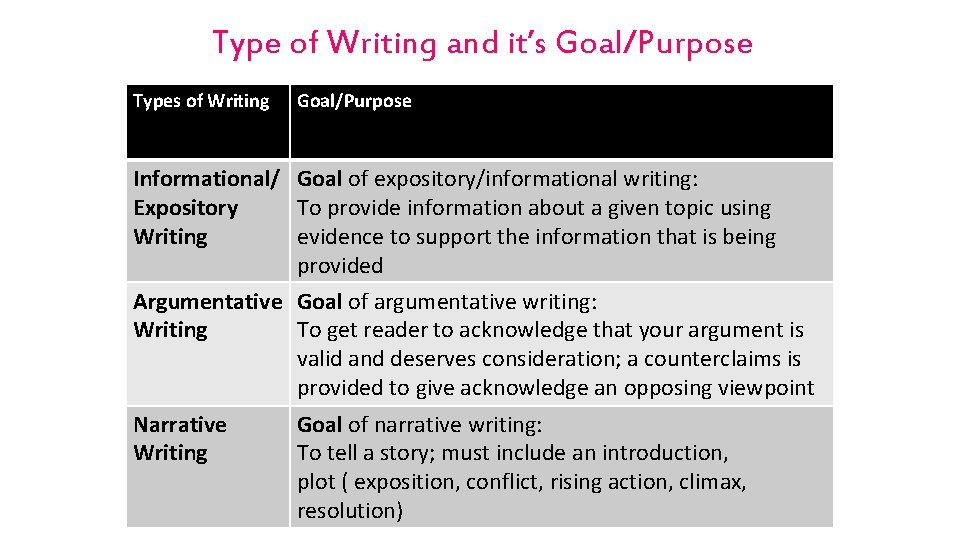
Type of Writing and it’s Goal/Purpose Types of Writing Goal/Purpose Informational/ Goal of expository/informational writing: Expository To provide information about a given topic using Writing evidence to support the information that is being provided Argumentative Goal of argumentative writing: Writing To get reader to acknowledge that your argument is valid and deserves consideration; a counterclaims is provided to give acknowledge an opposing viewpoint Narrative Writing Goal of narrative writing: To tell a story; must include an introduction, plot ( exposition, conflict, rising action, climax, resolution)
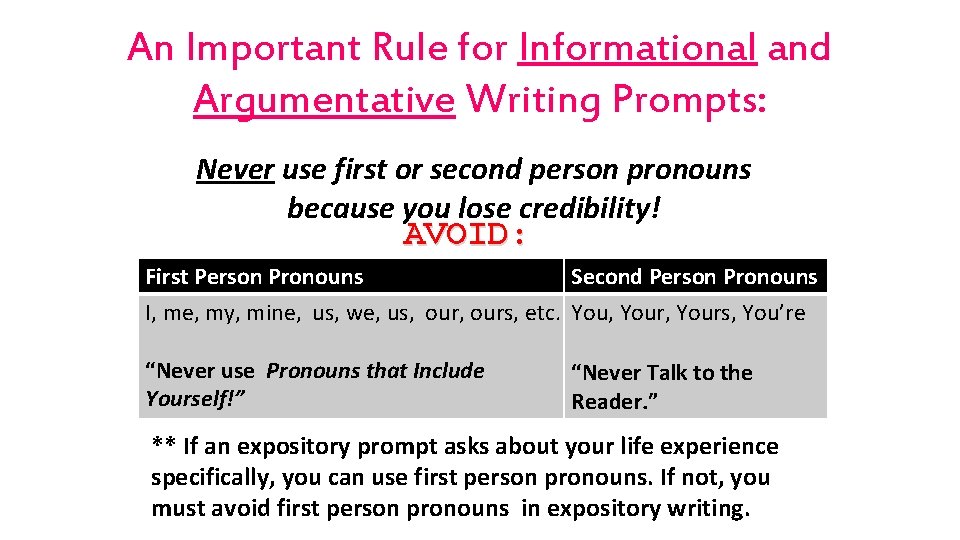
An Important Rule for Informational and Argumentative Writing Prompts: Never use first or second person pronouns because you lose credibility! AVOID: First Person Pronouns Second Person Pronouns I, me, my, mine, us, we, us, ours, etc. You, Yours, You’re “Never use Pronouns that Include Yourself!” “Never Talk to the Reader. ” ** If an expository prompt asks about your life experience specifically, you can use first person pronouns. If not, you must avoid first person pronouns in expository writing.
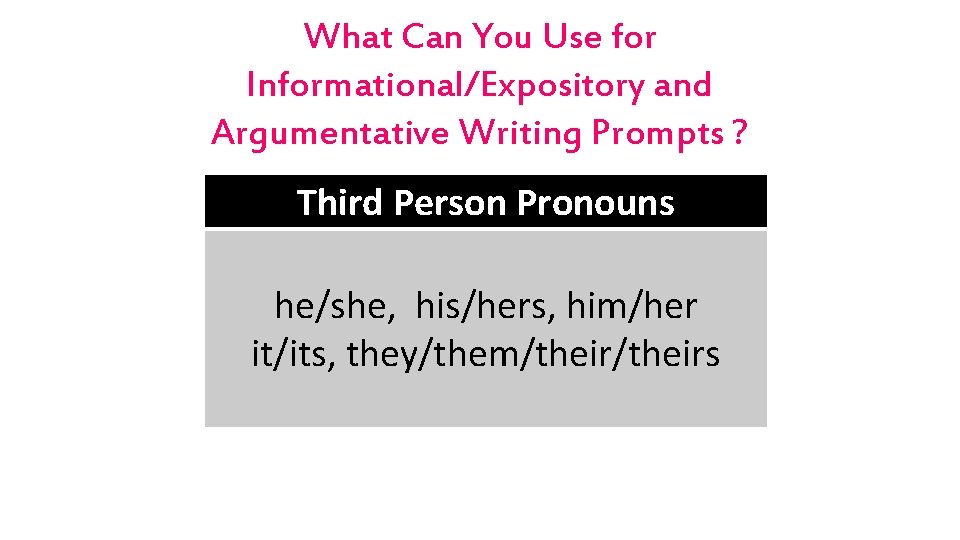
What Can You Use for Informational/Expository and Argumentative Writing Prompts ? Third Person Pronouns he/she, his/hers, him/her it/its, they/them/theirs
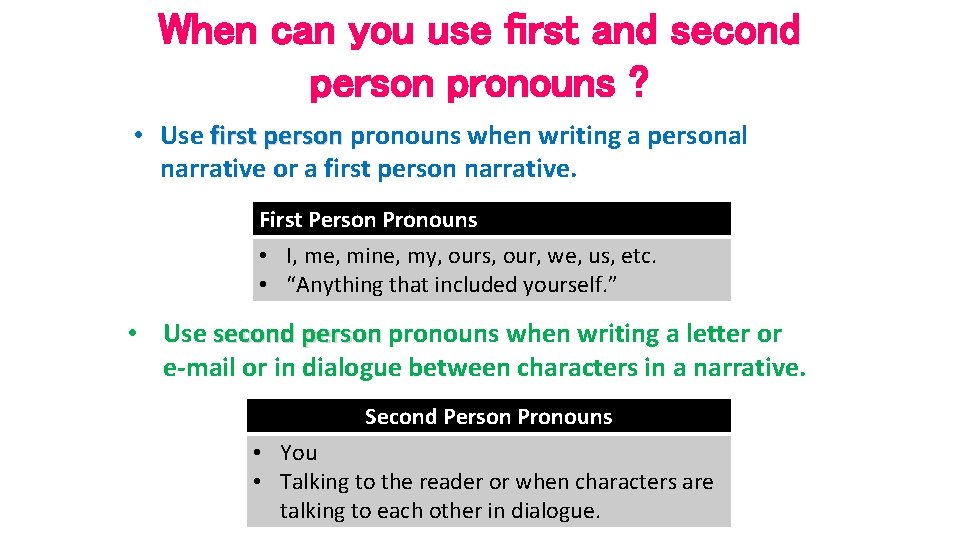
When can you use first and second person pronouns ? • Use first person pronouns when writing a personal narrative or a first person narrative. First Person Pronouns • I, me, mine, my, ours, our, we, us, etc. • “Anything that included yourself. ” • Use second person pronouns when writing a letter or e-mail or in dialogue between characters in a narrative. Second Person Pronouns • You • Talking to the reader or when characters are talking to each other in dialogue.
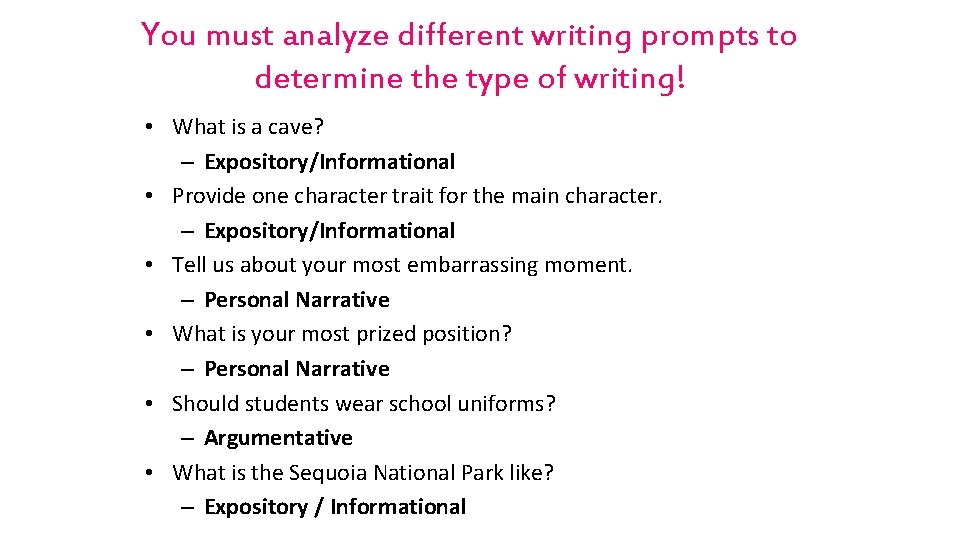
You must analyze different writing prompts to determine the type of writing! • What is a cave? – Expository/Informational • Provide one character trait for the main character. – Expository/Informational • Tell us about your most embarrassing moment. – Personal Narrative • What is your most prized position? – Personal Narrative • Should students wear school uniforms? – Argumentative • What is the Sequoia National Park like? – Expository / Informational
You must analyze different writing prompts to determine the type of writing! • What is a cave? – Expository/Informational • Provide one character trait for the main character. – Expository/Informational • Tell us about your most embarrassing moment. – Personal Narrative • What is your most prized position? – Personal Narrative • Should students wear school uniforms? – Argumentative • What is the Sequoia National Park like? – Expository / Informational
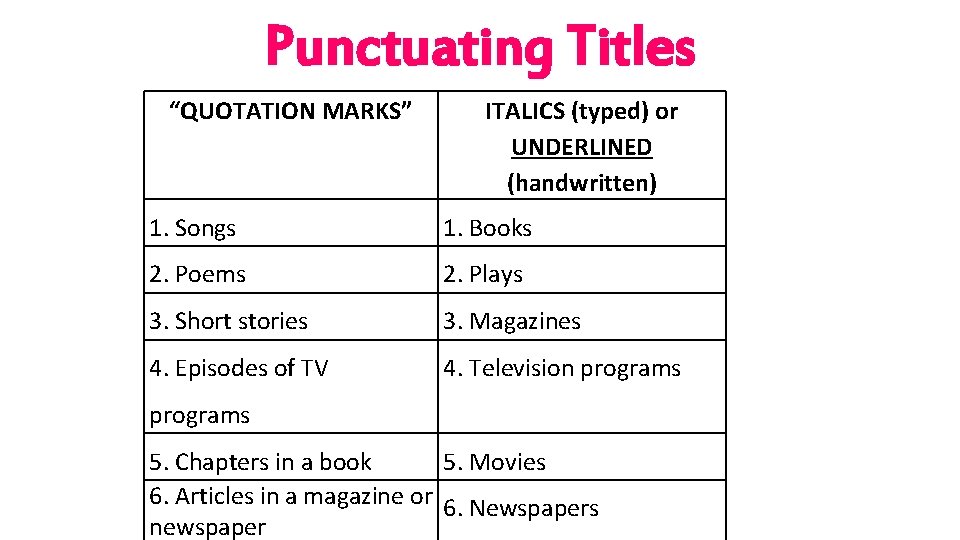
Punctuating Titles “QUOTATION MARKS” ITALICS (typed) or UNDERLINED (handwritten) 1. Songs 1. Books 2. Poems 2. Plays 3. Short stories 3. Magazines 4. Episodes of TV 4. Television programs 5. Chapters in a book 5. Movies 6. Articles in a magazine or 6. Newspapers newspaper
Now take out a scrap piece of paper and number it 1 -9…
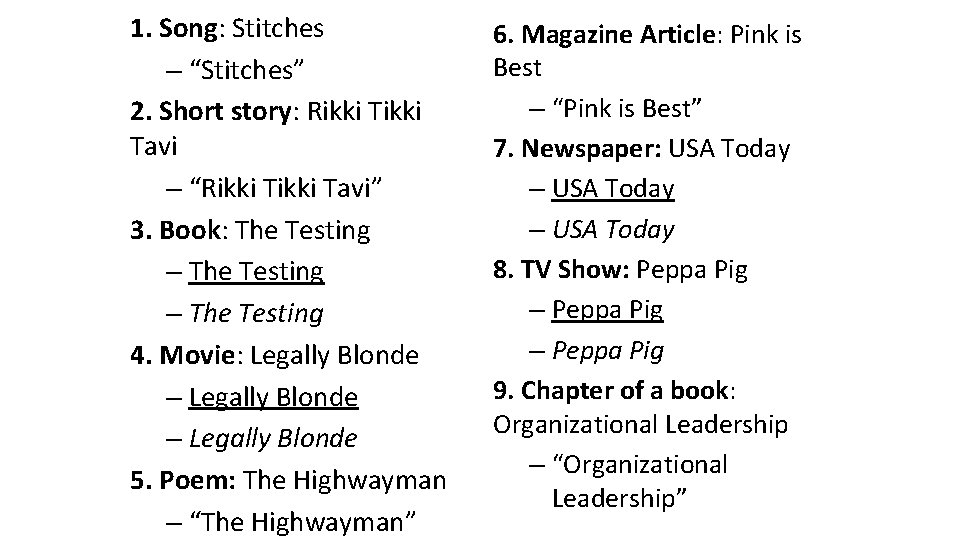
1. Song: Stitches – “Stitches” 2. Short story: Rikki Tavi – “Rikki Tavi” 3. Book: The Testing – The Testing 4. Movie: Legally Blonde – Legally Blonde 5. Poem: The Highwayman – “The Highwayman” 6. Magazine Article: Pink is Best – “Pink is Best” 7. Newspaper: USA Today – USA Today 8. TV Show: Peppa Pig – Peppa Pig 9. Chapter of a book: Organizational Leadership – “Organizational Leadership”
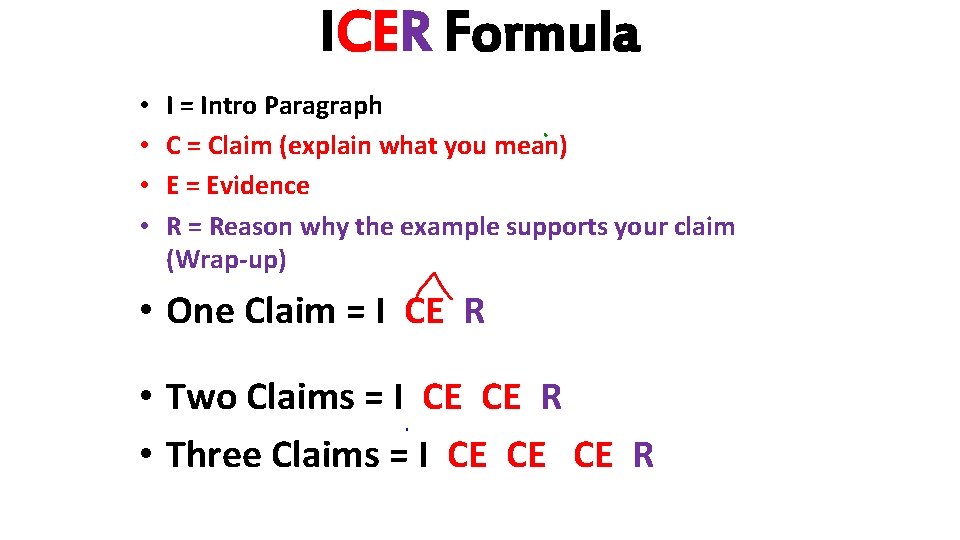
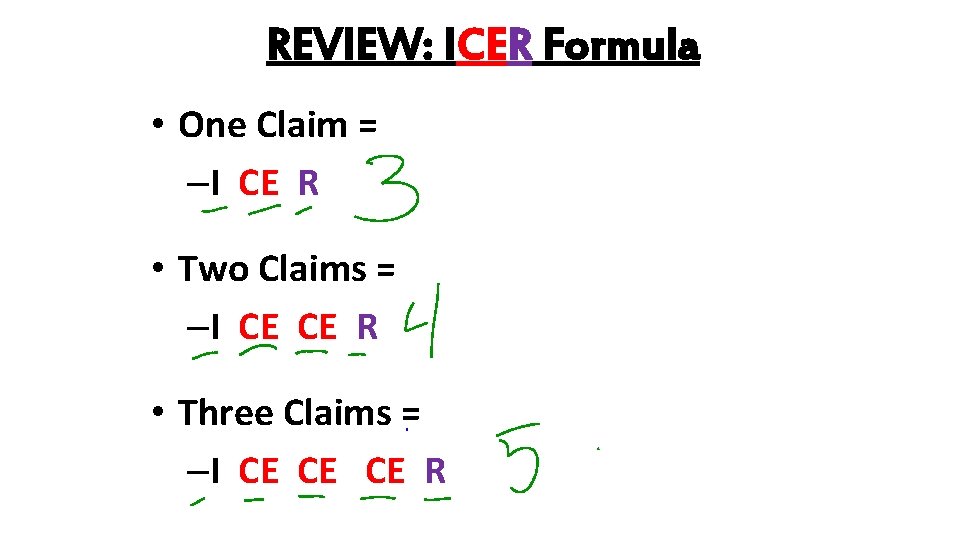
ICER Formula • • I = Intro Paragraph C = Claim (explain what you mean) E = Evidence R = Reason why the example supports your claim (Wrap-up) • One Claim = I CE R • Two Claims = I CE CE R • Three Claims = I CE CE CE R
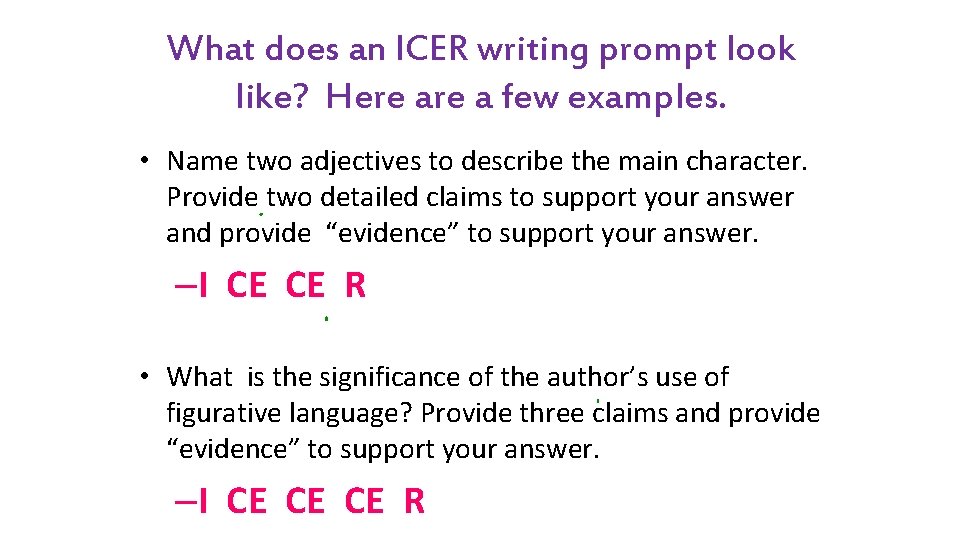
What does an ICER writing prompt look like? Here a few examples. • Name two adjectives to describe the main character. Provide two detailed claims to support your answer and provide “evidence” to support your answer. –I CE CE R • What is the significance of the author’s use of figurative language? Provide three claims and provide “evidence” to support your answer. –I CE CE CE R
ICER • The job of the I is to introduce the reader to the topic and answer the question or prompt.
Components of the I • Components: – 1. Attention Getter – 2. Broad statement – 3. Answer/Mini-thesis • The attention getter will be added to this paragraph in February, but for now, the introductory paragraph will only contain two sentences.
I = Introduce and Answer/Thesis • The “I” is the first paragraph of your ICER essay. • When you begin writing your I, you will need to keep the following in mind…
I = Introductory Paragraph • The I is made up of an attention getter (will add on later), one broad statement sentence and one answer/mini-thesis sentence. • Formulate the “Answer/Thesis” in your head and complete an organizer. *** If thesis is wrong the entire essay is wrong! • Make sure your answer is correct and fully answers the question/prompt. Do not use the word because unless the question asks you how or why. • Credit the source (author and title). If they are not known, leave them out. • Follow the “answer recipe” to construct your answer. Write it on your organizer in the correct space. • Create a broad statement about the general topic. Indent at the broad statement for now.
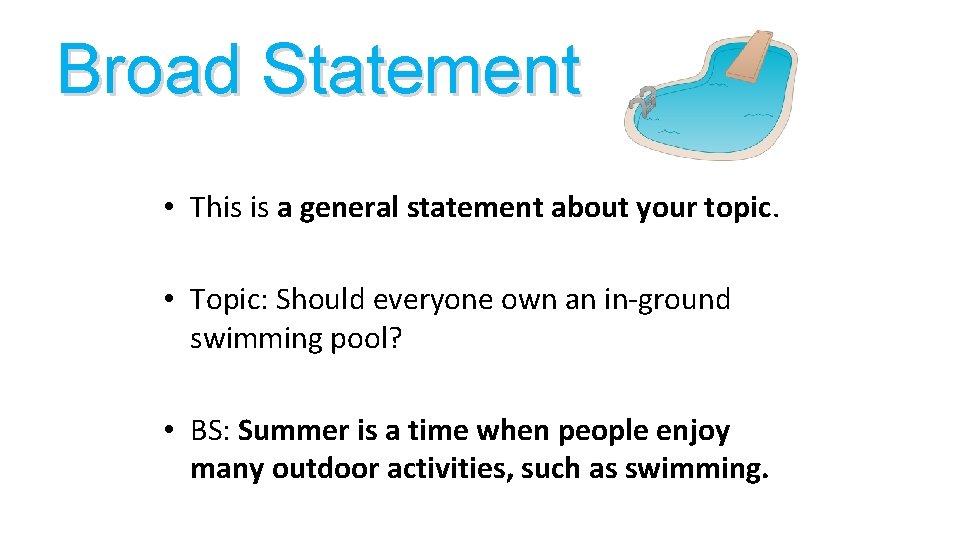
Broad Statement • This is a general statement about your topic. • Topic: Should everyone own an in-ground swimming pool? • BS: Summer is a time when people enjoy many outdoor activities, such as swimming.
Broad Statement Examples • What are three most exciting vacation activities offered in Pennsylvania? – Pennsylvania is a wonderful place to visit for vacation. • What are the top three deadly natural disasters? – Most storms are a frequent part of nature that cause minimal to no damage, but some storms can be extremely dangerous. • What is the biggest difference between middle school and elementary school? – Middle school is extremely different from elementary school.
REVIEW: ICER Formula WHAT DOES ICER STAND FOR? • I= – Intro Paragraph • C= – Claim(explain what you mean) • E= – Evidence • R= – Restate the main idea
REVIEW: ICER Formula WHICH TWO PARTS OF ICER ALWAYS STAY TOGETHER? • C AND E!!!!
REVIEW: ICER Formula • One Claim = –I CE R • Two Claims = –I CE CE R • Three Claims = –I CE CE CE R
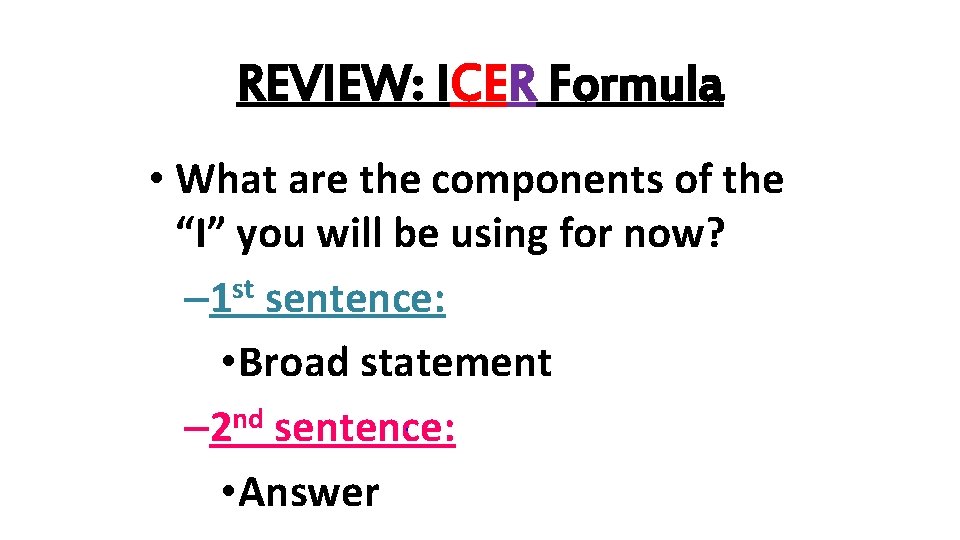
REVIEW: ICER Formula • What are the components of the “I” you will be using for now? – 1 st sentence: • Broad statement nd – 2 sentence: • Answer
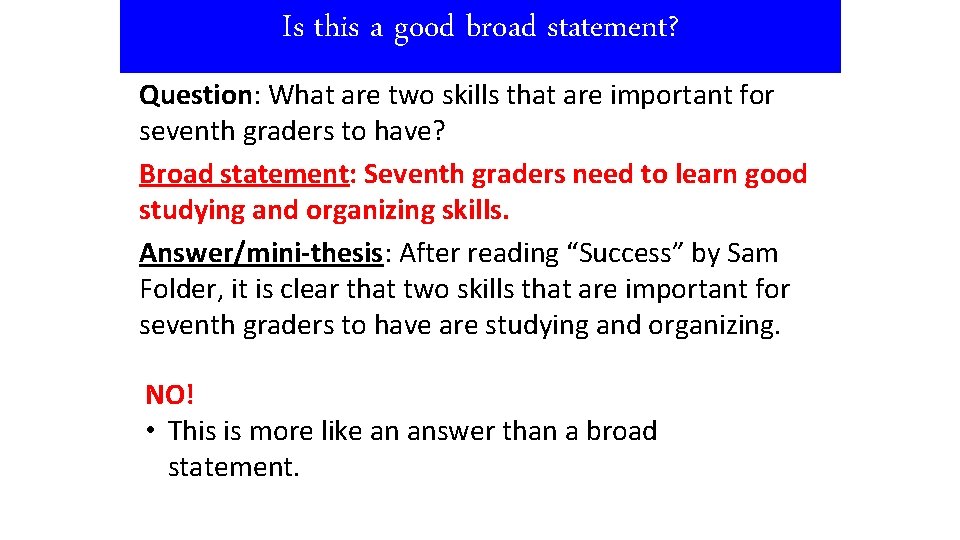
Is this a good broad statement? Question: What are two skills that are important for seventh graders to have? Broad statement: Seventh graders need to learn good studying and organizing skills. Answer/mini-thesis: After reading “Success” by Sam Folder, it is clear that two skills that are important for seventh graders to have are studying and organizing. NO! • This is more like an answer than a broad statement.
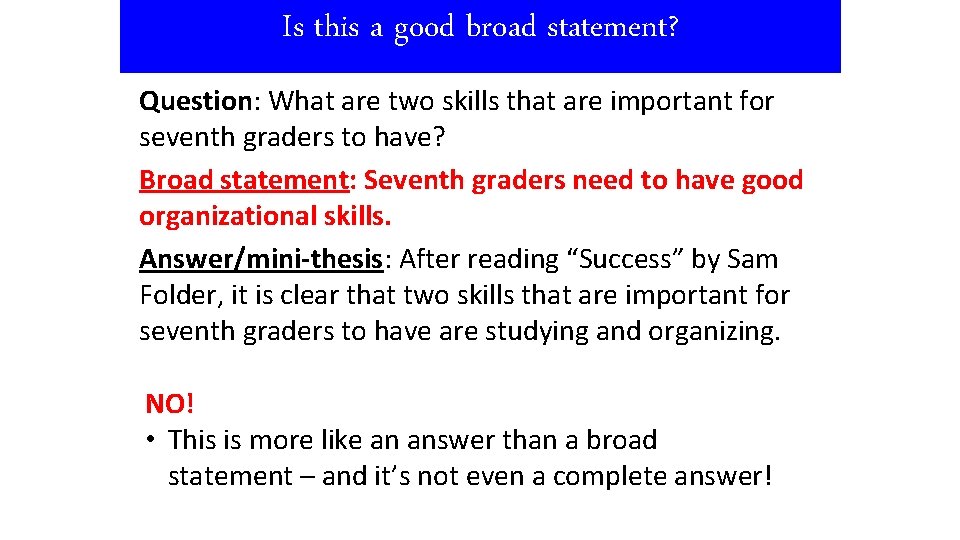
Is this a good broad statement? Question: What are two skills that are important for seventh graders to have? Broad statement: Seventh graders need to have good organizational skills. Answer/mini-thesis: After reading “Success” by Sam Folder, it is clear that two skills that are important for seventh graders to have are studying and organizing. NO! • This is more like an answer than a broad statement – and it’s not even a complete answer!
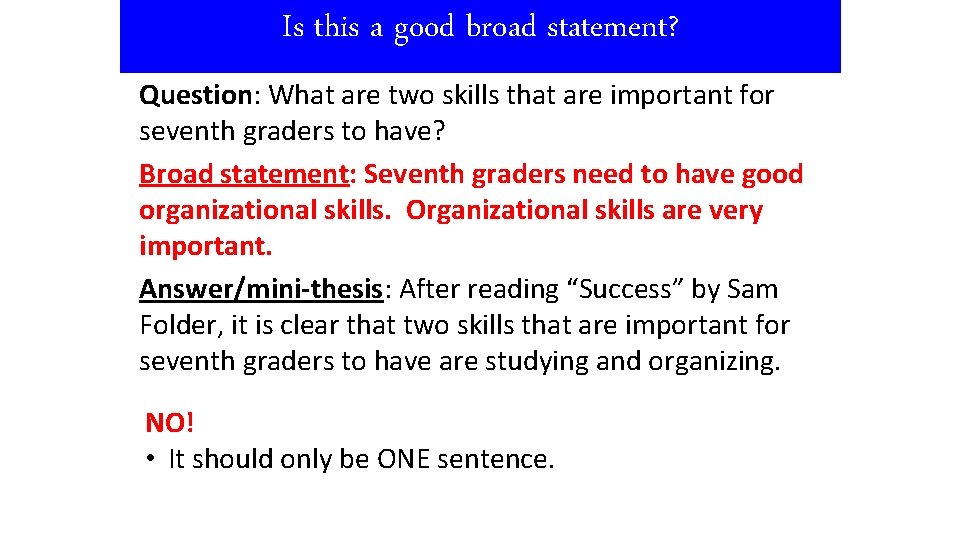
Is this a good broad statement? Question: What are two skills that are important for seventh graders to have? Broad statement: Seventh graders need to have good organizational skills. Organizational skills are very important. Answer/mini-thesis: After reading “Success” by Sam Folder, it is clear that two skills that are important for seventh graders to have are studying and organizing. NO! • It should only be ONE sentence.
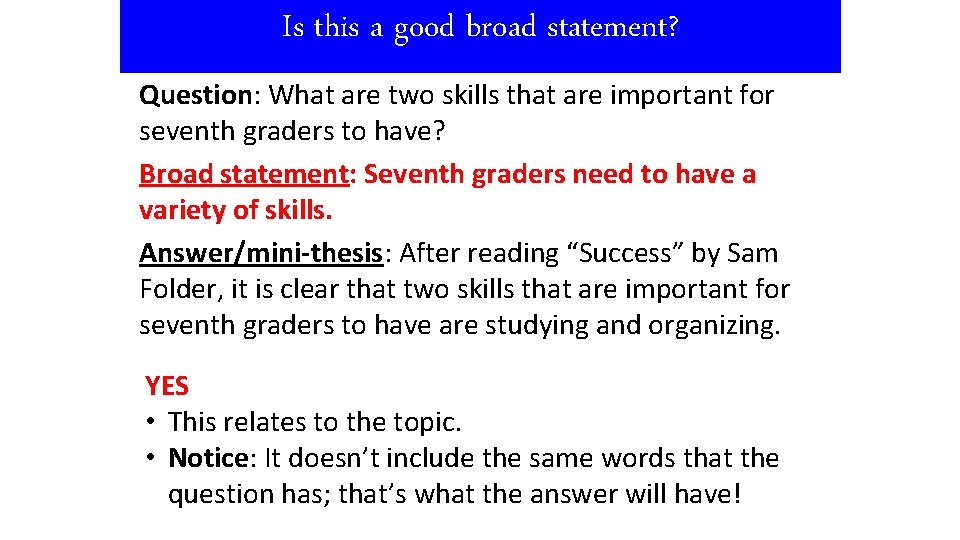
Is this a good broad statement? Question: What are two skills that are important for seventh graders to have? Broad statement: Seventh graders need to have a variety of skills. Answer/mini-thesis: After reading “Success” by Sam Folder, it is clear that two skills that are important for seventh graders to have are studying and organizing. YES • This relates to the topic. • Notice: It doesn’t include the same words that the question has; that’s what the answer will have!
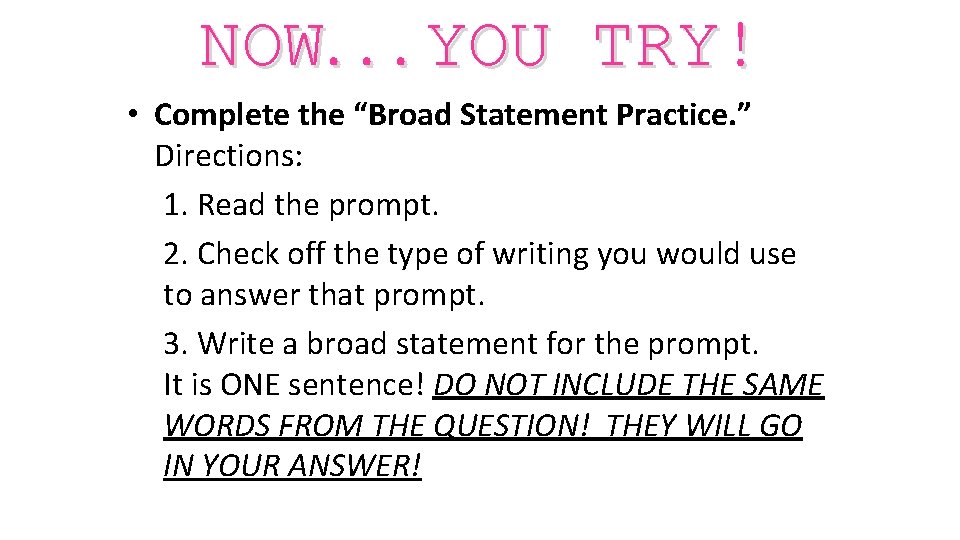
NOW. . . YOU TRY! • Complete the “Broad Statement Practice. ” Directions: 1. Read the prompt. 2. Check off the type of writing you would use to answer that prompt. 3. Write a broad statement for the prompt. It is ONE sentence! DO NOT INCLUDE THE SAME WORDS FROM THE QUESTION! THEY WILL GO IN YOUR ANSWER!
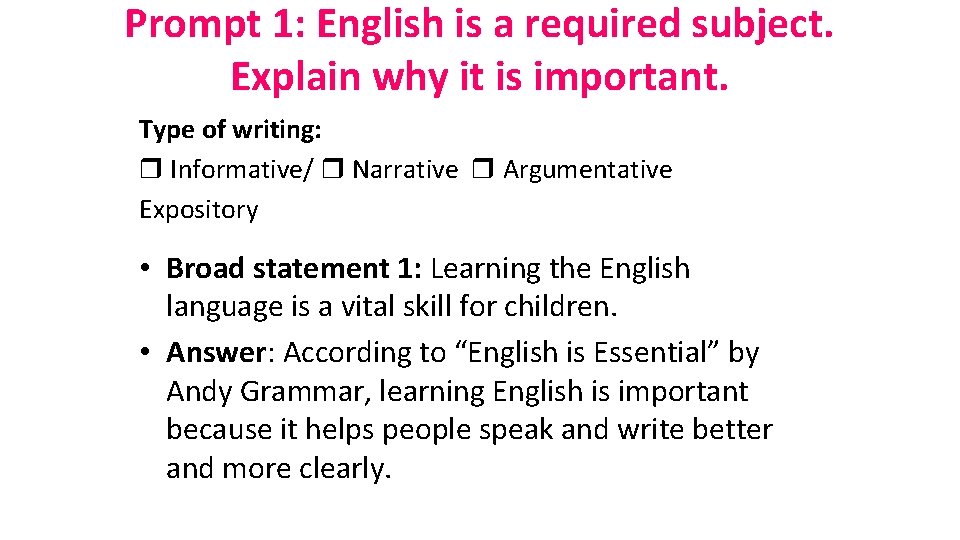
Prompt 1: English is a required subject. Explain why it is important. Type of writing: Informative/ Narrative Argumentative Expository • Broad statement 1: Learning the English language is a vital skill for children. • Answer: According to “English is Essential” by Andy Grammar, learning English is important because it helps people speak and write better and more clearly.
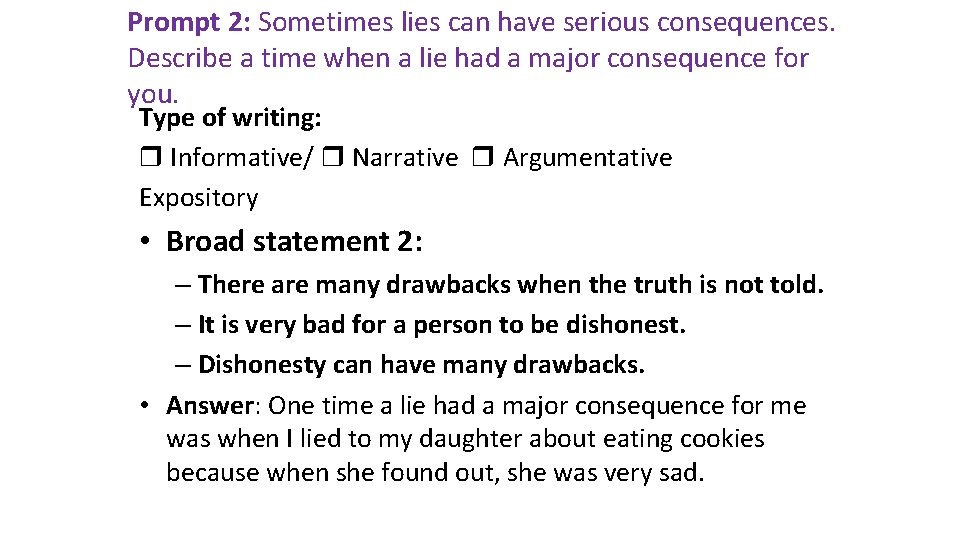
Prompt 2: Sometimes lies can have serious consequences. Describe a time when a lie had a major consequence for you. Type of writing: Informative/ Narrative Argumentative Expository • Broad statement 2: – There are many drawbacks when the truth is not told. – It is very bad for a person to be dishonest. – Dishonesty can have many drawbacks. • Answer: One time a lie had a major consequence for me was when I lied to my daughter about eating cookies because when she found out, she was very sad.
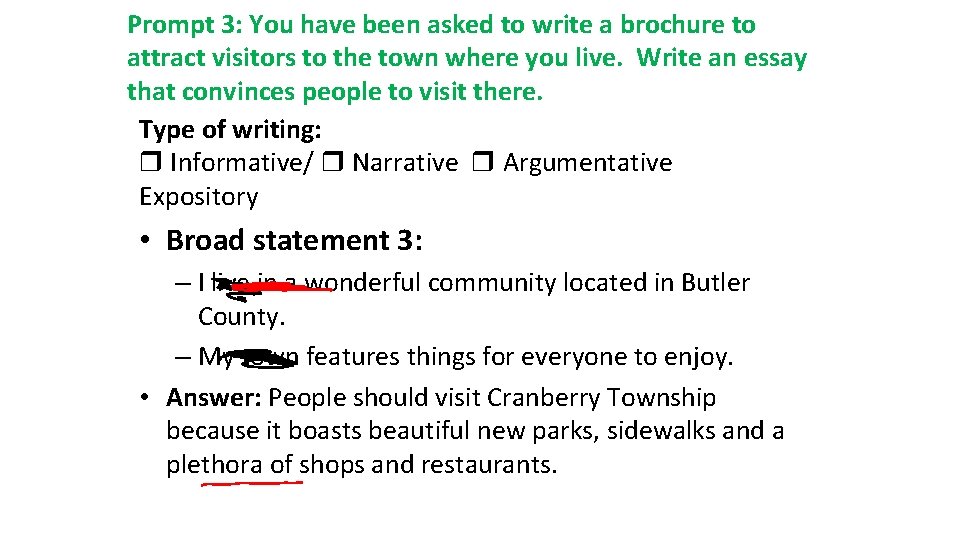
Prompt 3: You have been asked to write a brochure to attract visitors to the town where you live. Write an essay that convinces people to visit there. Type of writing: Informative/ Narrative Argumentative Expository • Broad statement 3: – I live in a wonderful community located in Butler County. – My town features things for everyone to enjoy. • Answer: People should visit Cranberry Township because it boasts beautiful new parks, sidewalks and a plethora of shops and restaurants.
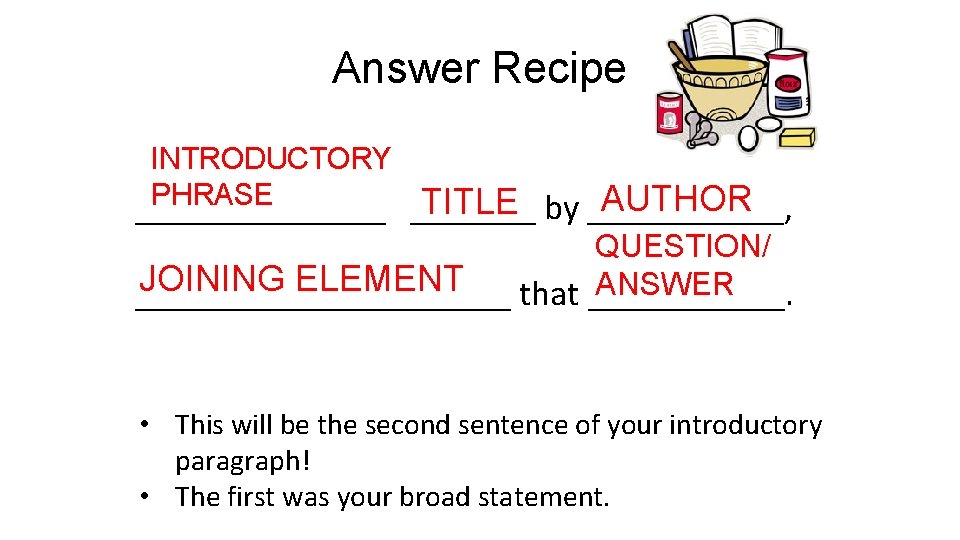
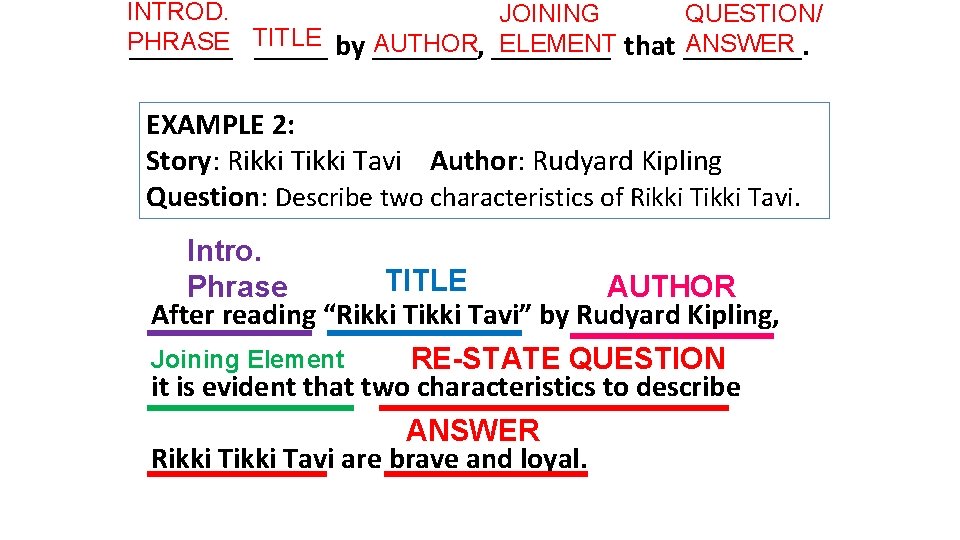
Answer Recipe INTRODUCTORY PHRASE _______ AUTHOR TITLE by ______, _______ QUESTION/ JOINING ELEMENT ANSWER ___________ that ______. • This will be the second sentence of your introductory paragraph! • The first was your broad statement.
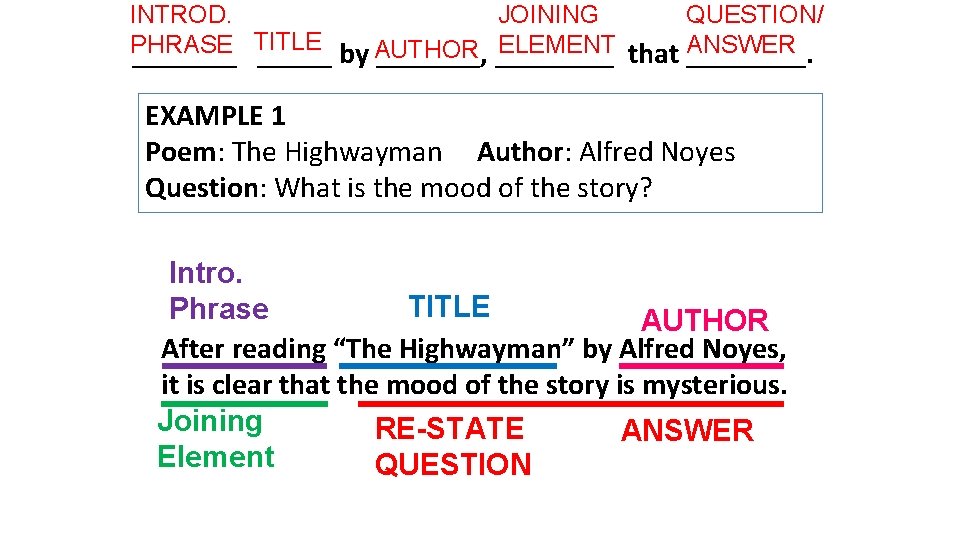
JOINING INTROD. ELEMENT PHRASE _______ TITLE _____ by AUTHOR _______, ____ QUESTION/ that ANSWER ____. EXAMPLE 1 Poem: The Highwayman Author: Alfred Noyes Question: What is the mood of the story? Intro. TITLE Phrase AUTHOR After reading “The Highwayman” by Alfred Noyes, it is clear that the mood of the story is mysterious. Joining RE-STATE ANSWER Element QUESTION
INTROD. JOINING QUESTION/ PHRASE ELEMENT that ____. ANSWER AUTHOR _______ TITLE _____ by _______, EXAMPLE 2: Story: Rikki Tavi Author: Rudyard Kipling Question: Describe two characteristics of Rikki Tavi. Intro. TITLE AUTHOR Phrase After reading “Rikki Tavi” by Rudyard Kipling, RE-STATE QUESTION it is evident that two characteristics to describe Joining Element ANSWER Rikki Tavi are brave and loyal.
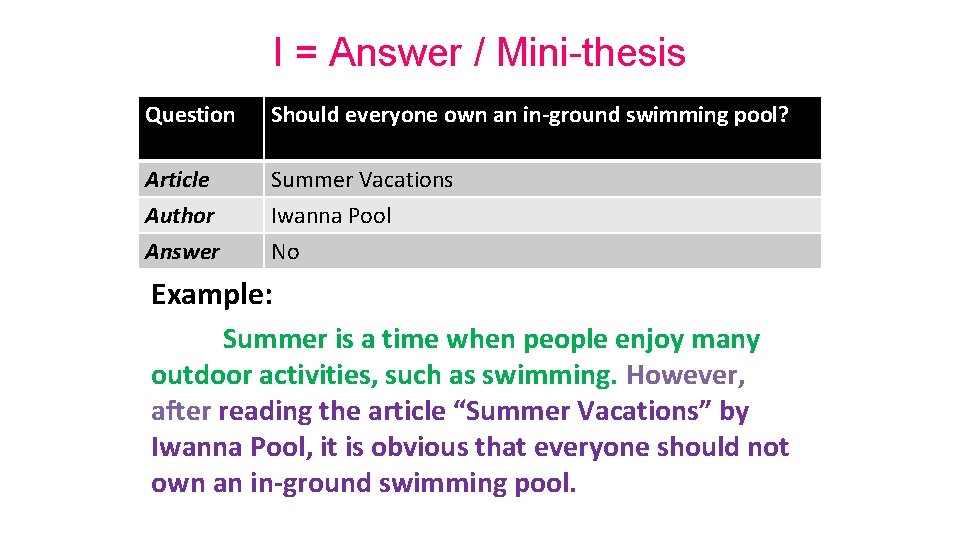
I = Answer / Mini-thesis Question Should everyone own an in-ground swimming pool? Article Summer Vacations Author Iwanna Pool Answer No Example: Summer is a time when people enjoy many outdoor activities, such as swimming. However, after reading the article “Summer Vacations” by Iwanna Pool, it is obvious that everyone should not own an in-ground swimming pool.
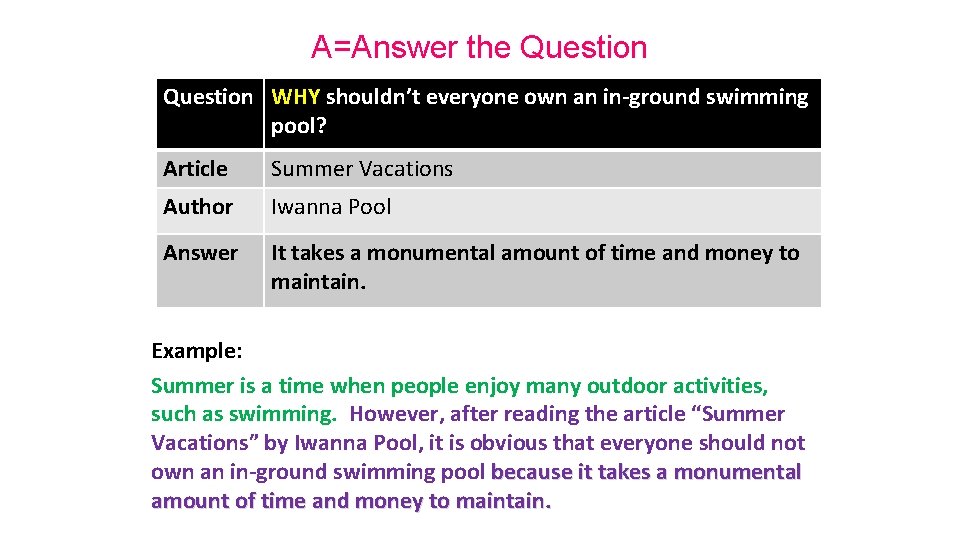
A=Answer the Question WHY shouldn’t everyone own an in-ground swimming pool? Article Summer Vacations Author Iwanna Pool Answer It takes a monumental amount of time and money to maintain. Example: Summer is a time when people enjoy many outdoor activities, such as swimming. However, after reading the article “Summer Vacations” by Iwanna Pool, it is obvious that everyone should not own an in-ground swimming pool because it takes a monumental amount of time and money to maintain.
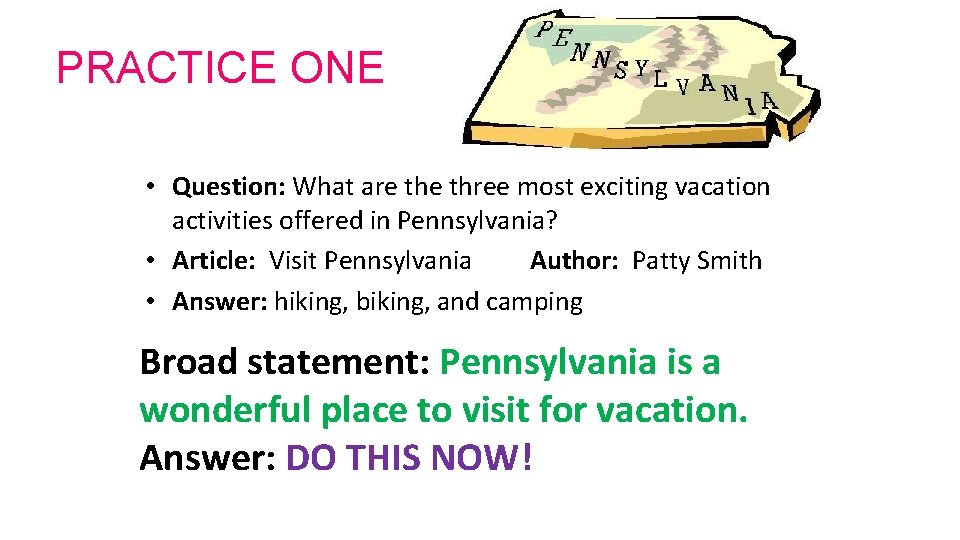
PRACTICE ONE • Question: What are three most exciting vacation activities offered in Pennsylvania? • Article: Visit Pennsylvania Author: Patty Smith • Answer: hiking, biking, and camping Broad statement: Pennsylvania is a wonderful place to visit for vacation. Answer: DO THIS NOW!
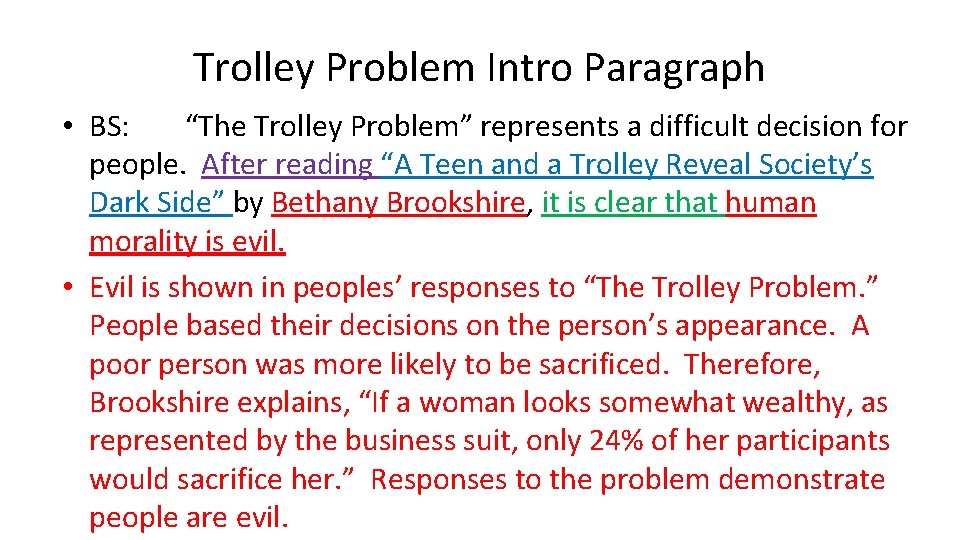
Trolley Problem Intro Paragraph • BS: “The Trolley Problem” represents a difficult decision for people. After reading “A Teen and a Trolley Reveal Society’s Dark Side” by Bethany Brookshire, it is clear that human morality is evil. • Evil is shown in peoples’ responses to “The Trolley Problem. ” People based their decisions on the person’s appearance. A poor person was more likely to be sacrificed. Therefore, Brookshire explains, “If a woman looks somewhat wealthy, as represented by the business suit, only 24% of her participants would sacrifice her. ” Responses to the problem demonstrate people are evil.
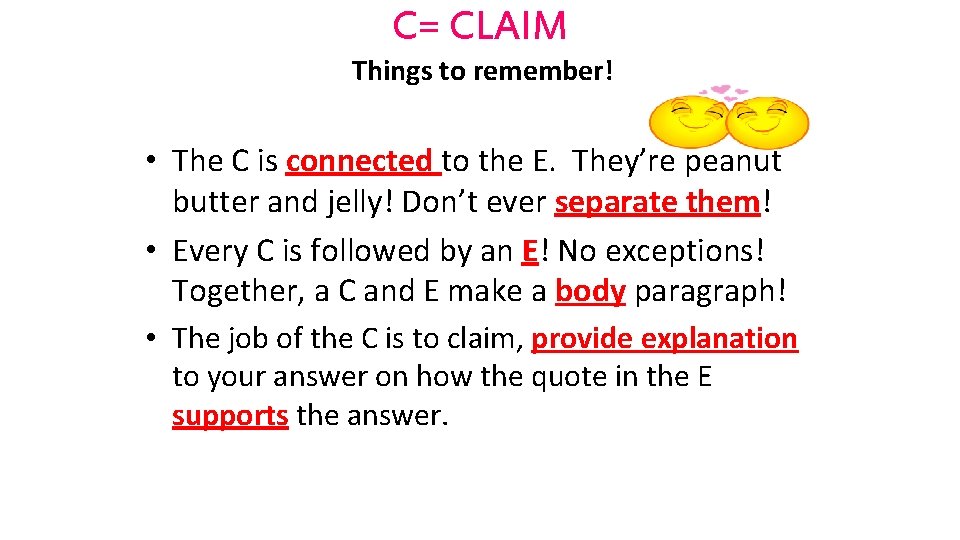
C= CLAIM Things to remember! • The C is connected to the E. They’re peanut butter and jelly! Don’t ever separate them! • Every C is followed by an E! No exceptions! Together, a C and E make a body paragraph! • The job of the C is to claim, provide explanation to your answer on how the quote in the E supports the answer.
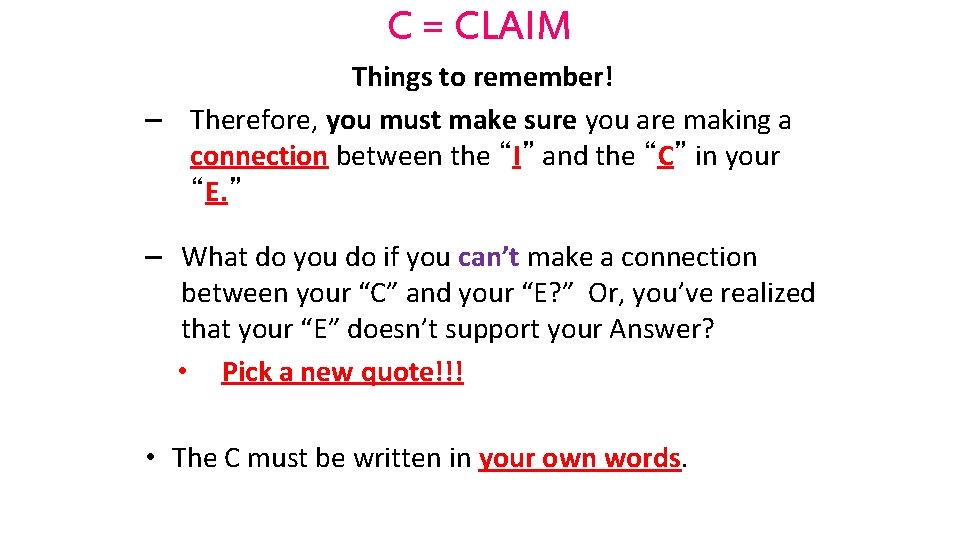
C = CLAIM Things to remember! – Therefore, you must make sure you are making a connection between the “I” and the “C” in your “E. ” – What do you do if you can’t make a connection between your “C” and your “E? ” Or, you’ve realized that your “E” doesn’t support your Answer? • Pick a new quote!!! • The C must be written in your own words.
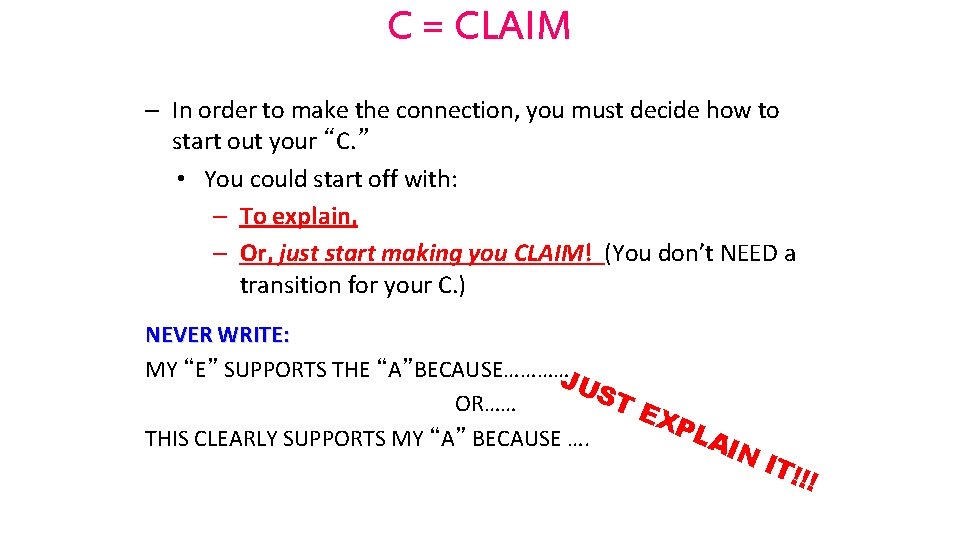
C = CLAIM – In order to make the connection, you must decide how to start out your “C. ” • You could start off with: – To explain, – Or, just start making you CLAIM! (You don’t NEED a transition for your C. ) NEVER WRITE: MY “E” SUPPORTS THE “A”BECAUSE…………J US TE OR…… XP LA THIS CLEARLY SUPPORTS MY “A” BECAUSE …. IN IT! !!
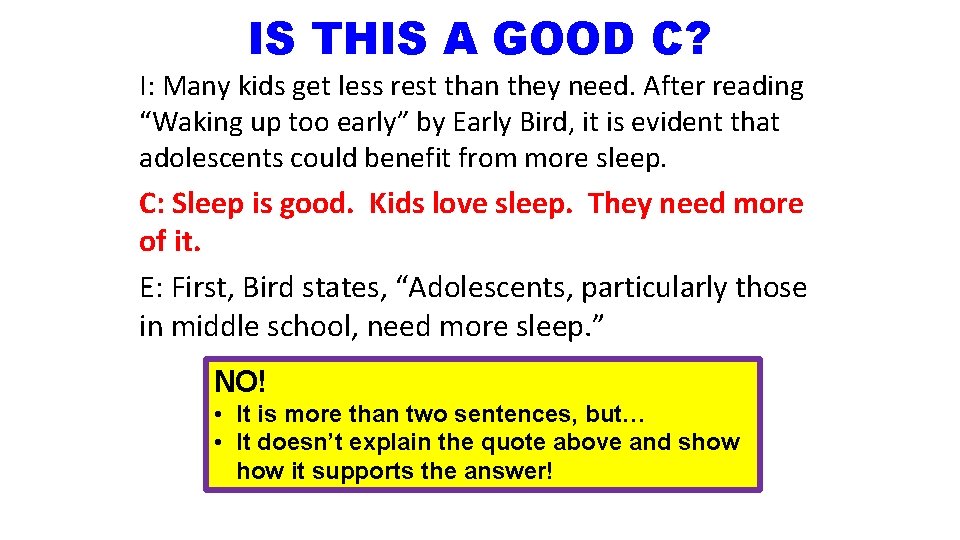
IS THIS A GOOD C? I: Many kids get less rest than they need. After reading “Waking up too early” by Early Bird, it is evident that adolescents could benefit from more sleep. C: Sleep is good. Kids love sleep. They need more of it. E: First, Bird states, “Adolescents, particularly those in middle school, need more sleep. ” NO! • It is more than two sentences, but… • It doesn’t explain the quote above and show it supports the answer!
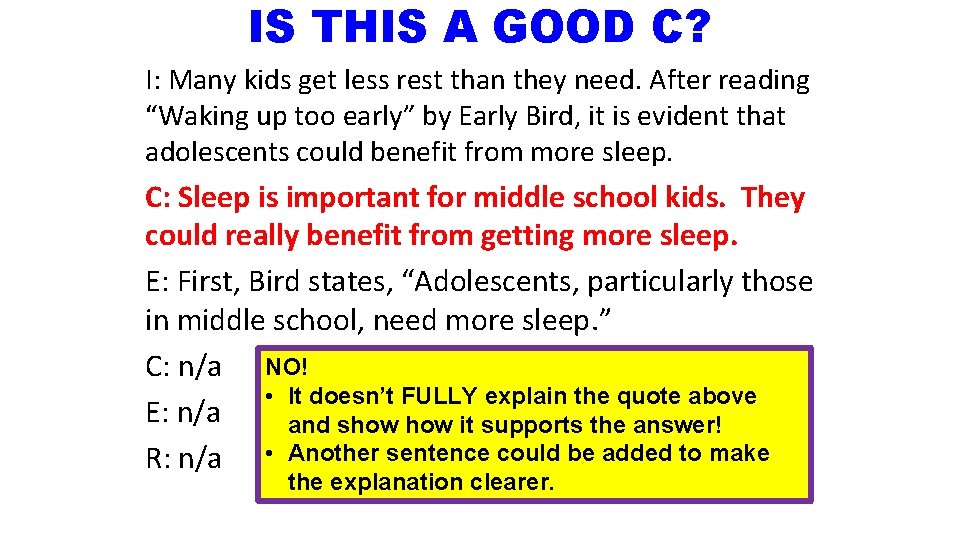
IS THIS A GOOD C? I: Many kids get less rest than they need. After reading “Waking up too early” by Early Bird, it is evident that adolescents could benefit from more sleep. C: Sleep is important for middle school kids. They could really benefit from getting more sleep. E: First, Bird states, “Adolescents, particularly those in middle school, need more sleep. ” C: n/a NO! • It doesn’t FULLY explain the quote above E: n/a and show it supports the answer! R: n/a • Another sentence could be added to make the explanation clearer.
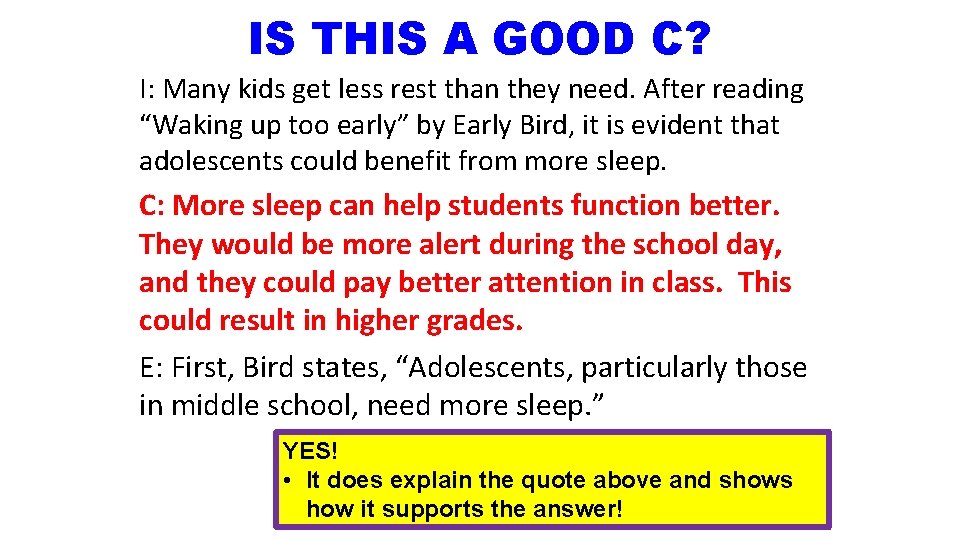
IS THIS A GOOD C? I: Many kids get less rest than they need. After reading “Waking up too early” by Early Bird, it is evident that adolescents could benefit from more sleep. C: More sleep can help students function better. They would be more alert during the school day, and they could pay better attention in class. This could result in higher grades. E: First, Bird states, “Adolescents, particularly those in middle school, need more sleep. ” YES! • It does explain the quote above and shows how it supports the answer!
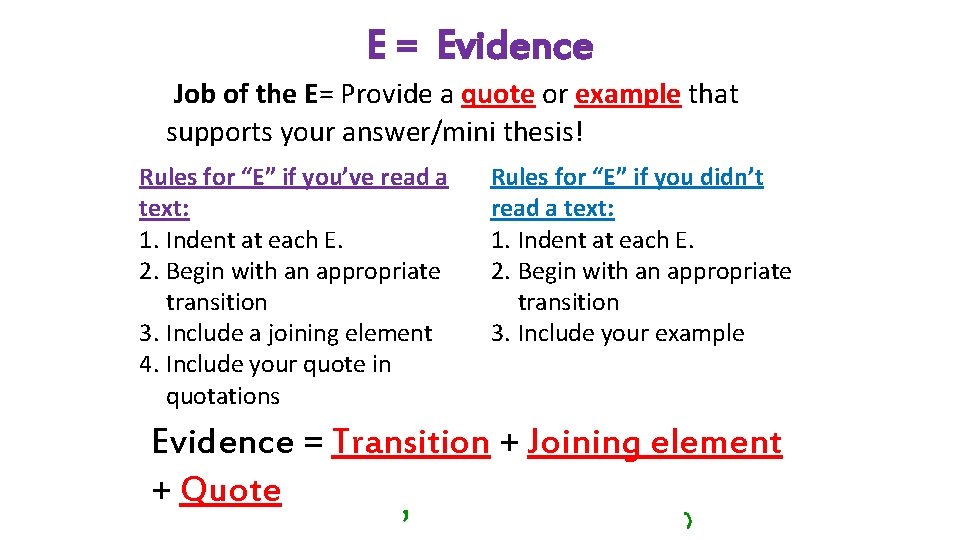
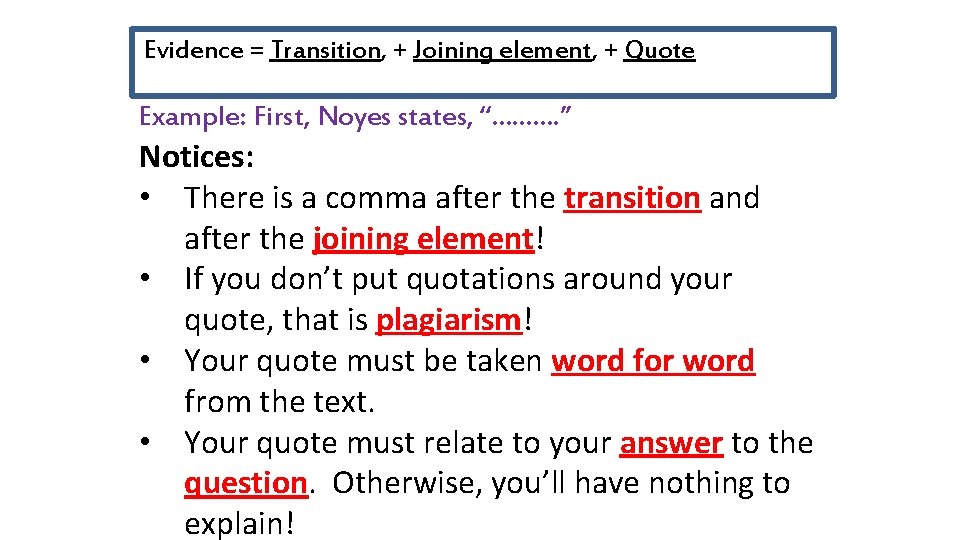
E = Evidence Job of the E= Provide a quote or example that supports your answer/mini thesis! Rules for “E” if you’ve read a text: 1. Indent at each E. 2. Begin with an appropriate transition 3. Include a joining element 4. Include your quote in quotations Rules for “E” if you didn’t read a text: 1. Indent at each E. 2. Begin with an appropriate transition 3. Include your example Evidence = Transition + Joining element + Quote
Evidence = Transition, + Joining element, + Quote Example: First, Noyes states, “………. ” Notices: • There is a comma after the transition and after the joining element! • If you don’t put quotations around your quote, that is plagiarism! • Your quote must be taken word for word from the text. • Your quote must relate to your answer to the question. Otherwise, you’ll have nothing to explain!
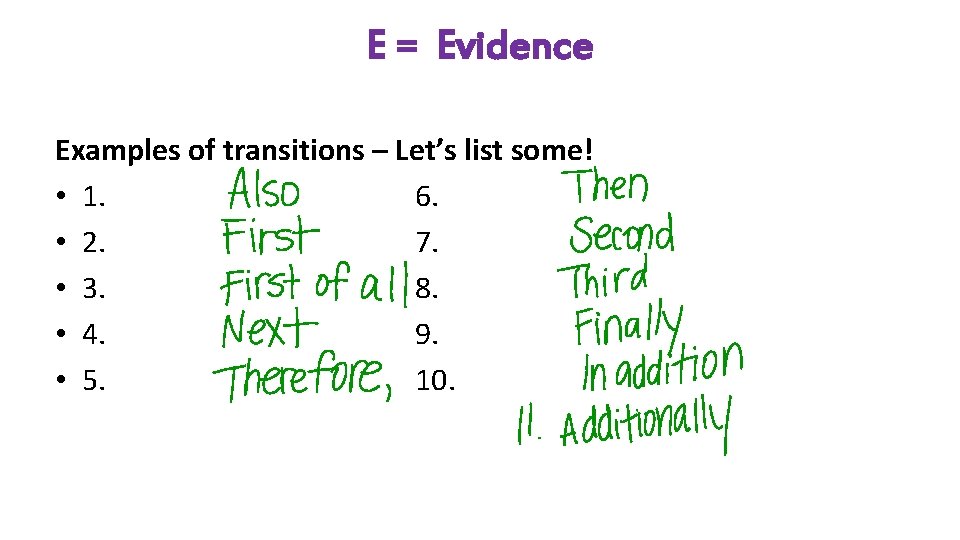
E = Evidence Examples of transitions – Let’s list some! • 1. 6. • 2. 7. • 3. 8. • 4. 9. • 5. 10.
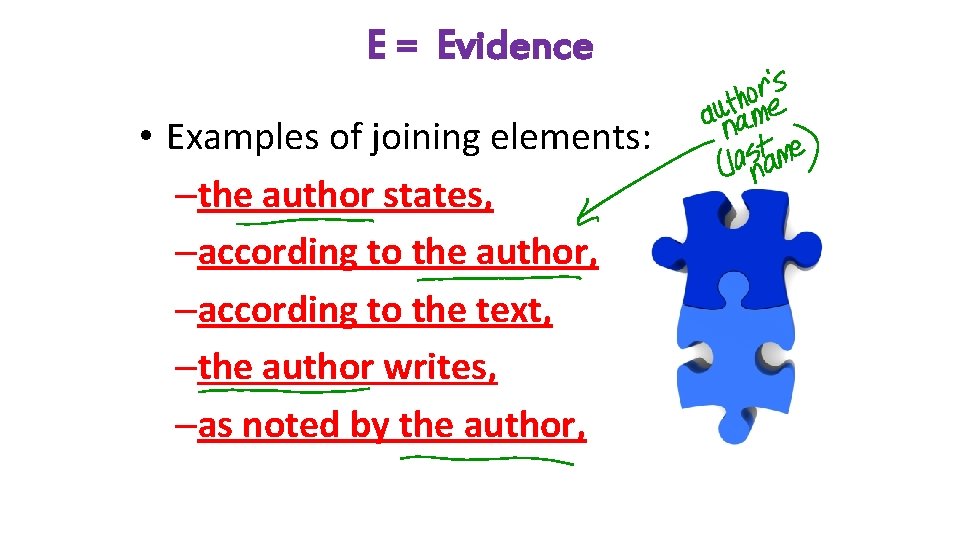
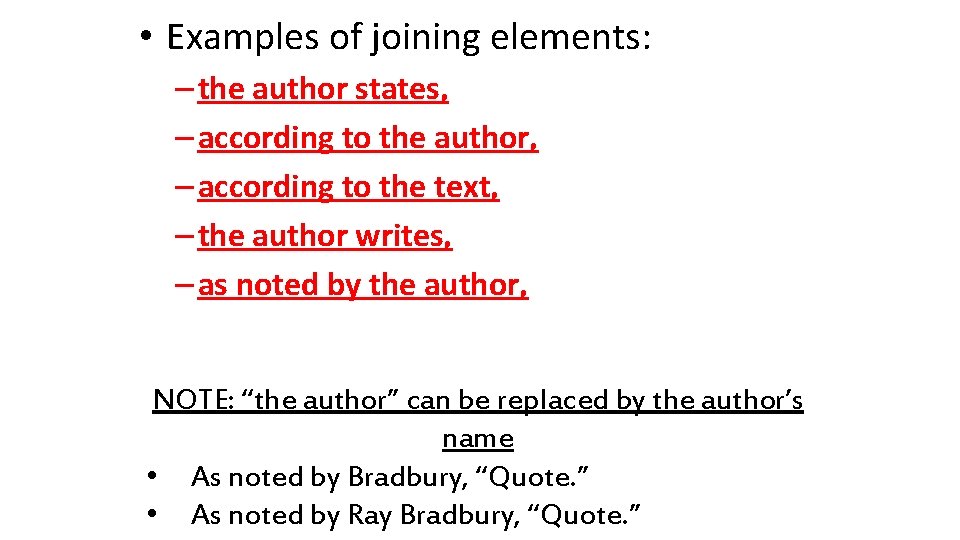
E = Evidence • Examples of joining elements: –the author states, –according to the author, –according to the text, –the author writes, –as noted by the author,
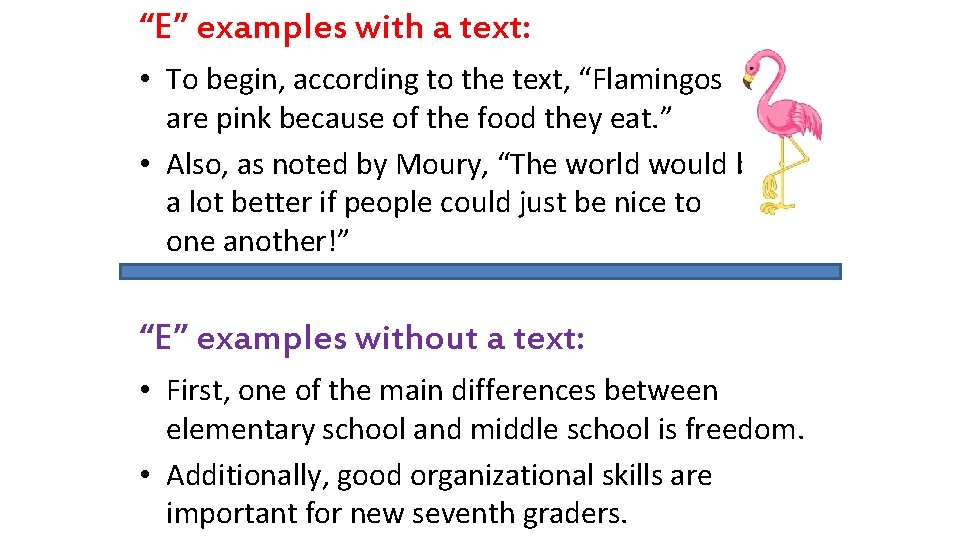
“E” examples with a text: • To begin, according to the text, “Flamingos are pink because of the food they eat. ” • Also, as noted by Moury, “The world would be a lot better if people could just be nice to one another!” “E” examples without a text: • First, one of the main differences between elementary school and middle school is freedom. • Additionally, good organizational skills are important for new seventh graders.
• Examples of joining elements: – the author states, – according to the author, – according to the text, – the author writes, – as noted by the author, NOTE: “the author” can be replaced by the author’s name • As noted by Bradbury, “Quote. ” • As noted by Ray Bradbury, “Quote. ”
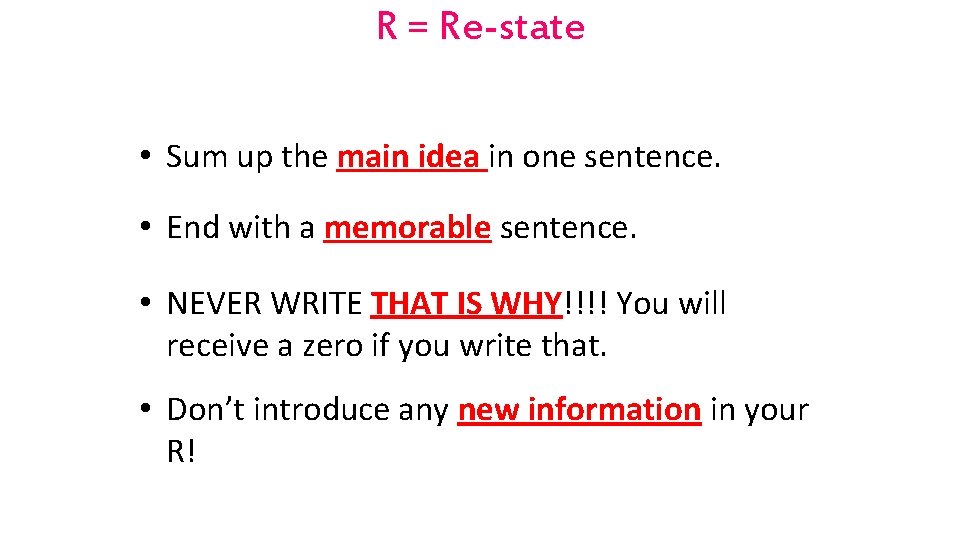
R = Re-state • The job of the R is to restate the answer/mini-thesis and wrap-up the writing response! • You’re not done until you add the R. • The “R” in ICER is the wrap-up paragraph, which restates the main points of your paper. • Indent your “R” paragraph.
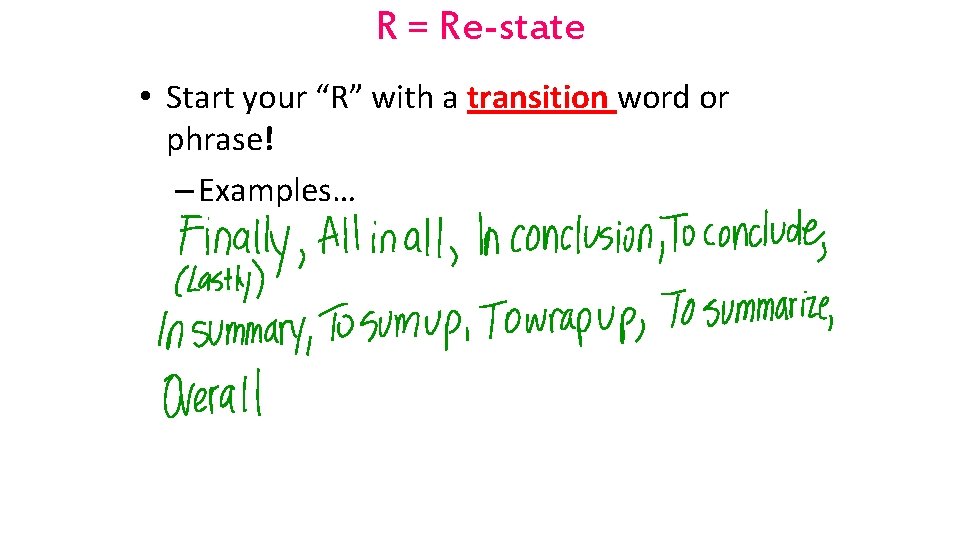
R = Re-state • Start your “R” with a transition word or phrase! – Examples…
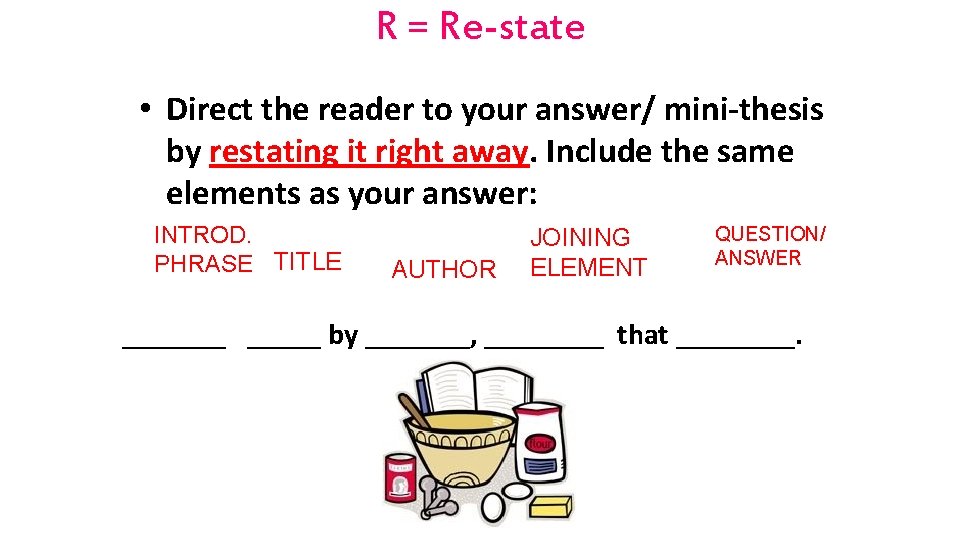
R = Re-state • Direct the reader to your answer/ mini-thesis by restating it right away. Include the same elements as your answer: INTROD. PHRASE TITLE AUTHOR JOINING ELEMENT QUESTION/ ANSWER _______ by _______, ____ that ____.
R = Re-state • Sum up the main idea in one sentence. • End with a memorable sentence. • NEVER WRITE THAT IS WHY!!!! You will receive a zero if you write that. • Don’t introduce any new information in your R!
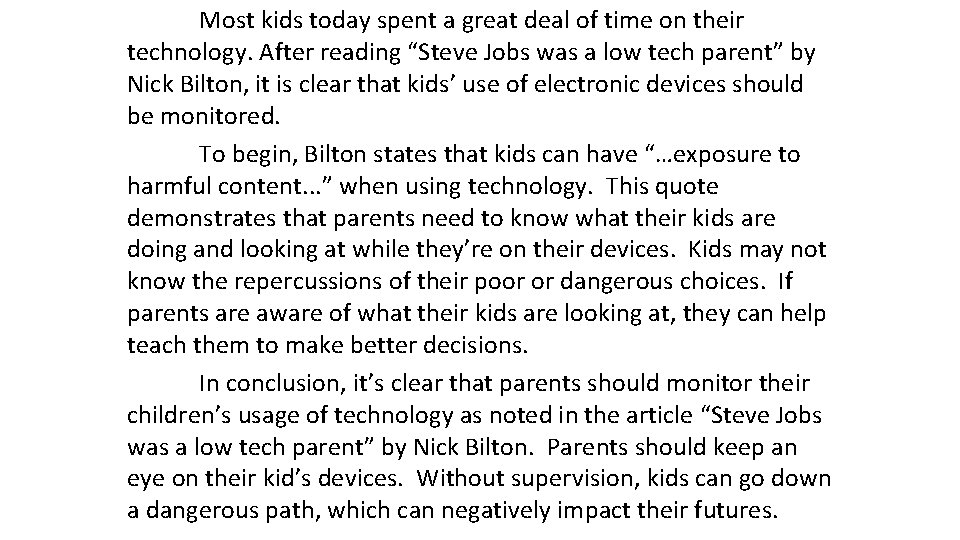
Most kids today spent a great deal of time on their technology. After reading “Steve Jobs was a low tech parent” by Nick Bilton, it is clear that kids’ use of electronic devices should be monitored. To begin, Bilton states that kids can have “…exposure to harmful content. . . ” when using technology. This quote demonstrates that parents need to know what their kids are doing and looking at while they’re on their devices. Kids may not know the repercussions of their poor or dangerous choices. If parents are aware of what their kids are looking at, they can help teach them to make better decisions. In conclusion, it’s clear that parents should monitor their children’s usage of technology as noted in the article “Steve Jobs was a low tech parent” by Nick Bilton. Parents should keep an eye on their kid’s devices. Without supervision, kids can go down a dangerous path, which can negatively impact their futures.