
Types of Waves Diagram the parts of the

- Slides: 5
Types of Waves Diagram the parts of the wave
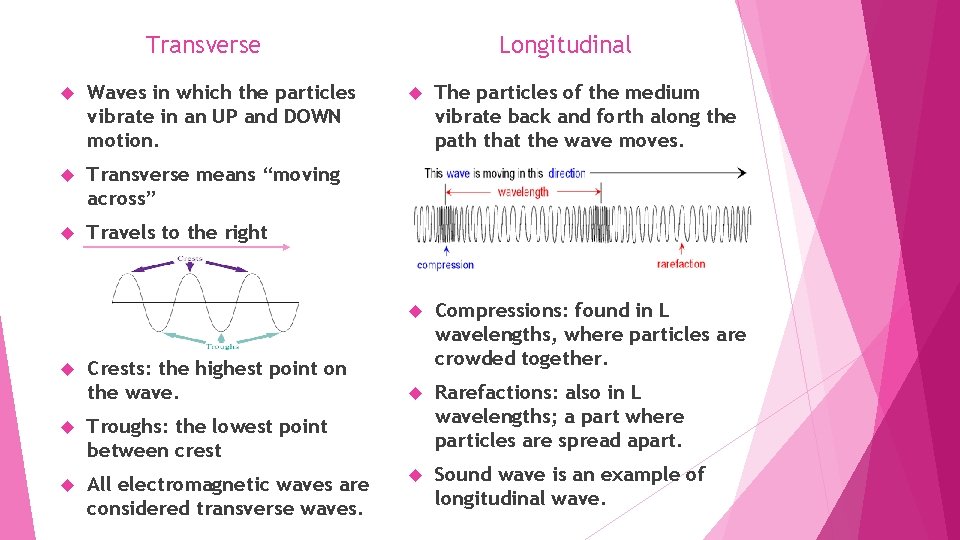
Transverse Waves in which the particles vibrate in an UP and DOWN motion. Transverse means “moving across” Travels to the right Crests: the highest point on the wave. Troughs: the lowest point between crest All electromagnetic waves are considered transverse waves. Longitudinal The particles of the medium vibrate back and forth along the path that the wave moves. Compressions: found in L wavelengths, where particles are crowded together. Rarefactions: also in L wavelengths; a part where particles are spread apart. Sound wave is an example of longitudinal wave.
Combination of Waves When waves form at or near the boundary between TWO MEDIA, a transverse wave and a longitudinal wave can combine to form a SURFACE WAVE. https: //www. youtube. com/watch? v=7 y. PTa 8 qi 5 X 8 Surface waves look like transverse waves, but the particles of the medium in a surface wav move in circles rather than up and down. The particles will move forward at the crest and move backward at the trough of the wave.
Parts of a T Wave
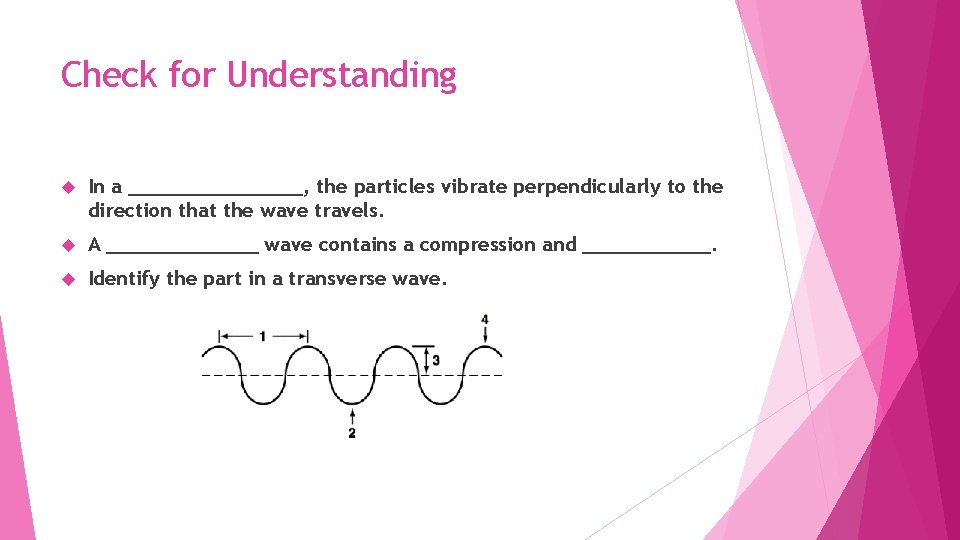
Check for Understanding In a ________, the particles vibrate perpendicularly to the direction that the wave travels. A _______ wave contains a compression and ______. Identify the part in a transverse wave.