
Types of variation Starter The current population of

- Slides: 23
Types of variation
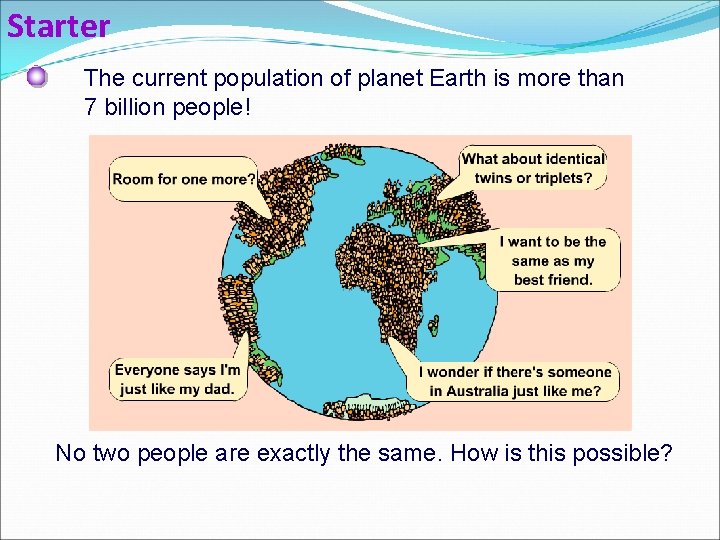
Starter The current population of planet Earth is more than 7 billion people! No two people are exactly the same. How is this possible?
Learning Objectives To understand the variation in living organisms Success criteria Learners should be able to demonstrate and apply their knowledge and understanding of: (f) the different types of variation To include intraspecific and interspecific variation AND the differences between continuous and discontinuous variation, using examples of a range of characteristics found in plants, animals and microorganisms AND both genetic and environmental causes of variation.
Variation can be described as differences that exist between individuals. There are 2 types Interspecific – between different species Intraspecific – within a species
Causes of variation Remember from GCSE what 2 factors affect variation? Genetic variation Environmental variation
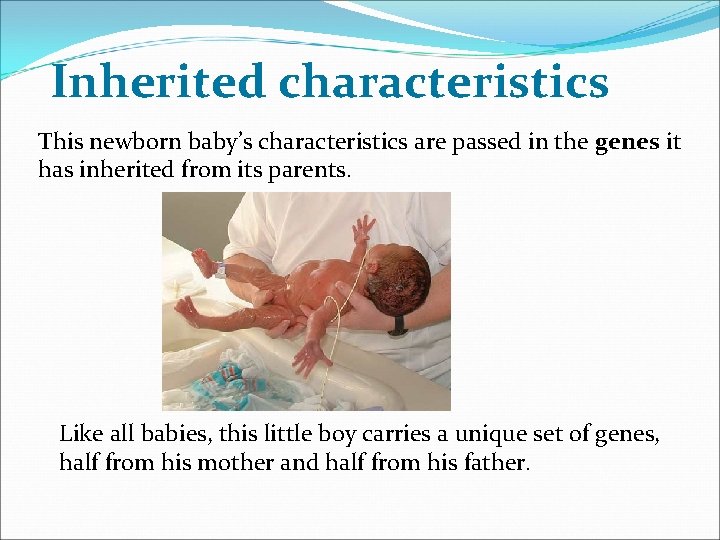
Inherited characteristics This newborn baby’s characteristics are passed in the genes it has inherited from its parents. Like all babies, this little boy carries a unique set of genes, half from his mother and half from his father.
Genetic causes of variation What are alleles? Version of a gene e. g. Blood groups - 3 different alleles (A, B, O) giving 4 different blood groups (A, B, AB, O) What are mutations? Changes to the DNA sequence, can lead to change in genes and therefore proteins. Somatic mutation – affects body cells in individual only Gamete mutation – passed on to offspring
Genetic causes of variation List 3 ways how sexual reproduction produces genetic variation amongst a species
Genetic causes of variation 3 ways how sexual reproduction produces variation amongst a species: Random mating Random fertilisation of gametes Independent assortment of chromosomes (and therefore alleles) and crossing over during meiosis
Asexual reproduction How does this affect variation? Organisms that reproduce asexually have less variation Asexual reproduction results in clones Only mutation can increase genetic variation
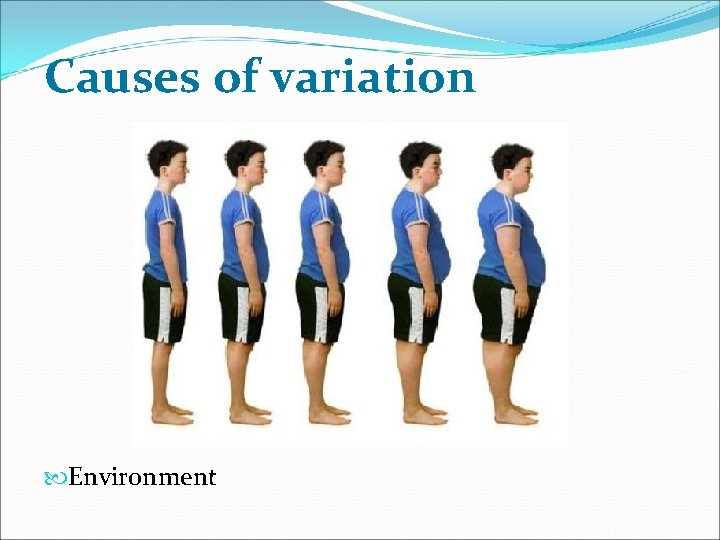
Causes of variation Environment
Environmental Variation Examples in which Environment effects amount of growth Amount of food available Amount of water available Exposure to sunlight Strong prevailing wind to trees
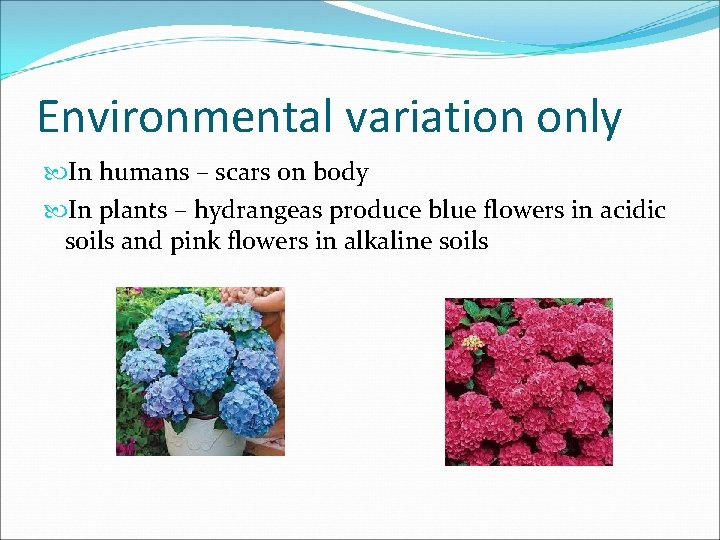
Environmental variation only In humans – scars on body In plants – hydrangeas produce blue flowers in acidic soils and pink flowers in alkaline soils
Causes of variation Your unique characteristics are caused by: - the unique set of genes you have inherited from your parents - the environment in which you have developed. Differences in some characteristics are due to a combination of both inherited and environmental factors. Name three examples of this type of characteristic.
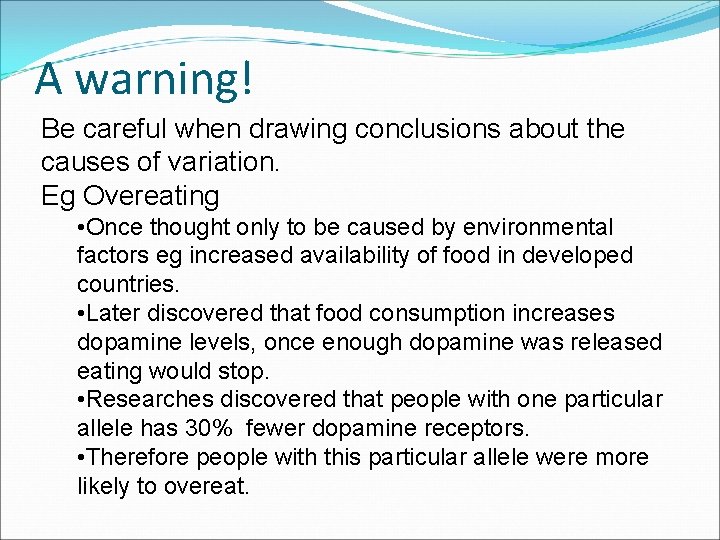
A warning! Be careful when drawing conclusions about the causes of variation. Eg Overeating • Once thought only to be caused by environmental factors eg increased availability of food in developed countries. • Later discovered that food consumption increases dopamine levels, once enough dopamine was released eating would stop. • Researches discovered that people with one particular allele has 30% fewer dopamine receptors. • Therefore people with this particular allele were more likely to overeat.
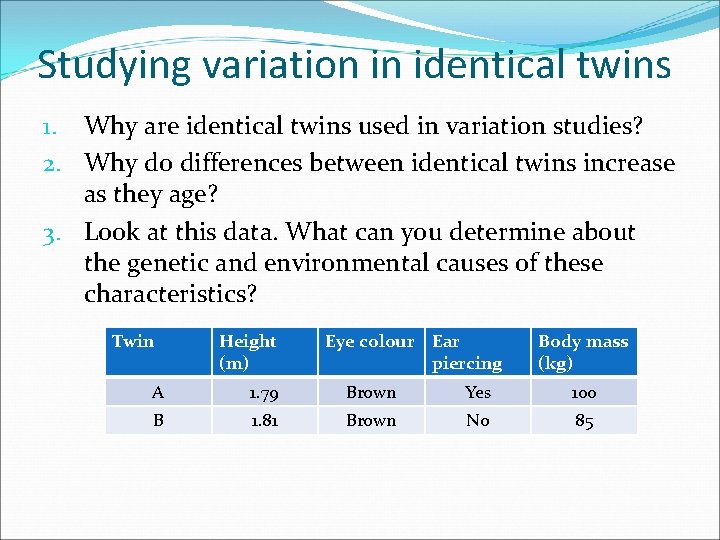
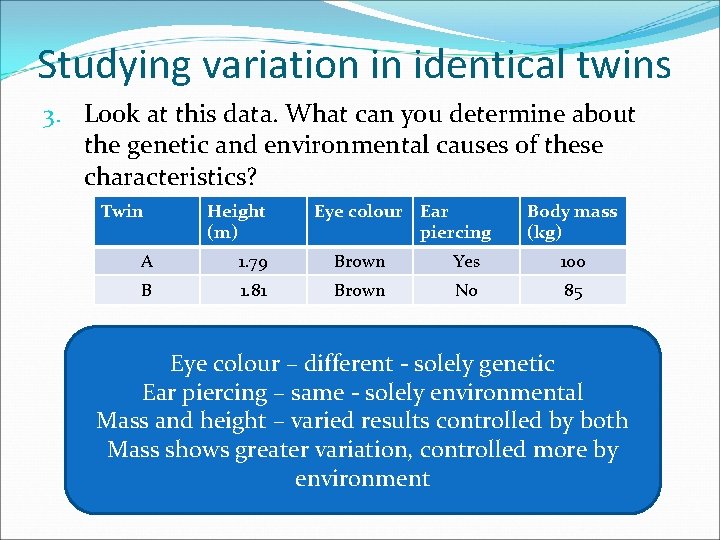
Studying variation in identical twins 1. Why are identical twins used in variation studies? 2. Why do differences between identical twins increase as they age? 3. Look at this data. What can you determine about the genetic and environmental causes of these characteristics? Twin Height (m) Eye colour Ear piercing Body mass (kg) A 1. 79 Brown Yes 100 B 1. 81 Brown No 85
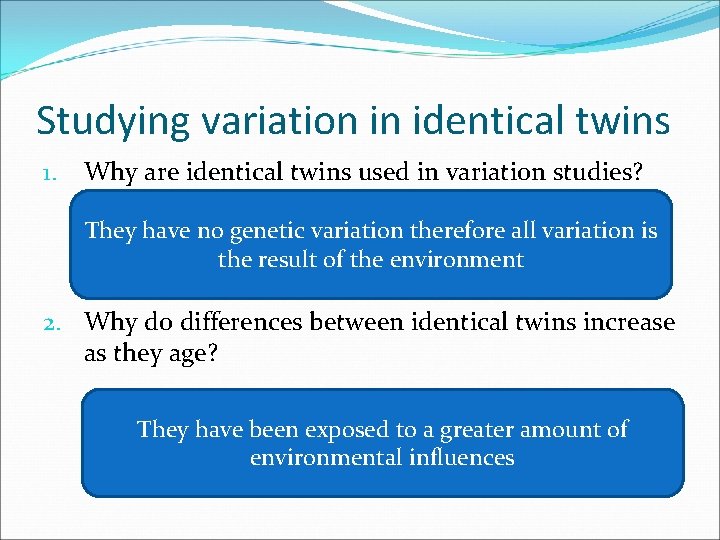
Studying variation in identical twins 1. Why are identical twins used in variation studies? They have no genetic variation therefore all variation is the result of the environment 2. Why do differences between identical twins increase as they age? They have been exposed to a greater amount of environmental influences
Studying variation in identical twins 3. Look at this data. What can you determine about the genetic and environmental causes of these characteristics? Twin Height (m) Eye colour Ear piercing Body mass (kg) A 1. 79 Brown Yes 100 B 1. 81 Brown No 85 Eye colour – different - solely genetic Ear piercing – same - solely environmental Mass and height – varied results controlled by both Mass shows greater variation, controlled more by environment
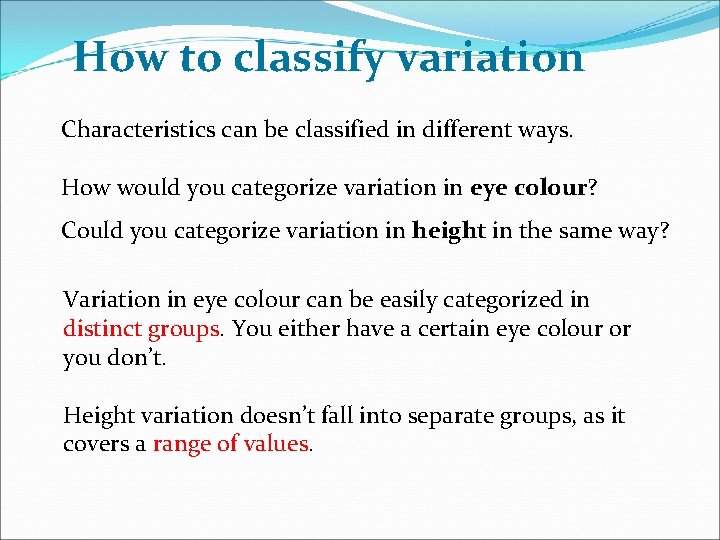
How to classify variation Characteristics can be classified in different ways. How would you categorize variation in eye colour? Could you categorize variation in height in the same way? Variation in eye colour can be easily categorized in distinct groups. You either have a certain eye colour or you don’t. Height variation doesn’t fall into separate groups, as it covers a range of values.
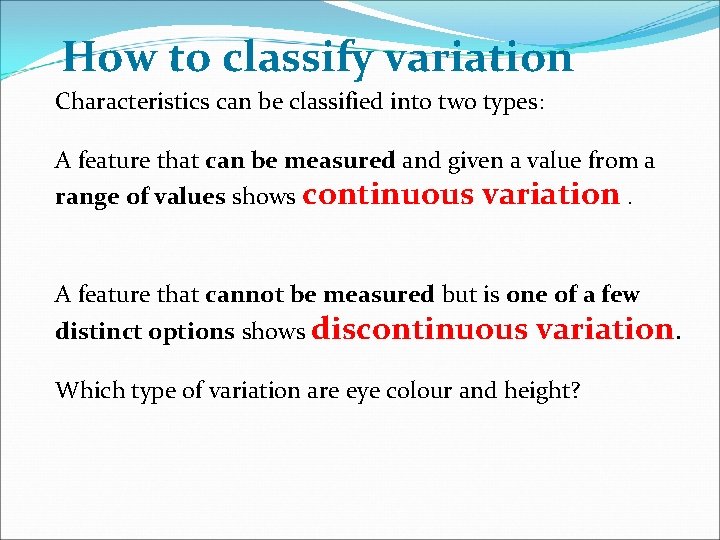
How to classify variation Characteristics can be classified into two types: A feature that can be measured and given a value from a range of values shows continuous variation. A feature that cannot be measured but is one of a few distinct options shows discontinuous variation. Which type of variation are eye colour and height?
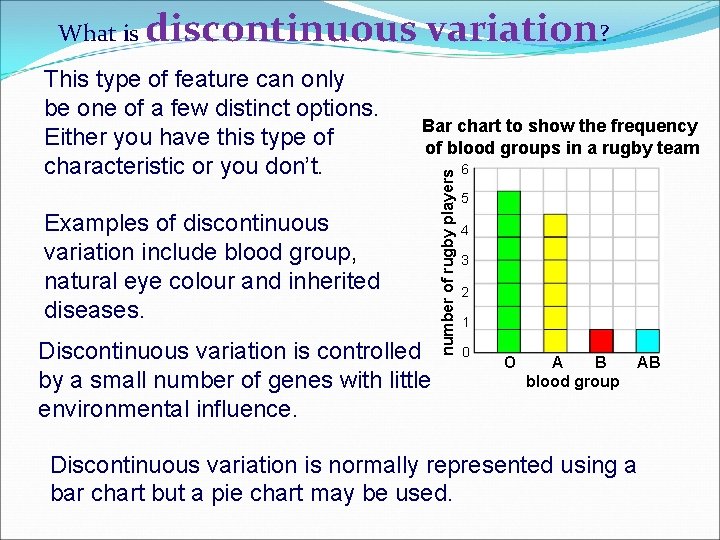
discontinuous variation? This type of feature can only be one of a few distinct options. Either you have this type of characteristic or you don’t. Bar chart to show the frequency of blood groups in a rugby team Examples of discontinuous variation include blood group, natural eye colour and inherited diseases. Discontinuous variation is controlled by a small number of genes with little environmental influence. number of rugby players What is 6 5 4 3 2 1 0 O A B blood group AB Discontinuous variation is normally represented using a bar chart but a pie chart may be used.
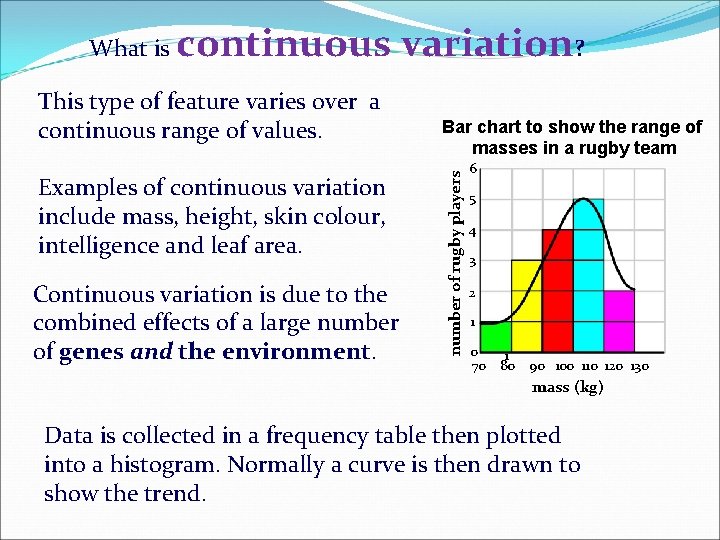
continuous variation? This type of feature varies over a continuous range of values. Examples of continuous variation include mass, height, skin colour, intelligence and leaf area. Continuous variation is due to the combined effects of a large number of genes and the environment. Bar chart to show the range of masses in a rugby team number of rugby players What is 6 5 4 3 2 1 0 70 1 80 90 100 110 120 130 mass (kg) Data is collected in a frequency table then plotted into a histogram. Normally a curve is then drawn to show the trend.
Learning Objectives To understand the variation in living organisms Success criteria Learners should be able to demonstrate and apply their knowledge and understanding of: (f) the different types of variation To include intraspecific and interspecific variation AND the differences between continuous and discontinuous variation, using examples of a range of characteristics found in plants, animals and microorganisms AND both genetic and environmental causes of variation.