
Types of Validity 30 December 2021 Experimental Design
Types of Validity 30 December 2021 Experimental Design and Evaluation Instructor: Mark Hancock
By the next break, you will be able to identify and distinguish the four types of validity. 30 December 2021 Experimental Design and Evaluation Instructor: Mark Hancock
What makes a study valid? 30 December 2021 Experimental Design and Evaluation Instructor: Mark Hancock
Types of Validity • External • Construct • Internal • Conclusion 30 December 2021 Experimental Design and Evaluation Instructor: Mark Hancock
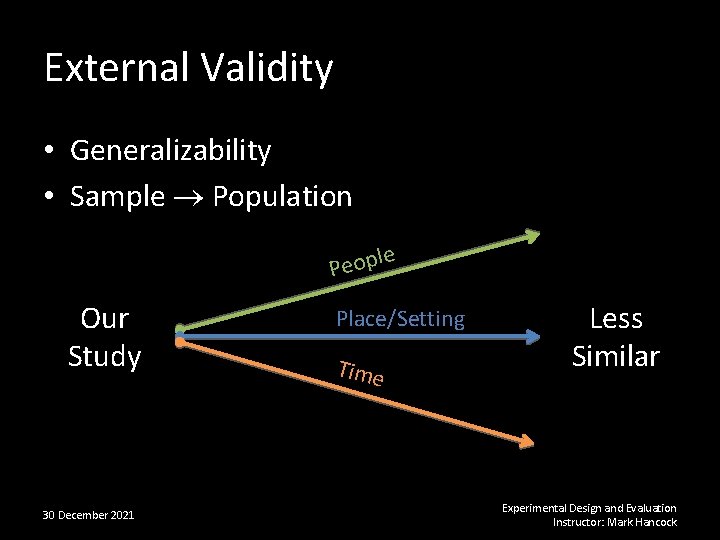
External Validity • Generalizability • Sample Population le p o e P Our Study 30 December 2021 Place/Setting Time Less Similar Experimental Design and Evaluation Instructor: Mark Hancock
Example • You perform a study on 12 university students. Each participant is asked to find three unique insights about the data. • How similar would this population need to be to reproduce your results? 30 December 2021 Experimental Design and Evaluation Instructor: Mark Hancock
Construct Validity • Do your observations correspond to theory you are using to describe them? • One interpretation: do you have the right labels? 30 December 2021 Experimental Design and Evaluation Instructor: Mark Hancock
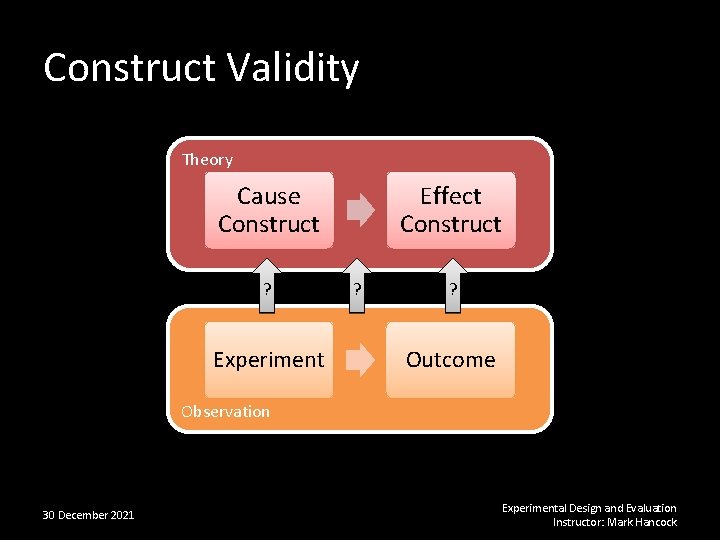
Construct Validity Theory Cause Construct ? Experiment Effect Construct ? ? Outcome Observation 30 December 2021 Experimental Design and Evaluation Instructor: Mark Hancock
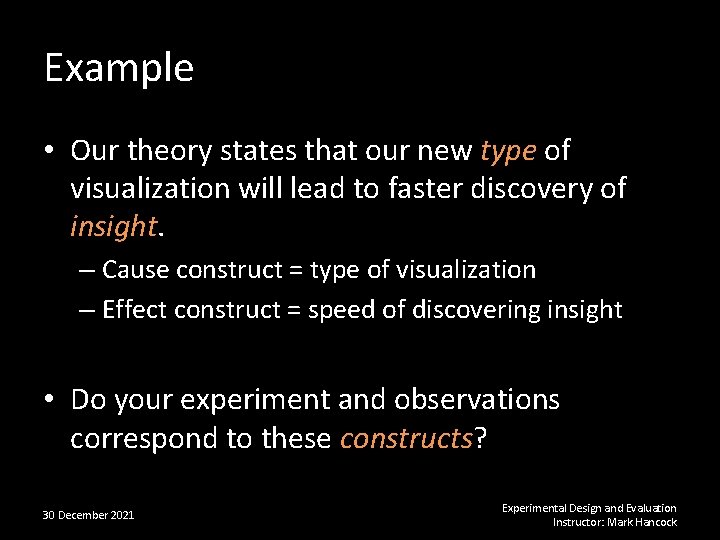
Example • Our theory states that our new type of visualization will lead to faster discovery of insight. – Cause construct = type of visualization – Effect construct = speed of discovering insight • Do your experiment and observations correspond to these constructs? 30 December 2021 Experimental Design and Evaluation Instructor: Mark Hancock
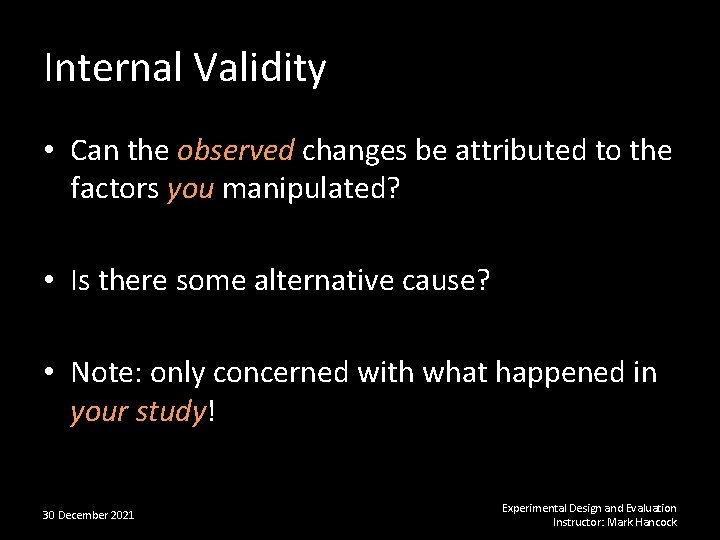
Internal Validity • Can the observed changes be attributed to the factors you manipulated? • Is there some alternative cause? • Note: only concerned with what happened in your study! 30 December 2021 Experimental Design and Evaluation Instructor: Mark Hancock
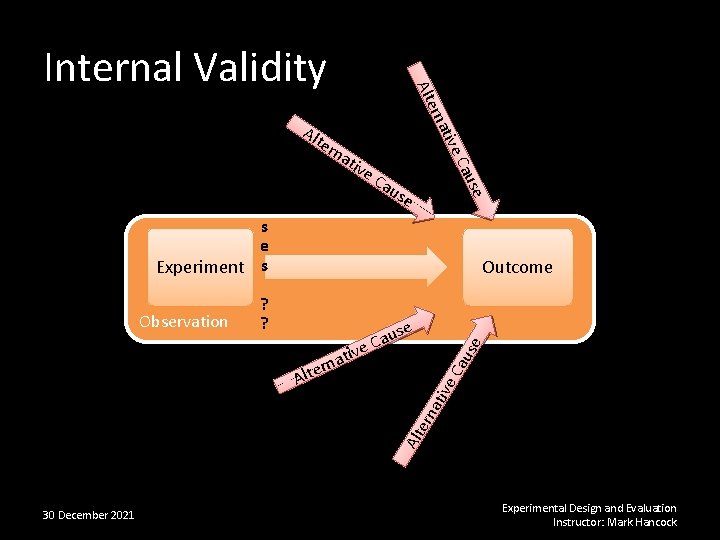
aus e. C ativ au se e Outcome ? ? e se au e. C Alt ti a n r Alte aus C ve ern ati v Observation Alt ern ati v ern C a u s e Experiment s Alt Internal Validity 30 December 2021 Experimental Design and Evaluation Instructor: Mark Hancock
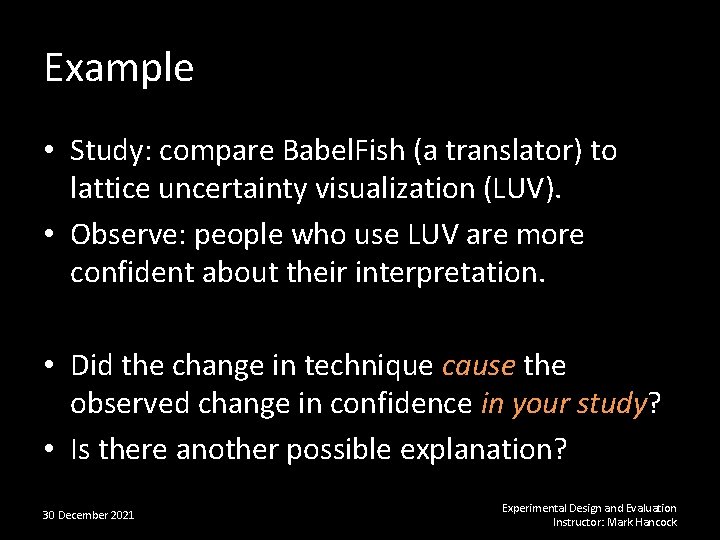
Example • Study: compare Babel. Fish (a translator) to lattice uncertainty visualization (LUV). • Observe: people who use LUV are more confident about their interpretation. • Did the change in technique cause the observed change in confidence in your study? • Is there another possible explanation? 30 December 2021 Experimental Design and Evaluation Instructor: Mark Hancock

(Statistical) Conclusion Validity • Is the conclusion we make about the relationship between the independent and dependent variables valid? • Not concerned with cause, only correlation • Is our analysis correct? 30 December 2021 Experimental Design and Evaluation Instructor: Mark Hancock
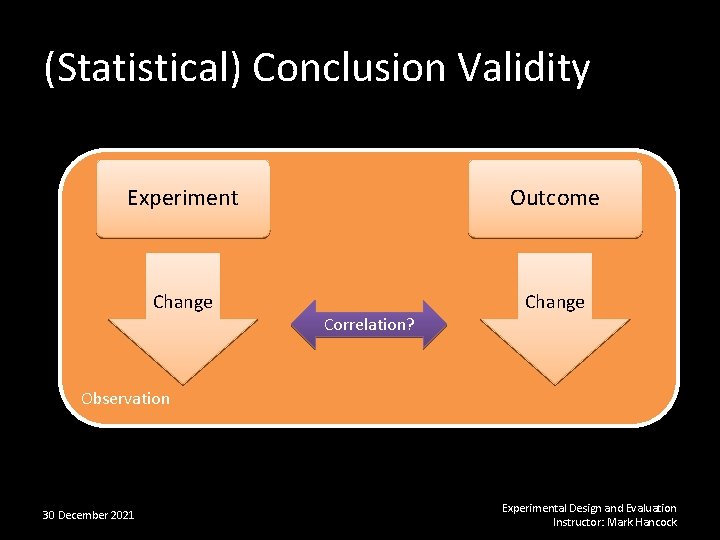
(Statistical) Conclusion Validity Experiment Outcome Change Correlation? Observation 30 December 2021 Experimental Design and Evaluation Instructor: Mark Hancock
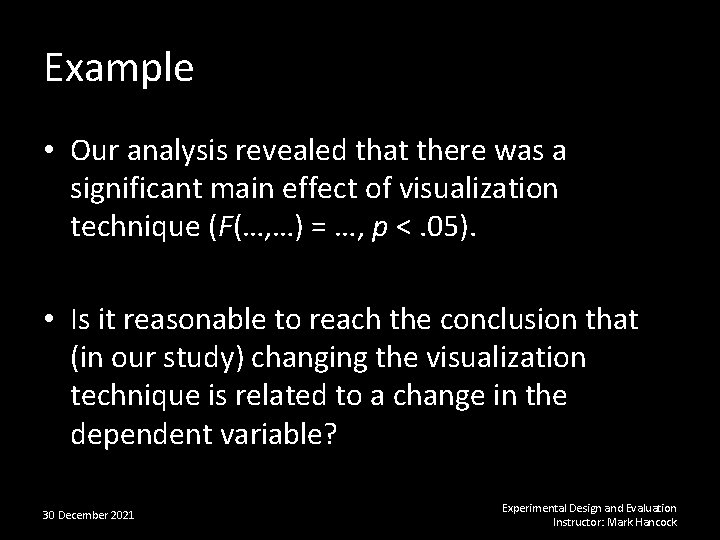
Example • Our analysis revealed that there was a significant main effect of visualization technique (F(…, …) = …, p <. 05). • Is it reasonable to reach the conclusion that (in our study) changing the visualization technique is related to a change in the dependent variable? 30 December 2021 Experimental Design and Evaluation Instructor: Mark Hancock
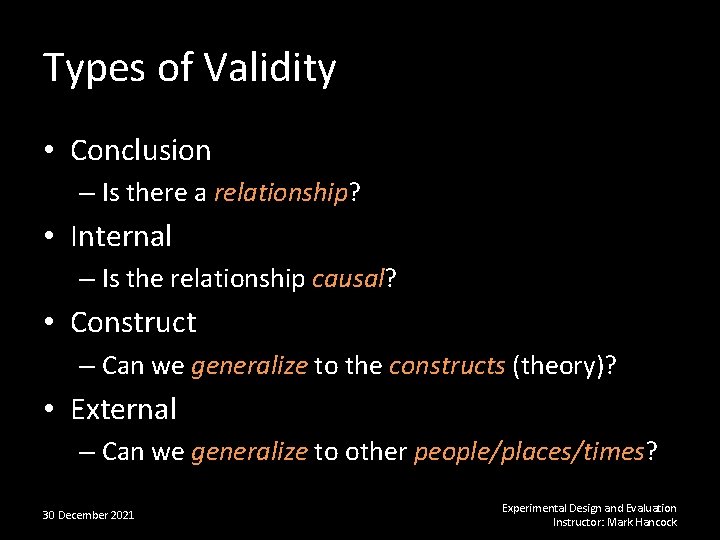
Types of Validity • Conclusion – Is there a relationship? • Internal – Is the relationship causal? • Construct – Can we generalize to the constructs (theory)? • External – Can we generalize to other people/places/times? 30 December 2021 Experimental Design and Evaluation Instructor: Mark Hancock
Activity (four groups, 5 minutes) • Conclusion – Is there a relationship? • Internal – Is the relationship causal? • Construct – Can we generalize to the constructs (theory)? • External – Can we generalize to other people/places/times? 30 December 2021 Experimental Design and Evaluation Instructor: Mark Hancock
What form of validity? • My theory states that people who spend all day typing have weaker wrists than those that don’t. • I measure how far two groups (typists and non -typists) can throw a Frisbee. • Does what I observe in my study correspond to my theory about typists? 30 December 2021 Experimental Design and Evaluation Instructor: Mark Hancock
What form of validity? • A longitudinal study on working habits was performed to measure the effect of working long hours on success. • The study showed that people who worked long hours tended to be more successful. • Is the conclusion that working long hours leads to success valid? 30 December 2021 Experimental Design and Evaluation Instructor: Mark Hancock
What form of validity? • Two Mac users and two windows users were asked to rate their operating system on a scale of 1 (terrible) to 9 (fantastic). Results of a <analysis? > showed that people preferred Mac OS X to Windows. • Were there enough people in this study to claim a significant result? 30 December 2021 Experimental Design and Evaluation Instructor: Mark Hancock
What form of validity? • A study of 12 computer science students was performed to compare three 3 D interaction techniques. Results showed that a 10 -button mouse outperformed the arrow keys on a keyboard. • Would this result be the same if the study was performed on 12 architects? 30 December 2021 Experimental Design and Evaluation Instructor: Mark Hancock
Summary • Conclusion – Is there a relationship? • Internal – Is the relationship causal? • Construct – Can we generalize to the constructs (theory)? • External – Can we generalize to other people/places/times? 30 December 2021 Experimental Design and Evaluation Instructor: Mark Hancock
Break: 15 Minutes 30 December 2021 Experimental Design and Evaluation Instructor: Mark Hancock
Is our list of forms of validity exhaustive? (Note: I called them “the four types”) 30 December 2021 Experimental Design and Evaluation Instructor: Mark Hancock
After the next 10 minutes, you will be able to distinguish between external validity and ecological validity. 30 December 2021 Experimental Design and Evaluation Instructor: Mark Hancock
Has anyone been criticised about the validity of an experiment they ran (e. g. , in a review)? 30 December 2021 Experimental Design and Evaluation Instructor: Mark Hancock
Ecological Validity • How closely does the experimental setting correspond to the real setting? 30 December 2021 Experimental Design and Evaluation Instructor: Mark Hancock
Compare Ecological Validity External Validity • How closely does the experimental setting correspond to the real setting? • Does what we observed in our study generalize to what would happen with different people, in a different place, or in a different time? How can one happen without the other? 30 December 2021 Experimental Design and Evaluation Instructor: Mark Hancock
Example • We perform a study that compares how quickly people can select menu items in a circular menu and a rectangular menu. • The menus were filled with different types of fruit in a random order and asked to select a target fruit. Time to select targets was measured. 30 December 2021 Experimental Design and Evaluation Instructor: Mark Hancock
Activity (same group, 2 minutes) • Come up with an example of a study that has high ecological validity and low external validity? 30 December 2021 Experimental Design and Evaluation Instructor: Mark Hancock
Summary • Ecological validity – Does the experimental setting match its realistic counterpart? • External validity – Can we generalize our results to other settings? 30 December 2021 Experimental Design and Evaluation Instructor: Mark Hancock
Threats to Validity 30 December 2021 Experimental Design and Evaluation Instructor: Mark Hancock
By the next break, you will be able to criticise a study according to the four types of validity. 30 December 2021 Experimental Design and Evaluation Instructor: Mark Hancock
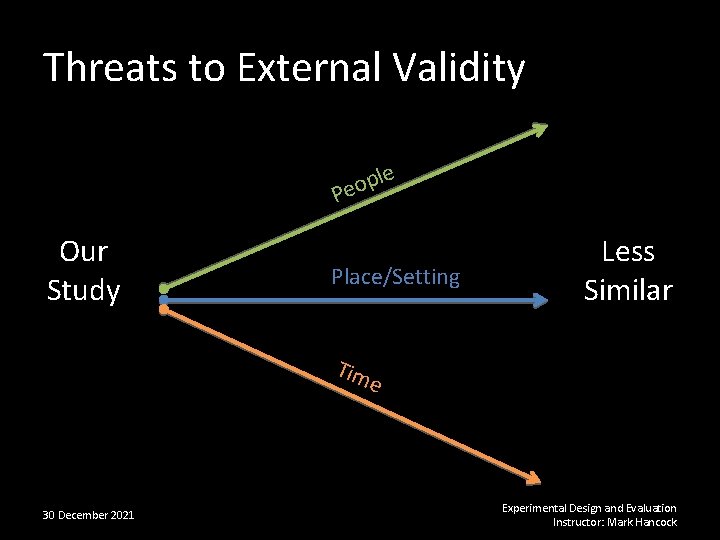
Threats to External Validity le p o Pe Our Study Place/Setting Less Similar Tim e 30 December 2021 Experimental Design and Evaluation Instructor: Mark Hancock
Examples • Criticism #1: you used only computer science students (people) • Criticism #2: you performed the study in a lab setting (place) • Criticism #3: you performed the study right after the Wii was released (time) 30 December 2021 Experimental Design and Evaluation Instructor: Mark Hancock
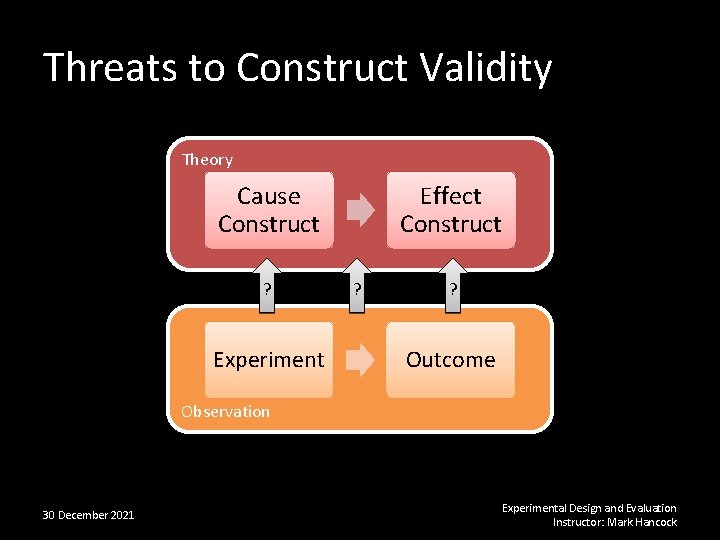
Threats to Construct Validity Theory Cause Construct ? Experiment Effect Construct ? ? Outcome Observation 30 December 2021 Experimental Design and Evaluation Instructor: Mark Hancock
Threats to Construct Validity • Poorly defined construct • Only one representative: – cause construct (e. g. , one multi-D vis. ) – effect construct (e. g. , one measure of “insight”) • Interaction: – cause construct (e. g. , combination of causes) – effect construct (e. g. , experiment + cause) 30 December 2021 Experimental Design and Evaluation Instructor: Mark Hancock
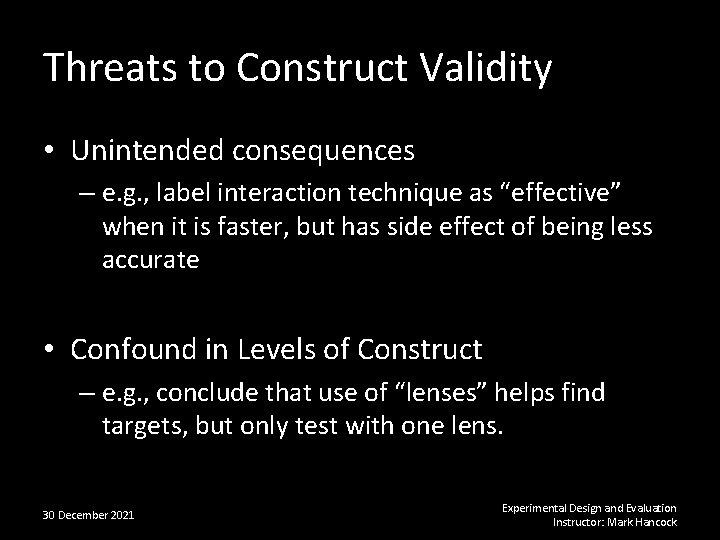
Threats to Construct Validity • Unintended consequences – e. g. , label interaction technique as “effective” when it is faster, but has side effect of being less accurate • Confound in Levels of Construct – e. g. , conclude that use of “lenses” helps find targets, but only test with one lens. 30 December 2021 Experimental Design and Evaluation Instructor: Mark Hancock
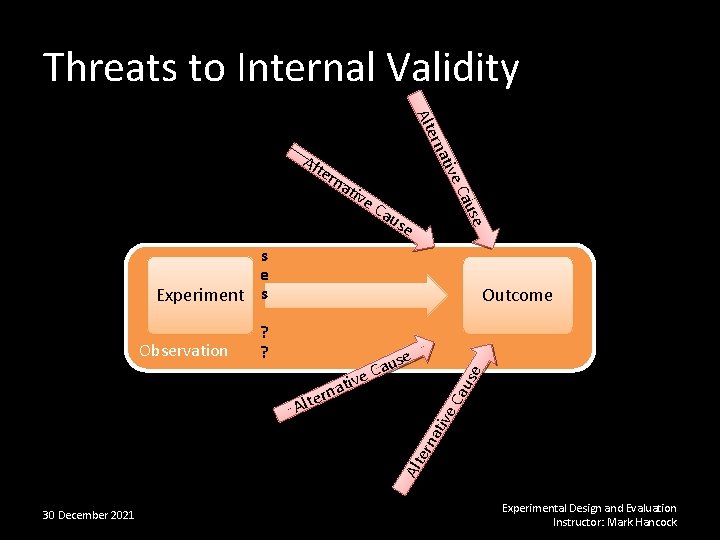
Threats to Internal Validity er Alt ive nat Alt au se se Outcome se au e Alt tiv a n r Alte se u a C e. C ? ? ern ati v Observation tiv e. C Cau C a u s e Experiment s ern a 30 December 2021 Experimental Design and Evaluation Instructor: Mark Hancock
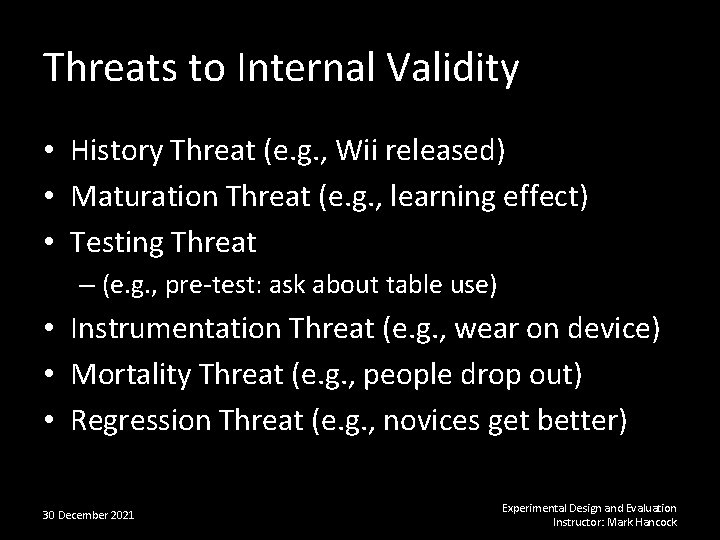
Threats to Internal Validity • History Threat (e. g. , Wii released) • Maturation Threat (e. g. , learning effect) • Testing Threat – (e. g. , pre-test: ask about table use) • Instrumentation Threat (e. g. , wear on device) • Mortality Threat (e. g. , people drop out) • Regression Threat (e. g. , novices get better) 30 December 2021 Experimental Design and Evaluation Instructor: Mark Hancock
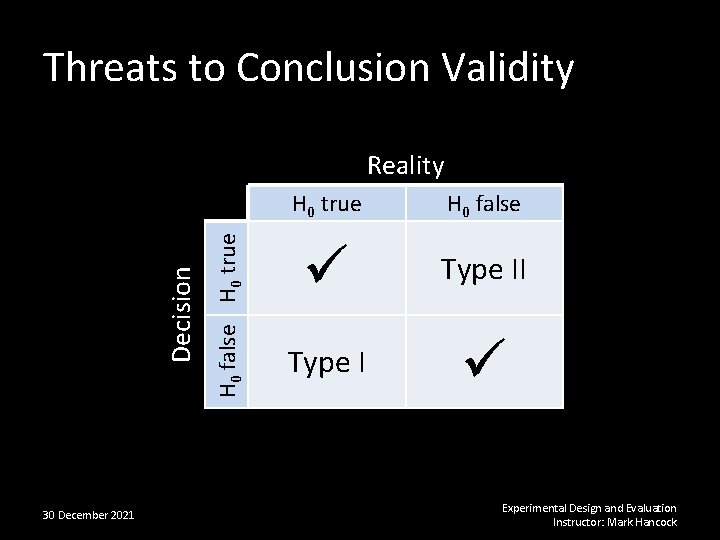
Threats to Conclusion Validity 30 December 2021 H 0 false H 0 true Decision Reality H 0 true H 0 false Type II Type I Experimental Design and Evaluation Instructor: Mark Hancock
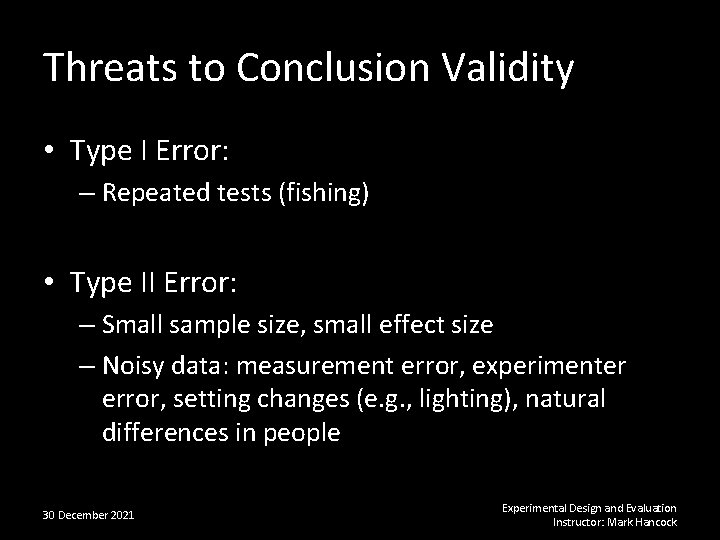
Threats to Conclusion Validity • Type I Error: – Repeated tests (fishing) • Type II Error: – Small sample size, small effect size – Noisy data: measurement error, experimenter error, setting changes (e. g. , lighting), natural differences in people 30 December 2021 Experimental Design and Evaluation Instructor: Mark Hancock
Activity (same groups) • What threat to validity lead to the invalidity in your previous examples? 30 December 2021 Experimental Design and Evaluation Instructor: Mark Hancock
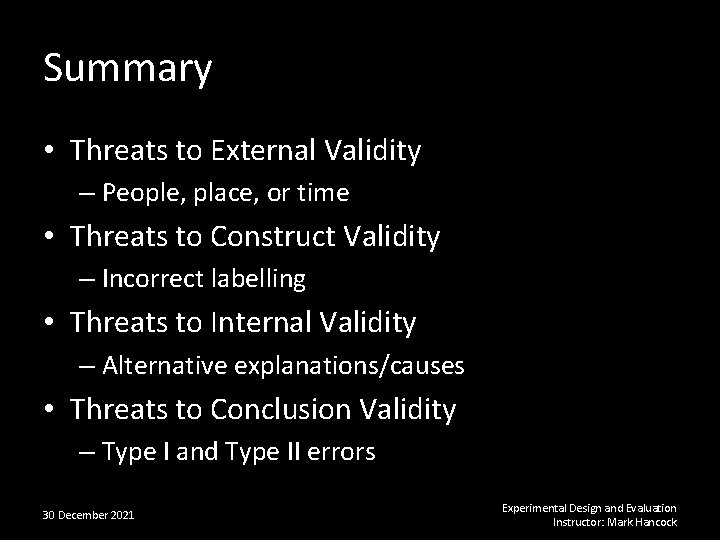
Summary • Threats to External Validity – People, place, or time • Threats to Construct Validity – Incorrect labelling • Threats to Internal Validity – Alternative explanations/causes • Threats to Conclusion Validity – Type I and Type II errors 30 December 2021 Experimental Design and Evaluation Instructor: Mark Hancock
Break: 15 Minutes 30 December 2021 Experimental Design and Evaluation Instructor: Mark Hancock
Assignment 3 30 December 2021 Experimental Design and Evaluation Instructor: Mark Hancock
Experimental Design 30 December 2021 Experimental Design and Evaluation Instructor: Mark Hancock
By the end of this course (!), you will be able to design and analyse your own experiment. 30 December 2021 Experimental Design and Evaluation Instructor: Mark Hancock
Has anyone performed their own experiment and analysis? 30 December 2021 Experimental Design and Evaluation Instructor: Mark Hancock
Method • What is the problem? • What is your hypothesis? • How can you test your hypothesis? – What factors might be interesting? – What/how can you measure? – How can you avoid the threats to the four types of validity? 30 December 2021 Experimental Design and Evaluation Instructor: Mark Hancock
Activity/Discussion • Design a study. 30 December 2021 Experimental Design and Evaluation Instructor: Mark Hancock
Summary of (Final) Day • Four forms of validity – Conclusion, internal, construct, external • Ecological validity • Threats to Validity • Experimental Design 30 December 2021 Experimental Design and Evaluation Instructor: Mark Hancock
Thanks for being a great class : ) 30 December 2021 Experimental Design and Evaluation Instructor: Mark Hancock
- Slides: 53