
TYPES OF URANIUM DEPOSITS Virginia T Mc Lemore
- Slides: 49
TYPES OF URANIUM DEPOSITS Virginia T. Mc. Lemore New Mexico Bureau of Geology and Mineral Resources New Mexico Institute of Mining and Technology, Socorro, NM
Outline • How do we classify mineral deposits? • Formation of uranium deposits • Parameters • Types of deposits • What are the major types in North America
HOW DO WE CLASSIFY MINERAL DEPOSITS?
HOW DO WE CLASSIFY MINERAL DEPOSITS? • • Tectonics Mineralogy Chemistry Host rock Commodity Form Mining method Orogenesis
Foramtion of uranium deposits • ore-element source • mineralizing fluid source • mobilization mechanism • migration mechanism and form • regional migration control • local migration control • internal environment (fluid character) • at deposition site • external environment (rock character) at deposition site • concentration mechanism • fixation mechanism • preservation
What important parameters to characterize uranium deposits? • • • location shape size depth orientation geotectonics mineralogy hydrology boundary conditions
TYPES OF DEPOSITS • Unconformity-related deposits • Sandstone deposits • Quartz-pebble conglomerate deposits • Vein deposits • Breccia complex deposits • Intrusive deposits • Phosphorite deposits • Collapse breccia pipe deposits • Volcanic deposits • Surficial deposits • Metasomatite deposits • Metamorphic deposits • Lignite • Black shale deposits • Other types of deposits
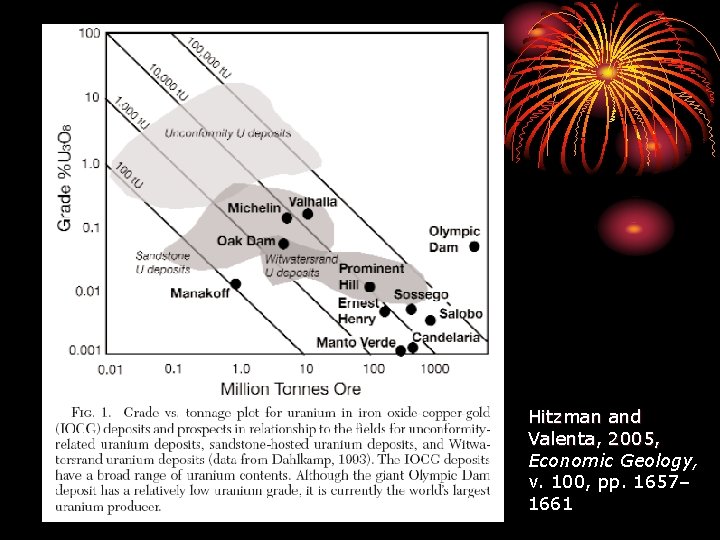
Hitzman and Valenta, 2005, Economic Geology, v. 100, pp. 1657– 1661
Unconformity-associated uranium deposits
Types of Unconformityassociated uranium deposits • Clay-bound Proterozoic unconformity • Strata-bound proterozoic unconformity • Phanerozoic unconformityrelated
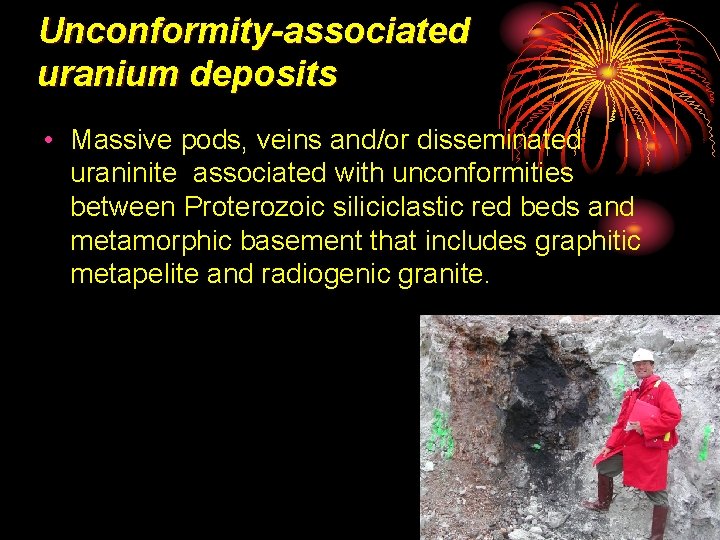
Unconformity-associated uranium deposits • Massive pods, veins and/or disseminated uraninite associated with unconformities between Proterozoic siliciclastic red beds and metamorphic basement that includes graphitic metapelite and radiogenic granite.
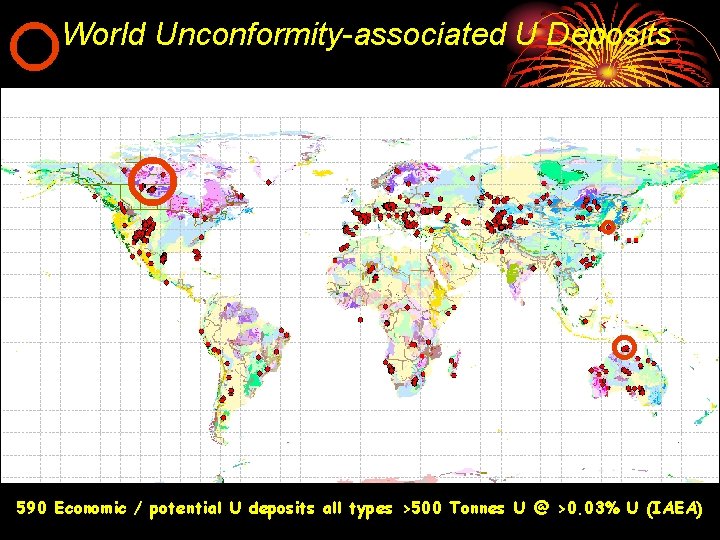
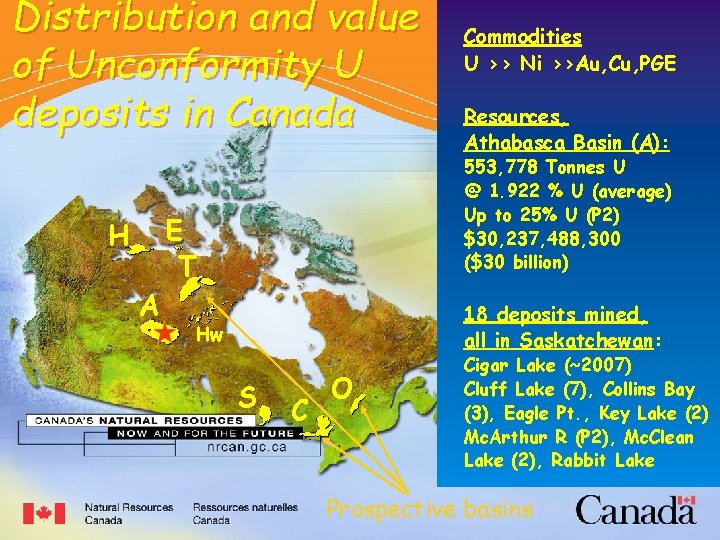
Unconformity-associated uranium deposits • Pitchblende fills extensional features in reactivated fault zones and replaces matrix in sandstone • One mining district in Canada – the Athabasca Basin - >30 deposits /prospects - most in eastern ¼ of basin - produces 1/3 of world’s U
World Unconformity-associated U Deposits 590 Economic / potential U deposits all types >500 Tonnes U @ >0. 03% U (IAEA)
Distribution and value of Unconformity U deposits in Canada H A Commodities U >> Ni >>Au, Cu, PGE Resources, Athabasca Basin (A): 553, 778 Tonnes U @ 1. 922 % U (average) Up to 25% U (P 2) $30, 237, 488, 300 ($30 billion) E T 18 deposits mined, all in Saskatchewan: Hw S C O Cigar Lake (~2007) Cluff Lake (7), Collins Bay (3), Eagle Pt. , Key Lake (2) Mc. Arthur R (P 2), Mc. Clean Lake (2), Rabbit Lake Prospective basins
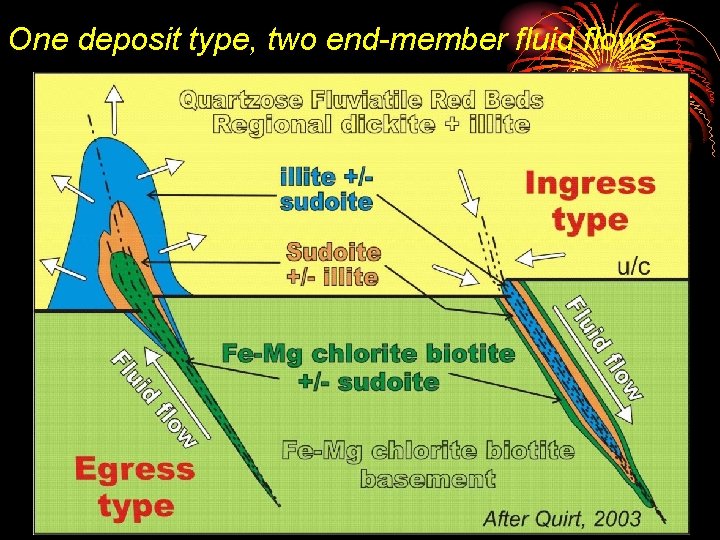
One deposit type, two end-member fluid flows
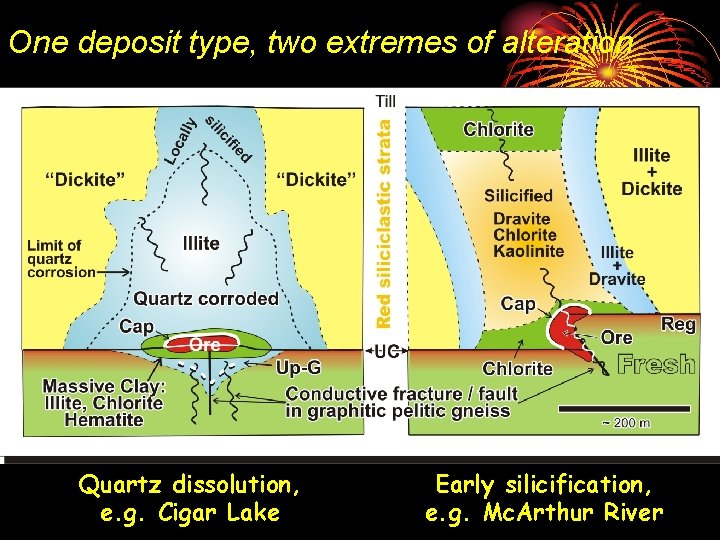
One deposit type, two extremes of alteration Quartz dissolution, e. g. Cigar Lake Early silicification, e. g. Mc. Arthur River
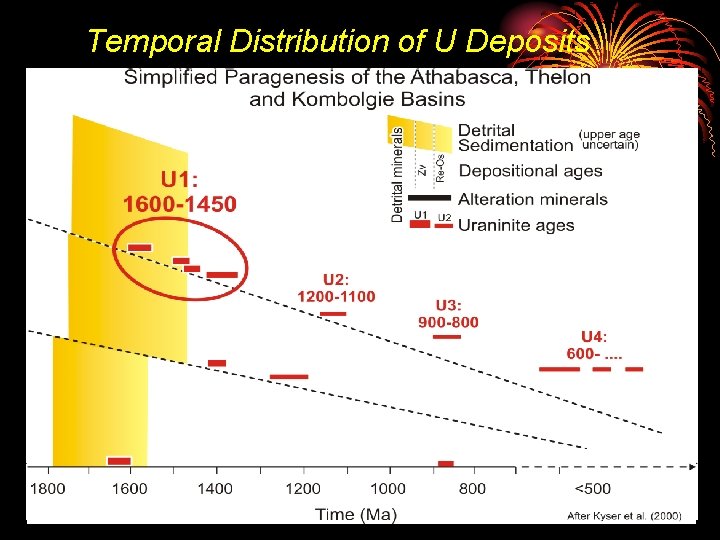
Temporal Distribution of U Deposits
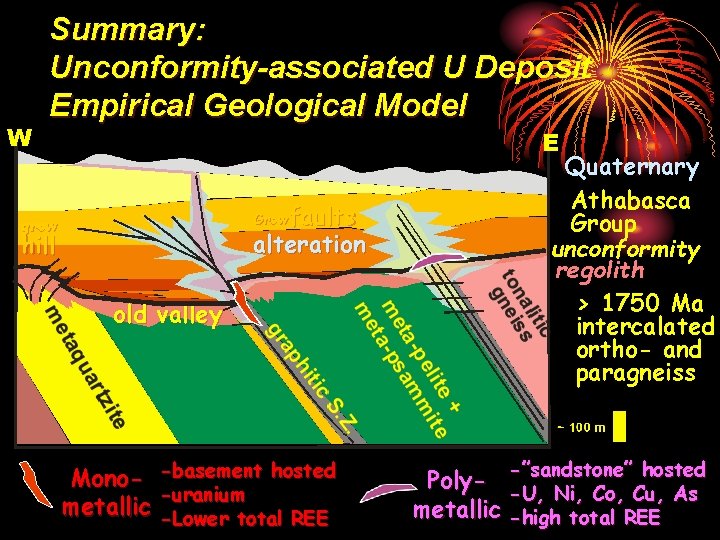
W Summary: Unconformity-associated U Deposit Empirical Geological Model E Quaternary Athabasca Group unconformity regolith > 1750 Ma intercalated ortho- and paragneiss faults alteration Grow grow hill old valley Mono- -basement hosted -uranium metallic -Lower total REE Polymetallic -”sandstone” hosted -U, Ni, Co, Cu, As -high total REE
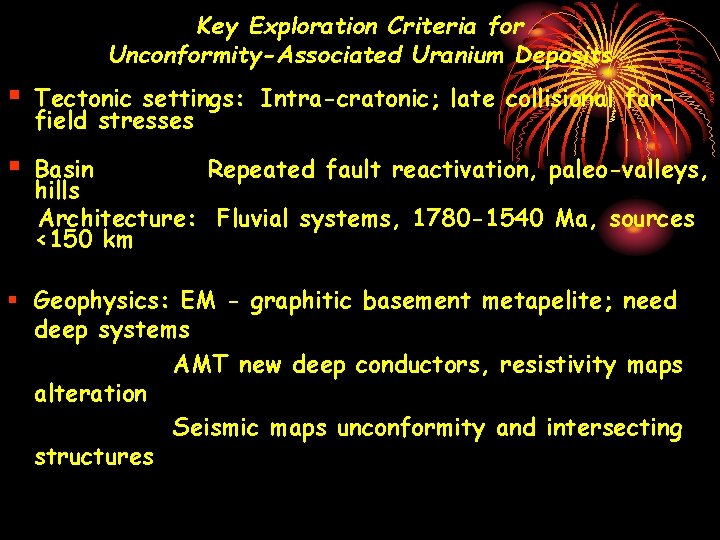
Key Exploration Criteria for Unconformity-Associated Uranium Deposits § Tectonic settings: Intra-cratonic; late collisional farfield stresses § Basin Repeated fault reactivation, paleo-valleys, hills Architecture: Fluvial systems, 1780 -1540 Ma, sources <150 km § Geophysics: EM - graphitic basement metapelite; need deep systems AMT new deep conductors, resistivity maps alteration Seismic maps unconformity and intersecting structures
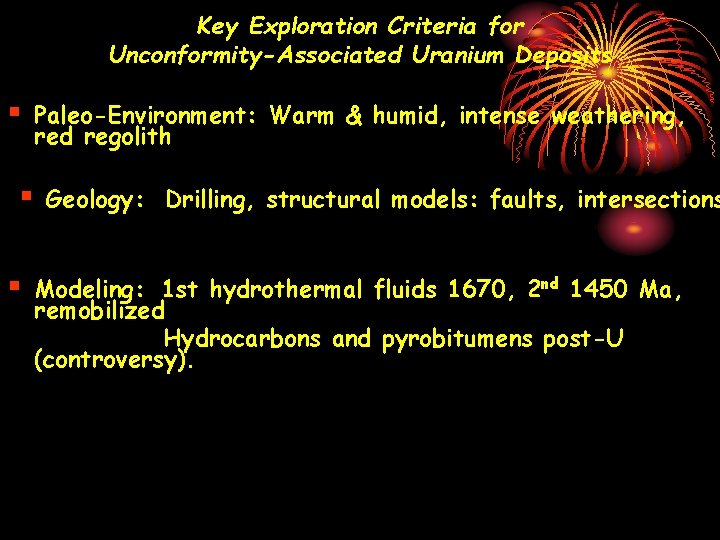
Key Exploration Criteria for Unconformity-Associated Uranium Deposits § § § Paleo-Environment: Warm & humid, intense weathering, red regolith Geology: Drilling, structural models: faults, intersections Modeling: 1 st hydrothermal fluids 1670, 2 nd 1450 Ma, remobilized Hydrocarbons and pyrobitumens post-U (controversy).
Major unconformity type deposits in the world • Athabasca Basin, Saskatchewan, Canada • Pine Creek Geosyncline, Northern Territory, Australia
SANDSTONE
Quartz-pebble conglomerate deposits
Quartz-pebble conglomerate deposits • Upper Archean to Lower Proterozoic age • consist of detrital ore minerals of uranium and other metals • pyrite • Interbedded within siliciclastic sequences containing layers of quartzite and argillite • mineralized conglomerates. • Blind River, uranium and rare earth elements base of the stratigraphic sequence above the unconformity. • In the Witwatersrand, uranium in multiple beds dispersed through a thick stratigraphic sequence and is recovered as a by-product of gold production.
Quartz-pebble conglomerate deposits • Blind River — Elliot Lake, Ontario, Canada • Witwatersrand, South Africa
Veins
Veins • lenses or sheets in joints, fractures, breccias or stockworks. • pitchblende and/or coffinite • Size veins varies • spatially related to granite • transect metamorphic or sedimentary rocks • Breccia complex uranium deposits
Breccia complex deposits Iron oxide-copper-gold (IOCG) deposits
Breccia complex deposits Iron oxide-copper-gold (IOCG) deposits • Olympic Dam deposit • hematite-rich granite breccia • iron, copper, uranium, gold, silver, rare earth elements (mainly lanthanum and cerium) and fluorine • hydraulic fracturing, tectonic faulting, chemical corrosion, and gravity collapse
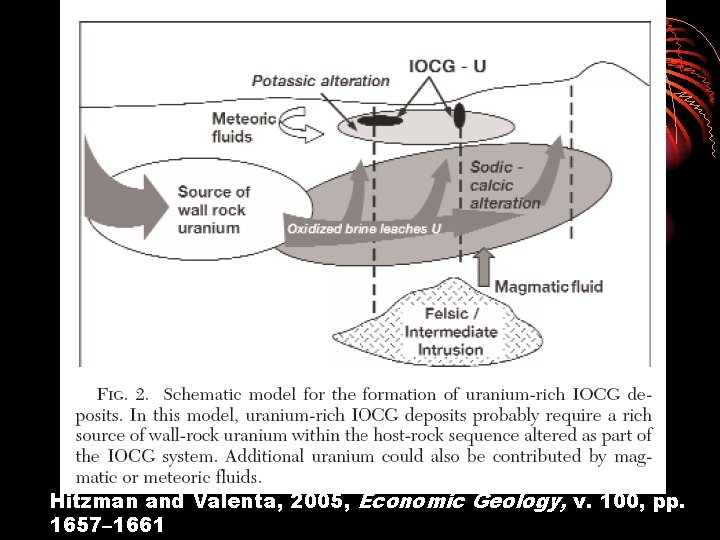
Hitzman and Valenta, 2005, Economic Geology, v. 100, pp. 1657– 1661
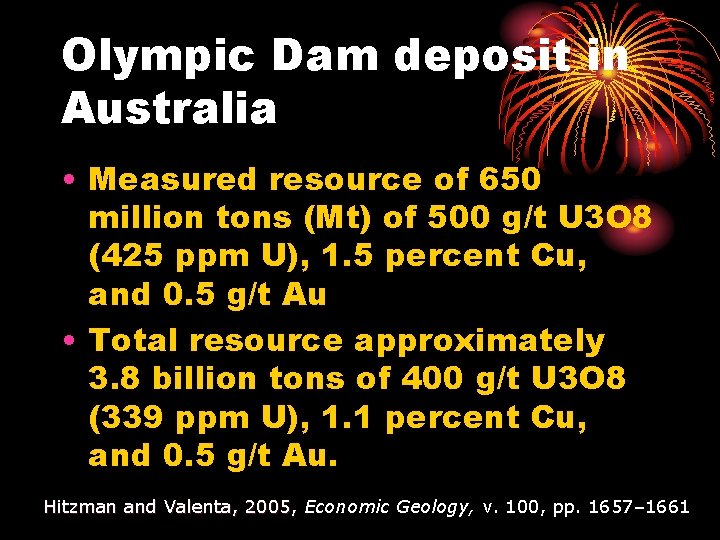
Olympic Dam deposit in Australia • Measured resource of 650 million tons (Mt) of 500 g/t U 3 O 8 (425 ppm U), 1. 5 percent Cu, and 0. 5 g/t Au • Total resource approximately 3. 8 billion tons of 400 g/t U 3 O 8 (339 ppm U), 1. 1 percent Cu, and 0. 5 g/t Au. Hitzman and Valenta, 2005, Economic Geology, v. 100, pp. 1657– 1661
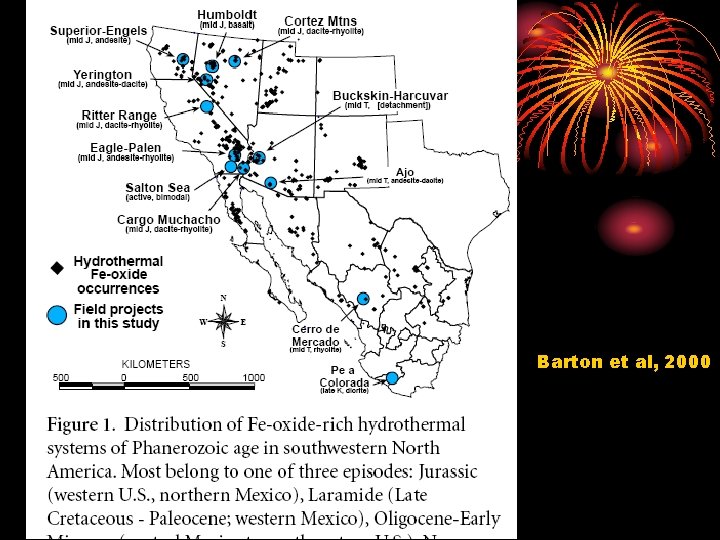
Barton et al, 2000
Surficial deposits
Surficial deposits • young (Tertiary to Recent) nearsurface uranium concentrations in sediments or soils • secondary cementing minerals including calcite, gypsum, dolomite, ferric oxide, and halite • uranyl minerals or adsorbed on other materials
Calcrete deposits • uranium-rich granites were deeply weathered in a semi-arid to arid climate • valley-fill sediments along Tertiary drainage channels, and in playa lake sediments • Lake Raeside, Australia
Volcanic deposits
Volcanic deposits • acid volcanic rocks and are related to faults and shear zones within the volcanics • commonly associated with molybdenum and fluorine
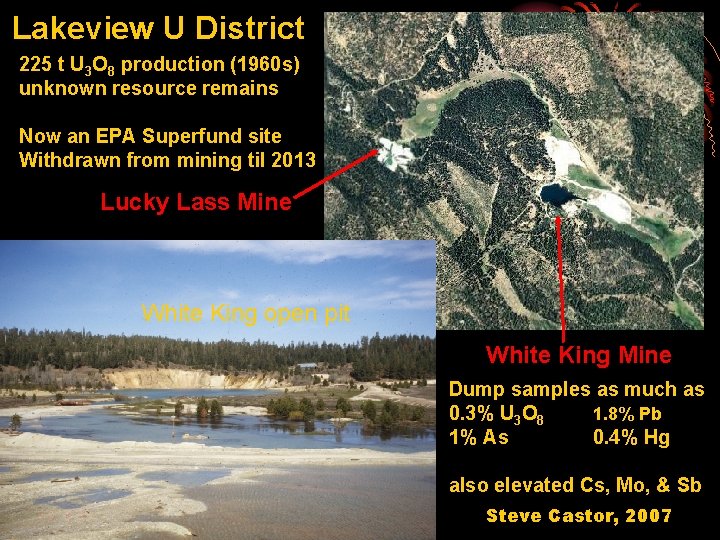
Lakeview U District 225 t U 3 O 8 production (1960 s) unknown resource remains Now an EPA Superfund site Withdrawn from mining til 2013 Lucky Lass Mine White King open pit White King Mine Dump samples as much as 0. 3% U 3 O 8 1. 8% Pb 1% As 0. 4% Hg also elevated Cs, Mo, & Sb Steve Castor, 2007
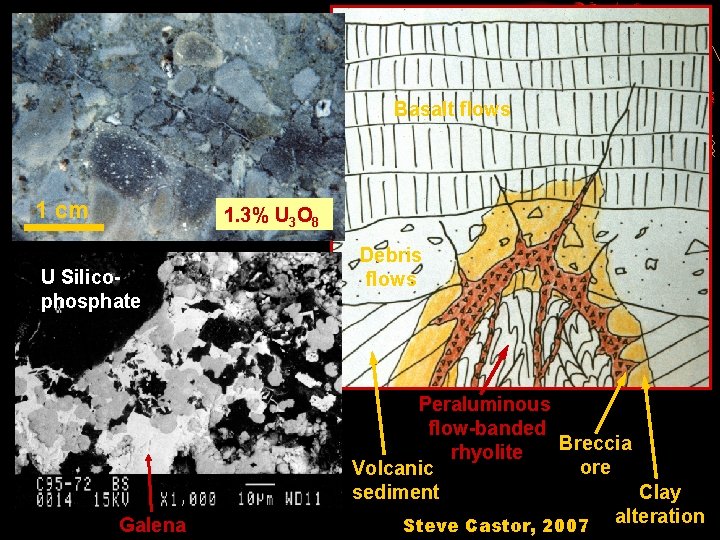
Basalt flows 1 cm 1. 3% U 3 O 8 U Silicophosphate Galena Debris flows Peraluminous flow-banded Breccia rhyolite ore Volcanic sediment Clay Steve Castor, 2007 alteration
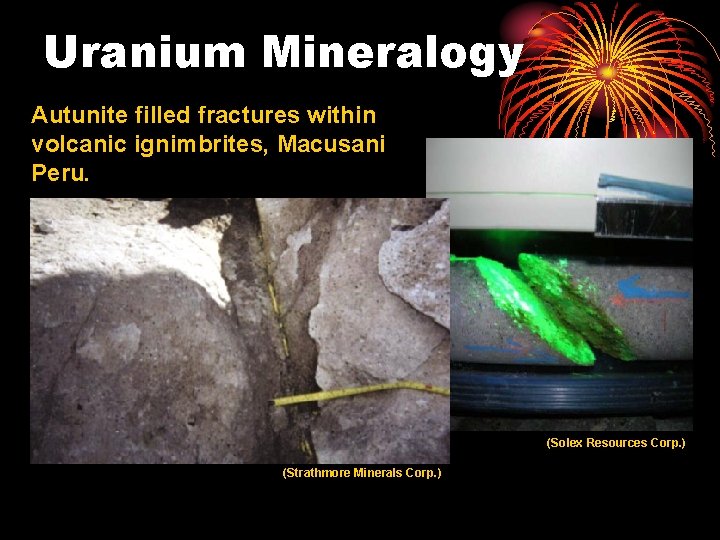
Uranium Mineralogy Autunite filled fractures within volcanic ignimbrites, Macusani Peru. (Solex Resources Corp. ) (Strathmore Minerals Corp. )
Intrusive deposits
Intrusive deposits • Alaskite • Rössing, Namibia • Granite, Monzonite • Bingham Canyon, Utah, USA • Pegmatite • Bancroft area, Ontario, Canada • Peralkaline syenite • Kvanefjeld, Greenland • Carbonatites • Phalaborwa, South Africa
Phosphorite
Phosphorite • fine-grained apatite in phosphorite horizons within interbedded marine muds, shales, carbonates and sandstones • primary bedded (Phosphoria Formation, Utah–Idaho) • sedimentologically reworked (Florida) phosphorite
Collapse breccia pipe
Collapse breccia pipe • Circular, vertical (up to 1000 metres in vertical extent) pipes filled with down-dropped coarse and fine fragments stopped from the overlying sediments • Mineralized pipes range from 30 to 200 metres in diameter • Orphan mine, Arizona, USA
What are the major uranium deposit types in North America?
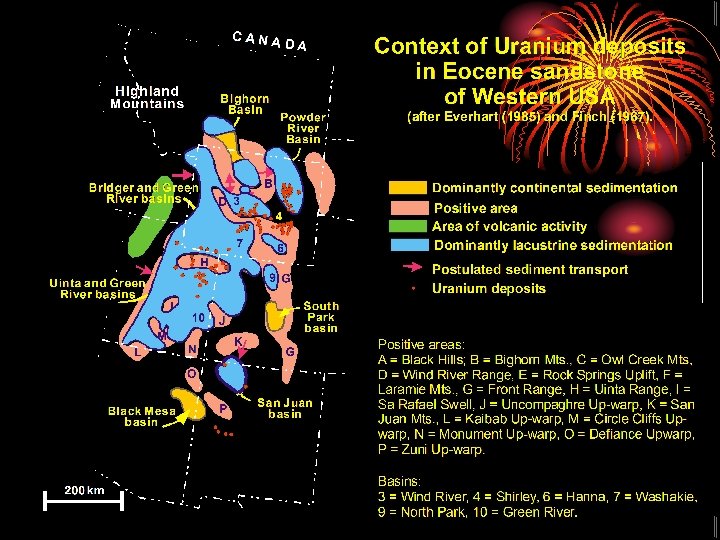
Major Uranium Deposit Types – North America • Unconformity • Athabasca Basin, Saskatchewan and Thelon Basin, NWT • Sandstone • Intermountain basins of Wyoming; Colorado Plateau; Gulf Coast Plain of Texas; Grants Mineral Belt, New Mexico • Breccia Pipes • Northern Arizona • Quartz-pebble conglomerate • Elliot Lake