
Types of Transformations Reflections These are like mirror

- Slides: 11
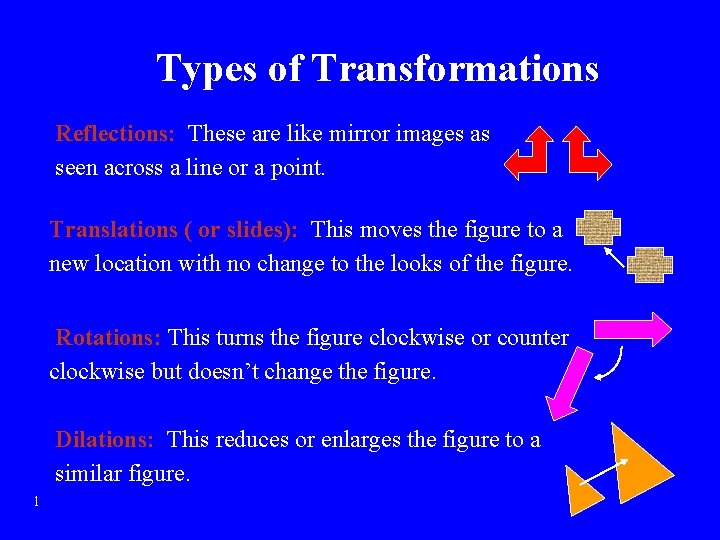
Types of Transformations Reflections: These are like mirror images as seen across a line or a point. Translations ( or slides): This moves the figure to a new location with no change to the looks of the figure. Rotations: This turns the figure clockwise or counter clockwise but doesn’t change the figure. Dilations: This reduces or enlarges the figure to a similar figure. 1
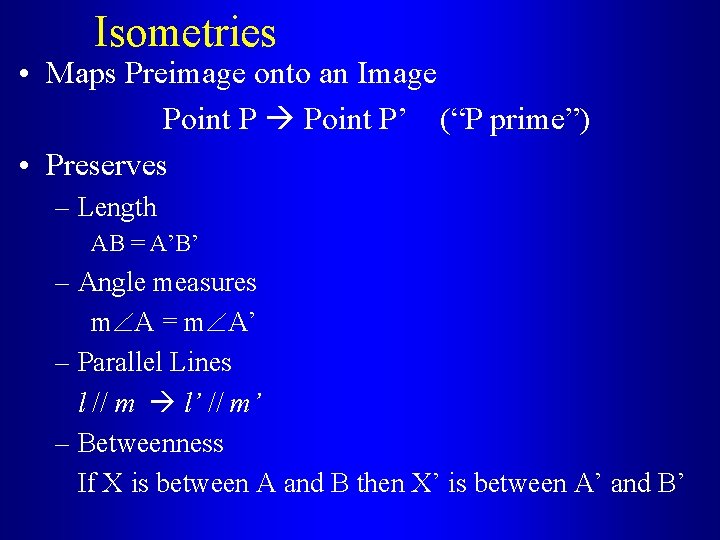
Isometries • Maps Preimage onto an Image Point P’ (“P prime”) • Preserves – Length AB = A’B’ – Angle measures m A = m A’ – Parallel Lines l // m l’ // m’ – Betweenness If X is between A and B then X’ is between A’ and B’
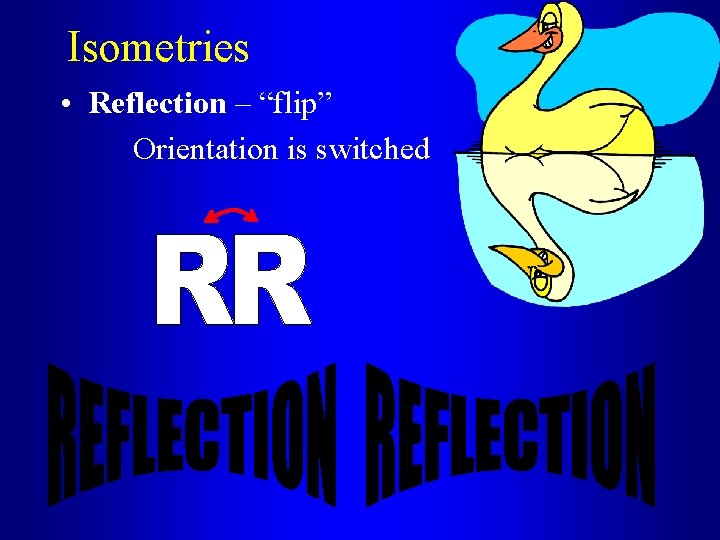
Isometries • Reflection – “flip” Orientation is switched
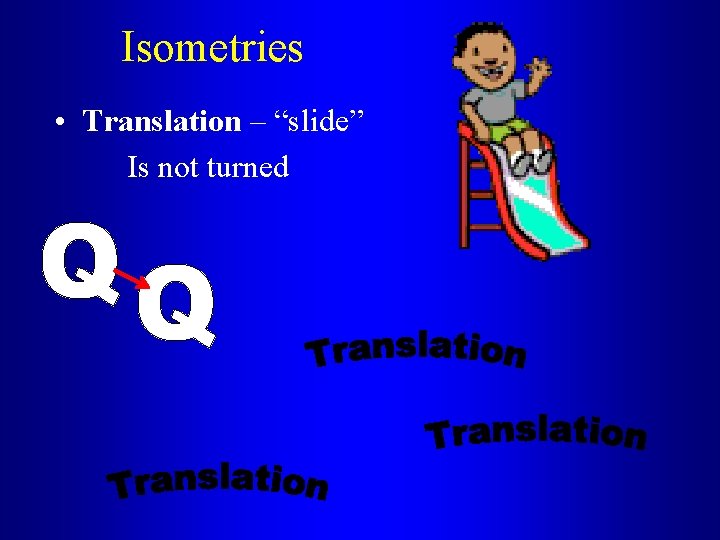
Isometries • Translation – “slide” Is not turned
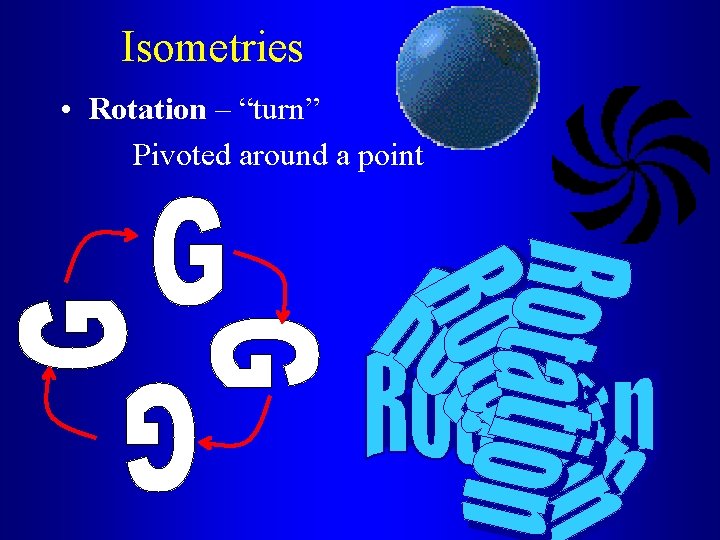
Isometries • Rotation – “turn” Pivoted around a point
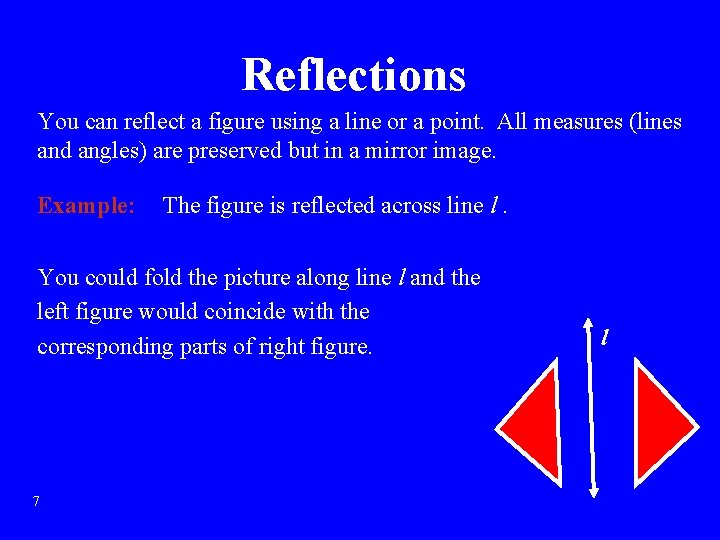
Reflections You can reflect a figure using a line or a point. All measures (lines and angles) are preserved but in a mirror image. Example: The figure is reflected across line l. You could fold the picture along line l and the left figure would coincide with the corresponding parts of right figure. 7 l
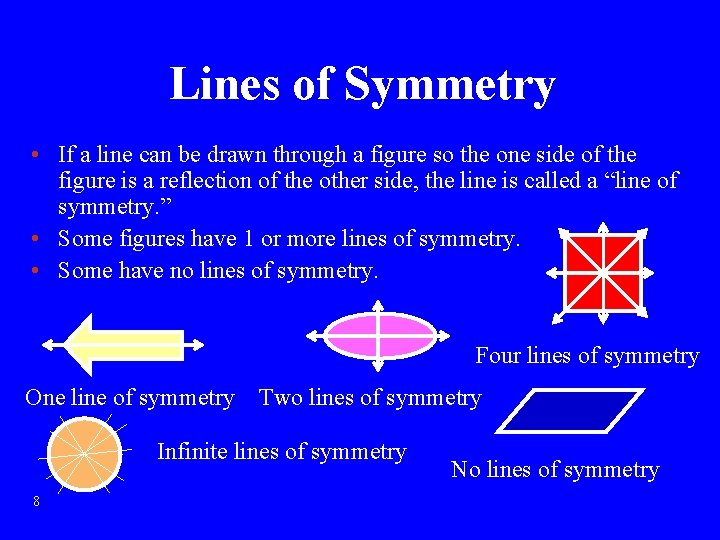
Lines of Symmetry • If a line can be drawn through a figure so the one side of the figure is a reflection of the other side, the line is called a “line of symmetry. ” • Some figures have 1 or more lines of symmetry. • Some have no lines of symmetry. Four lines of symmetry One line of symmetry Two lines of symmetry Infinite lines of symmetry 8 No lines of symmetry
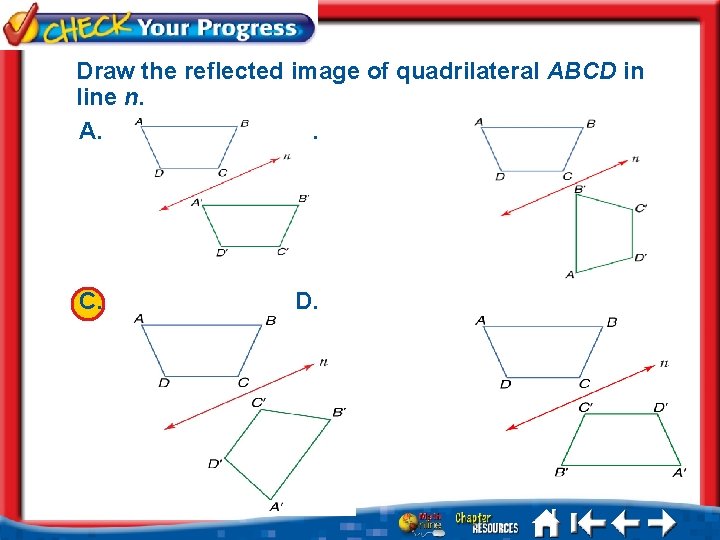
Draw the reflected image of quadrilateral ABCD in line n. A. B. C. D. A. B. C. D. A B C D
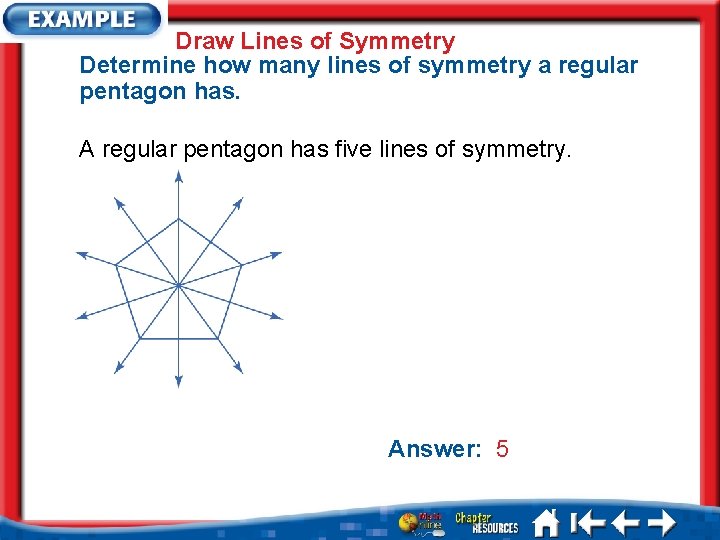
Draw Lines of Symmetry Determine how many lines of symmetry a regular pentagon has. A regular pentagon has five lines of symmetry. Answer: 5
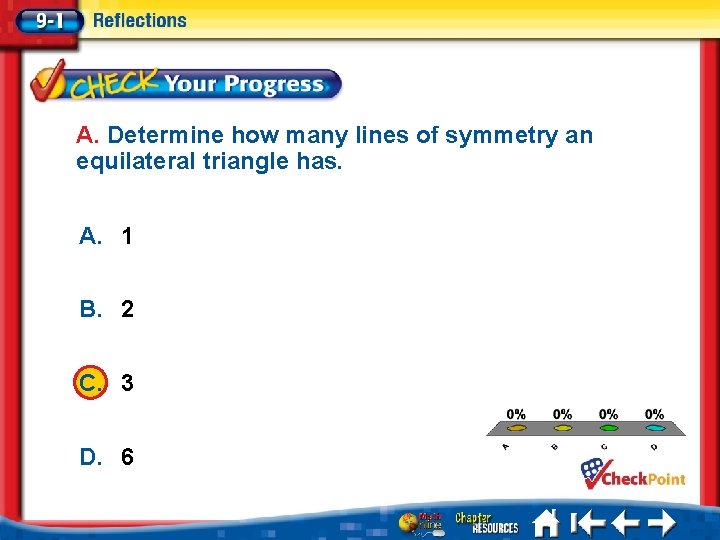
A. Determine how many lines of symmetry an equilateral triangle has. A. 1 B. 2 C. 3 D. 6 A. B. C. D. A B C D