
Types of table setting Types of cutlery glasses
Types of table setting Types of cutlery, glasses and tableware
Table covering with tableware • Depending on the types of meals and services offered, we have different types of cover • The place setting consists of all the necessary cutlery, dishes, glass and table linen required for the meal
When organizing a party, we must remember to place the place setting on the table. The table setting (from the French couvert) is all the items that we set on the table before the arrival of guests. It includes: cutlery, napkins, glass, possibly vignettes and some dishes. Depending on the menu and the type of party - two types of arrangement of the covering can be distinguished, i. e. basic covering and extended covering. The same principle applies in both types of table setting. The decorative plate (or pad) on which we place the tableware sets the center of the entire cover. Cutlery is always arranged from the inside out in the order of meals. Therefore, those from which food begins should be furthest away from the plate. Knives and spoons are placed on the right and forks on the left.
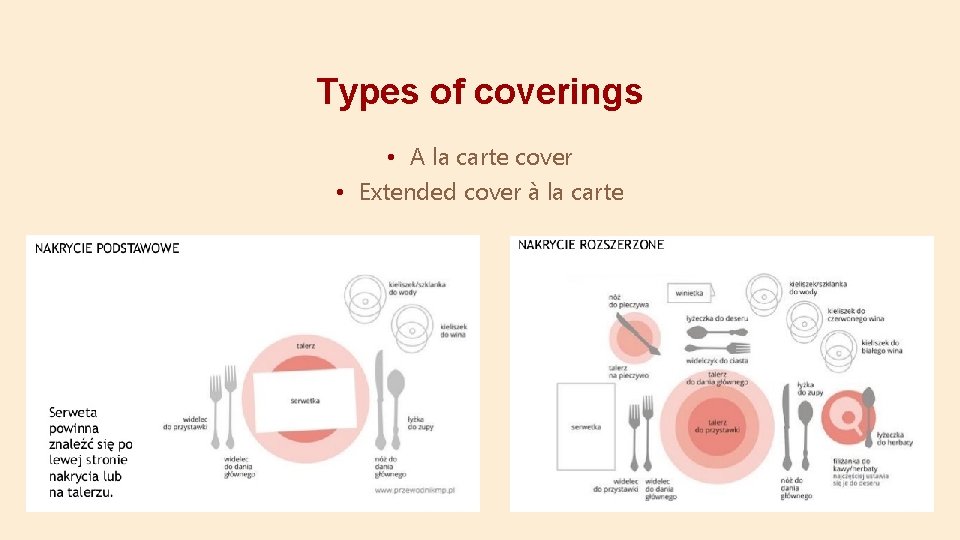
Types of coverings • A la carte cover • Extended cover à la carte
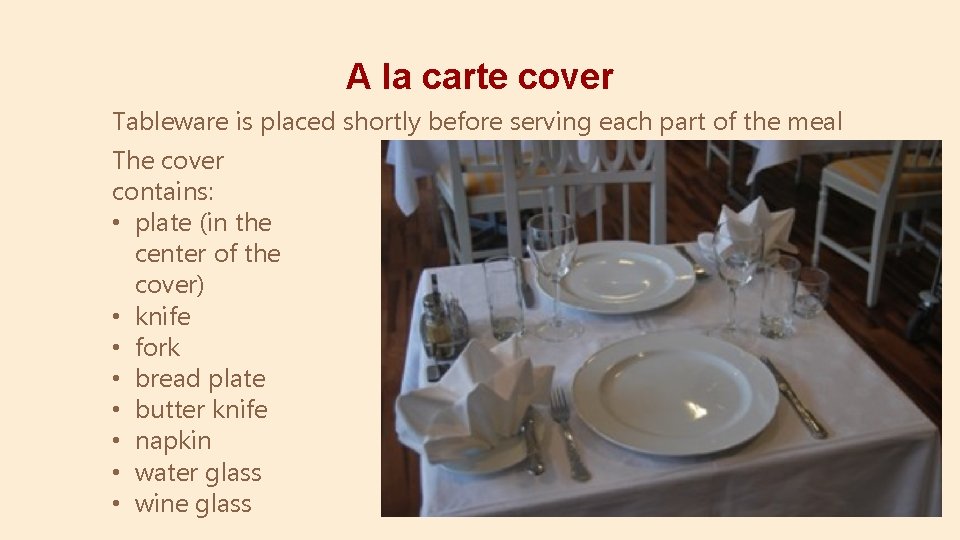
A la carte cover Tableware is placed shortly before serving each part of the meal The cover contains: • plate (in the center of the cover) • knife • fork • bread plate • butter knife • napkin • water glass • wine glass
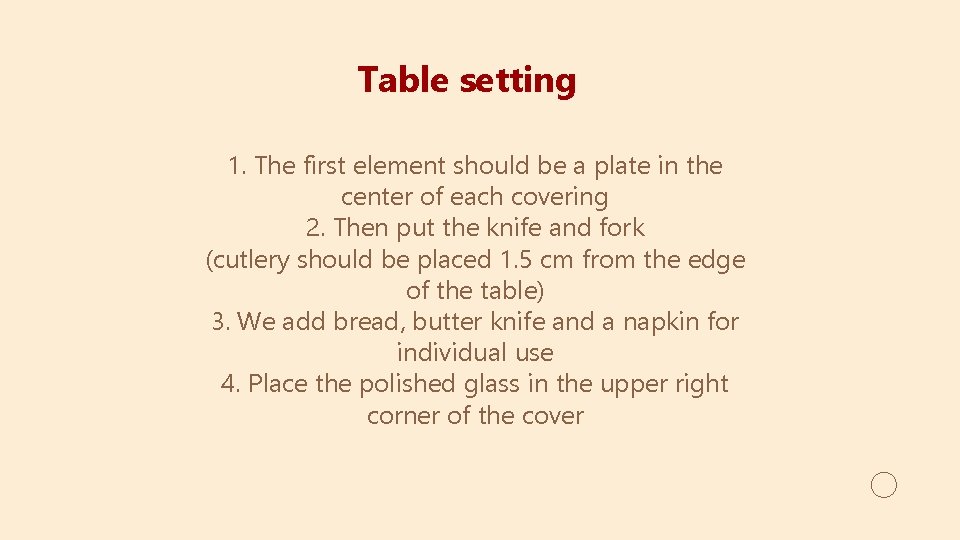
Table setting 1. The first element should be a plate in the center of each covering 2. Then put the knife and fork (cutlery should be placed 1. 5 cm from the edge of the table) 3. We add bread, butter knife and a napkin for individual use 4. Place the polished glass in the upper right corner of the cover
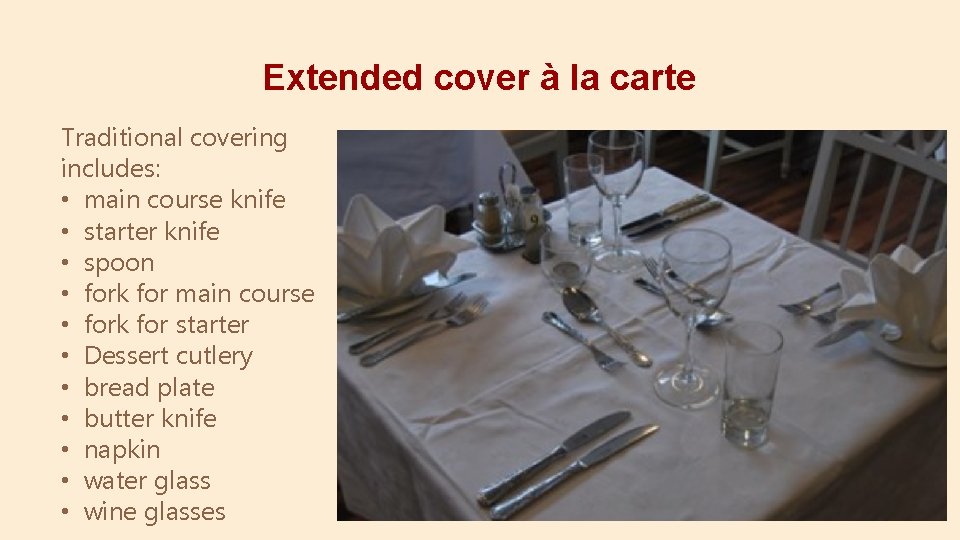
Extended cover à la carte Traditional covering includes: • main course knife • starter knife • spoon • fork for main course • fork for starter • Dessert cutlery • bread plate • butter knife • napkin • water glass • wine glasses 7
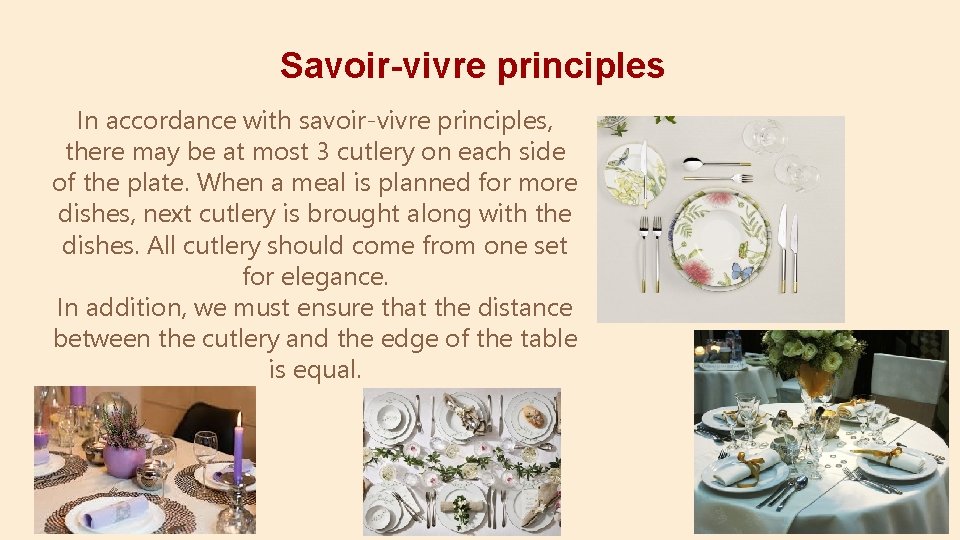
Savoir-vivre principles In accordance with savoir-vivre principles, there may be at most 3 cutlery on each side of the plate. When a meal is planned for more dishes, next cutlery is brought along with the dishes. All cutlery should come from one set for elegance. In addition, we must ensure that the distance between the cutlery and the edge of the table is equal. 8

Glass setting The glass is placed in one group, on the right, i. e. above the knife.
Types of glasses Red wine glasses Glasses dedicated to serving red wines are always bigger and higher than those for white wines. Their bowl is more bulky. White wine glasses White wine is served in long-stemmed glasses, but smaller than red wine glasses. Rose wine glasses Pink wine is a typical dessert, light drink. The serving glass will certainly have the smallest capacity of all types of wine glasses. The canopy can roll gently upwards (in the shape of a tulip) or close upwards. Water glasses The water glass, or goblet, will be the largest in terms of size and capacity. The squat canopy is set on a relatively low leg. Canopy can also take other shapes than round. Champagne glasses Champagne and sparkling wines are alcohols that should be served chilled. Hence, a glass shape special for this type of drink was forced - slim, tall, narrow.
Shot glasses Vodka glasses cannot be mistaken for others. They are distinguished by their small size and appropriate capacity, usually 25, 40 or 50 ml. They may have a short leg, but are often quite lacking - shot glasses look like miniature glasses. Liqueur and tincture glasses It happens that they are confused with vodka glasses. They are very similar to them, usually differ only in larger capacity. The narrow and relatively small bowl is set on a high leg. Cognac glasses Cognac is a strong, masculine drink that requires serving in the right glass to bring out its full flavor. A cognac and brandy glass is also called a napoleon glass. It has a large, bulky bowl that allows free hand adjustment and a short leg. Whiskey glass The whiskey also has the nickname male alcohol. It is served chilled, often with ice cubes, in whiskey glasses - low and wide, with a capacity of about 300 ml. The shape of the glass is intended to help maintain an appropriate temperature of the drink. Beer glasses and glasses Beer can be served in beer glasses or in pokal, i. e. glasses specially designed for this purpose. Pokal is distinguished by a large-volume and slim canopy, usually rolled up in the shape of a tulip, and a low leg. Pokale and beer glasses can be found most often in two capacities: 300 or 500 ml.

12
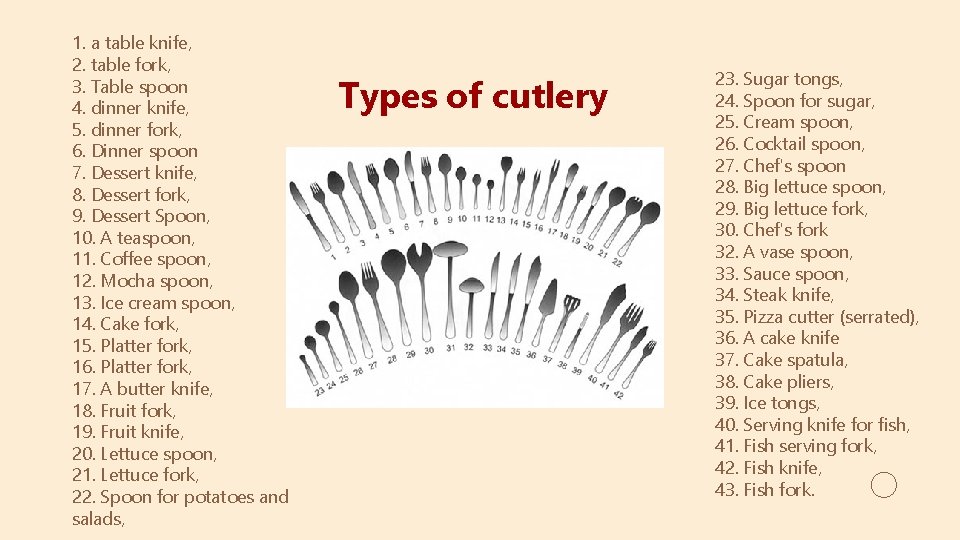
1. a table knife, 2. table fork, 3. Table spoon 4. dinner knife, 5. dinner fork, 6. Dinner spoon 7. Dessert knife, 8. Dessert fork, 9. Dessert Spoon, 10. A teaspoon, 11. Coffee spoon, 12. Mocha spoon, 13. Ice cream spoon, 14. Cake fork, 15. Platter fork, 16. Platter fork, 17. A butter knife, 18. Fruit fork, 19. Fruit knife, 20. Lettuce spoon, 21. Lettuce fork, 22. Spoon for potatoes and salads, Types of cutlery 23. Sugar tongs, 24. Spoon for sugar, 25. Cream spoon, 26. Cocktail spoon, 27. Chef's spoon 28. Big lettuce spoon, 29. Big lettuce fork, 30. Chef's fork 32. A vase spoon, 33. Sauce spoon, 34. Steak knife, 35. Pizza cutter (serrated), 36. A cake knife 37. Cake spatula, 38. Cake pliers, 39. Ice tongs, 40. Serving knife for fish, 41. Fish serving fork, 42. Fish knife, 43. Fish fork.
Prepared and developed Magdalena Warwas kl. 4 EKe
- Slides: 14