
Types of Solutes Electrolytes and NonElectrolytes Solutes Solutes
- Slides: 23
Types of Solutes Electrolytes and Non-Electrolytes
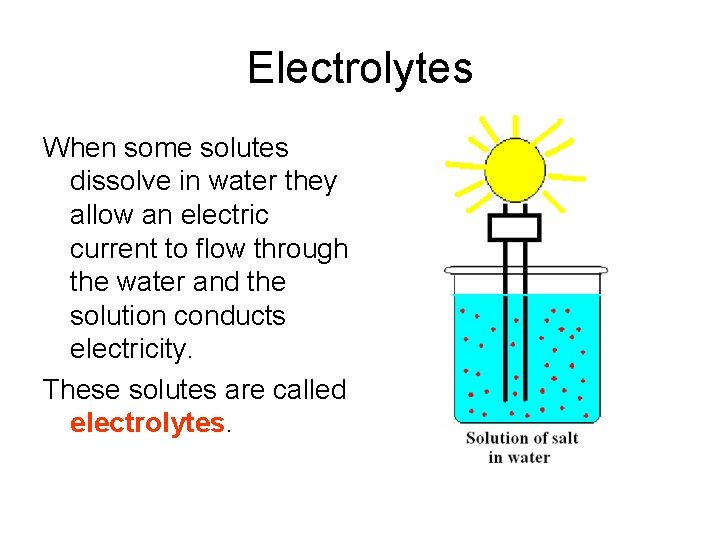
Solutes • Solutes that dissolve to form solutions that conduct electricity are called electrolytes. • Solutes that dissolve to form solutions that don’t conduct electricity are called nonelectrolytes.
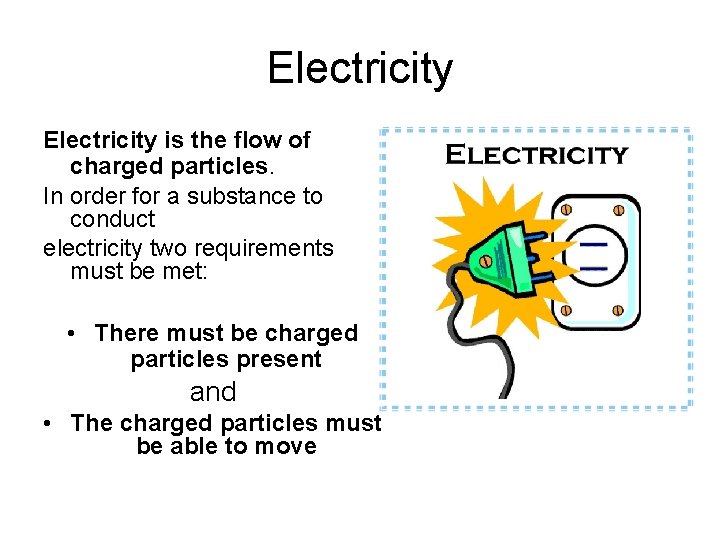
Electricity is the flow of charged particles. In order for a substance to conduct electricity two requirements must be met: • There must be charged particles present and • The charged particles must be able to move
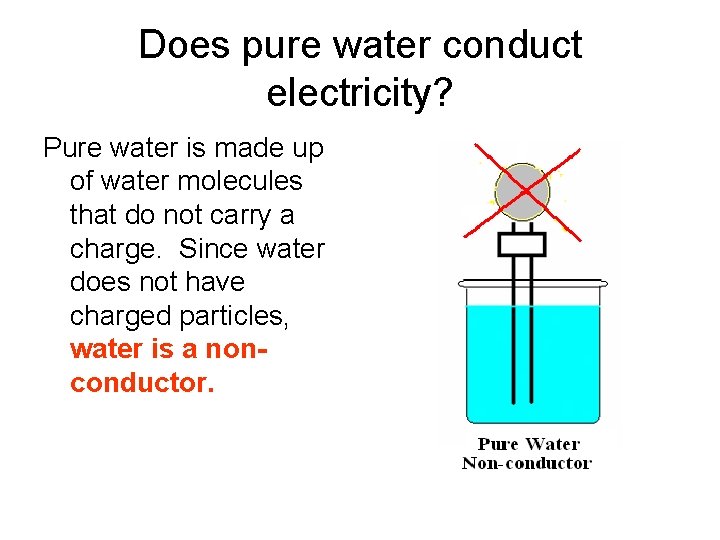
Does pure water conduct electricity? Pure water is made up of water molecules that do not carry a charge. Since water does not have charged particles, water is a nonconductor.
Electrolytes When some solutes dissolve in water they allow an electric current to flow through the water and the solution conducts electricity. These solutes are called electrolytes.
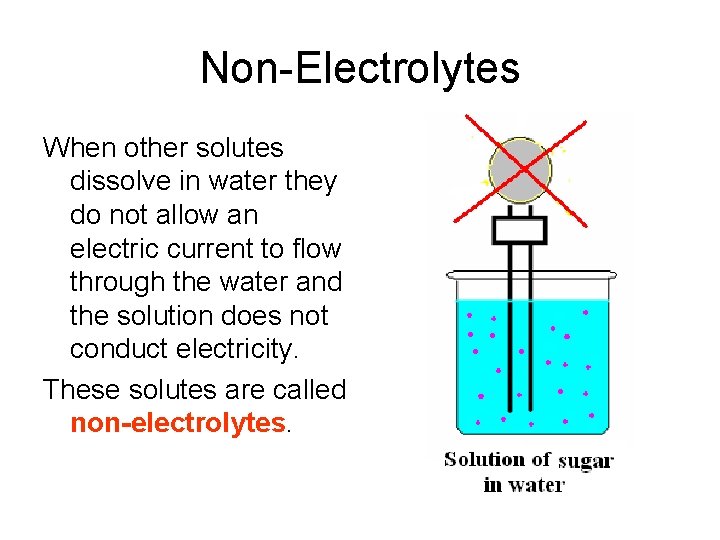
Non-Electrolytes When other solutes dissolve in water they do not allow an electric current to flow through the water and the solution does not conduct electricity. These solutes are called non-electrolytes.
Why Do Solutes Behave Differently? Theory of Ionization explains this behavior. It states that some solutes dissolve to form charged particles in solution while others dissolve to form neutral molecules in solution.
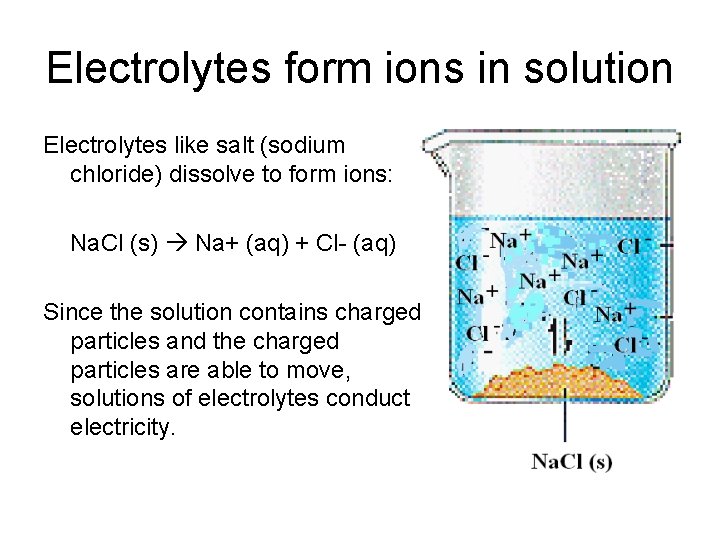
Electrolytes form ions in solution Electrolytes like salt (sodium chloride) dissolve to form ions: Na. Cl (s) Na+ (aq) + Cl- (aq) Since the solution contains charged particles and the charged particles are able to move, solutions of electrolytes conduct electricity.
Non-electrolytes form molecules in solution Non-electrolytes like sugar dissolve to form molecules in solution. C 6 H 12 O 6 (s) C 6 H 12 O 6 (aq) Since there are no charged particles present, solutions of non-electrolytes are not able to conduct electricity.
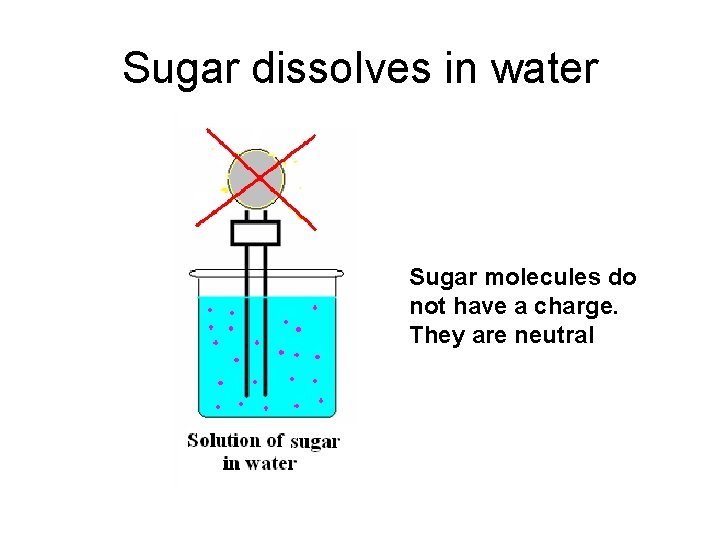
Sugar dissolves in water Sugar molecules do not have a charge. They are neutral
Electrolytes & Colligative Properties In the last chapter we learned that adding solute to a solvent had three effects: 1. It lowered the vapor pressure of the solvent 2. It lowered the freezing point of the solution 3. It raised the boiling point of the solution
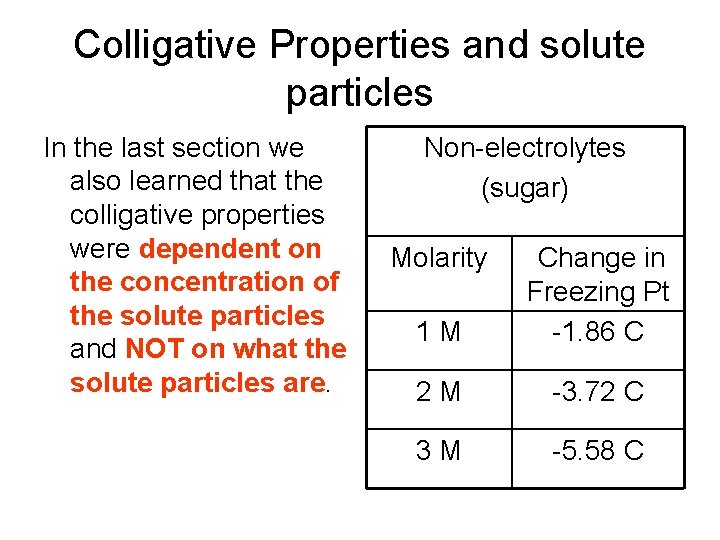
Colligative Properties and solute particles In the last section we also learned that the colligative properties were dependent on the concentration of the solute particles and NOT on what the solute particles are. Non-electrolytes (sugar) Molarity 1 M Change in Freezing Pt -1. 86 C 2 M -3. 72 C 3 M -5. 58 C
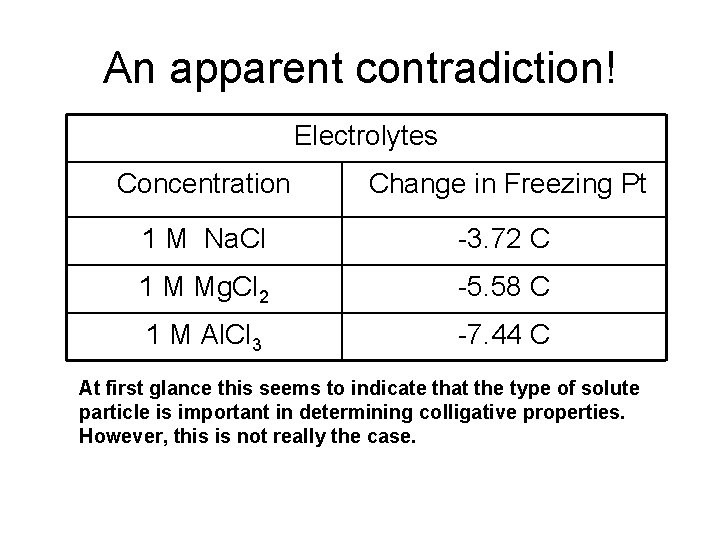
An apparent contradiction! Electrolytes Concentration Change in Freezing Pt 1 M Na. Cl -3. 72 C 1 M Mg. Cl 2 -5. 58 C 1 M Al. Cl 3 -7. 44 C At first glance this seems to indicate that the type of solute particle is important in determining colligative properties. However, this is not really the case.
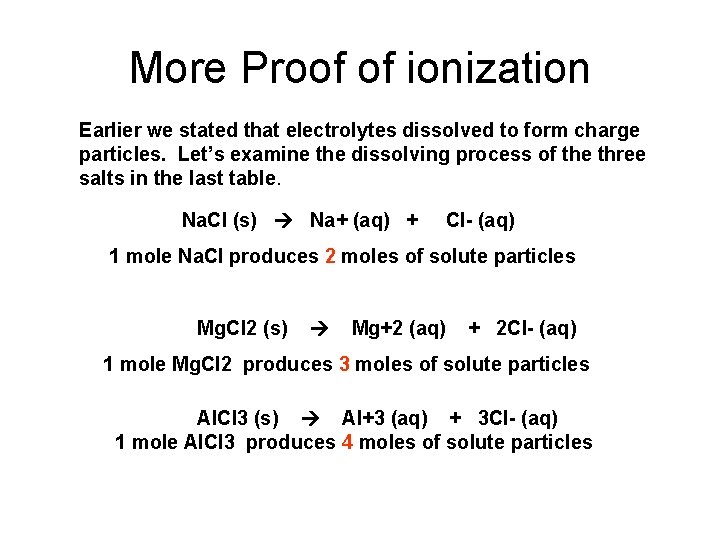
More Proof of ionization Earlier we stated that electrolytes dissolved to form charge particles. Let’s examine the dissolving process of the three salts in the last table. Na. Cl (s) Na+ (aq) + Cl- (aq) 1 mole Na. Cl produces 2 moles of solute particles Mg. Cl 2 (s) Mg+2 (aq) + 2 Cl- (aq) 1 mole Mg. Cl 2 produces 3 moles of solute particles Al. Cl 3 (s) Al+3 (aq) + 3 Cl- (aq) 1 mole Al. Cl 3 produces 4 moles of solute particles
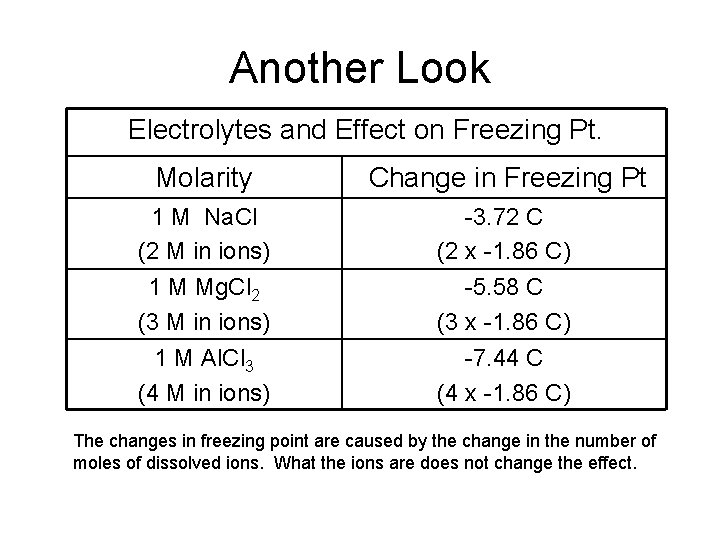
Another Look Electrolytes and Effect on Freezing Pt. Molarity Change in Freezing Pt 1 M Na. Cl (2 M in ions) -3. 72 C (2 x -1. 86 C) 1 M Mg. Cl 2 (3 M in ions) 1 M Al. Cl 3 (4 M in ions) -5. 58 C (3 x -1. 86 C) -7. 44 C (4 x -1. 86 C) The changes in freezing point are caused by the change in the number of moles of dissolved ions. What the ions are does not change the effect.
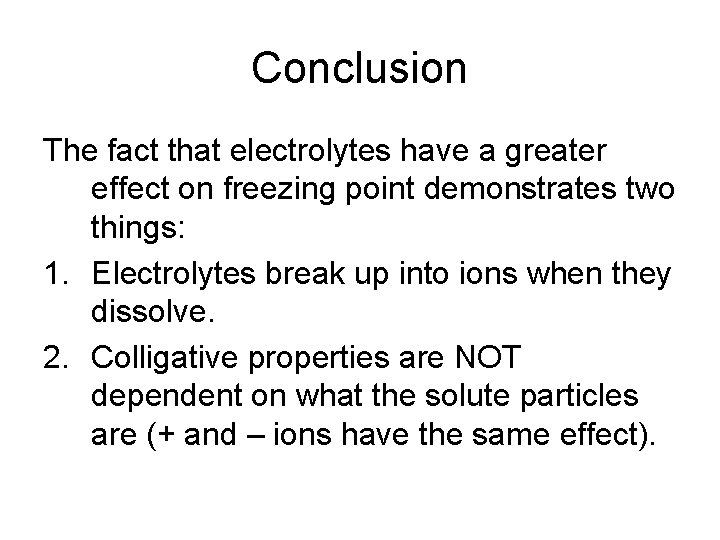
Conclusion The fact that electrolytes have a greater effect on freezing point demonstrates two things: 1. Electrolytes break up into ions when they dissolve. 2. Colligative properties are NOT dependent on what the solute particles are (+ and – ions have the same effect).
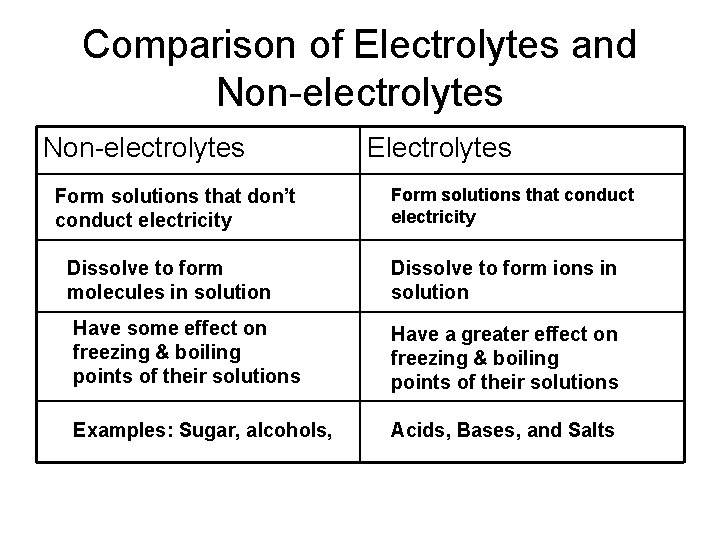
Comparison of Electrolytes and Non-electrolytes Form solutions that don’t conduct electricity Electrolytes Form solutions that conduct electricity Dissolve to form molecules in solution Dissolve to form ions in solution Have some effect on freezing & boiling points of their solutions Have a greater effect on freezing & boiling points of their solutions Examples: Sugar, alcohols, Acids, Bases, and Salts
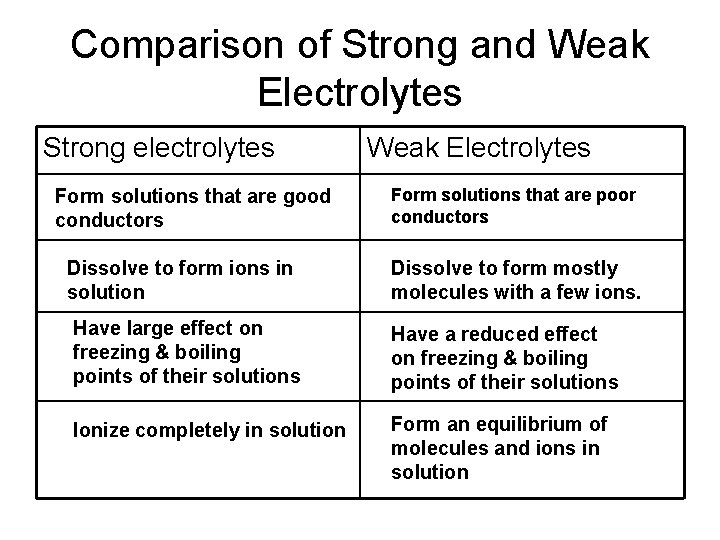
Two Types of Electrolytes All electrolytes break up to form charged particles in solution. However, not all electrolytes have the same properties. This has led chemists to define: 1. Strong electrolytes 2. Weak electrolytes
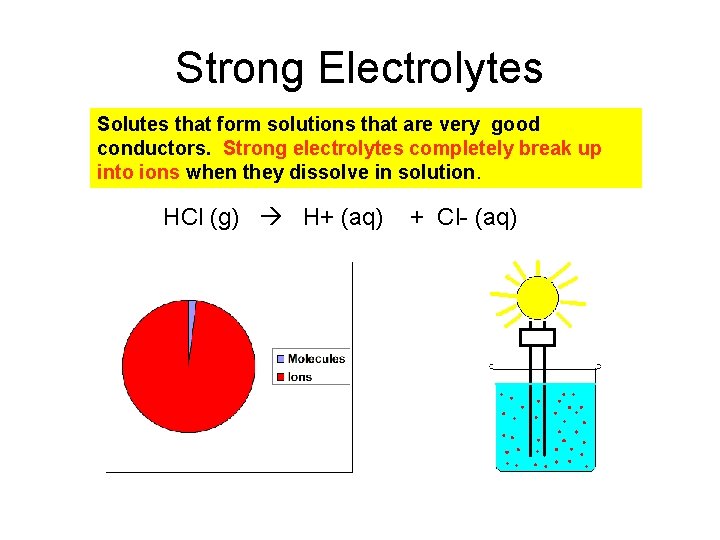
Strong Electrolytes Solutes that form solutions that are very good conductors. Strong electrolytes completely break up into ions when they dissolve in solution. HCl (g) H+ (aq) + Cl- (aq)
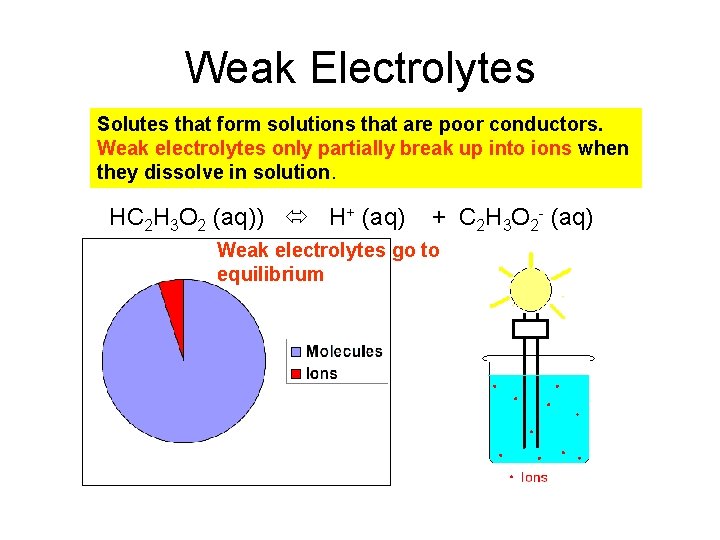
Weak Electrolytes Solutes that form solutions that are poor conductors. Weak electrolytes only partially break up into ions when they dissolve in solution. HC 2 H 3 O 2 (aq)) H+ (aq) + C 2 H 3 O 2 - (aq) Weak electrolytes go to equilibrium
Comparison of Strong and Weak Electrolytes Strong electrolytes Form solutions that are good conductors Weak Electrolytes Form solutions that are poor conductors Dissolve to form ions in solution Dissolve to form mostly molecules with a few ions. Have large effect on freezing & boiling points of their solutions Have a reduced effect on freezing & boiling points of their solutions Ionize completely in solution Form an equilibrium of molecules and ions in solution
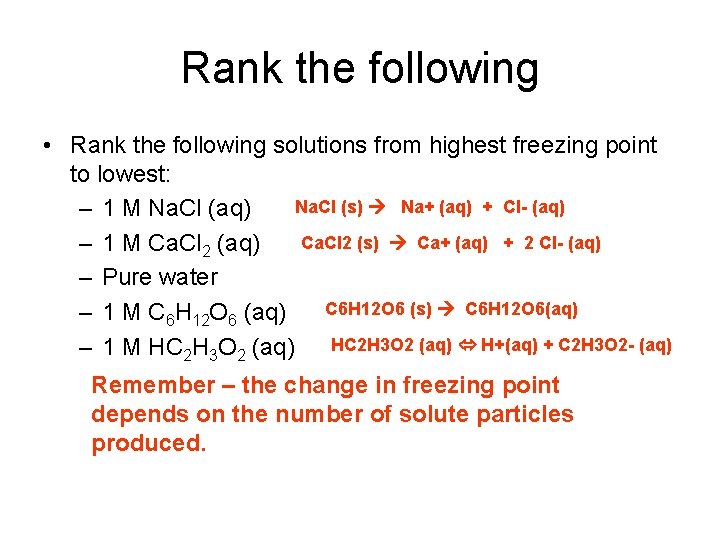
Rank the following • Rank the following solutions from highest freezing point to lowest: Na. Cl (s) Na+ (aq) + Cl- (aq) – 1 M Na. Cl (aq) Ca. Cl 2 (s) Ca+ (aq) + 2 Cl- (aq) – 1 M Ca. Cl 2 (aq) – Pure water C 6 H 12 O 6 (s) C 6 H 12 O 6(aq) – 1 M C 6 H 12 O 6 (aq) – 1 M HC 2 H 3 O 2 (aq) H+(aq) + C 2 H 3 O 2 - (aq) Remember – the change in freezing point depends on the number of solute particles produced.
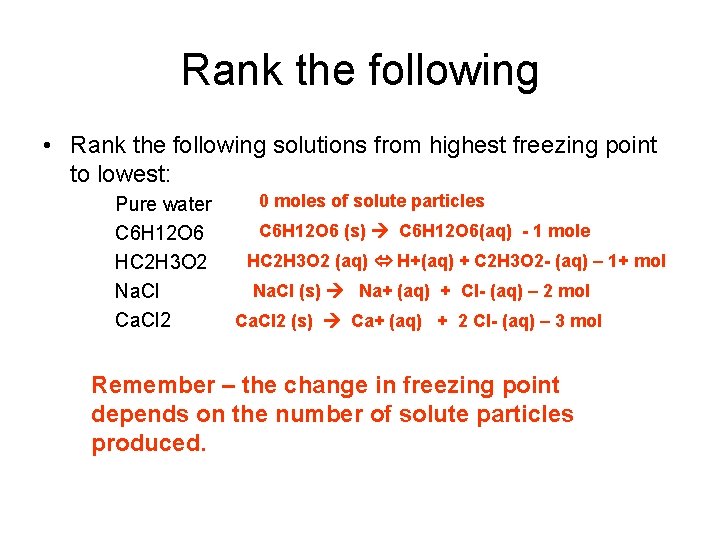
Rank the following • Rank the following solutions from highest freezing point to lowest: Pure water C 6 H 12 O 6 HC 2 H 3 O 2 Na. Cl Ca. Cl 2 0 moles of solute particles C 6 H 12 O 6 (s) C 6 H 12 O 6(aq) - 1 mole HC 2 H 3 O 2 (aq) H+(aq) + C 2 H 3 O 2 - (aq) – 1+ mol Na. Cl (s) Na+ (aq) + Cl- (aq) – 2 mol Ca. Cl 2 (s) Ca+ (aq) + 2 Cl- (aq) – 3 mol Remember – the change in freezing point depends on the number of solute particles produced.