
Types of Solids Worksheet Solutions Determine if the
- Slides: 2
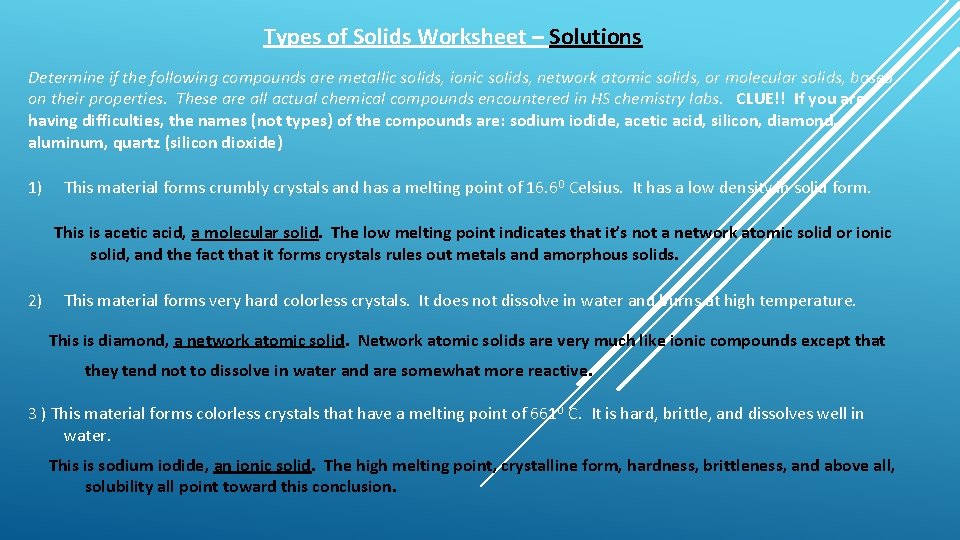
Types of Solids Worksheet – Solutions Determine if the following compounds are metallic solids, ionic solids, network atomic solids, or molecular solids, based on their properties. These are all actual chemical compounds encountered in HS chemistry labs. CLUE!! If you are having difficulties, the names (not types) of the compounds are: sodium iodide, acetic acid, silicon, diamond, aluminum, quartz (silicon dioxide) 1) This material forms crumbly crystals and has a melting point of 16. 60 Celsius. It has a low density in solid form. This is acetic acid, a molecular solid. The low melting point indicates that it’s not a network atomic solid or ionic solid, and the fact that it forms crystals rules out metals and amorphous solids. 2) This material forms very hard colorless crystals. It does not dissolve in water and burns at high temperature. This is diamond, a network atomic solid. Network atomic solids are very much like ionic compounds except that they tend not to dissolve in water and are somewhat more reactive. 3 ) This material forms colorless crystals that have a melting point of 661 0 C. It is hard, brittle, and dissolves well in water. This is sodium iodide, an ionic solid. The high melting point, crystalline form, hardness, brittleness, and above all, solubility all point toward this conclusion.
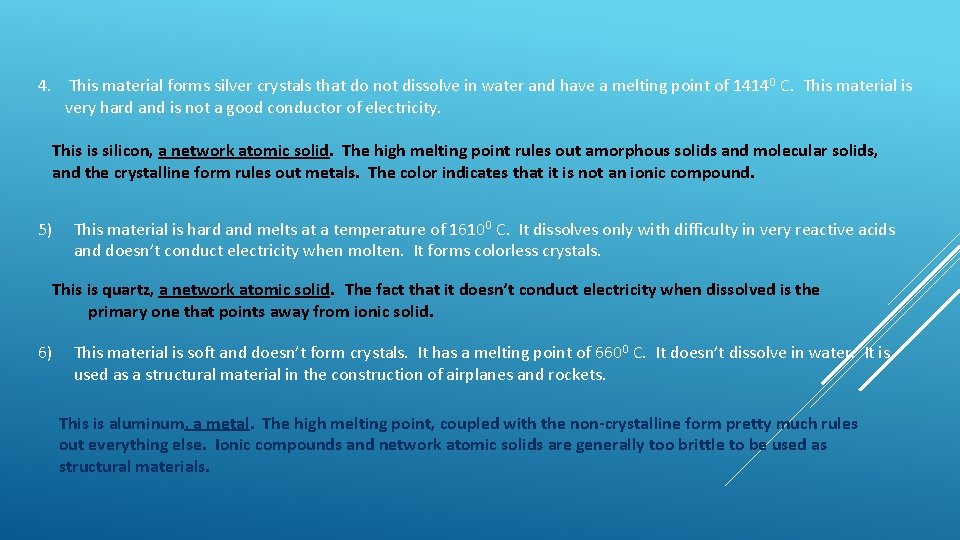
4. This material forms silver crystals that do not dissolve in water and have a melting point of 1414 0 C. This material is very hard and is not a good conductor of electricity. This is silicon, a network atomic solid. The high melting point rules out amorphous solids and molecular solids, and the crystalline form rules out metals. The color indicates that it is not an ionic compound. 5) This material is hard and melts at a temperature of 16100 C. It dissolves only with difficulty in very reactive acids and doesn’t conduct electricity when molten. It forms colorless crystals. This is quartz, a network atomic solid. The fact that it doesn’t conduct electricity when dissolved is the primary one that points away from ionic solid. 6) This material is soft and doesn’t form crystals. It has a melting point of 660 0 C. It doesn’t dissolve in water. It is used as a structural material in the construction of airplanes and rockets. This is aluminum, a metal. The high melting point, coupled with the non-crystalline form pretty much rules out everything else. Ionic compounds and network atomic solids are generally too brittle to be used as structural materials.