
TYPES OF SIMPLE MACHINES Big Q How do
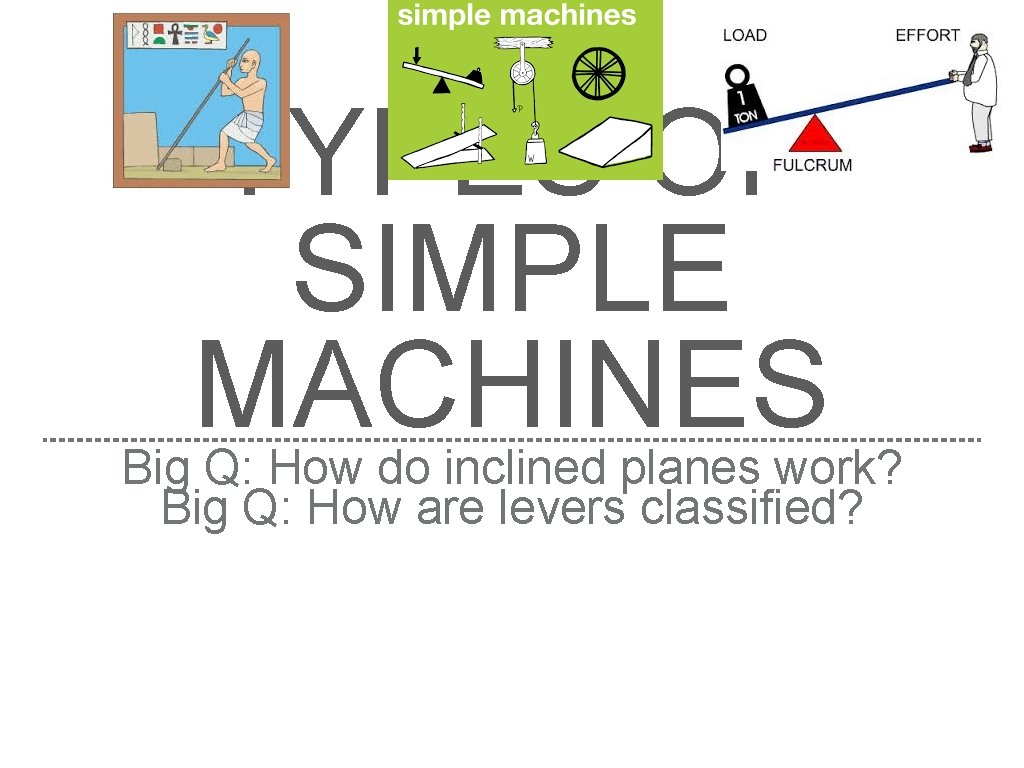
TYPES OF SIMPLE MACHINES Big Q: How do inclined planes work? Big Q: How are levers classified?

ENGAGE - IS IT A MACHINE? Which objects in the photo are machines? If you guessed the cars and the motorbike, you’re correct—but not completely! Remember, a device doesn’t have to be complicated or motorized in order to be a machine. Look below the motorbike. The ramp is a machine. Look at the person rolling the bike up the ramp. His hands hold the handlebars. His knees bend to help him walk. These are examples of simple machines. The motorbike and the other vehicles contain many simple machines. There are dozens of machines in this photo, not just the ones with motors.
ENGAGE - IS IT A MACHINE? ➤ What kind of work is made easier by the ramp in the picture? ➤ What are other examples of ramps that you have seen or used? ➤ How does the ramp at the back of the truck help the person do work?
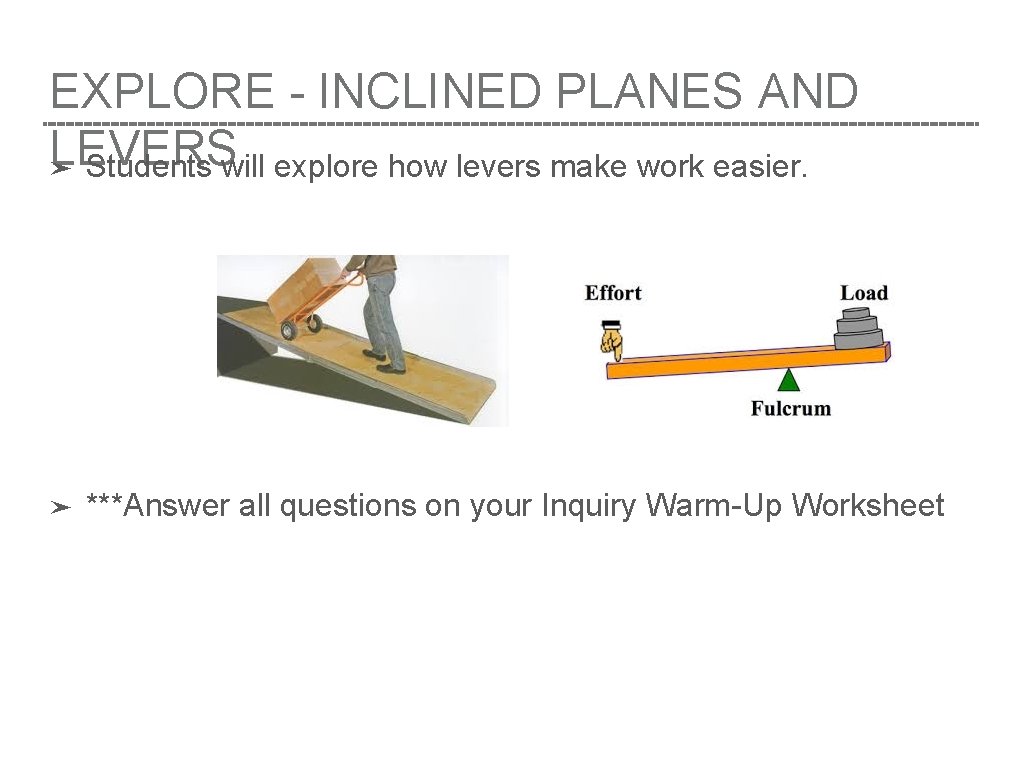
EXPLORE - INCLINED PLANES AND LEVERS ➤ Students will explore how levers make work easier. ➤ ***Answer all questions on your Inquiry Warm-Up Worksheet
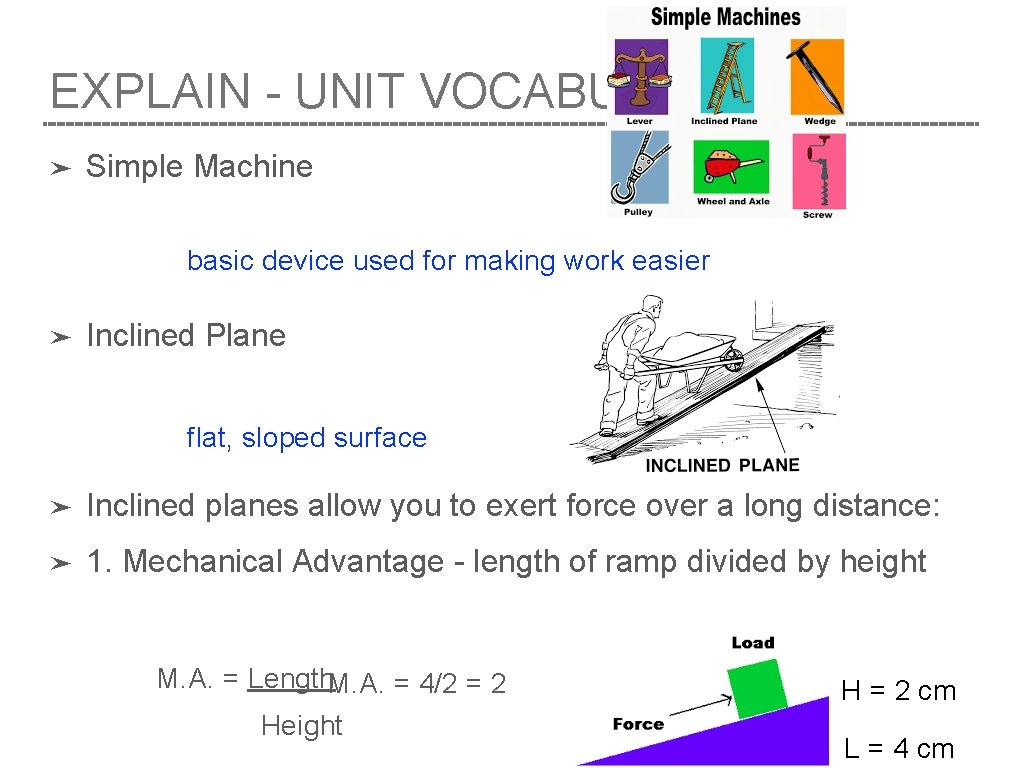
EXPLAIN - UNIT VOCABULARY ➤ Simple Machine basic device used for making work easier ➤ Inclined Plane flat, sloped surface ➤ Inclined planes allow you to exert force over a long distance: ➤ 1. Mechanical Advantage - length of ramp divided by height M. A. = Length. M. A. = 4/2 = 2 Height H = 2 cm L = 4 cm
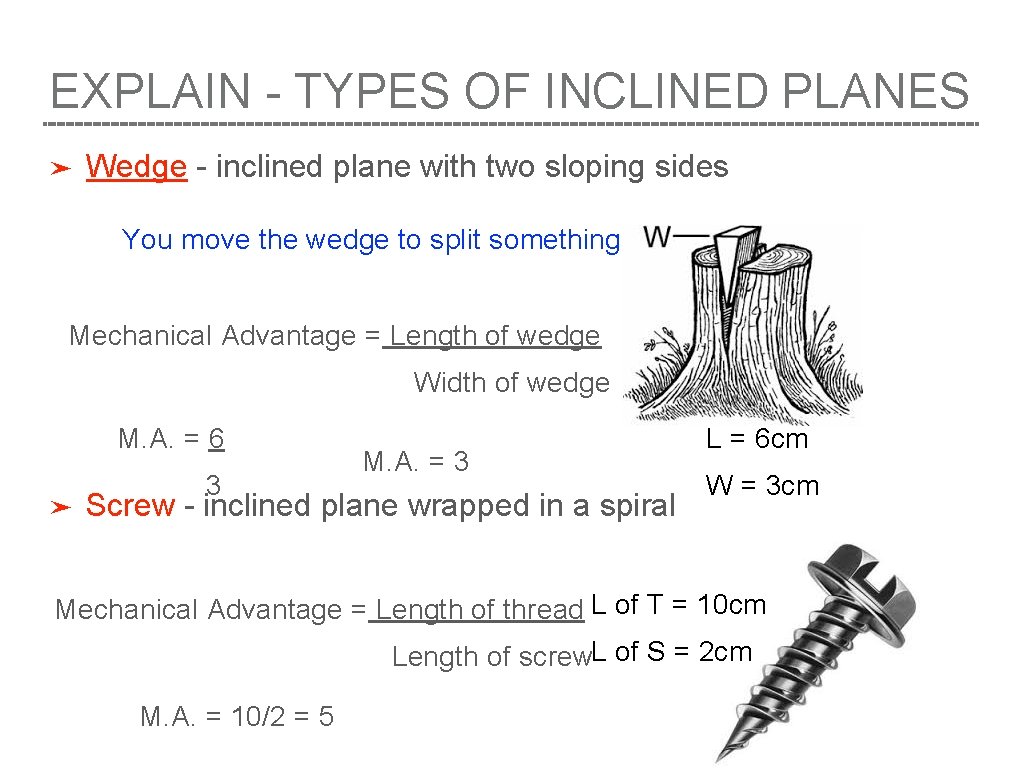
EXPLAIN - TYPES OF INCLINED PLANES ➤ Wedge - inclined plane with two sloping sides You move the wedge to split something in two Mechanical Advantage = Length of wedge Width of wedge M. A. = 6 ➤ 3 M. A. = 3 Screw - inclined plane wrapped in a spiral L = 6 cm W = 3 cm Mechanical Advantage = Length of thread L of T = 10 cm Length of screw. L of S = 2 cm M. A. = 10/2 = 5
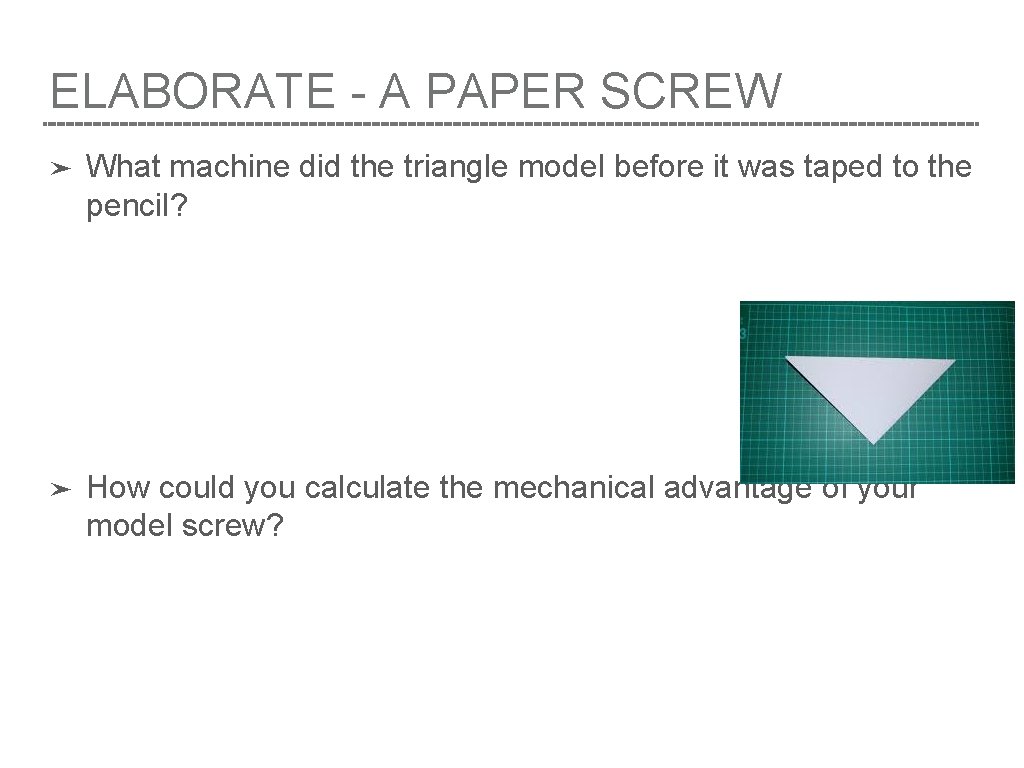
ELABORATE - A PAPER SCREW ➤ What machine did the triangle model before it was taped to the pencil? ➤ How could you calculate the mechanical advantage of your model screw?
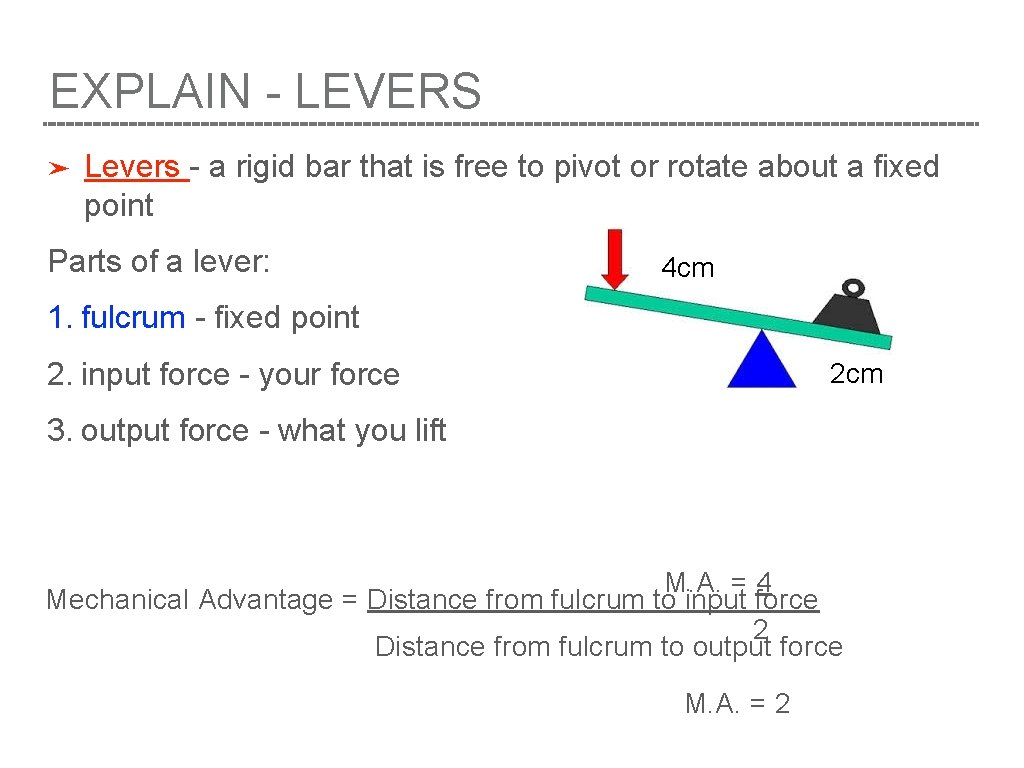
EXPLAIN - LEVERS ➤ Levers - a rigid bar that is free to pivot or rotate about a fixed point Parts of a lever: 4 cm 1. fulcrum - fixed point 2. input force - your force 2 cm 3. output force - what you lift M. A. = 4 Mechanical Advantage = Distance from fulcrum to input force 2 Distance from fulcrum to output force M. A. = 2
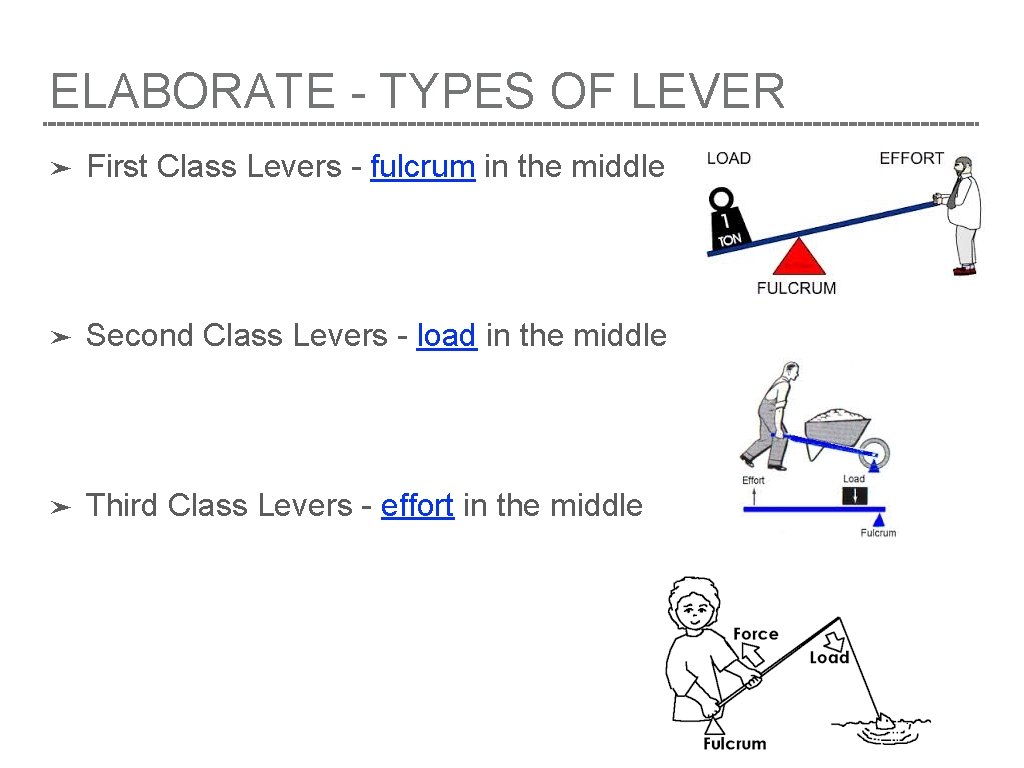
ELABORATE - TYPES OF LEVER ➤ First Class Levers - fulcrum in the middle ➤ Second Class Levers - load in the middle ➤ Third Class Levers - effort in the middle
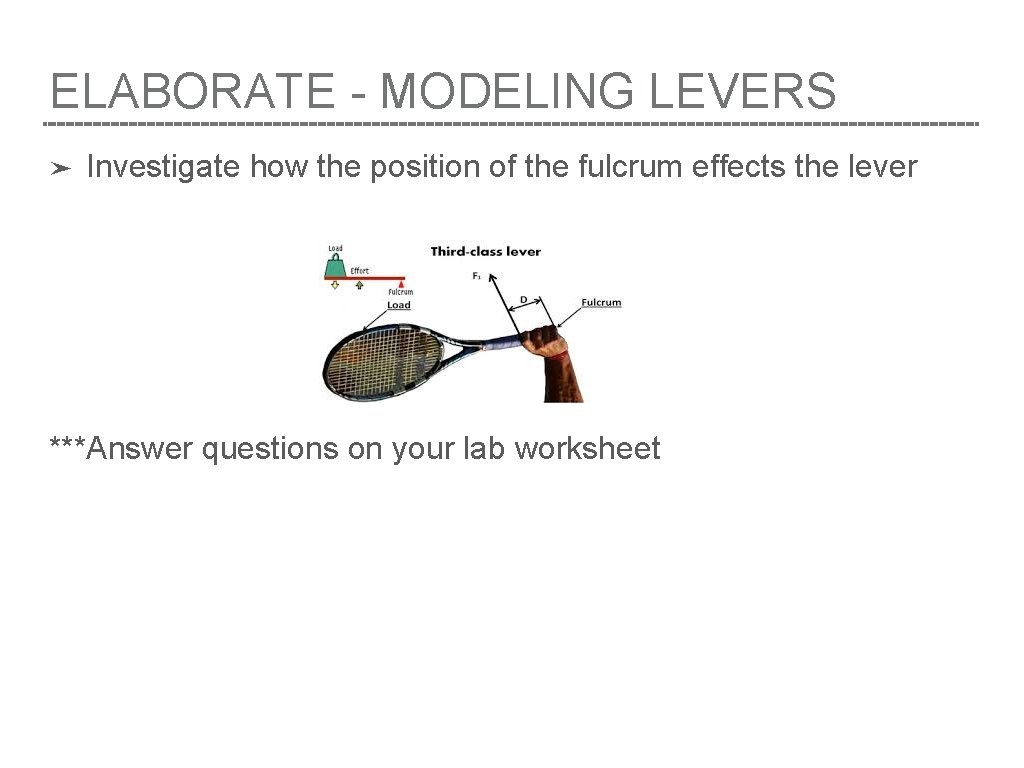
ELABORATE - MODELING LEVERS ➤ Investigate how the position of the fulcrum effects the lever ***Answer questions on your lab worksheet
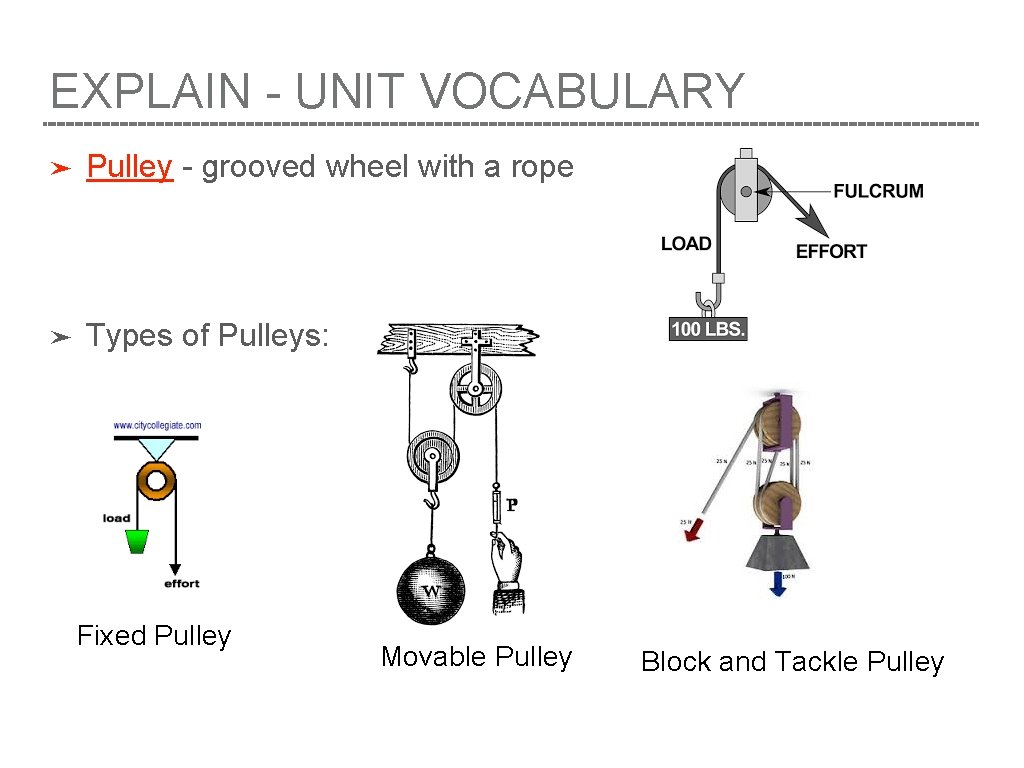
EXPLAIN - UNIT VOCABULARY ➤ Pulley - grooved wheel with a rope ➤ Types of Pulleys: Fixed Pulley Movable Pulley Block and Tackle Pulley
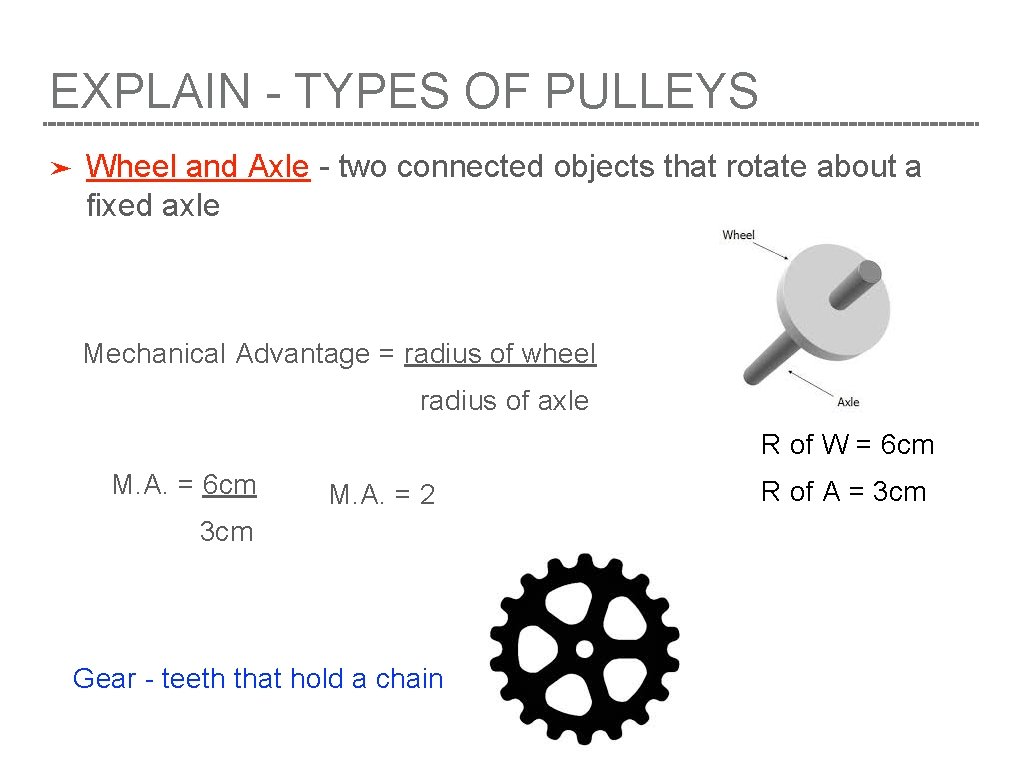
EXPLAIN - TYPES OF PULLEYS ➤ Wheel and Axle - two connected objects that rotate about a fixed axle Mechanical Advantage = radius of wheel radius of axle R of W = 6 cm M. A. = 2 3 cm Gear - teeth that hold a chain R of A = 3 cm
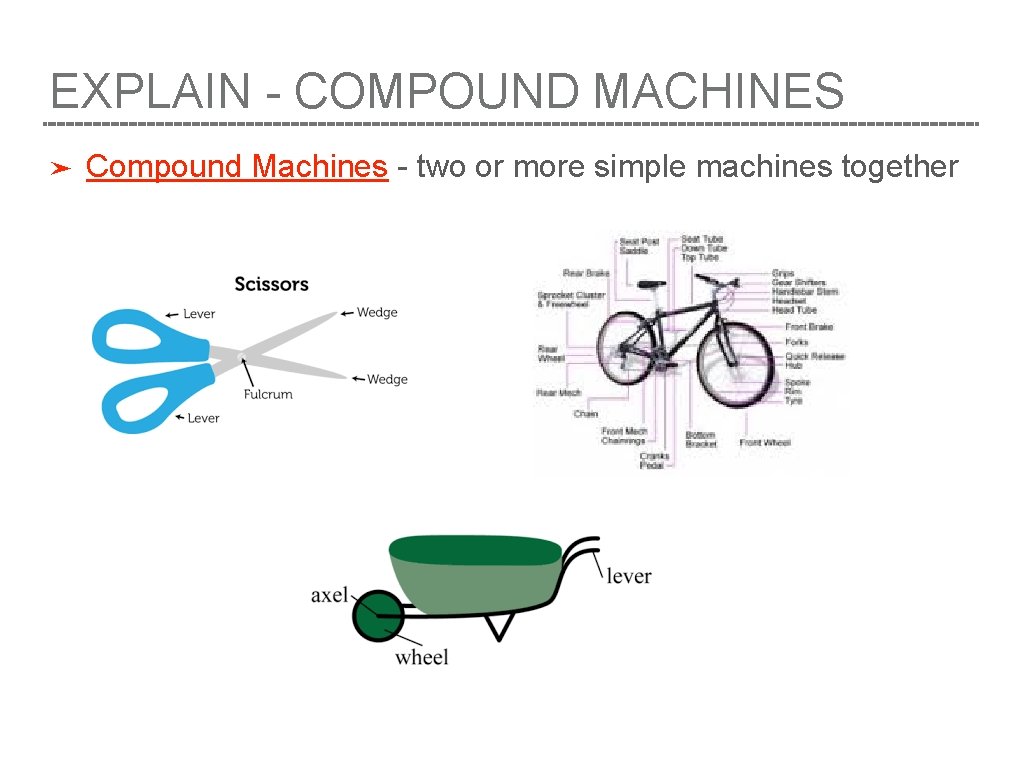
EXPLAIN - COMPOUND MACHINES ➤ Compound Machines - two or more simple machines together
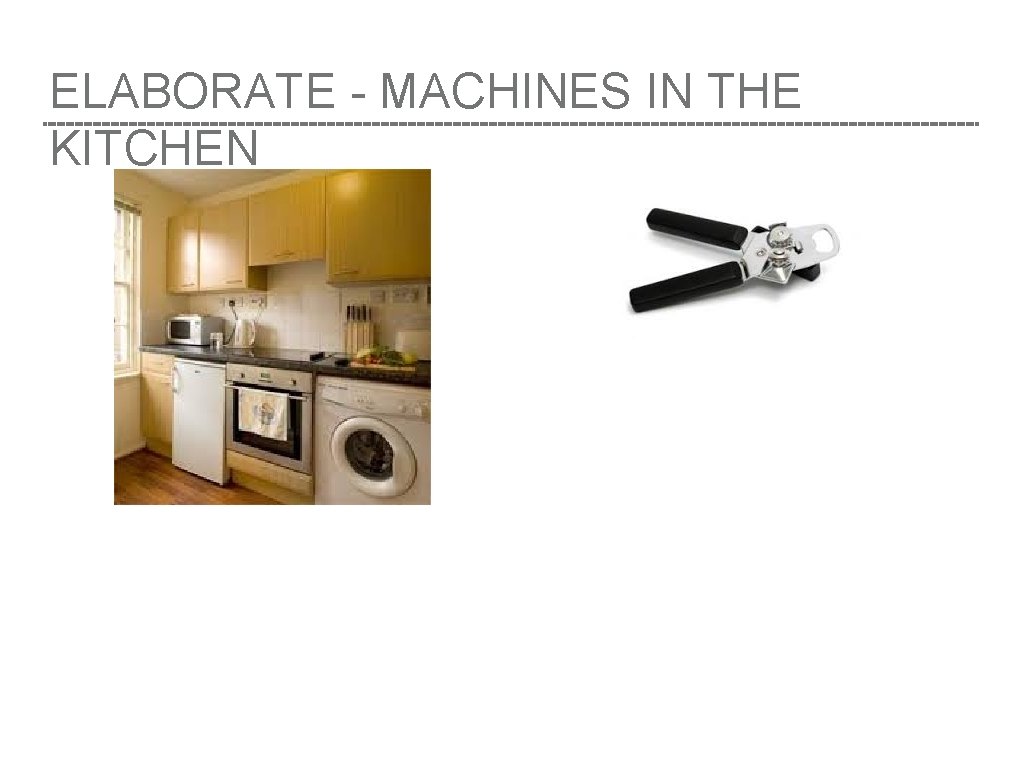
ELABORATE - MACHINES IN THE KITCHEN
EVALUATE - SIMPLE MACHINES
- Slides: 15