
Types of silk worms Dr C Esaivani Assistant
- Slides: 38
Types of silk worms Dr. C. Esaivani Assistant professor, PG Department of Zoology Sarah Tucker College Tirunelveli 11/26/2020
TYPES OF SILK WORMS INTRODUCTION Silk producing insects are commonly called silk moths which belongs to the families Bombycidae and saturnidae under order Lepidoptera and class insecta. Among the different kinds of silk, the mulberry silk is most important as it produces about 95% of world production of silk fibres. Naturally the term 'silk' commonly refers to the silk of the mulberry silk worm.
Types Mulberry silk worm Anaphe silk worm Taser silk worm Fagara silk worm Eri silk worm Coan silk worm Muga silk worm Mussel silk worm Oak Taser silk worm Spider silk worm 11/26/2020
11/26/2020
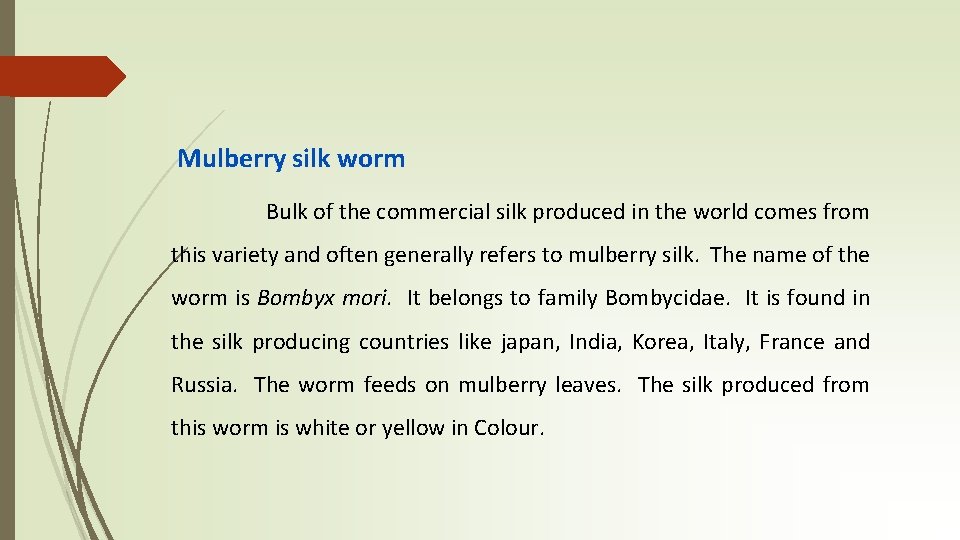
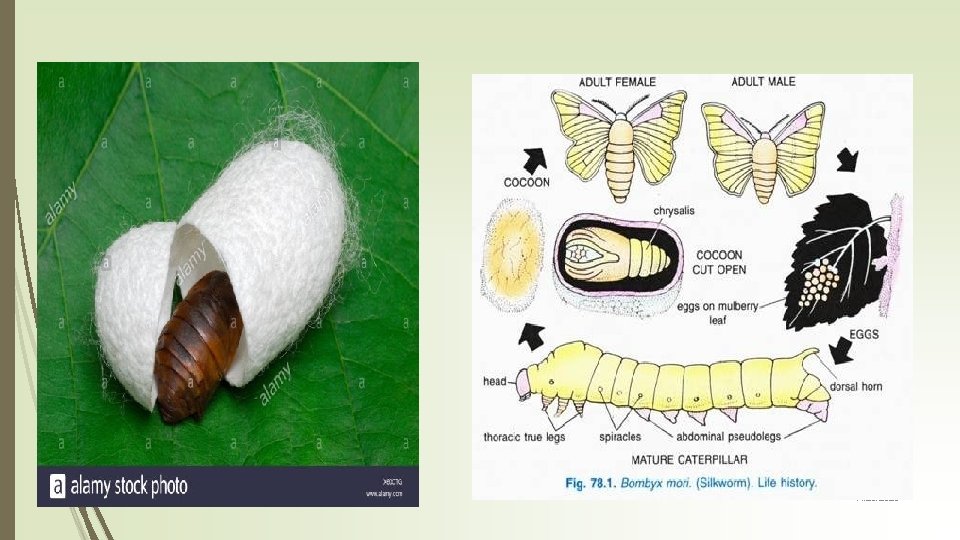
Mulberry silk worm Bulk of the commercial silk produced in the world comes from this variety and often generally refers to mulberry silk. The name of the worm is Bombyx mori. It belongs to family Bombycidae. It is found in the silk producing countries like japan, India, Korea, Italy, France and Russia. The worm feeds on mulberry leaves. The silk produced from this worm is white or yellow in Colour.
11/26/2020
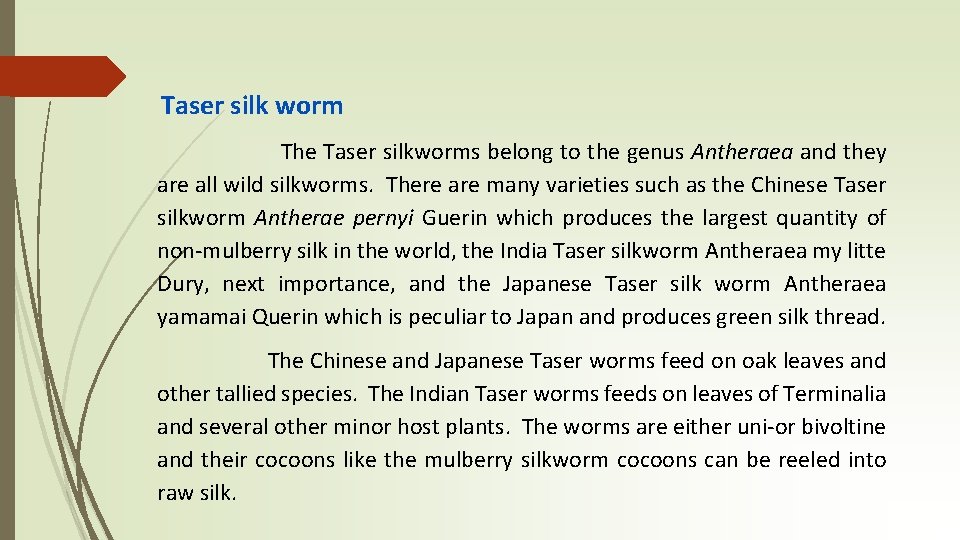
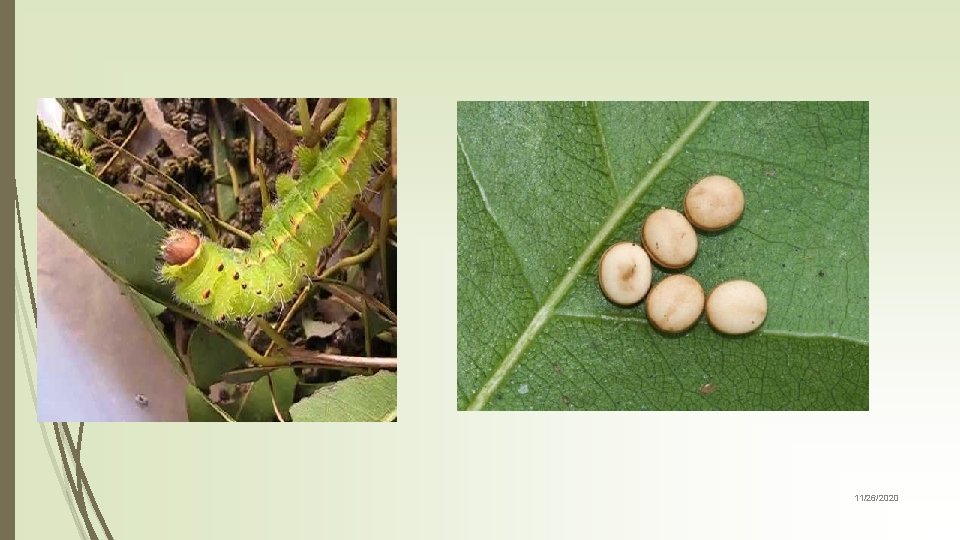
Taser silk worm The Taser silkworms belong to the genus Antheraea and they are all wild silkworms. There are many varieties such as the Chinese Taser silkworm Antherae pernyi Guerin which produces the largest quantity of non-mulberry silk in the world, the India Taser silkworm Antheraea my litte Dury, next importance, and the Japanese Taser silk worm Antheraea yamamai Querin which is peculiar to Japan and produces green silk thread. The Chinese and Japanese Taser worms feed on oak leaves and other tallied species. The Indian Taser worms feeds on leaves of Terminalia and several other minor host plants. The worms are either uni-or bivoltine and their cocoons like the mulberry silkworm cocoons can be reeled into raw silk.
11/26/2020
11/26/2020
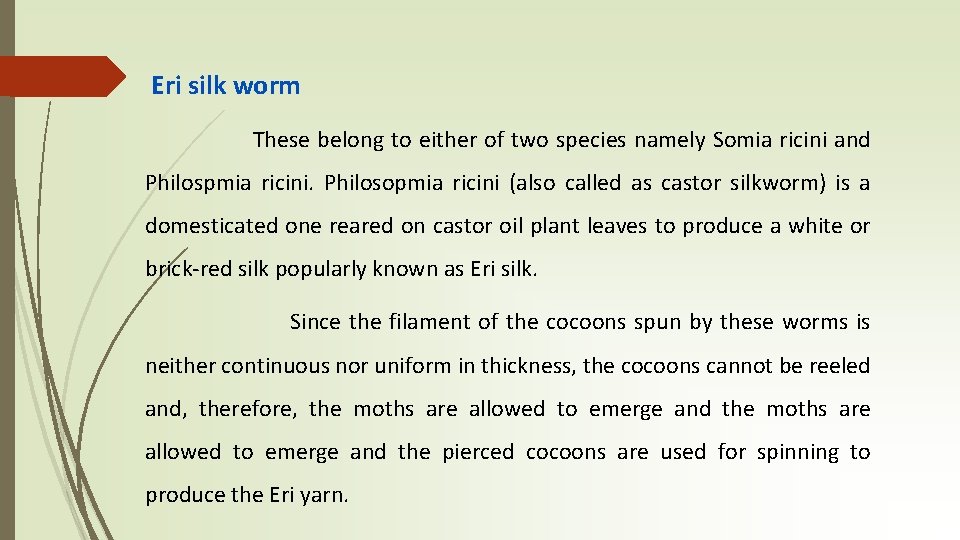
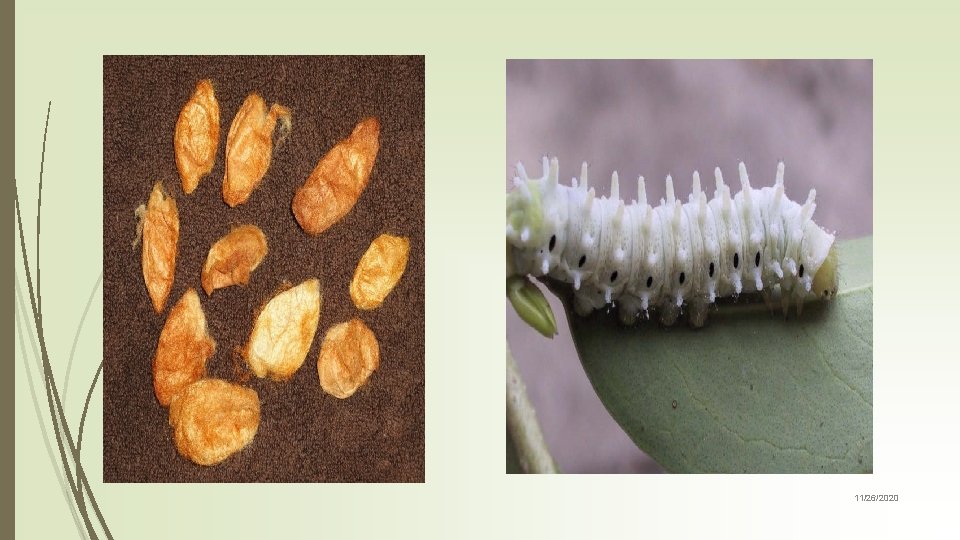
Eri silk worm These belong to either of two species namely Somia ricini and Philospmia ricini. Philosopmia ricini (also called as castor silkworm) is a domesticated one reared on castor oil plant leaves to produce a white or brick-red silk popularly known as Eri silk. Since the filament of the cocoons spun by these worms is neither continuous nor uniform in thickness, the cocoons cannot be reeled and, therefore, the moths are allowed to emerge and the pierced cocoons are used for spinning to produce the Eri yarn.
11/26/2020
11/26/2020
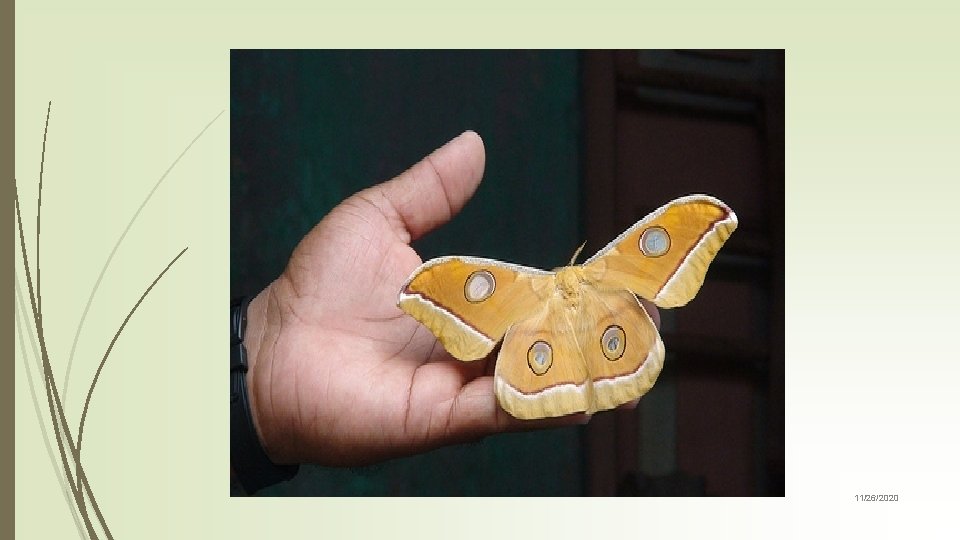
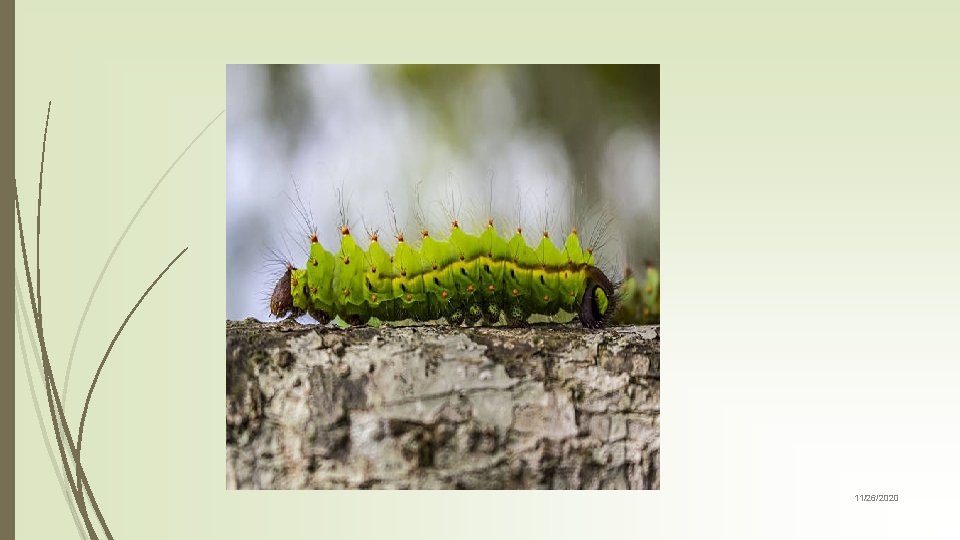
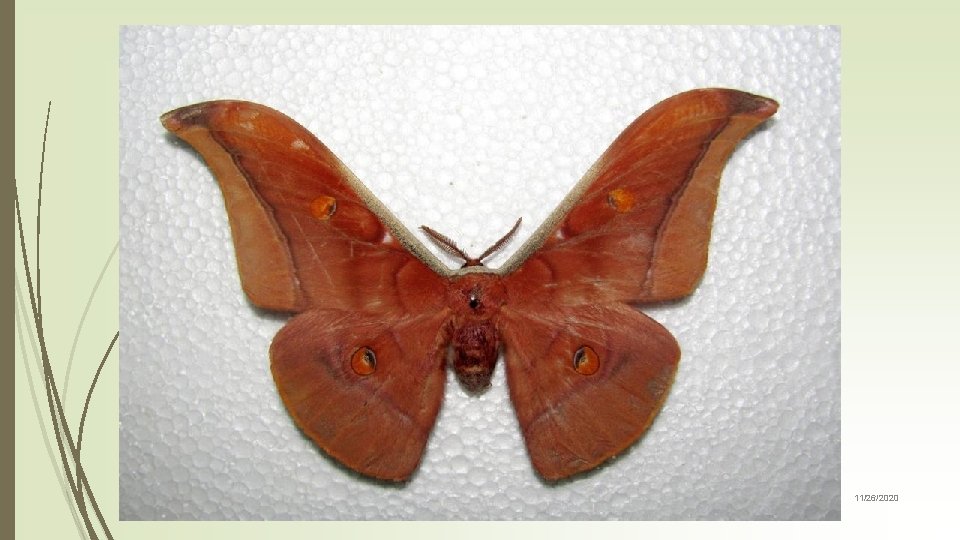
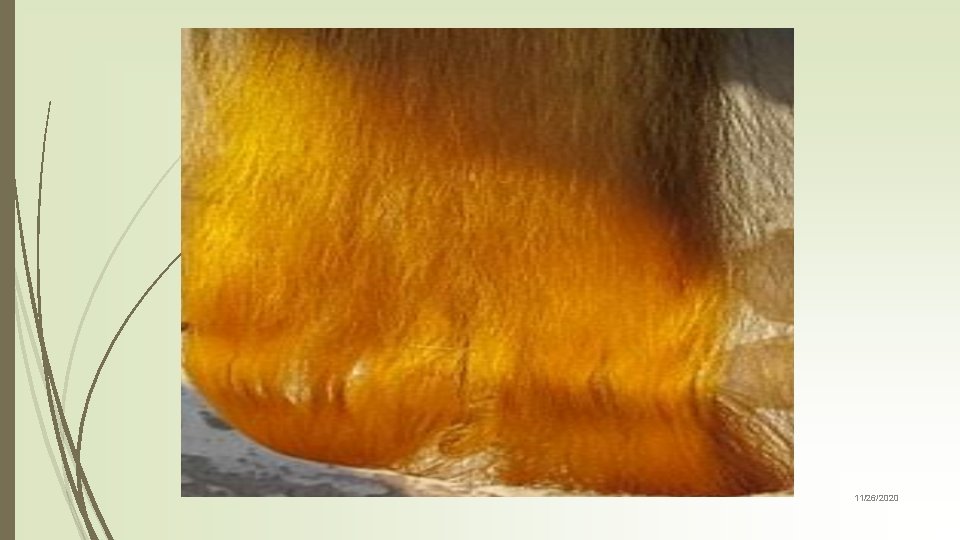
Muga silk worm The muga silkworms (Antheraea assamensis) also belong to the same genus as Taser worms, but produce an unusual golden-yellow silk thread which is very attractive and strong. These are found only in the state of Assam, India and feed on persea bombycina and Listaea monopetala leaves and those of other species. The quantity of muga silk produced is quite small and is mostly used for the making of traditional dresses in the state of Assam (India) itself.
11/26/2020
11/26/2020
Oak-Taser silk worm Besides these silk worm, Oak-Taser silk worm (Antheraea proylei) is reared in hill regions of Manipur. It is a fertile hybrid between the Chinese Taser and indigenous wild Taser species. The worm feeds on Oak leaves and yields good quality silk, but silk worm culture is not widely practiced because of the following limitations, Erratic emergence of moth. Storage difficulty of cocoons. Abundance of natural pests and predators. Continuous degeneration of the hybrids and poor reliability of the cocoons.
11/26/2020
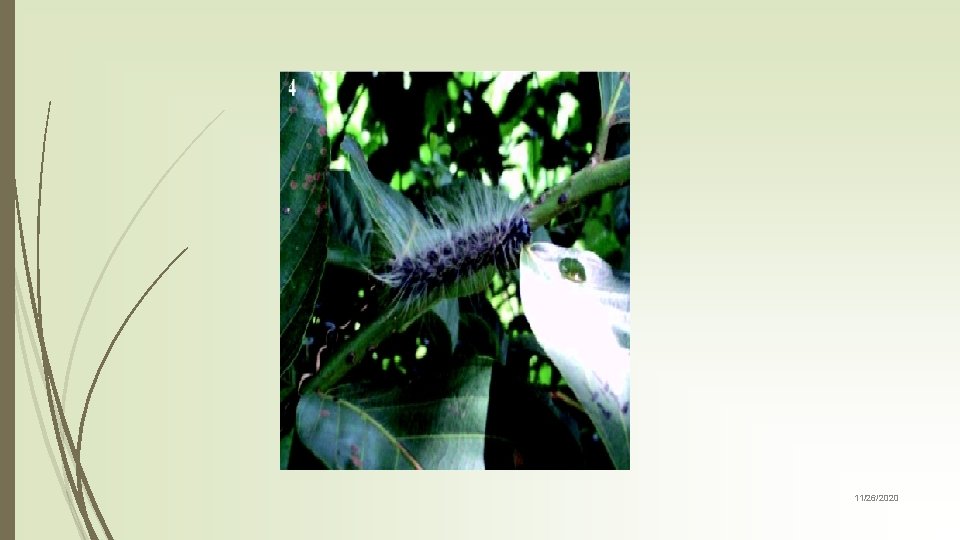
Anaphe silk worm This silk of southern and central Africa is produced by silkworms of the genus Anaphe: A. moloneyi Druce, A. panda Boisduval, A. reticulate walker, A. ambrizia Butler, A. carteri Walsingham, A. venata Butler and A. infracta Walsingham. They spin cocoons in communes, all enclosed by a thin layer of silk. The tribal people collect them from the forest and spin the fluff into a raw silk that is soft and fairly lustrous. The silk obtained from A. infracta is known locally as "book", and those from A. moleneyi as "Trisnian-tsamia" and "koko". The fabric is elastic and stronger than that of mulberry silk. Anaphe silk is used, for example, in velvet and plush.
11/26/2020
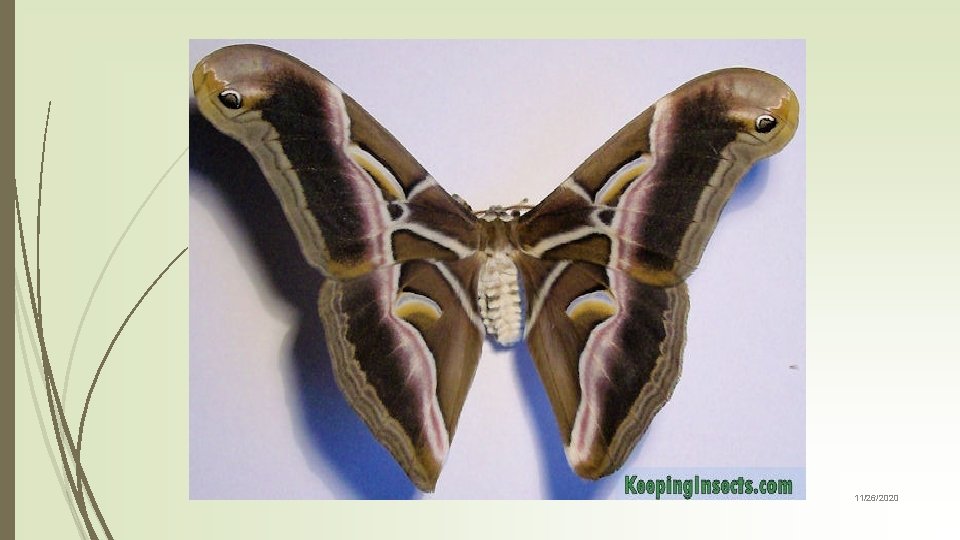
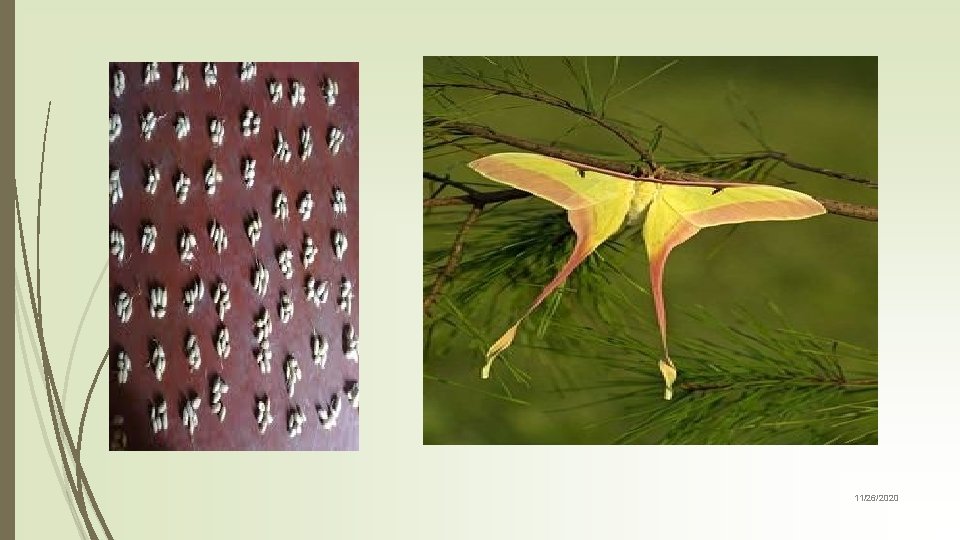
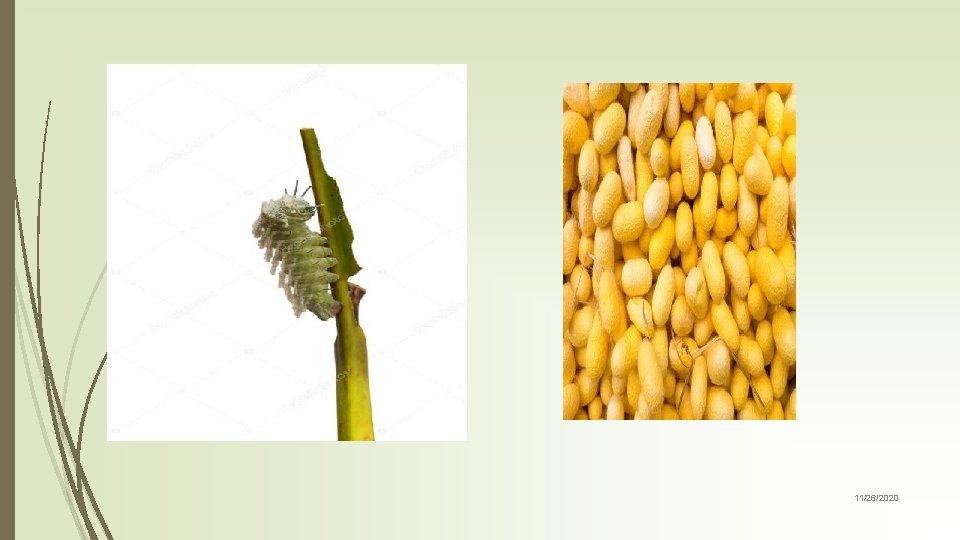
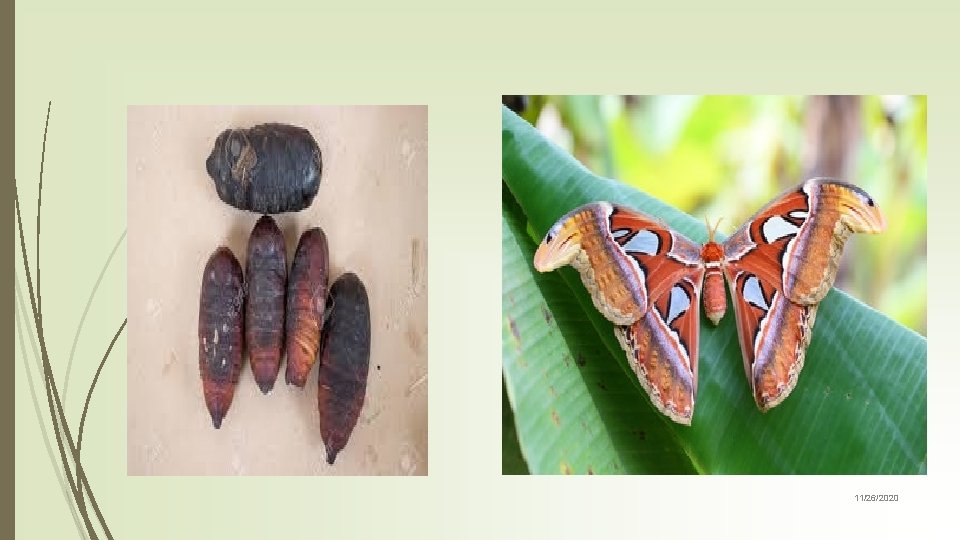
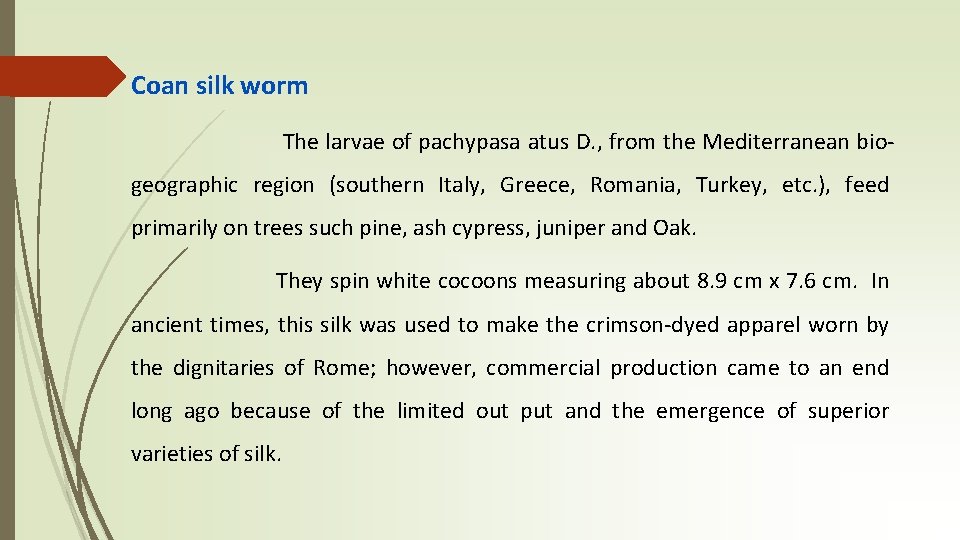
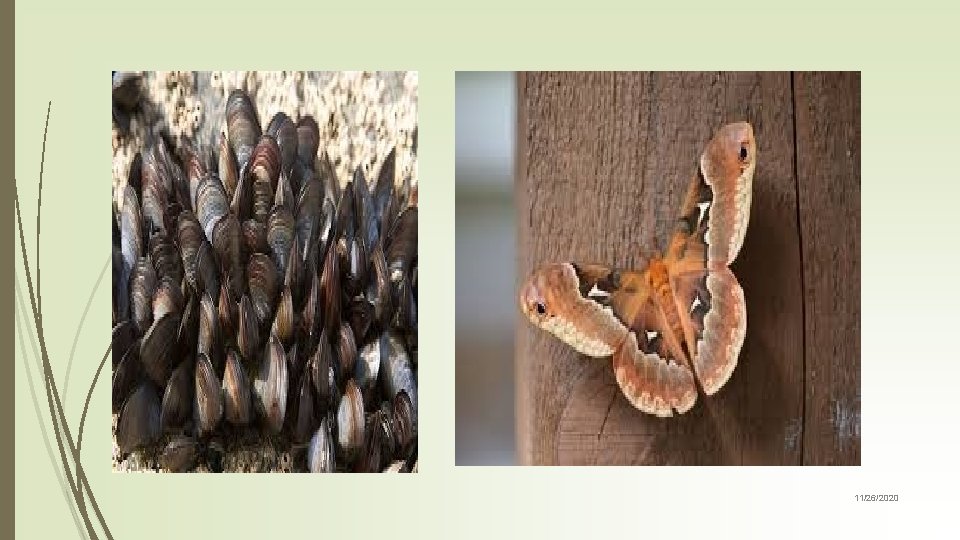
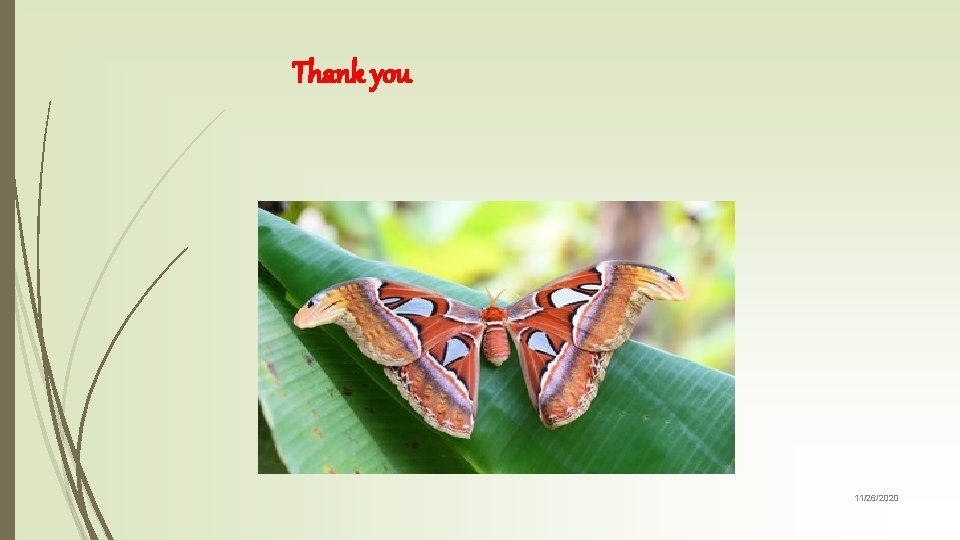
Fagara silk is obtained from the giant silk moth atlas L. and a few other related species or races inhabiting the Indo-Australian bio-geographic region, china and sudan. They spin light-brown cocoons nearly 6 cm long with peduncles of varying lengths (2 -10 cm).
11/26/2020
11/26/2020
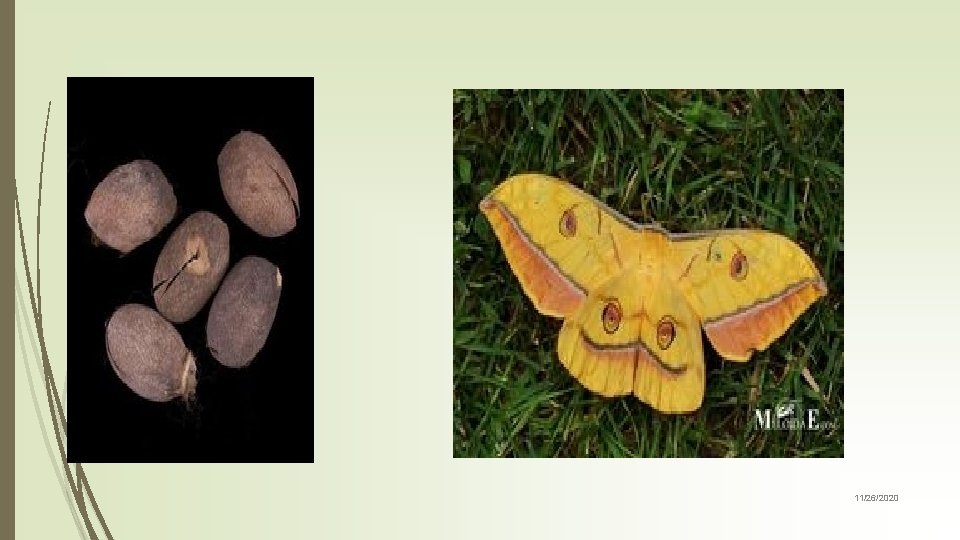
Coan silk worm The larvae of pachypasa atus D. , from the Mediterranean biogeographic region (southern Italy, Greece, Romania, Turkey, etc. ), feed primarily on trees such pine, ash cypress, juniper and Oak. They spin white cocoons measuring about 8. 9 cm x 7. 6 cm. In ancient times, this silk was used to make the crimson-dyed apparel worn by the dignitaries of Rome; however, commercial production came to an end long ago because of the limited out put and the emergence of superior varieties of silk.
11/26/2020
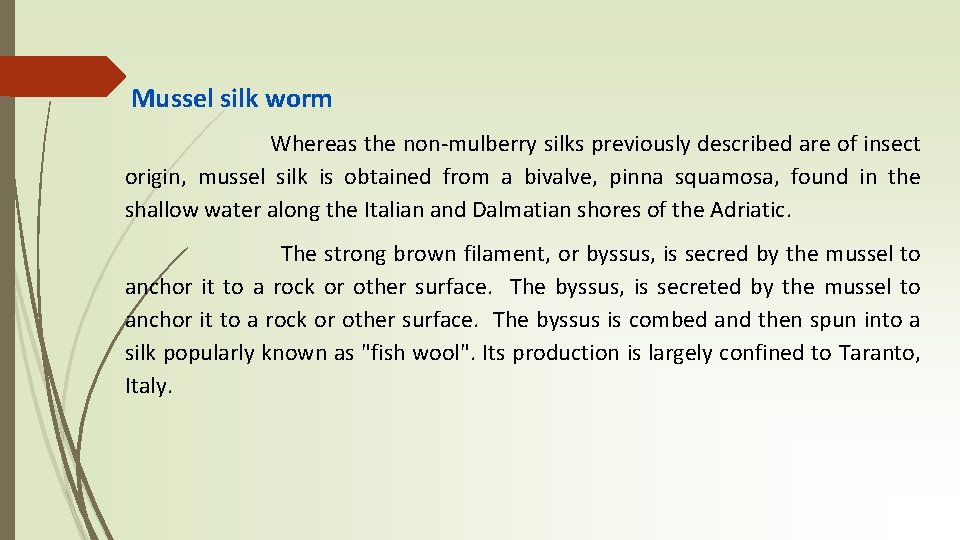
Mussel silk worm Whereas the non-mulberry silks previously described are of insect origin, mussel silk is obtained from a bivalve, pinna squamosa, found in the shallow water along the Italian and Dalmatian shores of the Adriatic. The strong brown filament, or byssus, is secred by the mussel to anchor it to a rock or other surface. The byssus, is secreted by the mussel to anchor it to a rock or other surface. The byssus is combed and then spun into a silk popularly known as "fish wool". Its production is largely confined to Taranto, Italy.
11/26/2020
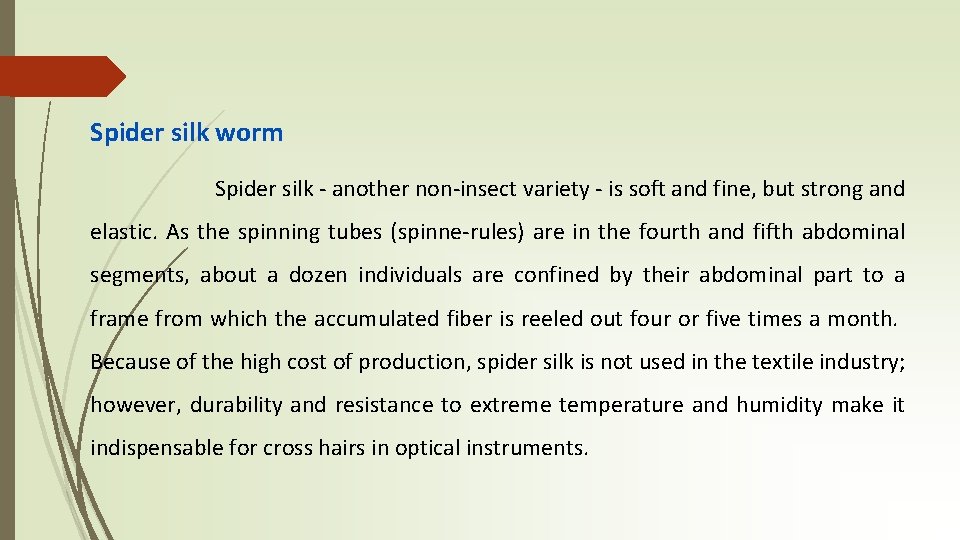
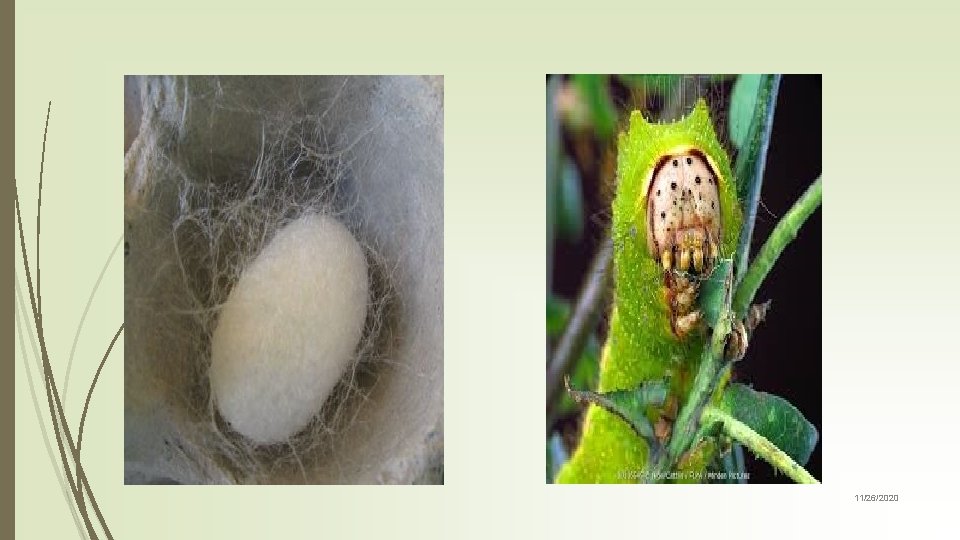
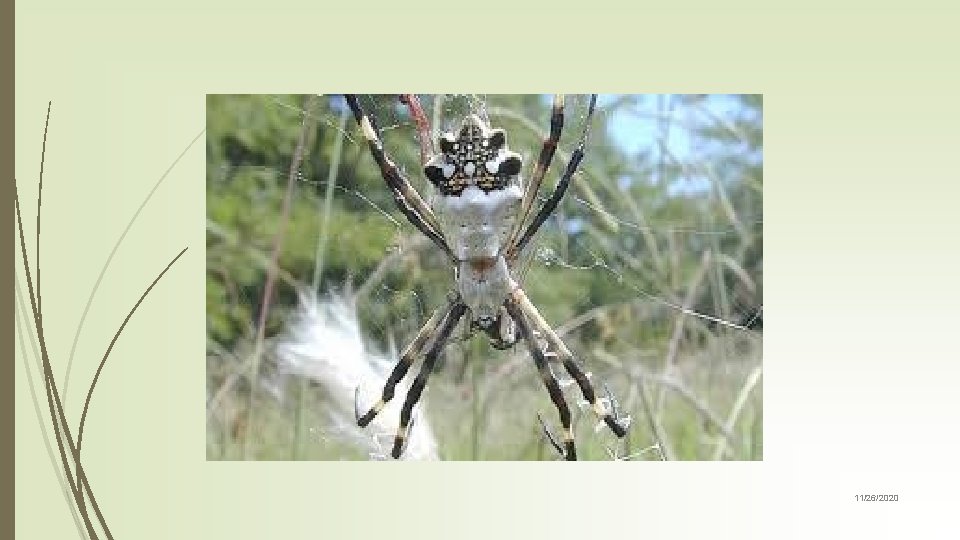
Spider silk worm Spider silk - another non-insect variety - is soft and fine, but strong and elastic. As the spinning tubes (spinne-rules) are in the fourth and fifth abdominal segments, about a dozen individuals are confined by their abdominal part to a frame from which the accumulated fiber is reeled out four or five times a month. Because of the high cost of production, spider silk is not used in the textile industry; however, durability and resistance to extreme temperature and humidity make it indispensable for cross hairs in optical instruments.
11/26/2020
11/26/2020
SILK INTRODUCTION Silk is a protein fibre consisting outer sericin and inner fibroin produced from the secretion of the silk gland of mature (5 th instar) larvae of silk worm and that secretion initially becomes liquid and is transformed to a hard thread contact with air. PHYSICAL NATURE OF SILK FIBRE It is a smooth, soft, light and elastic fibre. 15 -35 in diameter 2. 1 -5. 2 PH 1. 4 -1. 42 Specific gravity The Colour of silk fibre depends upon the Colour of the haemolymph of silk moth larva which is gravened by the pigments present in mulberry leaves which are devoured by them. Different pigments are seen in the silk fibres viz. , Xanthophyll (golden-yellow fibre), carotene (yellow fibre), bombycitin (green fibre) etc. 11/26/2020
11/26/2020
CHEMICAL NATURE OF SILK FIBRE Silk fibre consists of central fibroin (C 30 H 46 N 10 O 12) and peripheral sericin (C 30 H 40 N 10 O 16). Fibroin is a fibrous protein while sercin is a gelatinous protein. In silk fibre fibroin and secricin remain in the ratio of 80: 20. The silk fibre used in weaving and in the cocoons has a little bit of difference in their contents. The fibres present in the cocoon contain glued substance which is dissolved in hot water during fibre extraction from cocoon. Silk fibre contains 17 types of amino acids and the chief amino acids are glycine, serine, alanine, valine, aspartic acid etc. In mulberry silk glycine content is higher than alanine while in non- mulberry silk alanine content is higher than that of glycine. 11/26/2020
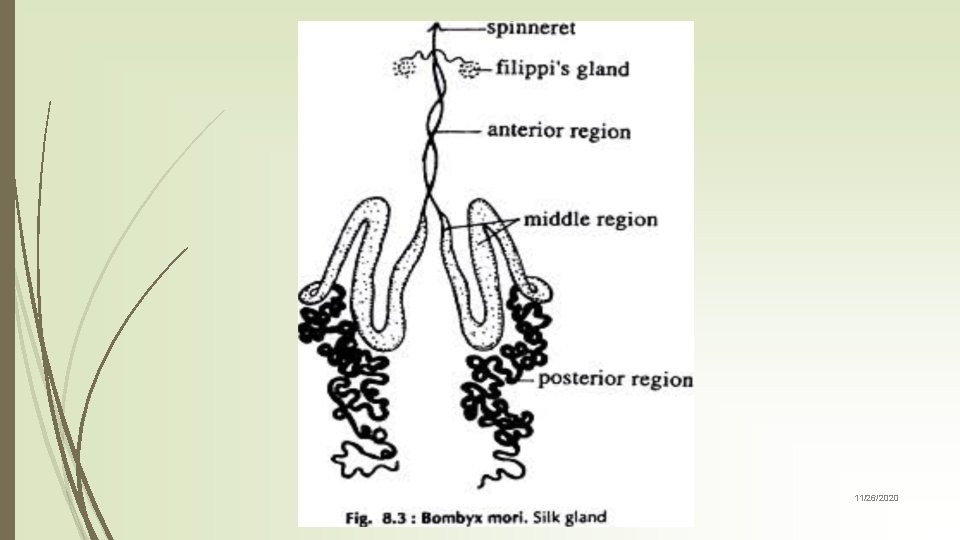
SILK GLAND INTRODUCTION Silk gland is a modified salivary gland of mature silk moth larva (5 th instar which secretes a liquid and when comes in contact with air forms the silk thread. LOCATION Silk glands are paired glands and these are located between the 4 th to 8 th abdominal segments on the ventral side of the alimentary canal of silk moth larva. STRUCTURE Each gland is about five times together than the length of larva. The gland is divided into anterior, middle and posterior parts. Posterior part The posterior part of the gland is long, narrow and coiled. This portion secretes fibroin protein which forms the inner core of the silk fibre. The fibroin comes to the middle part where maturation takes palace. 11/26/2020
11/26/2020
Middle part This portion is S-shaped broader and is known as reservoir. It secretes four types of sericin which envelop the fibroin stored there. Anterior part Two anterior parts of silk glands unite to end in the spinneret near the mouth. A pair of Lyonet's or Fillippis glands is located near the opening. A viscous fluid is secreted by these glands and perhaps the viscous secretion gives lusture to the silk fibre. The thin anterior region of silk gland has no secretory role only transports the assembled silk to spinneret. Spinneret It is a projection of the median part of the labium, which draws the silk out in the form of fine filament. The secreted silk comes out as a thread or filament as it passes through silk press which resembles a typical salivary pump. The two filaments coming out of two sides are called brins. The sericin (gum) layer of the two brins then bind together into a single filament of bave. 11/26/2020
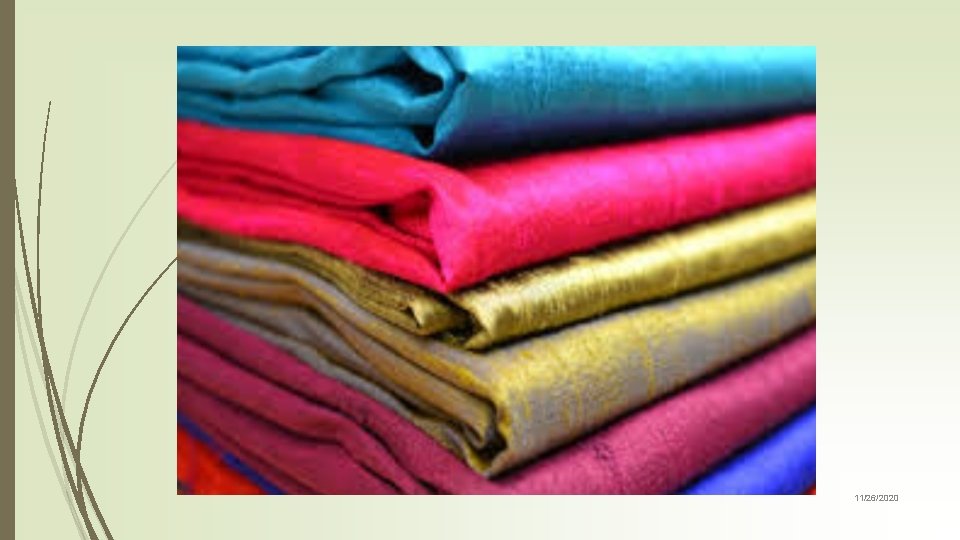
USES OF SILK Remarkable contribution of silk fibre is the production of female costume 'Silk saree'. It is also used in the manufacture of 'Dhoti', bush shirts etc. Silk fibres are mixed up with the synthetic fibres and prepare the cloth like Tery Silk. The silk is also used in handkerchiefs, scarves, stoles, mufflers, shawls, ties etc. Silk fibres are essential in the preparation of tyres particularly for racing and costly cars. Silk fibres are used in the preparation of sieves for flour mills. Silk fibres also used in some components of the parachute; though recently is replaced by synthetic fibres. It is used as insulating coil in telephone wires and wireless receivers. Silk threads are also used in surgical purposes. Silk fibers that undergo a special manufacturing process are used to construct prosthetic arteries. Due to silk's antibacterial properties, it's often used in the medical field for wounds and burns. 11/26/2020
11/26/2020
Thank you 11/26/2020