
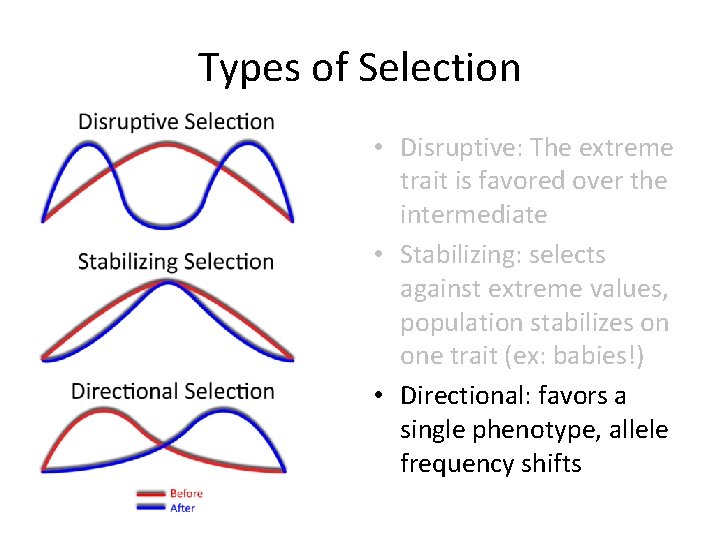
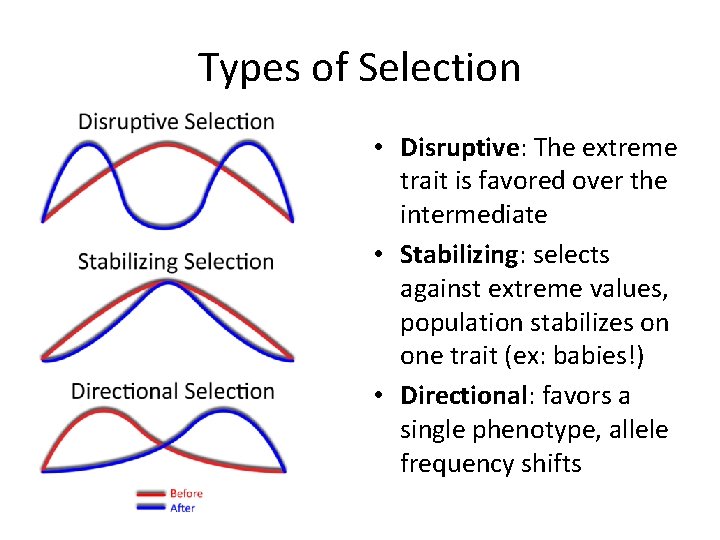
Types of Selection Disruptive The extreme trait is
- Slides: 12
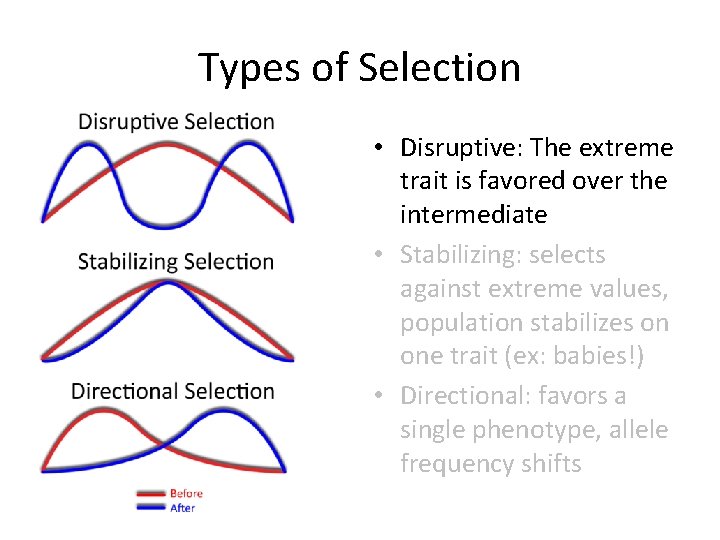
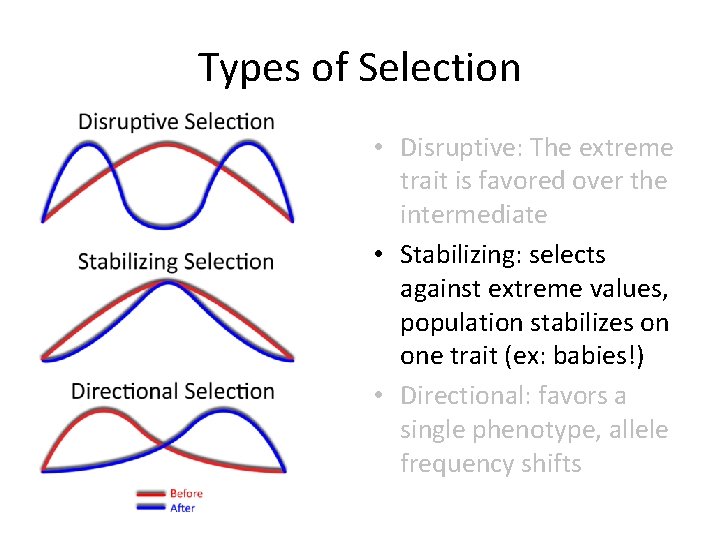
Types of Selection • Disruptive: The extreme trait is favored over the intermediate • Stabilizing: selects against extreme values, population stabilizes on one trait (ex: babies!) • Directional: favors a single phenotype, allele frequency shifts
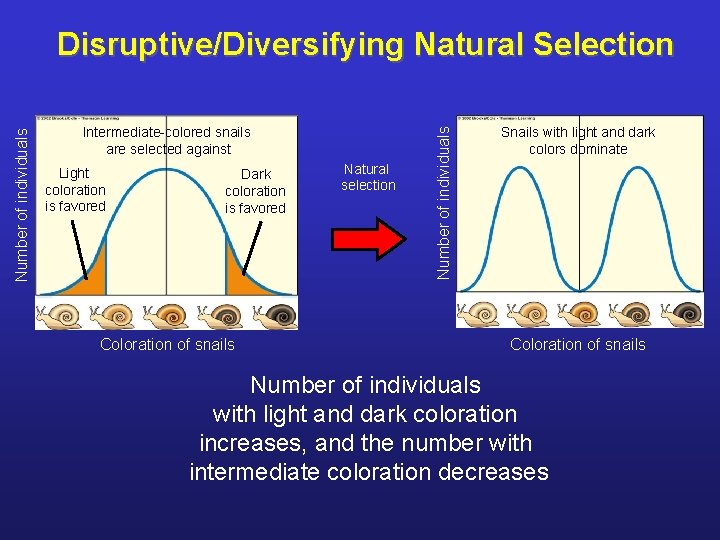
Intermediate-colored snails are selected against Light coloration is favored Dark coloration is favored Coloration of snails Natural selection Number of individuals Disruptive/Diversifying Natural Selection Snails with light and dark colors dominate Coloration of snails Number of individuals with light and dark coloration increases, and the number with intermediate coloration decreases
Types of Selection • Disruptive: The extreme trait is favored over the intermediate • Stabilizing: selects against extreme values, population stabilizes on one trait (ex: babies!) • Directional: favors a single phenotype, allele frequency shifts
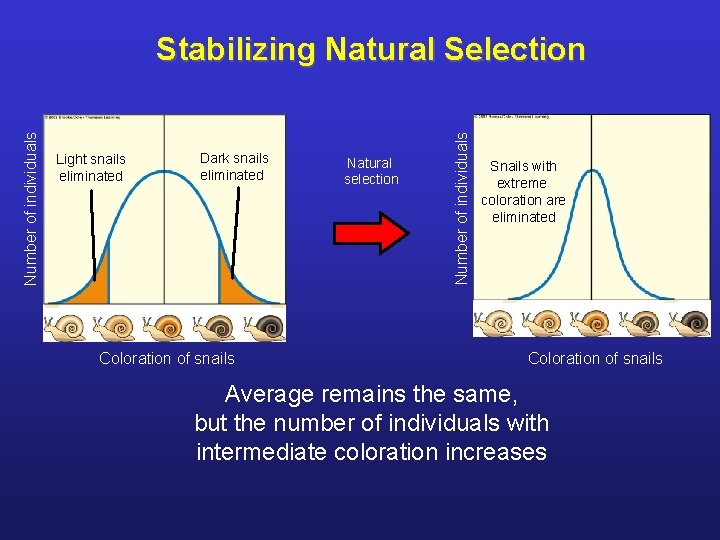
Light snails eliminated Dark snails eliminated Coloration of snails Natural selection Number of individuals Stabilizing Natural Selection Snails with extreme coloration are eliminated Coloration of snails Average remains the same, but the number of individuals with intermediate coloration increases
Types of Selection • Disruptive: The extreme trait is favored over the intermediate • Stabilizing: selects against extreme values, population stabilizes on one trait (ex: babies!) • Directional: favors a single phenotype, allele frequency shifts
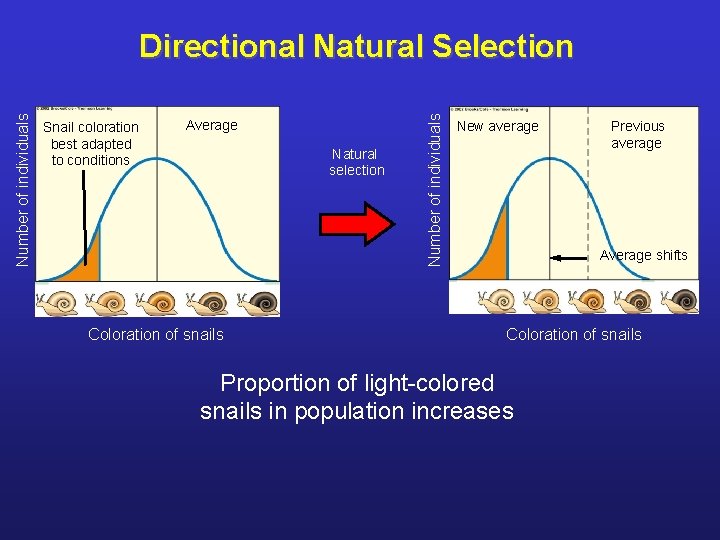
Snail coloration best adapted to conditions Average Natural selection Coloration of snails Number of individuals Directional Natural Selection New average Previous average Average shifts Coloration of snails Proportion of light-colored snails in population increases
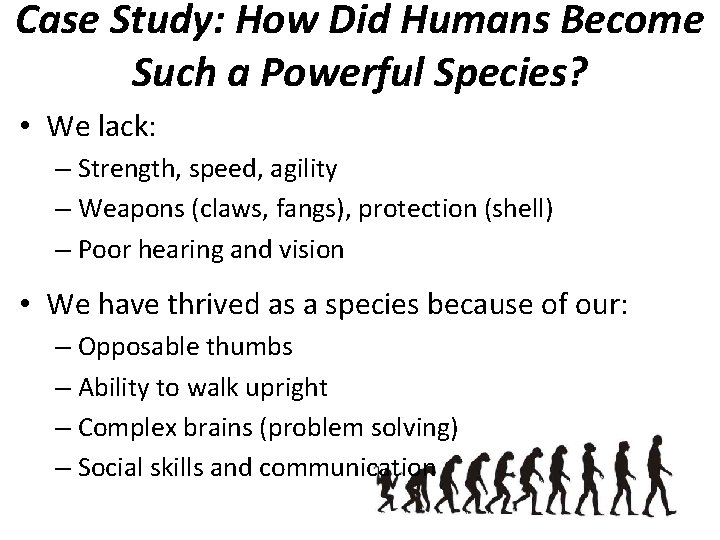
Case Study: How Did Humans Become Such a Powerful Species? • We lack: – Strength, speed, agility – Weapons (claws, fangs), protection (shell) – Poor hearing and vision • We have thrived as a species because of our: – Opposable thumbs – Ability to walk upright – Complex brains (problem solving) – Social skills and communication
APES Bell Ringer 11/14/2012 • What is natural selection? What are the 3 different types of natural selection? • Include QUESTIONS and Answers! • Natural Selection: Individuals of a population acquire genetically based traits that increase their chances of survival and their ability to produce offspring.
Types of Selection • Disruptive: The extreme trait is favored over the intermediate • Stabilizing: selects against extreme values, population stabilizes on one trait (ex: babies!) • Directional: favors a single phenotype, allele frequency shifts
Term clarification
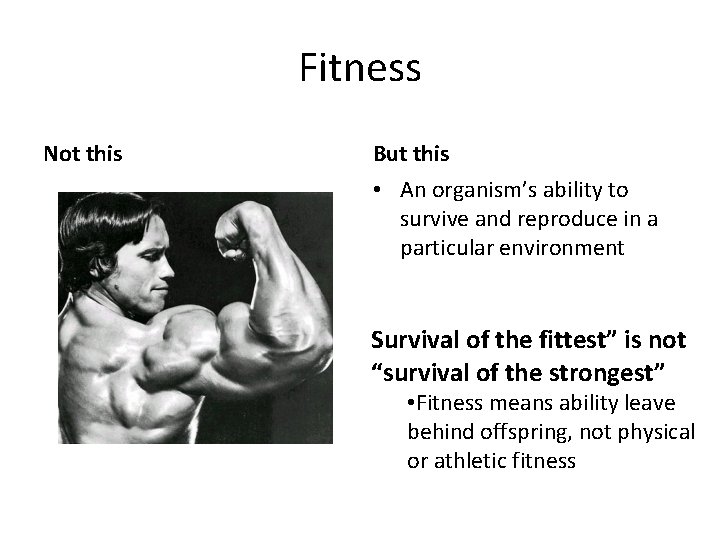
Fitness Not this But this • An organism’s ability to survive and reproduce in a particular environment Survival of the fittest” is not “survival of the strongest” • Fitness means ability leave behind offspring, not physical or athletic fitness
Common Myths-Evolution • Organisms do not develop traits out of need or want • A giraffe did not get a longer neck because it wanted it • Those with too short of a neck starved and those with longer necks got enough food to reproduce frequently • No grand plan of nature for perfect adaptation • There is no ultimate goal of perfection, just populations reacting to the current environmental conditions, whatever they may be…