
Types of Sedimentary Rocks 8 th Grade Earth

- Slides: 11
Types of Sedimentary Rocks 8 th Grade Earth and Space Science Class Notes
Wednesday, 12/12/12 Warm – Up • Describe one feature you may observe in a sedimentary rock. • Write down the HW. Learning Goal – Describe the types of sedimentary rocks. Agenda • Warm-Up Question/Review HW • Check/correct the Section 6. 1 Review Worksheet • Update Table of Contents • Class notes/discussion on the Types of Sedimentary Rocks • Sign up for Sedimentary Rock Lab Groups • Work on the Classification of Sedimentary Rocks WS and Section 6. 2 Review Worksheet Homework – Section 6. 2 Vocabulary due on Friday, 12/14 Section 6. 2 Review Worksheet due on Friday, 12/14 Greek and Latin Roots Quiz #2 on Friday, 12/14
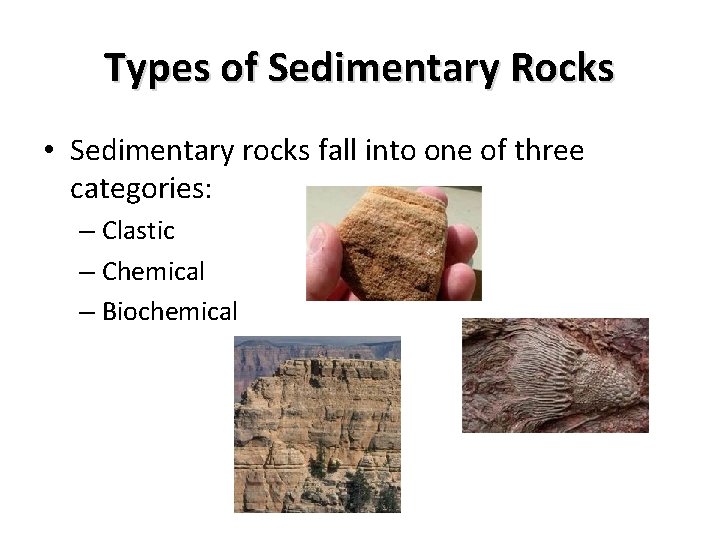
Types of Sedimentary Rocks • Sedimentary rocks fall into one of three categories: – Clastic – Chemical – Biochemical
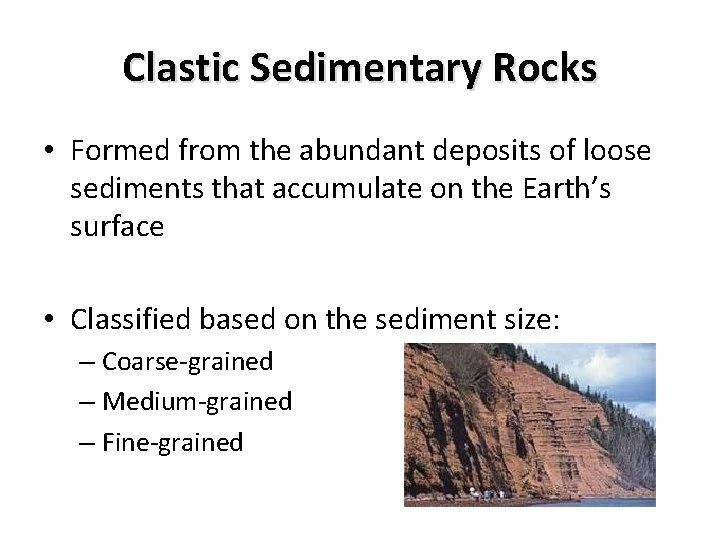
Clastic Sedimentary Rocks • Formed from the abundant deposits of loose sediments that accumulate on the Earth’s surface • Classified based on the sediment size: – Coarse-grained – Medium-grained – Fine-grained
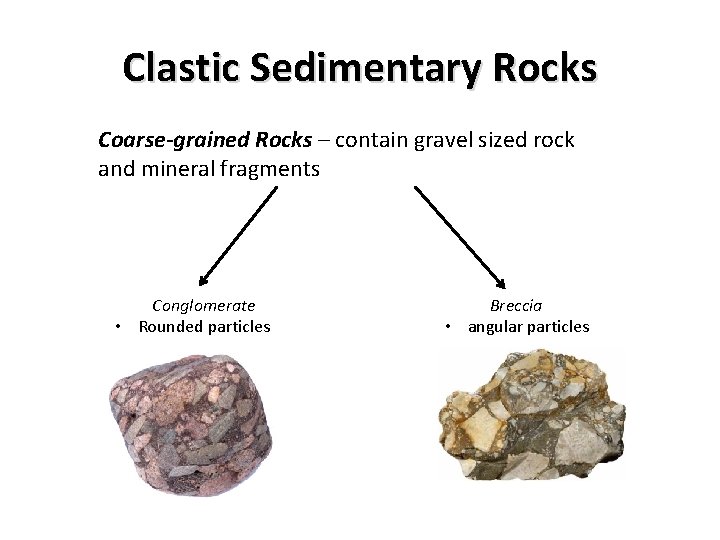
Clastic Sedimentary Rocks Coarse-grained Rocks – contain gravel sized rock and mineral fragments Conglomerate • Rounded particles Breccia • angular particles
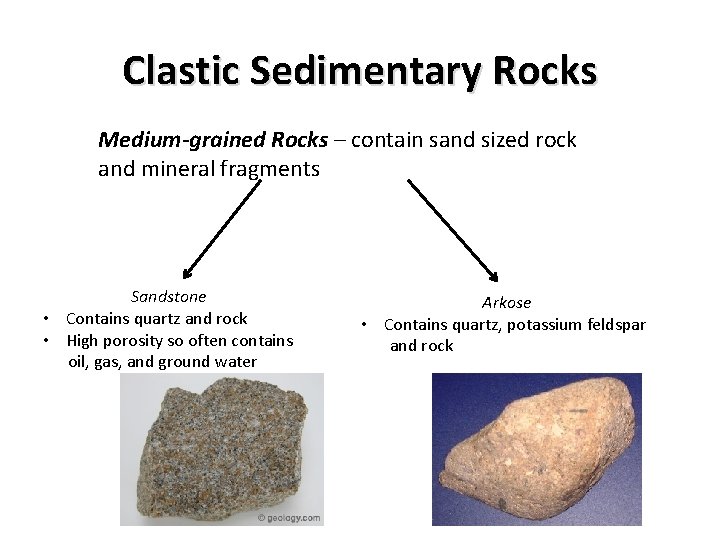
Clastic Sedimentary Rocks Medium-grained Rocks – contain sand sized rock and mineral fragments Sandstone • Contains quartz and rock • High porosity so often contains oil, gas, and ground water Arkose • Contains quartz, potassium feldspar and rock
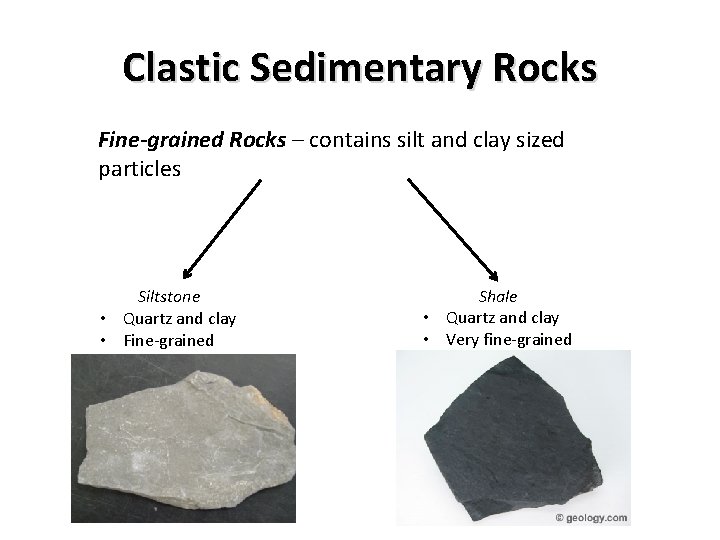
Clastic Sedimentary Rocks Fine-grained Rocks – contains silt and clay sized particles Siltstone • Quartz and clay • Fine-grained Shale • Quartz and clay • Very fine-grained
Chemical Sedimentary Rocks • Forms after the concentration of dissolved minerals reaches saturation and crystal grains settle out • Water evaporates and the minerals become more concentrated leading to thick layers on the bottom of a body of water. – Usually forms in areas that lack precipitation • See Table 6. 1 in your textbook for examples and classification
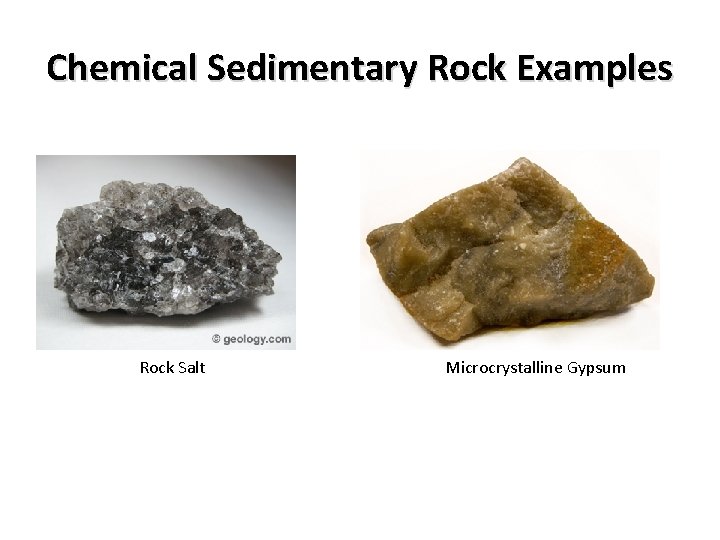
Chemical Sedimentary Rock Examples Rock Salt Microcrystalline Gypsum
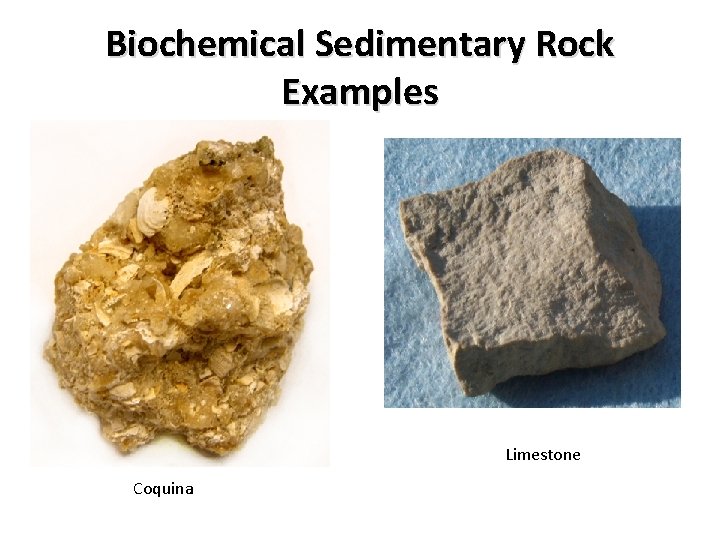
Biochemical Sedimentary Rocks • Form from the remains of once-living organisms • Most abundant is limestone (made of calcite) • Many contain fossils • See Table 6. 1 for examples and classification
Biochemical Sedimentary Rock Examples Limestone Coquina