
Types of Rudder What is a rudder A
- Slides: 17
Types of Rudder
What is a rudder? • A rudder is a primary control surface used to steer a ship, boat, submarine, hovercraft, aircraft, or other conveyance that moves through a fluid medium (generally air or water). On what basis • The type of rudder is a decision that needs to be based on various factors like hullform, speed, propeller design, structural arrangement of the stern, clearance between the propeller and the stern, and also a few hydrodynamic factors that dictate the flow of water aft of the propeller
Types of Rudder • Balanced rudder • Unbalanced rudder • Semi-balanced rudder – Flaps Rudder – Pleuger Rudder:
• A rudder is basically a rudder plate that is fixed to the rudder stock only at the top of the rudder. In other words, the rudder stock (or the axis of the rudder) doesn’t run down along the span of the rudder. • The position of the rudder stock along the chord (width meaning, from the forward to aft end of the rudder) of the rudder actually decides whether the rudder is a balanced or semibalanced
Balanced rudder
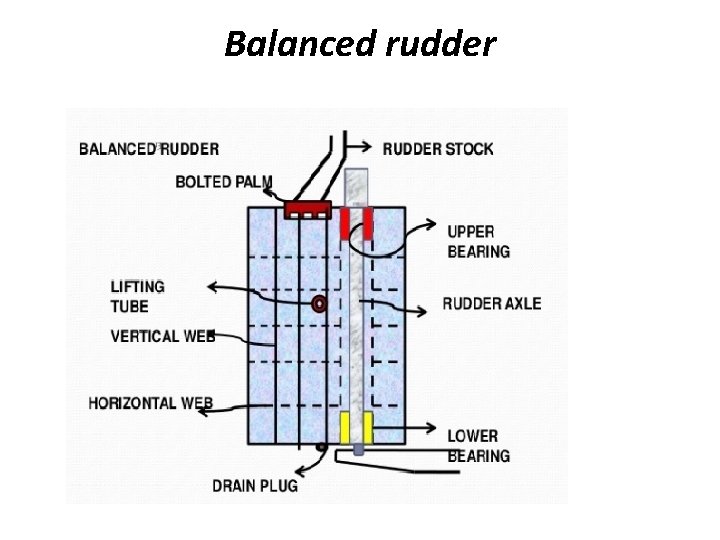
• In balanced rudders, the rudder stock is at such a position such that 40 percent of the rudder area is forward of the stock and the remaining is aft of it. • The concept of a balanced rudder involved the shifting of the centre of rotation of the rudder to point approximately 1/2 of the way from the forward end to the after end.
• When 30% to 40% of the area is forward of the turning axis there is no torque on the rudder stock at certain angles. • At some angle of rudder, it is balanced. i. e. , torque is zero, to keep rudder at that angle.
Why rudder stock is considered as reference position? The centre of gravity of the rudder will lie somewhere close to 40% of it’s chord length from its forward end. If the axis of the rudder is placed near to this location, the torque required to rotate the rudder will be much lesser than what is required to move it, had the axis been placed at the forward end of the rudder. • So, the energy requirement of the steering gear equipment is reduced, therefore lowering the fuel consumption of the ship. •
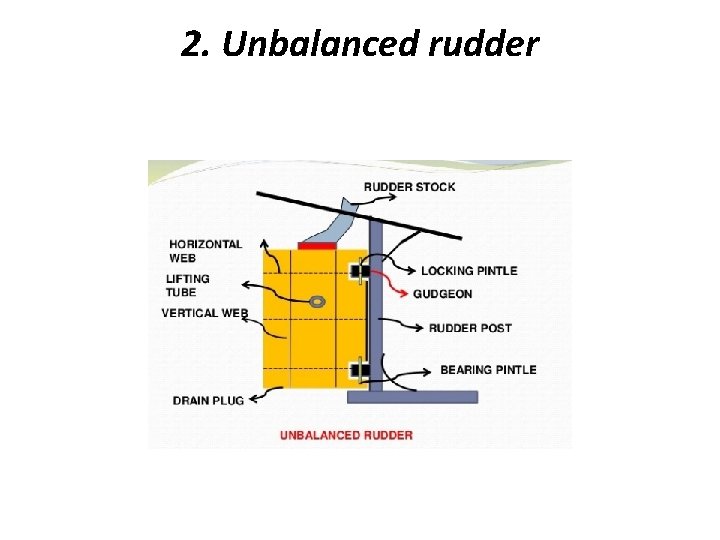
2. Unbalanced rudder
• These rudders have their stocks attached at the forward • Unlike balanced rudders, the rudder stock runs along the chord length of the rudder • In this case, the torque required to turn the rudder is way higher than what is required for a corresponding balanced rudder.
• So, the topmost part of the rudder has to be fixed to the spintle so as to prevent it from vertical displacement from it’s natural position. However, unbalanced rudders are not widely used now. • Researchers and ship operators had found significant problems with the balanced and unbalanced rudders. That is, in case there was a failure of the steering gear mechanism while turning a ship. The rudder would remain still with it’s angle of attack in that condition. The solution to this, was found in designing an optimized Semi-Balanced Rudder.
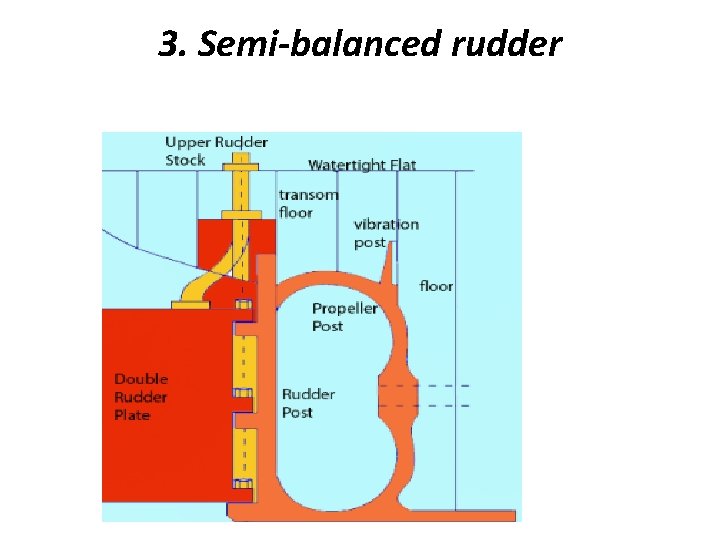
3. Semi-balanced rudder
• The rudder you see on most ships are semibalanced in the modern industry. The name semibalanced itself implies, that the rudder is partly balanced, and partly unbalanced. • If you refer to the figure , you’ll see that a portion of the chord length from the top is un-balanced, and the remaining chord length is balanced • The top part being un-balanced will help in acting as a structural support to the rudder from vertical displacement. And the balanced part will render less torque in swinging the rudder.
• As a result, a semi balanced rudder returns to the centreline orientation on its own if the steering gear equipment fails during a turn. • Semi balanced rudders are again of two types of rudder horn depending upon the depth of the horn (which affects the response and torque characteristics of the rudder).
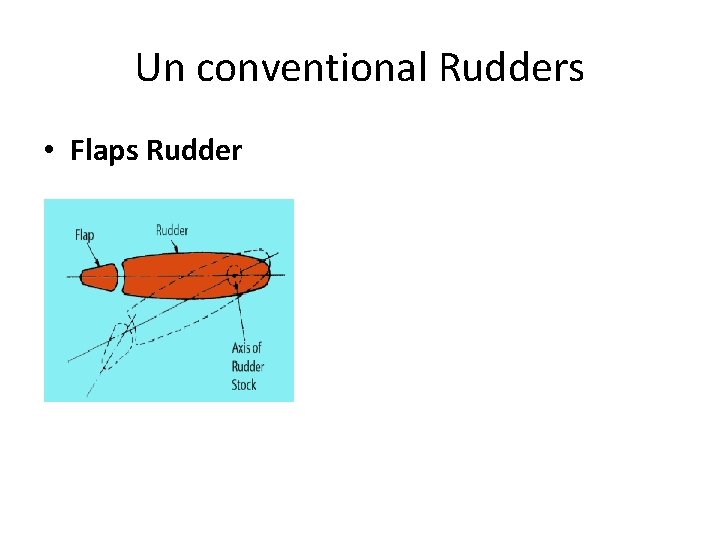
Un conventional Rudders • Flaps Rudder
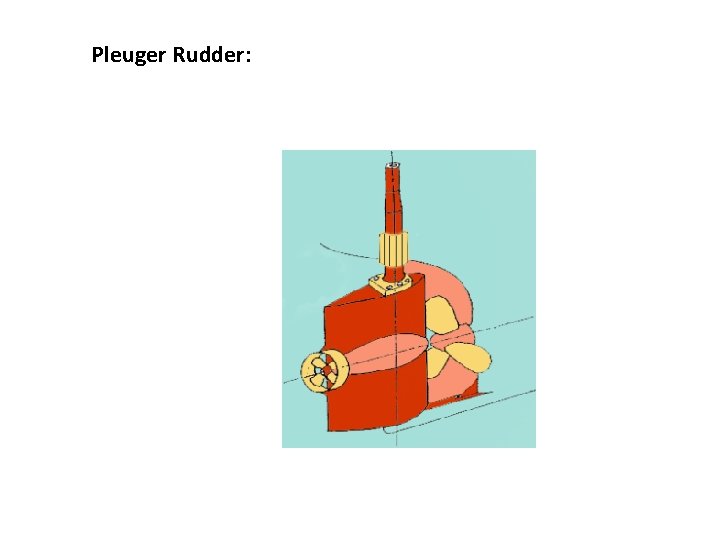
Pleuger Rudder: • A Pleuger has a smaller auxiliary propeller housed within it (which runs by a motor). As this housing is mounted on the rudder itself, it generates a thrust (which is smaller than what is generated by the ship’s main engine propeller) in a direction that is oriented along the rudder, therefore allowing effective manoeuvre in slow speed condition.
Pleuger Rudder: