
Types of RF plasma sources Old RIE parallel

- Slides: 61
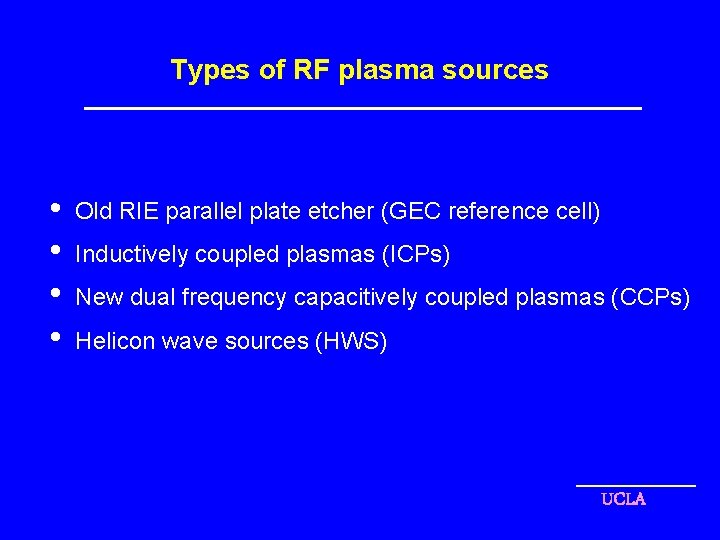
Types of RF plasma sources • • Old RIE parallel plate etcher (GEC reference cell) Inductively coupled plasmas (ICPs) New dual frequency capacitively coupled plasmas (CCPs) Helicon wave sources (HWS) UCLA
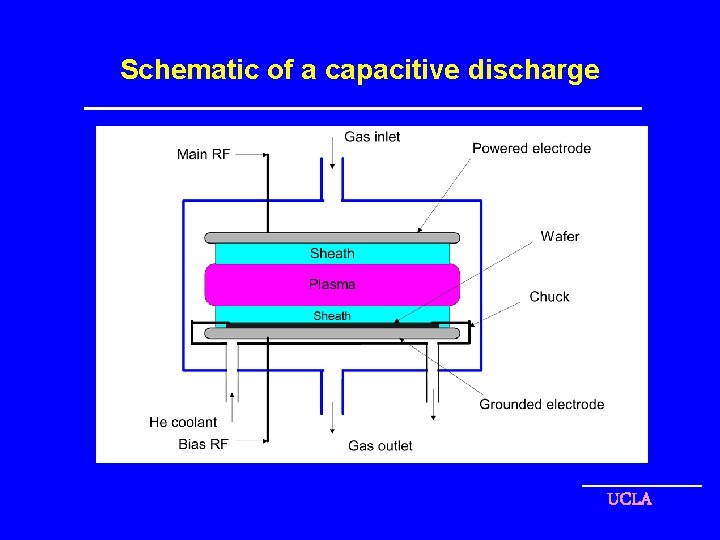
Schematic of a capacitive discharge UCLA
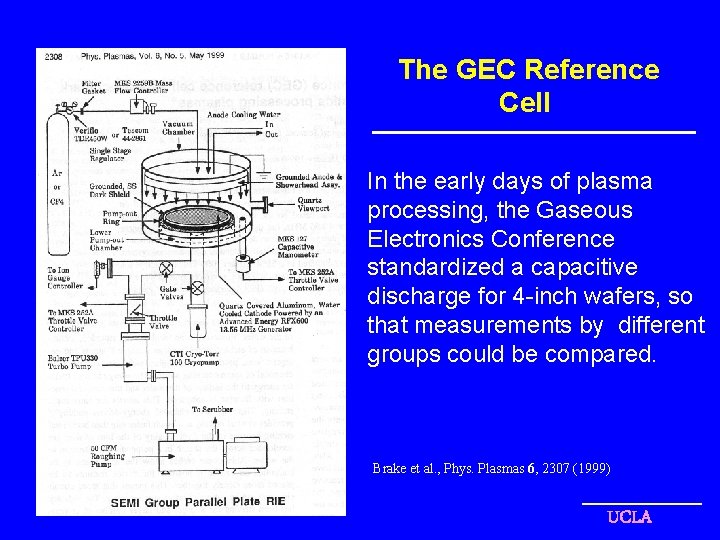
The GEC Reference Cell In the early days of plasma processing, the Gaseous Electronics Conference standardized a capacitive discharge for 4 -inch wafers, so that measurements by different groups could be compared. Brake et al. , Phys. Plasmas 6, 2307 (1999) UCLA
Problems with the original RIE discharge • • The electrodes have to be inside the vacuum • • • Particulates tend to form and be trapped Changing the power changes both the density and the sheath drop Densities are low relative to the power used In general, too few knobs to turn to control the ion and electron distributions and the plasma uniformity UCLA
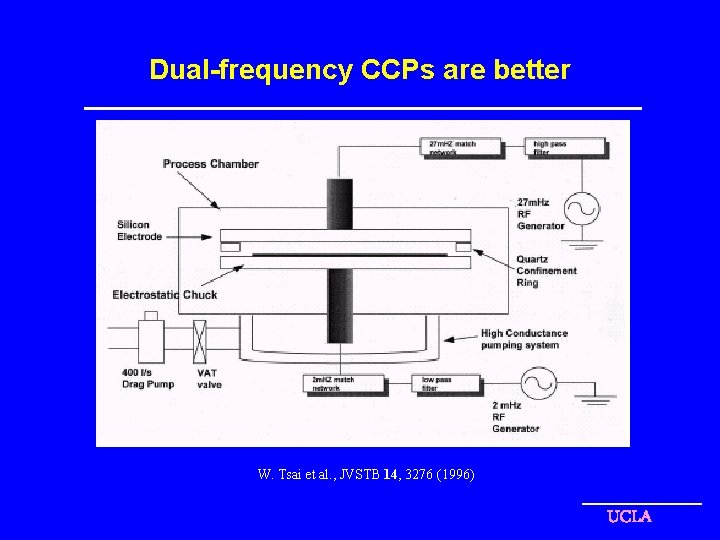
Dual-frequency CCPs are better W. Tsai et al. , JVSTB 14, 3276 (1996) UCLA
One advantage of a capacitive discharge Fast and uniform gas feed for depositing amorphous silicon on very large glass substrates for displays (Applied Komatsu) UCLA
Types of RF plasma sources • • Old RIE parallel plate etcher (GEC reference cell) Inductively coupled plasmas (ICPs) New dual frequency capacitively coupled plasmas (CCPs) Helicon wave sources (HWS) UCLA
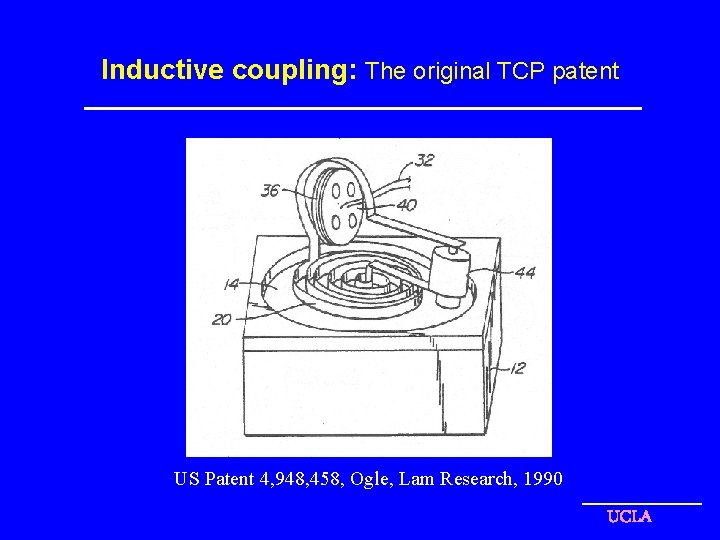
Inductive coupling: The original TCP patent US Patent 4, 948, 458, Ogle, Lam Research, 1990 UCLA
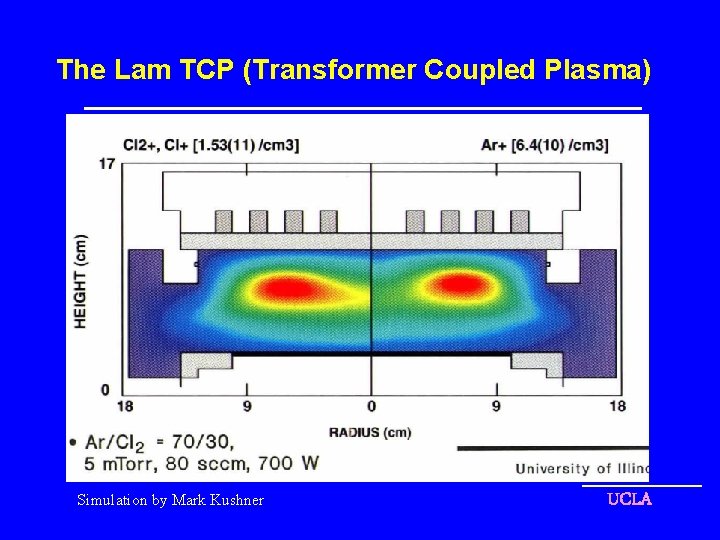
The Lam TCP (Transformer Coupled Plasma) Simulation by Mark Kushner UCLA
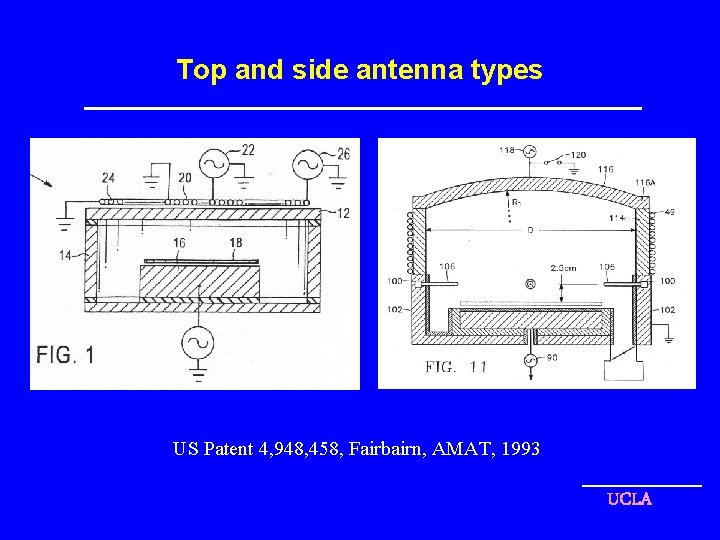
Top and side antenna types US Patent 4, 948, 458, Fairbairn, AMAT, 1993 UCLA
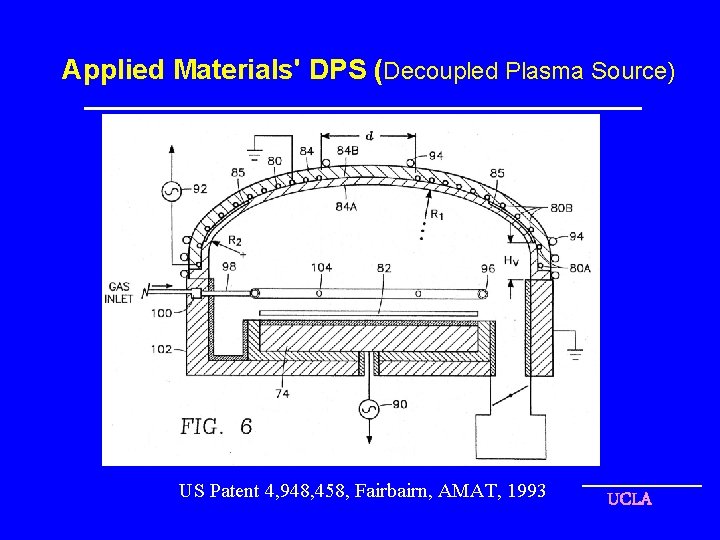
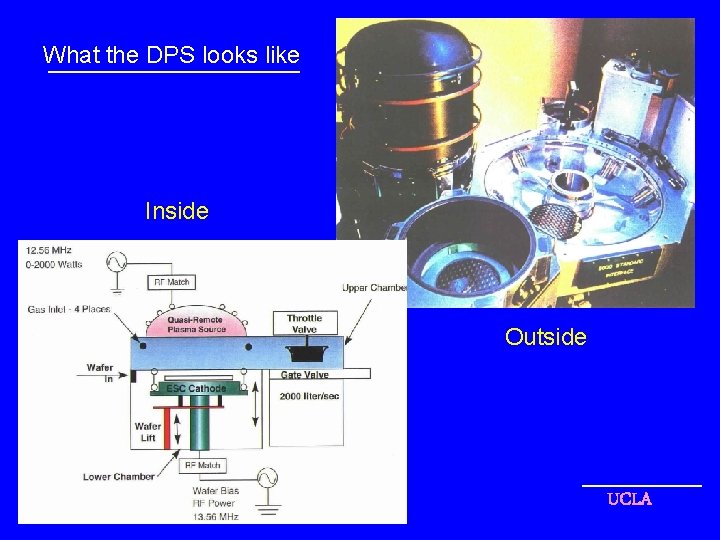
Applied Materials' DPS (Decoupled Plasma Source) US Patent 4, 948, 458, Fairbairn, AMAT, 1993 UCLA
What the DPS looks like Inside Outside UCLA
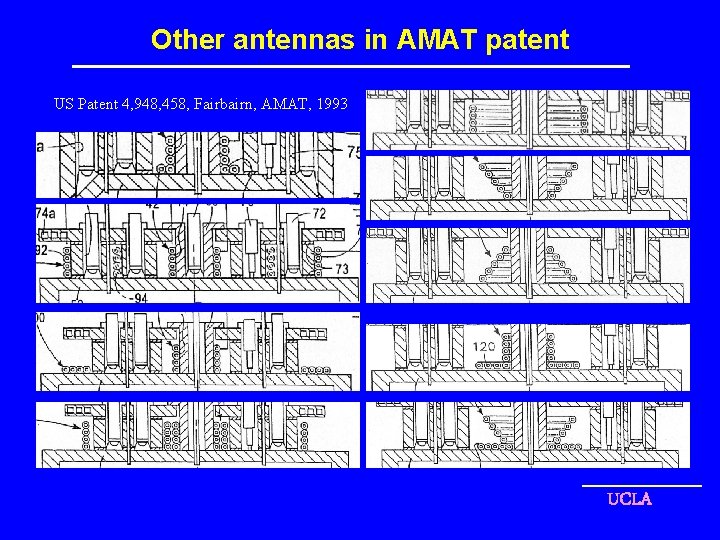
Other antennas in AMAT patent US Patent 4, 948, 458, Fairbairn, AMAT, 1993 UCLA
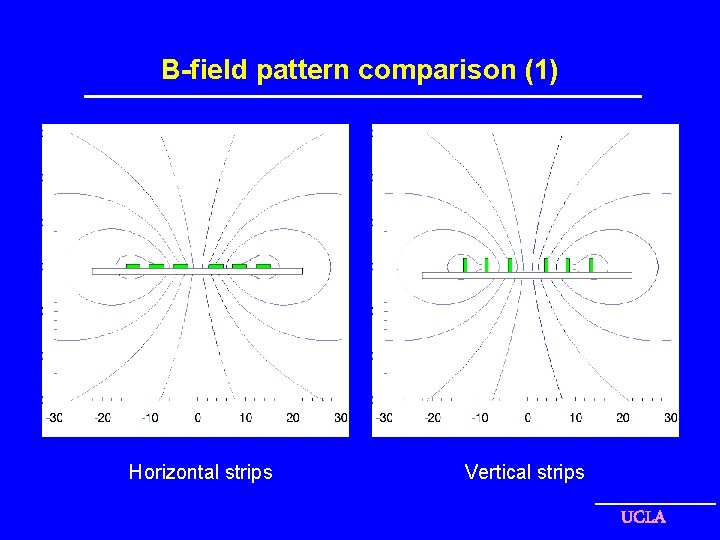
B-field pattern comparison (1) Horizontal strips Vertical strips UCLA
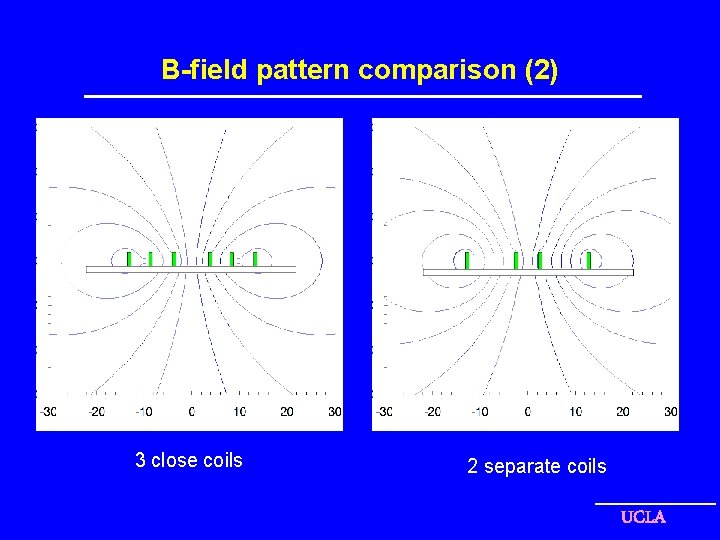
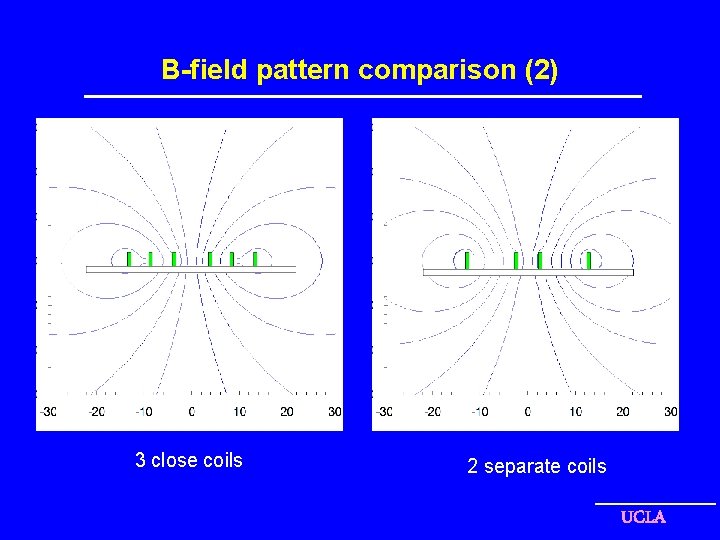
B-field pattern comparison (2) 3 close coils 2 separate coils UCLA
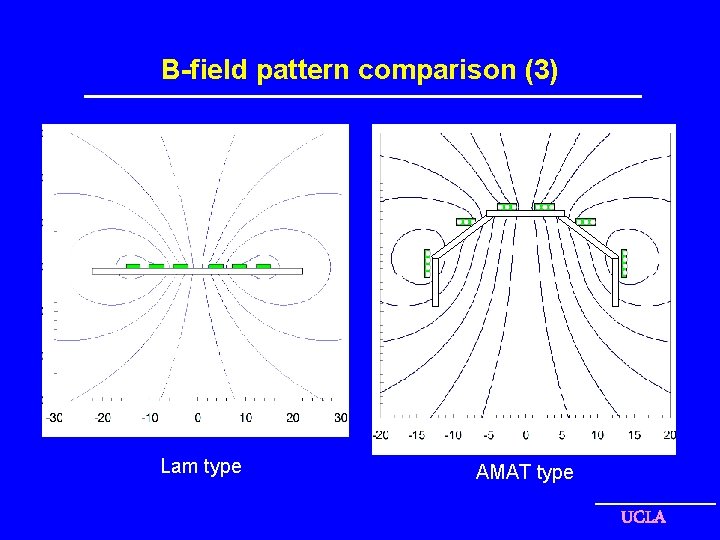
B-field pattern comparison (3) Lam type AMAT type UCLA
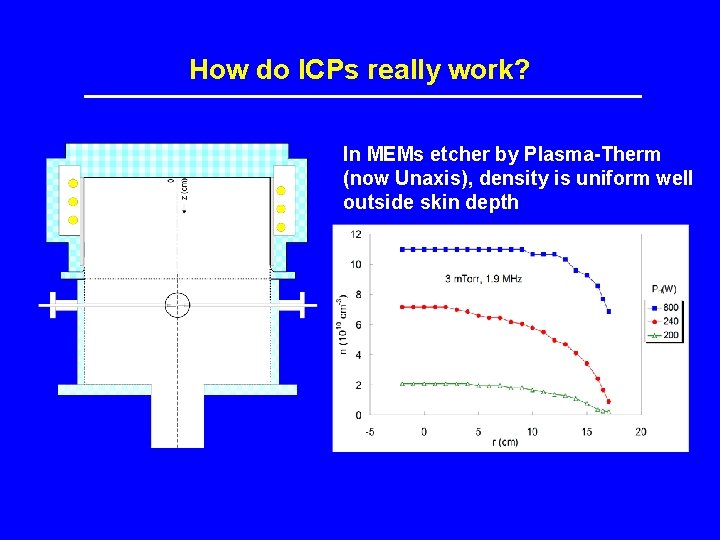
How do ICPs really work? In MEMs etcher by Plasma-Therm (now Unaxis), density is uniform well outside skin depth
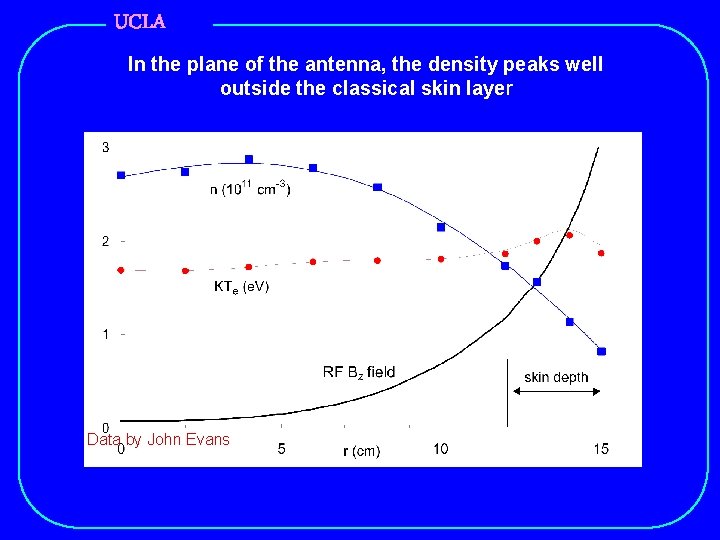
UCLA In the plane of the antenna, the density peaks well outside the classical skin layer Data by John Evans
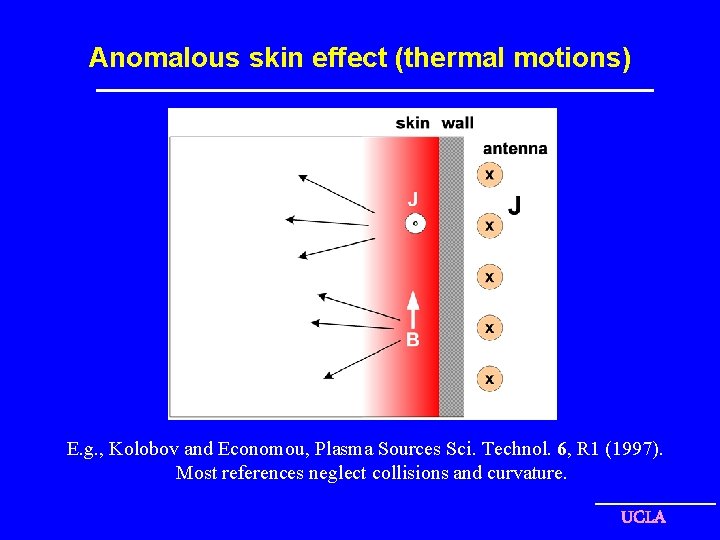
Anomalous skin effect (thermal motions) E. g. , Kolobov and Economou, Plasma Sources Sci. Technol. 6, R 1 (1997). Most references neglect collisions and curvature. UCLA
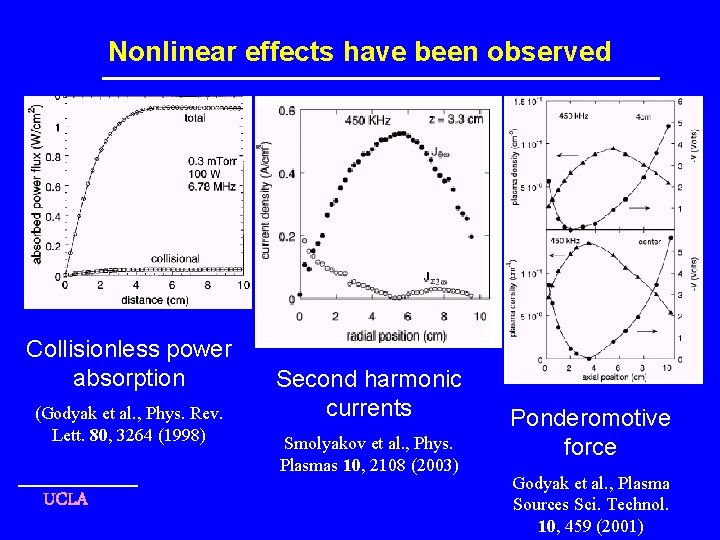
Nonlinear effects have been observed Collisionless power absorption (Godyak et al. , Phys. Rev. Lett. 80, 3264 (1998) UCLA Second harmonic currents Smolyakov et al. , Phys. Plasmas 10, 2108 (2003) Ponderomotive force Godyak et al. , Plasma Sources Sci. Technol. 10, 459 (2001)
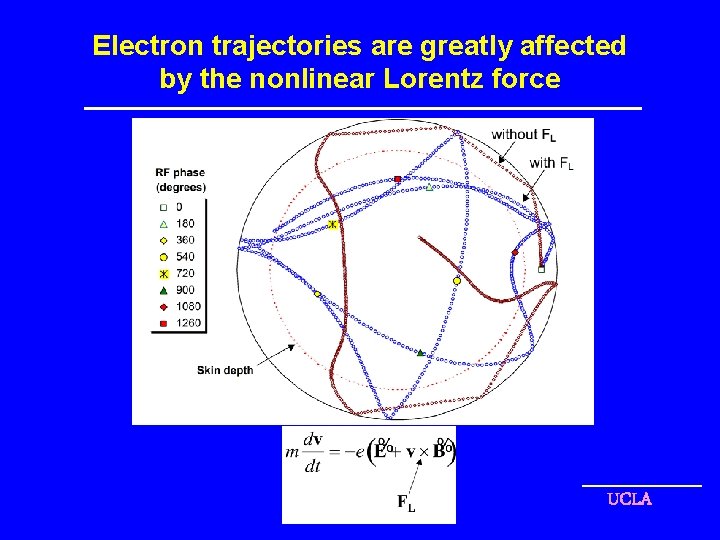
Electron trajectories are greatly affected by the nonlinear Lorentz force UCLA
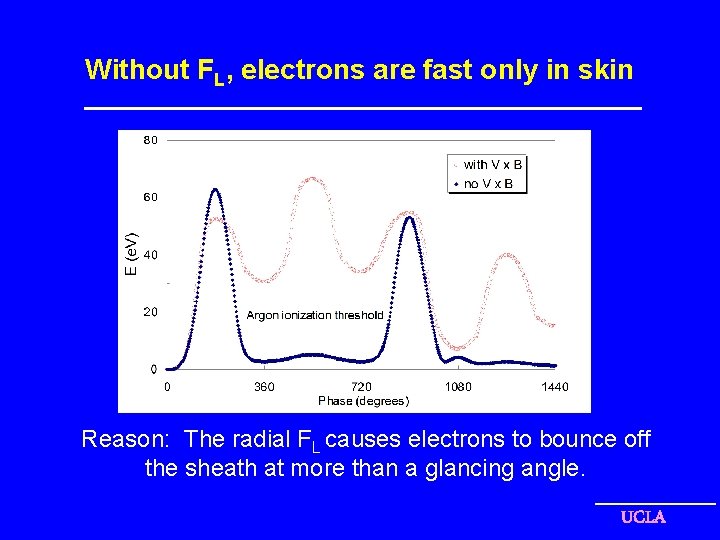
Without FL, electrons are fast only in skin Reason: The radial FL causes electrons to bounce off the sheath at more than a glancing angle. UCLA
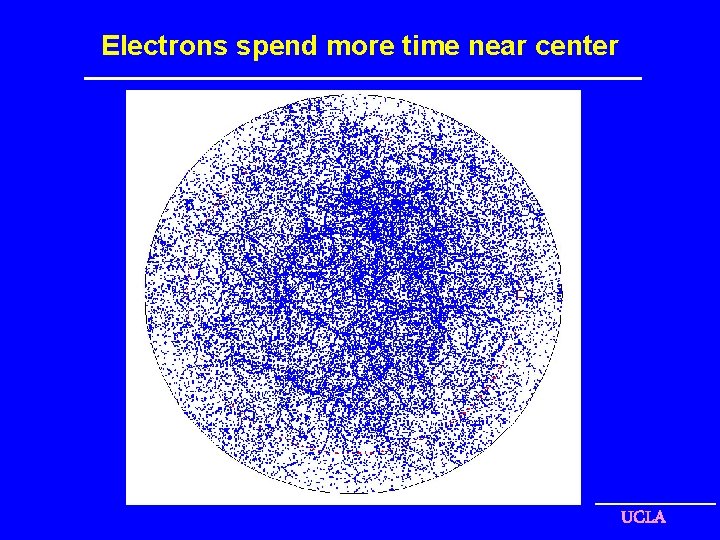
Electrons spend more time near center UCLA
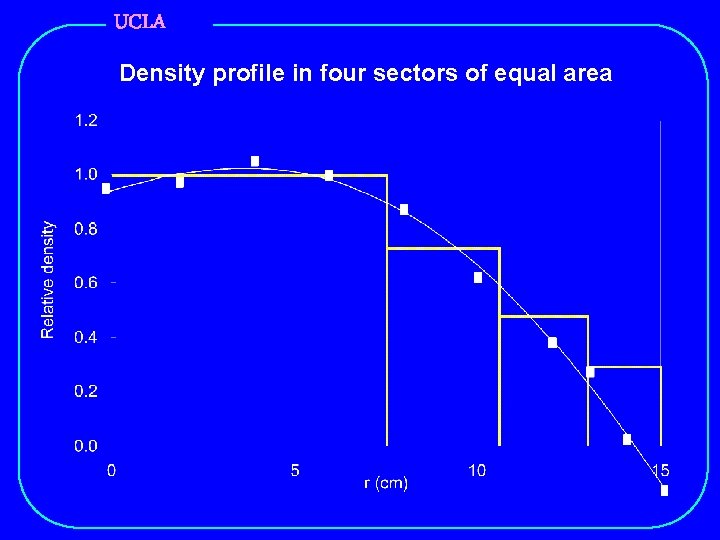
UCLA Density profile in four sectors of equal area Points are data from Slide 5
Disadvantages of stove-top antennas • Skin depth limits RF field penetration. Density falls rapidly away from antenna • • If wafer is close to antenna, its coil structure is seen Large coils have transmission line effects Capacitive coupling at high-voltage ends of antenna Less than optimal use of RF energy UCLA
B-field pattern comparison (2) 3 close coils 2 separate coils UCLA
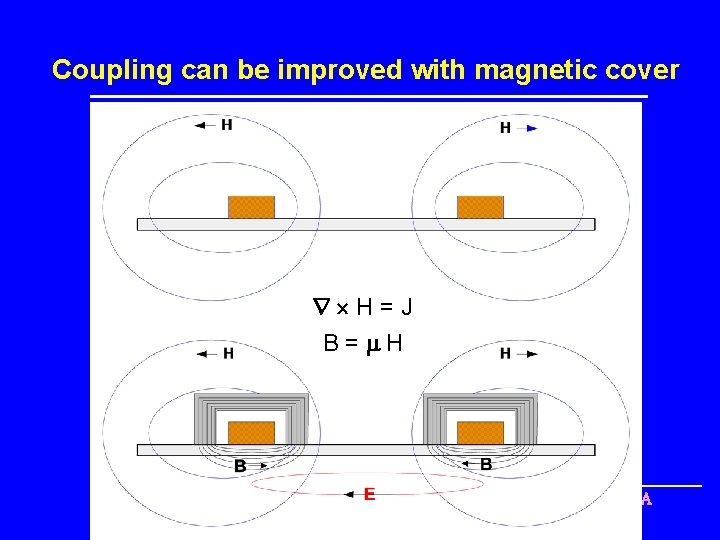
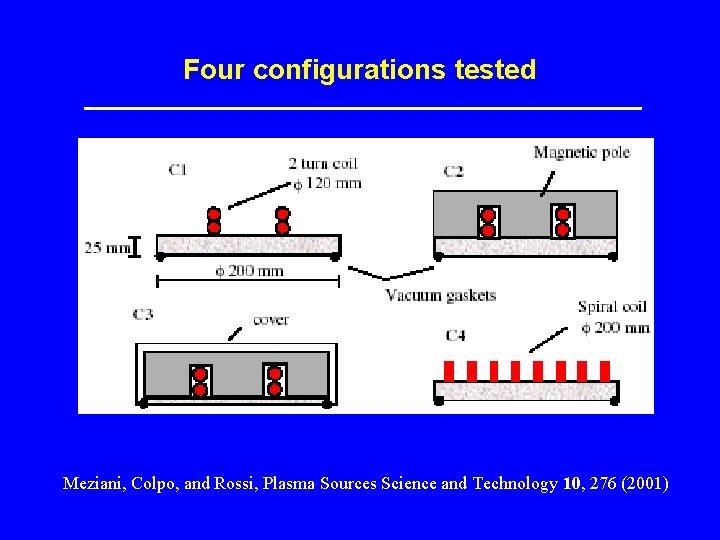
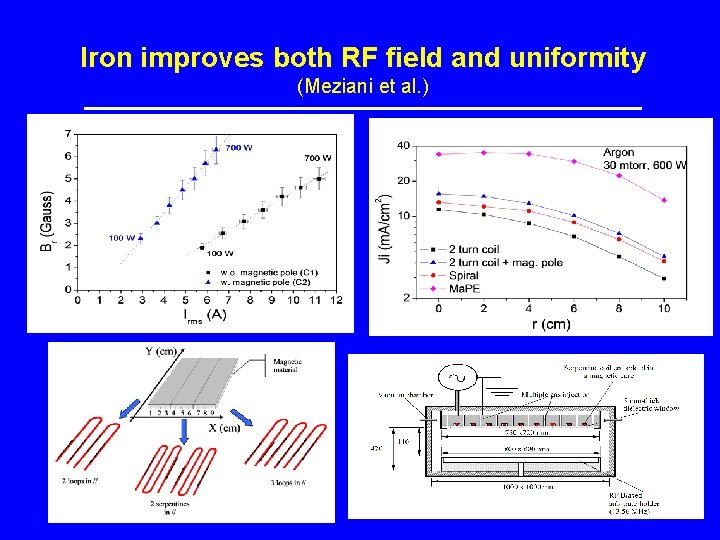
Coupling can be improved with magnetic cover H=J B=m. H UCLA
Four configurations tested Meziani, Colpo, and Rossi, Plasma Sources Science and Technology 10, 276 (2001)
The dielectric is inside the vacuum Meziani, Colpo, and Rossi, Plasma Sources Science and Technology 10, 276 (2001)
Iron improves both RF field and uniformity (Meziani et al. )
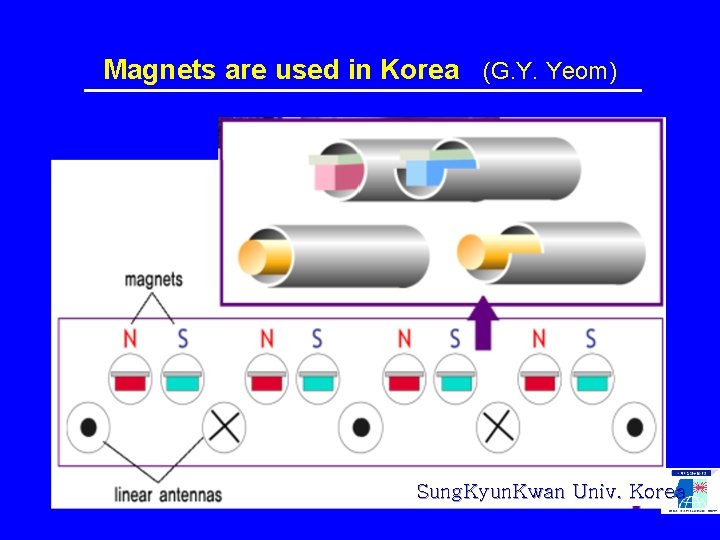
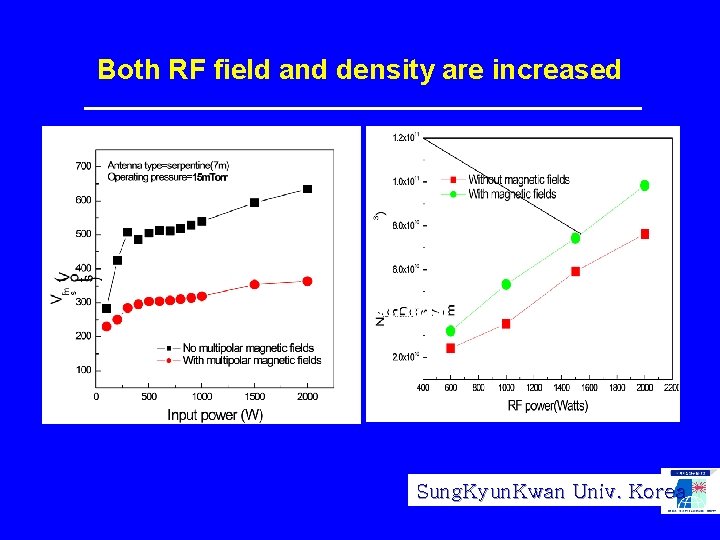
Magnets are used in Korea (G. Y. Yeom) Sung. Kyun. Kwan Univ. Korea
Both RF field and density are increased Sung. Kyun. Kwan Univ. Korea
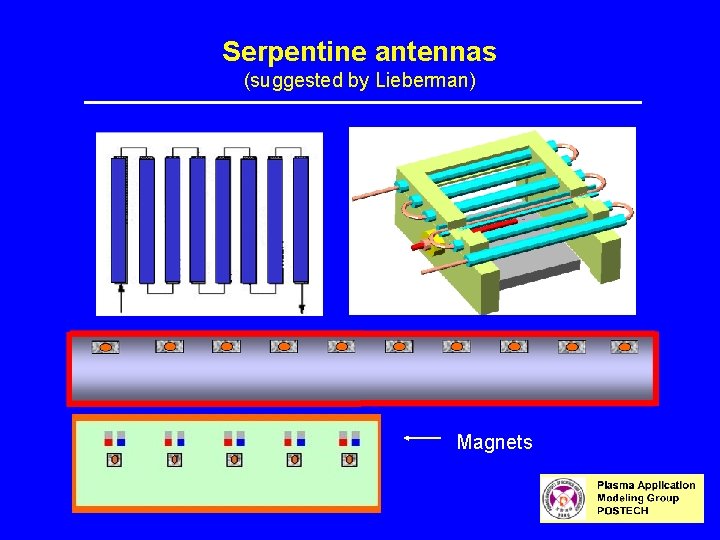
Serpentine antennas (suggested by Lieberman) Magnets
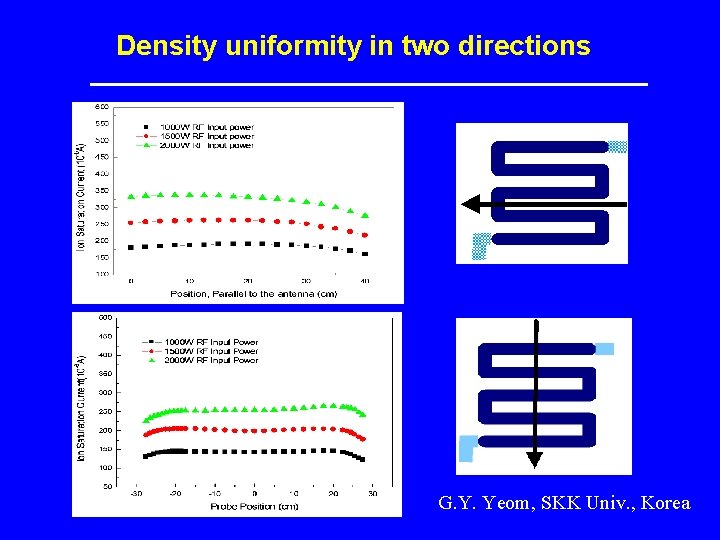
Density uniformity in two directions G. Y. Yeom, SKK Univ. , Korea
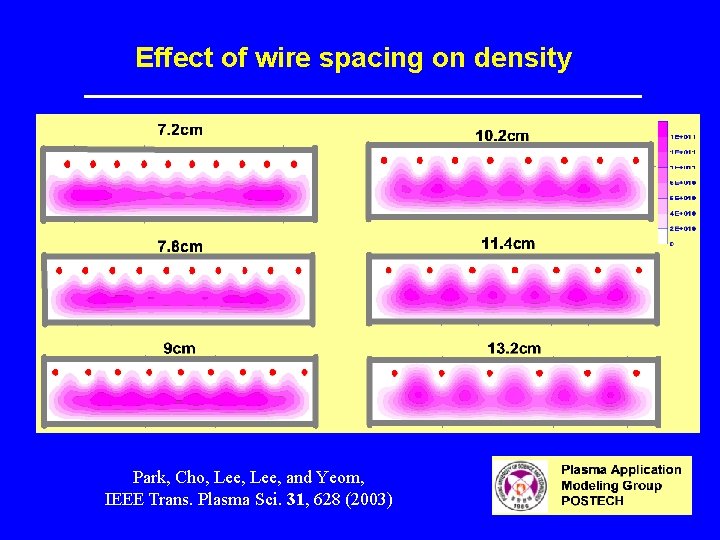
Effect of wire spacing on density Park, Cho, Lee, and Yeom, IEEE Trans. Plasma Sci. 31, 628 (2003)
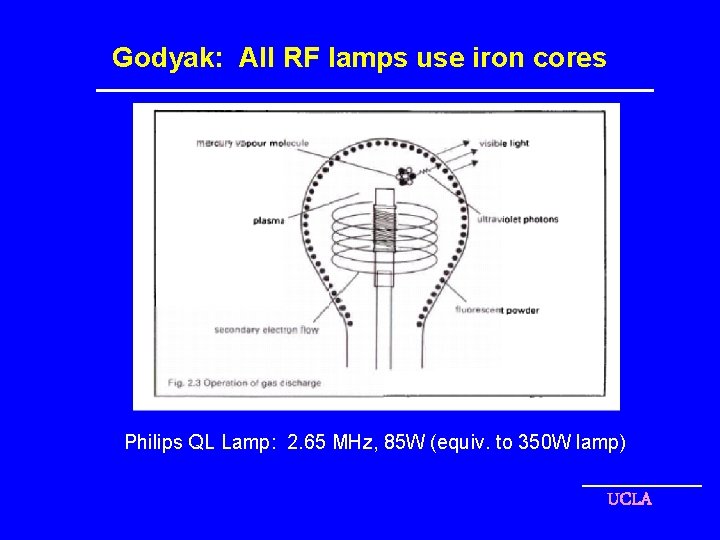
Godyak: All RF lamps use iron cores Philips QL Lamp: 2. 65 MHz, 85 W (equiv. to 350 W lamp) UCLA
Types of RF plasma sources • • Old RIE parallel plate etcher (GEC reference cell) Inductively coupled plasmas (ICPs) New dual frequency capacitively coupled plasmas (CCPs) Helicon wave sources (HWS) UCLA
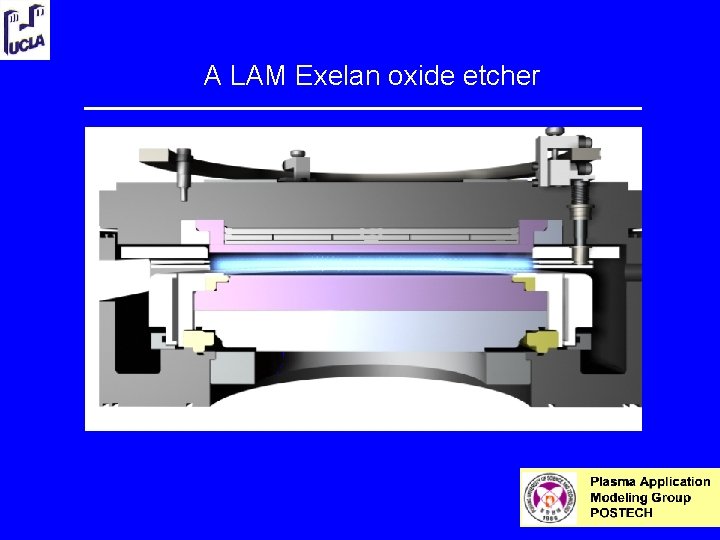
A LAM Exelan oxide etcher
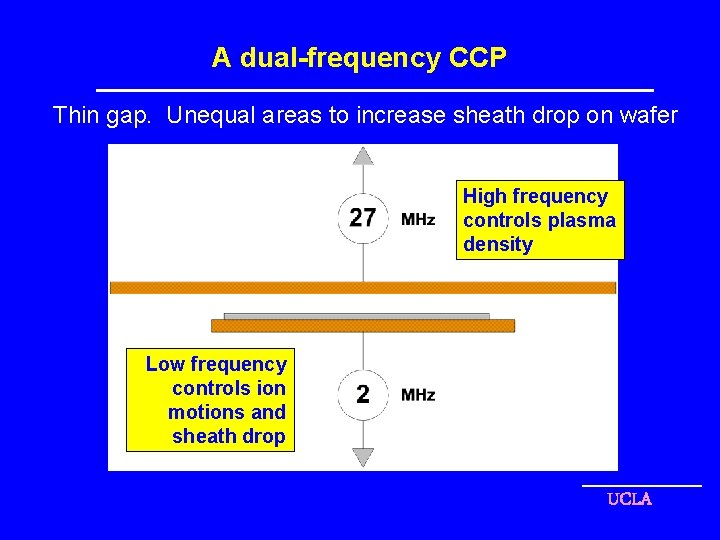
A dual-frequency CCP Thin gap. Unequal areas to increase sheath drop on wafer High frequency controls plasma density Low frequency controls ion motions and sheath drop UCLA
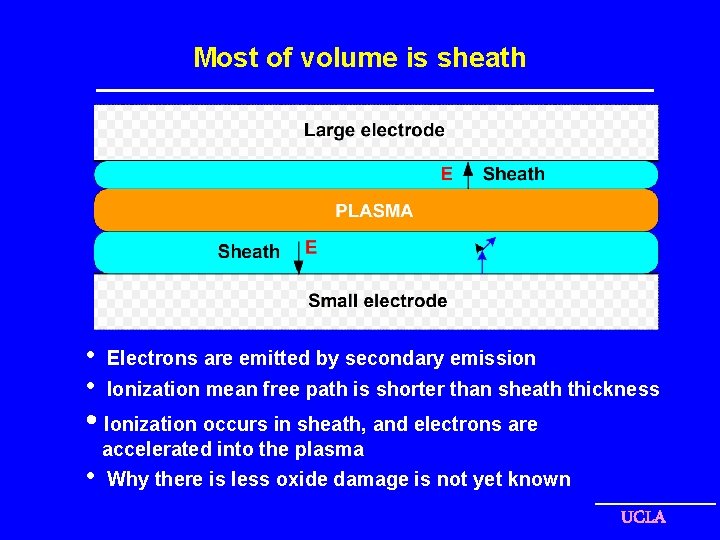
Most of volume is sheath • • Electrons are emitted by secondary emission Ionization mean free path is shorter than sheath thickness • Ionization occurs in sheath, and electrons are accelerated into the plasma • Why there is less oxide damage is not yet known UCLA
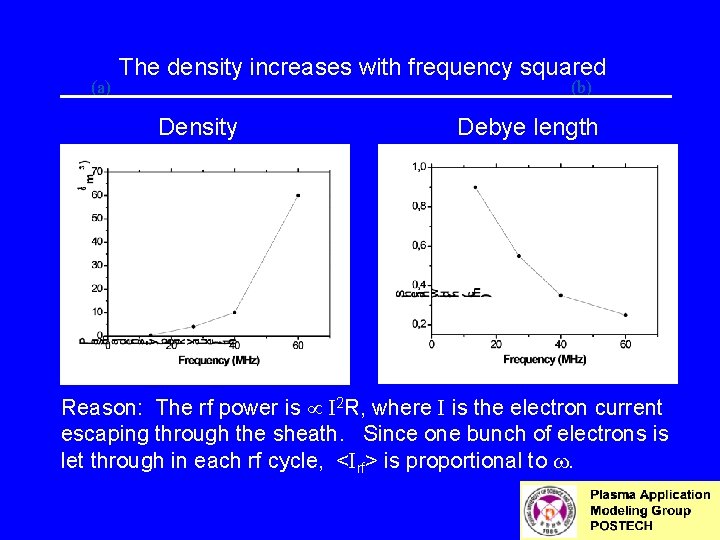
(a) The density increases with frequency squared (b) Density Debye length (c) (d) Reason: The rf power is I 2 R, where I is the electron current escaping through the sheath. Since one bunch of electrons is let through in each rf cycle, <Irf> is proportional to .
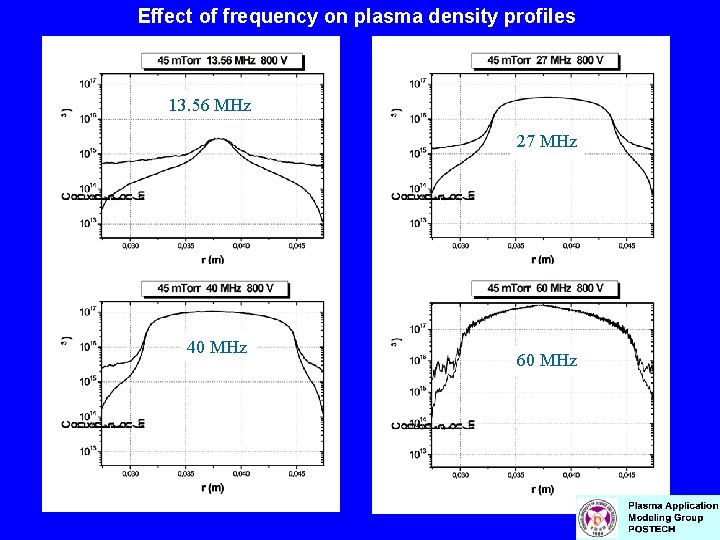
Effect of frequency on plasma density profiles 13. 56 MHz 27 MHz 40 MHz 60 MHz
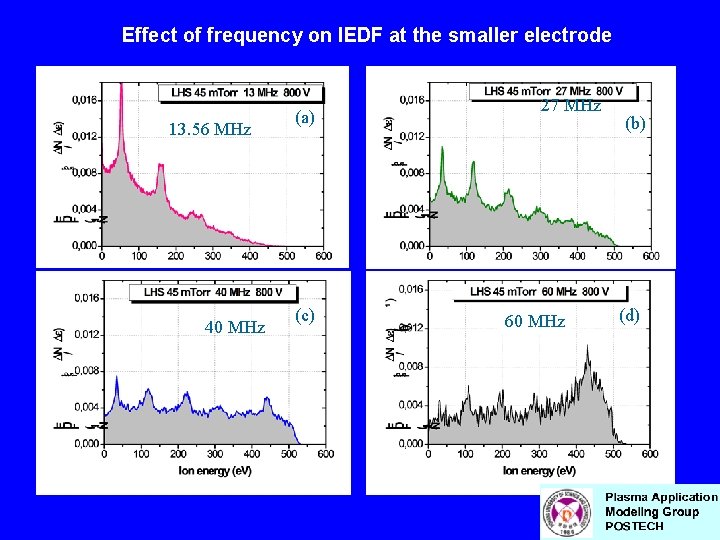
Effect of frequency on IEDF at the smaller electrode 13. 56 MHz 40 MHz (a) (c) 27 MHz 60 MHz (b) (d)
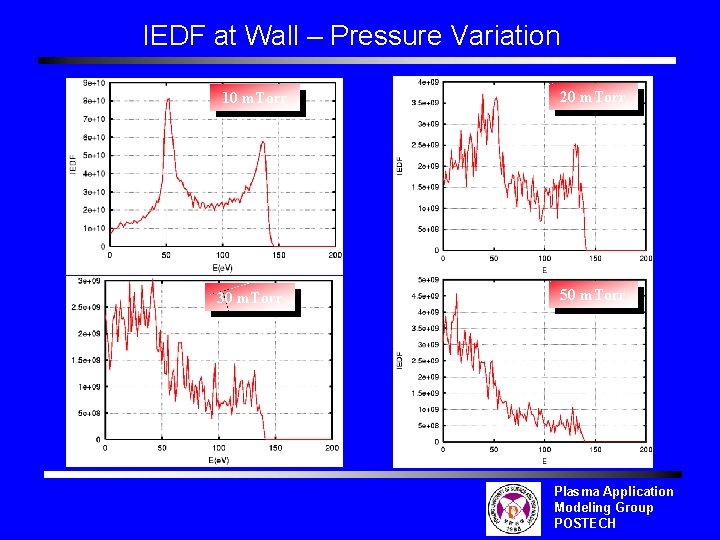
IEDF at Wall – Pressure Variation 10 m. Torr 20 m. Torr 30 m. Torr 50 m. Torr Plasma Application Modeling Group POSTECH
Types of RF plasma sources • • Old RIE parallel plate etcher (GEC reference cell) Inductively coupled plasmas (ICPs) New dual frequency capacitively coupled plasmas (CCPs) Helicon wave sources (HWS) UCLA
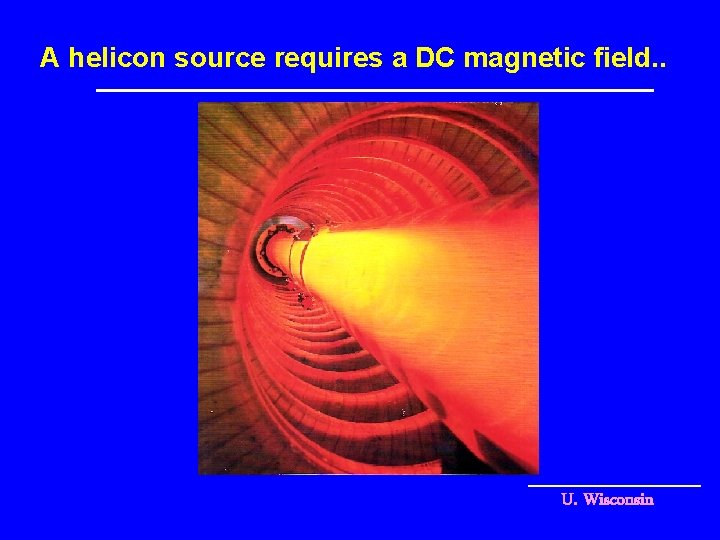
A helicon source requires a DC magnetic field. . U. Wisconsin
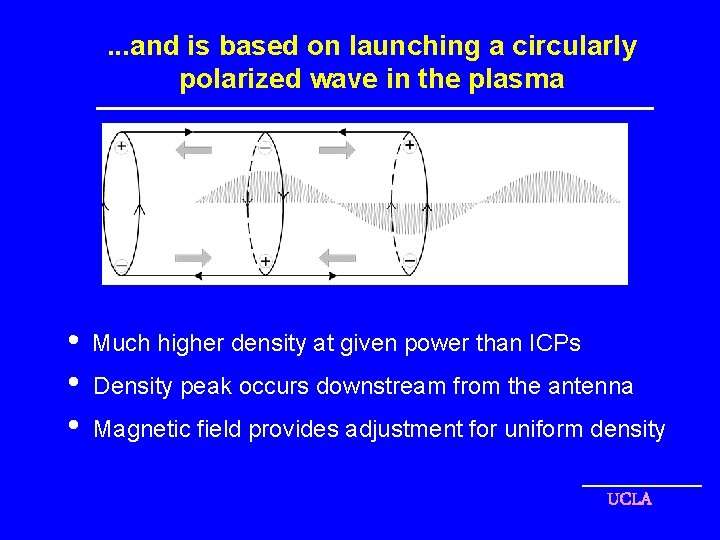
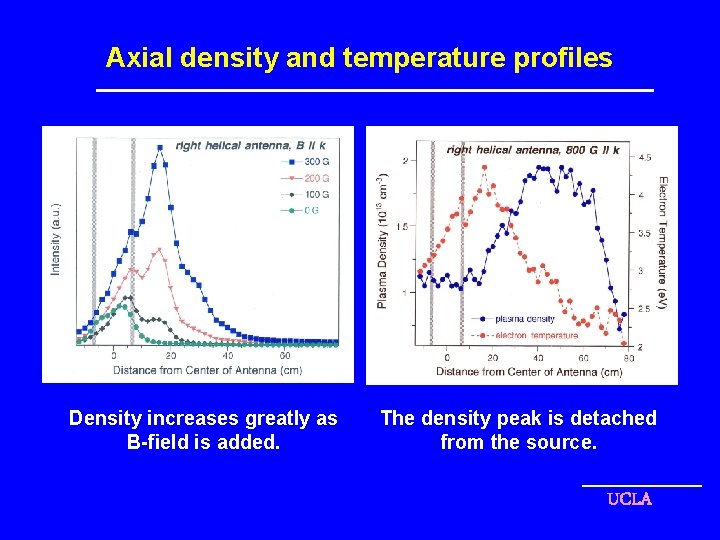
. . . and is based on launching a circularly polarized wave in the plasma • • • Much higher density at given power than ICPs Density peak occurs downstream from the antenna Magnetic field provides adjustment for uniform density UCLA
Axial density and temperature profiles Density increases greatly as B-field is added. The density peak is detached from the source. UCLA
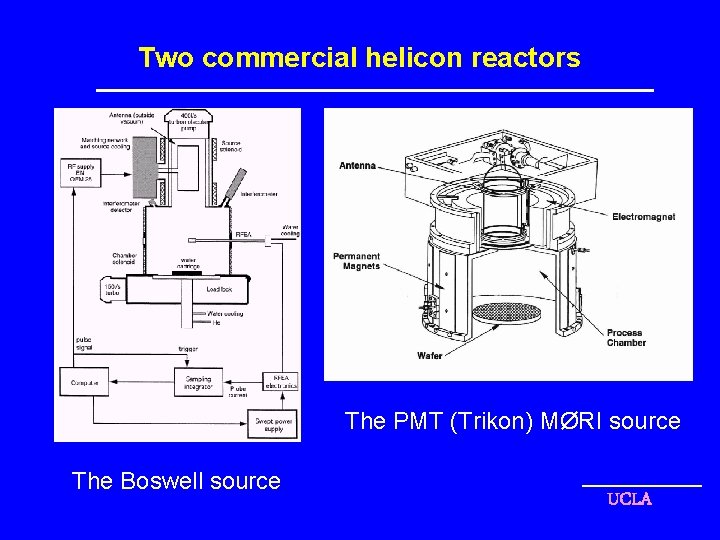
Two commercial helicon reactors The PMT (Trikon) MØRI source The Boswell source UCLA
The Coil Current Ratio shapes the plasma The MØRI source UCLA
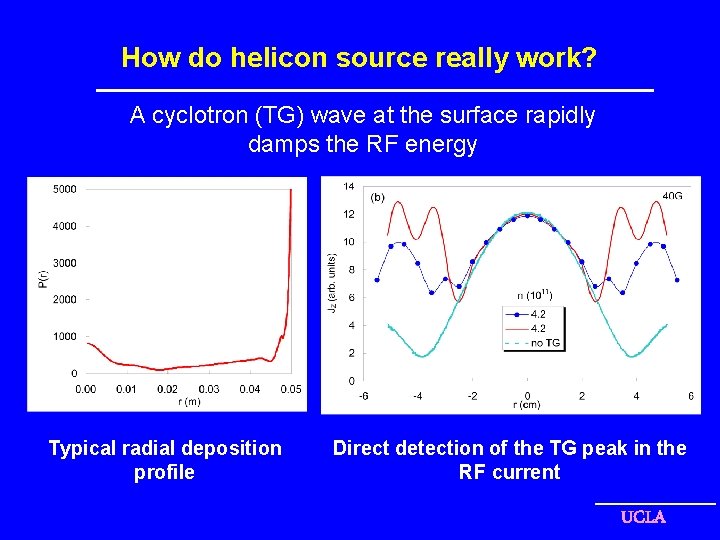
How do helicon source really work? A cyclotron (TG) wave at the surface rapidly damps the RF energy Typical radial deposition profile Direct detection of the TG peak in the RF current UCLA
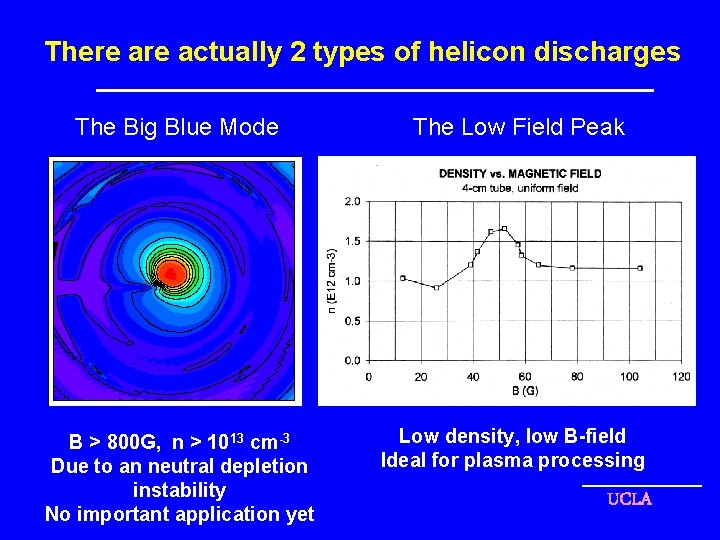
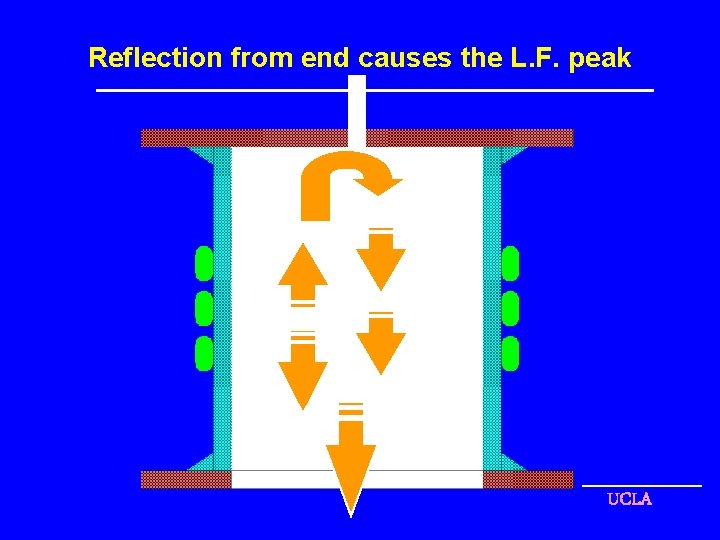
There actually 2 types of helicon discharges The Big Blue Mode B > 800 G, n > 1013 cm-3 Due to an neutral depletion instability No important application yet The Low Field Peak Low density, low B-field Ideal for plasma processing UCLA
Reflection from end causes the L. F. peak UCLA
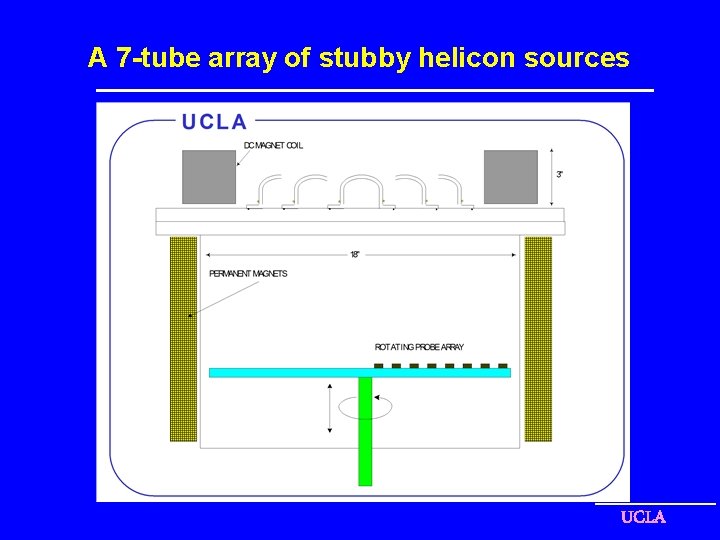
A 7 -tube array of stubby helicon sources UCLA
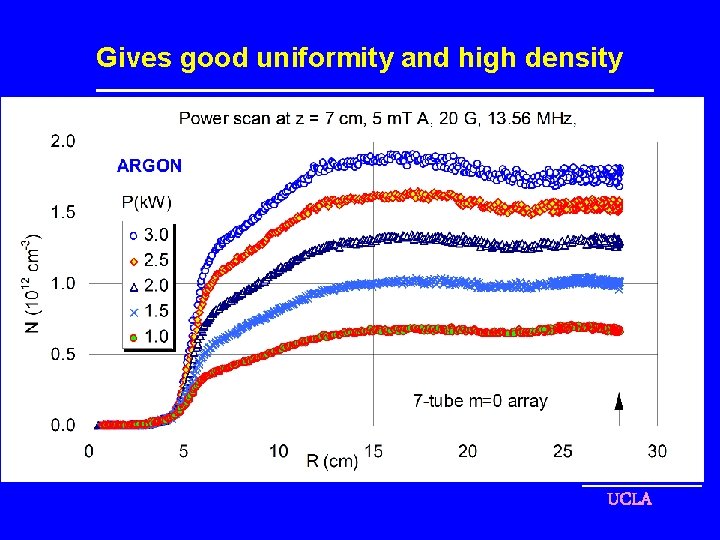
Gives good uniformity and high density UCLA
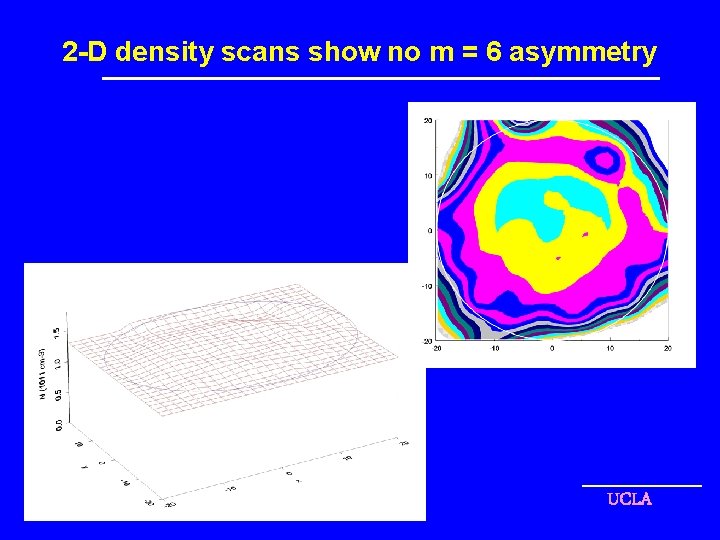
2 -D density scans show no m = 6 asymmetry UCLA
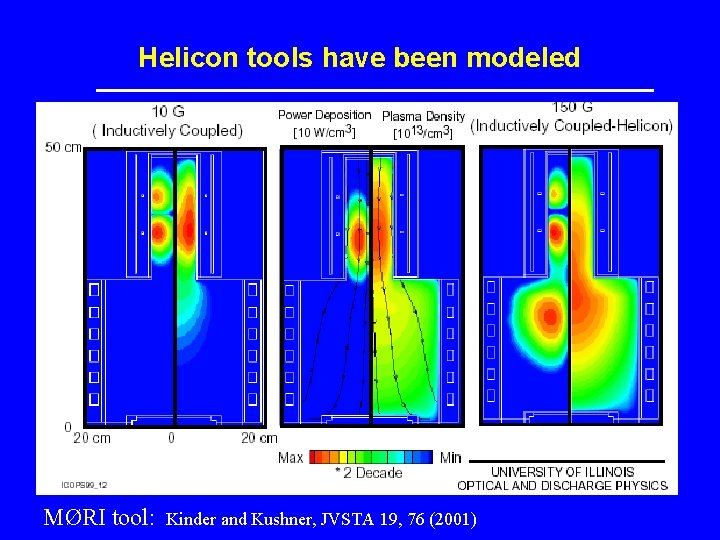
Helicon tools have been modeled MØRI tool: Kinder and Kushner, JVSTA 19, 76 (2001)
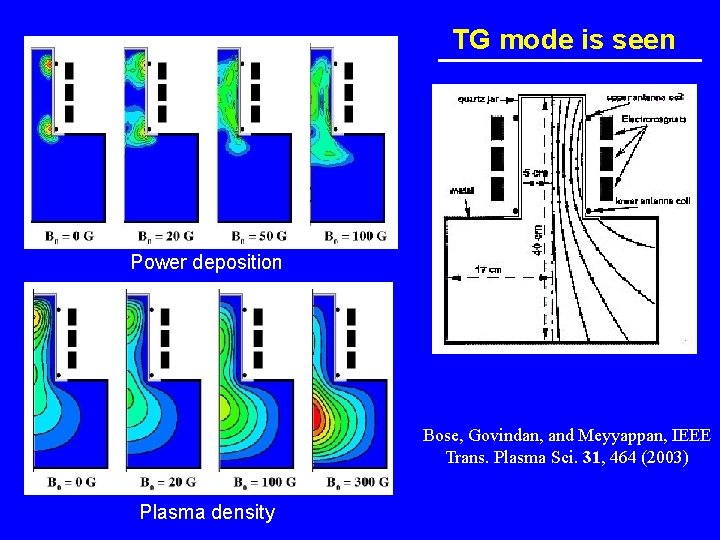
TG mode is seen Power deposition Bose, Govindan, and Meyyappan, IEEE Trans. Plasma Sci. 31, 464 (2003) Plasma density
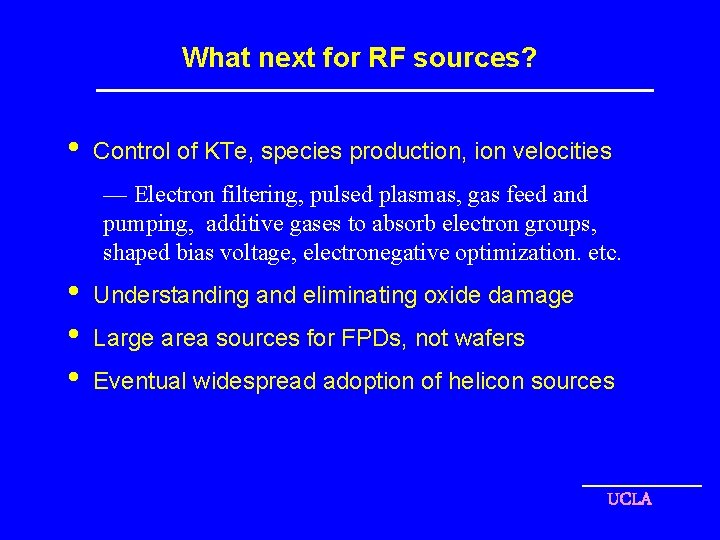
What next for RF sources? • Control of KTe, species production, ion velocities — Electron filtering, pulsed plasmas, gas feed and pumping, additive gases to absorb electron groups, shaped bias voltage, electronegative optimization. etc. • • • Understanding and eliminating oxide damage Large area sources for FPDs, not wafers Eventual widespread adoption of helicon sources UCLA