
TYPES OF RESEARCH By Prof Smita Mishra Panda
TYPES OF RESEARCH By Prof. Smita Mishra Panda RESEARCH METHODOLOGY CENTURION UNIVERSITY OF TECHNOLOGY AND MANAGEMENT 1
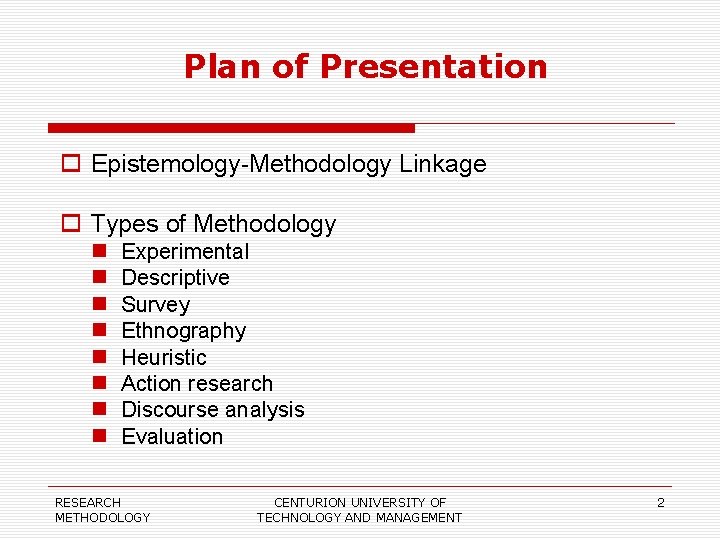
Plan of Presentation Epistemology-Methodology Linkage Types of Methodology Experimental Descriptive Survey Ethnography Heuristic Action research Discourse analysis Evaluation RESEARCH METHODOLOGY CENTURION UNIVERSITY OF TECHNOLOGY AND MANAGEMENT 2
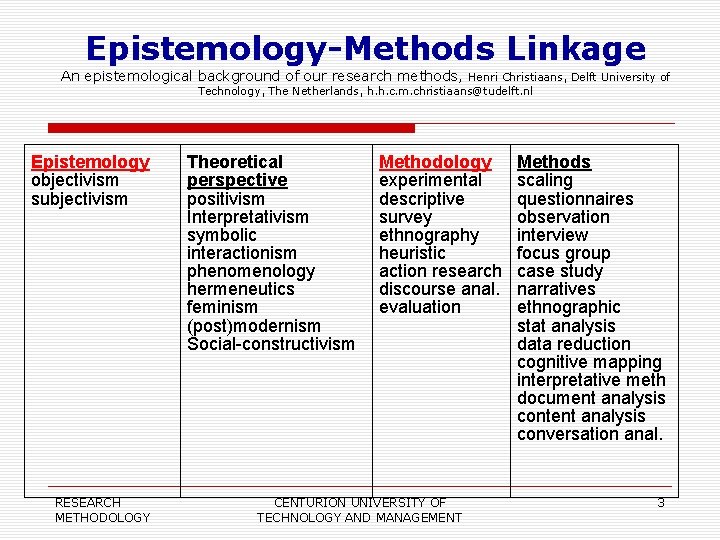
Epistemology-Methods Linkage An epistemological background of our research methods, Henri Christiaans, Delft University of Technology, The Netherlands, h. h. c. m. christiaans@tudelft. nl Epistemology objectivism subjectivism RESEARCH METHODOLOGY Theoretical perspective positivism Interpretativism symbolic interactionism phenomenology hermeneutics feminism (post)modernism Social-constructivism Methodology experimental descriptive survey ethnography heuristic action research discourse anal. evaluation CENTURION UNIVERSITY OF TECHNOLOGY AND MANAGEMENT Methods scaling questionnaires observation interview focus group case study narratives ethnographic stat analysis data reduction cognitive mapping interpretative meth document analysis content analysis conversation anal. 3

Experimental Methodology The purpose of the study is to test the existence of a causal relationship between two or more variables. In the experimental study, the independent variable is systematically varied/manipulated so that its effect on another variable can be measured Key Features: Random assignment of values to the independent variable, keeping all other variables constant When to Use: Most appropriate approach to study cause-effect relationship RESEARCH METHODOLOGY CENTURION UNIVERSITY OF TECHNOLOGY AND MANAGEMENT 4
Experimental Methodology Strengths: - It will have sound internal validity (appropriate methodology) Limitations: - It will be difficult to implement if affecting variables are not carefully controlled RESEARCH METHODOLOGY CENTURION UNIVERSITY OF TECHNOLOGY AND MANAGEMENT 5
Descriptive Methodology The purpose is to provide a ‘picture’ of a phenomena as it naturally occurs – rather than studying the impacts of the phenomenon or intervention Key Features - It is broad and encompasses different types of research design. - Not designed to provide information on cause-effect relationships When to Use: - Appropriate when the researcher is attempting to answer “what is” and “what was” questions RESEARCH METHODOLOGY CENTURION UNIVERSITY OF TECHNOLOGY AND MANAGEMENT 6
Descriptive Methodology Strengths: - Low cost and relatively easy to implement and able to yield results in a short period of time Limitations: - Not intended to answer questions of causal nature – no causal inferences can be made RESEARCH METHODOLOGY CENTURION UNIVERSITY OF TECHNOLOGY AND MANAGEMENT 7
Survey Methodology “to answer questions that have been raised, to solve problems that have been posed or observed, to assess needs and set goals, to determine whether or not specific objectives have been met, to establish baselines against which future comparisons can be made, to analyze trends across time, and generally, to describe what exists, in what amount, and in what context. ” (Isaac & Michael, 1997, p. 136) RESEARCH METHODOLOGY CENTURION UNIVERSITY OF TECHNOLOGY AND MANAGEMENT 8
Survey Methodology Key Features: - - In survey research, independent and dependent variables are used to define the scope of study, but cannot be explicitly controlled by the researcher. Before conducting the survey, the researcher must predicate a model that identifies the expected relationships among these variables. The survey is then constructed to test this model against observations of the phenomena RESEARCH METHODOLOGY CENTURION UNIVERSITY OF TECHNOLOGY AND MANAGEMENT 9
Survey Methodology When to Use: - Large samples over different geographical areas and population – NSSO and Census data - - Surveys are capable of obtaining information from large samples Strengths: They are also well suited to gathering demographic data that describe the composition of the sample. It requires minimal investment to develop and administer, and are relatively easy for making generalizations. RESEARCH METHODOLOGY CENTURION UNIVERSITY OF TECHNOLOGY AND MANAGEMENT 10
Survey Methodology Limitations: - Historical information is difficult to get. Recall maynot be effective - Not useful for populations with minimal variations RESEARCH METHODOLOGY CENTURION UNIVERSITY OF TECHNOLOGY AND MANAGEMENT 11
Ethnographic Methodology Ethnography is the study of cultures through close observation, reading, and interpretation – through field work by Ethnographic researchers. As a research method, ethnography is used in many disciplines, among them Anthropology, Political and Social studies, Education, and others. Key Features: - Done in small communties/cultures - Qualitative and subjective (inevitable) RESEARCH METHODOLOGY CENTURION UNIVERSITY OF TECHNOLOGY AND MANAGEMENT 12
Ethnographic Methodology Strengths: - Helps in closely observing cultures – e. g indigenous communities in remote areas - Documentation helps in developing some perspectives to understand other cultures Limitations: - Subjectivity can be minimised but cannot be eliminated - Can be applied to small communities effectively RESEARCH METHODOLOGY CENTURION UNIVERSITY OF TECHNOLOGY AND MANAGEMENT 13
Heuristic Methodology Heuristic methodology attempts to discover the nature and meaning of phenomenon through internal self-search, exploration, and discovery. Heuristic methodology encourages the researcher to explore and pursue the creative journey that begins inside one’s being and ultimately uncovers its direction and meaning through internal discovery (Douglass & Moustakas, 1985) Key Features: - Researcher is the participant and can co-opt some more co-researchers from the situation RESEARCH METHODOLOGY CENTURION UNIVERSITY OF TECHNOLOGY AND MANAGEMENT 14
Heuristic Methodology Heuristic inquiry is a unique research method that places human experiences above numbers and is deeply rooted in tacit knowledge that leads to a deeply subjective and creative connection between the researcher and phenomenon (Sela-Smith, 2002). Through a compassionate approach, the researcher moves towards an open discussion with coresearchers and facilitates an emotionally connected scientific inquiry (Anderson, 2000). RESEARCH METHODOLOGY CENTURION UNIVERSITY OF TECHNOLOGY AND MANAGEMENT 15
Heuristic Methodology Six Phases in Heuristic Enquiry: - Initial Engagement - self dialogue and exploration - Immersion – become one with the topic and question - Incubation – become detached from intense immersion - Illumination – come up with themes - reflection - Explication – complete picture starts forming - Creative Synthesis – story, poetry, narrative, painting… Strengths: - Refugee studies, war situations (e. g logotherapy), disasters etc Limitations: RESEARCH CENTURION UNIVERSITY OF 16 - Subjectivity cannot be eliminated METHODOLOGY TECHNOLOGY AND MANAGEMENT
Action Research Methodology Action research is a method used for improving practice. It involves action, evaluation, and critical reflection and – based on the evidence gathered – changes in practice are then implemented. Action research is participative and collaborative; it is undertaken by individuals with a common purpose. It is situation-based and context specific. It develops reflection based on interpretations made by the participants. RESEARCH METHODOLOGY CENTURION UNIVERSITY OF TECHNOLOGY AND MANAGEMENT 17
Action Research Methodology Knowledge is created through action and at the point of application. Action research can involve problem solving, if the solution to the problem leads to the improvement of practice. In action research findings will emerge as action develops, but these are not conclusive or absolute. When to Use: - When planning for change or improvement at the ground level – e. g health, community development, women’s empowerment etc. RESEARCH METHODOLOGY CENTURION UNIVERSITY OF TECHNOLOGY AND MANAGEMENT 18
Action Research Methodology Key Features: - Planning for change - Acting and observing the process and consequences of change - Reflecting on the processes and consequences and then re-planning for action - Contributes to both knowledge and practice Strengths: - Connect between theory and practice - Close relation between research and action at the ground level RESEARCH METHODOLOGY CENTURION UNIVERSITY OF TECHNOLOGY AND MANAGEMENT 19
Discourse Analysis Methodology Discourse analysis is a way of understanding social interactions. The researcher acknowledges their own bias and position on the issue, known as reflexivity. A conversation or a piece of text is transcribed and then deconstructed. This involves attempting to identify features in the text, such as discourses. Key Features: - Wide reading on theme is very important Identifying the key themes that would help in research RESEARCH METHODOLOGY CENTURION UNIVERSITY OF TECHNOLOGY AND MANAGEMENT 20
Discourse Analysis Methodology When to Use: - When the researcher wants to understand already published data on a theme exclusively or in combination with other approaches e. g women’s empowerment and divorce in society, racism and employment, globalisation and inequality Strengths: - Saves time in research and provides a good base for looking at various ramifications/implications/related fields of research Limitation: - Can create a bias RESEARCH METHODOLOGY CENTURION UNIVERSITY OF TECHNOLOGY AND MANAGEMENT 21
Evaluation Methodology To look at a situation in different points of time Before and after With or without Projects – how it has performed on the ground Action research can be followed by evaluation RESEARCH METHODOLOGY CENTURION UNIVERSITY OF TECHNOLOGY AND MANAGEMENT 22
- Slides: 22